Chapter 8
Taal or Talam and Raga or Ragam in Indian Music
Objective: Understand the concept of raga and rhythm in North and South Indian classical music.
DO YOU KNOW
In Hindustani music’s tala system, the first matra is called sam.
Taal in Hindustani Classical Music
Keharva Taal
| Mantra:8 Vibhag:2 |
Tali: on 1 matra Khali:on 5 matra |
|||||||
| Taal signs | X | 0 | ||||||
| Matra | 1 | 2 | 3 | 4 | 5 | 6 | 7 | 8 |
| Bols | Dha | Ge | Na | Ti | Na | Ka | Dhin | Na |
Dadra Taal
| Mantra:6 Vibhag:2 |
Tali: on 1 matra Khali:on 4 matra |
|||||
| Taal signs | X | 0 | ||||
| Matra | 1 | 2 | 3 | 4 | 5 | 6 |
| Bols | Dha | Dhin | Na | Dha | Tu | Na |
Teen Taal
| Mantra:16 Vibhag:4 |
Tali: on 1,5,13 matra Khali:on 9 matra |
|||||||||||||||
| Taal signs | X | 2 | 0 | 3 | ||||||||||||
| Matra | 1 | 2 | 3 | 4 | 5 | 6 | 7 | 8 | 9 | 10 | 11 | 12 | 13 | 14 | 15 | 16 |
| Bols | dha | dhin | dhin | dha | dha | dhin | dhin | dha | dha | tin | tin | ta | ta | dhin | dhin | dha |
DO YOU KNOW
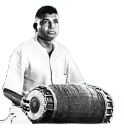
Mridangam maestro Sangeetha Kalanidhi and Padma Bhushan awardee, Palghat Mani Iyer, gave his first performance when he was 10 years old. He trained under Thanjavur Sri Vaidyanatha Iyer. Mani Iyer introduced the concept of actively supporting the musical phrases on the mridangam rather than merely providing rhythmic support. He accompanied many leading artistes of his time. His fans also enjoyed his thani avartanams (solos). Many of his students became popular performers.
Talam in Carnatic Music
In Carnatic music, talam is used to keep the beat. Each talam has a fixed number of beats and is repeated. This is known as talam cycle or avartanam. The parts of a talam are known as angams. The three angams are:
Laghu — This is a clap followed by counting of fingers. It can be 3, 4, 5, 7 or 9 beats. It is represented as | followed by the number of beats (as subscript).
When the laghu has three beats, we call it tishra jaati.
When the laghu has four beats, we call it chaturashra jaati.
When the laghu has five beats, we call it hhanda jaati.
When the laghu has seven beats, we call it mishra jaati.
When the laghu has nine beats, we call it sankeerna jaati.
Dhrutam — This is a clap followed by the wave of the hand. It has two beats. It is represented as O.
Anudhrutam — This is just a clap. It has one beat and is represented as U and it is less used in comparison to the above two.
Let us see how the laghu and dhrutam are presented in the form of tala.
Rupaka Talam — This talam has one dhrutam followed by one laghu. The chaturashra jaati rupaka talam therefore, is a cycle of six beats (4 + 2). It is represented as O |4 .
Adi Talam — This talam has one laghu followed by two dhrutams. It is a cycle of eight beats (4 + 2 + 2). It is represented as |4 O O.
Interesting Terms
| Carnatic Music Term | Hindustani Music Term |
| Ragam | Raga |
| Arohanam | Aroha |
| Avarohanam | Avaroha |
| Gamakam | Gamak |
| Layam | Laya |
Ragas in Indian Music
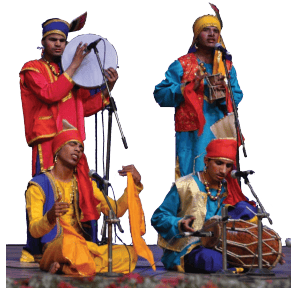
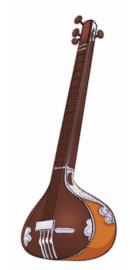
There are two different styles of classical music in India — Carnatic or South Indian classical music, and Hindustani or North Indian classical music. The swaras in each style have been explained to you in the earlier pages. Carnatic music uses instruments like the veena, violin, flute, nadaswaram, mridangam, ghatam, kanjira and morsing. The compositions are usually in Sanskrit, Telugu, Kannada, Malayalam and Tamil language. Hindustani music uses instruments like the tanpura, sitar, sarod, sarangi, santoor, tabla, and pakhawaj. Songs are composed usually in Hindi, Sanskrit, and Brijbhasha.
Watch videos to understand about raga and tala.
Raga is based on a scale. Every scale has notes (swaras) in ascending (arohana) and descending (avarohana) order. Imagine a staircase made of swaras! The notes in the scale change according to the raga.
Notation Scheme
When writing the notes in the higher octave (taar saptak), the notes are represented by a dot on top like this, Ṡ. The notes in the lower octave (mandra saptak) are represented by a dot below like this, Ṇ. The notes in the middle octave (madhya saptak) are represented by just the swara like this, S.
Jaatis of Raga
Let us know another interesting terminology used for a specific set of notes in ragas. If a raga has five notes it is known as audav jaati. If a raga has six notes it is known as shadav Jaati. If a raga has seven notes it is known as sampoorna jaati.
Activity 1: Raga Bhoop
The raga bhoop has the following notes:
Aroha/Arohana: S R G P D Ṡ
Avaroha/Avarohana: Ṡ D P G R S
The raga hamsadhwani has the following notes:
Aroha/Arohana: S R G P N Ṡ
Avaroha/Avarohana: Ṡ N P G R S

If you decorate a scale by using gamakas (ornamentations), repeating certain notes, and playing special phrases, it can become a raga. Each raga is ornamented with important notes and special phrases.
Raga in Sanskrit means something that colours the mind. Every raga evokes certain emotional responses in the mind. This is called rasa.
Watch the video on raga and rasa to understand more about ragas and their moods!
In Indian classical music, composition refers to the structured arrangement of musical elements such as melody (raga), rhythm (tala), and lyrics (if any). Compositions in Indian classical music are typically called bandish in hindustani classical music and kritis in carnatic classical music.
Activity 2: Learn a Swaramalika in Raga Bilawal
A composition sung in a sargam (swaras) is called a swarmalika. The swarmalika can be composed using different ragas. Listen? to the swaramalika in raga bilawal, set to teentaal.
Swaramalika
| Raga: Bilawal Tala: Teentaal Composer: Traditional |
Aroha: S R G M P D N Ṡ Avaroha: Ṡ N D P M G R S |
|||||||||||||||
| Sthayi | ||||||||||||||||
| 1 | 2 | 3 | 4 | 5 | 6 | 7 | 8 | 9 | 10 | 11 | 12 | 13 | 14 | 15 | 16 | |
| S | P | M | G | R | G | R | S | S | R | S | Ṇ | Ḍ | Ṇ | S | - | |
| S | G | R | M | G | P | M | G | G | M | P | M | G | R | S | - | |
| Antara | ||||||||||||||||
| P | Ṡ | N | D | P | M | P | D | N | - | Ṡ | - | Ṙ | Ṙ | Ṡ | Ṡ | |
| Ṡ | Ṙ | Ġ | Ṙ | Ṡ | N | D | P | Ṡ | N | D | P | M | G | R | S | |
Interesting Term
The predominant mood of Raga Yaman is shringar or love. There are many popular film songs composed in this raga! Try and find some popular songs based on this raga. Learn and sing them.
Activity 3: Learn a Bandish in Raga Yaman
Watch this video to learn a bandish in Raga Yaman.
The aroha or ascending notes in raga yaman are, N R G M D N Ṡ.
The avaroha or descending notes in raga yaman are, Ṡ N D P M G R S.
Note that the M is higher than the regular M that you have sung before. This small shift in one note alters the mood of the song!
The song describes Lord Krishna playing the flute and the gopikas of Vrindavan dancing to its melody.
Raga Yaman Chhota Khayal — Kanha Bansuri
Sthayi
Aaj Bajaaii Kanha Bansuri Moha Layi Sagari Brija Naari Pyari
Antara
Brindavana Ki Kunja Galina Mei Sanga Brikhabhaana Dulaari Pyari
Teen Taal
Sthayi
| 1 | 2 | 3 | 4 | 5 | 6 | 7 | 8 | 9 | 10 | 11 | 12 | 13 | 14 | 15 | 16 |
| X | 2 | 0 | 3 | ||||||||||||
| P Aa |
PM′ ja |
GR Ba |
SṆ ja |
Ḍ ii |
Ṇ Ka |
R nha |
GM′ Ban |
P - |
M′ su |
||||||
| P | - | R | R | G | - | P | PM′ | G | R | S | Ṇ | Ṙ | GM′ | P | M′ |
| ri | - | - | - | - | - | Aa | ja | Ba | ja | ii | Ka | nha | Ban | - | Su |
| P | - | R | R | G | P | M' | D | P | - | M' | M' | G | - | PM' | GR |
| ri | - | - | - | - | Mo | ha | la | yi | - | Sa | ga | ri | - | Bri | ja |
| R | G | R | S | - | S | ||||||||||
| Naa | - | ri | Pya | - | ri |
Antara
| 1 | 2 | 3 | 4 | 5 | 6 | 7 | 8 | 9 | 10 | 11 | 12 | 13 | 14 | 15 | 16 |
| X | 2 | 0 | 3 | ||||||||||||
| - - |
P Brin |
Ṡ -da |
Ṡ - |
Ṡ va |
Ṡ na |
Ṡ ki |
- - |
||||||||
| - | ND | N | Ṙ | N | ND | P | - | - | M′ | DN | Ṡ | Ṡ | Ṡ | Ṡ | - |
| - | Kun | ja | Ga | li | na | mei | - | - | Brin | da | - | va | na | ki | - |
| - | ND | N | Ṙ | N | ND | P | - | - | M' | D | M' | DN | ṘN | N | ND |
| - | kun | ja | Ga | li | na | mei | - | - | San | ga | Li | ye | -- | Bri | kha |
| P | - | R | R | RG | PR | P | PM' | ||||||||
| bha | - | na | Du | la- | ri | Aa | ja |
DO YOU KNOW
Pandit Vishnu Narayan Bhatkhande developed the notation system in Hindustani classical music. He was a lawyer by profession, and had great memory and intellect. He toured the whole country to meet musicians and collect compositions from them. Inspite of many harships, he collected many different compositions and documented them in Kramik Pustak Maalika (six parts) according to the notation, he developed.
Learn a Bandish on Guru in Raga Yaman (Kramik Pustak Maalika — Part I)
Sthayi
Guru Bin Kaise Gun Gaaye, Guru Naa Maaney To Gun Naahi Aaye Guniyan Mey Vey Guni Kahavey
Antara
Maaney To Rijhavey Sabko Charan Gahe Saadikan Ke Jab Aavey Achapal Taal Sur
Taal – Teentaal
*s denotes the extension of a word.
*- denotes the extension of a swara in the Hindustani music notation system.
Sthayi
| Dha dhin dhin dha | Dha dhin dhin dha | Dha tin tin taa | Ta dhin dhin dha | ||||||||||||
| P Gu |
P ru |
N bi |
P na |
P Kai |
D - |
P Se |
- - |
||||||||
| M' Gu |
R na |
M' gaa |
M' - |
P Ye |
- - |
- - |
- - |
P Gu |
N ru |
D naa |
P maa |
- - |
M' ne |
G to |
R - |
| G Gu |
R n |
GM'P naa |
R hee |
S Aa |
R - |
S ye |
- - |
S Gu |
S nee |
R ya |
R n |
G mey |
M' - |
M' vey |
- - |
| P Gu |
P ni |
- - |
N ka |
M' Ha |
D - |
P ve |
|||||||||
Antara
| P Maa |
- - |
P ne |
M - |
G To |
- - |
R Ri |
- - |
||||||||
| G Jha |
P - |
Ṡ vey |
D - |
Ṡ Sa |
Ṡ ba |
Ṡ ko |
Ṡ - |
Ṡ Ch |
Ṡ r |
Ġ n |
Ṙ Ga |
C hey |
Ṙ - |
Ṡ Saa |
- - |
| N di |
D - |
Ṡ ka |
Ṡ na |
N Ke |
N - |
M' Ja |
P b |
P Aa |
G _ |
P Ve |
- - |
G A |
R ch |
S pa |
S l |
| SR Ta |
GG - |
PD - |
NṠ la |
ND - |
PM' - |
GR - |
SS Sur |
||||||||
The Trinity of Carnatic Music
Tyagaraja, Muthuswami Dikshitar and Shyama Shastri are known as the trinity of carnatic music. They are considered the pioneer composers of carnatic music. Tyagaraja’s mudra (signature word) was Tyagaraja, Muthuswami Dikshitar’s was Guruguha and Shyama Shastri’s was Shyama Krishna. Tyagaraja’s songs were mostly in praise of Lord Rama. Muthuswami Dikshitar was a scholar in Sanskrit, and sang kritis in praise of all deities. Shyama Shastri composed scholarly compositions on Goddess Kamakshi.
Activity 4: Learn a Geetam in Ragam Kalyani
Listen to the audio to learn the swaras (notes) and the sahitya (lyrics) of the geetam in Ragam Kalyani. A geetam is a composition in carnatic classical music, in praise of a God or a Goddess. This geetam is composed in the ragam kalyani and is set to triputa tala. Triputa tala is a seven beat rhythmic cycle divided as 3+2+2. The notes in kalyani are the same as the notes in shankarabharanam, except for M. The M in kalyani is higher.
Lyrics
Kamala Jaadala
Vimala Sunayana
Karivarada Karunaambudhe
Karuna Sharade Kamalaakaanta
Keshi Narakaasura Vibhedana
Varada Velaapura Surottama
Karuna Sharadhe Kamalaakaanta
This song is about Lord Vishnu who is the protector of the universe.
Kamalajaadala
| Ragam: Kalyani Tala: Triputa Composer: Purandaradasa |
Arohanam: S R2
G3
M2
P D2
N3 Ṡ Avarohanam: Ṡ N3 D2 P M2 G3 R2 S |
|||||
| Ṡ Ka |
Ṡ ma |
Ṡ la |
N jaa |
D - |
N da |
Ṡ la |
| N Vi |
D ma |
P la |
D su |
P na |
M ya |
P na |
| G Ka |
M ri |
P va |
P ra |
D da |
D Ka |
N ru |
| D naam |
P |
M bu |
P dhe |
G |
R |
S |
| Ḍ Ka |
Ṇ ru |
Ḍ na |
G Sha |
R ra |
G dhe |
' |
| M Ka |
P ma |
' |
M laa |
G |
R |
S |
| R Kaan |
' |
' |
S ta |
' |
S |
' |
| G Ke |
M |
P shi |
M Na |
P ra |
D kaa |
p |
| N su |
D ra |
P Vi |
D bhe |
P |
M da |
p na |
| G Va |
M ra |
P da |
P ve |
D |
D laa |
N |
| D pu |
P ra |
M su |
P ro |
G |
R tta |
S ma |
| Ḍ Ka |
Ṇ ru |
Ḍ na |
G sha |
R ra |
G dhe |
' |
| M Ka |
P ma |
' |
M laa |
G |
R |
S |
| R Kaan |
' |
' |
S ta |
' |
S |
' |
This song describes his compassion and glory.
Singing Techniques
Gamakas are special decorations that musicians use to make their music sound more beautiful and expressive. The pitch of the note is modulated by oscillating or gliding to the next note.
Here are some vocal warm-ups in Ragam Kalyani. Listen to them and practise.
| 1. | Ṡ S G S |
N , R R |
D , S G |
P , Ṇ M |
M S S P |
G , R D |
R , G N |
S , M Ṡ |
| 2. | Ṡ S G S G S |
N , R Ṇ R R |
D , S S S G |
P , Ṇ R Ṇ M |
M S S G S P |
G , S M R D |
R , Ṇ P G N |
S , S M M Ṡ |
| 3. | Ṡ S G S G S G S |
N , R Ṇ R Ṇ R R |
D , S S S S S G |
P , Ṇ R Ṇ R Ṇ M |
M S Ḍ G S G S P |
G , Ṇ M S M R D |
R , S P Ṇ P G N |
S , Ṇ M S M M Ṡ |
| 4. | Ṡ S G S G S G S G S |
N , R Ṇ R Ṇ R Ṇ R R |
D , S S S S S S S G |
P , Ṇ R Ṇ R Ṇ R Ṇ M |
M S Ḍ G Ḍ G S G S P |
G , P M Ṇ M S M R D |
R , Ḍ P S P Ṇ P G N |
S , Ṇ M Ṇ M S M M Ṡ |