Chapter 13
Breaking Barriers with Dance
In dance, characters are sometimes performed by a single dancer irrespective of their gender. In many traditional performances of dance, men often play the women characters.
Bhakti movement
The Bhakti movement, starting around the sixth or seventh century AD, influenced the development of regional classical dance forms which expand the roots of our present-day classical dances.
In the bhakti period, dancers became part of the pooja rituals inside the temple. The Devadasis and Tevadichhis of Southern India and the Maharis of Odisha directly served the deity inside the temple. The 64 rituals are performed through ritualistic dance in the Sattaras of Assam and the Bhagavatars in the South. The Kathakars of the North sang and enacted stories in praise of Lord Shiva’s tandava to enhance moral values of the people.
The concept of bhakti movements was easy for the common people to understand.
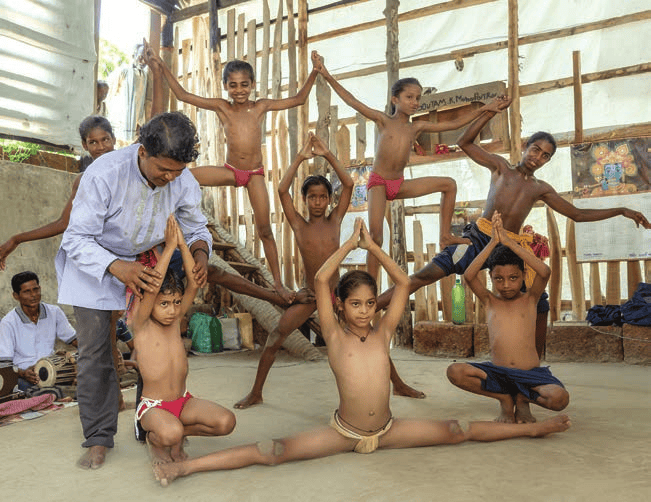
Students learning Gotipua dance
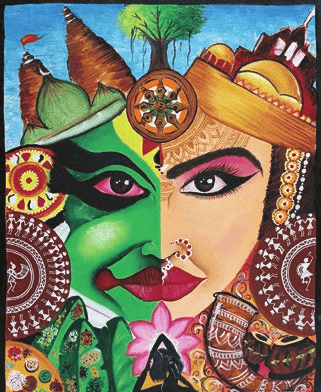
The Ardhanareeshwara
Examples
The Gotipua Dance
Watch a video (Youtube) of the Gotipua dance which originated in Odisha.
The Maharis performed this inside the temple in praise of Lord Jagannatha and the Gotipuas where the young boys danced for the public.
Here, the young boys dress up as girls and perform dances combined with acrobatic movements.
The Ardhanareeshwara Dance In the painting, you can see Lord Shiva and Goddess Parvathi on a single face with dance make-up.
Activity 1: Watch Videos of Unique Loka Nritya
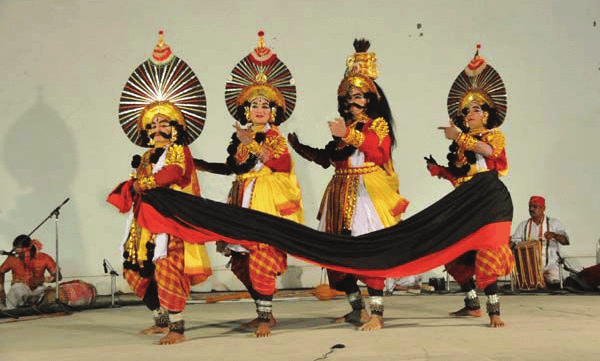
Watch the videos of different loka nrityas which are performed with unique postures, gestures, ways of walking, steps, costumes and music.
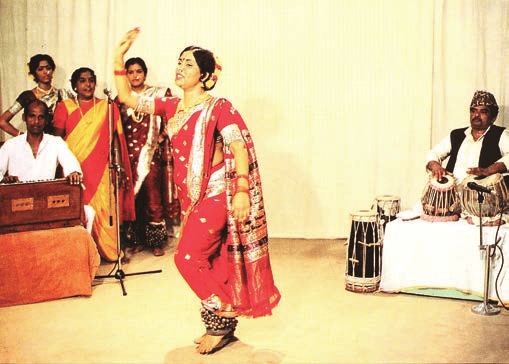
Lavani (predominantly female form) from Maharashtra
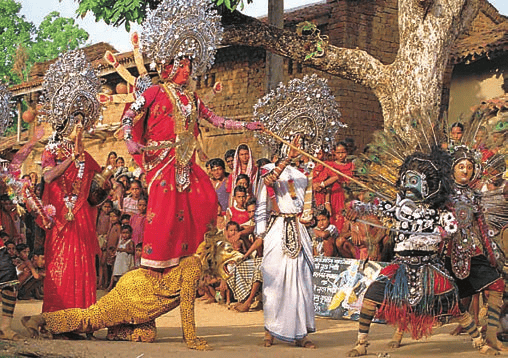
Purulia Chhau from West Bengal originally performed only by males
Yakshagana from Karnataka
Now, you can try the steps of both Lavni and Chhau.
The dances like Mohiniyattam (earlier performed only by women), Kathakali and Yakshagana (earlier performed by only men) have undergone a drastic transformationby removing the gender constraints in modern times.
It’s important to note that in dance, these stances and gaits are not strictly limited by gender. Dancers often blend elements from various styles to create their own unique expression, breaking traditional gender norms.
Now, you have come to a stage where you have to learn the steps of the dance forms in your region.
Activity 2: Stepping for Loka Nritya
Let us practice the tried out steps with the required bents, in vigorous or gentle movements.
Lavni and bhangra, both dance forms can be practiced by girls and boys.
Explore the arm and hand gestures used in these dances.
Activity 3: Project Work
Frame of the project — inspiring story from childhood (if any), learning experiences, achievements and associations.

Dance, Shapes and Tala
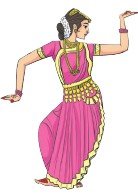
Rectangular shape
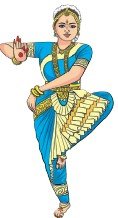
Triangular shape
Mathematics and dance complement each other.
We can demonstrate geometrical shapes through dance. Dancing involves geometrical postures and movements in mathematical rhythm. We can use different geometrical patterns for formations in a choreography. Rhythm and beat are simply arithmatical patterns.
Try these out in the next activity.
Activity 4: Dance and Geometrical Shapes
How many different geometrical shapes can be performed in a dance?
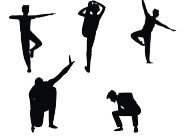
Dancers showing different shapes
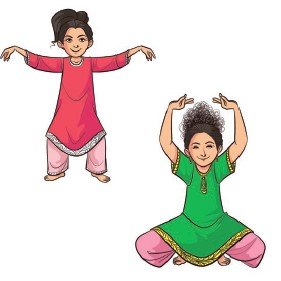
Triangle, circle, square, rectangle, etc., can be formed by using your hands, arms and legs. Discuss in the class and try out some geometrical movements.
Activity 5: Rhythmic Geometry
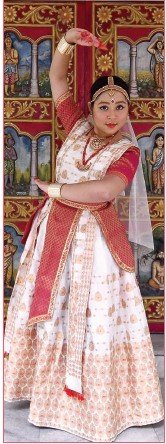
Now, combine all the elements of the previous activity (arms , hands, legs) and examine the different geometrical shapes while adding another element of rhythm.
Talas are different permutations and combinations of rhythmic units.
Make groups and try different arithmetic rythm combinations to create various geometrical patterns or formations.
Examples
2 beats + 2 beats = 4 beats
2 beats + 3 beats = 5 beats
2 beats + 4 beats = 6 beats
3 beats + 3 beats = 6 beats
3 beats + 4 beats = 7 beats
Go through such movements and discuss in the class, how such movements relate to the said action.