
Chapter 14
Harmony in Motion
India boasts of a rich tapestry of traditional dances, each deeply rooted in the country’s diverse cultural heritage. These dances are not merely an expression of movement, but also convey stories, emotions and spirituality.
A traditional dance may be shastriya nritya or loka nritya. The variety of dance in our culture spreads different fragrances which are unique in nature.
We have numerous instruments, properties, costumes, languages and
cultural beliefs that are performed by several groups of people. Such traditional dances uplift our nation and reinforce societal and moral integrity.
Now, it is your responsibility to preserve and protect our rich cultural heritage of dance.
Activity 1: Our Traditional Dance
Choose any traditional dance of your region and the song related to it.
Dance in a rhythm with instruments used in your region.
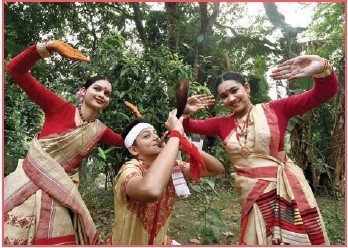
Example 1: Bihu of Assam uses an instrument called dhol and a unique wind instrument made of buffalo horn called pepa.
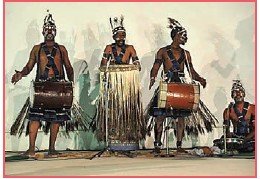
Example 2: Sidi Dhamal dance is from Gujarat. It uses big drums as instrument during performance.
Are you ready to perform? Just wait for a moment. Have you discussed what props (if any like pots, sticks, rings …) will you use in your dance?
Do you have an idea of the costumes used in a particular dance which you are going to perform?
All dances in India are rooted in our cultural heritage. Not only does the dance consists of movement, rhythm, music but also includes costume, prop, make-up and stage position.
Activity 2: Making of Dance Jewellery and Props
Discuss with your respective groups about costumes required for the
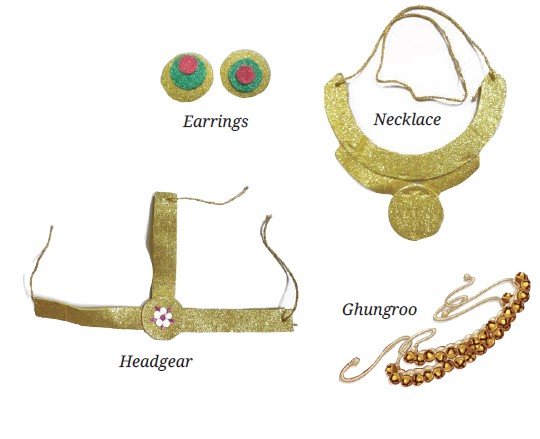
dance. Try to make it yourself using cardboard, colour paper, decorative
ribbons, etc.
Example: Dance jewellery like necklace, head dress, Hanuman face mask and queen’s crown.
Activity 3: Draw a Jewellery or Prop of Your Choice

Activity 4: Knowledge of Performance Space
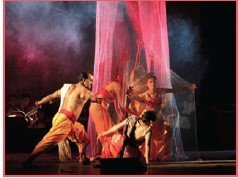
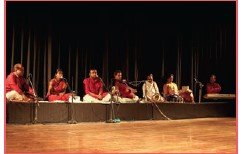
Discuss the following in the class:
• Placing the required props on the stage without distracting the performance.
• Designing costumes which feel comfortable (lifting hands and legs, jumping, flipping, etc.) to dance in.
• Entry and exit from the stage through two sides. (Refer stage structure in theatre section.)
Different dance forms have different props and stage decorations. Hope every element of dance is clear to all.
Till now, you have worked in small groups. Going forward, you will be working as a collective group consisting of all the members of class. Now, you are going to explore a new thing!
Dance Drama (Natya)
We are not only aware of the word ‘dance’ but also ‘drama’. Will it work if we combine both dance and drama together? Dance drama or natya is a form of creative expression where the participants use dance as a means to tell a story or convey a message using steps, body and hastamudras enacting often to songs and music.
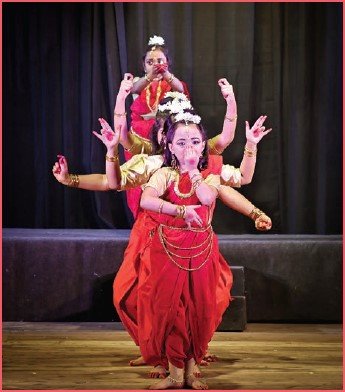
Dance drama requires — coordination, expression and collaboration among performers.
Coordination
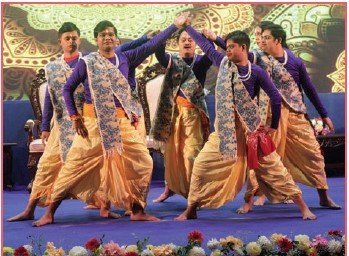
Expression
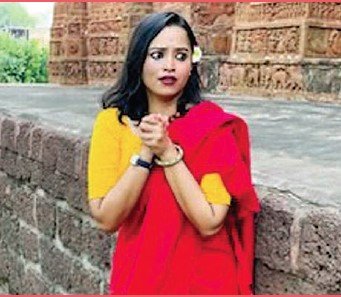
Collaboration among Performers
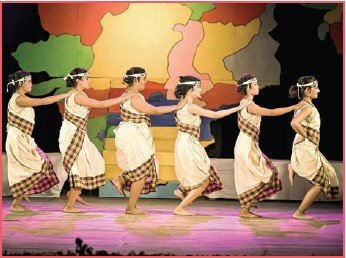
Dance drama brings a narrative through the art of movement and acting in tandem. Dance dramas can be inspired by various themes, cultures or historical events, providing a rich and diverse platform for artistic exploration.
Activity 5: Sharing a Story of Nature
Search and discuss a story related to nature or environment, or freedom movement which convey a moral value to the society.
Examples
Stories related to—
• Avoiding plastic use.
• Saving waterbodies.
• Excessive use of mobile phone.
• Organic farming.
• Equality in education.
Note: Choose a story from English or any other language textbook.
Choose and share an appropriate story in the class which you can relate with your surrounding situation and region.
Script is a written document containing dialogues, songs, action, and direction for performance or presentation of dance drama, natya. In dance, dialogue is mostly through hastamudras though words can also be used.
Think …
Discuss …
Write …
For a selected story or a poem, try to write a script and share ideas with each other to create a natya.
While writing the script, think of dialogues with hastamudras, characters, costumes, props and stage requirements.
In this activity, you are giving lives to all characters of the story.
Practice hastamudras, hand and body movements for natya performance. Compile elements of rhythm, steps, movements, hastamudras, postures into the poem and practice.
Also, identify dance with the rhythmic patterns using bols or collukettus (for
example, tha ka dhi mi) and sargams (often learnt in music class) which are
incorporated in natya.
Practice facial expressions which is a key element in natya. All of you have
to work collaboratively for a systematic outcome of your natya.
Activity 6: Choreography and Performing Natya
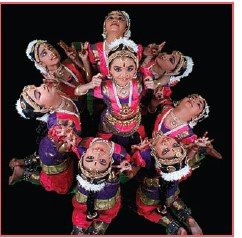
Come together and choreograph a natya which comprises dialogues, rhythmic music, dance beats and movements by working as a team.
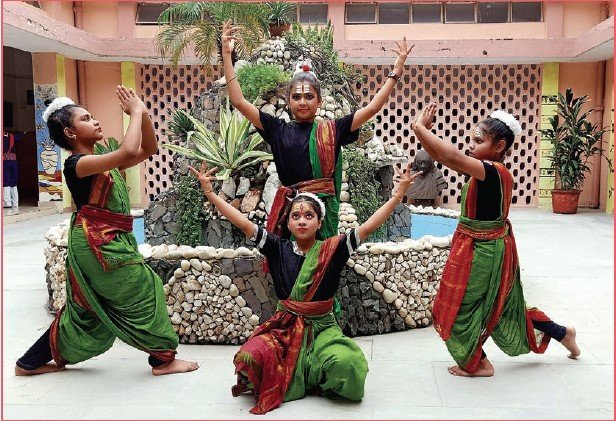
Dance
In this stage of choreography, we need to look into the props, costumes, jewellery, stage decoration and so on.
Practice with the props, beforehand while performing so that you can handle them comfortably.
Once the choreography is done, it’s time to practice.
Practice! Practice! Practice!
The key element of success is practice …
After practice of natya, now it’s time to rehearse on the stage.
Well done!
Perform your natya in front of your class or a large audience.