
Integration of All Art Forms
We all know that we have come to the final part of the book. We have learned about different aspects of all the four art forms. Now it’s time to collaborate them all together. Let’s learn how we can integrate them all in a single activity.
First of all, let’s have a story, then we will figure out the parts where we can use elements of one particular art form.
Sounds fun? Did you realise that in this tiny story, all the art forms are woven together? Let’s decode?
Seal — you did it in the chapter of this book as an activity of Visual Arts.
Local and regional songs and
dance — you have learnt so many in the Music and Dance periods.
You have learnt all the dialogues and expressions of joy, fear, and surprise in Theatre activities and now you also know how to create them.
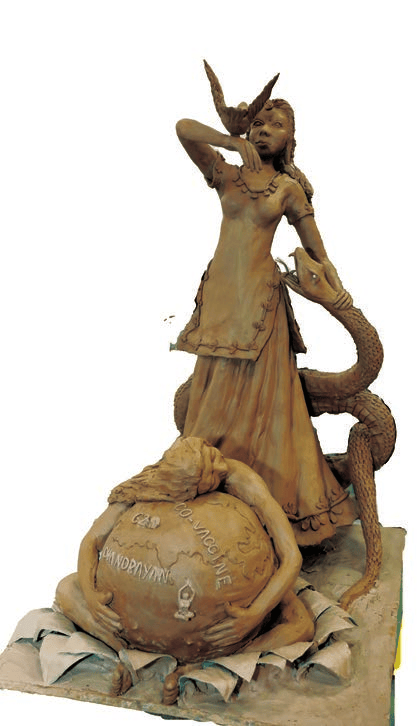
Story example
Two friends were playing at the edge of the forest, and found a mystery seal with a secret code. They went on an adventure to unravel the secret code. But they were unable to find anything and realised that they were lost in the jungle. They were almost ready to give up. Right moment at that one of them saw some indigenous people dancing in front of their God. Kids got caught! Those people took both of them to their village. The kids were very scared and planned to escape. Just as they were about to leave, they noticed that all the huts in the village have the same design as in the seal. They showed their seal to those people and somehow made them understand that they found the seal in the jungle and also got lost. After seeing their sacred seal, all the villagers of the forest were thrilled to make friends with them. They showed them around and told them that they worship the Earth as their God.
|
DO YOU KNOW
The Pancha (five) Tattva (elements) or Pancha Bhuta are the five basic elements. These are earth, water, fire, air and space
|
Now do you realise how beautifully we can connect them all to construct a story. Well, go ahead and create your own.
The suggested theme is ‘Earth and Water’ of Pancha Tattva — the five elements of nature.
Individual Activity
Let us discuss about the two elements — Earth and Water.
Firstly, identify the areas, problem areas or issues which we can showcase by different art forms. For example, if we choose soil pollution, we can make a campaign of photography or make some posters (visual art). We can also write a song with motivational lyrics and compose it in an energetic tune (music), or practise dance steps as well in this particular song (dance), and even make a short skit, drama or nukkad natak and incorporate all the above said elements of art.
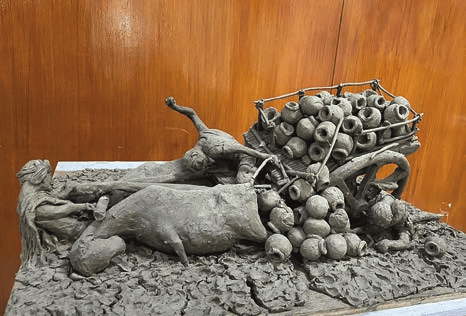
Apply your knowledge and skills of music, theatre, dance and visual art to develop a project to express your ideas, emotions and concerns related to earth and water.
You can continue doing this activity whenever you think of a different way to connect an art form with the five elements in nature. As you continue thinking about these connections, we will start working in groups in the fun activity which can be played as a game.
Element
|
Elements
of Theatre
(Emotions,
Actions,
Words)
|
Elements of
Music (Sounds,
Rhythms,
Emotions,
Words)
|
Elements
of Dance
(Rhythms,
Movement,
Expressions)
|
Elements of
Visual Art (Lines,
Shapes, Colours,
Textures)
|
Earth and
Water
|
|
|
|
|
Remember that the way you connect the elements might be different from how
your friends connect the elements. Fill in this table according to your ideas. You can use your notebook or a separate sheet of paper if you need more space to write or draw.
|
Group Activity or Team Work
You will choose a topic or an issue or problem area related to Earth and water just like the individual activity. Here are some thought provoking ideas for your young minds. Have you thought of the quality of soil, or source of drinking water in your locality or natural resources around you? Can you describe a pond, lake or river and its ecosystem, the range of hills that you see, the beauty of the waterfall you visited recently? Can you imagine a day without water or can you imagine living in a very dirty and polluted land? Well, we can always try and make some positive changes through the arts because art is not only a skill to develop but also has the potential to make social changes and reforms. The knowledge of art brings sensitivity and awareness in us about everything because we start appreciating small things, beauty and changes around us.
|
Now, are you ready for some brainstorming exercises?
Instructions
1. Make five sets of chits. Each set has the activities associated with a particular art form written in those chits. (Use the list below to write activities.)
2. Divide the class into two or three groups, to have about 10 – 12 members in each group. Each group chooses either ‘earth’ (prithvi) or ‘water’ (jala) as their area of work.
3. One representative from each group picks one chit from each set. So each group now has one activity each from theatre, music, visual art and dance. The chit under ‘values’ can be used as a theme to bring together all the artforms.
4. Now, sit with your group and develop an integrated project that involves all the art forms. Create your own production and present it to the class.
Activity
THEATRE
|
MUSIC
|
VISUAL ART
|
DANCE
|
VALUES
|
Mask making
|
Songwriting
and composing
|
Create artwork
with the
elements itself —
mud and clay or
water colours
|
Use only
footwork
and
expression
|
Sustainability
|
Puppet show
|
Create sound
with materials
around you
|
Use
natural
colours
|
Find a
folk
dance
related to
earth and water
|
Cultural
sensitivity
|
Design
costume
and
make-up
|
Use any
instrument to
create emotion
related to the
element
|
Use
element
related surface
or
material to
create art
|
Use only hand
gestures
|
Selfless
work
|
Write a
script with
characters
and a
conversation
|
Find a song
sung by
a famous
musician you
have learnt
about
|
Upcycle (reuse)
discarded
materials related
to the elements
like bottles or
pipes
|
Compose
a
dance
with
either a
song or
music
|
Swachhta
|