UNIT 3

Fundamental
Skills of
Kho-Kho
In this unit, we will learn about an exciting Indian
sport called Kho-Kho. This game is interesting and
helps us to work together as a team.
Kho-Kho is a sport where two teams compete. One
team tries to tag members of the opponent team while
they avoid being tagged. The game involves quick
movement, agility, speed, leg strength and teamwork,
with players taking turns to defend and chase.
Here’s what we will do:
- Learn and Play: We will have fun sessions where we will learn how to play Kho-Kho through interactive games and group exercises.
- Develop Skills: We will do exciting lead up activities to develop kho-kho skills.
- Work as a Team: We will focus on working together and supporting each other during the game.
Let’s get ready to play, learn and enjoy the game of
Kho-Kho!
Sitting
| Warm-up | Activity | Cool-down | Circle Time |
|---|---|---|---|
| On the spot run to
fast feet
Head to Toe Stretch |
Sitting |
Hamstring Stretch
Calf Stretch
Crossed Leg Toe Touch |
Strength |
Sitting
Stance
- Stand at the designated block.
- Look straight
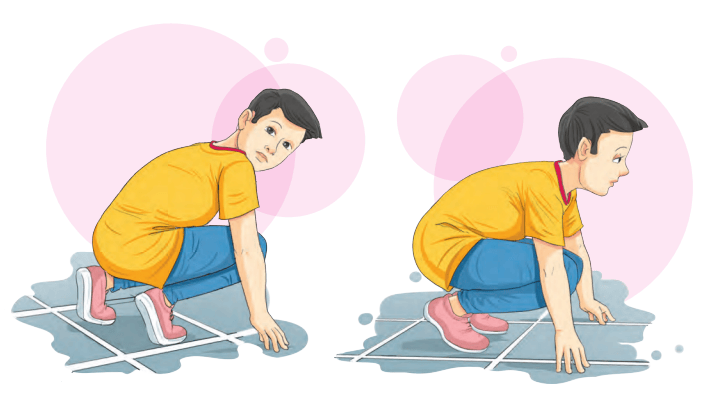
Execution
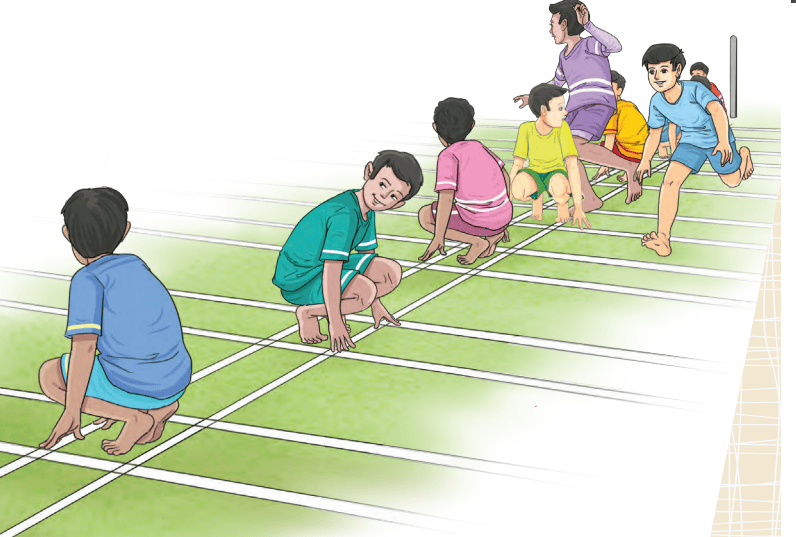
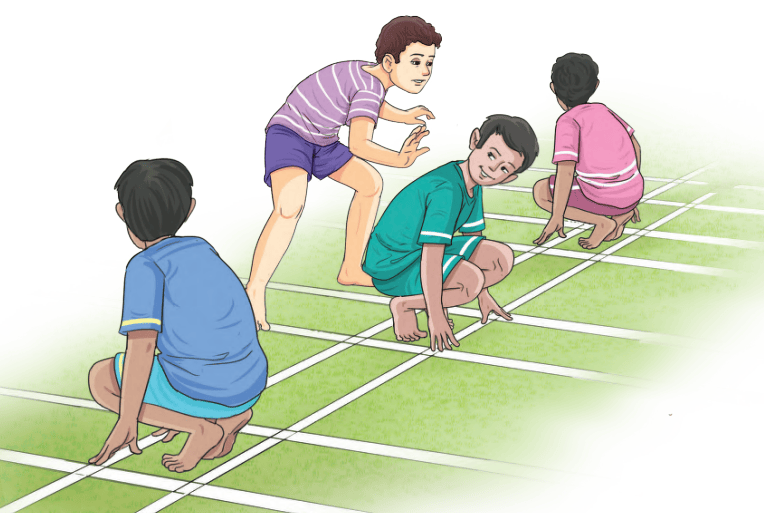
- In a block drawn on the ground sit on your toes.
- Place your hands on the ground, forming a bridge with your fingers and thumb.
- Lean a little forward, the body weight should be
balanced on both the toes and hands, as shown
in the picture.
Lead-up Activity
Organise competition between players to complete a circuit—
20seconds of kho-kho sitting stance, followed by 10 metres of frog
jump and 10 metres of duck walk.
Circle Time – Strength
- In which body parts did you feel the stress during the
activity?
- Discuss activities that will help in developing body strength
and stamina.
Did You Know?
Measurement of kho-kho court for sub
junior boys/girls is 14 × 24 square metre.
Chasing
| Warm-up | Activity | Cool-down | Circle Time |
|---|---|---|---|
| Lower Limbs Rotations
High Knee and Butt Kick |
Running |
Floor Touch
Calf Stretch
Crouch Leg Stretch |
Footwork |
Chasing
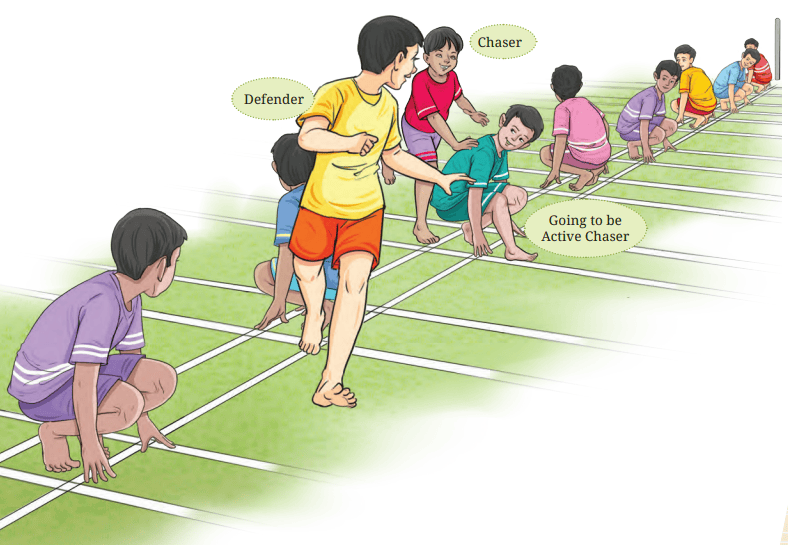
Initial Position
- Chaser will start from the position (sitting stance) we learned in the previous session.
Footwork
- You should take out your left leg forward first for running
in the left direction and right leg for running in the right
direction.
Running Technique
- Maintain an upright posture with your head up.
- Swing your arms naturally back and forth.
- Focus on defender.
Lead-up Activity
Rise and Run: Assemble on a starting line and sit in the kho-kho stance.
Start running towards the finish line at the sound ofthe long whistle and sit
down on the sound of the short whistle. The teacher will guide the students
with every whistle. Sitting and rising on wrong whistle will be a foul.
Circle Time – Footwork
- Discuss the footwork that you followed while getting up
as described in the skill section.
- Elaborate the basic rules of kho-kho in your own words.
Giving Kho
| Warm-up | Activity | Cool-down | Circle Time |
|---|---|---|---|
| Jumping
Squat
Ankle Stretch |
Giving Kho |
Overhead Arm Stretch
Torso Twist
Crossed Leg Toe Touch |
Anticipating the Kho |
Giving
Kho
Oral and Touch Signal
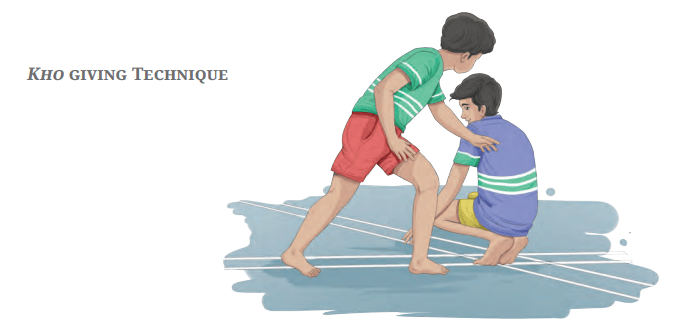
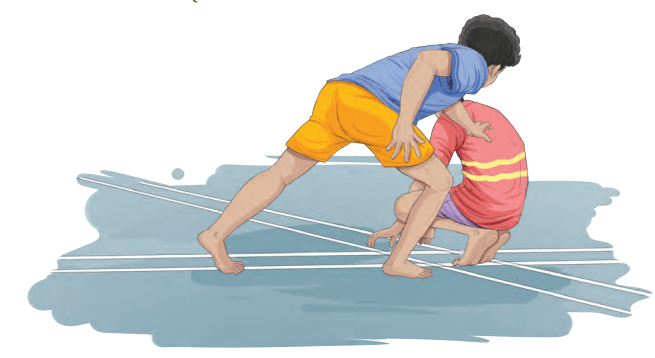
Kho signal is given by tapping the back of the teammate
and shouting kho at the same time. At the time of giving
kho at least one of the legs should be behind the cross lane.
Kho giving Technique
Lead-up Activity
Form two teams of equal number of players practice giving kho in different
techniques.
Circle Time – Anticipating the Kho
How did you anticipate while playing kho-kho who is going to
give you the Kho?
Did You Know?
There are 3 types of giving kho
- Simple touch kho
- Early kho
- Late kho
Running on a
Straight Line
| Warm-up | Activity | Cool-down | Circle Time |
|---|---|---|---|
| Leaping and skipping
Jumps Hip and
Pelvic Muscle Stretch |
Running on a
Straight line |
Pashchimottanasana
Camel pose
Pigeon pose |
Realising mistake
and how to
improve |
Running on a
Straight Line
Proper Running Form
- Maintain an upright posture,
keeping your chest and
head straight.
- Keep the movement of your
hands straight and parallel to
the ground.
Acceleration Drills
- Practice drills of taking a quick start and gaining speed
swiftly. This will improve your ability to chase swiftly.
- Use markers or cones to prepare the track, and encourage
yourself to keep your eyes focused on the end-point to
maintain a straight line.
Lead-up Activity
Modified Shuttle Run: Draw parallel lines of 10 metres having
30 cm distance between them. Players will take a sitting stance.
On the sound of the whistle they will get up and run straight
towards the finishing line, and then come back towards the
starting point. In case the feet touch the boundary lines or the
body moves sideways, the player has to start again from the
beginning. Finally, the one who finishes first wins the race.
Circle Time – Realising mistake and steps to improve
Identify and understand the mistake that you probably made
while the sound and visual signal for starting the run was given.
Dodging
| Warm-up | Activity | Cool-down | Circle Time |
|---|---|---|---|
| Sliding and Galloping
Knee Hug and
Quadricep Stretch |
Dodging |
Forward and
Backward Lunges
Lower Limbs Rotations |
Wrong
footing a
player |
Dodging
Dodging (Defender)
- It is a skill for defender in kho kho, as it allows them to move quickly and avoid the attempts of the chasers to get them out. Effective dodging involves a combination of quick footwork, agility and strategic movement.
Leaning
- Defender leans their body in one direction and runs in
another direction to mislead the chasers about their
intended direction. This can create an opening for the
defender to slip past the chasers.
- Rapid turns and pivots can help you change the
direction swiftly, making it difficult for chasers to anticipate
your movement.
Changing Speed (Chaser)
- You can move at a consistent pace and then suddenly speed
up or slow down to catch your opponent off guard.
Lead-up Activity
Move to Safety
- Mark a starting and finishing line 20 metres apart. Divide the
players in two groups.
- Runners will stand on the starting line and the chasers will be at
the centre.
- Runners have to run and dodge the chasers and reach the
finishing line without getting tapped or caught.
- The number of people reaching the end-line will be the number of
points scored by that team.
- Now change the roles and play again.
Circle Time – Wrong footing
Elaborate your strategy to confuse a player by leaning and
dropping your shoulder in one direction and moving in another.
Zig-Zag Running
| Warm-up | Activity | Cool-down | Circle Time |
|---|---|---|---|
| Lower Body Stretching, Lunge
Jump, Single and both Legs
Drills, Squat Jump |
Zig-Zag Running |
Pigeon Pose
Child Pose
Cobra Pose |
Reaction
Time |
Zig-Zag
Running
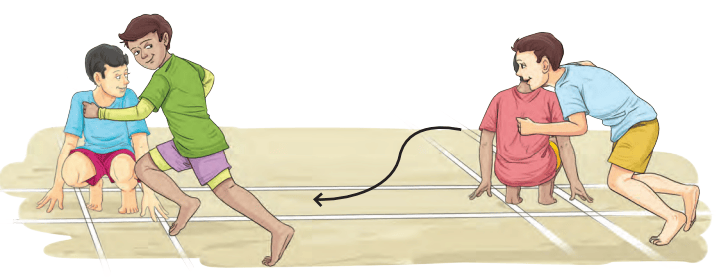
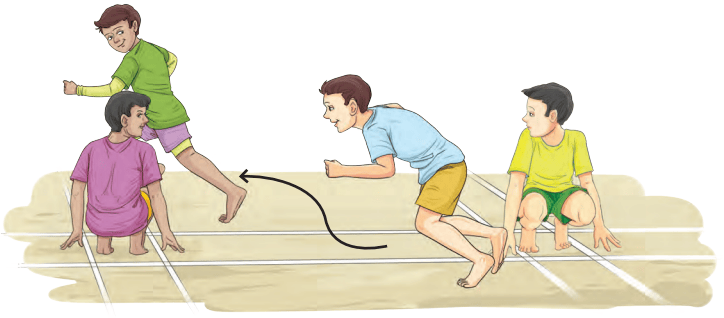
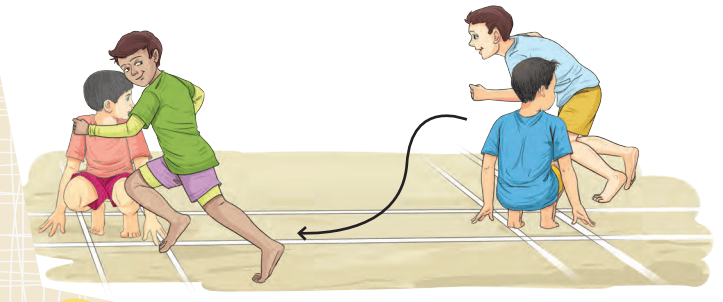
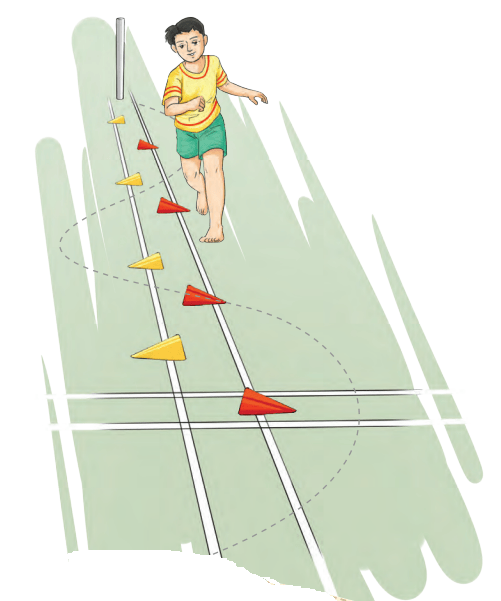
There are two types of zig-zag running that
are used in the game of kho-kho. One is straight
running and a the other one is sidewards running.
Start Slow
- Begin with a slow-paced jog or walk through the zig-zag
pattern. Focus on the proper footwork and changes in
directions.
- Include specific Kho-Kho movements, such as, dodging,
chasing and tagging in a controlled and gradual manner.
- Players should gradually increase the speed of the
zig-zag running. The emphasis should be on quick
and controlled movements.
Lateral Movements (Sideways Movements)
- Practice lateral movements by crossing one foot over the other as you change direction between the cones. This helps in improving agility and coordination.
- Once players are confident, the teacher will call
out directions or use visual cues to prompt random
changes in the zig-zag pattern, challenging the
participants to react quickly.
Lead-up Activity
Play Kho-Kho with single chain pole to pole running skill. The player
covering the court in minimum time is the winner.
Circle Time – Reaction Time
Share your experience while playing kho-kho. How did you
anticipate the random visual signal for starting a movement?
Pole Turn
| Warm-up | Activity | Cool-down | Circle Time |
|---|---|---|---|
| Side Walk
Back Walk
Jogging Drills |
Pole Turn |
Bow Pose, Crocodile Pose
Wheel Pose |
Pole turning
technique |
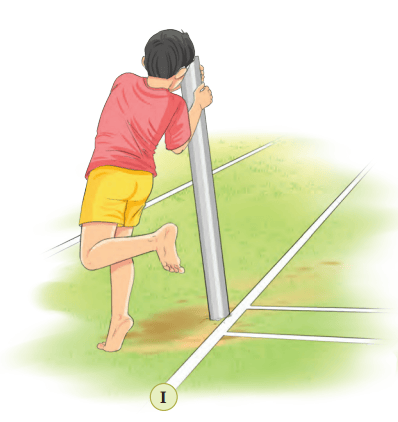
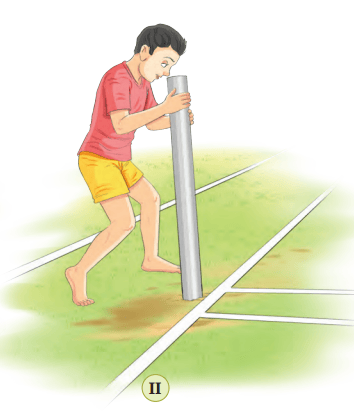
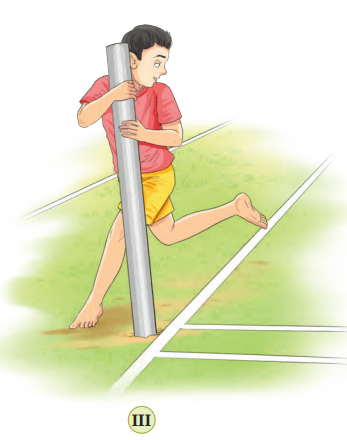
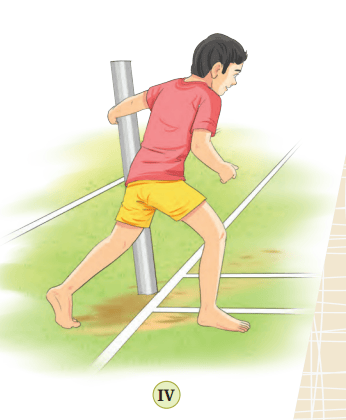
Pole Turn
Pole turn is a skill used by the chasers to
make quick turns and tag or tap the runners.
Approach the Pole
- As you approach the pole, maintain a controlled and balanced run. Keep your eyes on the pole when you intend to turn around.
- As you reach the pole, initiate the turn by planting your
inner foot (the foot closest to the pole) firmly on the
ground.
- Rotate your body in the direction of the turn by using
a pivot motion on the planted foot.
- Simultaneously, swing your free leg around the pole in the desired direction of the turn.
- As your turn is completed, push off the pole with the
direction of the flow.
Lead-up Activity
Pole Shuttle Run: Make two teams A and B. The team that completes
the pole shuttle run in the minimum time wins. Ask the team members
to sit in a row at a distance of 4 metres apart from the kho-kho pole.
First player of the Team A runs towards the pole, completes the turn and
comes back to give kho to the next player. The next player repeats the
same. This goes on till all the players have completed the shuttle run. The
time is noted both at the beginning and at the finishing ends of the run.
Similarly, Team B players will repeat the same.
Circle Time – Pole turning technique
Discuss what happens each time when elbows are flexed and
not flexed while making the pole turn.
Covering Chase
| Warm-up | Activity | Cool-down | Circle Time |
|---|---|---|---|
| Leaping and Skipping jumps
Hip and Pelvic Muscle Stretch |
Covering
Chase |
Chest stretch
Shoulder Circles
Cross Body Shoulder Stretch |
Anticipation |
Covering
Chase
Covering
- Covering helps the player to understand
the importance of offensive (chaser) strategies
that are in coordination with other players strategies.
Also, they will learn the importance of maintaining proper
position and effectively pursuing the defender.
Coordinate Movements
- This involves reading the defender’s actions and adjusting
your approach accordingly. In this skill, the chaser gets
up and walks toward the defender on a straight line and
whenever the opportunity arises the chaser moves towards
the defender by making a straight, left or right move.
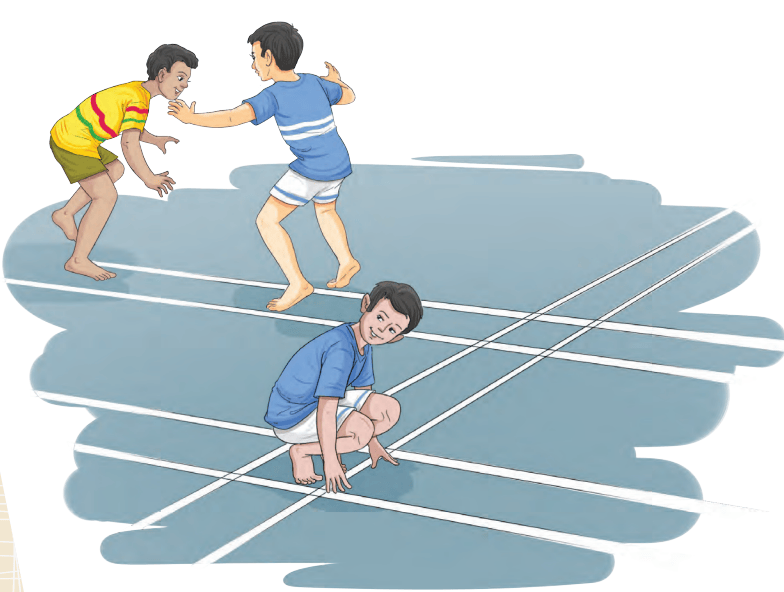
Individual Pursuit Drill
- Practice one-on-one pursuit drills where covering chasers
try to chase a single runner. This helps in improving your
skills such as speed, timing and the ability to anticipate the
runners movements.
Lead-up Activity
Covering Chase Relay - Make two teams A and B. Team that will finish
the drill first wins the match. Team A first lines up for the sitting stance
on the centre line. First player from Team A is in the sitting stance and
gets a kho. Player walks in the cross line, takes 3 steps, attacks towards
left and touches the cone placed at a 45 degree angle, makes a left turn
and returns to give kho to the second player sitting in box number
two. All players repeat this till the 8th player does it and comes back
to touch the pole. Team B repeats the same. Similarly, same relay can
be played by taking a right turn. The team that finishes the relay in
minimum time wins the game.
Circle Time – Anticipation
Pictorially elaborate the strategy for covering and chasing, how
to anticipate the opportunity for covering and then attack.
Did You Know?
At the time of receiving
kho both hands of chasers
should be placed outside the
centre line.
Chain
| Warm-up | Activity | Cool-down | Circle Time |
|---|---|---|---|
| Leaping and skipping
Jumps Hip and
Pelvic Muscle Strtetch |
Chain |
Torso Twist
Calf Stretch
Quadriceps Stretch |
Reaction
time |
Chain
The Concept
- The team will work together to create
a barrier that moves along with the runners.
The objective is to corner the runner and prevent them
from crossing the centre-line.
- Ensure that you understand your designated positions in
the chain. Positions will be assigned based on the order
in which players are lined up at the start of the match.
Each player in the chain has a specific role to play in
maintaining the barrier.
- You need to move together as a unit to maintain a strong
defensive formation. Initially, practice the chain in slow
motion and just focus on the action.
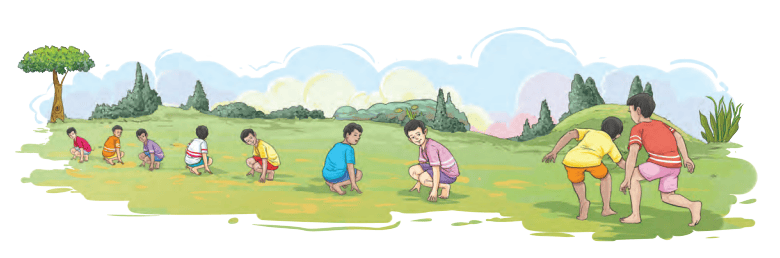
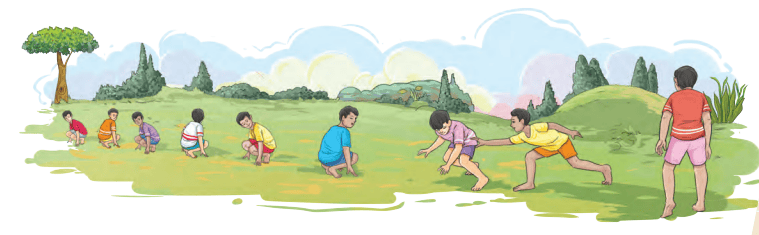
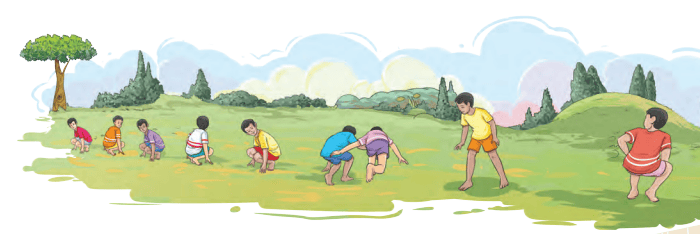
Hand and Verbal Signals
- Use hand and sound signal to start the chain. Players should be
aware of when to start forming the chain and when to adjust
their positions based on the movements of the runners.
Lead-up Activity
Sitting Relay Race: Make two teams having nine members in each team.
From each team one player will stand and others will sit in the kho-kho
stance 2–3 metres apart. The one standing in front of the lanes will start
the race by running towards the partner sitting nearest and then gives
a pat (kho) on their back and the sequence will continue till the last
teammate completes the race. The team that finishes first will be
the winner
Circle Time – Reaction time
Reaction time – Elaborate how you anticipated the kho and
how to reduce the time between the kho and standing up for
a chase.
Fake Kho
| Warm-up | Activity | Cool-down | Circle Time |
|---|---|---|---|
| Sliding and Galloping
Knee Hug and
Quadriceps Stretch |
Fake Kho |
Pigeon Pose
Child Pose
Cobra Pose |
Unpredictable
fake kho |
Fake Kho
Fake Kho
- Fake is a strategy to mislead the defenders,
create openings and gain advantage.
- Timing and unpredictability are very crucial when
executing fakes. You should be able to seamlessly integrate
fakes into your overall game without disturbing the flow
of your movements.
Reaction Time Drills
- Set up scenarios where you need to react quickly to cues
or signals, incorporating fakes into your responses. This
helps in making fakes more natural during the actual
game.
Competitive faking drills
- Organise competitive drills that specifically focus on
faking. For example, set up a one-on-one situation where
you must use fakes to get past defenders.
Lead-up Activity
Ace-of-the-fake: Form three to four teams of nine players in each team.
Eight players from each team will sit in the kho-kho formation and one
player will start the game. Target of each team is to give three actual
kho and two fake kho as soon as possible and shout ‘Pancham’. The team
which finishes first wins the game.
Circle Time – Unpredictable fake kho
Discuss ideas on how you can be unpredictable in giving
fake kho.
Did You Know?
Fake kho may also used
near a pole.
Pole Dive
| Warm-up | Activity | Cool-down | Circle Time |
|---|---|---|---|
| Jumping Jacks and
Frog Jump
Chest and Back
Quadriceps Stretch |
Pole Dive |
Overhead Arm Stretch
Torso Twist
Cross-legged Toe Touch |
Footwork and
safety for pole
dive |
Pole Dive
Approach
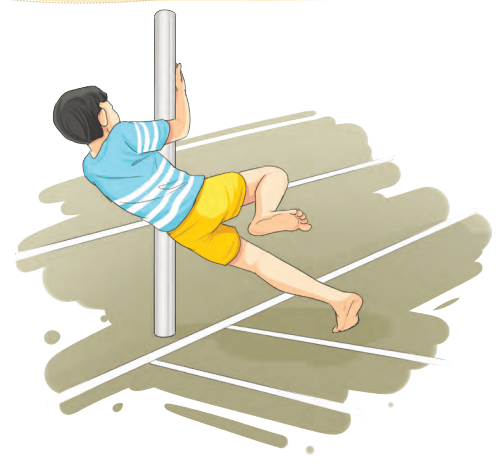
- As you approach the pole, maintain a controlled
and steady pace, preparing for the quick movement.
- Keep your body low to the ground and slightly lean in the
direction of the dive.
- As you reach the pole, If you are diving towards left, plant
your left foot and grab the pole with right hand to make
the dive, if you are diving towards right, plant your right
foot and grab it with you left hand to perform the dive.
- Use your free arm and torso to generate the movement
and get the player out.
- As the dive is completed, push off with the outer foot and
both the hands. Rotate your non-planted foot around the
pole to get out of the dive.
Circle Time – Footwork and safety for pole dive
- Why is the footwork important for pole dive? Explain with
appropriate examples.
- Write a set of instructions on avoiding head or leg collisions with the pole.
Lead-up Activity
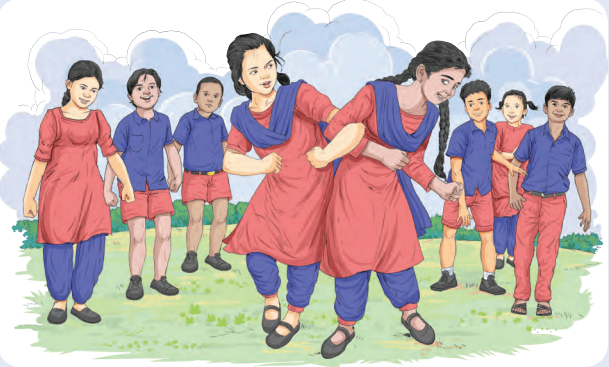
Elbow Lock Challenge: Make two teams. Line up both the teams facing each
other on the opposing sides a distance of six metres approximately. One player
from each team will come in the centre and will lock elbows with each other.
Both players will sing one to two lines of any folk song while moving in a circle.
As the first stanza ends, both the players will try to pull each other towards
their own side. The player that successfully pulls the other player towards their
side earns one point. Repeat the process until everyone gets their turn.
Toe Tapping
| Warm-up | Activity | Cool-down | Circle Time |
|---|---|---|---|
| Lower Limbs
Rotations
High Knee and
Butt Kick |
Toe
Tapping |
Lower Limbs Rotations
Reverse and
Forward Lunges
Butterfly Pose |
Stretch to reach |
Toe Tapping
Position
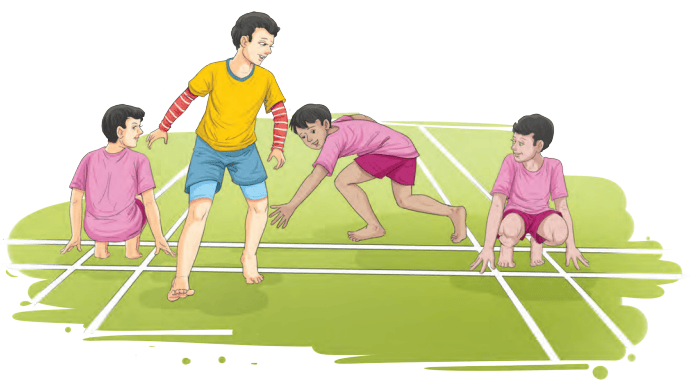
- You will be in a sitting position as (we have
learned previously), ready to react quickly to
the movements of the defenders.
- You need to focus on the movements of the defender and
anticipate their next move by predicting the speed, direction
and pattern.
- Timing is crucial. As the defender approaches, you should
extend one arm forward, aiming to tap defenders toe or
feet without falling over the centre line.
Lead-up Activity
Grab The Cone: Mark a starting line and restraining line about
three to five metres apart. Place three cones in a row one metre after
the restraining line as shown below. Players will line up behind the
starting line. Each player will run towards the cone and touch them as
per instructions (Centre, Right, Left) without crossing the restraining
line. The teacher can slowly decrease the time intervals between the
instructions.

Do not cross this line for touching the cone
 Restraining
line
Restraining
line 
Starting line
Circle Time – Stretch to reach
Student will discuss the technique to be used for reaching the
cone without falling over the restraining line.
3-2-3 Chain
| Warm-up | Activity | Cool-down | Circle Time |
|---|---|---|---|
| Leaping and Skipping Jumps
Hip and Pelvic Muscle Stretch |
3-2-3 Chain |
Forward Lunges
and Backward
Lunges |
Appreciating
Performance |
3-2-3 Chain
Concept
- The 3-2-3 chain in Kho-Kho involves a specific
defense strategy where players form a chain with
three chasers in the front, two in the middle and three at
the back. This formation is used to create a strong defense
barrier.
Positioning
- Ensure that you have understood your designated position
in the 3-2-3 chain. Positions are typically assigned based
on the order in which players are lined up at the start of
the match. Each player in the chain has a specific role to
play in maintaining the barrier.
Demonstration
- Demonstration of the 3-2-3 chain formation
will be done by your teacher to showcase the proper
positioning. Highlighting the role of each player in the
front, middle and back, and how they work together to
chase the defender.
Practice
- Begin practicing the 3-2-3 chain formation without the
chaser initially. This allows you to focus on the technique
of forming the chain and improving your movements
without the pressure of the opponents.
Lead-up Activity
Standing Kho-Kho: Form a circle. Form six groups and stand at the
circle’s border. One of you will be the chaser, while the other will
be the runner. ‘Chaser’ can enter the circle, but the runner cannot.
When the runner wishes to pass, then only entry is allowed in
the circle and then the runner can stand in front of the lane. The
runner will join the lane in which the last person will become the
runner. If the chaser catches the runner, the runner turns into the
chaser and vice versa.
Circle Time – Appreciating Performance
Will you appreciate the performance of the opponent team
player and why?