UNIT 4

Fundamental
Skills of
Handball
In this unit, we will learn about the game of handball.
This is a fast-paced invasive team sport played with
a ball. Players pass, dribble and shoot the ball to
score points. Defence involves intercepting passes
and blocking the shots.
Here’s what we will do:
- Learn and Play: We will learn how to play Handball
through interactive games and exercises.
- Better Coordination, Strength and Endurance:
Handball will help us in improving our
coordination, strength, and endurance.
- Team Spirit: We will focus on working together,
involving everyone, and supporting each other
during the game.
Passing
| Warm-up | Activity | Cool-down | Circle Time |
|---|---|---|---|
| Lower Limbs Rotations,
High Knee and Butt Kick |
Passing
Handball |
Overhead Arm Stretch,
Torso Twist, Crossed-leg
Toe Touch |
Point of
Release |
Passing
Handball
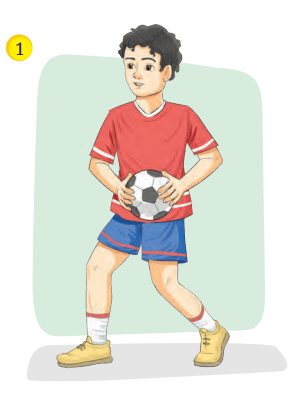
Stance
- Keep your feet shoulder-width apart, forming a steady basis. The non-throwing arm is often extended to maintain the balance and protect the ball from the defenders.
- The player holds the ball in one hand, slightly above
the head, with fingers spread around the ball for
maintaining the control.
Target
- The player will deliver the pass to a teammate
aiming for their torso.
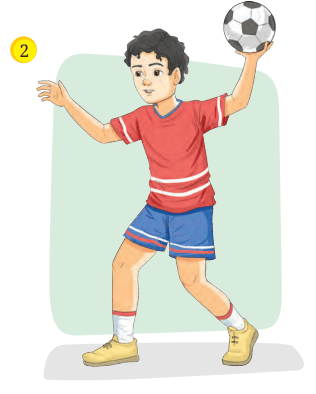
Execution
- The throwing arm is brought back behind
the head with elbow bent at an angle of 90 degrees.
That means the ball is placed slightly behind and above
the player’s head.
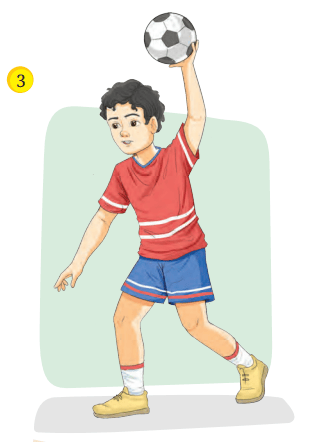
- In an effortless action, the player stretches his throwing arm
upward and forward before releasing the ball at the highest
point. The wrist snaps forward upon release, adding accuracy
to the pass.
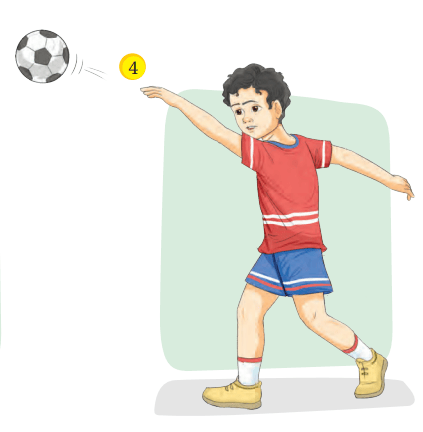
Follow-through
- After releasing the ball, the throwing arm moves in forward
and downward position with the hand pointing in the direction
of the desired target. This follow-through helps to keep
the pass accurate and powerful.
Lead-up Activity
Monkey in the Middle: Form a Circle. One ‘monkey’ (player) will
be inside the circle. The other players aim to pass the handball to
each other while the monkey in the middle will try to intercept or
touch the ball. If the monkey disrupts a pass, the player who made
the unsuccessful pass becomes the new monkey.
Variation: Monkeys can be two or three in number.
Circle Time – Point of Release
Observe and explain in your own words the point of release
of the ball while throwing. Discuss the difference between the
throws when released from the medial line of the body and
the one which is not through from the medial line of the body
Catching
| Warm-up | Activity | Cool-down | Circle Time |
|---|---|---|---|
| Leaping and Skipping
Jumps, Hip and Pelvic
Muscle Stretch |
Catching
Handball |
Chest Stretch, Shoulder
Circles, Cross Body Shoulder
Stretch |
Eye-hand
Coordination |
Catching
Handball
Stance
- Maintain balance by standing with your feet
shoulder-width apart and your knees
slightly bent.
- To react effortlessly to the ball, lean slightly forward while
maintaining your weight on your feet.
Execution
- Spread your fingers widely apart to maximise the surface
area available for catching the ball as you position your
hands in front of your torso.
- Maintain a slight bend in your elbows while keeping your eyes fixed on the ball and follow its path.
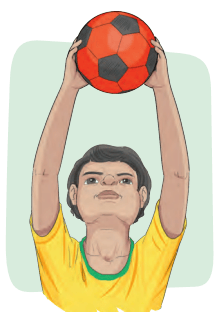
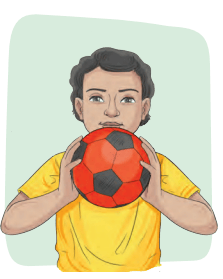
- Catch the ball with your wrist loose, fingers firm and pad of the palm as shown in the figure.
Follow-through
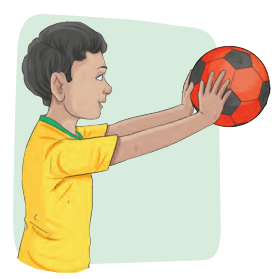
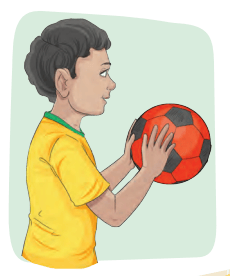
- Step closer to the ball to reduce the distance. Bend your elbows and bring your hands slightly back with the ball towards your body to minimise the force of the ball, preventing the ball from bouncing back.
Lead-up Activity
Say and Catch: Form a circle. One player will start the game by
throwing the ball towards the other player and calling out their
name loudly. Then that player will have to catch the ball. The player
who drops the ball will be declared out. The one who remains in
the game till the end will be the winner of the game.
Circle Time – Eye-hand Coordination
Discuss the eye-hand coordination required for learning the
catching skill.
Did You Know?
Handball demands agility, strength and
tactical acumen.
10-pass
| Warm-up | Activity | Cool-down | Circle Time |
|---|---|---|---|
| Arm Rotations and
Movements |
10-pass |
Floor Touch, Calf Stretch,
Crouch Leg Stretch |
Importance of
Correct Form |
10-pass
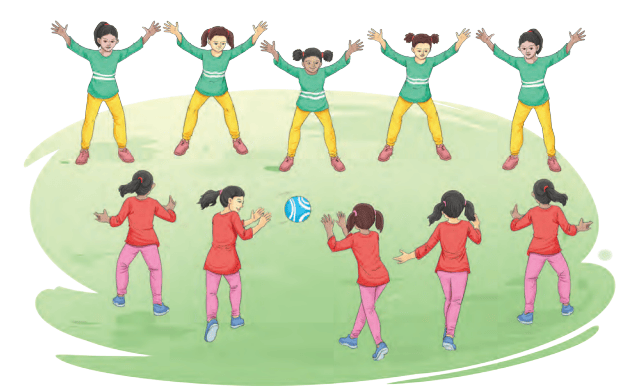
Divide the players into two teams.
The number of players per team depends on
the overall number of players available. Define a play
area that will be appropriate for the number of players.
It might be a half-court or a smaller area of the handball
court to increase the difficulty level. The team with the ball
begins the game and must aim to complete ten consecutive
passes. The players are encouraged to move continuously,
looking for open spaces and establishing passing lanes. The
opposing team plays for the defence, attempting to intercept
the ball. If the ball is intercepted or dropped, possession of
the ball shifts to the defence team. The new defence squad
then attempts to complete their own 10-pass series.
Lead-up Activity
Pass and Chase: Two groups will line up on opposite sides and run
parallel to each other in the same direction. Make sure that the groups
are at least 5 metres apart from each other. One player will hold the ball,
while the others will be empty-handed. The player with the ball will try
to pass it to the other group player while the other players are running.
The player from the receiving group who catches the ball joins back
the throwing team’s queue. Also the player who threw the ball joins the
receiving team’s queue. The game continues with both groups running
and passing the ball back and forth.
Circle Time – Importance of Correct Form
Discuss the correct form of passing and catching the ball. Also,
elaborate the different types of foul and their rules.
Dribbling
| Warm-up | Activity | Cool-down | Circle Time |
|---|---|---|---|
| Leaping and Skipping
Jumps, Hip and Pelvic
Muscle Stretch |
Dribbling |
Arm Swinging,
Shoulder Shrug, Hamstring
Stretch, Calf Stretch |
Creative
Lead-ups |
Dribbling
Hand Position
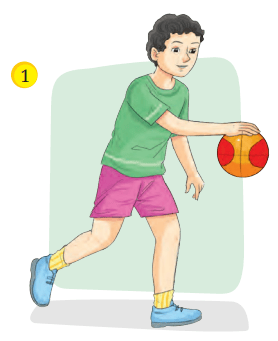
- For improved control, hold the handball with
fingertips rather than the palm.
- Gently spread fingers across the ball’s surface.
- Wrist and forearm should be in line. Maintain the position
of the hand on the top of the ball.
Position of the Body
- With knees slightly bent, take stance and lower the body.
To have a clear vision of the court, keep your head up and
back straight.
Dribbling Height
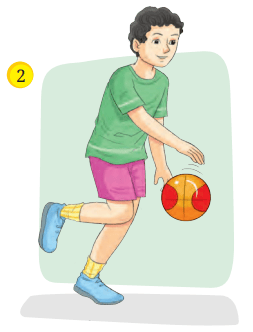
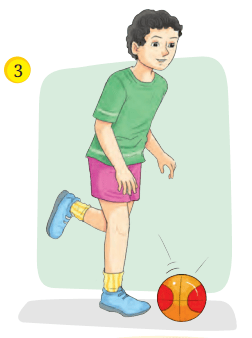
- To make it more difficult for defenders to grab the ball,
dribble it downwards, keeping it as low as possible
to the ground.
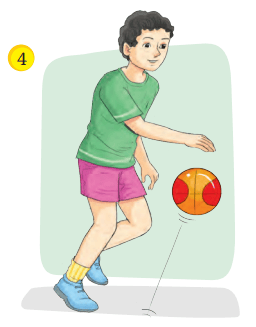
- Depending on the circumstances,
adjust the dribble’s height, but in general,
maintain it below the waist level.
- Develop the ability to dribble with both the hands. Practice
non-dominant hand dribbling technique to enhance the
overall ball-handling abilities.
- Try to keep your balance and control while dribbling. To cover larger distance, take longer strides without loosing control of the ball.
- Keep head up and look for the open spaces.
Lead-up Activity
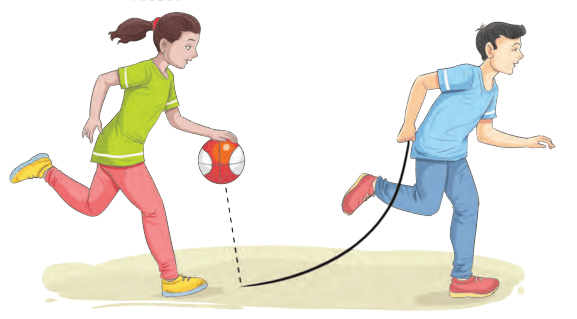
Make pairs. One player will run around the court, holding a rope
loosely between the thumb and the forefingers. The other players
will dribble their ball, trying to dribble on the rope and pull it free.
If they succeed, they get a point. After the rope has been pulled
free, switch the roles. The player with maximum points will be
declared as the winner.
Circle Time – Creative Lead-ups
Design a new game which is as creative as the lead-up activity.
Obstacle
Dribbling
| Warm-up | Activity | Cool-down | Circle Time |
|---|---|---|---|
| Sliding and Galloping,
Knee Hug and
Quadriceps Stretch |
Obstacle
Dribbling |
Forward Lunges and
Backward Lunges, Lower
Limbs Rotations |
Footwork and
Body Gestures |
Obstacle Dribbling
Arrange a set of cones or markers to create a challenging obstacle course. To imitate real-game conditions, arrange them in a variety of patterns such as zigzags, loops and sudden turns. Players are supposed to overcome all the obstacles while dribbling smoothly with clear movements with least or zero fumbles in minimum possible time.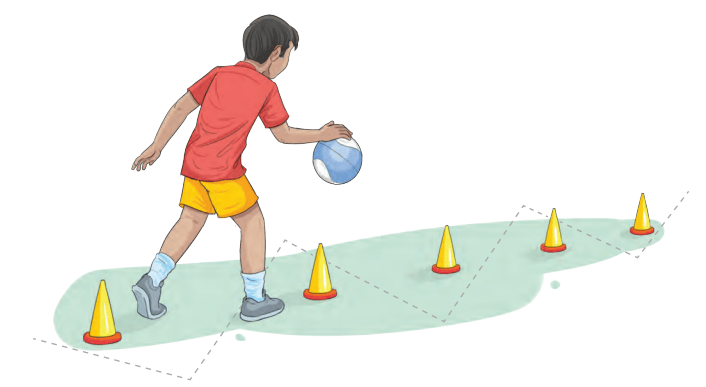
Lead-up Activity
Sadhu and Shaitan: It involves four children dribbling within a
marked area (sadhu) while two children (shaitan) will try to stop
them. Four cones are set up in the four corners, roughly 4 metres
away from one another. The players are numbered from 1 to 4.
Players 1 and 3 will have one ball each and will start the game at
the same time. On the sound of the whistle, Player 1 will dribble
the ball twice and throw it towards the Player 2, and then run and
take the place of Player 2. Similarly, Player 3 will dribble twice and
throw the ball towards the Player 4. This will create a relay and
two players will try to stop this relay by blocking the ball. Whoever
succeeds in obstructing the ball will exchange the role with the
player and relay continues.
Circle Time – Footwork and Body Gestures
How do you anticipate the possible challenges by studying the
footwork and body gestures of your opponent team member?
Shoot the Ball
| Warm-up | Activity | Cool-down | Circle Time |
|---|---|---|---|
| Leaping and Skipping
Jumps, Hip and Pelvic
Muscle Stretch |
Shoot the
Ball |
Bow pose, Crocodile pose,
Wheel pose |
Doing Things
Differently |
Shoot the Ball
Grip
- Hold the ball firmly with your fingers spread
for optimal control and spin in the throw.
Stance
- To maintain balance, place your feet shoulder-width apart.
- Position your body sideways towards the goal with your
non-throwing shoulder towards the target.
- Bend your knees and transfer your body weight forward
on both your toes. After that prepare yourself for a
high jump.
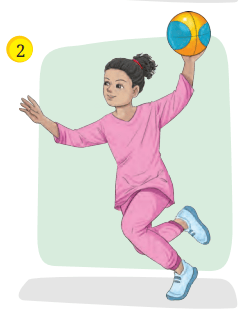
- Extend the elbow of the throwing arm in the air and raise the forearm high, and then extend the shoulder at a roughly 90° angle to the arm behind the head.
- Indicate the target with the nonthrowing arm.
- As you throw towards the target,
start by bringing the elbow to the
front along with a swift action of
the forearm, wrist, shoulder and
the torso.
- At the peak of the jump, release the
ball forcefully downward in the
direction of the goal, right in front of
your forehead.
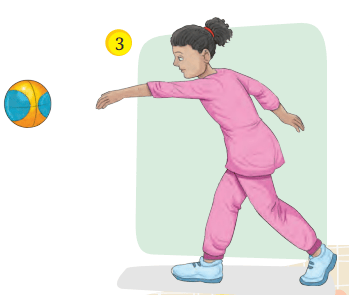
- After releasing the ball, continue the
motion with your arm.
- The follow-through improves
accuracy and directs the ball towards
the fixed goal.
Lead-up Activity
Blindfolded Shooter: Make two teams comprising of two players each.
One will be the ‘shooter’ and other will be the ‘instructor’. The shooter
will be blindfolded and cannot see the goal. The instructor will stand
behind the shooter and will give verbal instructions to help the shooter
locate and aim at their goals. The shooter will then attempt to throw
the handball towards the goal based on the instruction given by the
instructor. After five goals, the pair will switch the roles.
Circle Time – Doing Things Differently
What have the instructor and the shooter done differently to
improve their performance?
Did You Know?
Players are not allowed to touch the ball
with their feet
Dodge Ball
| Warm-up | Activity | Cool-down | Circle Time |
|---|---|---|---|
| Jumping Jacks and Frog
Jump, Chest and Back
Stretch, Quadriceps
Stretch |
Dodge Ball |
Chest Stretch, Shoulder
Circles, Cross Body Shoulder
Stretch |
Footwork and
Anticipation |
Dodge Ball
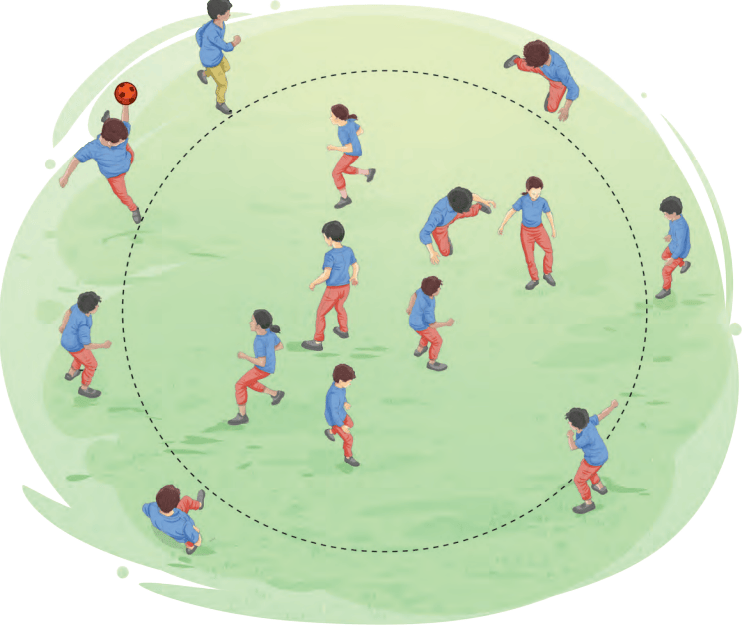
Make two teams. The members of one team
will form a circle by keeping one arm space between
each other. The other team will enter the circle. The goal for
the team that has formed the circle is to tag members of the
other team who are standing inside the circle with the softball,
aiming only below the waist with overhead throws. The
players inside the cirlce can move and dodge within the
circle, but those outside cannot.
Lead-up Activity
Get the Handkerchief: Make two teams i.e., Team A and Team B. Then tie a
handkerchief on the hand of one of the players from Team A. Now players
from Team B will try to take off the handkerchief from the hand of the player.
Whereas, Team A will try to defend their player. The team whose player who
successfully takes off the handkerchief will be declared the winner.
Circle Time – Footwork and Anticipation
Discuss what type of footwork defenders used for dodging the
throwers and how the throwers anticipated the movements of
the defenders.
Dribble and Shoot
| Warm-up | Activity | Cool-down | Circle Time |
|---|---|---|---|
| Leaping and Skipping
Jumps, Hip and Pelvic
Muscle Stretch |
Dribble and
Shoot |
Arm Swinging,
Shoulder Shrug, Hamstring
Stretch, Calf Stretch |
Taking Defeat
Gracefully |
Dribble
and Shoot
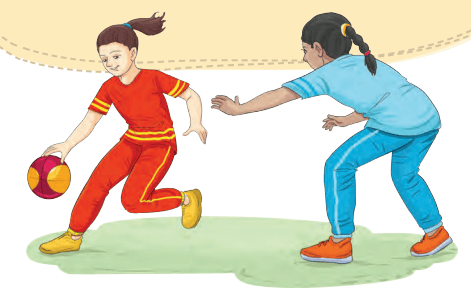
Begin dribbling the ball along the chosen
path towards the goal. As you approach the goal,
select the best technique to goal. After attempting the shot at
the goal, return to the starting place so that the next group of
players can begin their dribbling routine.
Lead-up Activity
Shark Tank: Make two teams. Designate one of the two teams as
‘sharks’ and the other team as ‘the minnows’. The minnows will line up
at one end of the court with the ball. Then they will attempt to dribble
across to the other side of the court and score a goal without getting
their ball stolen by the sharks. If a minnow’s ball is taken or knocked
out of bounds, they will become a shark. The game continues until all
the minnows have been converted into the sharks.
Circle Time – Taking Defeat Gracefully
Prepare a short write-up about how you feel after a defeat.
Did You Know?
Players are not permitted to pull, hit or
punch the ball out of the hands of an
opponent.
Pass and Shoot
| Warm-up | Activity | Cool-down | Circle Time |
|---|---|---|---|
| Sliding and Galloping, Knee
Hug and Quadriceps Stretch |
Pass and
Shoot |
Torso Twist, Calf Stretch,
Quadriceps Stretch |
Reviewing the
Activity |
Pass and Shoot
Make a semicircle of radius 9 metres from
the goalpost. Five players will take the position on this
semicircle. The goalkeeper starts the game by throwing
the ball towards one of the players. That player now has to
decide whether it will be advantageous to goal or should the
ball be passed to another player who has a better angle and
therefore has a better chance of scoring a goal. If the player
attempts a goal and fails then that player will become the
goalkeeper and the game continues.
Lead-up Activity
Play this game in half handball court with five players in each
team— ‘taggers’ and ‘runners’.
The taggers which have possession of the ball cannot move. But
can either take the goal or pass it to another tagger who is in an
advantageous position. One of the taggers will start the game while
the others will run to get better positions for receiving the ball and
tagging the opponents. The one who gets tagged goes out of the
court. This game will end when all the opponents have been tagged
and they are out of the court.
Circle Time – Reviewing the Activity
Make a list of the formations and positions for tagging
the opponents.
Did You Know?
The importance of 3 in handball:
- The Player can run with the ball for maximum three steps.
- The Player can hold the ball for upto 3 seconds.
Shootout
Tournament
| Warm-up | Activity | Cool-down | Circle Time |
|---|---|---|---|
| Sliding and Galloping, Knee
Hug and Quadriceps Stretch |
Pass and
Shoot |
Torso Twist, Calf Stretch,
Quadriceps Stretch |
Reviewing the
Activity |
Shootout
Tournament
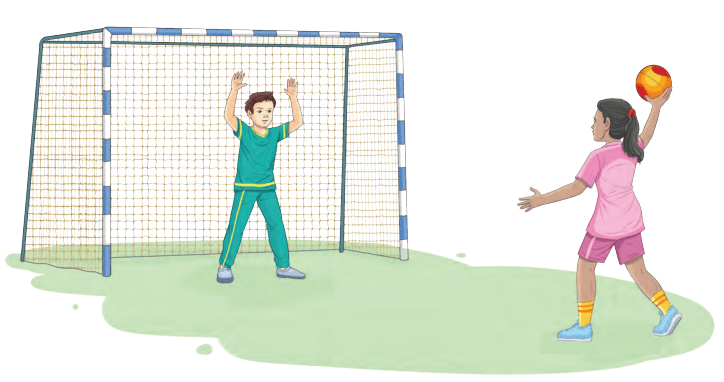
Make two teams. Players will take turns to shoot
goals inside the goalpost by dodging the
goalkeeper. Every successful goal will earn one point
for the team. Rotate players or teams through several
rounds to determine the final champion.
Lead-up Activity
Hit the Target: Players take turns to throw the ball at the corners
of the goalpost. Each player gets three to five throws per round.
Points will be awarded each time a player goals. The player with
the most points at the end of all rounds wins the game.
Circle Time – Anticipation
Elaborate how do you anticipate the movement of a goalkeeper
by looking at their footwork and gesture.
Goalkeeper’s
Defensive Skills
| Warm-up | Activity | Cool-down | Circle Time |
|---|---|---|---|
| Jumping, Squat,
Ankle Stretch |
Goalkeeper’s
Defensive
Skills |
Sit and reach
(Pashchimottanasana), Camel
pose, Pigeon pose |
Anticipating
the Shoot |
Goalkeeper’s
Defensive Skills
Stance
- Stand straight with feet shoulder-width apart.
Bend your knees slightly and take a position at the
centre of the goalpost.
- As you prepare to move fast, maintain your weight on
your feet.
- Hold your arms up so that you can deflect or catch the ball.
- Spread your fingers wider to capture the ball.
Execution
- Observe the shooter’s body language and arm movement
to anticipate the direction of the goal.
- Maintain focus on the ball and be ready to react.
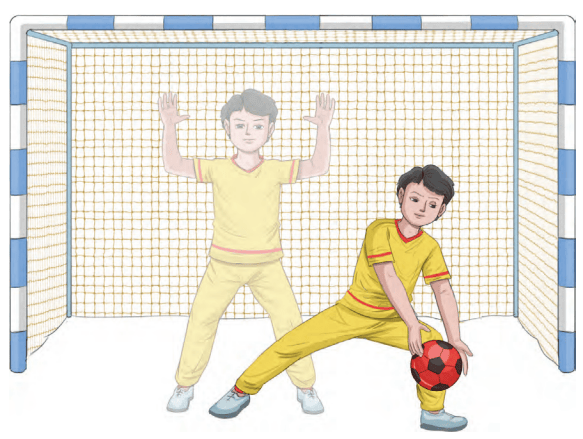
- Move laterally or side to side while
maintaining alignment with the ball, take
short and rapid steps.
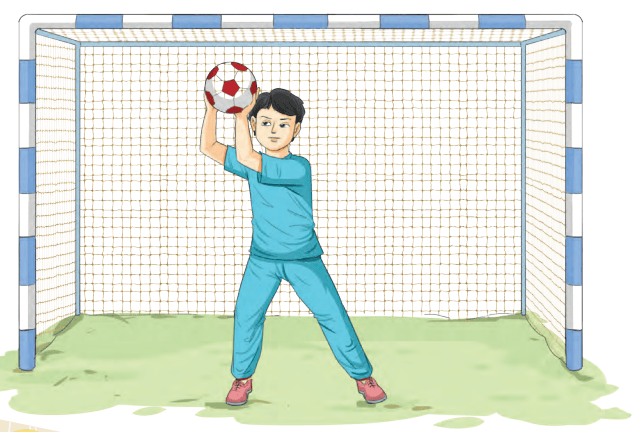
- Maintain your center of gravity and be
prepared to dive or leap in any direction to catch the ball if
required.
- After blocking the ball, absorb the force and prevent the ball
from rebounding.
- Catch the ball fast and secure it or divert it away from
the goal area.
Lead-up Activity
Battle of Balloons: Set up two poles each of 2 metres height at a
distance of 3 metres. Now, tie balloons at the top and bottom of both
the poles. Name the four points of the pole as Right Top (RT), Right
Bottom (RB), Left Top (LT), Left Bottom (LB). Line up students 6 metres
away from the poles. On the sound of the whistle, each student will
run towards the pole and take the position right in the centre of the
poles. The teacher then calls RT, RB, LT and LB randomly and the
player has to do quick movements to touch the balloons either with
their hands or legs. Each player will get ten chances. After finishing
the drill, the player will return to the starting line.
Circle Time – Anticipating the Shoot
Share your experience stating how you anticipated the direction
and speed of the ball from the movements of the shooter.
Blocking
| Warm-up | Activity | Cool-down | Circle Time |
|---|---|---|---|
| Side Walk, Back Walk,
Jogging Drills |
Blocking |
Lower Limbs Rotations,
Reverse and Forward
Lunges, Butterfly pose |
How to block? |
Blocking
Stance
- Goal Side Positioning: Always
position yourself in between the
goal and your opponent.
- Body Position: To make it
easier to move quickly, stand
with your feet shoulder-width
apart, your knees bent and your
weight on your feet.
- Maintain your balance and
be prepared to move in any
direction by taking short and
rapid steps.
Execution
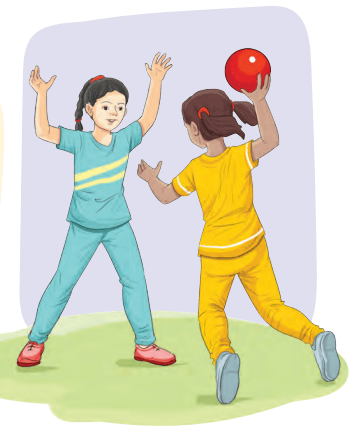
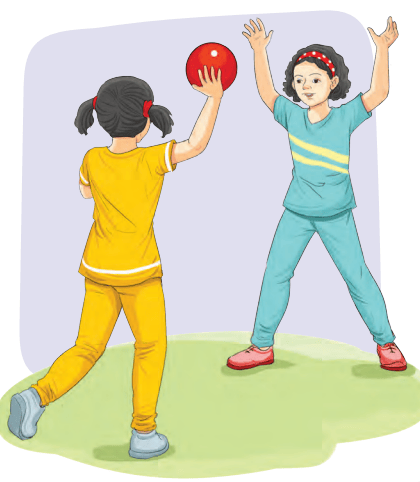
- Prepare to intercept the ball by anticipating your opponent’s passes.
- Raise both your arms to divert the ball and block the shooter’s line of sight.
- To maximise your blocking reach, time your jumps and movement according to the shooter’s ball release.
- To prevent a foul, use your body to block the opponent’s route.
- Remain alert and move quickly to get into the
passing lane.
Lead-up Activity
Rapid Fire: The defender stands in the goal area with multiple
shooters lined up outside. Shooters take turns to goal rapidly from
different angles. The defender attempts to block each goal, focusing
on staying alert and being reactive. Continue for a set time
(1–2 minutes) before replacing the defender.
Circle Time – How to Block?
Discuss how did you anticipate the trajectory of the ball from
the movements of the opponent and decide your hand positions
for blocking the ball.
Did You Know?
Officials have 17 hand signals to communicate
the decisions.
Assimilation
| Warm-up | Activity | Cool-down | Circle Time |
|---|---|---|---|
| Jumping Jacks and Frog
Jump, Chest and Back
Stretch, Quadriceps
Stretch |
Assimilation |
Forward Lunges and
Backward Lunges, Lower
Limb Rotations |
Reviewing the
Activity |
Assimilation
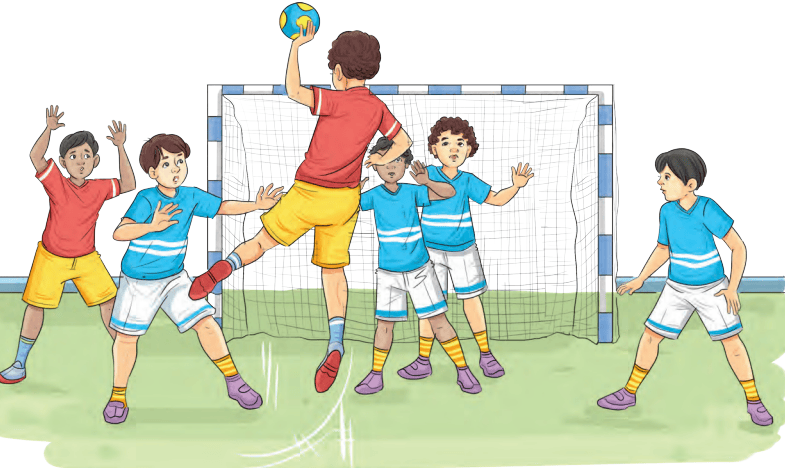
Divide players to form various balanced teams and
prepare the court area for the game. Players play small-sided
games and try to execute all the skills they have learned
in previous classes with rotating teams. The winning team
remains on the court to face further challenges. The teams will
receive points by scoring goals and defending effectively. The
team who scores the most points at the end of the session gets
the title, “King of the Court”.
Lead-up Activity
Obstacle Course, Dribble and Goal: Each player will take turns for
completing the obstacle course while moving the ball around the waist
with their hands. You have to complete the course as quickly as possible
while maintaining control of the ball. After completing the obstacle course,
you will dribble the ball while running and then attempt to score a goal.
It will be continued until everyone gets a chance to score a goal.
Circle Time – Reviewing the Activity
- Write a note about the patterns of play in the opponents’
teams.
- Discuss what helps you to take the defeat gracefully.