UNIT 5
Yoga
Welcome to the world of Yoga for holistic
health and well-being. In this unit, let us
explore the ancient art and science of Yoga –
a practice that originated in India and endured
for thousands of years. Passed down through
generations in India, it is now enjoyed by
people all around the world.
Yoga is a journey of self-discovery to keep our body strong and
mind calm. We will delve into the rich practices of Yoga, exploring
its history, philosophy and practical applications. From the
fundamental principles of healthy living to the intricacies of
different yogic practices, each section offers valuable insights
and practical activities or steps to enhance your understanding
and practice of Yoga.
It is a common misconception that Yoga is simply a form
of physical exercise involving complex breathing techniques,
twists, turns and stretches. In its true sense, Yoga is a profound
science that can unfold the infinite potentials of the human
mind and soul.
Whether you are a beginner seeking to embark on your Yogic
journey or a practitioner looking to deepen your knowledge,
this unit serves as a comprehensive resource to support your
exploration and growth in the realm of Yoga. Let us embark
on this transformative journey, unlocking the secrets of Yoga
and discovering the boundless capabilities that lie within each
of us.
This unit begins with an introduction to Yoga before delving
into a deeper understanding of Yama (social discipline) and
Niyama (personal discipline) and their applications in daily life,
Sūkshṣma Vyāyāma (joint movements), Śithalīkaraṇa vyāyāma
(loosening exercises), Prānāyāma (breathing practices), Āsanas
(postures), Pratyāhāra (mastery over senses), relaxation,
Dhārana (concentration), Dhyāna (meditation) and Krīḍā Yoga
(Yoga games).
Yoga Session Structure
Start each Yoga session with a prayer given below. It is about
the sacred bond between a student and the teacher. Both pray
together to illuminate their paths with divine protection and
nourishment with wisdom. They wish for peace everywhere
and for everyone.
| Opening Prayer
|
ॐ सह नाववतु |
सह नौ भुनक्तु |
सह वीर्यं करवाव है |
तेजस्वि नावधीतमस्तु मा विद्विषाव है |
ॐ शान्तिः शान्तिः शान्तिः || |
Om Saha Nāvavatu |
Saha Nau Bhunaktu |
Saha Viryam Karavāva hai |
Tejasvi- Nāvadhitamastu
Mā Vidvisāva hai |
Om Śāntih Śāntih Śāntih ||
|
Meaning of the Prayer
May we both (Guru and Śiśya) be protected. May we both be
nourished. May we practise with great vigour and energy.
Let our studies be fruitful and enlightening. May we not
hate each other.
|
After opening prayer, conduct the activities as per the session
plan. It includes yogic practices like Yama and Niyama,
Sūkshṣma Vyāyāma, Śithalīkarana Vyāyāma, Āsanas (Postures),
Prānāyāma, Pratyāhāra, Relaxation, Dhārana, Dhyāna and
Krīḍā Yoga.
End each Yoga session with a prayer given below. Closing prayer
helps the students to assimilate the knowledge and reinforce
the day with positively and happiness.
| Opening Prayer
|
ॐ सर्वे भवन्तु सुखिनः |
सर्वे सन्तु निरामयाः |
सर्वे भद्राणि पश्यन्तु |
मा कश्चित दुःख भाग्भवेत |
ॐ शान्तिः शान्तिः शान्तिः ||
|
Om Sarve Bhavantu Sukhinah
Sarve Santu Nirāmayāh |
Sarve Bhadrāni Paśyantu
Mā Kaśhcidduhkhabhagbhāvet |
Om Śāntih Śāntih Śāntih ||
|
Meaning of the Prayer
May all be happy. May all be free from illness. May all
see what is auspicious. May no one suffer. Let there be
peace everywhere.
|
General instruction to begin and end a Yoga session:
- Sit in a comfortable Sukhāsana posture.
- Keep the back straight, eyes closed and face relaxed.
- Place your hands in Cin Mudra and become aware of your
breath.
- Observe your breathing for a few seconds and then take a
deep breath. As you exhale, chant, “Om”.
- Gently place your hands in Namaskāra Mudra and chant
the prayer.
- Observe how you feel after the chanting.
- Gently rub the palms of your hands, cup them and place
them on your eyes.
Chapter 1
Yoga for Daily Life
As students, you have busy schedules filled with classes,
activities, projects and homework. Yoga can help you manage
these activities by keeping your mind clear and focused. It can
also improve physical health, making it easier to participate
in sports and other activities. By incorporating Yoga into your
daily routine, you will find it easier to stay calm and energised
throughout the day.
Yoga helps you to focus and be more aware of your thoughts
and feelings. It helps you get stronger and more flexible. It can
improve your concentration, so you might find it easier to pay
attention in class or while doing homework. Yoga can help you
relax by helping you let go of your worries, especially if you
are feeling stressed about school or other things. Overall, doing
Yoga can make you feel happier and more at ease. Even a few
minutes of Yoga each day can make a big difference. It’s a great
way to take care of your body and mind.
History of Yoga
Yoga's roots can be traced back to the Vedās, the oldest sacred
texts of India. During this time, people practised Yoga to connect
with nature and the divine. Each chapter of the Bhagavad Gīta,
part of the epic Mahabharata, is named after different types of
Yoga, including Karma Yoga (Yoga of action), Bhakti Yoga (Yoga
of devotion), Jnana Yoga (Yoga of wisdom) and Raja Yoga (Yoga
of willpower).
More than 2,000 years ago, Mahārṣi Patanjali compiled the
practices of Yoga in 196 Yoga Sutras. These sutras describe a
step-by-step path to achieve the highest state of bliss (Samādhi)
through systematic practices defined as the eight limbs or
aspects, called Ashtāṅga Yoga. We will learn more about
Ashtāṅga Yoga later in this chapter.
Yoga continued to evolve with new practices and ideas.
Hatha Yoga, which deals with the practical aspects of Yoga, was
developed around 1,500 years ago.
In the 19th and 20th centuries, Yoga masters like Swami
Vivekananda, Paramahamsa Yogananda, Sage Aurobindo and
B.K.S. Iyengar brought Yoga to the rest of the world. Today, Yoga
is practised globally; the International Day of Yoga is celebrated
on 21st June in more than 190 countries.
What is Yoga?
Ancient Indians had discovered that practising Yoga, can lead
one to good health and well-being. Yoga can be defined as the
science of healthy and happy living. It helps us to be peaceful
and efficient in our work, study and other activities and move
towards the full realisation of our potential.
The term Yoga is derived from the Sanskrit word “yuj” which
means “to unite or integrate”. It signifies the union of the body,
mind and inner self. Yoga is about bringing different parts of
yourself to create balance, harmony and a sense of oneness –
both within and with the world around you. It also helps make
the mind still, quiet and free from all distractions.
Yoga involves systematic efforts, not haphazard actions.
Efforts become fruitful only through disciplined actions.
Let’s explore the eight aspects of Ashtāṅga Yoga,
which consists of the systematic processes formulated by
Mahārṣi Patanjali.
These eight aspects are explained below:
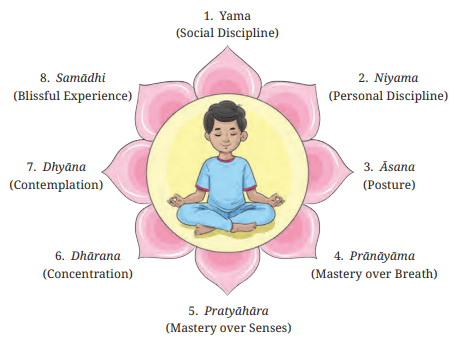
- Yama (Social Discipline and Ethics): These are guidelines
about how to behave towards others, such as being kind
and honest.
- Niyama (Personal Discipline): These are guidelines about
how to take care of yourself, like keeping clean and being
content.
- Āsana (Posture): Performing Yoga postures daily to make
our body strong and flexible.
- Prānāyāma (Mastery over Breath or Breath control): This is
about controlling the breath. You learn to take deep, calm
breaths to ease the body and mind.
- Pratyāhāra (Mastery over the Senses – taste, touch, smell,
sight and hearing): This aspect involves turning your
attention inward, focusing on yourself and not getting
distracted by external elements.
- Dhārana (Concentration): It means keeping the mind steady
and practising single-pointed awareness.
- Dhyāna (Meditation): Dhyāna means deep contemplation
or meditation.
- Samādhi (State of Bliss): This is a state of profound peace and
happiness that comes from practising all the other steps.
This is the ultimate goal of Yoga, where you feel completely
happy and at peace.
Yoga is a lifelong journey. We have to practice it every day.
Let us start our journey with the first two steps – Yama and
Niyama.
Yama
There are five important guidelines for living happily with
others according to Ashtāṅga Yoga; these social disciplines are
called Yama. Yama forms the first limb of Ashtāṅga Yoga. Let’s
find out more about these five Yamas.
- Ahimsa means being kind and not hurting any living being,
including plants and animals.
- Satya refers to always telling the truth and being honest.
- Asteya teaches you to not take things that do not belong to
you.
- Brahmacharya is about using your energy wisely and having
self-control.
- Aparigraha means not being greedy and being happy with
what you have. (We will explore Aparigraha in detail later
in this chapter).
Activity
Identify the most appropriate Yama for the examples given below:
- Treat your pet dog gently, play with him and never hit or scare him.
..............................
- If you break something at home and your mother enquires about it,
you tell the truth and not hide it. ..............................
- You feel a strong urge to play video games, but you also know that
you have to finish your science project. You control the urge to play a
video game and complete the project. ..............................
- During a group discussion in the class, you are tempted to share an
idea of your friend as your idea, but then you decide not to steal it.
..............................
- You like a dress at a shop and the elders with you ask if you want to
buy it. Thinking of all the clothes you have at home, you decide not to
get one more dress because you do not need it now. ..............................
Aparigraha
Aparigraha is about letting go of wanting
more and more and being grateful for
what you already have. It helps you to
live a simple life and to be generous with
others.
Let us learn about Aparigraha through
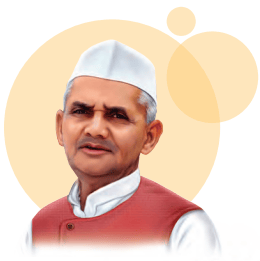
an inspiring story of Lal Bahadur Shastri,
who served as the second prime minister
of India.
Simple living and great
thinking
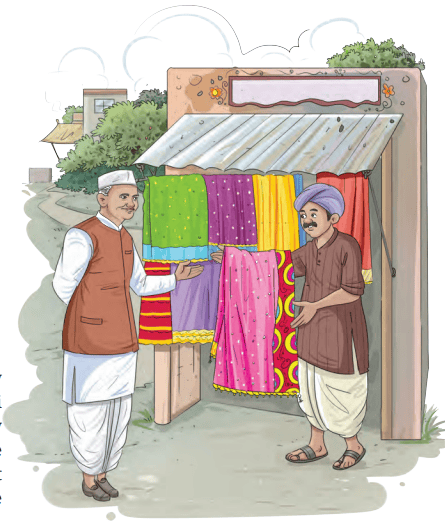
Once when Lal Bahadur
Shastri was the Prime
Minister of India, he went
to a fabric shop to buy
a saree for his wife. The
shop's owner showed him
some lovely sarees, but
when Shastri asked for the
price, he found them to be
too expensive. He asked the
shop to see less expensive
sarees but still found them
too costly.
The shop owner was very
surprised. He said, “Shastri
ji, you don’t need to worry
about the price. You are the
Prime Minister of India! It
would be my honour to give
you these sarees as a gift.”
Shastri smiled and said, “I appreciate your kindness, but I
cannot accept gifts just because I am the prime minister. I will
only buy a saree that fits my budget.” Shastri was content with.
Note for the Teacher
- Help students in identifying role models from their locality and help them
create questionnaires for the interview.
- Discuss with the students their needs and wants and how to avoid greed to
remain peaceful and happy.
whatever he could afford and not think of possessing beyond
the need.
Aparigraha is to be humble and to be content with what
we have. Let us become like Lal Bahadur Shastri by not being
greedy and possess things beyond our needs.
Activity
- Identify a person in your family or neighborhood who is leading
a simple life.
- Ask them why they chose to live a simple lifestyle and what experiences
they have had as a result of their decision.
- Tell your class about your discussion with the person and listen to their
experiences as well
Activity
- Ask students to bring a fairly new small item, which they like but don’t use
often (a book, a toy, etc).
- Sit in a circle and let each student talk about the item they have brought.
- Encourage them to give away the item to one of their friends or to
the needy.
- Children will experience the joy of giving and practice of letting go
of possessions.
Niyama
The second aspect of Ashṭāṅga Yoga is Niyama, which consists
of five important guidelines or habits for personal discipline.
Let us find out more about these five Niyamas.
- Śauca means keeping our body, mind and surroundings
clean. It is about hygiene and purity of mind and body.
- Santosha deals with being happy and content with what we
have and not being greedy.
- Tapas means having self-discipline and determination to
achieve our goals, even if they are difficult.
- Svādhyāya refers to self-study and improving
our knowledge.
5. Īśvara Pranidhāna talks about trusting in
something bigger than yourself.
Activity
Identify the most appropriate Niyama from the examples given below:
- Set a personal goal for a week, such as completing a project,
exercising every day, or helping at home. Track your progress with
each goal. .........................................
- Read good books every day or writing a reflective diary.
.........................................
- Clean up and decorate the classroom. .........................................
- Show gratitude. .........................................
- Do your best and trust that things will work out as they should.
.........................................
Let us explore Tapas through an inspiring story
Tapas
Tapas, one of the five Niyamas, means self-discipline,
determination and perseverance.
Imagine you have a big test coming up and instead of waiting
until the last minute, you decide to study a little bit each day.
This steady and consistent effort is called Tapas.
It’s like training for a sports event, practising an instrument, or
helping with chores at home — doing things regularly, even when
you don’t feel like it. Tapas teaches that hard work and dedication
can help us to achieve our goals and improve ourselves. By
practising Tapas, we learn the importance of commitment and
how small consistent actions can lead to big results.
Tapas in our life:
Dedication towards studies, self-discipline, regular exercise
for good health, always eating nutritious food, keeping things
clean, always speaking the truth, daily practice of Yoga, etc.
We see many great people around us, their success is inspiring
us to set high goals in our lives. Have you heard about the Tapas of
these great people? Let us read the inspiring story of Malli Mastan
Babu-India’s mountain man to understand the power of Tapas.
Malli Mastan Babu’s Determination
Malli Mastan Babu was born in a small village in Andhra Pradesh
and his father was a farmer. A bright student and eager to learn
about new things, Babu studied very hard and went to some
of the best schools in India. He got degrees in engineering and
management.
During the course of his studies, Babu developed a keen
interest in mountaineering. Inspired by the challenge and
beauty of the mountains, he decided to pursue this passion
alongside his professional career. He trained hard, learning
everything about climbing. He practiced yoga to build physical
strength, flexibility and stay mentally focused, all of which
helped in his challenging climbs. His dedication to physical
fitness, including yoga, was a significant part of his success in
achieving numerous expeditions.
His approach to mountaineering was driven by an unwavering
passion and dedication. He believed in pushing his limits and
embraced the challenges that came with high-altitude climbing.
Through his climbs, he aimed to inspire others to follow their dreams
and overcome obstacles, no matter how difficult they might seem.
Babu, whenever on expedition, would plan every last detail.
He would start early in the day, carry his own load and walk at a
steady clip throughout the day. During his expedition he used to
pitch his own tent, cook his own food and fine-tune the next day’s
plan with his guide.
Babu’s record-breaking achievement was that he completed
climbing seven highest peaks in seven continents in 172 days.
With this, Babu set a new benchmark of physical and mental
endurance and excellence. He became the first Indian and
South Asian to achieve this record, earning him international
recognition and admiration.
Even though he is no longer with us, his story is one of
extraordinary courage, determination and passion. His life
reminds us to dream big, work hard and always do our best.
He remains an enduring inspiration to those who dare to push
their boundaries and reach for the skies.
Activity
- Narrate a story of your role model in the class.
- Discuss the common themes in all the stories told.
- Think and discuss why it is important to have goal in life.
- Write about a time when they worked hard to achieve something. What
did they learn from the experience and how did they feel after achieving
the goal?
Note for the Teacher
- Discuss with the students how great achievers like scientists, administrators,
national awardees, athletes, etc., could reach their goals with determination
and consistent effort.
Activity
- 1. Setting Goals: Each student writes down one goal they want to achieve,
such as reading for 20 minutes every day, practising a sport, or helping
with chores.
- Plan: Write down the steps to achieve this goal.
- Tracking Progress: Make a simple chart to track daily progress.
- Reflection: At the end of the week, discuss what you have learned about
self-discipline and how it felt to work towards achieving the goal.
Pratyāhāra
Pratyāhāra, the fifth aspect of Ashtāṅga Yoga, is all about
learning to control your senses and focus your mind.
Imagine you are in a noisy room, but you need to concentrate
on your homework. Pratyāhāra means to restrain or to
withdraw, not to get disturbed by things that one sees, hears,
smells, tastes or feels.
Pratyāhāra helps you ignore the noise and focus on what
you're doing by tuning out distractions.
By practising this you learn to turn your attention inward,
away from the things around you and become more aware of
your thoughts and feelings.
We sense the world around us through five senses; to focus
on the desired activity and avoid distractions, we need to master
these senses by practices.
Let’s look at some activities which will help us in turning senses
inwards.
- Quiet time: Find a comfortable place to sit quietly without
any distractions (no TV, mobile phone, or loud noises). Close
your eyes and focus on your breathing.
- Mindful eating: Turn off the TV and put away gadgets
during meals. Focus on the taste, texture and smell of the
food. Chew slowly and enjoy each bite.
- Tune with nature: Go for a walk in a park or garden. Observe
the sights, sounds and smells around you without getting
lost in thoughts or using electronic devices.
- Listening to music: Choose some soothing music, sit quietly
and listen to the sounds without doing anything else.
- Before going to bed: Spend a few minutes sitting quietly.
Close your eyes gently and focus on your breath. Avoid
using electronic devices at least 30 minutes before bedtime,
instead try to read a book.
These activities will help you to enhance your ability to focus,
reduce stress and connect more deeply with yourselves and
your surroundings.
Food plays a very important role in the development of our
personality. Further, we should consume healthy food according
to the season and in moderate quantity. So, it is necessary to
develop healthy food habits as per Ayurveda (ancient Indian
medical science).
Did You Know?
Healthy food habits as per Ayurveda.
Hitabhuk —
Consume healthy
and nourishing
food. |
Mitabhuk — Eat in
moderate
quantity. |
Ritabhuk —
Consume
food
according
to the
season. |
ACTIVITY
- Eat at least one homemade meal a day with your family.
- While eating, ensure that you taste every little bite and every morsel.
- Do not use electronic gadgets like your mobile phone and TV while eating.
- Volunteer to serve food and water to your family members.
Chapter 2
Preparing for Yogic Practices
Namaste Young Yogis!
Are you ready to embark on a journey with the Yogic practices?
In the previous chapter, you learnt about Yama and Niyama.
Here let us explore Āsanas, Prānāyāma, Pratyāhāra. Dhārana
and Dhyāna. We will also learn about some other aspects of
Yoga, like Krīḍā Yoga in the following chapters, starting with
preparatory practices.
Learn these practices under the guidance of your teacher
in the school and master them by performing daily at home.
Regular practice (sadhana) makes us strong, flexible and calm. It
helps us feel peaceful and concentrate better on our homework,
during play and in everything we do.
So, let’s roll out our Yoga mats, take a deep breath and start
this amazing adventure together!
Remember, Yoga is about feeling good; it is important to pay
attention to how your body feels during the practice. Never
push yourself into a pose that causes pain or discomfort.
Before we start Āsanas and Prānāyāma, it is important
to prepare ourselves by doing breathing practices, loosening the
joints (Sūkshma Vyāyāma) and flexing the spine (Śithalīkarana
Vyāyāma).
General guidelines to be followed before practising all yogic
practices.
- . Do not force yourself to breathe deeply or to hold your
breath while doing the Āsanas. Breathe normally while
doing the Āsanas. Always breathe through the nose.
- Always be alert, attentive and watchful when you practice.
Concentrate on your pose. Watch your teachers carefully
and pay attention to their instructions.
- Do not wear shoes or socks while doing the Āsanas.
- Whenever you are feeling ill or sick, you must rest. If you
have a cold, cough, headache, stomach ache, sprained ankle
etc., consult your teacher and seek their guidance.
- Especially for girls, when you have your menstrual period,
inform or consult your teacher before the practice.
Breathing Practices
Before learning Prānāyāma, it is necessary to improve the
function of the lungs. For healthy lungs, it is necessary to
practice proper breathing.
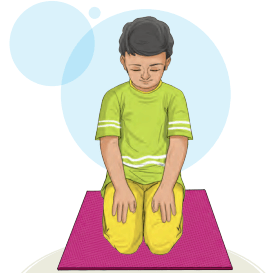
Let us learn about Rabbit and Dog breathing. Rabbit breathing
focuses on deep, rhythmic breaths that mimic the breathing
pattern of a rabbit. Dog breathing involves mimicking the rapid,
shallow breathing of a dog, which can help to release heat from
the body and improve breath control.
Breathing practices enhance lung capacity, improve respiratory
efficiency, promote relaxation and reduce stress.
Limitations: people suffering from epilepsy should
avoid this practice.
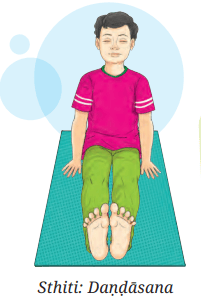
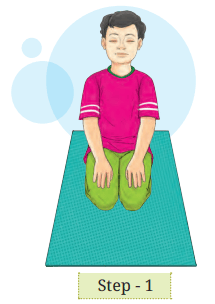
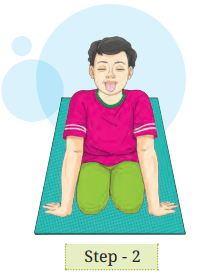
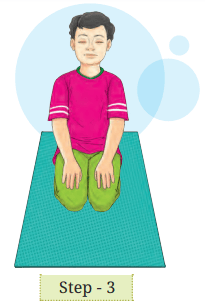
Rabbit Breathing
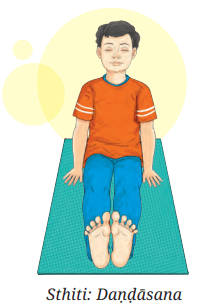
Sthiti Daṇḍāsana
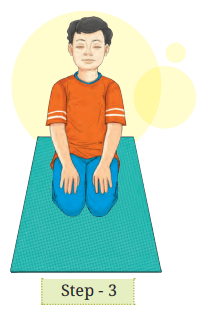
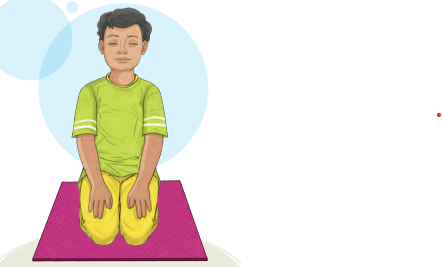
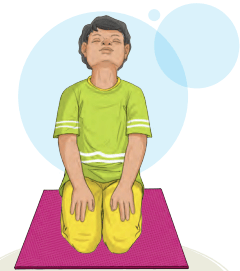
Step 1: Come to Vajrāsana by folding the right leg and the left leg.
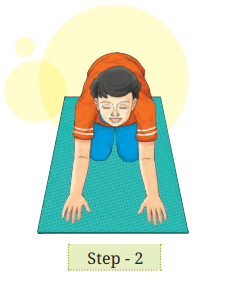
Step 2: Bend down and keep
the hands in front of
the knees such that the
elbows touch the knees.
Keep the hands parallel to
each other, palms facing
down. Abdomen gently
resting on the thighs, pull
out the tongue halfway
and breathe in and out
as fast as possible (10 to
30 rounds).
Step 3: After the practice, slowly
return to Vajrāsana.
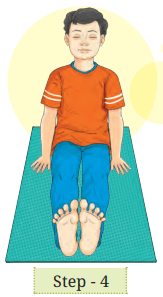
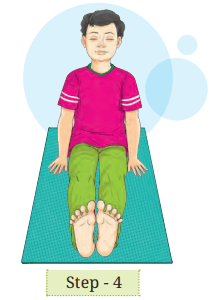
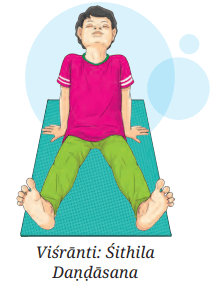
Step 4: Release the right leg and
the left leg and come
to Daṇḍāsana.
Relax in Śithila Daṇḍāsana.
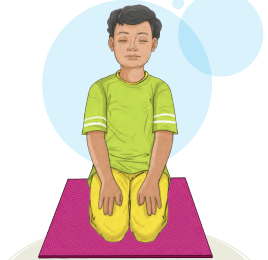
Dog Breathing
Sthiti: Daṇḍāsana
Step 1: Come to Vajrāsana by
folding the right leg and
the left leg.
Step 2: Place the palms by the
side of the knee with
fingers pointed backward
and stretch out the
tongue completely. Let the
inhalation and exhalation
be fast and vigorous
so that the abdomen
bulges and contracts.
Beginners can practice 10
to 20 rounds initially and
gradually increase it to
50 rounds.
Step 3: After the practice, slowly
return to Vajrāsana.
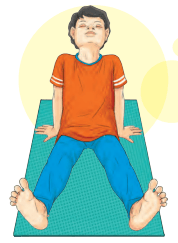
Step 4: Release the right leg and
the left leg and come
to Daṇḍāsana.
Relax in Śithila Daṇḍāsana
Note for the Teacher
- Discuss with the students, how
they felt after the practice.
- Ask them whether they
can concentrate on breath
while practising.
Sūkshma Vyāyāma
Sūkshma Vyāyāma is a series of subtle exercises designed to
loosen (release tension) the joints and improve flexibility. The
term “Sūkshma Vyāyāma” comes from Sanskrit, where “Sūkshma”
means “subtle” or “micro” and “Vyāyāma” means “exercise” or
“movement”. These exercises are gentle, easy to perform and
can be practised by people of all ages and fitness levels.
The exercises involve small, subtle movements that focus on
different parts of the body. These movements help to increase
circulation, improve joint mobility and release muscular
tension. The subtle movements enhance blood flow to various
parts of the body, promoting better circulation and oxygenation
of tissues.
Each movement is synchronised with the breath, enhancing
the flow of Prānā (vital energy) throughout the body.
The simplicity of Sūkshma Vyāyāma makes it accessible to
everyone, including the elderly, those with limited mobility or
beginners new to Yoga. These exercises can be performed while
sitting or standing.
Sūkshma Vyāyāma includes neck exercises, shoulder
rotations, finger and wrist movements knee movements, ankle
and foot exercises, etc.
Let’s practice Sūkshma Vyāyāma for the neck.
Neck Movements (Greevasanchālana)
This set of neck exercises increases the strength and flexibility
of neck joints and muscles.
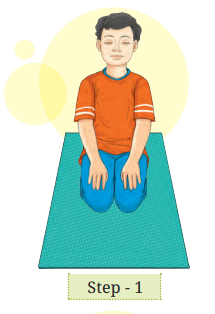
1. Up and down movement
Sit in Vajrāsana, adopt chin
mudra and place hands on
the thighs.
Sthithi
While inhaling,
bend the neck
backward.
Step - 1
While exhaling, bend the neck
downward, such that chin
touches the chest.
Step - 2
Come back to Sthithi
after the practice
Sthithi
2. Left and right movement
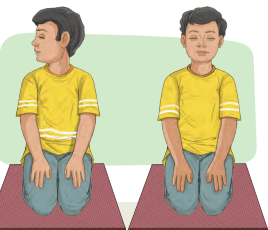
While exhaling, turn the head
to the right and inhale come to
the centre.
Step - 3
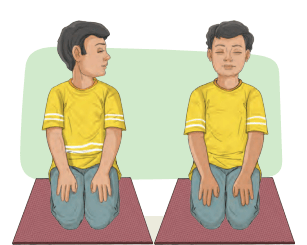
While exhaling, turn the head
to the left and inhale come to
the centre.
Step - 4
3. Side bending of the neck
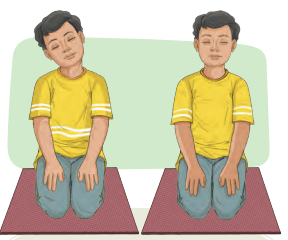
While exhaling, turn the head
to the right and inhale come to
the centre.
Step - 5
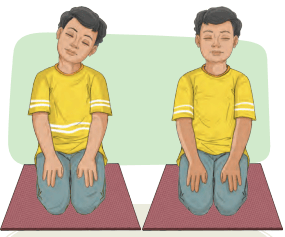
While exhaling, turn the head
to the left and inhale come to
the centre.
Step - 6
4. Rotate the neck clockwise and anti-clockwise
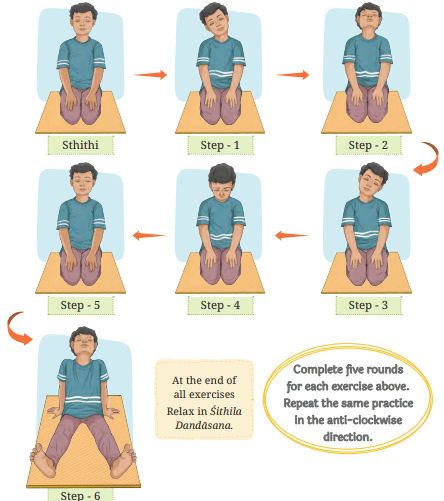
At the end of
all exercises
Relax in Śithila
Dandāsana
Complete five rounds
for each exercise above.
Repeat the same practice
in the anti-clockwise
direction.
Note for the Teacher
Ensure that students keep their spine erect during the practice.
Check in to see if they were comfortable doing the practice.
This practice is to be avoided in case of any neck injury
Śithalīkarana Vyāyāma (Dynamic Practices)
Śithalīkarana Vyāyāma refers to a set of loosening exercises
that prepare the body for more intense Yoga practices.
Śithalīkarana Vyāyāma is designed to warm up the body,
flex the spine by repeatedly stretching and relaxing different
muscles. It also improves joint mobility and enhance circulation.
These are often used at the beginning of a Yoga session to ensure
that the spine and large muscles are adequately prepared for
the Āsanas
Śithalīkarana Vyāyāma or dynamic practices:
- Jogging in Place: Various forms of jogging (slow, backward,
forward and side) to elevates heart rate and warm up
the body.
- Bending forward, backward and sideways: Improves
mobility and flexibility of the waist region.
- Leg swings and rotations: Movements to enhance mobility
in the lower body.
- Spinal twists: Gentle twists to stretch and relax the spine.
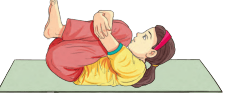
In this grade let’s practice Pavanamuktāsana Kriya to keep
our spine healthy. It is practiced with one leg and both leg
movements.
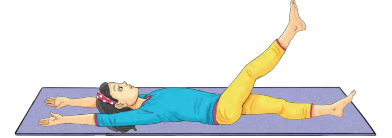
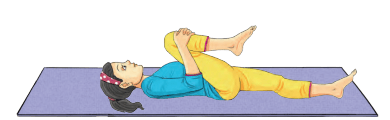
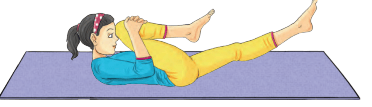
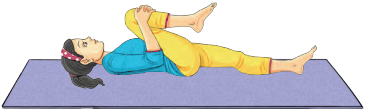
- Ekapāda Pavanamuktāsana Kriya (single leg)
- Dvi Pāda Pavana Muktāsana Kriya (both legs)
Ekapāda Pavanamuktāsana Kriya (single leg)
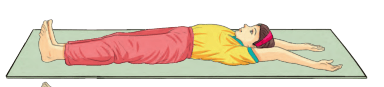
Sthiti: Supine posture
Step - 1
Step - 2
Step - 3
Step - 4
Step - 5
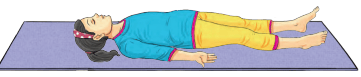
Viśrānti:
Śavāsana
Come to Sthiti: Supine posture
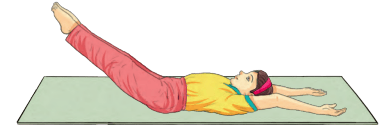
Step 1: While inhaling, raise the right leg at a 45° angle.
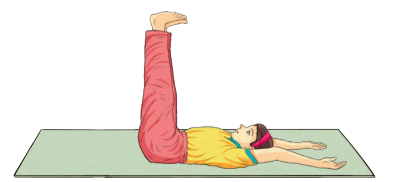
Step 2: Further, inhale and raise the right leg at a 90° angle.
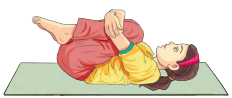
Step 3: While exhaling, bend the right leg at the knee, inhaling interlock both the hands around the right knee and pull it back.
Step 4: While exhaling, raise the head and touch the chin or head to
the knee and simultaneously rise the left leg.
Step 5: Rotate the right leg clockwise and anti-clockwise for five rounds each.
Release the legs and relax in Śavāsana.
Repeat the
practice with the
left leg.
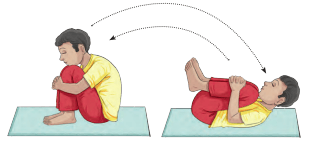
Dvi Pāda Pavana Muktāsana Kriya
This kriya includes following actions:
Preparation steps for kriya
1. Kriya Practice:
a. Rock and Roll
b. Left and Right movement
c. Rotation
2. Steps to release the legs after practice
Sthiti: Supine posture
Step - 1
Step - 2
Step-3
Step-4
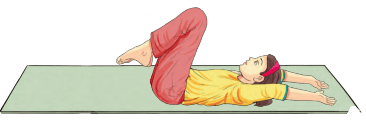
Come to Sthiti: Supine posture
Step 1: While inhaling, raise both the legs at a 45° angle.
Step 2: Further, inhale and raise both the legs at a 90° angle.
Step 3: While exhaling, bend both the legs at the knee and while
inhaling interlock both the hands around the knees and
pull them back.
Step 4: While exhaling, raise the head and touch the chin or head
to the knee.
1. Let us perform the Kriya practice
a. Rock and Roll
Roll forward and backward for five rounds.
Note
While rolling back, inhale and while rolling forward, exhale. If possible, try to get up on your feet when rolling forward.
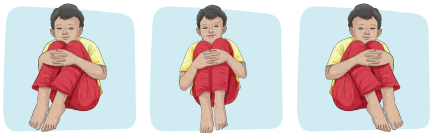
b. Left and right
While exhaling,
slowly move the body
to the left side.
While inhaling, come
to the centre.
While exhaling, slowly
move the body to the
Right side.
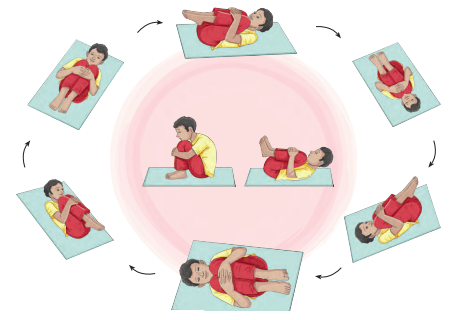
c. Rotation
Start rotating the body clockwise and anti-clockwise direction for
five rounds and come to the centre.
2. Follow the below steps to release the legs after the practice
and come back to Śavāsana
Step - 5
Step - 6
Step - 7
Step - 8
Viśrānti:
Śavāsana
Come to Sthiti: Supine posture
Step 5: While inhaling, release the hands.
Step 6: Inhaling further, stretch the legs at a 90° angle.
Step 7: While exhaling, bring the leg at a 45° angle.
Step 8: Exhaling some more, place your legs back on the mat.
Relax in Śavāsana.
Benefits
1. Regular practice of Pavanamuktāsana can reduce abdominal fat.
2. It releases gas accumulated in the digestive tract and improves
digestion.
3. It increases appetite and assimilation of food.
4. It prevents constipation.
Note for the Teacher
• Ensure that students perform practice with ease and take time to relax the body
after the practice.
• Ask the students to observe the changes in their breathing after the practice
Sūrya Namaskāra
Sūrya Namaskāra is a series of 12 powerful Yoga poses performed in a
sequence. This practice is traditionally done in the morning to greet the sun
and energise the body for the day ahead. Sūrya Namaskāra combines Āsana
(postures), Prānāyāma (breath awareness) and chanting of mantrās, making
it a comprehensive workout for the body and mind. It serves as an excellent
warm-up for more advanced Yoga practices or as a standalone routine for
maintaining overall health and well-being. Now let us learn the various preparatory techniques of Sūrya
Namaskāra practice.
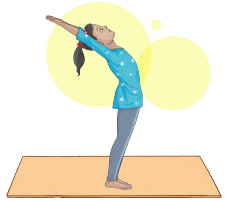
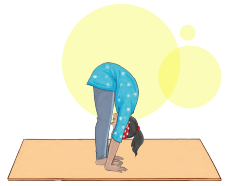
1. Ardhacakrāsana to Pādahastāsana
While inhaling come
to Ardhacakrāsana
While exhaling come
to Pādahastāsana
2. Pādahastāsana to Aśvasañcalanāsana (Alternate the
practice with right and left leg)
While inhaling, come
to Pādahastāsana
While exhaling, come
to Aśvasañcalanāsana
3. Daṇḍāsana to Śaśāṅkāsana
While inhaling, come
to Daṇḍāsana
While exhaling, come
to Śaśāṅkāsana
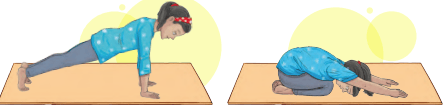
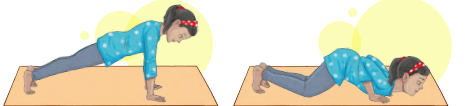
4. Daṇḍāsana to Sāṣṭāṅga Namaskāra
While inhaling come to
Daṇḍāsana
While exhaling come to
Sāshtāṅga
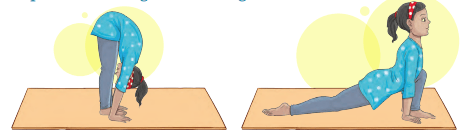
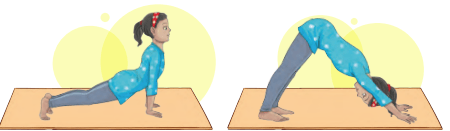
5. Ūrdhvamukha Śvānāsana to Adhomukha Śvānāsana
While inhaling, come to
Ūrdhvamukha Śvānāsana
While exhaling, come to
Adhomukha Śvānāsana
Do each practice for five rounds.
Benefits
- Sūrya Namaskāra strengthens the muscles, improves flexibility
and enhances cardiovascular health.
- It stimulates the digestive system, improving digestion
and metabolism.
- Sūrya Namaskāra, along with mindful breathing, helps reduce
stress and anxiety, promoting mental clarity and focus.
Note for the Teacher
- While students practice the techniques, ensure that they avoid jerky movements.
- Breathing should be steady and rhythmic.
Chapter 3
Āsanas
Āsana, the third limb of Ashtāṅga Yoga, are specialised postures of
the body, which help our body to be flexible, strong, balanced and
disease-free. Mahārṣi Patanjali defines Āsana as “Sthirm Sukham
Āsanam” which, meaning to be “able to be in a comfortable
position for extended periods.” When Āsanas are combined with
breath awareness, they cultivate a deeper connection between
the body and mind. They also remove physical discomfort and
prepare individuals for meditation.
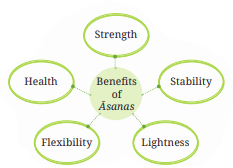
There are several benefits of practising Āsanas every day, some
of which are listed below:
- Strength and flexibility:
Regular practice of
Āsanas increases muscle
strength, flexibility and
balance. Different poses
target various muscle
groups, enhancing
overall physical fitness.
- Improved functioning of
internal systems: Āsanas
improve blood flow and oxygen delivery to all parts of the
body. Many poses stimulate internal organs and glands,
thus improving digestion and metabolic functions.
- . Concentration and relaxation: Practising Āsanas helps to
calm the mind and reduce stress by focusing on the breath
and the body.
- Mind-body connection: Āsanas create a harmonious connection
between the body and mind, which is essential for spiritual growth
and self-awareness.
Are you ready to continue your Yogic journey? Loosen the joints, flex
the spine and prepare the mind to perform standing, sitting, prone and
supine Āsanas.
Guidelines for the Practice of Āsanas
- Yoga practice should be done in clean and well-ventilated place.
- Always use a mat for practice.
- Āsanas should always be performed empty stomach. Avoid the practice of Āsanas for at least four hours after having food. Best is in the morning before going to school.
- Spectacles, wrist watches and jewellery should be removed before doing the practice.
- Wear loose and comfortable clothes.
- Follow the steps given for each Āsanas and maintain each posture with closed eyes if possible.
- Keep the body relaxed and be aware of your breathing while practising.
- If you have any health problems, inform your teacher before starting Yogic practices.
- Relax after performing the Āsanas.
- Perform all Āsanas under the guidance of a teacher
In this grade we shall learn following Āsanas:
- Standing – Ardhakaṭicakrāsana
- Sitting – Padmāsana
- Prone – Bhujaṅgāsana and Shalabhāsana
- Supine – Uttanapadāsana
Perform each Āsana under the guidance of the teacher
and according to the steps provided.
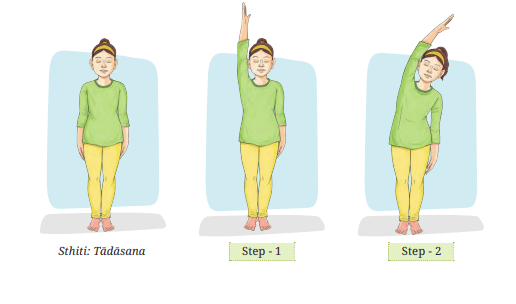
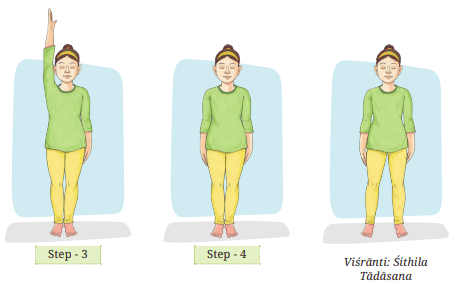
Ardhakaṭicakrāsana: Lateral arc posture
(lateral bending)
Come to Sthiti Tādāsana.
Step 1: While inhaling, raise the right hand up at a 180° angle. Let
the right bicep touch the right ear, with the palm facing the
left side. Inhale and stretch up further. Feel the stretch from
the toes to the fingers.
Step 2: While exhaling, laterally bend towards the left side at the
trunk region. Feel the stretch from the toes to the fingers.
Feel the compression on the left side and the extension on
the right. Stay in this posture for a few minutes with ease
and pleasure.
Step 3: While inhaling, bring the right hand back at a 180° angle.
Inhale and stretch up further.
Step 4: While exhaling, release the hand down.
Relax in Śithila Tādāsana
Repeat the Āsana on the left side.
Benefits
1. Ardhakaṭicakrāsana helps to reduces the fat around waist
region, provides lateral bending to the spine and improves the
liver function.
2. The practice helps keeping the spine flexible and healthy. It also
strengthens the legs, knees, thighs and calf muscles.
Limitations: This Āsana 7
has no limitations
Note for the Teacher
Ensure students do not bend forward or backward, but bend laterally
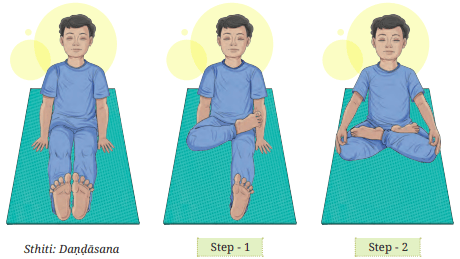
Padmāsana – Lotus Posture
Come to Stithi Daṇḍāsana
Step 1: While inhaling, fold the right leg and keep it on the root of
the left thigh.
Step 2: While exhaling, fold the left leg and keep it on the root of
the right thigh. Adopt Cin Mudra in both the hands and
place it on the thighs. Keep the back erect, neck free and
face smiling. Close the eyes and stay in this posture for
a few minutes with ease and pleasure.
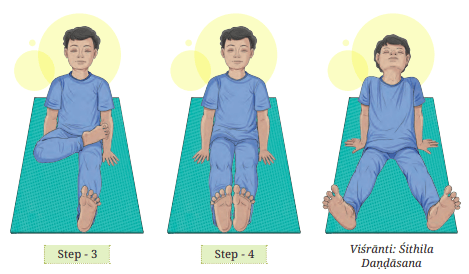
Step 3: While inhaling unfold the left leg.
Step 4: While exhaling, unfold the right leg and come to Daṇḍāsana.
Relax in Śithila Daṇḍāsana
Repeat the Āsana with the left leg.
Benefits
1. Padmāsana is called ‘the destroyer of disease’ and good
meditative posture.
2. It stimulates the nerves in the lower back and increases the flow
of blood to them.
Limitations: Students with knee and ankle joint pain should
avoid this practice.
Note for the Teacher
• Ensure students sit with the spine erect.
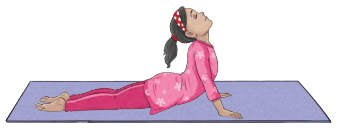
Bhujaṅgāsana – Serpent Posture
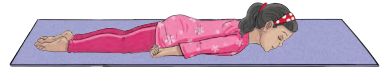
Sthiti:
Prome posture
Step - 1
Step - 2
Step - 3
Step - 4
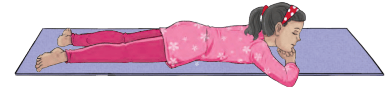
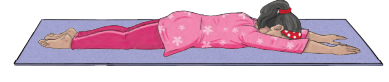
Viśrānti:
Makarāsana
Come to Stithi Prone posture
Step 1: Keep the hands by the side of the chest, with the palms facing
down and chin on the ground.
Step 2: While inhaling, raise the body till the hands are straight. Keep
your eyes closed. Stay in this posture for a few minutes.
Step 3: While exhaling, slowly come down and place the forehead on
the ground.
Step 4: Move both hands above the head, with palms facing down.
Rest your forehead on the ground and keep your eyes
gently closed.
Relax in Makarāsana.
Benefits
- Bhujaṅgāsana brings flexibility to the spine and strengthens the
spinal muscles.
- It reduces the abdominal fat
- It is useful for respiratory disorders
Limitations:Students who have undergone recent abdominal
surgery may avoid this practice.
Note for the Teacher
- Ensure the students keep the palms by the sides of the chest and don’t spread the elbows.
- Body below the navel to be in touch with the ground.
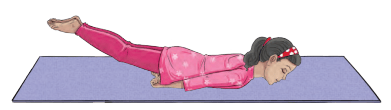
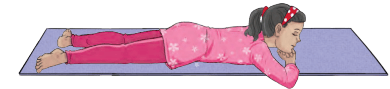
Shalabhāsana – Locust Posture
Sthiti:
Prone posture
Step - 1
Step - 2
Step - 3
Step - 4
Viśrānti:
Makarāsana
Come to Stithi Prone posture
Step 1: Make a fists with both hands and place them below the thighs. Then place your chin on the ground.
Step 2: While inhaling, raise both legs without bending the knees.
Stay in this posture with your eyes closed for a few minutes.
Step 3: While exhaling, slowly place the legs on the ground.
Step 4: Raise both the hands above the head. Palms facing down.
Forehead on the ground. Eyes gently closed.
Relax in Makarāsana
Benefits
- Shalabhāsana helps in keeping the spine healthy and flexible.
- It strengthens the hips, thighs, knees and calf muscles.
- It enhances the functioning of the kidney
Limitations: Students with heart conditions and
diabetes can avoid this practice.
Note for the Teacher
• Ensure students are careful while performing this in case of lower back pain.
• Ask whether the students are able to maintain the final posture without
any discomfort.
• Ask them to observe their breathing during the practice
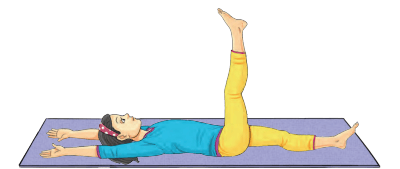
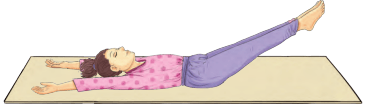
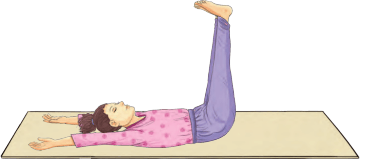
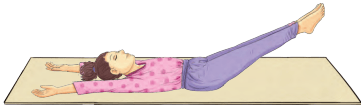
Uttanapadāsana – Raised Leg Posture
Sthiti: Supine posture
Step - 1
Step - 2
Step -3
Step - 4
Viśrānti:
Śavāsana
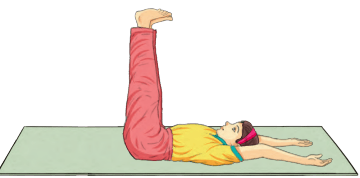
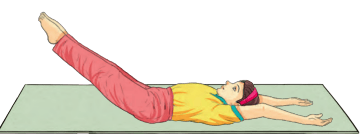
Come to Stithi Supine posture
Step 1: While inhaling, raise both the legs at a 45° angle.
Step 2: Inhaling further, raise both the legs to at a 90° angle.
Maintain the posture for as long as you can, breathe
normally.
Step 3: While exhaling, slowly bring both legs at a 45° angle.
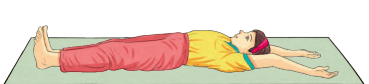
Step 4: Exhaling further, place both the legs on to the mat.
Relax in Śavāsana.
- Uttanapadāsana brings flexibility to the spine and strengthens
the spinal muscles.
- It reduces the abdominal fat.

Limitations: Students with lower back pain should
avoid this practice.
Note for the Teacher
- Ensure the students keep the legs straight, without bending the knees.
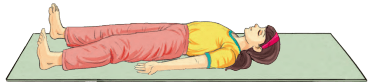
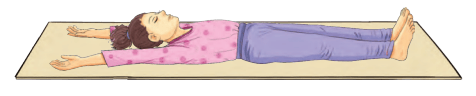
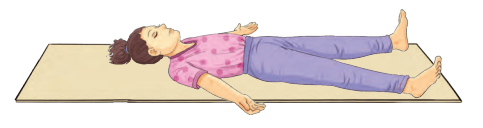
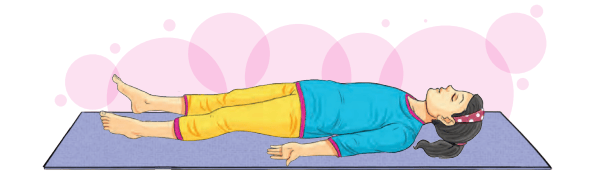
Relaxation – Quick Technique
After performing Āsana, it is advisable to perform relaxation.
This helps in releasing any tension in the body and calms down
the mind
Lie on your back with legs apart, hands apart and palms facing
the roof. Release the whole body and relax.
Observation of abdominal movements
Observe the rise and fall of the abdomen as you breathe.
Observe for five rounds.
Synchronise breathing with abdominal movements
Slow down the breathing and synchronise it with abdominal
movements.
While inhaling, the abdomen rises up and while exhaling, take
over sinks.
Each inhalation and exhalation together form one round.
Observe for five rounds.
Observation of feelings
While inhaling, feel the body becoming light and energetic.
While exhaling, feel the body collapsed and relaxed. Observe
for five rounds.
Chapter 4
Prānāyāma
One of the most essential signs of life is breath. It has to function
continuously for us to be alive. The quality of breath has a
profound impact on the quality of our lives. In Yoga, breath
is called manifestation of ‘Prāna’ (life force) and ‘Ayāma’ is
control and expansion of this life force – breath. There are three
important practices in Prānāyāma.
- Inhalation of breath (Puraka)
- Exhalation of breath (Rechaka)
- Retention of breath (Kumbhaka)
There are several Prānāyāma techniques (breathing
practices) to strengthen the life force. It impacts the smooth
functioning of major systems of our body (digestive, circulatory,
respiratory, excretory and nervous systems), calm down the
mind, improve concentration and helps in achieving overall
harmony and well-being.
Prānāyāma starts with breathing practices to develop healthy
habits of deep and rhythmic breathing and being aware of the
breath. Prānāyāma stimulates, calms down and balances the
energy channels promoting calmness and clarity.
Techniques like Bhrāmarī soothe the nervous system and
reduce anxiety. There are several other techniques to increase
the oxygen supply, energise the body and exercise the lungs.
Now, we will learn about:
- Sectional Breathing
- Nādīśuddhi Prānāyāma
- Bhrāmarī Prānāyāma
Perform these techniques under the guidance of the teacher
and follow the instructions given below.
Guidelines for the practice of Prānāyāma:
- Breathing in Prānāyāma should be done through the nose
only.
- The face, shoulder and other parts of the body should be
relaxed while practising Prānāyāma.
- Keep the eyes closed, neck and head straight and
spine erect.
- Observe the abdominal movement during the Prānāyāma
practice.
- Repeat each practice five times to understand it fully and
then practice it daily to slowly gain mastery.
Sectional Breathing
Sectional breathing is a Prānāyāma technique— that involves
consciously directing the breath to specific sections of the lungs
to enhance respiratory capacity and awareness. This technique
helps practitioners become more aware of their breathing,
which improves lung efficiency by fully utilising different parts
of the lungs. It also ensures better oxygenation of blood and
reduces anxiety through deep mindful breathing.
Let us learn sectional breathing in the following three sections:
- Abdominal or diaphragmatic breathing
- Thoracic (chest) or intercostal breathing
- Clavicular (upper chest) or upper lobar breathing
Sit in Vajrāsana, Vīrāsana, Padmāsana, or Sukhāsana with
spine erect, face relaxed and eyes gently closed.
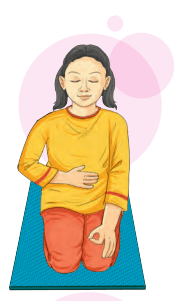
Abdominal or Diaphragmatic Breathing –
Adhama Śvāsa
- Adopt Cin Mudra and keep your hands on your thighs.
- Inhale completely so that the abdomen bulges out and
the diaphragm is pushed down.
- Exhale slowly and completely so that the abdomen is
drawn inwards and the diaphragm returns to its
normal state.
- The inhalation and exhalation should be slow, deep,
smooth, relaxed and rhythmic.
- There should be no jerks in the whole process.
- Repeat the practice for five rounds.
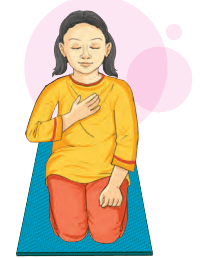
Thoracic or (Chest) Intercostal Breathing –
Madhyama Śvāsa
- Adopt Cinmaya Mudra and keep your hands on
your thighs.
- Inhale deeply while expanding the chest.
- Exhale completely while contracting the chest.
- During thoracic breathing, air flows through both the
nostrils slowly and continuously and the middle lobes
of the lungs open up.
- Repeat the practice for five rounds.
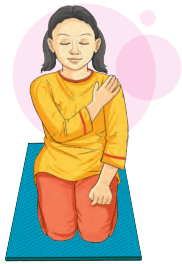
Clavicular (Upper Chest) or Upper Lobar
Breathing – Ādhya Śvāsa
- Adopt Ādi Mudra and keep your hands on your thighs.
- Inhale deeply while raising the collar bones.
- Exhale slowly while bringing back the collar bones to
normal position.
- Repeat the practice for five rounds.
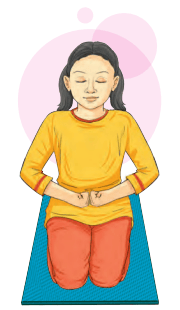
Full Yogic Breathing – Pūrna Śvāsa
- Adopt Brahma Mudra as shown in the picture and
place it below the navel region.
- Inhale deeply while bulging the abdomen, expanding
the chest and raising the collar bones.
- Exhale slowly while sinking the abdomen,
contracting the chest and bringing back the collar
bones.
Alternate Nostril Breathing – Nādīśuddhi
Prānāyāma or Prānāyāma
Nādīśuddhi Prānāyāma is a simple and powerful technique
that balances the flow of Prānā (life force) and cleans the
subtle energy channels. Nādī means energy channels and
śuddhi means cleaning. The balanced and rhythmic breathing
patterns calm down the mind, reduce anxiety and promote
emotional stability.
A few points are important for the practice of Nādīśuddhi
Prānāyāma:
- Practice this Prānāyāma daily for long-term benefits.
- Be aware of the breath while practising.
- Let the breath flow naturally.
- Avoid jerks or strain during the practice.
Note for the Teacher
- Encourage the students to co-ordinate the movement with the breathing.
- Ensure students perform sectional breathing smoothly.
Now, let us practice Nādīśuddhi Prānāyāma.
Step-1
Step-2
Step-3
Step-4
Step-5
Step-6
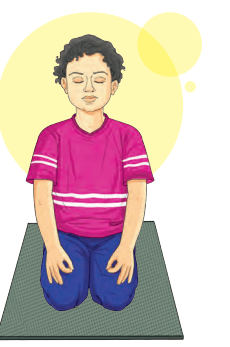
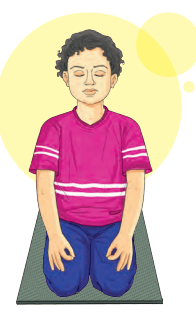
Step 1: Sit in Padmāsana, Vajrāsana, or Sukhāsana with the spine
erect, face relaxed and eyes gently closed.
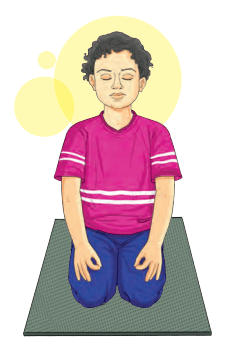
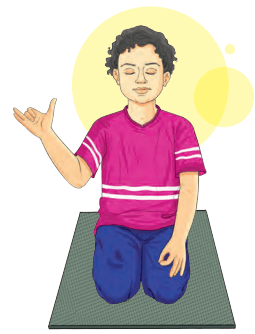
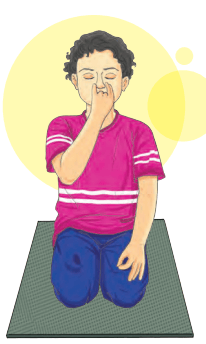
Step 2: Adopt Nāsika Mudra in the right hand by folding the index
and middle finger, placing it on the left thigh. Keep the
thumb, the ring finger and the little finger open. Now adopt
Cin Mudra in the left hand and place on the left thigh.
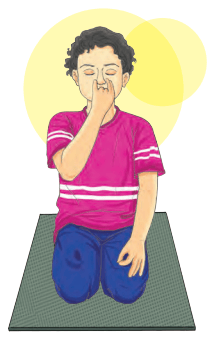
Step 3: Close the right nostril with the thumb, and exhale
completely through the left nostril. Inhale deeply through
the left nostril, hold the breath, lift the thumb from the right
nostril and close the left nostril with the ring and the little
finger.
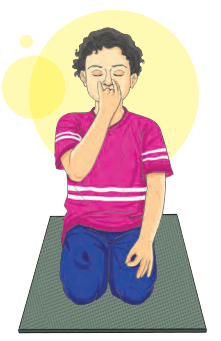
Step 4: Exhale slowly through the right nostril. Inhale deeply
through the right nostril, lift the ring and little finger from
the left nostril and close the right nostril with the thumb.
Step 5: Exhale slowly through the left nostril. This counts as one
round. Continue this practice for three to five rounds
Step 6: After the practice, drop the right hand, adopt Cin Mudra and
observe the changes.
Benefits of Nādīśuddhi Prānāyāma
- Nādīśuddhi Prānāyāma promotes balance between both nostrils apart
from cleansing the nasal tract.
- It increases the appetite.
- It helps in reducing stress hormones.
Note for the Teacher
- Demonstrate Cin Mudra and Nāsika Mudra to the students and ensure they do
it properly.
- Demonstrate one full cycle of right and left nostril breathing with instructions.
- Observe the position of the thumb, ring finger and little finger during the
practice to help them understand the technique and follow the steps properly.
- Ask them how they felt after the practice and if they were able to experience a
calm state of mind.
Bhrāmarī Prānāyāma
The Bhrāmarī Prānāyāma technique mimics the humming
sound of a female bee. The name “Bhrāmarī ” comes from the
Sanskrit word “Bhrāmarī,” which means female bee. Bhrāmarī
Prānāyāma is a calming technique, which has a soothing effect
on the mind and nervous system. It involves inhaling deeply
and producing a low humming sound during exhalation.
Bhrāmarī Prānāyāma has several benefits:
- Reduces stress and anxiety.
- Improves concentration and memory.
- Improves sleep quality.
- Induces a state of deep relaxation.
- Balances blood pressure.
Let us learn how to perform Bhrāmarī Prānāyāma:
- Sit in Sukhāsana with the spine erect,
face smiling and eyes gently closed.
- Inhale deeply with both nostrils filling both
the lungs.
- As you exhale, make a steady, low-pitched humming sound
like a bee. (Makara sound from Omkāra chanting)
- Feel the vibration of the sound resonate throughout your
head and body.
- Repeat the practice five times.
Note for the Teacher
- Ask the students whether they could feel the resonance during the practice. Ask
about their state of mind after the practice.
Pratyāhāra
In today’s fast-moving world, Pratyāhāra assumes a very
important role. As all our sense organs are turned outward
they respond to speed, it is necessary to learn the art of slowing
down or different ways of sublimation or willful withdrawal of
our senses.
The Yogic practice of Pratyāhāra helps to increase happiness
by exercising moderation in food, entertainment, sleep and
in all our activities. By practising Pratyāhāra one can avoid
distraction caused by our senses. By doing this one can process
the inward journey.
In the previous chapters, we have learnt various ways of
managing the senses through Pratyāhāra activities.
Chapter 5
Dhārana, Dhyāna,
and Samādhi
In this chapter, let us first learn about how to focus before
doing Dhyāna.
Have you ever sat down calmly with your eyes closed?
When our eyes are open, we see the world outside and when
our eyes are closed, we can experience the world within us.
Dhārana, Dhyāna and Samādhi are three limbs of Ashtāṅga
Yoga, which deal with focusing and calming the mind to
experience peace and joy.
The first step towards experiencing the peace within is to
focus our wandering mind on some object, it can be observing
the breath or flame of the candle or the tip of the thumb from
the stretched hand. This single-point concentration is called
Dhārana. Dhārana involves keeping the mind steady and
maintaining concentration.
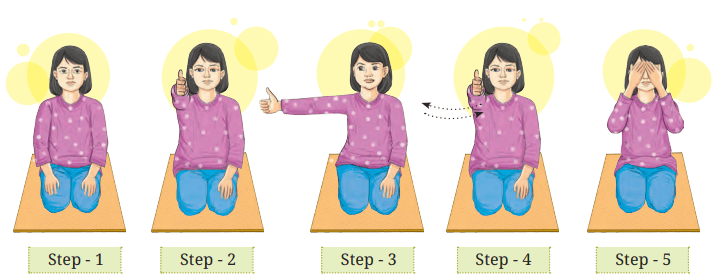
Let us learn the art of focusing by practising Jatru Trataka
using the shoulders and the thumbs.
Jatru Trataka
Jatru Trataka is a Yogic gazing that helps to bring one pointed
concentration or focus. It is a practice where the gaze is fixed
on an object or the target.
Step 1: Sit in Vajrāsana or Sukhāsana comfortably. Keep your eyes
open and hands on the thigh.
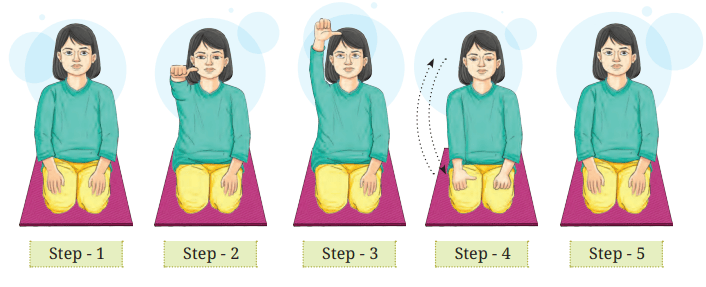
Step 2: Lift the right hand to the shoulder level in front, and make
a fist with the thumb turned sideward.
Step 3: Focus eyes on the tip of the thumb and slowly start moving
the right hand up.
Step 4: Both the eyes must be constantly focused on the tip of the
thumb while the hand keeps moving up and down. Do not
move the head, but move only the eyeballs up and down.
Repeat this practice for three to five rounds.
Step 5: After the practice do simple palming and relax in Vajrāsana
or Sukhāsana .
Repeat the same practice on the left side.
Right and Left Viewing
Step 1: Sit in Vajrāsana or Sukhāsana comfortably. Keep your eyes
open and hands on the thighs.
Step 2: Stretch the right hand in front, and make a fist out of it with
the thumb raised upwards.
Step 3: Move the right hand towards the right shoulder parallel to
the ground and keep gazing at the tip of the thumb. Maintain
this position for a while by holding the hand at the right end.
Step 4: Slowly move the right hand back to the original position
while gazing at the tip of the thumb. Do not move the head
but move only the eyeballs sideways.
Step 5: After the practice do simple palming and relax in Vajrāsana
or Sukhāsana.
Repeat the same practice on the left side
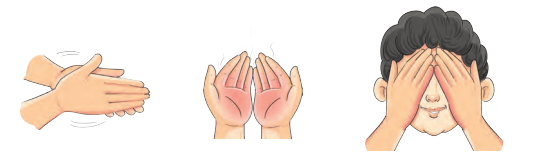
Simple palming procedure:
- Rub both palms until they become warm.
- Cup your palms and place them gently over the eyes (do not
put pressure on the eyeballs).
- Keep the eyes closed.
Keep your palms on your eyes for 10–15 seconds, then gently
lift them.
- Jatru Trataka improves concentration, intelligence and memory.
- It also improves eyesight and vision.
- It enhances self-confidence, patience and willpower.
Limitations: Students with severe headache should
avoid the practice.
Note for the Teacher
- Ensure that students remove their glasses and wrist watches.
- Encourage them to sit with the head, neck and spine erect during the practice.
Always open the eyes with a few blinks.
- Ensure palming is done after each practice.
Dhyāna
Dhyāna means meditation, contemplation or reflection of the
higher self or God. When concentration becomes uninterrupted
and flows continuously like a stream, it transforms into Dhyāna.
In Dhyāna, there is a continuous flow of attention towards the
chosen focus without distraction. Unlike Dhārana where effort
is required to maintain concentration, Dhyāna is characterised
by a state of effortless presence and immersion in the object of
meditation.
Practising Dhyāna leads to a profound sense of inner stillness
and tranquility. Regular practice of Dhyāna enhances mental
clarity, sharpens focus, reduces anxiety and improves cognitive
function.
Dhyāna can be practiced in many ways. In this grade, we will
learn about Nadānusandhāna (meditating on sound).
Guidelines for the practice of Dhyāna
- Find a calm and clean place. Sit in Padmāsana or Sukhāsana
with the spine erect and the body relaxed.
- Select the object of focus, such as a breath or a mantrā or
some visual object and focus your attention on it. Keep your
eyes closed during the practice.
- Remain non-reactive to the thoughts or emotions that come
up during the practice.
- In the beginning it is generally difficult to observe the
breath for a long time. If your mind wanders, slowly but
firmly bring your attention back to your breath.
- Consistency is important; practice dhyāna daily, starting
with a few minutes and gradually increasing the duration.
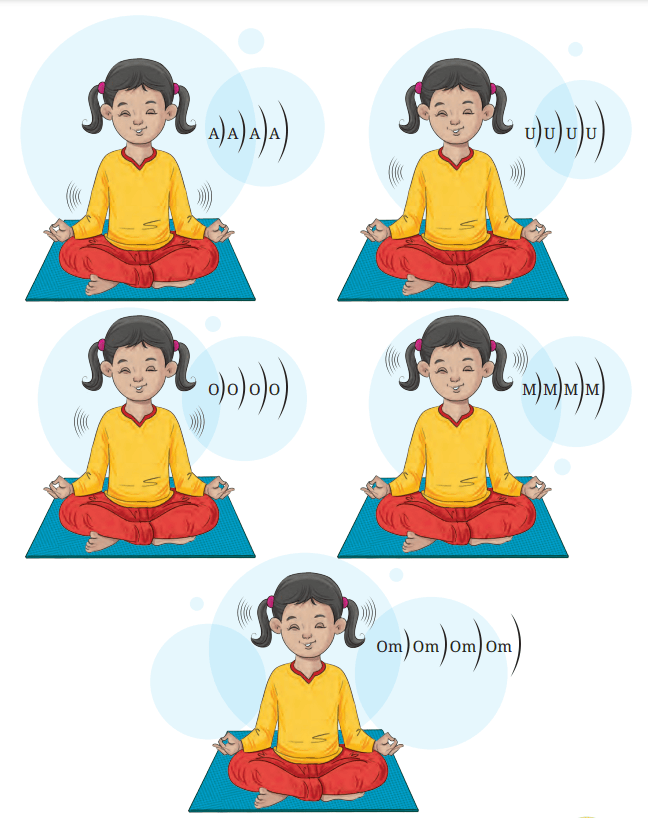
Nādanusandhāna (Sound meditation)
The term “Nāda” means sound and “Anusandhāna” means
investigation or exploration. Therefore, Nādanusandhāna
involves the exploration and deep meditation on sound
vibrations. Different sounds like A, U, M and AUM are chanted
slowly so that they generate a fine resonance all over the body.
- Sit in Vajrāsana or Sukhāsana with the spine erect, face
relaxed and eyes gently closed.
- Adopt Cin Mudra in both hands and place it on the thighs.
- Chant Akāra for three to five rounds and feel the
resonance in the lower body (abdominal).
- Chant Ukāra for three to five rounds and feel the
resonance in the middle (chest region) part of the body.
- Chant Mkāra for three to five rounds and feel the
resonance in the upper (head region) part of the body.
- Chant Omkāra for three to five rounds and feel the resonance
in the body.
- Repeat the Nādanusandhāna several times a day. It helps in
the expansion of awareness.
Samādhi
Samādhi is the highest state of consciousness. This is possible
to achieve during meditation. In Samādhi, the mind is focused
perfectly on the higher self or God for a long time.
Chapter 6
Krīdā Yoga
Various games are designed to understand concepts of Yoga
playfully. In Sanskrit, Krīḍā means ‘play’ or ‘sports’; hence,
Krīḍā Yoga means learning Yoga through play. Krīḍā Yoga helps
in developing some of the principles of Yoga such as joy, being
mindful, concentration, strengthening breathing, creativity
and love. Krīḍā Yoga helps reduce stress and anxiety, promoting
mental well-being and emotional balance.
By making Yoga enjoyable and interactive, Krīḍā Yoga helps
foster a lifelong interest in the practice and supports holistic
development.
A few games are given below, you may design new games based
on various principles of Yoga and play with your friends in the
class or with members of your family.
Padārtha Grāhi – Mindful Eating
Mindful eating is an indoor game, normally played in groups.
This game can be used as an “icebreaker”, a game played to
reduce inhibitions and to bring out the best in the students.
In this game, food is used as a theme to encourage students to
develop healthy eating habits. This game brings out creativity,
awareness and emotional culture.
How to play
- Students are instructed to keep their left hand near their
chest to resemble a plate.
- The teacher calls out names of different edibles and takes
over edible things rapidly.
For example, Names of vegetables: carrot, pumpkin, paper,
beetroot, bat, cabbage, pencil, drumsticks, beans, radish,
eraser, potato.
Names of fruits: apples, mango, chiku, chair, grapes,
orange, desk, banana, grapes, pineapple, duster, papaya,
watermelon.
- Whenever the teacher names a healthy food item, the
students should mime eating from the plate with their right
hands and say, “We eat”.
For example, if the teacher says “Carrot”, the students
should do the eating action and say, “We eat”.
- The teacher can mix different non-edible items like mud,
stone, etc. or junk food in between. For non-edible and junk
food items, the students should remain silent.
- The students who do the action or say, “We eat”, for nonedible or junk food items are considered out.
- Those who remain till the end are declared winners.
Note for the Teacher
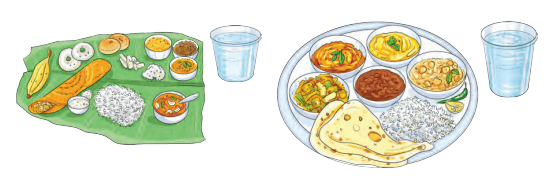
- The teacher can take up the names of healthy food
(“We eat”) and junk food (silent).
- Food items like rice, dosa, dal, chapati, idly, upma, etc.,
can also be used.
Pañcabhūta
Pañcabhūta is a group game, through which children learn the
names of five elements or Pañcabhūtas as shown in the below
picture. This game focuses on awareness, attention, listening
comprehension and coordination between the body and the
mind. Initially, the teacher has to perform the actions along
with the students to understand the instructions of the game.
| Pañcabhūta |
| Pṛithvi |
Āāp |
Agni |
Vāyu |
Ākāśa |
| Earth |
Water |
Fire |
Wind |
Sky |
How to play
- The students should stand in a circle with the teacher in
the centre.
- When the teacher names a pañcabhūta element students
should act as that element as given in the following table.
- The speed of these motions can be increased gradually and
the order of the Pañcabhūtās can be mixed.
- The students who do it wrong are out. The student who
remains till the end wins the game.
Note for the Teacher
- Variations are encouraged to make the game interesting.
- Ensure all students participate in the game.
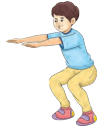
| Pṛithvi |
The students
should either
squat, sit or
crossed leg.
|
|
Āāp
|
The students
have to make
the
sound of
water in the
mouth (like
Galagalagala…….)
|

|
Agni
|
The students
have to imitate
the
burning of
the fire with
their fingers
by closing all
the fingers
and opening
them.
|
|
Vāyu
|
The students
should raise both
hands and rotate
either clockwise
or anti-clockwise.
|

|
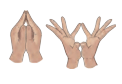
Ākāśa
|
The students
should raise
both hands
with
their p
|

|
Suggested
Session Plans
for Teachers
Session plan for Yoga
| Month 1 |
|
3rd
period |
6th
period |
9th
period |
12th
period |
Yoga for
Daily
Life |
Yoga for
Daily Life —
Introduction
(10 mins)
|
History
of Yoga
(10 mins)
|
What is
Yoga?
(10 mins)
|
Introduction
to
Yama
(10 mins)
|
Yoga
Sādhana
|
Neck Exercises
(5 mins)
|
Neck
Exercises
(5 mins)
|
Dog Breathing
(5)
Pavanamuktāsana
(Single leg)
(10 mins)
|
Techniques of
Sūrya
Namaskāra
|
Introduction
to
Krīḍā Yoga
Mindful eating
(15 mins)
|
Rabbit
Breathing
(5 mins)
|
Yoga Sādhana
|
Ardhacakrāsana
to
Pādahastāsana,
Aśvasañcalanāsana
interchanging
of
legs
(10 mins)
|
Yoga Sādhana
|
Mindful
Eating
(15 mins)
|
Techniques of
Sūrya Namaskāra
–
Ardhacakrāsana
to Pādahastāsana
(5 mins)
|
Introduction
to
Āsana
Ardhakaṭicakrāsana
|
| Month 2 |
|
15th period |
18th Period |
21st Period |
24th Period |
| Yoga for Daily Life |
Story on Aparigrahas(10 mins) |
Test 1 Assessment(10 mins) |
Activity on Aparigraha(10 mins) |
Introduction to Niyama(10 mins) |
Yoga
Sādhana |
Rabbit breathing
(5 mins) |
Dog Breathing (5)
Pavanamuktāsana (single and both legs)
(5 mins) |
Ardhacakrāsana and Pādahastāsana, Daṇḍāsana to Śaśāṅkāsana
(5 mins) |
Dog and Rabbit breathing
(5 mins) |
Aśvasañcalanāsana – interchanging of legs
(5 mins) |
Yoga Sādhana |
Padmāsana
(10 mins) |
Dandāsana to Sāshtāṅga Namaskāra,
Ūrdhvamukha Śvānāsana to Adhomukha Śvānāsana
(10 mins) |
Daṇḍāsana and
Śaśāṅkāsana
(5 mins) |
Introduction to
Padmāsana
(10 mins) |
Introduction to
Prānāyāma
Sectional breathing — abdominal breathing
(5 mins) |
Relaxation (5 mins) |
| Revision of Ardhakaṭicakrāsana (10 mins) |
Yoga Sādhana |
Yoga Sādhana |
Yoga Sādhana |
| Month 3 |
|
27th period |
30th Period |
33rd Period |
36th Period |
| Yoga for Daily Life |
Activity on
Niyama
(10 mins) |
Story on Tapas
(10 mins) |
Activity on Tapas
(10 mins) |
Yoga Sādhana |
Yoga
Sādhana |
Rabbit and Dog Breathing
(5 mins) |
Neck movements (10 mins) |
Daṇḍāsana to Śaśāṅkāsana, Aśvasañcalanāsana – interchanging of legs
(5 mins) |
Mid-Term Assessment |
Ardhacakrāsana to
Pādahastāsana
(5 mins) |
Pavanamuktāsana- rocking & rolling
(5 mins) |
Yoga Sādhana |
Pavanamuktāsana
both legs |
Sectional breathing (10 mins) |
Relaxation
(5 mins) |
| Relaxation (5 mins) |
Yoga Sādhana |
Introduction to
Nāḍīśuddhi
(10 mins) |
| Month 4 |
|
39th Period |
42nd Period |
45th Period |
48th Period |
| Yoga for Daily Life |
Introduction on Pratyāhāra |
Activity on
Pratyāhāra |
Yoga Sādhana |
Yoga Sādhana |
Yoga
Sādhana |
Dog breathing
(5 mins) |
Dog breathing
(5 mins) |
Ardhacakrāsana to Pādahastāsana, Aśvasañcalanāsana – interchanging of
legs (5 mins) |
Daṇḍāsana and Sāṣṭāṅga Namaskāra, Ūrdhvamukha Śvānāsana and Adhomukha Śvānāsana
(5 mins)
|
Ūrdhvamukha Śvānāsana to Adhomukha Śvānāsana
(5 mins)
|
Neck movements (5 mins) |
Yoga Sādhana |
Yoga Sādhana |
| Yoga Sādhana |
Pavanamuktāsana
- single leg, Rotation
(10 mins)
|
Introduction to Bhujaṅgāsana and Shalabhāsana
(10 mins)
|
Pavanamuktāsana both the legs, Rock and Rolling
(5 mins)
|
Padmāsana
(10 mins)
|
Yoga Sādhana |
Relaxtion
(5 mins)
|
Ardhakaṭicakrāsana
(10 mins)
|
Introduction to Bhrāmarī Prāṇāyāma –
( 5 mins)
|
Pañcabhūta
(10 mins) |
Sectional breathing (10 mins) |
Pañcabhūta
(10 mins) |
| Month 5 |
|
51st Period |
54th period |
57th period |
60th period |
| Yoga for Daily Life |
Yoga Sādhana |
Test 2 Assessment |
Yoga Sādhana |
Yoga Sādhana |
Yoga
Sādhana |
Ardhacakrāsana to Pādahastāsana, Aśvasañcalanāsana – interchanging of
legs (5 mins) |
Neck movements (10 Mins)
Ūrdhvamukha Śvānāsana and Adhomukha Śvānāsana
(5 mins) |
Daṇḍāsana and Sāṣṭāṅga Namaskāra, Ūrdhvamukha Śvānāsana and Adhomukha Śvānāsana
(10 mins) |
Ardhacakrāsana to Pādahastāsana, Daṇḍāsana to Śaśāṅkāsana
(5 mins) |
| Yoga Sādhana |
Relaxation (5 mins) |
Bhujaṅgāsana and Shalabhāsana
(10 mins) |
Uttanapadāsana
(10 mins) |
Introduction to
Uttanapadāsana
(10 mins)
Relaxtion
(5 mins)
|
Introduction to
Dhyāna
Practice of
Nadānusandhāna
(10 mins)
|
Jatru Trataka
(10 mins) |
Relaxation
(5 mins) |
Introduction to
Dhārana
Practice of Jatru Trataka
(10 mins)
|
Yoga Sādhana |
Yoga Sādhana |
Sectional breathing and Nāḍīśuddhi Prāṇāyāma
(10 mins)
|
| Month 6 |
|
63rd Period |
66th period |
69th periodq |
72nd period |
| Yoga for Daily Life |
Yoga Sādhana |
Yoga Sādhana |
Revision of Aṣṭāṅga Yoga (10 mins) |
Final Assessment |
Yoga
Sādhana |
Pavanamuktāsana Both the legs - Rotation
(10 mins)
|
Daṇḍāsana and Śaśāṅkāsana, Aśvasañcalanāsana
(5 mins)
|
Ardhacakrāsana and Pādahastāsana
(5 mins)
|
Jatru Trataka
(10 mins) |
Revision of Āsana
(10 mins) |
Revision of
Āsana (10 mins) |
| Yoga Sādhana |
Relaxation –
(5 mins) |
Relaxation–
(5 mins) |
Nāḍīśuddhi and Bhrāmarī Prāṇāyāma
(10 mins)
|
Bhrāmarī Prāṇāyāma
(5 mins) |
Yoga Sādhana |
| Yoga Sādhana |
Nadānusandhāna
(5 mins)
|
Yoga Sādhana |
Suggestive Annual
Session Plan for All Units
| Period |
Unit No. |
Session Type |
Activity Name |
Activity No. |
C'lative |
| 1 |
Unit 1 |
Type 2 |
Ice Water |
PE-1 |
PE-1 |
| 2 |
Unit 1 |
Type 2 |
Seven Stones |
PE-2 |
PE-2 |
| 3 |
Unit 5 |
Yoga |
Yoga for Daily Life |
YG-1 |
YG-1 |
| 4 |
Unit 1 |
Type 2 |
Aerobics Exercise |
PE-3 |
PE-3 |
| 5 |
Unit 1 |
Type 2 |
Follow Me |
PE-4 |
PE-4 |
| 6 |
Unit 5 |
Yoga |
History of Yoga |
YG-2 |
YG-2 |
| 7 |
Unit 1 |
Type 2 |
Number Game |
PE-5 |
PE-5 |
| 8 |
Unit 1 |
Type 2 |
Hula Hoop Jump |
PE-6 |
PE-6 |
| 9 |
Unit 5 |
Yoga |
What is Yoga? |
YG-3 |
YG-3 |
| 10 |
Unit 2 |
Type 1 |
Obstacle Race |
PFC-1 |
PFC-1 |
| 11 |
Unit 2 |
Type 1 |
Balancing Act |
PFC-2 |
PFC-2 |
| 12 |
Unit 5 |
Yoga |
Introduction to Yama |
YG-4 |
YG-4 |
| 13 |
|
|
Formative Assessment |
FA-1 |
FA-1 |
| 14 |
Unit 2 |
Type 1 |
Shivam Says |
PFC-3 |
PFC-3 |
| 15 |
Unit 2 |
Type 1 |
Collaborate and Conquer |
PFC-4 |
PFC-4 |
| 16 |
Unit 5 |
Yoga |
Story of Aparigrahas |
YG-5 |
YG-5 |
| 17 & 18 |
Unit 2 |
Type 1 |
Running Between the Cones |
PFC-5 |
PFC-6 |
| 19 |
Unit 2 |
Type 1 |
Grab the Ball |
PFC-6 |
PFC-7 |
| 20 |
Unit 5 |
Yoga |
Test-1 Assessment |
YG-6 |
YG-6 |
| 21 & 22 |
Unit 2 |
Type 1 |
Push-up Position and Pass the Ball |
PFC-7 |
PFC-9 |
| 23 & 24 |
Unit 2 |
Type 1 |
Tic-Tac-Toe Dribble Relay |
PFC-8 |
PFC-11 |
| 25 |
|
|
Formative Assessment |
FA-2 |
FA-2 |
| 26 |
Unit 5 |
Yoga |
Activity on
Aparigrahas |
YG-7 |
YG-7 |
| 27 |
Unit 2 |
Type 1 |
Crocodile Race |
PFC-9 |
PFC-12 |
| 28 |
Unit 2 |
Type 3 |
Head, Shoulder, Knee and Ball |
PFC-10 |
PFC-13 |
| 29 |
Unit 5 |
Yoga |
Introduction toNiyāma |
YG-8 |
YG-8 |
| 30 |
Unit 3 |
Type 3 |
Sitting |
FS-A-1 |
FS-A-1 |
| 31 |
Unit 3 |
Type 3 |
Chasing |
FS-A-2 |
FS-A-2 |
| 32 |
Unit 5 |
Yoga |
Activity on Niyāma |
YG-9 |
YG-9 |
| 33 |
Unit 3 |
Type 3 |
Sitting |
FS-A-3 |
FS-A-3 |
| 34 |
Unit 3 |
Type 3 |
Chasing |
FS-A-4 |
FS-A-4 |
| 35 |
Unit 5 |
Yoga |
Story on Tapas |
YG-10 |
YG-10 |
| 36 |
Unit 3 |
Type 3 |
Giving Kho |
FS-A-5 |
FS-A-5 |
| 37 |
|
|
Formative Assessment |
FA-3 |
FA-3 |
| 38 |
Unit 3 |
Type 3 |
Running on a Straight Line |
FS-A-6 |
FS-A-6 |
| 39 |
Unit 5 |
Yoga |
Story on Tapas |
YG-11 |
YG-11 |
| 40 |
Unit 3 |
Type 3 |
Giving Kho |
FS-A-7 |
FS-A-7 |
| 41 |
Unit 3 |
Type 4 |
Running on a Straight Line |
FS-A-8 |
FS-A-8 |
| 42 |
Unit 5 |
Yoga |
Activity on Tapas |
YG-12 |
YG-12 |
| 43 |
Unit 3 |
Type 3 |
Dodging |
FS-A-9 |
FS-A-9 |
| 44 |
Unit 3 |
Type 4 |
Zig-Zag Running |
FS-A-10 |
FS-A-10 |
| 45 |
Unit 5 |
Yoga |
Yoga Sādhana |
YG-13 |
YG-13 |
| 46 |
Unit 3 |
Type 3 |
Dodging |
FS-A-11 |
FS-A-11 |
| 47 |
Unit 3 |
Type 4 |
Zig-Zag Running |
FS-A-12 |
FS-A-12 |
| 48 |
Unit 5 |
Yoga |
Introduction onPratyāhāra |
YG-14 |
YG-14 |
| 49 |
|
|
Formative Assessment |
FA-4 |
FA-4 |
| 50 & 51 |
Unit 3 |
Type 3 |
Pole Turn |
FS-A-13 |
FS-A-14 |
| 52 |
Unit 5 |
Yoga |
Activity on Pratyāhāra |
YG-15 |
YG-15 |
| 53 to 61 |
|
|
Summative Assessment 1 |
SA-1 |
SA-9 |
| 62 & 63 |
Unit 3 |
Type 4 |
Covering Chase |
FS-A-14 |
FS-A-16 |
| 64 |
Unit 5 |
Yoga |
Yoga Sādhana |
YG-16 |
YG-16 |
| 65 & 66 |
Unit 3 |
Type 3 |
Chain |
FS-A-15 |
FS-A-18 |
| 67 & 68 |
Unit 3 |
Type 4 |
Fake Kho |
FS-A-16 |
FS-A-20 |
| 69 |
Unit 3 |
Type 3 |
Pole Dive |
FS-A-17 |
FS-A-21 |
| 70 |
|
|
Formative Assessment |
FA-5 |
FA-5 |
| 71 |
Unit 3 |
Type 3 |
Pole Dive |
FS-A-18 |
FS-A-22 |
| 72 & 73 |
Unit 3 |
Type 3 |
Toe Tapping |
FS-A-19 |
FS-A-24 |
| 74 |
Unit 5 |
Yoga |
Yoga Sādhana |
YG-17 |
YG-17 |
| 75 & 76 |
Unit 3 |
Type 3 |
3-2-3 Chain |
FS-A-19 |
FS-A-26 |
| 77 |
Unit 4 |
Type 3 |
Passing |
FS-B-1 |
FS-B-1 |
| 78 |
Unit 4 |
Type 3 |
Catching |
FS-B-2 |
FS-B-2 |
| 79 |
Unit 4 |
Type 3 |
Passing |
FS-B-3 |
FS-B-3 |
| 80 |
Unit 4 |
Type 3 |
Catching |
FS-B-4 |
FS-B-4 |
| 81 |
Unit 5 |
Yoga |
Yoga Sādhana |
YG-18 |
YG-18 |
| 82 |
|
|
Formative Assessment |
FA-6 |
FA-6 |
| 83 & 84 |
Unit 4 |
Type 1 |
10-pass |
FS-B-5 |
FS-B-6 |
| 85 |
Unit 5 |
Yoga |
Test 2 Assessment |
YG-19 |
YG-19 |
| 86 & 87 |
Unit 4 |
Type 3 |
Dribbling |
FS-B-6 |
FS-B-8 |
| 88 & 89 |
Unit 4 |
Type 3 |
Obstacle Dribbling |
FS-B-7 |
FS-B-10 |
| 90 |
Unit 4 |
Type 3 |
Shoot the Ball |
FS-B-8 |
FS-B-11 |
| 91 |
Unit 5 |
Yoga |
Yoga Sādhana |
YG-20 |
YG-20 |
| 92 |
Unit 4 |
Type 3 |
Shoot the Ball |
FS-B-9 |
FS-B-12 |
| 93 & 94 |
Unit 4 |
Type 1 |
Dodge Ball |
FS-B-10 |
FS-B-14 |
| 95 |
|
|
Formative Assessment |
FA-7 |
FA-7 |
| 96 |
Unit 5 |
Yoga |
Yoga Sādhana |
YG-21 |
YG-21 |
| 97 & 98 |
Unit 4 |
Type 3 |
Dribble and Shoot |
FS-B-11 |
FS-B-16 |
| 99 &100 |
Unit 4 |
Type 4 |
Pass and Shoot |
FS-B-12 |
FS-B-18 |
| 101 |
Unit 4 |
Type 3 |
Shootout Tournament |
FS-B-13 |
FS-B-19 |
| 102 |
Unit 5 |
Yoga |
Yoga Sādhana |
YG-22 |
YG-22 |
| 103 &104 |
Unit 4 |
Type 3 |
Shootout Tournament |
FS-B-14 |
FS-B-21 |
| 105 |
Unit 4 |
Type 3 |
Goalkeeper’s Defensive Skills |
FS-B-15 |
FS-B-22 |
| 106 |
Unit 5 |
Yoga |
Yoga Sādhana |
YG-23 |
YG-23 |
| 107 |
Unit 4 |
Type 3 |
Goalkeeper’s Defensive Skills |
FS-B-16 |
FS-B-23 |
| 108 |
Unit 4 |
Type 3 |
Blocking |
FS-B-17 |
FS-B-24 |
| 109 |
Unit 5 |
Yoga |
Revision of AṣṭāṅgaYoga |
YG-24 |
YG-24 |
| 110 |
|
|
Formative Assessment |
FA-8 |
FA-8 |
| 111 |
Unit 4 |
Type 3 |
Blocking |
FS-B-18 |
FS-B-25 |
| 112 &113 |
Unit 4 |
Type 4 |
Assimilation |
FS-B-19 |
FS-B-27 |
| 114 to122 |
|
|
Summative Assessment 2 |
SA-1 |
SA-9 |
Notes