2. Read the questions given below. Talk about them and make a list.
(a) Which games or sports do you play for fun?
(b) Which games or sports do you play for competition?
3. How do you feel when you win or lose?
4. Work in pairs. Tick the correct meaning of the following:
(a) friendly matches
(i) matches played to win a trophy
(ii) matches played without competition
(b) opponent
(i) someone who you compete with
(ii) someone you want to be a partner with
(c) tally of marks
(i) final marks on a report card
(ii) record of points in a game/match
(d) sporting spirit
(i) following all the rules in a game
(ii) being fair and respecting each player in a game
Let us read
Prabhat always wanted to win. His parents,
teachers, and friends said that he did not
know how to accept defeat. The fact was that
he could not bear losing, not even at marbles.
He felt so good when he won that he never
wanted to give up that feeling. On the contrary,
losing made him feel terrible. He thought that
losing was the worst thing that could happen
to anyone.
If Prabhat sensed that he would lose a game,
he would not play it. He would take part only
when he was sure of winning, even if the game
lasted only for a minute. You could not stop
him from playing the kind of games he was
really good at, like badminton.
A new student joined Prabhat’s school, and
his name was Surya. Surya was an excellent
badminton player. Prabhat waited for the last
Friday of the month. Last Friday was significant.
This was when the coach conducted friendly
matches in the games period. The teams were
decided on Monday and it was no surprise
when Prabhat and Surya were chosen to play
a round against each other. Prabhat was given
the responsibility of keeping score for their
match. On one hand, Prabhat prepared for the
match with great seriousness. Surya, on the
other hand, seemed relaxed, not taking the
things seriously at all. He walked about the whole time, smiling and cracking jokes about all
sorts of things.But on Friday, at the badminton
court, Surya was a real phenomenon. He won
points again and again, laughing and joking all
the time. However, Surya was paying so little
attention to the match that Prabhat managed
to change the scoreboard while his opponent
was looking elsewhere.
Prabhat managed to win by cheating. He
made a big thing of his win, but it did not
matter to Surya.
“It’s been fun. We should play again some
other time,” said Surya.
defeat: loss, terrible:
unhappy, on the contrary:
just the opposite, sensed: had
known, significant:
important, conducted:
organised,
phenomenon:
someone who
has special
qualities
Let us discuss
1. State whether the following is True or False.
Prabhat would accept losing to anyone easily. .............
2. What was special about the last Friday of each month?
3. Who was responsible for maintaining the score for the match?
4. Do you think Prabhat wished to play another match with
Surya? Why do you think so?
II
On that day, everyone was discussing their game and how Prabhat
had played so well. Surprisingly, Prabhat could not sleep well that
night. He had won the game but he did not feel as happy as he
usually did. What was surprising was that Surya did not feel bad
about losing. What was more surprising was that Prabhat saw Surya playing basketball the next day. Surya
was so hopeless at it that he could not score a
basket for ten minutes. Yet, he enjoyed playing
the game. His happy smile never left his face.
Prabhat kept a close watch on Surya for
some days. He was great at some things,
terrible at others but what was common was
the enjoyment. He enjoyed everything equally.
As Prabhat went on with his observation, he
realised that to enjoy a game, you did not need
a scoreboard to keep a tally of your scores.
Neither did you have to worry about winning
and losing. You needed to enjoy the game for
its own sake. What matters is trying to do well,
and enjoying every moment of it.
Prabhat learnt something through the
observations every day, soon realising the
change in himself. He had even begun playing
hide and seek, and felt sad whenever it was
about to end. He also started joking while
playing badminton. Soon, the other students
started talking amongst themselves, “Good fun
playing with Prabhat, that fellow definitely has
a great sporting spirit.”
hopeless:
having no skill
in something, kept a close
watch on:
observed
Let us discuss
1. How did Surya feel about playing?
2. What was it about Surya that Prabhat observed?
Let us think and reflect
1. Read the lines given below and answer the questions.
(a) If Prabhat sensed that he would lose a game, he would not play it. He
would take part only when he was sure of winning, even if the game
lasted only for a minute. You could not stop him from playing the kind
of games he was really good at, like badminton.
(i) Complete the sentence suitably.
Prabhat would play a game only if ____________________.
(ii) Which game was Prabhat good at playing?
(iii) Select the most suitable option to complete the sentence.
This behaviour of Prabhat tells us that he was ________________.
a. good at the game
b. sure to win
c. afraid of losing
(b) Surprisingly, Prabhat could not sleep well that night. He had won
the game but he did not feel as happy as he usually did. What was
surprising was that Surya did not feel bad about losing. What was
more surprising was that Prabhat saw Surya playing basketball the
next day.
(i) Select the one option that tells us about the way Prabhat was
feeling that night.
a. hurt b. unhappy c. afraid d. focused
(ii) Why does Prabhat find Surya’s behaviour ‘surprising’?
(iii) Fill in the blank by choosing the most suitable option given in
the bracket.
We can say that Surya’s reaction to not winning was
____________________ (similar to/as serious as/different from)
Prabhat’s.
2. Answer the following questions.
(a) How did Prabhat’s attitude towards winning and losing affect his
enjoyment of games in the beginning?
(b) Why do you think Prabhat cheated in the beginning to win the
badminton match against Surya?
(c) How did Surya’s attitude differ from Prabhat’s?
(d) Do you think Prabhat’s approach to games was healthy? Why or why
not?
(e) Why do you think sporting spirit is important?
(f ) Explain how the title of the story, ‘Change of Heart’, is suitable.
Let us learn
1. Make as many words as possible using consecutive letters, without
changing the order of the letters, from the words in the boxes. One has
been done for you.
a.
BADMINTON
BAD
ADMIN
MINT
IN
TON
ON
b.
PHENOMENON
c.
BASKETBALL
Now, you can choose words of your own and create your own such
puzzles. Share them with your class and try solving others’.
2. Read the following sentences and circle the verbs.
(a) Everyone was discussing their game and how Prabhat had played
so well.
(b) He had won the game but he did not feel as happy as he usually did.
(c) What was more surprising was that Surya had not felt bad about
losing.
3. Arrange the circled verbs as the first action (old action) or second
action (new action). One has been done for you.
S. No.
Column A FIRST ACTION (OLD)
Column B SECOND ACTION (NEW)
1.
had played
was discussing
2.
3.
The verbs in column A that refer to the first action or the old action
are past perfect.
4. Fill in the blanks with the past perfect form of verbs given within
the brackets.
(a) Prabhat __________ already __________ his homework before
going to the badminton match. (finish)
(b) Surya __________ basketball for years before joining the school’s
badminton team. (play)
(c) By the time Prabhat arrived, Surya __________ already __________
several matches. (win)
(d) The new student, Surya, __________ Prabhat before coming to
the school. (never meet)
(e) Before the games period, Prabhat __________ badminton
extensively. (practice)
Let us listen
1. You will listen to an announcement. As you listen, circle the pair that
was chosen to play chess. (refer to page 128 for transcript)
Rima - Dhiraj, Gita - Hitesh, Sarita - Nupur
2. You will once again listen to the announcement. As you listen, fill in the
notes with important details.
Questions
Answers
1. How many Friday matches will be played?
2. What was put up on the sports’ notice board?
3. Who will sponsor the kho-kho team’s refreshments?
4. Who will be the scorekeeper for chess?
5. Who will be the referee for kho-kho?
6. Which Friday periods are meant for kho-kho?
Let us speak
Look at the situations given below. In pairs, take turns to use the three magic
words—‘please’, ‘thank you’ and ‘sorry’—for the situations given below. Use
the prompts given in the table to learn how to thank and apologise properly.
1. You are Vani— You want to request your friends to take you in their
team during games period.
2. You are Somiwon— You want to tell Hitesh to help you with the cleaning
of the classroom cupboard.
3. You are Sumit— You accidently spilled water on Nupur’s desk.
4. You are Hitesh— You forgot to get Simran’s Art file to school.
5. You are Kriti— You spoke rudely to Nupur.
6. You are Mohan— You wish to thank Hitesh for helping you practice for
the Inter-House speech competition.
7. You are Meher— You are grateful that Simran helped you understand a
chapter taught at school when you were absent.
8. You are Rima— You are thankful to Gita for helping you collect the
notebooks from the staff-room.
Request
• Could you please ...
• Please can you help me with ...
Kindly _______________, please.
For rude behaviour
For a mistake
• I’m very sorry for the way I behaved.
• I apologise. I was out of line.
• I’m sorry, that was my fault.
For being grateful/thankful
• Thank you. It means so much to me that you ...
• I truly appreciate your help with ... Thank you.
• I wish to thank you from the bottom of my heart because you ...
Let us write
Prabhat managed to change the scoreboard while Surya was looking
elsewhere. Yet, he did not feel so happy that night. Unable to sleep, he decided
to write down his feelings in his diary.
Given below is the page where he wrote his feelings that night. Complete it
with the help of the phrases given in the box below.
I won the match
I do not feel happy about it
I will lose the match
I managed to change the scoreboard
I felt very happy
Everyone congratulated me after my win
Surya did not feel bad
He had fun playing with me
Saturday
17 August 20XX 8:00 p.m.
Today, I defeated Surya in a badminton match but
(i) __________________________. He was playing very
well and was getting the points easily. I was sure that
(ii) _____________________. So, when everyone was laughing at a joke he
cracked, (iii) _____________________________. No one noticed the change and
(iv) __________________________________. What surprised me the most was
that he said (v) _________________ and we should play again. How could he
be so relaxed after losing a match? He should have been sad if not crying
over his loss!
Though (vi) _______________________________, I did not enjoy as I usually
do. It really disturbed me that (vii) ____________________ about losing the
match. It is still bothering me. Is it because I changed the score? I do not
understand myself.
Let me sleep now. I feel that it may make me feel better.
Goodnight!
Let us explore
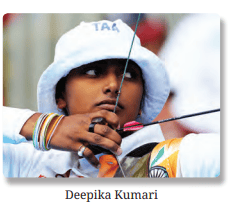
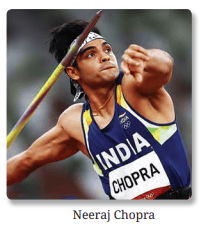
1. Read the brief bio-sketches of sportspersons from India.
Deepika Kumari
• Archer from Jharkhand
• Father, an auto-rickshaw driver and
mother, a nurse
• Practised archery while aiming for
mangoes with stones
• Practised archery with homemade
bamboo bows and arrows
• Joined Tata Archery Academy
• Won a gold medal in the 2010
Commonwealth Games
Neeraj Chopra
• Young athlete from Khandra village in
Haryana
• Family largely involved in agriculture
• First Asian athlete to win an
Olympic gold medal in javelin throw
• Worked hard for several years to
achieve his passion
• At the age of 23, he became the second
Indian to win an individual gold medal
in Olympics
2. Visit the given link to know more about other Indian sportspersons.
2. Discuss the given questions with your classmates and teacher. You may
begin your sentences with—
I go to …
I play with ...
The place I go to for playing ...
I like playing ...
Sometimes I come back ...
(a) When do you go to play after school?
(b) Who do you play with?
(c) Where do you go to play in the evening?
(d) Which games do you like playing?
(e) When do you come back home?
Let us read
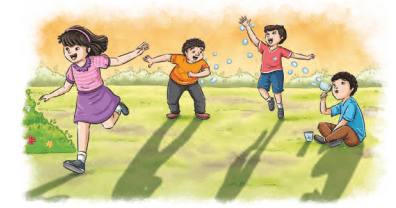
Evenings,
we play ball
next to the creek
in our neighbour’s field.
We run so fast
I
can’t
even
catch
my
breath.
When blue dark turns to black,
cold grass aches our feet,
trees creep close—
game’s over.
Night wins!
Let us discuss
1. Read the given lines from the poem. Write the meaning of the lines by
identifying the words/expressions in them.
S.No
Lines from the poem
Meaning
1.
next to the creek Clue: a small body of water
2.
I can’t even catch my breath Clue: the child has been running
3.
When blue dark turns to black Clue: the colour of the sky changes from blue to black. What does it mean?
4.
trees creep close Clue: it is evening time. Why do you think the trees seem close?
2. Read the poem. Complete the following based on the poem.
The children play ______________ in the ______________ in the neighbour’s
______________. They run so ______________ that they run out of breath. They
continue to play till the evening when the blue sky turns ______________,
and the trees are not clearly visible. They can feel their feet ______________,
now that it is cold. Finally, they stop ______________ and go home as it is
night.
Let us think and reflect
1. Read the given lines and answer the questions that follow.
(a) We run so fast
I
can’t
even
catch
my
breath.
(i) Complete the sentence given below with the correct option.
The speaker needs to catch her breath because
_________________.
a. everyone decides to walk
b. all the friends wish to go home
c. running fast results in being breathless
d. they need to do breathing exercises
(ii) Is the speaker alone? Why do you say so?
(iii) What does the pattern in the lines tell us?
(b) When blue dark turns to black,
cold grass aches our feet,
trees creep close—
game’s over.
Night wins!
(i) Give one reason why the grass is cold.
(ii) Complete the sentence suitably.
The children’s feet are aching because_________________.
(iii) Why does ‘Night’ win?
Night wins because the ___________________________.
a. time for play has ended
b. children are tired
c. time to play at home begins
d. night follows day
Let us learn
1. Read the information given in the table and see what the poet has done
in the poem ‘The Winner’.
Lines from the poem
What the poet has done
Other examples
I can’t even catch my breath
This tells us that the children are really out of breath. The pattern is used to highlight them being out of breath.
The leaves are falling, falling, falling.
Night wins!
The poet has used human qualities for inanimate things. Here, night has been shown as winning. This is called personification.
The sun played hide-and-seek with the clouds.
Now, try to write some examples of your own for both. Use your
imagination when creating these examples.
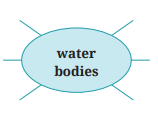
2. The poet has talked about a creek in the poem.
You now know that creek is a water body.
Complete the word web given below by writing
which other water bodies you can think of.
Discuss with your teacher.
Let us listen
Listen to the riddles and write which sport is being referred to in the
table below.
Riddle
1
2
3
4
Sport
Riddle 1
Run and pass, run and pass Kick a black and white ball Kick it straight into the goal Watch for mud—don’t fall What sport am I?
Riddle 2
Hold your breath, say Hu-tu-tu,
till you touch one or two.
Take care to keep a distance wide
As you run back to your team’s side.
Which sport am I?
Riddle 3
In the water, hold your breath,
The water is very cool,
Arms turn, legs kick
In the blue pool.
Which sport am I?
Riddle 4
Breathe in, breathe out!
Practice every day just right,
You will be healthy and fit
Get energy and grow in might.
What am I?
Try to create a riddle about your favourite game/sport/activity. Share
your riddles with your classmates. Let’s see who all are able to guess
it right.
Let us speak
Enact the roles of a parent and a child.
Situation 1 : Coming home late after play.
(Parent upset/Child explaining)
Situation 2 : Sharing details of the games you played.
(Child excited/Parent asking details with interest)
Situation 3 : Bring a new friend home after playtime.
(Child introducing/Parent welcoming)
Let us write
Write a paragraph about your playtime, using the clues given below.
• What time do I go out to play?
• Who do I play with?
• What games do we play?
• Which is my favourite game?
• What do we gain from playing together?
• When do we finish playing and go home?
Now, give a title to your paragraph.
Let us explore
There are many indigenous games in India. Kho-kho is an example of an
indigenous game. Indigenous games are native to a region. Find out some
native games of your state and other parts of India. Learn the rules of
one such game and play it with your classmates under the supervision of
your teacher.
Yoga–A Way of Life
Let us do these activities before we read.
1. What do you know about yoga?
Discuss in pairs and share with the
whole class.
2. What is 21st June known for? What
do we do on this day?
3. List as many words you know
related to yoga. Share them with
your classmates
Let us read
Yoga is a physical, mental, and spiritual practice
that originated in ancient India. The word
‘Yoga’ comes from the Sanskrit root ‘yuj’, which
means ‘to join’ or ‘to unite’. This symbolises the
unity of mind and body; thought and action;
harmony between human and nature. It is a
holistic approach to health and well-being.
Sage Patanjali presented the ancient
tradition of yoga in a systematic way in ‘Yoga
Sutras of Patanjali’. He described yoga as the
means to make the mind quiet and free from
all distractions.
Yoga has become increasingly popular
around the world due to its many health
benefits.
• Yoga postures (asanas) help to stretch and
strengthen the muscles, increase flexibility,
endurance and balance. This can improve
overall physical fitness. This can also help to
reduce body pains, such as lower back pain.
• Yoga involves breathing techniques and
meditation, which can help to calm the mind
and reduce stress and anxiety. It relaxes
the mind, improves the quality of sleep and
increases concentration.
• Yoga has been shown to boost the immune
system. It can improve heart health by
lowering blood pressure and improving
circulation.
• Yoga can aid in weight loss by burning
calories, and maintaining health.
Yoga promotes a sense
of overall well-being.
This is the reason why
the benefits of practising
yoga are internationally
recognised. The World
Health Organisation (WHO) on 20th June 2021,
launched an App called WHO mYoga. The app
contains a collection of videos and audio files
to teach and support yoga practice. The aim
was to have an easy-to-use and free tool for
people across the world to encourage them to
practise yoga.
endurance: capacity to continue without giving up, anxiety: worry, boost: increase
We can start practicing yoga at any given moment of time. We
must remember that when we practice yoga asanas (postures),
we do not just stretch the body. The mind has to be with the body.
This is the reason why it should be practised without distractions.
If each stretch is coordinated with the breath and awareness,
our practice will become a yogic practice.
Being the first accessory of Hatha-Yoga, āsana is described first. It should be
practised for gaining steady posture, health and weightlessness of body.
SOURCE: HAṬHA YOGA PRADIPIKĀ
Let us discuss
1. Read the passage again and fill in the blanks with words from the box.
sleep lifestyle health strength calm stress balance
Yoga is a practice that not only improves physical flexibility but
also improves mental (i) ______________ and leads to a healthier
(ii) ______________. It involves a series of asanas, which increase muscular
(iii) ______________. Practicing yoga also leads to a better body and
mind (iv) ______________ and reduces body pain such as the lower back.
Moreover, the focus on breathing techniques and meditation makes
the mind (v) ______________, lessens (vi) ______________, and improves
the quality of (vii) ______________. This helps to adopt a more positive
lifestyle.
Let us think and reflect
1. What is the aim of yoga?
2. Explain the idea of unity in yoga.
3. What does the launch of the WHO mYoga app tell us about the
importance of yoga?
4. Describe one long-term effect that the practice of yoga can have on a
person’s qualities.
Let Us Learn
1. Let us play the game of Antakshari. The first word is ‘yoga’. The next
word must then begin with the letter ‘a’. This activity will go on and the
whole class will participate and will write the words on the blackboard.
How many new words have you learnt?
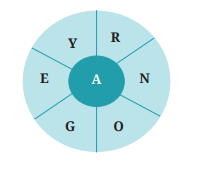
2. Make as many words as you can R
using the letters shown. Use the
letter ‘A’ in all the words that you
make.
Let us listen
You will listen to a girl talk about practicing yoga. As you listen, select
four true statements from the sentences given in the table. (refer to page
129 for transcript)
Statements
T / F
1. The girl sees people at the park doing breathing exercises.
2. Her grandfather began practising yoga sixteen years ago.
3. The girl practises some easy yoga exercises with her grandfather.
4. The girl practises breathing exercises to relax.
5. Her grandfather is fit even though he has untimely meals.
6. Her grandfather’s regular yoga practice has kept him strong.
7. The girl wishes to learn asanas over the weekend
Let us speak
1. Participate in groups of four to share your ‘yoga thoughts’.
If you have tried yoga
If you have not tried yoga, yet
• I practise yoga because ...
• My favourite thing about yoga is ...
• I feel ____________ after a yoga session because ...
• The one thing in yoga that I want to practise is ____________ because ...
• I wish to practice yoga because ...
• I hope that once I begin practising yoga, I ...
• The kind of exercise I want to try in yoga is ____________ because ...
2. Take turns to speak and listen to others when they share their thoughts.
Let us write
Write a short paragraph on ‘The Benefits of Yoga’. You may use the following
sentence starters along with your own ideas to create the paragraph.
Opening line
Yoga is important because ...
Supporting ideas
• One benefit of yoga that interests me is ...
• Practicing yoga can help people ...
• A popular yoga pose is _____ because ...
• Yoga is not just physical exercise; it also ...
Concluding line
Finally, yoga can be a great way to ...
Let us explore
1. Do you know?
• A few seals of the Sindhu-Sarasvati Civilisation, dating back to
2700 BC, indicate that yoga was prevalent in ancient India. Many
people contributed to its development and now, yoga has spread
all over the world. On 11th December 2014, the United Nations
General Assembly (UNGA) with 193 members accepted the proposal
to celebrate ‘21st June’ as ‘International Yoga Day’.
2. Find out about two asanas and their benefits, and share your findings
with your classmates and teacher. You may visit the following websites
to learn more about yoga.
Good morning, everyone. I know you all are excited about
the Friday, friendly matches. This Friday we shall have three
matches—one for chess, the next for kho-kho and finally one
for badminton. I have put up the kho-kho teams’ name list
on the sports’ notice board. Since this is a team game, your
class VI-B shall be playing against the VI-D kho-kho team. The
kho-kho match refreshments are being sponsored by Xydium
Sports Club. Let me clarify, the spelling is X-Y-D-I-U-M, Xydium.
Now the places for the matches—the first one is chess.
It’ll take place in the 1st floor activity room with Vani as the
scorekeeper. Kho-kho will be played in the sport’s ground
where I myself will be the referee. For badminton, we have
chosen the multipurpose hall on the ground floor hall. The net
will be put up there.
For the chess match, it has been decided that this match
shall be played between Sarita and Nupur. Two matches will
be played during the regular games period on Friday but khokho will be played in the 2nd and 3rd period. Remember the
kho-kho team names are up on the Sports’ Notice Board.
Good luck!
You will listen to the audio or narration once again. As you
listen, check your answers.
Transcripts
Let us listen (refer to page 125)
Yoga–A Way of Life
Namaste everyone!
I wish to share with you all that I do simple yoga exercises
with my grandfather. He has been practising yoga since he
was 16 years old. My grandfather is fit and strong even at
the age of 65. I am sure that this is the result of many good
habits. I know that eating a balanced diet regularly and
making yoga a part of his life have been hundred percent
effective. When I accompany my grandfather to the park, I
see so many people–young and old–doing yogic breathing
exercises.
I like doing these exercises. Whenever I’m a little worried
about an Inter-House competition, I always remember to do
some of these exercises early morning that day. It relaxes
me and makes me feel focused and calm. I plan on learning
some asanas from my grandfather during the summer
vacations.
Wish me luck!
Wish me luck!
You will listen to the audio or narration once again. As you
listen, check your answers.
Who Am I?
I am an odd number.
Take away a letter and I
become even.
What number am I?
You go at green,
but stop at red.
Who am I?
I follow you all the time,
but you can’t touch me or
catch me. What am I?
three letters in my name; backwards-forwards it’s the same. i am a body part. who am i?