
UNIT 05
CULTURE AND TRADITION
Hamara Bharat — Incredible India!
Let us read the following passage.
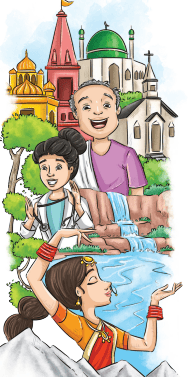
Bharat has been known
worldwide as a land of wise
and heroic individuals. Its
rich and diverse culture has
attracted numerous travellers
since ancient times. The
people here live in unison,
presenting to the world unity
in diversity. Bharat is a land
rich with rivers, lakes, and
high mountains. Its green
forests are home to many
plants, insects, birds, and
animals. All these elements
ensure that Bharat prospers
and is respected globally. As
its inhabitants, we need to
continue working hard and
make sure that it prospers
Let us discuss
1. What has Bharat always been known for?
2. What is attractive about Bharat?
3. What is special about the fact that the people live here in unison
4. What geographical features does the passage mention?
5. What is the advice given to everyone ?
Kalakritiyon ka Bharat
Let us do these activities before we read
Our country is beautiful and every state has its own uniqueness. The words
given below are part of our identity. Complete these words with the correct
vowels (A, E, I, O, U).
(a) We like to decorate our homes with our f __ l k __ r t.
(b) Our c __ l t __ r e consists of our ideas, customs, traditions, values, arts,
and languages
(c) All of us celebrate our f __ s t __ v __ l s together.
(d) We tell stories to our children to teach them about our c __ l t __ r e,h __ s t __ r y, and l __ g __ n d s.
(e) We have our own l __ n g __ a g __ s to talk to each other.
. 
Let us read
“So, are you ready to meet your friends from all over the country?”
the teacher asked the students sitting in the big hall.
“Yes!” was the loud answer from the class.
“Can someone tell me for which programme are we here?”
the teacher asked.
“Ek Bharat, Shreshtha Bharat”, the students answered together again.
“Please raise your hand to tell me what it is all about,” the teacher said.
Many hands went up and some were jumping to answer. Theteacher asked Renu. With a smile on her face, she said, “It is to know that we all belong to one nation and that is the bond we share. And our unity in diversity makes us the most wonderfulcountry in the world.”
Let us discuss
1. What is the Ek Bharat, Shreshtha Bharat programme all about?
2. Why is this programme being conducted?
II
The teacher smiled at her as everyone clapped. Just then, Bala pointed out, “Look! The video has started!” The big screen now had little windows each with a smiling child. Each child hadsomething to share.
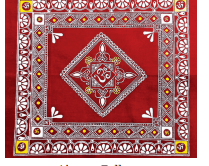
Pranam! I am
Aakansha from
Uttarakhand. I am
going to tell you
about Aipan, our folk
art, that we draw on
family functions and
festivals. It is done
with white rice flour
paste on brick-red
walls coloured with geru. It is made on floors
and walls of puja rooms, and outside the main
door of the home. It is an art form made by
the women in the family. The designs are very
beautiful and mathematical, and are based on
our cultural traditions, and observations of
nature.
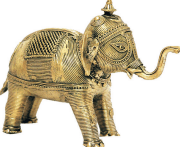
Suprabhat! I am
Priyaranjan from Odisha.
My tribe practises a
4000-year-old metal craft
named Dhokra. To begin,
we make a figure with
clay, dry it, and cover
it with a layer of wax.
Then, we carve the fine
details on the wax. After that, we cover the figure
with clay, and put it in the fire. The wax melts and
comes out of small openings. Next, brass scrap
is melted and poured into the empty space. The
liquid metal takes the same shape as the wax.
Finally, we remove the outer layer of clay and finish the metal figure as we want.
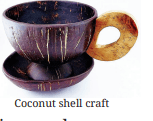
Suprabhaatam! I am
Chitra from Kerala. I want
to tell you about coconut
shell craft. First, we clean
the outside and inside of a
brown coconut shell. After
that, we make it smooth by using sandpaper or
a machine. Then we give it the shape we want,and make it stable by fixing a base under it.
At last, we polish it using wood polish to make
it shine. We make household things like bowls
and even jewellery from the coconut shells. It
is a biodegradable craft.
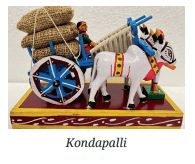
Subhodayam! I am Balamurali from
Andhra Pradesh. I
want to tell you about
the 400-year-old art
of making toys in my
village, Kondapalli.
To make the toys, we
take soft wood from
the nearby hills. After
that, we carve each part of the toy separately.
Then, we use makku—a paste of tamarind
seed powder and sawdust to join the pieces
together. Next, we add details and finish the
toys. Finally, we use oil and water-colours or
vegetable dyes and enamel paints to colour
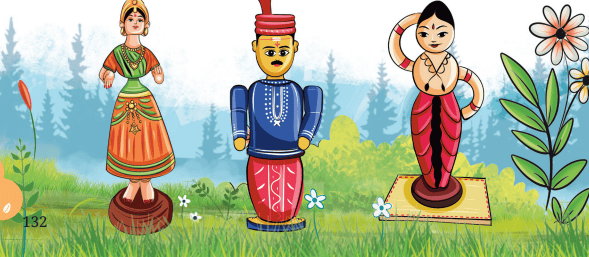
them. These toys are based on folk stories,
animals, birds, bullock carts, rural life, etc.
Let us discuss
On the basis of what the speakers said about the art forms, complete thetable given below
Let us think and reflect
1. Fill in the blanks to complete the following sentences.
(a) The designs for Aipan are taken from ________________ and
________________.
(b) Dhokra metal craft is very old because it is ________________ old.
(c) A base is needed for coconut shell craft to make it ________________.
(d) Soft wood, ________________ and colours are used to make Kondapalli
toys.
2. Why does Akanksha’s family make Aipan?
3. In Dhokra, why does wax come out of the small openings?
4. What is common in the toys made in Balamurali’s village and coconut
shell craft in Kerala?
1. Fill in the blanks to complete the following sentences.
(a) The designs for Aipan are taken from ________________ and
________________.
(b) Dhokra metal craft is very old because it is ________________ old.
(c) A base is needed for coconut shell craft to make it ________________.
(d) Soft wood, ________________ and colours are used to make Kondapalli
toys.
2. Why does Akanksha’s family make Aipan?
3. In Dhokra, why does wax come out of the small openings?
4. What is common in the toys made in Balamurali’s village and coconut
shell craft in Kerala?
Let us learn
1. Priyaranjan, Chitra and Balamurali share how art works of their states
are made. They use some words to show the order of making it. Those
words are given in the box below
1. Priyaranjan, Chitra and Balamurali share how art works of their states
are made. They use some words to show the order of making it. Those
words are given in the box below
Now, use some of these words to complete the paragraph given below.
Use one word only once.
How I Get Ready for School
(i) ____________ I get up and go to take a shower. (ii) ____________, I wear
my school dress. (iii) ____________, I eat my food. (iv) ____________, I wear
my shoes. (v) ____________, I pick up my bag and go out of my home.
2. The children from different states each speak about one art form from
their state. When they speak, they use the first form of the verb. It shows
something that happens regularly. It is called the present tense. With
he, she and it, -s/-es is used with the verb to show the present tense.
Make five sentences with the help of the words given in the table below.
Use -s/-es wherever necessary. Two examples are given.
137
Pronouns Verbs Part of a sentence Complete Sentence
Let us listen
1. Listen to the description of gakkad bharta and complete the notes
given below. (refer to page 162 for transcript)
Gakkad Bharta
(a) Name of the speaker : __________________________
(b) The town of the speaker : __________________________
(c) The state he belongs to : __________________________
(d) The name of the food item : __________________________
(e) Vegetables roasted for bharta : __________________________
2. Now, listen to the description again and complete the flowchart on howto make gakkad bharta.
Let us speak
1. Speak about a local art form of your region. It can be any one out of
painting, rangoli, metal craft, embroidery, music, dance or drama.
Remember to include:
• the name of the art form
• what things do they need for it
• how do they make/present it
2. You may use the words given below when you speak.
• I know about the art form called …
• They need ...
• To make it, first ... after that ... next ... then ... at last ..
Let us write
You heard children from different states speak about the art forms from their state. Discuss in pairs which art form you liked the most.
Now, write a paragraph with five sentences giving your reasons for liking it.
Let us explore
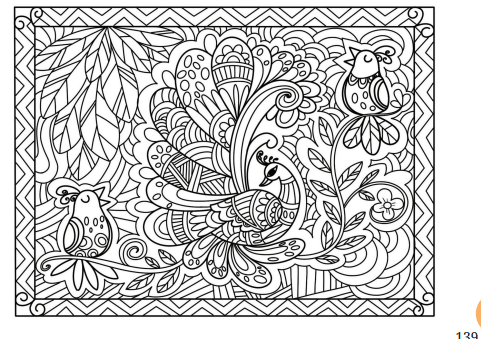
1. Madhubani painting is a traditional art form from Bihar. The artists use natural colours to make them on the walls of their houses. You can also make and use natural colours as given below.
• yellow from haldi
• green from leaves
• red from red flowers/geru/sindoor
• orange from flowers
• blue from neel/indigo powder
Given below is a Madhubani painting. Colour it with natural colours or any other colour.
2. Ek Bharat, Shreshtha Bharat Programm
Bharat has diverse languages, cuisines, music, dance, theatre, movies and films, handicrafts, sports, literature, festivals, paintings, sculptures, etc. The Ek Bharat, Shreshtha Bharat programme aims to enhance interaction and promote mutual understanding between people of different states/UTs through the concept of state/UT pairing. This is to celebrate the unity in diversity and strengthen the emotional bonds between its citizens. The vision is to enable people to develop a sense of common identity by sharing best practices and experiences. The programme aims to contribute to nation building by highlighting the
inter-connectedness between various cultures and traditions.

The Kites
Let us do these activities before we read
1. Answer the following questions and share them with your teacher and
classmates.
(a) Have you ever flown a kite or seen someone fly it? Where? When?
(b) Describe the kite—colour(s), shape, design of tail, any other detail.
(c) What did you think when you saw the kite up in the sky?
2. Search the internet for videos on Kite Festivals and watch them with
your teacher and classmates.
(a) Share the things with your teacher that you saw and what the people
were doing.
(b) Would you like to participate in this kind of festival? Why?
(c) What kind of kite would you like to fly?
3. Look at the picture and complete the sentences. Share your responses
with your teacher
(a) I can see ___________, ___________ and
___________ in the picture.
(b) The weather in the picture is ___________.
(c) The kite is ___________ high in the sky.
(d) The child is ___________ from below.
(e) The tail of the kite ___________.
4. Now, think and answer.
(a) List two more things that you want to add to
the picture.
(b) If I were the child, I would ___________.
(c) If I were the kite, I would ___________
Let us read
Up in the air
See the kites fly,
Like coloured birds
In the wind-whipped sky.
I wish I were small
And light as air,
I would climb on a kite
And sail up there.
Then I would drift upon
The paper wings,
And hear the songs
That the wild wind sings.
What fun it would be
To look right down,
Over the park
And the rooftops of town.
The people below
Would stand and stare,
And wish they were me
High, high in the air.
Daphne Lister
Let us discuss
1. Read the poem silently. As you read, mark the given statements as Trueor False.
2. Complete the following sentences. (a) The poet says that the kites are like coloured birds – See the kites fly/Like coloured birds in the sky. The kites have been compared to b __ __ __ __ because they ______________. (b) The child wishes to be like air – I wish I were small / And as light as air. The child wishes to be as l __ __ __ t as __ __ __. The child wishes this to be able to c __ __ m __ on a kite and fly. 143
Do you think that the use of simile in this poem helps us imagine better
when we read the poem? Share your thoughts with your teacher and
classmates.
3. Find a set of words from the poem that begin with the same consonan sound.
Stanza 1
Which consonant sound do both words begin with ?
Stanza 2
Which consonant sound do both words begin with ?
This is called alliteration. For example, big bright blue bag, funny fan,
etc.
Create 4 other sets of words using alliteration.
4. In the last stanza, the two words that the poet repeats are __________,
__________ to tell us that the kite is flying __ __ __ y high.
5. Study each stanza and underline the rhyming words from the end of
each line. Also, circle the end words in the stanzas that do not rhyme
Let us think and reflect
1. Read the given lines from the poem and answer the following questions.
What fun it would be
To look right down,
Over the park
And the rooftops of tow
(a) Circle the word that does not share the same feeling as ‘fun’:joy, excitement, care, happiness.
(b) Which line tells us that the poet was somewhere above ?
(c) Choose the scene the child saw.
(i)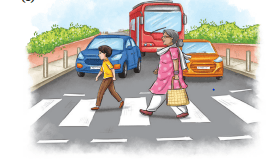
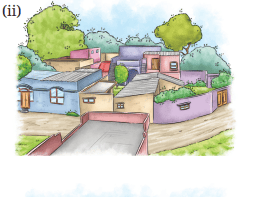
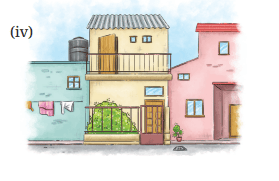
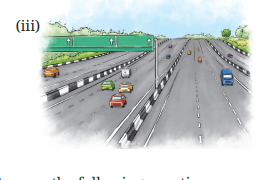
2. Answer the following questions.
(a) How does the poet describe the kites in the first two lines?
(b) Why does the child say that they have to climb a tree first to get onto
the kite?
(c) What are the songs that the child hears when flying atop the kite?
(d) Why did the people look up at the child and stare? If you looked up
and saw that, what feelings would you have?
(e) If you were the kite carrying the child high up in the air, what would you tell them?
Let us learn
1. Look at the picture of the kite and read what some of its parts are named.
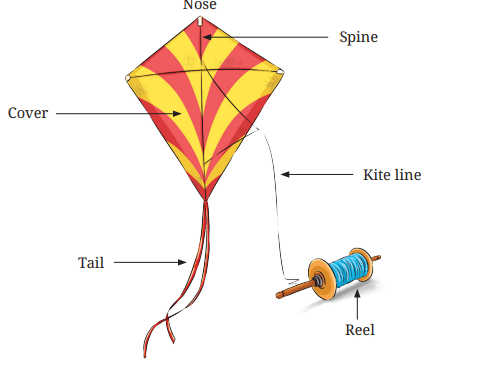
Now, complete the given conversation by filling the blanks with some
‘parts of a kite’ words from above.
Bina : I love the long yellow t _ _ _ at the end of my kite.
What colour is your kite?
Saroj : My kite’s c _ _ _ _ is pink. The s _ _ _ _ e is black.
Bina : Oh wonderful! My kite l _ _ _ is red. The r_ _ l that wraps it is green. I really like it.
Saroj : My kite line is red too. The tip of my kite has a blue
_ _ _ e.
Bina : Beautiful! Let’s go and fly our pretty kite.
2. Let us create a poem using words in a kite!
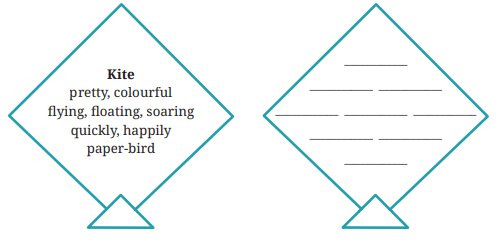
This is called a cinquain poem. It is a five line poem that describes
a person, a place or a thing.
Now, create a cinquain poem yourself on anything you like.
3. The poet uses the word ‘fly’ and ‘drift’ to tell us about the kite’s movement.
(a) Circle the words that match with the ‘drift’ movement. You can
choose more than one word.
slow fast quick upward
downward round and round float
(b) Study some other words about the kite’s movement and share what type of movement they show. You can look at (a) for the type of movement.
4. The poet has used expressions like—
up in the air; look right down; stay up there; stand and stare
(a) Read how these expressions are used in the poem.
(b) In pairs, make sentences using these expressions. Discuss with
your teacher and then write in your notebooks.
Let us listen
Listen about the Kite Festival in India. As you listen, circle the words that
are not correct. Then, listen again and write the correct words. (refer to
page 163 for transcript)
(a) Kite Festival is celebrated during the month of June.
(b) The International Kite Festival is named Uttarayan in Eastern India.
(c) Uttarayan is mainly celebrated in Gujarat, but also in Maharashtra
and Telangana.
(d) During the Kite Festival, we can see kites of different shapes, sizes
and colours.
(e)In Karnataka, the Tourism Department organises the kite festival
every year.
(f) The Punjab region celebrates Basant Panchami and Baisakhi by
flying kites.
(g) People of India also enjoy flying kites on Earth Day.
Let us speak
Share a kite-flying experience with your classmates. If you have not
flown a kite yet, share an experience of watching kites fly. Give details Where? When? Why? How? Speak in complete sentences.
Let us write
1. Imagine yourself as a kite. In pairs, first discuss all the following hints.
• What shape of kite are you? What colours do you have? What other
parts of yourself are you happy about?
• Where are you? Who do you belong to? What activities do you do?
Who are your friends?
• Do you have any message for humans?
2. Now, write a paragraph of about 100 words, with the title—I am a Kite .
Let us explore
1. The mention of kites exists in ancient Indian texts. It can be found in the poetry of the thirteenth-century Marathi saint and poet, Namadeva. In his poems or gathas, he called a kite a gudi, and there is a mention that the kites were made from kaagad (paper).
2. Have a look at some of the different types of kites. Choose which one is commonly seen.
(a) Find out the steps to make a kite.
(b) Follow the steps and create your own kite. Get it to school to show your
teacher and classmates.
(c) Write a message on the kite. For example: Happy Independance Day!
Ila Sachani:
Embroidering Dreams with her Feet
Let us do these activities before we read.
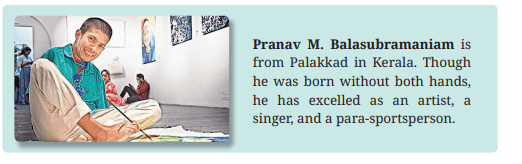
1. Look at the given picture and information. Discuss the questions with your teacher and classmates.
(a) Do you think Pranav’s task is simple? Why or why not?
(b) How does Pranav’s special ability make you feel?
(c) What qualities do you think were important for Pranav to become
successful?
(d) What message does Pranav’s story give us?
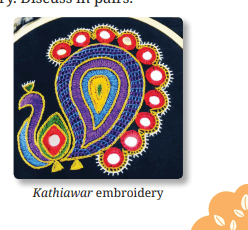
2. Look at the picture of Kathiawar embroidery. Discuss in pairs.
(a) List the steps you think are needed to
create this embroidery.
(b) Discuss if these steps can be done
with feet, instead of hands.
(c) What efforts would be needed if
someone has to embroider with their
feet? Do you think it is possible?
Let us read
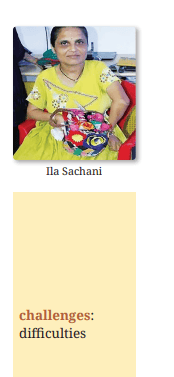
1. When you enter a tiny room in Moti Vavdi village, Bhavnagar, Gujarat, you will see lots of bright colours. There are many lovely things like cushions, bedcovers,
pillows, and more, with beautiful designs. Ila Sachani, a wonderful lady with a big smile, makes all these using a shiny needle to create these designs. She is very good at
Kathiawar embroidery—a style that needs a lot of skill.
2. Ila Sachani’s journey began in the quiet settings of Amreli, Gujarat, where she was born into a farmer’s family. From the beginning, life presented its challenges,
as Ila was born with her hands hanging loose by her sides. Unlike other children, she could not use her hands in the usual way. While other small hands drew figures
in the sand or plucked wild flowers, she wondered why she could not join them. She too wanted to hold a chalk in her hands and draw figures on a slate.
3. Ila’s mother and grandmother encouraged the little girl and were single-minded to help her overcome her challenge. They were skilled in the traditional art 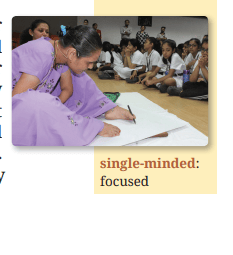
of Kathiawar embroidery and decided to share this art with Ila. They taught her to create many beautiful patterns using her feet! It was certainly not an easy task, but Ila accepted the challenge with determination. Her parents also helped her learn to do things with her legs, like eating and combing her hair.
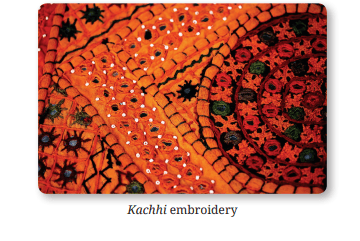
4. Threading a needle was hard, but Ila did not give up and became an expert at a young age. Her younger brother and sister helped her too. She learned many styles, even ones from outside Gujarat—Kachhi, Kashmiri, Lucknawi and others.
5. For Ila, embroidery became a way to express herself. At first, she crafted fine designs only for her family and friends, who were awestruck by her talent. They talked about
those designs to others. Soon, the people in the village, too, discovered Ila’s special skill and the admiration for her work began to spread.
6. Word reached the government office, in Surat. They were moved by Ila’s story and impressed by her work. They decided to display some samples of her embroidery
at a state exhibition. This experience opened new doors for Ila. People observed the beauty woven by her feet and readily purchased the creations. Ila was no more ahidden talent, but famous!
7. Encouraged by this popularity, Ila participated in more exhibitions, not just within the state but at the national level. She received many awards and honours, not just for her art but also the willpower and creativity that her work showed. Ila Sachani, once a farmer’s daughter facing a tough challenge, worked hard and became a celebrated artist and receiver of the President’s Medal.
8. The most important change for Ila was the new independence. Through her skill, she not only earned a regular income but also found joy in doing what she loved. She proved, through her creations, that challenges can be turned into victories with focus, hard work, positivity and never giving up.
9. Her embroidery, created with her feet, reminds us that art has the power to rise above physical boundaries and touch the soul.
Let us discuss
Read the paragraphs and write the main idea for each. Then, match the main idea with two supporting details.
Let us think and reflect
1. Read the following lines and answer the questions that follows.
Unlike other children, she could not use her hands in the usual way. While
other small hands drew figures in the sand or plucked wild flowers, she
wondered why she could not join them. She too wanted to hold a chalk in
her hands and draw figures on a slate.
(a) Choose the correct option to fill in the blank.
‘Unlike other children’ means that Ila was _____________. (unaware/different/simple)
(b) What could Ila have felt when she could not join others in things
they did?
(c) Complete the following with a suitable reason.
Ila could not draw figures on the slate because ___________.
2. What creative ways did Ila and her family use to overcome the challenges
she faced?
3. How did ‘new independence’ help Ila?
4. Why was the first state exhibition an important event in Ila’s life?
5. What does the sentence, ‘art has the power to rise above physical
boundaries and touch the soul’, tell us about the power of art?
6. How can we be helpful and encouraging like Ila’s family and friends
when someone faces challenges?
7. How can Ila’s story help others to overcome challenges in their lives?
Let us learn
1. Read the words from the text given in Column A. Then, try to understand
what they mean by reading the sentences in Column B. Now, match the
word to its correct synonym in Column C. There are two extra synonyms
given. You may refer to the dictionary.
2. Unscramble the antonyms of the words in Column A. An example has
been given for you.
Example: display – E D I H (H I D E )
(a) tiny – E G H U (H __ __ __)
(b) wonderful – R E E B L I T R (T __ R __ __ B ___ E)
(c) quiet – I Y N S O (N __ __ __ __)
(d) task – S I A E M T P (P __ S T __ __ E)
(e) tough – SEYA (E __ __ __)
Use these antonyms in sentences of your own.
3. Read the sentences from the text and focus on the highlighted words.
• You will see lots of bright colours.
• There are many lovely things like cushions and bedcovers.
• They taught her to create many beautiful patterns using her feet!
She learned many styles.
• She received many awards.
(a) The highlighted words tell us about the quantity. Choose what the
words show.
(i) Unmentioned quantity
(ii) Large quantity
(b) Let us now understand what words of quantity tell us.
Fill in the blanks to complete an example for each word of quantity. Hints are given in the brackets.
Now, create two sentences for each word of quantity (i-vi), and share them with your teacher and classmates.
Let us listen
You will listen to a talk about Kathiawar embroidery. As you listen, circle
the correct option. (refer to page 164 for transcript)
a. Form b. Colours
(i) old (i) soft
(ii) new (ii) bright
c. Stitches d. Seen on
(i) running stitch (i) children’s cap
(ii) chain stitch (ii) pants
e. Things used f. Designs
(i) small mirrors (i) elephants and horse
(ii) shapes of buttons (ii) squares and triangles
Let us speak
(a) Look at two examples.
Where were you born? Did you go to school?
The Yes/No questions use a rising tone at the end.
(b) Speak the example questions aloud as a peer activity at least five
times.
(c) Now, take turns to ask your questions to another classmate.
Speak clearly and with the correct rising tone as shown in (a).
Let us explore
1. Does anyone in your family or neighbourhood do embroidery? Find out
what type of embroidery they do and how they learnt it.
2. Try a simple stitch on cloth with the guidance of a family member.
3. Visit the given link to find out about embroidery types from different
parts of India. Share with your teacher and classmates which one you
liked the most and why
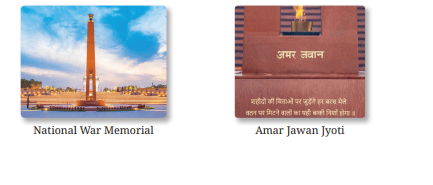
National War Memorial
National War Memorial, New Delhi was established in February 2019. It is a national monument built by the Government of India in honour of our brave soldiers.
Let us read
In Bharat’s heartland, a grand sight to behold, The National War Memorial, honours brave stories retold.
With respect and grace, it stands with pride, Each name etched, each stone, each story to confide.
From battle fields to skies, and to oceans wide, They stand for Bharat, side by side.
The eternal flame, in silence it glows, Paying homage to their courage that shows.
Their sacrifice, always in our mind, In blessed memory, forever remind.
With pride and respect, let’s always remember,At the National War Memorial, their sacrifice forever
Let us do these activities
1. Read the poem aloud.
2. Recite the poem with your classmates and teacher.
3. Remember the poem.
Let us explore
1. Visit the website of the National War Memorial and learn more about it.
https://nationalwarmemorial.gov.in/
2. Plan a visit to the National War Memorial with your teacher/parents