On 28 February, the school hosted a science fair to celebrate National Science Day. At the entry gate, siblings Ashwin and Keerthi were greeted with a white sheet of paper. They were curious to know why a white sheet of paper was given to them!
A few steps ahead, there was a volunteer spraying a liquid on these sheets of paper. The siblings also got their white sheets sprayed. To their surprise, the words ‘Welcome to the Wonderful World of Science’ appeared on the papers the moment the liquid was sprayed (Fig. 2.1). They were excited and eager to know how this happened and the reason behind it.
Their curiosity was partly satisfi ed at the ‘Colourful World of Substances’ stall. They saw many activities showing colour changes on mixing diff erent substances. They decided to explore these changes further. Let us join them on this learning adventure.
National Science Day
Explore! Enquire! Enjoy!
Fig. 2.1: Scene of a science fair
2.1 Nature — Our Science Laboratory
2.1.1 Litmus as an indicator
Activity 2.1: Let us explore
Collect samples of lemon juice, soap solution, amla juice, tamarind water, vinegar, baking soda solution, lime water, tap water, washing powder solution, sugar solution, and salt solution.
Take a strip of blue litmus paper and cut it into small
pieces.
Spread these pieces on a clean and dry white tile.
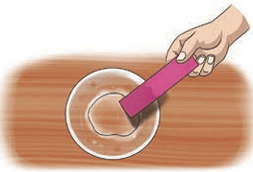
Using a dropper, put one drop of each of the samples, one-by-one, on these litmus paper pieces, as shown in Fig. 2.2a.
Fig. 2.2(a): Colour change in blue litmus paper
Do you observe any change in the colour of the blue litmus pieces?
Record your observations in Table 2.1.
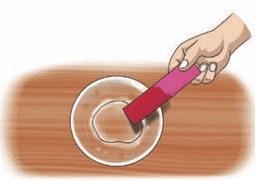
Repeat the same activity with pieces of red litmus paper as shown in Fig. 2.2b and record your observations in Table 2.1.
Fig. 2.2(b): Colour change in red litmus paper
How to prepare lime water?
Do not confuse lime water with the word lime, which is a fruit
similar to lemon.
Lime water (solution of calcium hydroxide in water) can be easily prepared by mixing lime (chuna, i.e. calcium oxide) in water and leaving it undisturbed for some time, say an hour. Filter the liquid into another container and use it as lime water.
Table 2.1: Testing the nature of samples with blue and red litmus papers
S.No.
Name of the sample
Colour of blue litmus paper after putting a drop of sample
Colour of red litmus paper after putting a drop of sample
1.
Lemon juice
2.
Soap solution
3.
Amla juice
4.
Tamarind water
5.
Vinegar
6.
Baking soda solution
7.
Lime water
8.
Tap water
9.
Washing powder solution
10.
Sugar solution
11.
Salt solution
12.
Any other
Now, let us analyse Table 2.1 and sort the samples into three groups as follows —
Group A with samples that turn the blue litmus paper to red.
Group B with samples that turn the red litmus paper to blue.
Group C with samples that do not affect either of the two
litmus papers.
Record the data in Table 2.2.
Table 2.2: Grouping of samples tested in Table 2.1
Group A
Group B
Group C
I am curious to know — what are these red and blue litmus paper strips made of? Why do they change colour when drops of some samples are put on them?
Let us fi nd out!
Litmus is a natural substance obtained from lichens. It is available both as a solution and in the form of paper strips, known as litmus paper. The litmus paper is available in two colours—blue and red, as shown in Fig. 2.3.
Fig. 2.3: Blue and red litmus paper strips
Substances that turn blue litmus paper to red are acidic in nature, while those that turn red litmus paper to blue are basic in nature. Since litmus shows diff erent colours in acidic and basic solutions, it is called an acid-base indicator.
Some other substances, both natural and synthetic, can also be used as indicators. Synthetic indicators are made in laboratories, and you will learn more about them in higher grades.
HOLISTIC LENS
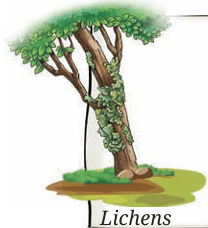
Lichens are formed by the association of two living organisms, a fungus and an alga. They grow on rocks and trees in regions that have abundant rainfall and clean air. Do you find lichens on trees in your neighbourhood?
Lichens
Now, let us classify the substances sorted in Group A, Group B, and Group C in Table 2.2.
The substances in Group A, such as lemon juice, amla juice,
tamarind water, and vinegar turned the blue litmus paper to red, implying that these substances are acidic in nature.
The substances in Group B, such as soap solution, baking soda solution, lime water, and washing powder solution turned the red litmus paper to blue. Hence, these substances are basic in nature.
The substances in Group C, such as tap water, sugar solution,
and salt solution, did not change the colour of either litmus
paper. Can you predict their nature?
These substances are said to be neutral because they are neither acidic nor basic.
Activity 2.2: Let us relate and explore
Are all the substances in Group A of Table 2.2 edible? Have you
ever tasted these edible substances? Can you recall their taste?
You will find that all these substances taste sour. Thus, we can
say that substances that taste sour tend to contain acids and are acidic in nature.
Caution — Do not taste anything until asked to do so. Do not taste any unknown substance.
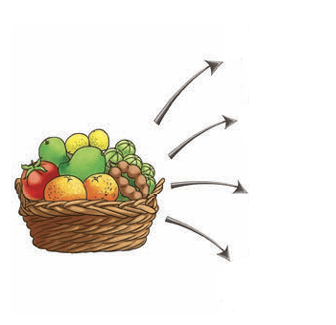
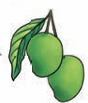
Some common edible substances and the names of the most common acids present in them are given in Fig. 2.4.
Citric acid
Ascorbic acid (Vitamin C)and Citric acid
Tartaric acid
Citric acid and Oxalic acid
Fig. 2.4: The most common acids present in some edible substances
Find out and write the names of the most common acids
present in the following substances —
Now, let us take one of the substances — baking soda solution — from Group B. Rub the baking soda solution between your fingers. What do you observe?
It feels soapy or slippery. Basic substances are generally
slippery to touch.
Also, bases generally taste bitter, but everything that tastes bitter may not contain a base. For example, bitter gourd (karela) possesses a bitter taste but is not basic in nature.
Now, I can check the nature of floor cleaning liquid using an indicator!
If litmus is not available, are there some other natural substances that can serve as acid-base indicators?
2.1.2 Red rose as an indicator
You might have observed many coloured flowers in your surroundings. Try making your indicators using these flowers.
Activity 2.3: Let us prepare
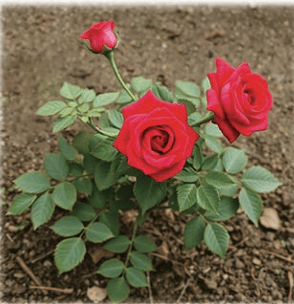
Collect some fallen petals of red roses available in your
surroundings (Fig. 2.5). It is advised not to pluck flowers. You
may pick petals or flowers fallen on the ground.
Fig. 2.5: Red roses
Take a fistful of the collected petals of red roses and wash
them with water.
Crush the petals using a mortar and pestle.
Place them in a glass tumbler.
Pour some hot water into the glass tumbler to ensure that the crushed flower petals are completely immersed.
Caution— Perform this step under the supervision of an adult.
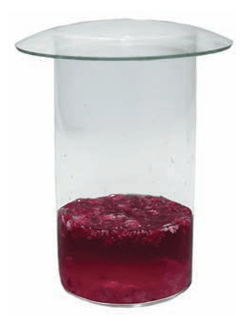
Fig. 2.6: Red rose petals immersed in hot water
Cover the glass tumbler with a lid. Wait for 5 – 10 minutes till
the water becomes coloured (Fig. 2.6), and filter it.
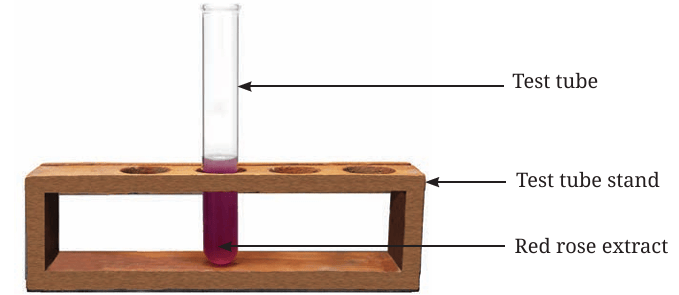
The filtrate (liquid after filtration) is the required flower extract (Fig. 2.7) to be used as an acid-base indicator.
Test tube
Test tube stand
Red rose extract
Fig. 2.7: Test tube containing the red rose extract
Activity 2.4: Let us find out
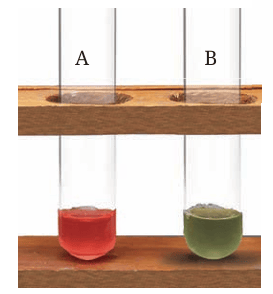
Place 10 – 20 drops of the prepared red rose extract in each of two small transparent bottles or test tubes. Mark them A and B.
Add 20 – 30 drops of lemon juice in test tube A and 20 – 30 drops of soap solution in test tube B with the help of
droppers.
Fig. 2.8: The changes in colour of the red rose extract on adding lemon juice (A) and soap solution (B)
Observe and record any colour changes (Fig. 2.8) to the extract in Table 2.3.
Repeat the same with the other samples used in Activity 2.1 and record your observations in Table 2.3.
Table 2.3: Testing the nature of samples with the red rose extract
S.No.
Name of the sample
The colour of the red rose extract after adding the sample
Nature of the substance
1.
Lemon juice
2.
Soap solution
3.
Amla juice
4.
.....
Discuss your observations with your classmates.
Are the samples that change the colour of the flower extract to a shade of red the same as those that changed the colour of blue litmus paper to red? (Group A, Table 2.2)
Are the samples that change the colour of the flower extract to a shade of green the same as those that changed the colour of red litmus paper to blue? (Group B, Table 2.2)
Are the samples that do not change the colour of the flower extract the same as those that did not change the colour of red and blue litmus papers? (Group C, Table 2.2)
From the above activity, we can conclude that the red rose extract can also be used to test the nature of the substances; hence, it is another example of an acid-base indicator. We can conclude that the red rose extract seems to give red colour in an acidic solution and green colour in a basic solution.
Can you now fi ll in the nature of the substances in Table 2.3?
We are sure that you will be excited about the above results.
You may repeat the process of preparing the extract and testing substances with some vegetables, fruits, or flowers, such as beetroot, purple cabbage, turmeric, Indian blackberry (jamun), and red hibiscus (gudhal) flower. They can also act as acid-base indicators.
FASCINATING FACTS
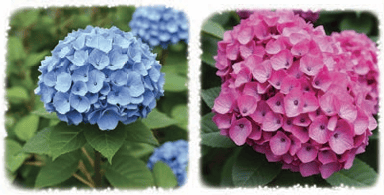
Hydrangea is a plant that grows in cooler climates in the Himalayan region and the North-eastern states. It gives flowers of diff erent colours, depending on the nature of the
soil. Acidic soil produces blue coloured flowers, whereas in basic soil, the flowers are pink or red. Can gardeners alter the colour of hydrangea flowers by adjusting the acidic or basic nature of the soil?
Hydrangea flowers
2.1.3 Turmeric as an indicator
We have used blue and red litmus paper strips in Activity 2.1. Can
you also make paper strips with some other natural indicators? Find out by performing the following activity.
Activity 2.5: Let us prepare
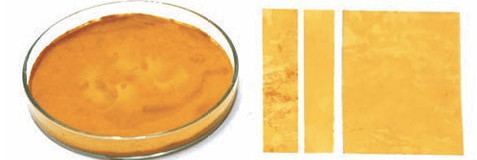
Take a spoonful of turmeric (haldi) in a petri dish or container and add a little water to make a paste (Fig. 2.9a). You may also grind a piece of fresh turmeric.
Carefully dip a piece of fi lter paper in the turmeric paste
until it gets yellow colour.
Take it out and allow it to dry.
Cut this yellow paper into thin strips, which are used as
‘turmeric paper’ (Fig. 2.9b).
Caution— Perform this step under the supervision of an adult.
(a) Turmeric paste (b) Turmeric paper strips
Fig. 2.9: Preparing turmeric paper
Using a dropper, put a drop of each of the samples used in
Activity 2.1, one by one, on separate pieces of turmeric paper.
Record your observations in Table 2.4.
Table 2.4: Testing the nature of samples with turmeric paper
S.No.
Name of the sample
The colour of the turmeric paper after putting a drop of the sample
1.
Lemon juice
2.
Soap solution
3.
Amla juice
4.
.....
What did you observe?
Do all samples change the colour of the turmeric paper?
Group the samples which do not change the colour of the
turmeric paper.
Compare them with the samples in Group A, Group B, and Group C in Table 2.2.
Can turmeric paper be used as an indicator for acidic substances? Discuss your observations with your classmates.
I got a curry stain on my white shirt and on applying soap it changed its colour! Wow! Now I know the reason.
Based on the observations, we can conclude that turmeric paper can be used to test basic substances. However, it cannot differentiate between acidic and neutral substances.
FASCINATING FACTS
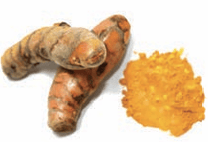
Why is turmeric known as a ‘Golden’ spice? Turmeric is a member of the ginger family, which is grown in India and other countries. A common spice in daily households, it is being researched for benefits beyond the taste and colour it provides to the food! In the Ayurvedic system of medicine, turmeric is considered to have numerous health system of medicine, turmeric is considered to have numerous health benefits, and is commonly used in several traditional home remedies.
Turmeric (Haldi)
Ashwin created a greeting card to pay gratitude to his teacher on the day of Guru Purnima. He applied turmeric paste on white paper and dried it. He wrote his wishes in the teacher's mother tongue (Odia language) on the dried paper using one of the solutions tested in Table 2.4. Which solution can be used to write the message? His teacher applauded his creative use of this concept.
I respect my teacher as she nurtured curiosity within me and bestowed upon me the gift of learning. I bow my head in gratitude to her!
Are there any substances whose odours change on
adding acidic or basic substances?
There are some substances whose odours change in an acidic or basic medium. These are called olfactory indicators.
Let us explore more!
Activity 2.6: Let us investigate
Take some finely chopped onions in a container, along with
some strips of clean cotton cloth or filter paper.
Tightly close the container and leave it overnight.
Take two of the cotton cloth or filter paper strips from the
container and check their odour.
Keep them on a clean surface and put a few drops of tamarind water on one strip and a few drops of baking soda solution on the other. Allow the drops to spread on the strips.
Check the odour again.
Do you notice any change in the odour of the onion strips
before and after putting tamarind water and baking soda solution on them?
Note your observations.
Similarly, test the change in the odour with other acidic and
basic substances and record your observations.
KNOW A SCIENTIST
Acharya Prafulla Chandra Ray (P.C. Ray) is known as the ‘Father of Modern Indian Chemistry’. He earned a doctorate in chemistry from the United Kingdom and returned to India. He contributed towards advancing scientific research in India. He also established India’s first pharmaceutical company (a company in the field of Through his
writings on the history of medicines) in 1901. He was a person rooted in Indian culture and knowledge traditions. Through his writings on the history of chemistry in India, he highlighted the
achievements and expertise of ancient Indian scientists to the modern world. Ray, a social reformer, also advocated the use of the mother tongue as a medium of instruction in educational
institutions.
2.2 What Happens When Acidic Substances Mix with Basic Substances?
Let us investigate by performing the following experiment.
Activity 2.7: Let us experiment
Take one drop of lemon juice in a test tube and add around twenty drops of water to it. Observe the colour.
Add a drop of blue litmus solution to it.
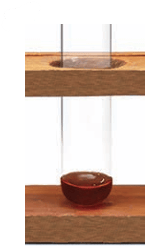
Do you observe any colour change (Fig. 2.10a)?
Fig. 2.10(a): The colour of the solution on adding blue litmus solution
Slowly add drops of lime water to this test tube with the help of a dropper and swirl it well.
What do you observe? Is there any change in the colour of the solution?
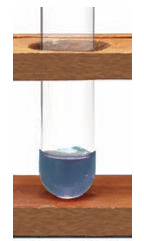
A stage comes when the colour of the solution changes from red to blue (Fig. 2.10b).
Fig. 2.10(b): The colour of the solution on adding lime water
Again, add one drop of lemon juice to the above solution.
Can you predict why there is a change in colour?
Initially, when a drop of blue litmus solution is added to the
lemon juice solution, the colour of the solution turns red. When
lime water is added to this test tube, the colour of the solution
eventually changes from red to blue. This shows that the solution
in the test tube is no longer acidic. Lime water has neutralised
the effect of the acid.
When the solution of an acid is mixed with the solution of a base in sufficient quantity, we find that the resulting solution is
neither acidic nor basic. Such reactions are called neutralisation reactions. In a neutralisation reaction, salt and water are formed with the evolution (i.e., release) of heat.
Acid + Base → Salt + Water + Heat
There are many examples in everyday life where you can observe the use of neutralisation processes.
Let us find out!
2.3 Neutralisation in Daily Life
Situation 1: Keerthi was observing a butterfly in the garden with her hand resting on a tree trunk. Suddenly, a red ant bit her, leaving her skin red with stinging pain (Fig. 2.11). Her brother helped her by applying moist baking soda to the affected area, which relieved the pain. What do you think might be the reason for this?
Fig. 2.11: Stinging effect of an ant bite
When an ant bites, it injects an acidic liquid (formic acid) into the skin. The effect of the acid can be neutralised by rubbing moist baking soda, which is a base.
What remedies do people use to treat ant bites in your region?
Situation 2: On the Farmer’s Portal (an online platform from the Department of Agriculture, Cooperation and Farmers Welfare), a query from a farmer states, “My
plants are not growing well lately”. After a detailed discussion, it was found that the excessive use of chemical fertilisers
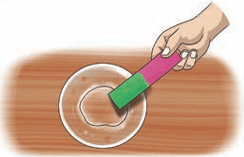
(substances added to soil to help plants grow better) made the soil acidic. What remedy might be provided to him? When the soil is too acidic, the plants do not grow well. It can be treated with lime, which is a base. (Fig. 2.12).
Fig. 2.12: Neutralising the acidic nature of soil
If the soil is basic, organic matter like manure and composted
leaves are added to it. Organic matter releases acids that neutralise the basic nature of the soil.
Sometimes, the soil may be neutral, but the plants growing in it may still show poor health, which can be due to the deficiency of nutrients in the soil.
Situation 3: Ashwin’s friend Gurbir stays near an industrial area. He shared with him that the fish population in his neighbourhood lake was declining day by day! What do you think might be the causes for this? It may be due to factory waste being released into the lake.
If the factory waste is acidic in nature, what could be done to
save the fi sh in the lake?
The factory waste can be neutralised by adding basic substances before releasing into the lake.
Let us wrap up!
Now, can you explain why the words ‘Welcome to the Wonderful World of Science’ appeared on Ashwin and Keerthi’s paper sheets when the liquid was sprayed on them?
Do you think that one possibility could be using a turmeric
solution for the spraying liquid and a soap solution for writing
on the paper?
In a Nutshell
Substances around us may be classified as acidic, basic, and
neutral in nature.
Extracts of lichen, red rose, red hibiscus, purple cabbage,
turmeric, etc., can be used to indicate the nature of substances.
Substances that show different colours in acidic and basic
solutions are called acid-base indicators.
Acids turn the colour of blue litmus to red. Bases turn the
colour of red litmus to blue.
Extract of red rose gives red colour in acidic solutions and
green colour in basic solutions.
The yellow colour of turmeric turns red in basic solutions but remains unchanged in acidic and neutral solutions.
An acid and a base neutralise each other, forming salt and water, along with the evolution of heat.
Many day-to-day problems like a red ant bite, acidic or basic
nature of soil, and industrial waste can be attempted to be
managed by the process of neutralisation.
Let Us Enhance Our Learning
1. A solution turns the red litmus paper to blue. Excess addition of which of the following solution would reverse the change?
(i) Lime water
(ii) Baking soda
(iii) Vinegar
(iv) Common salt solution
2. You are provided with three unknown solutions labelled A,
B, and C, but you do not know which of these are acidic, basic,
or neutral. Upon adding a few drops of red litmus solution
to solution A, it turns blue. When a few drops of turmeric
solution are added to solution B, it turns red. Finally, after
adding a few drops of red rose extract to solution C, it turns
green.
Based on the observations, which of the following is the correct sequence for the nature of solutions A, B, and C?
(i) Acidic, acidic, and acidic
(ii) Neutral, basic, and basic
(iii) Basic, basic, and acidic
(iv) Basic, basic, and basic
3. Observe and analyse Figs. 2.13, 2.14, and 2.15, in which red rose extract paper strips are used. Label the nature of solutions present in each of the containers.
Fig. 2.13
Fig. 2.14
Fig. 2.15
4. A liquid sample from the laboratory was tested using various
indicators:
Indicator
Red litmus
Blue litmus
Turmeric
Change
No change
Turned red
No change in colour
Based on the tests, identify the acidic or basic nature of the
liquid and justify your answer.
5. Manya is blindfolded. She is given two unknown solutions to test and determine whether they are acidic or basic. Which indicator should Manya use to test the solutions and why?
6. Could you suggest various materials which can be used for
writing the message on the white sheet of paper (given at the beginning of the chapter) and what could be in the spray bottle? Make a table of various possible combinations and the colour of the writing obtained.
7. Grape juice was mixed with red rose extract; the mixture got a tint of red colour. What will happen if baking soda is added to this mixture? Justify your answer.
8. Keerthi wrote a secret message to her grandmother on her birthday using orange juice. Can you assist her grandmother in revealing the message? Which indicator would you use to make it visible?
9. How can natural indicators be prepared? Explain by giving an example.
10. Three liquids are given to you. One is vinegar, another is a
baking soda solution, and the third is a sugar solution. Can
you identify them only using turmeric paper? Explain.
11. The extract of red rose turns the liquid X to green. What will
the nature of liquid X be? What will happen when excess of
amla juice is added to liquid X?
12. Observe and analyse the information given in the following
flowchart. Complete the missing information.
Imagine a garden with plants showing signs of poor health.
The soil can be ______ in nature.
The soil can be ______ in nature.
Which indicator can be used to test the nature of the soil?
______
The acidic soil can be treated with _______.
The basic soil can be treated with ______.
DIVE DEEPER
Aman accidentally spilt vinegar on some pieces of an eggshell or marble and noticed bubbling. He then poured a soap solution on another piece of eggshell or marble, but no bubbles appeared. Why did bubbles occur with vinegar but not with soap solution?
Exploratory Projects
Create rangoli using acidic or basic substances and natural
indicators.
You may discuss in your class the acidic, basic, or neutral
nature of water obtained from various sources. You may like to test the water samples available from sources such as rain, taps, rivers, etc.
Collect a soil sample of your area and find out whether it is
acidic, basic, or neutral in nature.








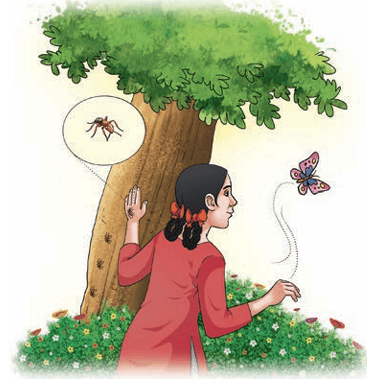
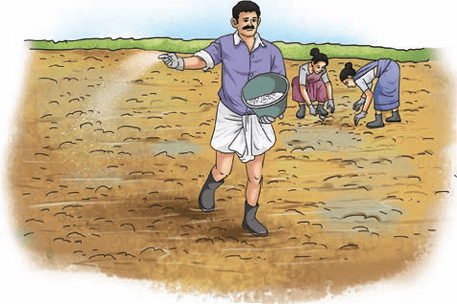


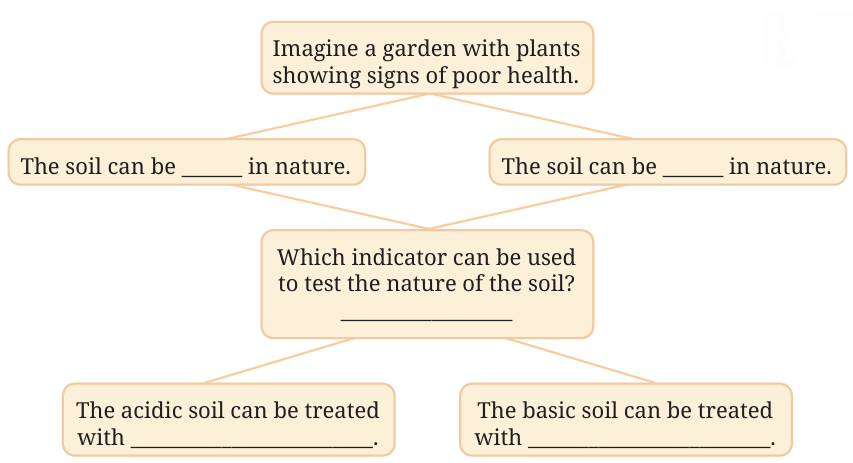

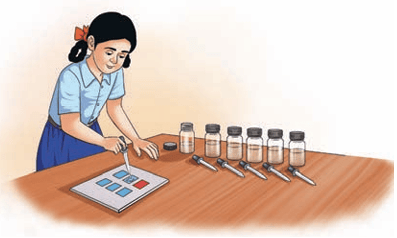 Fig. 2.2(a): Colour change in blue litmus paper
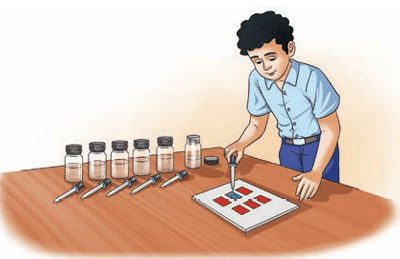 Fig. 2.2(b): Colour change in red litmus paper



 (a) Turmeric paste (b) Turmeric paper strips