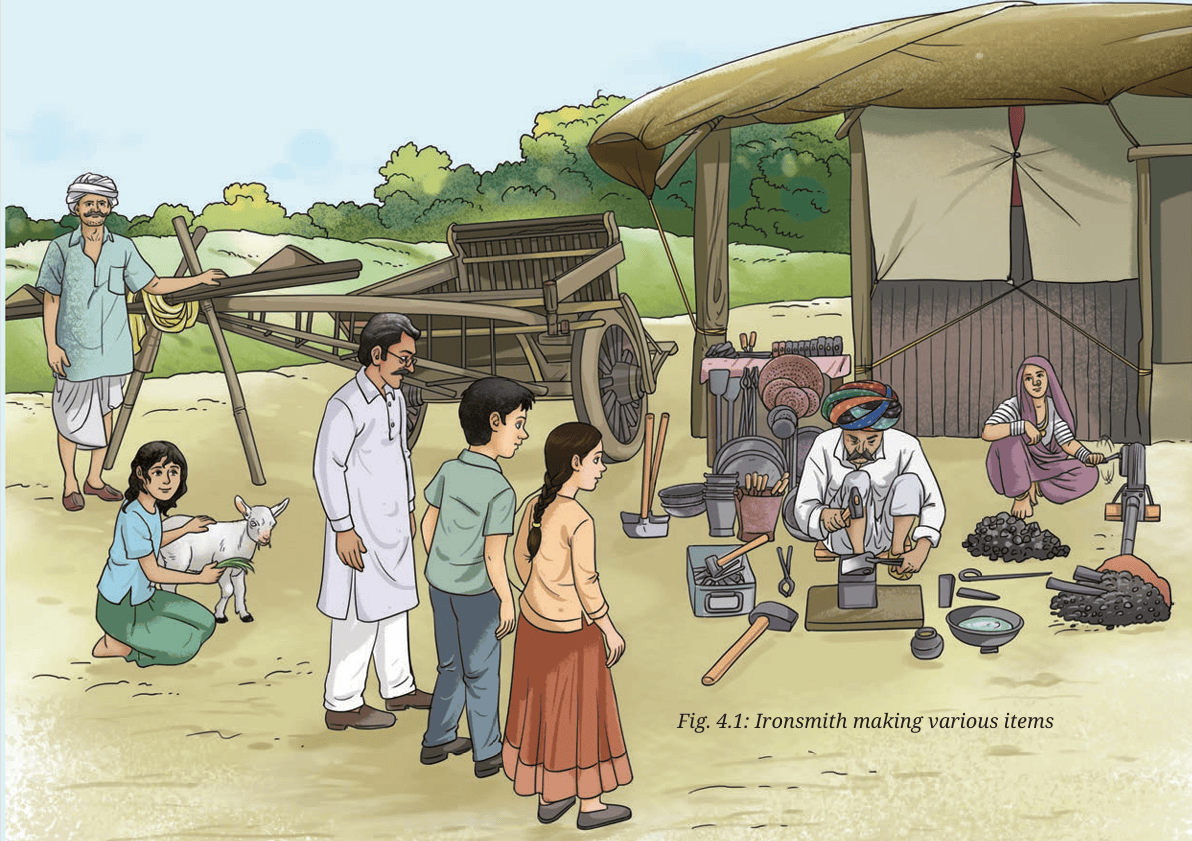
Yashwant and Anandi live in a village in Rajasthan. Their school has assigned them a project to learn about craftspersons who work with metals. They decide to visit the local ironsmiths who practise this craft. Yashwant and Anandi request their grandfather to accompany them (Fig. 4.1). They are curious to learn how these ironsmiths make different items of daily use. They interact with an elderly craftsperson, Sudarshan uncle.
Yashwant: Which items do you generally make?
Sudarshan: Generally, we make items of daily use, such as flat pans (tawas), buckets (baltis), tongs (chimtas), and farming tools like spades (phawras), axes (kulhadis), trowels (khurpis), and rakes (jelees).
Anandi: What materials are they made of?
Fig. 4.1: Ironsmith making various items
Sudarshan: We use iron metal to make these items. We also use wood to prepare handles wherever required. Additionally, we use coal in our furnaces to heat the iron.
Sudarshan is heating an iron block in the furnace. It has become red hot. He starts beating it hard with a hammer.
Anandi is amazed and asks, “Why are you beating it?”
Sudarshan: I am beating it to shape it into an axe.
Anandi: Wow, a piece of iron can be beaten into a flat shape! Can we do this with other metals as well?
You may also have many such questions — let us explore what else we can do with metals.
4.1 Properties of Materials
4.1.1 Malleability
Activity 4.1: Let us explore
Caution— Conduct this activity under the supervision of your teacher or an adult.
Collect some waste pieces of copper and aluminium, an iron nail, a piece of coal, a pea-sized lump of sulfur (gandhak), and a block of wood.
Recall the chapter ‘Materials Around Us’ in the Grade 6
Science textbook Curiosity and observe the appearances of
the above items. Are they lustrous? Also, note whether they
are hard or soft and record your observations in Table 4.1.
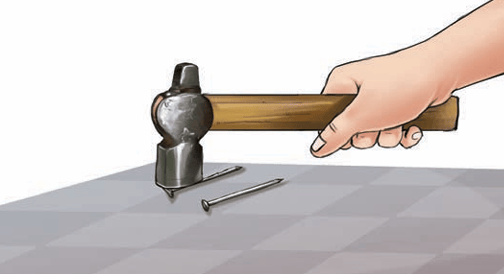
Now, place each of these items one by one on any hard surface and beat them with a hammer (Fig. 4.2).
Fig. 4.2: Beating an iron nail with a hammer
What do you think will happen? Do the objects become slightly flattened or do they break into pieces?
Record your observations in Table 4.1.
Table 4.1: Appearance, hardness, and effect of hammering on different objects or materials
S.No.
Object/Material
Appearance (lustrous/non-lustrous)
Hard/Soft
Effect of hammering(fl attens/breaks into
pieces)
1.
Piece of copper
2.
Piece of aluminium
3.
Iron nail
4.
Piece of coal
5.
Lump of sulfur (pea-sized)
6.
Block of wood
Analyse Table 4.1. Identify the objects that are lustrous in appearance and hard. You might have observed that objects made from copper, aluminium, and iron are lustrous in appearance and are hard. Lustre shown by metals is known as metallic lustre. Materials like copper, aluminium, and iron are known as metals, whereas, coal, sulfur, and wood are non-lustrous and not as hard as metals.
Are all metals hard and solid? Not really; some metals like
sodium and potassium are so soft that they can be cut with a knife. There is one metal, mercury, that is found in a liquid state at room temperature, which you might have seen in thermometers. Recall the chapter ‘Temperature and its Measurement’ from the Grade 6 Science textbook Curiosity.
Which objects did you find become flat on beating with a hammer?
You must have observed that objects such as a piece of copper, an iron nail, and a piece of aluminium become flat when beaten; whereas other objects or materials behave diff erently. This
property by which materials can be beaten into thin sheets is called malleability. Most metals possess this property. Can you give some examples of metal sheets? You might have seen thin silver foil on some sweets and aluminium foil used for wrapping food items. These are formed due to their malleability. Gold and silver are the most malleable metals.
A piece of coal or a lump of sulfur does not show this behaviour.
They break into pieces and are said to be brittle. On the other hand, wood neither gets flattened into a sheet nor breaks into pieces. Therefore, wood is neither malleable nor brittle.
HOLISTIC LENS
The impact of iron on the progress of civilisation of India
In the Grade 6 Social Science textbook Exploring Society India and Beyond, you learnt about the Harappans. They knew how to use metals like copper and gold. They used these metals to make various objects, from utensils to jewellery. However, you would hardly find any evidence of the Harappans using a very prominent metal iron, which you see a lot around you today. This is because it took a long time before iron was used in day-to-day activities.
However, once the use of iron gained prominence in the times that
followed, it contributed signifi cantly to the progress of civilisation in India. For instance, due to its strength, agricultural tools like ploughs made from iron were much superior to those used previously.
What could be the potential reason that it is generally considered
that copper was discovered earlier as compared to iron?
4.1.2 Ductility
Where do you find the use of metal wires?
You might have seen wires of metals like copper or aluminium
in electrical fittings. Some ornaments, like bangles, necklaces,
earrings, etc., are also made from metal wires. Metal wires play
important functions in a variety of stringed musical instruments,
such as veena, sitar, violin, and guitar.
This property of materials by which they can be drawn into wires is called ductility.
This property of ductility is mainly possessed by metals.
Gold is so ductile that one gram of it can be drawn into a 2 kilometre-long wire!
The ductile nature of metals enables for the creation of this tea strainer with metal wire.
Have you ever seen wires made of coal or sulfur? Obviously not! We can say that coal and sulfur are not ductile.
DIVE DEEPER
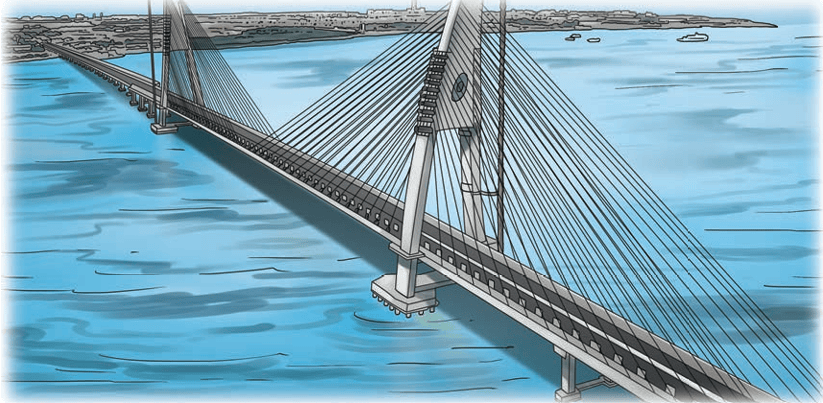
Do you know that ropes made of steel [a mixture of metal (iron) and non-metal (carbon)] wires can support heavy loads? Therefore, they are used in suspension bridges and in cranes to lift heavy objects.
Suspension bridge
4.1.3 Sonority
Have you ever noticed the sound produced when a metal spoon, or a metal plate, or a metal coin is dropped on the floor? How is it
different from the sound produced when a piece of coal or wood is dropped on the floor?
Activity 4.2: Let us investigate
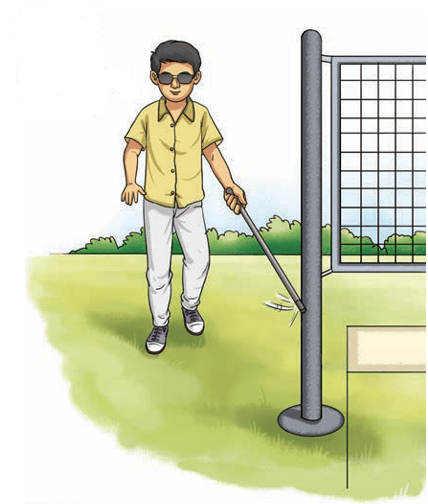
I use the difference in sound when my stick hits wood or metal to
help find my way.
Caution— Be careful while dropping the objects.
Take a few objects, such as a metal spoon, a coin, a piece of coal, and a block of wood.
Drop them one by one from a certain height.
Do you notice any difference in the sound produced by these objects?
You would observe that the metal spoon and the metal coin produce a ringing sound. Coal and wood, on the other hand, produce dull sounds.
This property of metals that enables them to produce a ringing
sound is called sonority, and metals are said to be sonorous in nature.
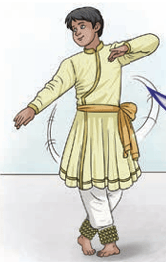
Oh! The ringing sound of my ghungroos is also due to the
sonority of metals.
Now, I understand! Now, I understand! The ringing sound of the school bell is due to the sonority of metals.
4.1.4 Conduction of heat
Have you ever observed the vessels used for cooking in the kitchen? You might have noticed that the vessels used for heating are made of metals. Can you name some metals that are used for making cooking vessels? Do you know why these metals are used for this purpose?
Let us find out!
Activity 4.3: Let us investigate
Caution— This activity must be performed under the supervision of your teacher or an adult. Be careful while handling hot water.
Place a glass tumbler on a table.
Fill it with hot water.
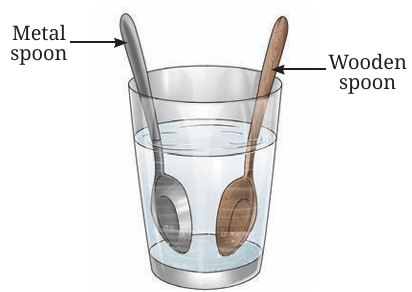
Take a metal spoon and a wooden spoon of almost the same size and thickness.
Immerse both the spoons simultaneously into the hot water
(Fig. 4.3) and leave them undisturbed for a few minutes.
Now, carefully touch the upper end of each spoon.
Fig. 4.3: Metal and wooden spoons immersed in hot water
Some discussion points:
Which of the spoons get hotter?
What does this experiment tell us about heat transfer along the two spoons?
You may have noticed that the metal spoon is hotter to touch
than the wooden spoon. Even though both spoons are immersed
in the water of the same temperature and for the same time. This
shows that the heat transfers through the metal spoon, making it
hotter. In contrast, the wooden spoon transfers heat poorly.
In such cases, the transfer of heat from one point to another of a material is called conduction, and materials that transfer heat are called conductors.
Based on the observations, one can say that metals are good conductors of heat, whereas wood is a poor conductor of heat. Now, we can understand why mostly metal vessels are used for cooking, and their handles are made with wood or other materials that do not conduct heat. You will learn more about this in the chapter ‘Heat Transfer in Nature’.
4.1.5 Conduction of electricity
Have you ever seen an electrician using a screwdriver? What type of material is used for making its handle? You may have also noticed the electrician wearing rubber gloves and shoes while working. What can be the reason for this?
Activity 4.4: Let us design and create
Design an electric circuit, like the ‘tester’ circuit in the chapter ‘Electricity: Circuits and their Components’. Repeat the same activity using the materials listed below and record your observations in Table 4.2.
You may collect a few objects, such as a piece of aluminium foil, an iron nail, a lump of sulfur (pea-sized), a copper wire, a piece of coal, a piece of dry wood, a stone, an eraser made of rubber and a piece of nylon rope.
Predict which of these could make the bulb of the tester
glow and which could not.
Table 4.2: Conduction of electricity by different objects or materials
S.No.
Object/Material
Observation (bulb glows/does not glow)
Good conductor of electricity or poor
conductor of electricity
1.
Piece of aluminium foil
2.
Iron nail
3.
Lump of sulfur (pea-sized)
4.
...
You might have observed that objects made of aluminium, iron, and copper make the bulb glow, whereas sulfur, coal, wood, stone, eraser, and nylon rope could not make it glow. Do you see any pattern in the glowing of bulbs when using different materials in Activity 4.4? It is observed that all the materials that make the bulb glow are metals.
Materials that allow electricity to flow through them easily
are called good conductors of electricity. In contrast, materials
that prevent the bulb from glowing by not allowing electricity to
pass through them are called poor conductors of electricity.
So, now we can understand that the plastic covering on screwdrivers and rubber gloves protect the electrician from electric shock because these materials are poor conductors of electricity.
We learnt that metals are generally hard, lustrous, malleable,
ductile, and good conductors of heat and electricity. Now, let us
learn how metals behave in the presence of air and water.
4.2 Effect of Air and Water on Metals: Iron
You would have often noticed that iron objects develop brown
deposits when left in the open for a few days. In which conditions
would an iron object develop brown deposits?
When it comes into contact with dry air only.
When it comes into contact with water only.
When it comes into contact with both air and water.
Activity 4.5: Let us experiment
Caution— Be careful while handling iron nails.
Take a few shining iron nails. If you are using old iron nails, make sure to remove brown deposits from their surface by scrubbing them with the help of a small piece of sandpaper.
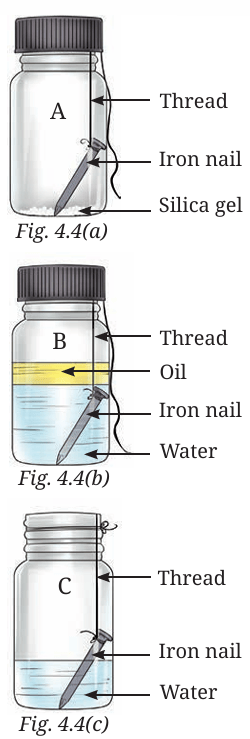
Take three clean, dry glass bottles or test tubes with tight-fitting caps or stoppers. Label them A, B, and C.
Take three iron nails and tie each iron nail with a thread.
Place one iron nail and some silica gel in the glass bottle ‘A’, and tighten the cap or stopper (Fig. 4.4a). Silica gel makes the air dry. It is the substance that is used in small pouches in some medicine bottles, water bottles, shoe boxes, etc., to keep them dry.
Place one iron nail in the glass bottle ‘B’. Pour freshly
boiled and cooled water (to remove dissolved gases) into it until the iron nail is completely dipped in it. Now, pour some oil to form a layer over the surface of the water (Fig. 4.4b). The layer of oil on the surface of the water prevents the air from dissolving in the water. Cap the glass bottle tightly.
Place one iron nail in the glass bottle ‘C’, and pour some
water so that the iron nail is partially dipped. Keep this glass bottle unstoppered. This allows the iron nail to come into contact with both water and air, as shown in Fig. 4.4c.
Fig. 4.4: Glass bottles containing iron nails
Place all the glass bottles undisturbed at room temperature and observe the changes for 8 – 10 days.
Record your observations in Table 4.3.
Table 4.3: Formation of brown deposit on iron nails
Glass Bottle
Conditions
Observation
Presence of water (Yes/No)
Presence of air (Yes/No)
A
No
Yes
B
C
What can you conclude from this experiment?
It is observed in glass bottles A and B that the iron nails do not
show any brown deposits. What does this observation indicate?
This indicates that brown deposits or discolouration on the iron
nails do not develop when the iron nail is kept in dry air alone
(bottle A) or water alone (bottle B). However, in glass bottle C, the iron nail shows the presence of brown deposits. This indicates that the presence of both water and air is essential for these deposits to develop. Thus, moist air is responsible for the development of brown deposits on objects made of iron. This brown deposit is called rust. The process of formation of rust on objects made of iron is called rusting.
Many other metals also exhibit discolouration when kept open in the atmosphere. Have you noticed the formation of a green coating on the surface of copper objects or a black coating on the surface of silver objects? Gradual deterioration of metal surfaces caused by air, water, or other substances is known as corrosion.
Do you know that rusting of iron is a serious problem in our country? Every year, an enormous amount of money is spent to replace or repair iron structures damaged due to rusting.
The rusting of iron can be prevented by several methods such as painting, oiling, greasing, and applying a protective layer of
zinc metal on iron (galvanisation). We will learn about this in
higher grades.
FASCINATING FACTS
The wonder of ancient Indian metallurgy!
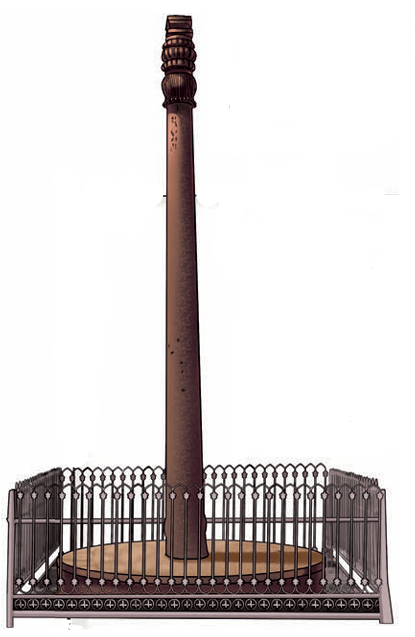
The Iron Pillar of Delhi was made in the time of Chandragupta II more than 1600 years ago. It is about 8 metres high and weighs more than 6000 kilograms. What is interesting about this iron pillar is that despite all these years of facing winds, rainfall, and intense
weather, it has barely any rust.
In other words, it has been made in a way that it resists rusting. This tells us about the skills that were developed in metal technology in India
The Iron Pillar (Delhi)
4.3 Effect of Air and Water on Other Metals
Activity 4.6: Let us investigate (demonstration activity)
The teacher may demonstrate this activity.
Caution— It is advisable for students to wear protective eyeglasses and keep safe distance.
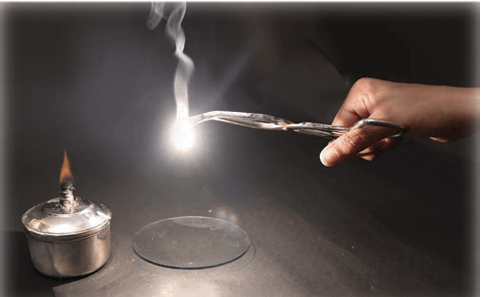
Take a magnesium ribbon about 3 – 4 centimetres long. Clean
it by rubbing with a piece of sandpaper.
Hold it with a pair of tongs. Ignite the other end using a
spirit lamp or a candle (Fig. 4.5).
Fig. 4.5: Burning magnesium ribbon
Let the magnesium ribbon burn.
What do you observe?
You must have observed that magnesium ribbon burns with a dazzling white flame and changes into a white powder. Collect it on a watch glass. This powder is magnesium oxide. It is formed due to the reaction between magnesium and oxygen present in the air.
Add a few drops of warm water to this white powder, stir it
well, and check its nature.
Recall the chapter ‘Exploring Substances: Acidic, Basic, and
Neutral’. Find out whether the solution of magnesium oxide is acidic or basic or neutral in nature. You can use any acid-base indicator.
What effect does this solution have on blue and red litmus papers?
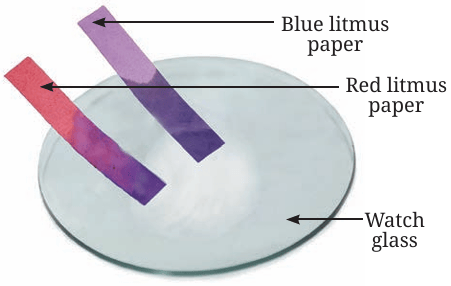
You would observe that it changes the colour of red litmus paper to blue (Fig. 4.6); hence, it is basic in nature. Generally, oxides of metals are basic in nature.
Fig. 4.6: Testing the nature of magnesium oxide
We will discuss this burning of magnesium ribbon further in the
chapter ‘Changes Around Us: Physical and Chemical’.
Do you know that sodium is a metal which is stored in kerosene
because it reacts vigorously with oxygen and water. A lot of heat
is generated in the reaction. Storing sodium in kerosene prevents
its exposure to moisture and air. Can you predict the nature of
its oxide?
Let us now discuss some substances that do not behave like metals.
4.4 Substances that Behave Differently from Metals in Air and Water
Activity 4.7: Let us experiment (demonstration activity)
The teacher may demonstrate this activity.
Caution— This activity must be performed in a fume hood or well-ventilated area. Burning sulfur produces gases, which can be harmful if inhaled.
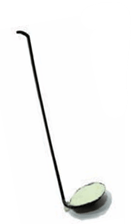
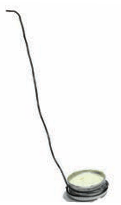
Take a small amount of powdered sulfur in a defl agrating spoon (it is a long-handled metal spoon used in experiments to safely heat and burn substances Fig. 4.7a). If a defl agrating spoon is not available, you may take a metallic cap of any bottle, wrap a metallic wire around it and give it the shape as shown in Fig. 4.7b.
Fig. 4.7(a): Deflagrating spoon
Fig. 4.7(b): Improvised deflagrating spoon
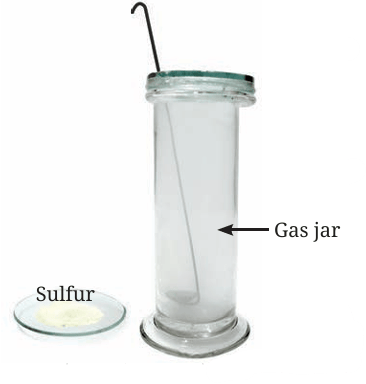
Heat it on a flame, and as soon as the sulfur starts burning, introduce the deflagrating spoon into a gas jar or glass tumbler (Fig. 4.7c). Cover the gas jar or glass tumbler with a lid to ensure that the gas produced does not escape.
Fig. 4.7(c): Burning of sulfur
Remove the lid after 3 – 4 minutes and take out the deflagrating spoon. Add a small quantity of water into the gas jar, quickly place the lid back and shake it so that the gas dissolves.
Again, recall the chapter ‘Exploring Substances: Acidic, Basic, and Neutral’. Using an acid-base indicator, check whether the solution obtained after the addition of water to the gas jar is acidic or basic or neutral.
What do you observe?
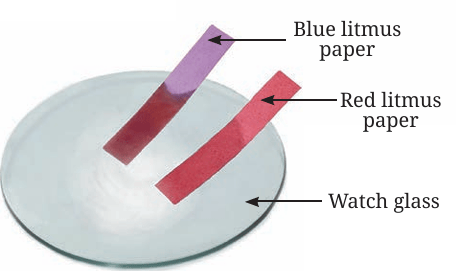
You would observe that it is acidic in nature (Fig. 4.7d).
Fig. 4.7(d): Testing of solution with litmus papers
On burning sulfur in air (oxygen), sulfur dioxide gas is formed. On dissolving sulfur dioxide gas in water, sulfurous acid is formed.
Does sulfur behave in water the same way metals do?
Activity 4.8: Let us explore
Take some sulfur powder in a glass tumbler.
Add a small amount of water to it.
What do you observe?
You may have noticed that there is no reaction when sulfur is
placed in water.
Substances like sulfur and phosphorus behave differently with air and water than metals. Phosphorus is stored in water as it catches fire when exposed to atmospheric air. These substances are usually soft and dull in appearance. They are neither malleable nor ductile, and they are not sonorous. They are also poor conductors of heat and electricity. These are called non-metals. Their oxides are acidic in nature.
Some other non-metals are oxygen, hydrogen, nitrogen, carbon, etc. These must not be confused with materials such as plastic, glass, wood, rubber, and paper. These materials are not classified as metals or non-metals because they are not elements.
DIVE DEEPER
Metals and non-metals are sub-categories of substances called elements. An element is a substance that cannot be broken down into simpler substances.
Presently 118 elements are known. These elements are the basic building blocks of all matter. Some are naturally occurring, while others are artificially made in the laboratory, and do not exist
in nature. You will study more about elements in higher grades.
4.5 Are Non-metals Essential in Everyday Life?
You often observe many metals in your day-to-day lives because
of their distinct properties, such as their lustrous nature, heat
and electrical conductivity, and high strength. However, this
should not give an impression in your mind that non-metals are
not important in our lives.
We breathe in oxygen, which is a non-metal, and without it, we would not be able to survive. Can you think of any other uses
of oxygen?
Carbon is essential in everyday life because it is the building
block of all life forms. It is a key component of proteins, fats, and carbohydrates, which are necessary for growth and energy.
Nitrogen is used in the manufacturing of fertilisers and other
chemicals. It is an essential nutrient for the growth of plants.
Chlorine is a non-metal commonly used in water purifi cation. A solution of iodine, a non-metal, is applied on wounds as an
antiseptic.
SCIENCE AND SOCIETY
Do you know that many metals and their alloys (mixtures of two or
more metals or a metal and a non-metal) are important for daily use as utensils and tools. These are also important for modern technologies and essential in almost every industry. Some special metals are also used in atomic energy (such as zirconium), aerospace (titanium), etc. In India, many metals, especially iron and aluminium, are recycled to minimise waste and contribute to sustainability.
In a Nutshell
Metals and non-metals are differentiated based on their
properties.
Generally, metals are lustrous, whereas most non-metals are
non-lustrous.
Metals are generally malleable and ductile, while non-metals
do not have these properties.
Metals are good conductors of heat and electricity, but non-metals are generally poor conductors.
Metals react with oxygen to produce metal oxides which are
basic in nature.
Non-metals react with oxygen to produce oxides which are
acidic in nature.
Generally, non-metals do not react with water.
Metal objects get damaged when exposed to moist air, and the process is known as corrosion.
Metals and non-metals have wide applications in everyday life.
Let Us Enhance Our Learning
1. Which metal is commonly used to make food packaging materials as it is cheaper, and its thin sheets can be folded easily into any shape?
(i) Aluminium
(ii) Copper
(iii) Iron
(iv) Gold
2. Which of the following metal catches fire when it comes in contact with water?
(i) Copper
(ii) Aluminium
(iii) Zinc
(iv) Sodium
3. State with reason(s) whether the following statements are True [T] or False [F].
(i) Aluminium and copper are examples of non-metals used for making utensils and statues. [ ]
(ii) Metals form oxides when combined with oxygen, the solution of which turns blue litmus paper to red. [ ]
(iii) Oxygen is a non-metal essential for respiration. [ ]
(iv) Copper vessels are used for boiling water because they are good conductors of electricity. [ ]
4. Why are only a few metals suitable for making jewellery?
5. Match the uses of metals and non-metals given in Column I with the jumbled names of metals and non-metals given in Column II.
Column I
Column II
(i) Used in electrical wiring
(a) E N X Y G O
(ii) Most malleable and ductile
(b) N E C O H I R L
(iii) Living organisms cannot survive without it.
(c) P E P O R C
(iv) Plants grow healthy when fertilisers containing it are added to the soil.
(d) T E N G O I N R
(v) Used in water purification
(e) O G D L
6. What happens when oxygen reacts with magnesium and sulfur. What are the main differences in the nature NOT of products formed?
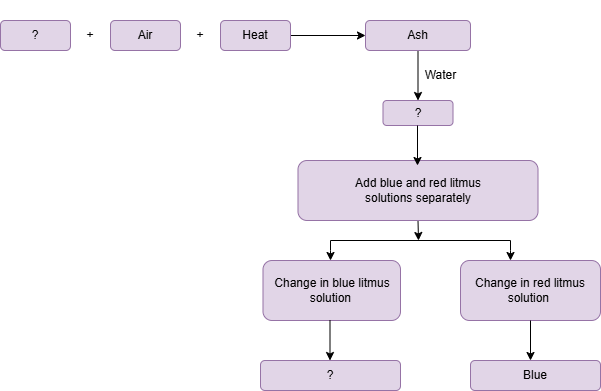
7. Complete the following flow chart:
8. You are provided with the following materials. Discuss which
material would be your choice to make a pan that is most suitable for boiling water and why?
Iron
copper
sulfur
coal
plastic
wood
cardboard
9. You are provided with three iron nails, each dipped in oil,
water and vinegar. Which iron nail will not rust, and why?
10. How do the different properties of metals and non-metals
determine their uses in everyday life?
11. One of the methods of protecting iron from getting rusted is
to put a thin coating of zinc metal over it. Since sulfur does
not react with water, can it be used for this purpose? Justify
your answer.
12. An ironsmith heats iron before making tools. Why is heating
necessary in this process?
Exploratory Projects
Dhokra, Bidriware, Pembarthi, and Kamrupi are some of India’s famous metal art styles. Find out the states where these artworks are made. Also, make a collage of their photographs.
On a map of India, mark the states where iron, gold, aluminium and other metals are found.
Explore the metals and non-metals found in smartphones and find out how they help the phone work properly.
Organise a classroom debate on whether the use of metals
for comfort and luxury should be increased or decreased.



 Do you know that ropes made of steel [a mixture of metal (iron) and non-metal (carbon)] wires can support heavy loads? Therefore, they are used in suspension bridges and in cranes to lift heavy objects.
 Suspension bridge