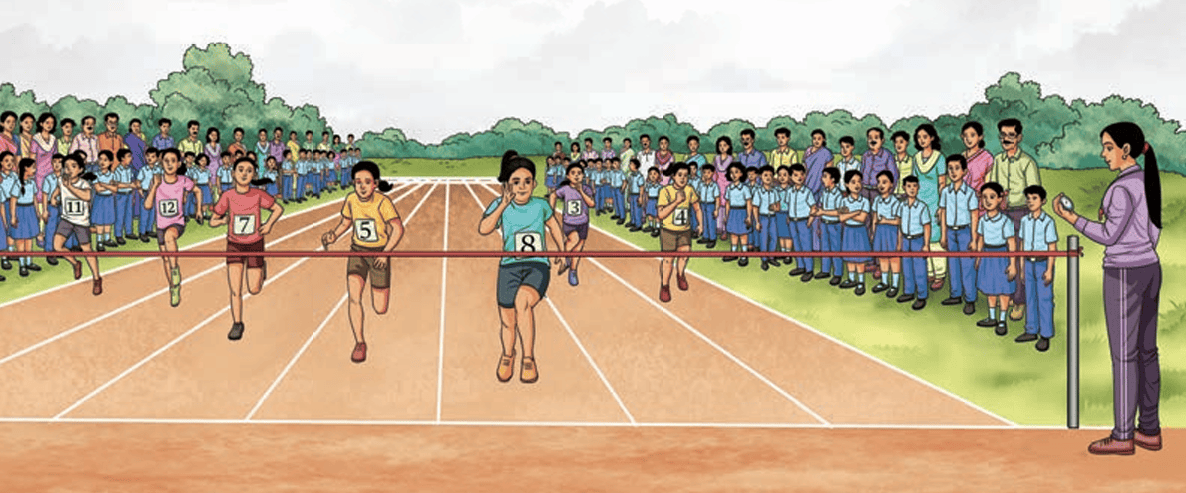
Prerna and her younger sister are watching a sports channel on television. Prerna enjoys running and she has been declared the fastest runner among the girls in her district for winning the 100 metre sprint at an interschool competition held at the district level. She is now training to compete at the state level. She dreams of representing India at the international level in 100 metre sprint contests in future.
While watching the rerun of sprints at the Olympic games held in the past, Prerna is always amazed that the measurement of the time taken for the race is so advanced that they could identify the winner even when two sprinters seemed to cross the finish line almost together. However, in her school, the sports teacher only used a special kind of watch called a ‘stopwatch’ for timing the school races. She had noticed her mother wearing a watch on her wrist and her sister looking at her mobile phone when she needed to check the time. Her uncle used a Braille watch and had recently acquired a talking watch that announced the time at the touch of a button. There was also a large clock on the wall near the school entrance. Her thoughts turned to people in the ancient past, who did not have the modern gadgets we have today and she wondered…
How was time measured when there were no clocks and watches?
8.1 Measurement of Time
Humans got interested in keeping track of time long ago. They
started noticing that many events in nature repeat themselves
after definite intervals of time. For example, the rising and setting of the Sun, the phases of the Moon and the changing seasons. They started using the cycles of these events for timekeeping. First, they devised calendars. A day was defined by the cycle of rising and setting of the Sun. Then began the quest to find ways of knowing the time of day.
So, they made many devices which helped them to measure smaller intervals of time within a day. Some of these were sundials, water clocks, hourglasses, and candle clocks.
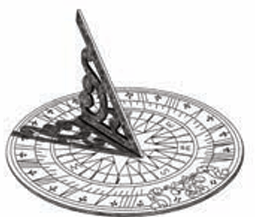
In a sundial, time is determined with the changing position of the shadow of an object cast by the light of the Sun during the day (Fig. 8.1).
Fig. 8.1 A sundial
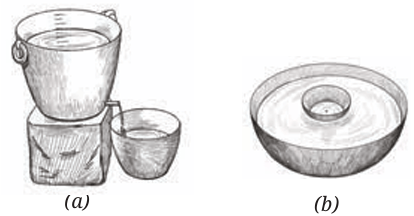
The water clocks used the flow of water out or into a vessel to measure time. In one type, water flowed out from a vessel which had markings for time (Fig. 8.2a). In the other type, there would be a bowl, with a fine hole at the bottom, which was floated on the surface of water (Fig. 8.2b). It gradually filled up in a fixed time and finally sank. Then, it was lifted up and floated again.
Fig. 8.2 A water clock (a) Water flowing out-type (b) Floating bowl-type
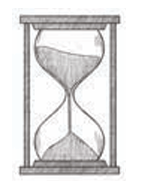
In an hourglass (Fig. 8.3), time was measured on the basis of the flow of sand from one bulb to another.
Fig. 8.3 An hourglass
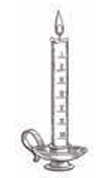
Candle clocks (Fig. 8.4) were candles with markings that indicated the passage of time when burned.
Fig. 8.4 A candle clock
FASCINATING FACTS
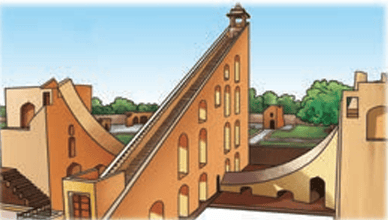
The world’s largest stone sundial, the Samrat Yantra, was built
around 300 years ago at the Jantar Mantar, in Jaipur, Rajasthan,
a UNESCO World Heritage site that houses several astronomical
instruments. With its imposing height of 27 metres, its shadow
moves at about 1 millimetre per second and falls on a scale finely marked to measure time intervals as short as 2 seconds. Like any sundial, it measures local or ‘solar time’, requiring a correction to determine Indian Standard Time.
Should we make a simple water clock?
Activity 8.1: Let us construct
Take a used transparent plastic bottle (1/2 litre or larger)
with its cap.
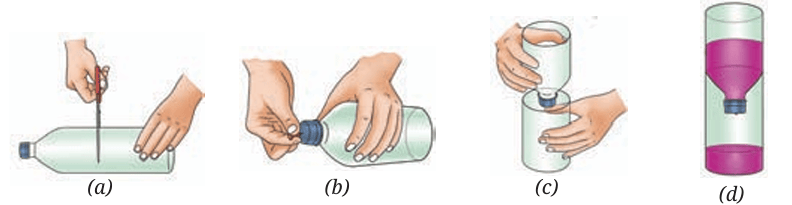
Cut it into two, roughly in the middle as shown in Fig. 8.5a.
Using a drawing pin, make a small hole in the cap of the
bottle (Fig. 8.5b).
Place the upper part of the bottle in an inverted position over
the lower half (Fig. 8.5c).
Fill the upper part of the bottle with water. You may add a
few drops of ink or colour to make the water level easily visible (Fig. 8.5d).
Fig. 8.5: Making a simple water clock
The water will start dripping into the lower part of the bottle. Using a watch, mark the level of water after every one minute till all the water drips down.
Your water clock is ready. Can you now guess how to use it? Pour the water from the lower part back into the top part and watch the level of water dripping into the lower part. Every time it touches a mark made by you, one more minute has passed.
FASCINATING FACTS
In ancient India, time was measured using both shadows and water
clocks. The earliest reference to shadow-based time measurement
appears in the Arthasastra by Kautilya (was composed and revised
between the second century BCE – third century CE). An accurate
expression for time in terms of the shadow of a vertical stick was
given by Varahamihira around 530 CE. The water clock with water
flowing out was described in the Arthasastra, Sardulakarnavadana,
and some other texts (early CE centuries). These clocks were not very accurate because as water levels dropped, the flow rate decreased. This led to the development of the sinking bowl water clock (Fig. 8.2b), or Ghatika-yantra, first mentioned by Aryabhata, and then in several astronomical texts later. Time was measured constantly with Ghatika-yantra at Buddhist monasteries, royal palaces, town squares, and each time the bowl sank, it was announced by drums, conch shells, or striking a gong. Though the Ghatika-yantra was progressively replaced by pendulum clocks in the late nineteenth century, it continued to be used at the religious places for rituals.
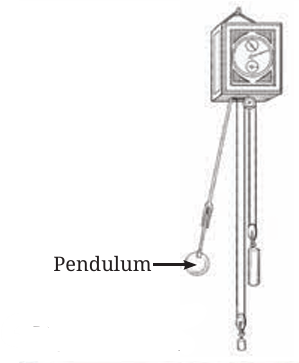
As human civilisation advanced, and as people began to travel long distances, the measurement of time became very critical. This led to the development of increasingly better mechanical devices for the measurement of time, driven by weights, gears, and springs from the fourteenth century onwards. However, the invention of the pendulum clock in the seventeenth century marked a major breakthrough in mechanical timekeeping.
Fig. 8.6: Huygens’ Pendulum clock
KNOW A SCIENTIST
The pendulum clock was invented in 1656 and patented in 1657 by Christiaan Huygens (1629 –1695). He was inspired by the investigations of pendulums by Galileo Galilei (1564 –1642). It is said that once while sitting in a church, Galileo’s attention was drawn to a lamp suspended from the ceiling, which was swinging back and forth. Using his pulse to measure time, Galileo found that the lamp took the same time for each swing. After experimenting with different pendulums, Galileo concluded that the time taken to complete one oscillation was always the same for a pendulum of a given length.
8.1.1 A simple pendulum
We did an activity in the chapter ‘Measurement of Length and Motion’ in the Grade 6 Science textbook Curiosity, where we observed the oscillatory motion of an eraser hung with a thread. Is the pendulum similar to that?
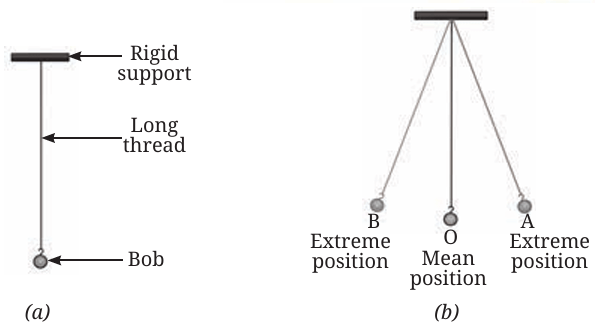
A simple pendulum consists of a small metallic ball (called the
bob of the pendulum) suspended from a rigid support by a long thread as shown in Fig. 8.7a.
Fig. 8.7 A simple pendulum
The pendulum at rest is in its mean position. When the bob of
the pendulum is moved slightly to one side and released, it starts
oscillatory motion. Its motion is periodic in nature because it
repeats its path after a fixed interval of time.
The pendulum is said to have completed one oscillation when its bob, starting from its mean position O, moves to extreme position A, changes direction and moves to another extreme position B, changes direction and comes back to O (Fig. 8.7b). The pendulum also completes one oscillation when its bob moves from one extreme position A to another extreme position B and comes back to A. The time taken by the pendulum to complete one oscillation is called its time period. Let us now set up a pendulum and measure its time period.
Activity 8.2: Let us experiment
Collect a piece of string around 150 cm long, a heavy metal
ball with hook/ a stone (bob), a stopwatch/ watch, and a ruler.
Tie the bob at one end of the string.
Fix the other end of the string to a rigid support such that the length of the string in between support and bob is around
100 cm.
Wait for the bob to come to rest. Your pendulum is now ready.
Gently hold the bob, move it slightly to one side and release
it. Take care not to push the bob while releasing it and that
the string is taut. Is your pendulum now oscillating?
Using a watch, measure the time it takes for the pendulum to complete 10 oscillations. Record the time in Table 8.1.
Repeat this activity 3–4 times.
Divide the time taken for 10 oscillations by 10 to calculate the time period of your pendulum. Note it down in Table 8.1.
Table 8.1 Time period of a simple pendulum
Length of the string = 100 cm
S.No.
Time taken for 10 oscillations (seconds)
Time period (seconds)
1.
2.
3.
Is the time period of your pendulum almost the same every time? What do you conclude from this observation? The time period of the pendulum is almost the same every time.
THINK LIKE A SCIENTIST!
You just did an important historical experiment which was fi rst done
by Galileo, except you used a watch to measure time in place of your
pulse beat. Suppose you were Galileo experimenting with pendulums,
what all would you investigate? What questions could you ask? Would
all pendulums have the same time period? How would you test this?
Repeat Activity 8.2 using the same bob but with pendulums of two
or three different lengths. Does the time period change? If so, how does the length aff ect it? If changing the length infl uences the time period, does the bob’s mass also matter? Test this by repeating Activity 8.2 with a fixed pendulum length but with bobs of different mass. Do you observe any change?
The time period of a simple pendulum depends on its length but
not on the bob’s mass. All pendulums of the same length have the same not on the bob’s mass. All pendulums of the same length have the same time period at a given location.
The time period of a simple pendulum of a given length is constant at a place. This property is used in the measurement of time.
All clocks, old or modern, are based on some process repeating
continuously, which can be used to mark equal intervals of time.
Modern clocks measure time using the same basic principle —
periodically repeating processes — but use tiny and very rapid
Modern clocks measure time using the same basic principle —
periodically repeating processes — but use tiny and very rapid
vibrations either from a quartz crystal (quartz clocks) or from some vibrations either from a quartz crystal (quartz clocks) or from some specific atoms (atomic clocks). While Huygens’ early pendulum specific atoms (atomic clocks). While Huygens’ early pendulum clocks could gain or lose 10 seconds each day, today’s atomic clocks clocks could gain or lose 10 seconds each day, today’s atomic clocks are so precise that they lose only one second in millions of years! Scientists are constantly searching for even better ways to measure time with greater accuracy.
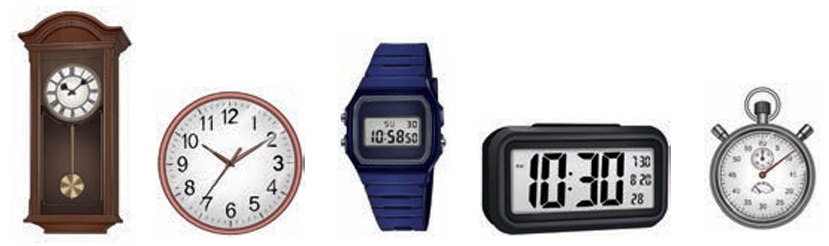
Fig. 8.8: Some common clocks and watches
8.1.2 SI unit of time
The SI unit of time is the second. Its symbol is s. The larger units of time are minute (min) and hour (h).
60 s = 1 min
60 min = 1 h
Units of time, such as second, minute, and hour begin with a lowercase letter, except at the beginning of a sentence. Their
symbols ‘s’, ‘min’, and ‘h’ are also written in lowercase letters
and in singular. Note that a full stop is not written after the symbol, except at the end of a sentence. While writing the time,
always leave a space between the number and the unit. Also, note that writing ‘sec’ for second and ‘hrs’ for hour is incorrect.
FASCINATING FACTS
The hole in the bowl of Ghatika-yantra was made in such a manner that it took 24 minutes to fill and sink. The time unit measured by this clock was called ghatika or ghati. It became the standard unit of time measurement and continued until the end of the nineteenth century. A 24-hour-long day was, thus, divided into 60 equal ghatis.
Activity 8.3: Let us identify
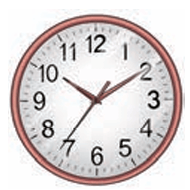
Look at the wall clock shown in Fig. 8.9 carefully. What is the smallest interval of time you can measure with it?
Fig. 8.9: A wall clock
One second is the smallest interval of time that we can measure using this clock.
SCIENCE AND SOCIETY
In today’s world, measuring tiny fractions of a second is very
important! For example, in sports, timekeeping devices can record events down to one-hundredth or even one-thousandth of a second (a millisecond) to determine the winners in a race. In medicine, heart monitors like Electrocardiogram (ECG) machines measure the millisecond variations in heartbeats to detect health issues. In music, digital recordings capture sound thousands of times per second for smooth playback. Many devices use even shorter intervals, smartphones, and computers process signals in microseconds (one-millionth of a second), allowing them to operate very fast. Scientists continue to develop even more precise time-measuring tools for space exploration, medicine, and advanced science experiments. The faster and more accurate our clocks become, the more they help society in ways we may not even notice!
8.1.1 A simple pendulum
For races covering the same distance, we can tell who was faster by measuring time. But how can we tell that when comparing races for different distances?
8.2 Slow or Fast
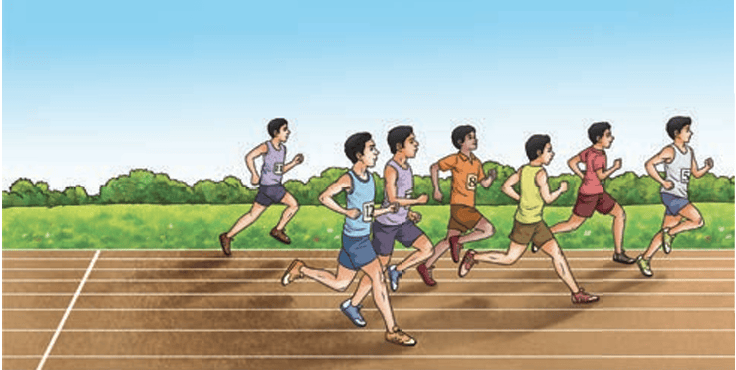
What do we mean when we say something is moving fast or slow?Suppose you are watching a 100 metre race on a straight track. All the players begin from the starting line together but after sometime they are not running together (Fig. 8.10). How do you decide who is running faster amongst them?
Fig. 8.10: Boys running a race on a straight track
Someone who is ahead of others at some instant of time, is running faster than them. Hence, someone who has covered more distance within the same time is running faster.
The distances moved by objects in a given interval of time decide which one is faster or slower. We often say that the faster runner has a higher speed. You are probably familiar with the word ‘speed’.
8.3 Speed
By comparing the distances moved by two or more objects in a unit time, it can be found out which of them is moving faster. The
unit time may be one second or one minute or one hour. We call
the distance covered by an object in a unit time as the speed of
the object.
How can we determine the speed of an object? It can be calculated, if we know the total distance covered by an object and the time taken to cover it. The speed of an object is the total distance covered divided by the total time taken to cover it. Thus,
Speed = Total distance covered/Total time taken
What would be the unit of speed? We know the SI units of length and time. Since the speed is distance/time, the SI unit of speed is metre/second and is expressed as m/s.
Speed can also be expressed in other units. If we express the distance in kilometre and time in hour, then the unit of speed is kilometre/hour, expressed as km/h.
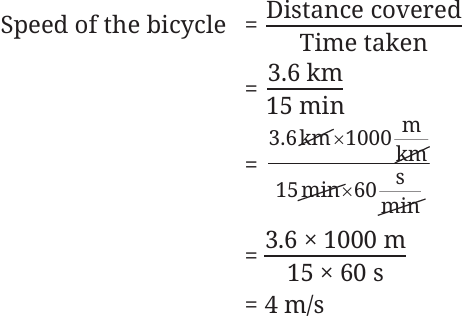
Example 8.1: Swati’s school is 3.6 km from her house. It took her 15 min to reach her school riding on her bicycle. Calculate the speed of the bicycle in m/s.
Solution:
Activity 8.4: Let us calculate
Look up at the railway timetable on the internet.
Identify a train stopping at the railway station nearest to your place of stay.
Find out the name of the next station where this train stops.
Also, find the distance to that station as given in the timetable.
Note the time at which the train departs from your station and
arrives at the next station. Find the diff erence to calculate the
time taken by the train to cover the distance till the next station.
Calculate the speed of the train between the two stations and
record it in Table 8.2.
Repeat for 4–5 different types of trains (Passenger/ Express/
Superfast).
Table 8.2: Finding the speed of trains
Name of the railway station nearest to your place of stay
__________.
S.No.
Name of the train
Name of the next station
Distance till the next station (km)
Time taken till the next station (h)
Speed of the train between these two stations (km/h)
Compare the speeds of the trains. Which is the fastest train?
The train which has covered the maximum distance in unit time
is the fastest train, that is, the one with the highest speed.
8.3.1 Relationship between speed, distance, and time
We already know how to calculate speed using
Speed = Total distance covered/Total time taken
if the distance travelled and time taken for it are known to us.
We can write this equation in a different form to calculate the
distance covered by an object, if we know its speed and the time
taken, by using
Total distance covered = Speed × Total time taken
Similarly, we can also calculate the time an object will take to
cover a distance, if the distance and speed are given, by using
Total time taken = Total distance covered/Speed
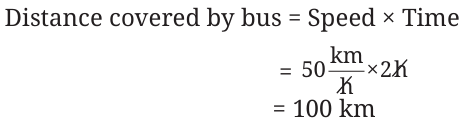
Example 8.2: Raghav is going to a neighbouring city in a bus
moving at a speed of 50 km/h. If it takes him 2 h to reach that
city, how far is that city?
Solution:
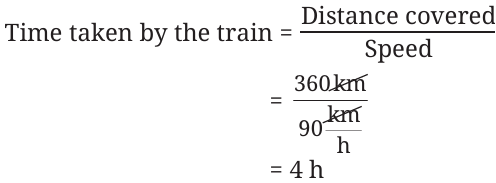
Example 8.3: A train is travelling at a speed of 90 km/h. How much time will it take to cover a distance of 360 km?
Solution:
In all the examples so far, we have found the speed of an object by using ‘the total distance covered divided by the total time taken’. However, the object might not have travelled with the same speed during the entire duration of time. The object might have sometimes moved slower or sometimes faster. So, the speed that we have calculated is the average speed, but, in this book, we have used the term ‘speed’ for ‘average speed’.
SCIENCE AND SOCIETY
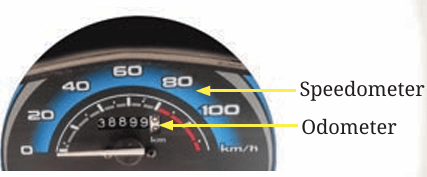
Vehicles such as scooters, motorbikes, cars, and buses have an instrument which measures and displays the vehicle’s speed in km/h. It is called a speedometer. Another instrument, known as an odometer, is also fitted in the vehicles that measures the distance travelled by the vehicle in kilometre.
I once watched a part of marathon on a straight road stretch. I noticed that some people seemed to be running at the same speed during that distance while some people would speed up or slow down.
How were their motion different?
8.4 Uniform and Non-uniform Linear Motion
Do you remember learning about linear motion in the chapter
‘Measurement of Length and Motion’ in the Grade 6 Science
textbook Curiosity? When an object moves along a straight line, its motion is called linear motion. Now, imagine a train on a
track which is along a straight line between two adjacent railway
stations. So, the motion of the train between these two stations is
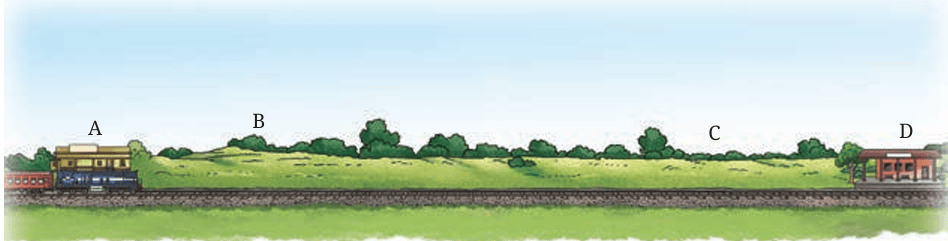
an example of linear motion (Fig. 8.11). The train starts from the
first station A at a slow speed, then moves at a faster speed, then
slows down and comes to a halt at the next station D. In between
the two stations, for some distance (B to C), the train moves at a
constant speed, that is, at an unchanging speed.
Fig. 8.11: A train on a straight track
An object moving along a straight line with a constant speed
is said to be in uniform linear motion. So, the train is in uniform
motion between B and C (Fig. 8.11). On the other hand, if the speed
of an object moving along a straight line keeps changing, it is said to be in non-uniform linear motion. The motion of the train
between A and B, as well as between C and D, is non-uniform
(Fig. 8.11).
An object in uniform linear motion covers equal distances in equal intervals of time, while it covers unequal distances in equal intervals of times when it is in non-uniform linear motion.
In Table 8.3, data are given for the distances travelled by two
trains, X and Y, between the time 10:00 AM and 11:00 AM.
Table 8.3: Distances travelled by two trains in equal time intervals of 10 minutes
Time (AM)
Train X
Train Y
Position (km)
Distance (km)
Position (km)
Distance (km)
10:00
0
0
0
0
10:10
20
20
20
20
10:20
40
20
35
15
10:30
60
20
50
15
10:40
80
20
75
25
10:50
100
20
95
20
11:00
120
20
120
25
Which of the two trains is in uniform linear motion between 10:00 AM and 11:00 AM? Train X covers equal distances in equal
intervals of time, so it is in uniform linear motion while Train Y
is in non-uniform linear motion.
Uniform linear motion is an idealisation. In everyday life, we seldom find objects moving with a constant speed over long distances or for long intervals of time. That is why we have to use
average speeds.
In a Nutshell
The time taken by the pendulum to complete one oscillation
is called its time period.
The time period of a simple pendulum of a given length is
constant at a place.
The SI unit of time is the second. Its symbol is s.
The average speed of an object is the total distance covered
divided by the total time taken to cover it.
An object moving along a straight line with a constant speed
is said to be in uniform linear motion.
If the speed of an object moving along a straight line keeps
changing, it is said to be in non-uniform linear motion.
Let Us Enhance Our Learning
1. Calculate the speed of a car that travels 150 metres in 10
seconds. Express your answer in km/h.
2. A runner completes 400 metres in 50 seconds. Another runner completes the same distance in 45 seconds. Who has a greater speed and by how much?
3. A train travels at a speed of 25 m/s and covers a distance of
360 km. How much time does it take?
4. A train travels 180 km in 3 h. Find its speed in:
(i) km/h
(ii) m/s
(iii) What distance will it travel in 4 h if it maintains the same
speed throughout the journey?
5. The fastest galloping horse can reach the speed of approximately 18 m/s. How does this compare to the speed of a train moving at 72 km/h?
6. Distinguish between uniform and non-uniform motion using the example of a car moving on a straight highway with no traffic and a car moving in city traffic.
7. Data for an object covering distances in different intervals
of time are given in the following table. If the object is in
uniform motion, fill in the gaps in the table.
Time (s)
0
10
20
30
50
70
Distance (m)
0
8
24
32
40
56
8. A car covers 60 km in the first hour, 70 km in the second hour, and 50 km in the third hour. Is the motion uniform? Justify your answer. Find the average speed of the car.
9. Which type of motion is more common in daily life— uniform or non-uniform? Provide three examples from your experience to support your answer.
10. Data for the motion of an object are given in the following
table. State whether the speed of the object is uniform or non-uniform. Find the average speed.
Time (s)
0
10
20
30
40
50
60
70
80
90
100
Distance (m)
0
6
10
16
21
29
35
42
45
55
60
11. A vehicle moves along a straight line and covers a distance
of 2 km. In the first 500 m, it moves with a speed of 10 m/s and in the next 500 m, it moves with a speed of 5 m/s. With what speed should it move the remaining distance so that the journey is complete in 200 s? What is the average speed of the vehicle for the entire journey?
Exploratory Projects
Construct a floating bowl-type water clock. Experiment by
using bowls of different sizes and making holes of different
sizes in them so that the sinking time of the bowl can be close
to 24 minutes.
Design an activity for measuring the pulse rate (number of
times the pulse of a person beats in 1 minute) of your friends.
Think of an activity where you can use your pulse to measure
time and develop a story over that idea.
What might be the reasons for the slight differences in the
time periods of a pendulum of a given length in different
readings taken in Activity 8.2. Think of ways to control those
and repeat the activity to check if the difference in readings
is reduced.
Visit a playground with a few swings. Measure the time taken
by a swing for 10 oscillations and calculate its time period.
Repeat it a few times with children of different weights to find out if its time period is almost the same. Repeat this with swings of different lengths. Find out how the time period changes with increasing length of the swings. Is the swing also an example of a pendulum?
Gather the timings of the winners of the races — 100 m,
200 m, and 400 m for men and women in the last two Olympic
games. Calculate and compare their speeds. In which event
is the speed the fastest?
FASCINATING FACTS
Time started when our Universe was created and will continue in the future. We cannot see or feel time but we can only measure its passage in terms of a time interval between events. These time intervals can be fractions of a second, or even days or months, or years or centuries. We can only say when an event occurred or for how long it lasted. Though we have learnt to measure time with increasing accuracy, and our lives are governed by watches and clocks, ‘What is time?’ continues to be a tricky question with no easy answer!