If your food is fully digested before you eat again, you won’t need medicine for pain.
(Thirukkural 942)
In the Grade 6 Science textbook Curiosity, chapter ‘Living
Creatures: Exploring their Characteristics’, we learnt about
processes essential for survival of living beings like nutrition,
respiration, excretion, and reproduction. These are collectively
called life processes. In this chapter, we will learn about life
processes such as nutrition and respiration in detail.
Observe your surroundings and notice what animals eat.
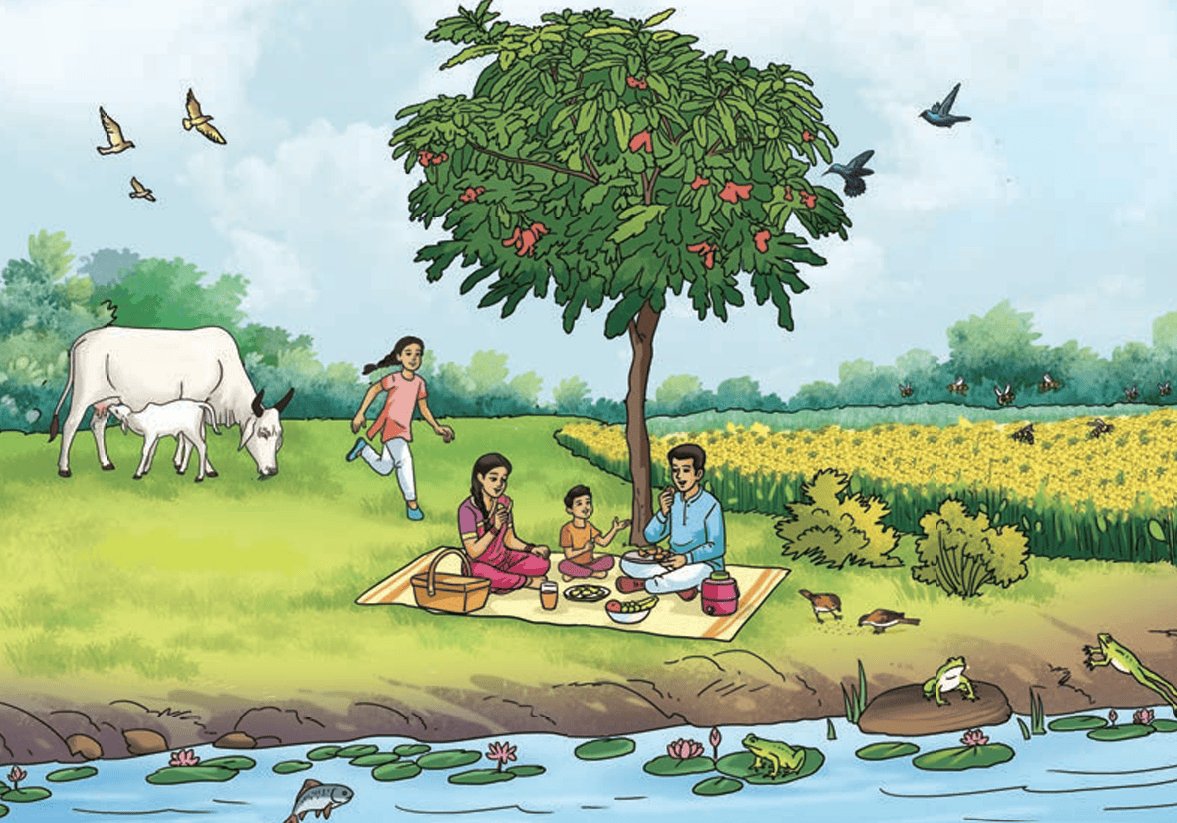
Animals eat different types of food. Bees and sunbirds suck the nectar of flowers, while infants of humans and many other animals feed on their mother’s milk. Snakes, like python, swallow the animals they prey upon. Some aquatic animals filter tiny food particles floating nearby and feed upon them.
Animals, including humans, obtain energy from food, which enables them to carry out various life processes. Animals consume food that contains complex components, such as carbohydrate, protein, and fat. These complex food components have to be broken down into simpler forms before the body can use them. But how does this process happen?
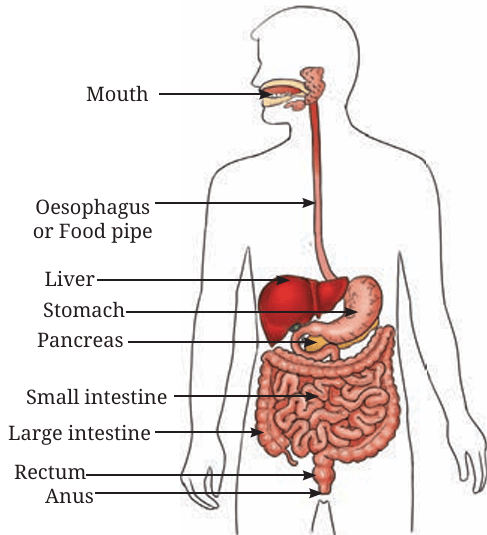
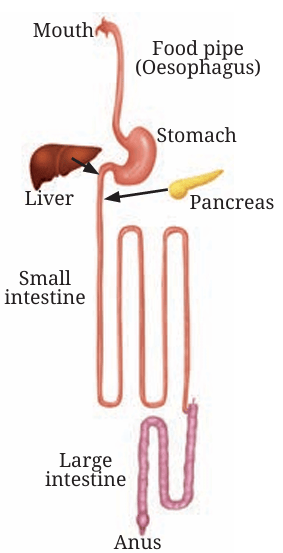
Breaking down of complex food components into simpler forms occurs in a long tube called the alimentary canal. This process starts in the mouth and ends at the anus (Fig. 9.1). As food moves through this canal, digestive juices secreted at different parts break it down into simpler forms. This simpler form of food is absorbed by different parts of our alimentary canal and transported to various parts of our body to carry out various functions.
Fig. 9.1: Human digestive system
9.1 Nutrition in Animals
How do the complex food components get broken down into simpler forms and used by the body in various animals? Is this process the same in all animals or does it vary? Let us first try to
understand this process in humans.
9.1.1 Digestion in human beings
Let us trace the journey of food inside our body as it passes
through different parts of the alimentary canal.
Beginning with the mouth cavity
The journey of the food you eat begins when it enters your mouth. Your teeth break down food you eat into smaller pieces by the processes of crushing and chewing. This process of initial
breakdown of food into fine pieces is called mechanical digestion. Think about your favourite food. Does your mouth feel watery?
This happens because of more saliva that gets released when you recall your favourite food.
What do you think is the role of saliva in your mouth? What do you feel when you eat other types of food, such as chapati? Let us find out.
Take a small piece of chapati or a bite-sized portion of boiled rice and chew it properly for 30–60 seconds. At first, the chapatior rice has its usual taste, but as you continue chewing, do you notice a change in taste? The food begins to taste sweet! Have you ever wondered why this happens?
Chapati or rice contains starch, which is a type of carbohydrate. Our saliva contains a digestive juice that helps break down starch into sugar. This explains why starchy food, like chapati, tastes sweet when you chew it for a long time. Saliva helps to break down components of food into simpler ones.
SCIENCE AND SOCIETY
A healthy mouth requires good oral hygiene. We should brush our
teeth and clean our tongue twice a day, and rinse our mouth with
water after each meal to prevent tooth decay and bad smell in the
mouth. Find out the ways our elders were maintaing oral hygiene.
Activity 9.1: Let us investigate
Take two test tubes and label them as ‘A’ and ‘B’.
Take one teaspoonful of boiled rice in test tube A, and take a
teaspoonful of boiled rice after chewing it for 30–60 seconds
in test tube B.
Add 3–4 mL of water in both the test tubes.
Note the initial colour of the rice-water mixture in Table 9.1.
Add 3–4 drops of iodine solution into each test tube with the
help of a dropper. Mix the content of each test tube separately
and observe
Record your observations in Table 9.1.
Table 9.1: Action of saliva on starch
Test tube
Initial colour before adding iodine
Final colour after adding iodine
Possible reason for the change in colour, if any
A: Boiled rice
B: Chewed boiled rice
Did you observe that the colour of boiled rice turned blue-black
in test tube A, while in test tube B, chewed boiled rice either did
not change colour or turned only a very light blue-black colour?
What causes the change of colour in test tube A? In Grade 6, we
learned that iodine gives a blue-black colour when it reacts with
starch. In test tube A, the appearance of the blue-black colour
indicates the presence of starch. In test tube B, which contains
chewed boiled rice, if there is no change in colour, it indicates
that the starch is no longer present; if there is only a slight
change in colour, it indicates that starch is present only in very
small amount. It has been broken down into simple sugars by
the action of saliva. If the colour still appears in test tube B, what changes would you make in the activity to explore it further? Would the colour change if chewing time is increased? Try to find out by repeating the activity.
Now, we know that saliva secretion in the mouth helps break down starch into sugars. This process of breaking complex food components into simpler forms in the body is called digestion. Food
is partially digested in the mouth. Let us learn how this partially
digested food gets further digested through the alimentary canal.
Food pipe (Oesophagus): A passage from the mouth to the stomach
When you chew your food, your saliva not only helps in digesting
the starch but also moistens it, making it soft and easy to
swallow. Your tongue helps in mixing chewed food with saliva
and pushing this softened food into a long, flexible tube called
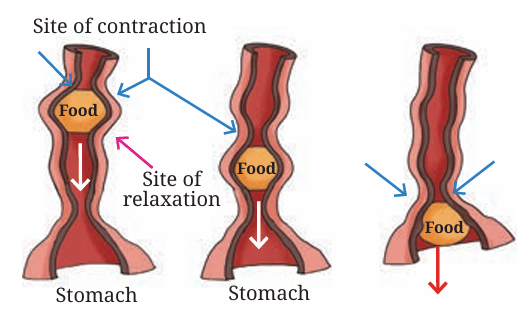
the food pipe or oesophagus (Fig. 9.2). But how does the food move down?
Fig. 9.2: Movement of food in the food pipe
The walls of the food pipe gently contract and relax in a wave-like motion to push the food down into the stomach. This movement takes place throughout the alimentary canal and pushes the food forward.
Stomach
In the stomach, the walls contract and relax to churn the food. The
churned food is then mixed with a secretion from the inner lining
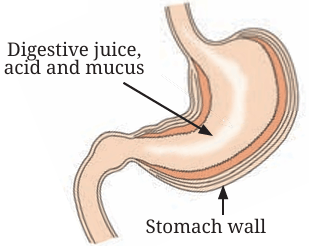
of the stomach. The secretion from stomach contains digestive juice, acid, and mucus.
The digestive juice of the stomach breaks down proteins present in the food into simpler components.
Fig. 9.3: Stomach
The acid not only helps break down proteins but also kills many harmful bacteria. The mucus protects the stomach lining from the acid, preventing damage. In the stomach, the food is partially digested and transformed into a semi-liquid mass, preparing
it for the next stage of digestion.
FASCINATING FACTS
How did scientists learn about digestion in the human body?
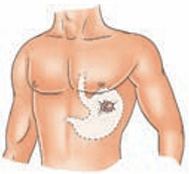
The discovery of how the stomach works happened by chance. In 1822, a man named Alexis St. Martin was accidentally shot in the stomach. He was treated by a doctor, William Beaumont. However, his wound
never fully healed, leaving a small permanent hole. This opening allowed Dr. Beaumont to observe digestion in the stomach as it happened. He conducted experiments on how different foods were broken down and studied how emotions affect digestion.
Alexis St. Martin’s shotgun wound
Small Intestine
After its journey through the stomach, the partially digested food moves into the small intestine. Look at Fig. 9.4. It is a sketch of a stretched-out alimentary canal. Guess how long it is. You will be surprised that although it is called small intestine, it is almost
6 metres long—almost twice the height of your classroom! You will be surprised to know that the small intestine is the longest part of the alimentary canal.
The small intestine receives digestive secretions from three sources—the inner lining of the small intestine itself, and two more structures associated with the alimentary canal—the liver and the pancreas (Fig. 9.4). The liver secretes bile, which
is mildly basic in nature. Recall the neutralisation reaction in chapter ‘Exploring Substances: Acidic, Basic, and Neutral’. Bile neutralises acids present in the food moving down from the stomach and breaks down fats into tiny droplets, making its digestion easier.
Fig. 9.4: Alimentary canal if it is stretched out
The pancreas secretes pancreatic juice, which is also basic in nature and helps neutralise acids present in the food. Additionally, pancreatic juice also breaks down carbohydrates,
proteins, and fats. The digestive juice secreted by the wall of the
small intestine further breaks down fats, proteins, and partially
digested carbohydrates into simpler forms.
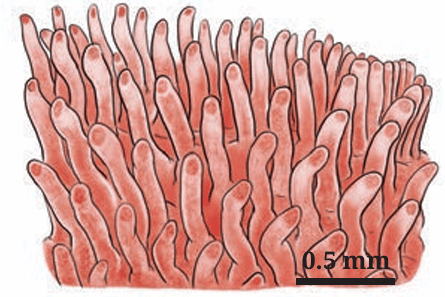
The digested nutrients pass on from the small intestine into the blood present in blood vessels found in the walls of the small intestine. This process is called absorption of nutrients. How are these nutrients absorbed from the small intestine? The inner lining of the small intestine is thin and has thousands of finger-like projections (Fig. 9.5) that increase the surface area for efficient nutrient absorption. These finger-like projections allow the digested nutrients to pass into the blood, which carries them to different parts of the body. These nutrients provide energy, support growth and repair, and help the body function properly.
Fig. 9.5: Inner lining of the small intestine
SCIENCE AND SOCIETY
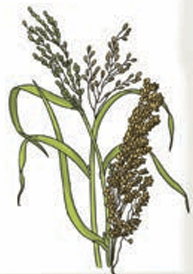
Celiac disease is a condition in which the body reacts to gluten, a protein found in wheat, barley, and rye. This reaction damages the inner lining of the small intestine, where nutrients are absorbed. As a result, the intestine cannot function properly. The only way
to manage celiac disease is to avoid foods that contain gluten. Millets (like jowar, bajra, and ragi) are good alternatives because they are naturally gluten-free.
Large intestine
After most of the nutrients are digested and absorbed in the
small intestine, what happens to the undigested food? It moves into the large intestine. The large intestine is about 1.5 metres in length. It is shorter than the small intestine. Then why is it
called the large intestine? The reason is that it is wider than the
small intestine. The large intestine absorbs water and some salts
from the undigested food, thus making the waste semi-solid. This
semi-solid waste is called stool. The stool is then stored in the lower part of the large intestine, called the rectum, until the body is ready to get rid of it. Eating fibre-rich foods like fruits, vegetables, and whole grains helps the large intestine function properly by making the stool easier to pass. Finally, it is expelled through the anus—a process known as egestion. This is how your body removes the waste it does not need, keeping you healthy!
Isn’t it fascinating how the digestive system works, absorbing
nutrients from food and eliminating waste?
FASCINATING FACTS
The large intestine contains various small living organisms, such as bacteria, that help in digestion. They help in keeping our
digestive system healthy. They break down undigested food,
especially fibre, and produce essential nutrients. Fibre-rich
food, and especially ‘fermented foods’ (like curd, buttermilk,
shrikhand, kanji, pickles, gundruk, and poita bhat) are good for a healthy digestive system and overall well-being.
SCIENCE AND SOCIETY
The importance of digestion in maintaining good health has been
recognised for centuries. The Charaka Samhita, an ancient Ayurvedic text, highlights the role of easily digestible foods and the judicious use of spices like ginger, black pepper, and cumin to enhance digestion. Advances in science in the area of nutrition also emphasise eating meals at proper timings, practising mindful eating, and avoiding overeating as key factors in maintaining digestive health.
9.1.2 Do all animals digest food the same way as humans do?
6.5 The ‘Why’ Question for Adolescence
I have seen cows keep chewing the food even when they are not actively grazing or eating anything. Why?
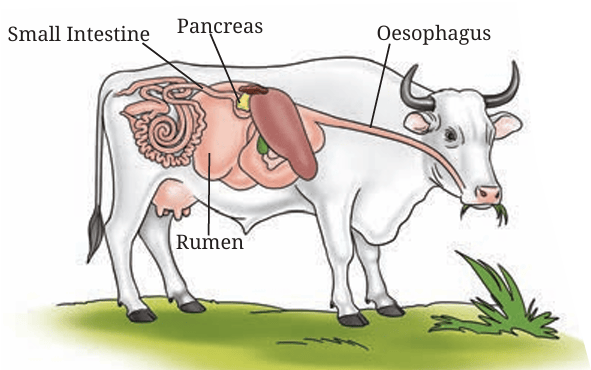
Grass-eating animals, such as cows (Fig. 9.6) and buffaloes, partially chew the grass and swallow it into their stomachs. In the stomach, partial digestion of the food takes place. The partially
digested food is brought back to the mouth for gradual chewing. This process is called rumination, and these animals are called ruminants. A cow spends about 8 hours a day just chewing the food! The thoroughly chewed food again passes down the alimentary canal for further digestion.
Fig. 9.6: Digestive system of a ruminant
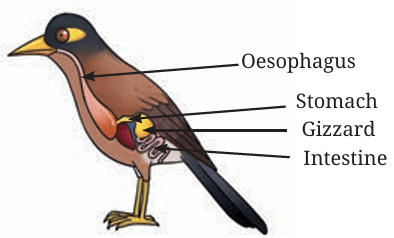
Birds do not have teeth, but they have a chamber called a gizzard (Fig. 9.7). Food is broken down by the contraction and relaxation
of the walls of the gizzard, often with the help of grit (small stones) that the birds swallow.
Fig. 9.7: Digestive system in birds
This shows that animals exhibit variations in the structure and function of the alimentary canal to adapt to different ways
of digesting different kinds of food.
We have learnt that the nutrients from digested food are carried to diff erent parts of the body. Some of the nutrients help build and repair the body, while others, like sugar, are broken
down inside the body to release energy. The process by which
nutrients are converted into usable energy is called respiration. Let us now explore how this process occurs in animals.
9.2 Respiration in Animals
We learnt in Grade 6 chapter ‘Living Creatures: Exploring their
Characteristics’, that all living beings respire. Is the process of
respiration the same in all animals? Let us first understand the
process of respiration in humans.
9.2.1 Respiration in humans
You know that we breathe in (inhale) and breathe out (exhale) air
continuously to obtain oxygen and release carbon dioxide. How is this oxygen used in the body? Are breathing and respiration
different? Let us find out.
How do we breathe?
The process of inhaling and exhaling air is called breathing. It is
difficult to live without food for a week; without water for a day or two, but without breathing, we usually cannot survive more than a few minutes. Why is that? All of us are alive because we breathe. Not just humans, plants and other animals also breathe. But how do we breathe?
Just as food follows a specific pathway in the digestive system,
our body also has a specific system for breathing and respiration.
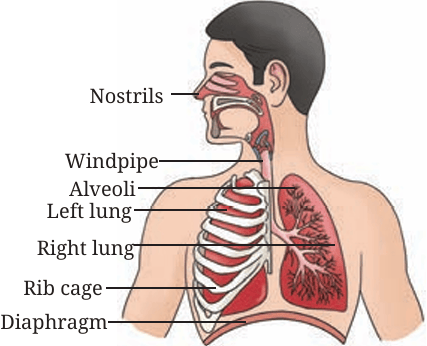
This system is called respiratory system. The respiratory system consists of various parts as shown in Fig. 9.8. In this system, the exchange of gases follows a specific pathway. The pathway through which the air is inhaled and exhaled involves various parts of the respiratory system assisting in the process of breathing and respiration.
Fig. 9.8: Human respiratory system
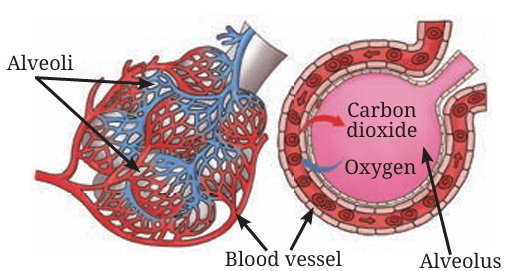
The respiratory system begins with a pair of nasal openings called nostrils through which we inhale and exhale air (Fig. 9.8). The inhaled air passes into a pair of small passages called the nasal passages. Have you noticed tiny hair inside your nostrils? These hair, along with mucus, help trap dust and dirt from the air we breathe in. This is why we should breathe through the nose and not through the mouth. From the nasal passages, the air reaches our lungs through the windpipe. The windpipe forms two branches, which enter the two lungs. In the lungs, these branches further divide into smaller and finer branches that end in small balloon-like sacs called alveoli (Fig. 9.8). Our lungs are protected by the rib cage.
SCIENCE AND SOCIETY
While a lot of the dust is filtered out from the inhaled air, often
small infectious particles can get through the lungs. For example,
during the COVID-19 pandemic, the SARS-CoV-2 virus affected the respiratory system, leading to breathing difficulties and Life Processes in Animalsoften causing serious lung problems.
Let us understand the mechanism of breathing by making a simple model.
Activity 9.2: Let us make a model
Take a wide transparent plastic bottle with a lid. Remove its
bottom.
Make a hole in the lid of the bottle.
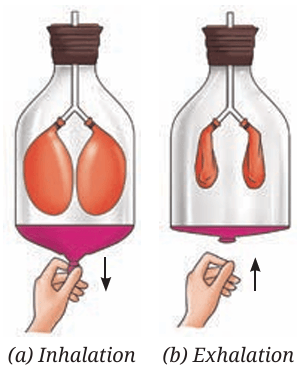
Take a Y-shaped hollow tube, as shown in Fig. 9.9.
Fix two deflated balloons to the forked end of the tube. Secure
them with rubber bands to make them airtight.
Insert the straight end of the tube tightly through the lid from the open base of the bottle and seal the lid with clay to make it airtight.
To the open base of the bottle, attach a thin rubber sheet
tightly using a large rubber band.
Fig. 9.9: Model to show mechanisms of breathing
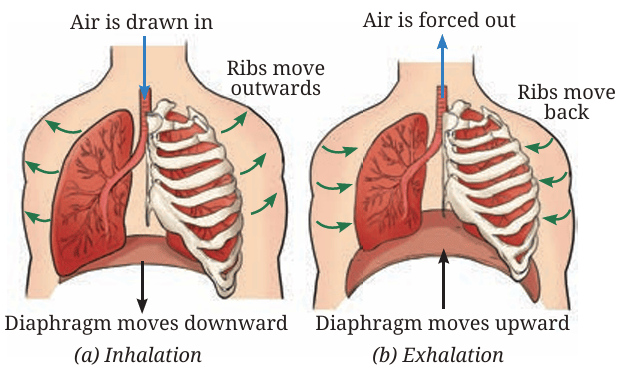
Pull the rubber sheet from the centre of the base downwards and watch the balloons (Fig. 9.9a). What do you observe? Now, release the rubber sheet upwards and observe the balloons (Fig. 9.9b). What changes do you see in the balloons? When you pull the rubber sheet downwards, the balloons inflate. Conversely, when you release the rubber sheet upwards, the balloons deflate. When you breathe
in (inhale), your chest expands as the ribs move up and outwards. The diaphragm (a dome-shaped muscle below the lungs) moves downwards during inhalation (Fig. 9.10a). This increases the space inside the chest, and air enters the lungs. When you breathe out (exhale), the ribs move down and inwards, and the diaphragm moves upwards (Fig. 9.10b), reducing space and pushing air out of the lungs.
Fig. 9.10: Mechanism of breathing
What do the balloons in the model mentioned in Fig. 9.9 represent? What does the rubber sheet represent? In this model, the balloons represent the lungs, and the rubber sheet represents the diaphragm.
SCIENCE AND SOCIETY
Breathing Practices for a Healthy Life
Breathing exercises have been practised across different cultures
in India and worldwide for centuries. Pranayama is well known for improving respiratory health, mind relaxation, and concentration. In Ladakh, people practise Tummo breathing,
a technique that improves lung function and helps keep the body warm even in cold weather. Similarly, deep breathing techniques are used to promote well-being. Some traditions combine deep breathing with chanting, using rhythmic breath control to enhance relaxation and mental clarity.
What do we breathe out?
Activity 9.3: Let us explore
To be demonstrated by the teacher
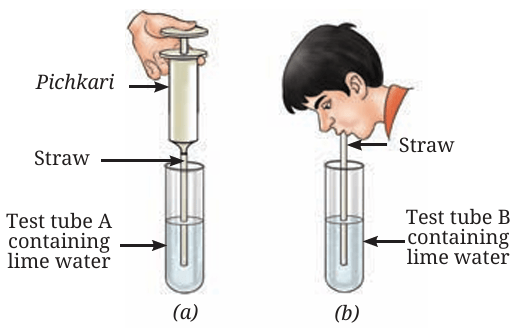
Take an equal amount of freshly prepared lime water in two
test tubes, A and B, as given in Fig. 9.11.
In test tube A, pass the air using a syringe/pichkari (Fig. 9.11a). This is the same air that you inhale.
In test tube B, repeatedly blow air through your mouth into
the lime water using a straw (Fig. 9.11b).
Fig. 9.11: (a) Air is passed into lime water with a
pichkari/syringe (b) Air is exhaled into lime water
Do you observe any changes in the colour of the lime water?
The lime water in test tube B turns milky (or cloudy), but the lime
water in test tube A does not. What does this indicate? Lime water
turns milky when it reacts with carbon dioxide. Therefore, this
indicates that the exhaled air contains more carbon dioxide than
the air we inhale.
How does the exchange of gases happen?
Through the process of breathing, fresh air from outside enters the
lungs and fills the alveoli. The alveoli have thin walls surrounded by fine tubes containing blood (Fig. 9.12). Blood carries carbon dioxide from the body to the alveoli, where it is released into the air. At the same time, oxygen from the alveoli passes into the blood and is transported to all parts of the body.
Fig. 9.12: Gas exchange through alveoli
Have you ever wondered how the food you eat gives you energy? The key is not only the food but also the oxygen we breathe! When we eat food, our body breaks it down into simple substances like sugar (glucose). Oxygen helps break down glucose to release energy. This process is called respiration. The word equation of the process of respiration is as follows—
Glucose + Oxygen → Carbon dioxide + Water + Energy
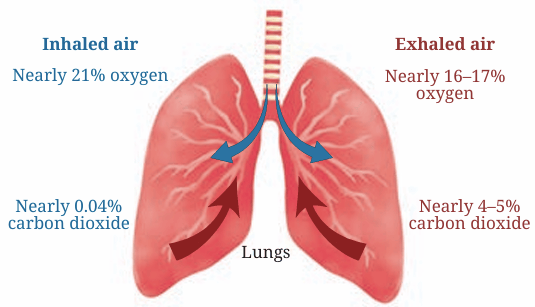
During breathing, we inhale air from our surroundings and exhale air having more carbon dioxide than the inhaled air. Note that not all the oxygen is used up (Fig. 9.13). Some other animals can use a larger fraction of the oxygen during respiration. This exchange of gases ensures that each segment of our body gets oxygen to produce energy and remove waste products. In simple words, breathing brings in oxygen and removes carbon dioxide, while respiration uses oxygen to break down food and release energy. This energy helps us walk, run, play, and even think!
Fig. 9.13: The percentage of oxygen and carbon dioxide in inhaled and exhaled air
Breathing is a physical process, while respiration is a chemical
process that occurs inside the body. Both the processes are
essential for our survival!
Our body has a unique system for the transport of nutrients,
oxygen, and other substances. This system is called the circulatory
system. It includes the heart, blood, and blood vessels. The heart
pumps blood through blood vessels, ensuring the transport of
nutrients, oxygen, and other substances to all parts of the body,
while waste products are carried away.
SCIENCE AND SOCIETY
Smoking is extremely harmful to health. It damages the lungs and
increases the risk of serious diseases, including lung cancer and
other respiratory illnesses. It leads to persistent coughing and
frequent infections.
In addition to harming the smoker, smoking releases toxic chemicals into the air, putting others at risk. When non-smokers inhale this polluted air, they experience passive smoking, which can be especially dangerous for children, pregnant women, and the elderly. Due to these risks, avoiding smoking helps protect both personal health and the well-being of those around us.
9.2.2 Do other animals breathe the same way as humans do?
You have learnt that diff erent animals
live in diff erent habitats. You may have
observed birds fl ying and fi sh swimming.
How do they breathe? Animals, such
as birds, elephants, lions, cows, goats,
lizards, and snakes, breathe through
their lungs. Although all these animals
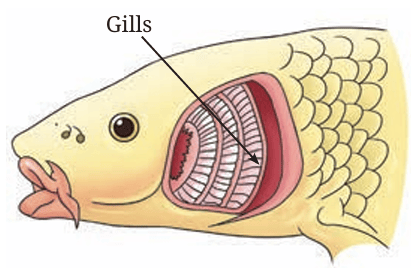
have lungs, the structure of their lungs are quite diff erent. Most aquatic animals
like fi sh, have specialised structures
known as gills (Fig. 9.14). These are
richly supplied with blood vessels. The exchange of oxygen and
carbon dioxide between the blood and the gases dissolved in
water takes place across the gills.
Fig. 9.14: Breathing body parts in a fish
Amphibians, like frogs, live both on land and in water. They use different body parts for breathing at various stages of their
life. For example, tadpoles breathe through gills, while adult frogs use lungs for breathing on land and skin for gas exchange when they stay in water. This adaptation helps them survive both in
water and on land, showing how animals have adapted over time to different environments. Earthworms use their moist skin for Life Processes in Animals the exchange of oxygen and carbon dioxide.
Thus, different animals have different breathing mechanisms to suit their unique habitats. Apart from the digestive system, the
respiratory system, and the circulatory system, there are other
systems which work in coordination with each other in the body
and perform different functions to sustain life. You will study
about them in higher grades.
In a Nutshell
Life processes such as nutrition, circulation, respiration,
excretion, and reproduction are essential for the survival
of living beings. These processes are collectively called life
processes.
The human digestive system consists of an alimentary canal
which includes the mouth, oesophagus, stomach, small intestine, large intestine, and anus, and its associated parts,
the liver and the pancreas.
The digested food is primarily absorbed through the walls of
the small intestine.
The nutrients absorbed are distributed through the blood
to different parts of the body where they are used for
performing various functions.
The large intestine absorbs most of the remaining water and
some salts from the undigested food.
Grass-eating animals such as cows and goats are called
ruminants. They chew the food partially and swallow it. Later, the partially digested food is returned to the mouth, and the animal chews it thoroughly.
Breathing involves the movement of air into the lungs
(inhalation) and out of the lungs (exhalation).
The exchange of oxygen and carbon dioxide occurs in the
alveoli of the lungs.
Respiration uses oxygen from inhaled air to break down
glucose into carbon dioxide and water. The process by which
nutrients are converted into usable energy is called respiration.
The circulatory system transports nutrients and oxygen to
all parts of the body. It includes the heart, which pumps
blood through blood vessels, delivering oxygen and nutrients
while also removing waste from the body.
Breathing is a physical process and respiration is a chemical
process.
Different animals have different breathing mechanisms
adapted to suit their habitats.
Let Us Enhance Our Learning
1. Complete the journey of food through the alimentary canal
by filling up the boxes with appropriate parts—
Food →
Mouth →
___ →
Stomach →
__ →
__ →
Anus
2. Sahil placed some pieces of chapati in test tube A. Neha placed chewed chapati in test tube B, and Santushti took boiled and mashed potato in test tube C. All of them added a few drops of iodine solution to their test tubes—A, B, and C, respectively. What would be their observations? Give reasons.
3. What is the role of the diaphragm in breathing?
(i) To filter the air
(ii) To produce sound
(iii) To help in inhalation and exhalation
(iv) To absorb oxygen
4. Match the following
Name of the part
Functions
(i) Nostrils
(a) fresh air from outside enters
(ii) Nasal passages
(b) exchange of gases occurs
(iii) Windpipe
(c) protects lungs
(iv) Alveoli
(d) tiny hair and mucus help to trap dust and dirt from the air
we breathe
(v) Ribcage
(e) air reaches our lungs through this part
5. Anil claims to his friend Sanvi that respiration and breathing
are the same process. What question(s) can Sanvi ask him to make him understand that he is not correct?
6. Which of the following statements is correct and why?
Anu: We inhale air.
Shanu: We inhale oxygen.
Tanu: We inhale air rich in oxygen.
7. We often sneeze when we inhale a lot of dust-laden air. What
can be possible explanations for this?
8. Paridhi and Anusha of Grade 7 started running for their
morning workout. After they completed their running, they
counted their breaths per minute. Anusha was breathing
faster than Paridhi. Provide at least two possible explanations
for why Anusha was breathing faster than Paridhi.
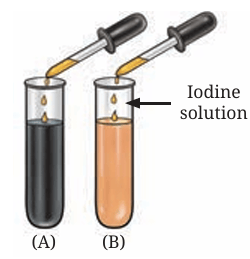
9. Yadu conducted an experiment to test his idea. He took two test tubes, A and B, and added a pinch of rice flour to the test tubes, half filled with water and stirred them properly. To test tube B, he added a few drops of saliva. He left the two test tubes for 35–45 min. After that, he added iodine solution into both the test tubes. Experimental results are as shown in Fig. 9.15. What do you think he wants to test?
Fig. 9.15: Experimental results
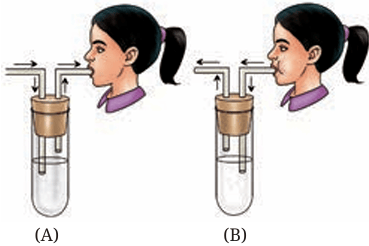
10. Rakshita designed an experiment taking two clean test tubes, A
and B and filled them with lime water as shown in the figure. In
test tube A, the surrounding air that we inhale was passed on by
sucking air from the pipe, and in test tube B, the exhaled air was blown through the pipe (Fig. 9.16). What do you think she is
trying to investigate? How can she confi rm her findings?
Fig. 9.16: Experimental set-up
Exploratory Projects
What are the good practices for maintaining oral hygiene? Try
to gather information on the same from books/newspapers/
conversation with elders. Prepare a report.
Find out different ways to maintain a healthy digestive system.
Suggest some food items that help to maintain good digestive
health. Make a report and present it in class.
Using coloured clay, prepare a 3-D model of the digestive system and label all parts of the digestive system using black paper strips.
What is air quality and AQI? Find out the effect of air quality on the respiratory systems of people working in various fields —
farmers, factory workers, or street vendors.
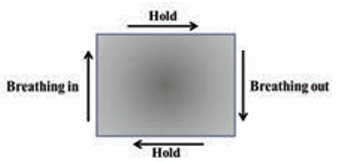
Try to read about the box-breathing technique (Fig. 9.17). What are its benefits?
Fig. 9.17: Box-breathing
Both birds and mammals have lungs for breathing, but birds can
fly at high altitudes where oxygen levels are low. How might their
respiratory system be adapted to help them survive in such conditions?