In Grade 6, we learnt that all living beings grow and need food
for their growth. Also, in the previous chapter, we discussed the
process through which animals obtain nutrition.
We know that animals eat food to grow, but what about plants? Have you ever seen plants eating food like animals do? As animals grow, their size and weight usually increase, and their bodies undergo various changes. What changes do you notice in plants when they grow?
We learnt that food provides nutrients like carbohydrates, fats, proteins, vitamins, and minerals, which, along with water, are all essential for growth. Let us explore how plants obtain nutrients for their growth.
10.1 How Do Plants Grow?
Look around your neighbourhood. Have you observed any changes in a plant during its life span? As a plant grows, new leaves and branches emerge, its height increases, and its stem thickens. What do you think causes these changes? Discuss with your friends and provide your explanation as well.
When we water plants regularly, they grow better. So, I think water also contributes to its growth.
Maybe plants take up food from the soil through their roots.
I think sunlight plays some role in the growth of plants.
I think, maybe, ______ plays some role!
Let us perform an experiment to test some of these explanations.
Activity 10.1: Let us test some explanations
Take three earthen pots (or used bottles/containers) of the
same size filled with garden soil. Plant saplings of similar sizes
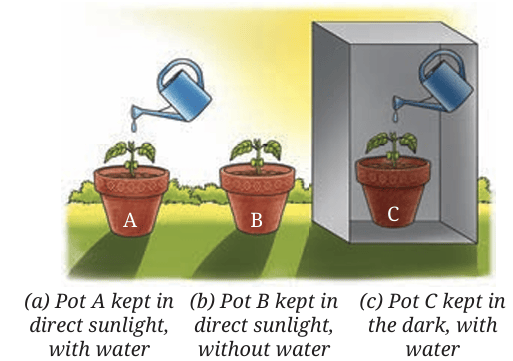
of a fast-growing plant like chilli or tomato in each pot (Fig. 10.1).
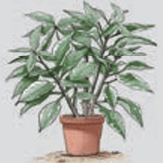
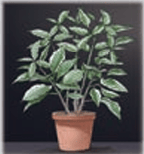
Fig. 10.1: Experimental set-up to understand the role of sunlight and water in plant growth
Label the pots A, B, and C.
Count the number of leaves on each sapling and record your
observations.
Place pot A in direct sunlight. Keep the soil in this pot slightly moist by adding an adequate amount of water every day (Fig. 10.1a).
Place pot B in direct sunlight, without adding water to the soil
(Fig. 10.1b).
Place pot C in the dark. Keep the soil in this pot slightly moist by adding an adequate amount of water every day (Fig. 10.1c).
Observe the plants for two weeks1 and record changes in their height, number of leaves, colour of leaves, and any other changes that may appear.
Record your observations in Table 10.1.
Table 10.1: Effect of sunlight and water on plant growth
Pots kept under different
conditions
Availability of
Height of plant (cm)
Number of leaves
Colour of leaves (Green/Yellow)
Sunlight
Water
Day 1
After 2 weeks
Day 1
After 2 weeks
Pot A: In direct sunlight, with water
Pot B: In direct sunlight, without water
Pot C: In the dark, with water
What differences did you observe between the plants in the
three pots?
Which pot has the plant with the maximum growth?
Which pot has the plant with the least growth?
Analyse the observations recorded in Table 10.1, and discuss
them with your teacher and friends.
You are likely to find that the plant in Pot A, kept in direct
sunlight with adequate water, grows better than the plant in Pot
C, which gets adequate water but no sunlight. The plant in Pot
B may have died as it did not get water even though it received
adequate sunlight.
What do you infer from the observations made in this activity? The results indicate that plants require both sunlight and water for their growth.
1 This experiment will need two weeks. Teachers can plan this activity accordingly.
FASCINATING FACTS
फलकसमसपदिचता रोपणतो भवित केवलान् न यत: ।
“Trees do not produce fruits and flowers merely because they are planted.”
This line is from an ancient Indian text named Vrikshayurveda. It records useful observations about plant growth, soil, and agricultural practices to help improve crop health, growth and production. The knowledge in the text seems to be based on practical experiences and patterns seen over time. These ideas were then systematically documented to guide farming practices.
For instance, there are references to different methods of organic
manure preparation, such as mixing water, barley, and variousseeds, like green, black, and horse grams.
10.2 How Do Plants Get Food for their Growth?
We know that animals get their food from plants, either directly by
eating plants or indirectly by eating animals that in turn eat plants for their nutrition and growth. But how do plants obtain the food they need to grow? Unlike animals, plants do not eat food.
10.2.1 Leaves: the ̒ food factoriesof plants
Plants store food in the form of starch, a type of carbohydrate.
This starch is produced in the leaves of a plant which, by design,
are generally broad and flat. These are mostly green because of
the presence of a green pigment called chlorophyll, that helps in capturing sunlight efficiently.
Let us find out the role chlorophyll plays in the preparation of
food in the form of starch in plants.
Activity 10.2: Let us check (demonstration activity)
The teacher may demonstrate this activity.
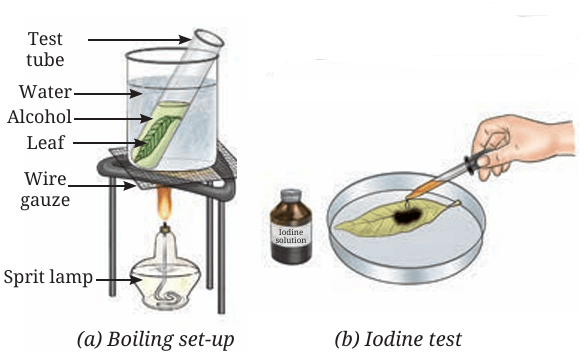
Keep a leaf in boiling water for five minutes to soften it.
Dip this leaf in a test tube containing alcohol.
Place the test tube in a beaker containing boiling water.
Wait until the leaf becomes colourless (Fig. 10.2a).
Take out the leaf and place it on a plate.
Now, put a few drops of diluted iodine solution with the help
of a dropper on the decolourised leaf (Fig. 10.2b). Wait for a
few minutes and observe.
Fig. 10.2: Starch test in a leaf
If the colour of the leaf changes to blue-black, it indicates the presence of starch.
Caution — Alcohol should never be placed near a heat source directly, as it is highly flammable and can easily lead to fire and burns.
DIVE DEEPER
Did you wonder why we decolourise the leaf in the beginning of this activity?
Decolourisation of a leaf enables us to easily observe colour change and, thus, the presence of starch.
In Activity 10.1, we have learnt that water and sunlight are
essential for plant growth. In Activity 10.2, we have discovered
that green leaves store starch as food.
Bhaskar loves gardening during his free time. Being a curious
student, he often looks around his garden and wonders how plants produce food. From his experiences, Bhaskar knows that water and sunlight are essential for plant growth. But he wonders if sunlight contributes to the production of food in the form of starch in plants.
How does sunlight contribute in the production of starch in plants?
Activity 10.3: Let us check
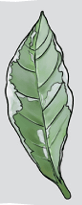
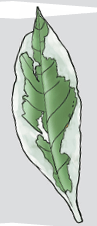
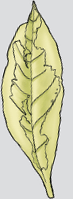
Bhaskar took a leaf having both green and non-green patches from each of two similar potted plants — one kept in sunlight and the other kept in the dark for 36 hours. He wanted to compare the leaves before and after the starch test.
He made a sketch of the leaves to record the location of the
green and the non-green patches on them with the help of a
tracing paper. After that, he performed an iodine test (as shown
in Activity 10.2) on the leaves. Bhaskar recorded his observations
in Table 10.2.
Table 10.2: Presence of starch in green and non-green parts of the leaves of plants
S.No.
Light conditions for potted plant
Initial colours before iodine test
Final colours after iodine test
1.
Plant kept in sunlight
Green and non-green patches on the leaf
Green patches of leaf turned blue-black
2.
Plant kept in the dark
Green and non-green patches on the leaf
No change in colour
In Table 10.2, Bhaskar recorded a blue-black colour (indicating
the presence of starch) on the green patches of the leaf obtained
from the plant placed in sunlight. Bhaskar also recorded that the
leaf obtained from the plant kept in the dark does not show a
blue-black colour, even on the green patches, indicating that no
starch has been produced. Non-green patches of the leaf obtained
from the plant placed in sunlight do not turn blue-black. Does it
indicate that there is no chlorophyll present in those patches?
The non-green patches may not have sufficient chlorophyll to
prepare enough starch to be detected using the iodine test.
FASCINATING FACTS
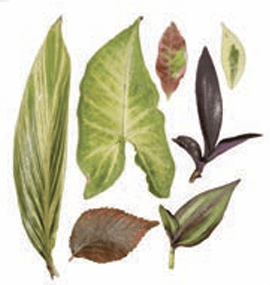
Some plant leaves appear red, violet, or brown because they contain more of these coloured pigments than the green-coloured chlorophyll. This hides the green colour. Some of these pigments
also help in photosynthesis. You can use an iodine test to check for the presence of starch in these leaves, indicating that
photosynthesis has indeed taken place.
What do we infer from the observations listed in Table 10.2?
As we know, leaves are mostly green because of the presence
of chlorophyll. We have also seen that the starch is produced
where green patches of the leaf are present. We can infer that
chlorophyll helps in preparing starch in the presence of sunlight.
In fact, it is essential for the preparation of starch. Hence, the
leaves are also called ‘food factories’ of plants.
What else is essential for the preparation of food in plants?
Let us find out.
10.2.2 Role of air in the preparation of food
While reading contributions of scientists in plant nutrition, my sister told me that air plays a role in the process of food preparation in plants.
Which gas from the air is essential in the process of food preparation in plants?
Activity 10.4: Let us experiment (demonstration activity)
The teacher may demonstrate this activity.
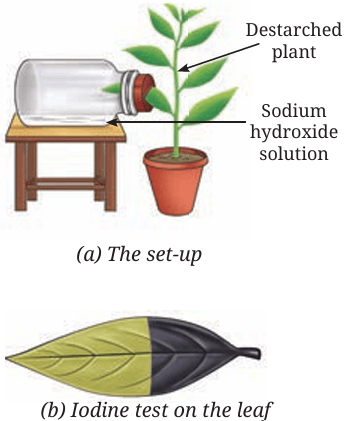
Take a potted green plant and keep it in the dark for two to three days to allow it to destarch (i.e., lose any stored starch). Then, locate one leaf of this plant for this experiment.
Take a wide-mouthed bottle and pour some caustic soda (sodium hydroxide) into it (caustic soda absorbs carbon dioxide from
the air).
Caution— Caustic soda is a strong chemical that can cause skin burns; only teachers should handle it.
Fig. 10.3: Testing the role of chlorophyll and air
Insert half of the destarched leaf into the bottle through a split cork, leaving the other half of the leaf outside, and place the bottle as shown in Fig. 10.3a.
Place the set-up in sunlight for a few hours.
Observe and record the availability of water, sunlight,
chlorophyll, and carbon dioxide in Table 10.3.
Remove the leaf and test it for starch using the iodine test, as was done in Activity 10.2.
Record your observations in Table 10.3.
Table 10.3: Role of air in the preparation of starch by plants
Part of the
leaf
Availability of
Starch present (Yes/No)
Water
Sunlight
Chlorophyll
Carbon dioxide
Part of the leaf inside the bottle
Part of the leaf outside the bottle
We notice that the part of the leaf that was outside the bottle
turns blue-black, indicating the presence of starch. However, the
part of the leaf inside the bottle does not turn blue-black in colour, indicating that food is not made in that part of the leaf. This is because the caustic soda solution inside the flask absorbs the carbon dioxide present in the air. What does this experiment show?
This experiment shows that carbon dioxide present in the air is essential for plants to prepare starch.
Based on Activities 10.3 and 10.4, what do you conclude?
Which part of the plant is involved in the synthesis of starch?
Based on our learnings so far, we have found that sunlight,
water, chlorophyll and carbon dioxide are essential for the
synthesis of food in plants. This process by which plants prepare
food in the presence of sunlight and chlorophyll is called
photosynthesis. A leaf is the primary site for photosynthesis. Do other green parts of the plant also perform photosynthesis? Yes, other parts of the plants which have chlorophyll also perform
photosynthesis.
So far, we have learnt that plants take in carbon dioxide from
the air and water, and use sunlight to prepare their food by the
process of photosynthesis. But have you ever thought about what
more happens during this process? Do plants only take in substances from their surroundings, or do they also release
something? Let us explore this through an experiment performed
by Barkha didi.
Activity 10.5: Let us explore
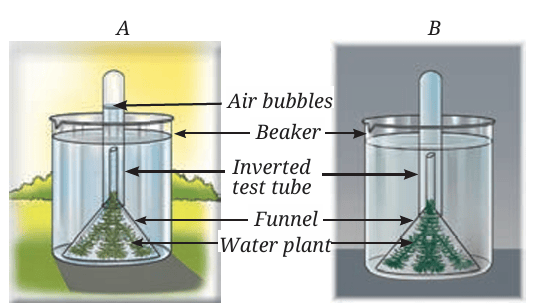
Look at Fig. 10.4. Compare the two set-ups labelled as A and B, and analyse.
Fig. 10.4: Activity showing the release of oxygen during photosynthesis
In Fig. 10.4, set-up A is placed in sunlight, and set-up B is placed in the dark. What difference do you observe in the two set-ups? Do you observe air bubbles emerging in the inverted test tube in set-up A? The gas produced in this set-up caused bubbles to emerge and get accumulated in the inverted test tube. Which gas is this?
Oh yes! I remember. In our science lab, I have seen a similar set-up placed under sunlight near a window.
When sufficient gas was accumulated in the inverted test tube, Barkha didi placed her thumb on the mouth of the test tube while
taking the test tube off the set-up. She then quickly inserted a lit matchstick into the tube and the matchstick produced an intense flame.
She inferred that the gas in the test tube is rich in oxygen. It indicates that oxygen is released during the process of photosynthesis. It also indicates that photosynthesis occurs in the presence of sunlight.
Based on Barkha didi’s experiment, we can conclude that
oxygen is released during photosynthesis.
10.2.3 Photosynthesis: in a nutshell
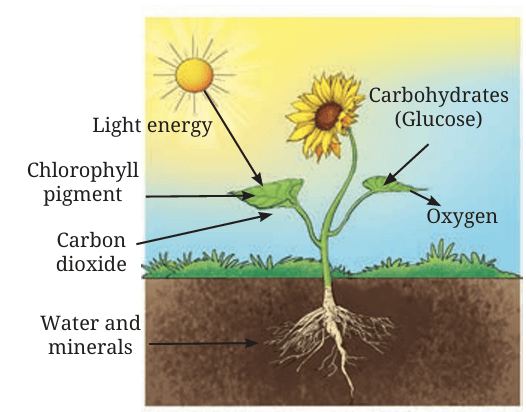
We know that water, sunlight, carbon dioxide from the air, and chlorophyll are necessary to carry out the process of
photosynthesis that produces carbohydrates (Fig. 10.5). During
photosynthesis, food is actually produced in the form of glucose, a
simple carbohydrate. This glucose not only serves as an instant source of energy but also later gets converted into starch for storage.
Fig. 10.5: A diagram showing photosynthesis
The word equation of photosynthesis is given below —
KNOW A SCIENTIST
Many scientists across the world contributed to develop an
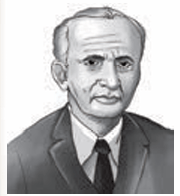
understanding of photosynthesis. In India, Rustom Hormusji Dastur
(1896–1961) studied the process of photosynthesis. He was a plant scientist and served as the head of the Botany Department at the Royal Institute of Science, Bombay (now the Institute of Science, Mumbai), from 1921–1935. He studied eff ects of the amount of water
and temperature on photosynthesis. He examined the importance of water, temperature, and the colour of light in the process of photosynthesis.
10.2.4 How do leaves exchange gases during photosynthesis?
We now know that photosynthesis requires carbon dioxide, and
oxygen is released in the process. Which part of the plant helps in
the exchange of carbon dioxide and oxygen? Let us conduct an
activity to understand where the exchange of gases takes place.
Activity 10.6: Let us examine (demonstration activity)
The teacher may demonstrate this activity.
Collect a leaf from a plant such as rhoeo, money plant, onion, hibiscus, coleus, or any grass.
Put it in a beaker filled with water.
Carefully peel a thin layer from the lower surface of the leaf.
Place the peel in a watch glass with water.
Now, take a microscope slide and carefully put a drop of water on it.
Using forceps, transfer the peel of the leaf from the watch glass to the slide with the help of forceps.
Put a drop of ink on the leaf peel with the help of a dropper.
Cover the peel with a coverslip and observe it under a microscope.
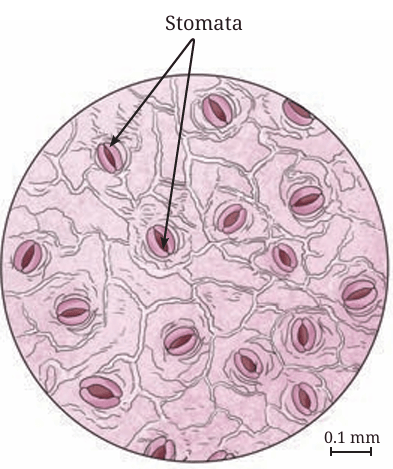
What do you observe? Do you notice tiny pores on the peel, as shown in Fig. 10.6? These pores are called stomata. Stomata, present on the surface of leaves, help in the exchange of gases.
Fig. 10.6: Stomata on the lower surface of a rhoeo leaf
10.3 Transport in Plants
10.3.1 Transport of water and minerals
All living beings need water to grow. Plants use water in the
process of photosynthesis. Water, along with minerals present in
the soil, is taken up by the roots of a plant. Minerals are important nutrients for the growth of plants. How do water and minerals taken up by the roots move to all parts of the plant?
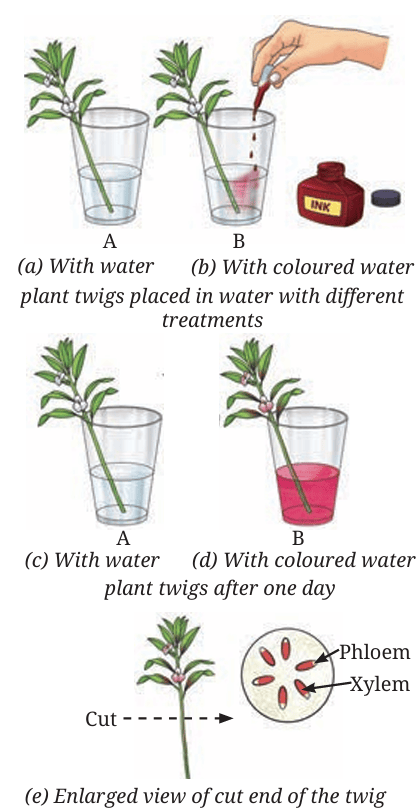
We can study water transport in plants by carrying out an activity. For this activity, we require two glass tumblers, some water, red ink, and twigs of two similar tender plants, preferably with white-coloured flowers (for example, white sadabahar,
balsam), as shown in Fig. 10.7.
Activity 10.7: Let us experiment
Take two tumblers and label them A and B.
Fill one-third of each tumbler with water.
Add a few drops of red ink to tumbler B.
Obliquely cut the stems of both plants at their base while keeping them inside the water and immediately place one plant in each tumbler, as shown in Fig. 10.7a and Fig. 10.7b.
Observe these plants the next day.
Fig. 10.7: Experiment to check for water transportation in plants
What do you notice? Compare the plant stems placed in the tumblers. Do you observe red colour in the stem, leaves, and flowers of the
plant from Tumbler B? Fig. 10.7c and Fig. 10.7d show the plants after one day. Compare the plant in Fig. 10.7c with that in Fig. 10.7d. A red colour is visible in the stem, leaves, and flowers of the plant in Fig. 10.7d. How did different parts of the plant acquire this red colour?
Cut the stem from the upper part of the plant that is not immersed in the red-coloured water. Observe the cut stem using a magnifying glass. Do you spot the red colour in the stem (Fig. 10.7e)?
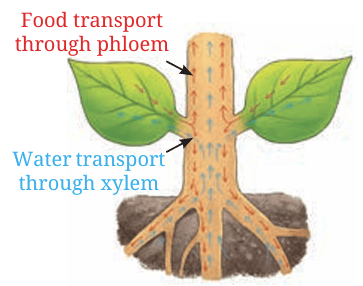
How does the red colour ink move upwards? This is due to the thin tube-like structure called the xylem present in the stem, branches, and leaves of plants. Just like red ink, minerals dissolved in water also move up the stem through the xylem.
Now, we know that water and minerals are transported to the leaves and other parts of plants through the xylem (Fig. 10.8). The water
transported through the xylem is used to perform various functions. How does food get transported to other parts of a plant?
Fig. 10.8: Transport of water and minerals in a plant
10.3.2 Transport of food
We know that leaves are the primary site for photosynthesis. The food prepared by plants in the leaves is transported to all parts of the plant. This food is transported through another set of thin
tube-like structures called the phloem (Fig. 10.8). The transported food may also be stored in some other parts of a plant, such as seeds and roots.
10.4 Do Plants Respire?
In the Grade 6 Science textbook Curiosity, chapter ‘Living
Creatures: Exploring their Characteristics’, you learnt that all
living beings respire. Do plants also respire like we do?
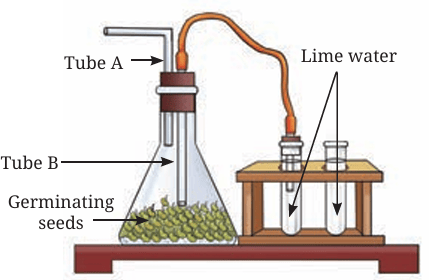
Activity 10.8: Let us find out(demonstration activity)
Soak some moong bean seeds in water overnight.
Put a layer of cotton in a conical flask (Fig. 10.9) and moisten the cotton with water to keep it wet.
Place the soaked seeds over the wet cotton in the conical flask.
Cover the mouth of the conical flask with a cork having two holes.
Fit two tubes A and B through the two holes on the cork, as shown in Fig. 10.9.
Leave it undisturbed for 24 hours in the dark.
Take two test tubes and fill them with lime water.
Cover the mouth of one test tube with a cork having one hole in it.
Dip one glass tube in the test tube through a hole in the cork.
Connect the flask and test tube with a rubber pipe as shown in Fig. 10.9.
Fig. 10.9: Set-up to test respiration in plants
Compare both the test tubes for any change in colour. Does the lime water turn milky in both the test tubes? Why does the lime water turn milky in the test tube connected to the flask? Lime water turns milky due to the presence of more carbon dioxide in the flask. But where does this carbon dioxide come from? As we know, carbon dioxide is naturally present in very small quantities in the air. In the flask, additional carbon dioxide is produced by the seeds as they respire.
During respiration, glucose is broken down in the presence of oxygen, releasing carbon dioxide, water, and energy. The word equation for the proccess of respiration, is as follows —
Glucose + Oxygen → Carbon dioxide + Water + Energy
The energy produced during respiration is used by plants for their growth and development. All parts of a plant, green or non-green, carry out respiration.
Thus, plants have different mechanisms for synthesising, transporting, and utilising food to get energy.
In a Nutshell
All living organisms require food that provide energy for their growth and development.
Plants use carbon dioxide and water in the presence of sunlight and chlorophyll to produce glucose and oxygen. This process of synthesis of food is known as photosynthesis.
Leaves are the ̒ food factories ̓ of a plant.
Tiny pores on the surface of leaves, called stomata, help in the exchange of oxygen and carbon dioxide during photosynthesis and respiration.
The xylem transports water and minerals from roots, while the phloem carries food from leaves to all parts of the plants.
Plants break down glucose and release energy by a process called respiration. They use oxygen and release carbon dioxide in this process.
Let Us Enhance Our Learning
1. Complete the following table
S.No.
Feature
Photosynthesis
Respiration
1.
Raw materials
2.
Products
3.
Word equation
4.
Importance
2. Imagine a situation where all the organisms that carry out
photosynthesis on the earth have disappeared. What would be the impact of this on living organisms?
3. A potato slice shows the presence of starch with iodine solution. Where does the starch in potatoes come from? Where is the food synthesised in the plant, and how does it reach the potato?
4. Does the broad and flat structure of leaves make plants more
efficient for photosynthesis? Justify your answer.
5. X is broken down using Y to release carbon dioxide, Z, and energy.
X + Y → Carbon dioxide + Z + Energy
X, Y, and Z are three different components of the process.
What do X, Y, and Z stand for?
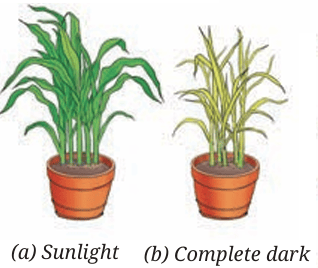
6. Krishna set-up an experiment with two potted plants of same size and placed one of them in sunlight and the other in a dark room, as shown in Fig. 10.10.
Fig. 10.10: Experimental pots
Answer the following questions —
(i) What idea might she be testing through this experiment?
(ii) What are the visible differences in plants in both the conditions?
(iii) According to you, leaves of which plants confirm the iodine test for the presence of starch?
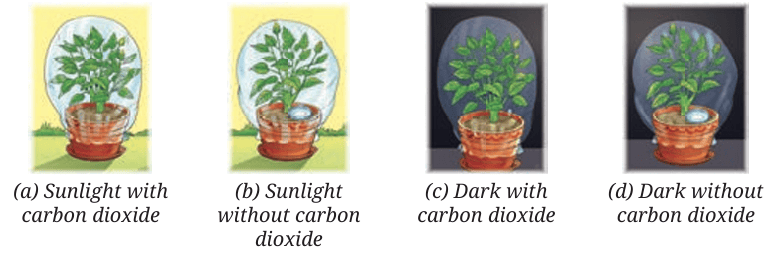
7. Vani believes that ‘carbon dioxide is essential for photosynthesis’. She puts an experimental set-up, as shown in Fig. 10.11, to collect evidence to support or reject her idea.
Fig. 10.11: A potted plant with sufficient water is placed under the prescribed conditions
Answer the following questions —
(i) In which plant(s) in the above set-up(s) will starch be formed?
(ii) In which plant(s) in the above set-up(s) will starch not be formed?
(iii) In which plant(s) in the above set-up(s) will oxygen be generated?
(iv) In which plant(s) in the above set-up(s) will oxygen not be generated?
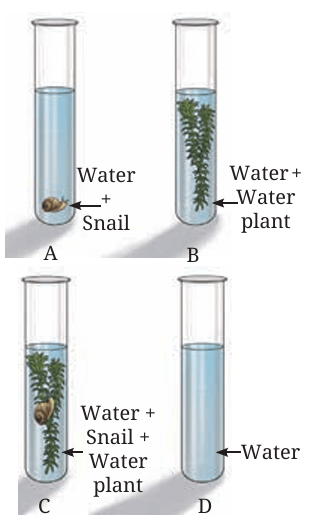
8. Ananya took four test tubes and filled three-fourth of each test tube with water. She labelled them A, B, C, and D (Fig. 10.12). In test tube A, she kept a snail; in test tube B, she kept a water plant; in test tube C, she kept both a snail and a plant. In test tube D, she kept only water. Ananya added a carbon dioxide indicator to all the test tubes. She recorded the initial colour of water and observed if there are any colour changes in the test tubes after 2–3 hours.
What do you think she wants to find out? How will she know if she is correct?
Fig. 10.12: Experimental set-up
9. Design an experiment to observe if water transportation in plants is quicker in warm or cold conditions.
10. Photosynthesis and respiration are essential to maintain balance in nature. Discuss.
Exploratory Projects
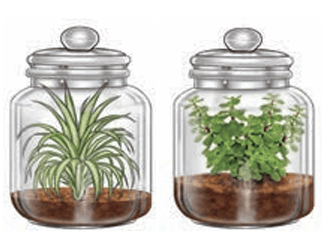
Develop a bottle garden by planting a growing plant like spider plant or jade plant in a large transparent bottle (Fig. 10.13). After growing the plant properly for some time, seal the mouth of the bottle. Observe the growth of the plant. If the plant is growing well that means the plant is maintaining the exchange of gases, that is, carbon dioxide produced in the process of respiration of the plant is utilised for performing photosynthesis, and oxygen generated in
photosynthesis is utilised in respiration by the plant inside the bottle.
Fig. 10.13: Bottle garden
How are plant processes like photosynthesis, respiration, and
water and food transportation crucial for crop production?
Visit a greenhouse, if there is one near your place. Observe
how people grow plants in a green house. Find out how they regulate the amount of light, water, and carbon dioxide used to grow plants.
KNOW A SCIENTIST
Kamala Sohonie (1911–1998) was a woman scientist of India. She
received a Ph.D. degree for her remarkable contribution in the area of respiration in plants from Cambridge University.
She returned to India and worked at the Lady
Hardinge Medical College in New Delhi, and later
at the Nutrition Research Laboratory, Coonoor.
Thereafter, she moved to the then Royal Institute
of Science, Bombay, where she was eventually
appointed as Director. Much of her work helped
improve the nutritive values of plant foods. She
also worked on the sap of the coconut palm as a
nutritive drink called Neera.