
4 New Beginnings: Cities and States
"The kingdom shall be protected by fortifying the capital and the towns
at the frontiers. The land should not only be capable of sustaining the
population but also outsiders in times of calamities. ... It should be
beautiful, being endowed with cultivable land, mines, timber forests,
elephant forests, and good pastures rich in cattle. It should not depend
[only on] rain for water. It should have good roads and waterways. It
should have a productive economy, with a wide variety of commodities …."
— Kauṭilya, Arthaśhāstra
The Big Questions?
1. What is meant by ‘Second
Urbanisation of India’?
2. Why were the janapadas and
mahājanapadas an important
development in India’s early
history?
3. What kind of system of
governance did they evolve?
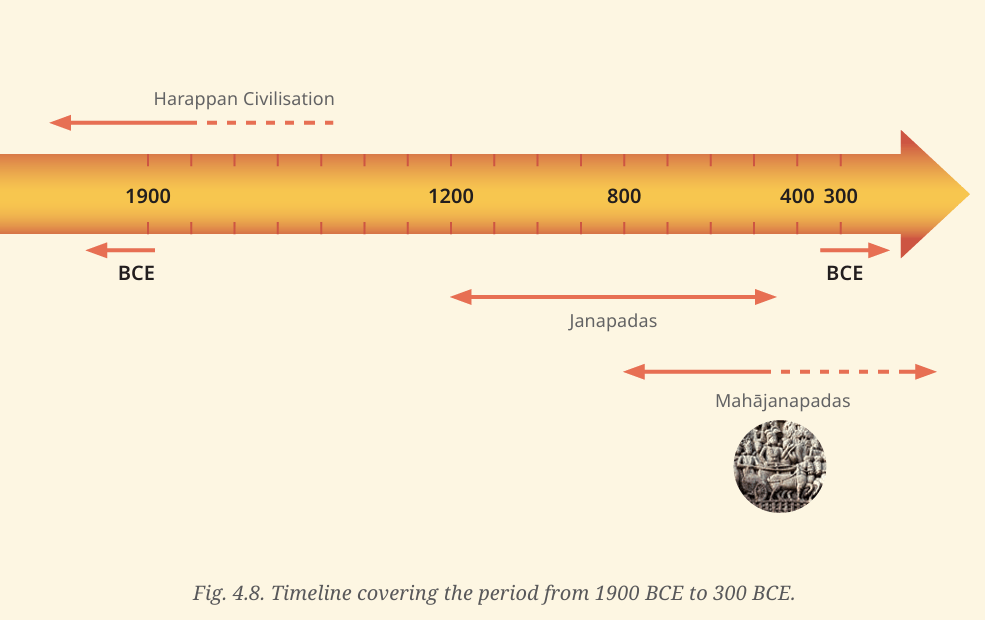
Let us recall that in the early 2nd millennium BCE (that is,
over a few centuries after 2000 BCE), the Indus / Harappan /
Sindhu-Sarasvatī civilisation, which we called India’s
‘First Urbanisation’, disintegrated. Some of its cities were
abandoned; in others, some people continued living
there, but reverting to a rural or village lifestyle. They
had to, since all the components of the Harappan urban
order had disappeared: elaborate structures, both private
and public; crowded streets and busy markets; different
communities with specialised occupations (metalsmiths,
potters, builders, weavers, craftspeople, and so on); a
writing system; a sanitation system; the presence of an
administration; and, behind it all, a larger state structure
with a ruling class at the head. And for a whole millennium,
urban life remained absent from India, though there may
have been a few towns here and there in north India. Indeed, there were important regional cultures, which we
need not study here.
Then, in the 1st millennium BCE, a vibrant new phase of
urbanisation began in the Ganga plains, parts of the Indus
(or Sindhu) basin and neighbouring regions, gradually
spreading to other parts of the Subcontinent. How do we
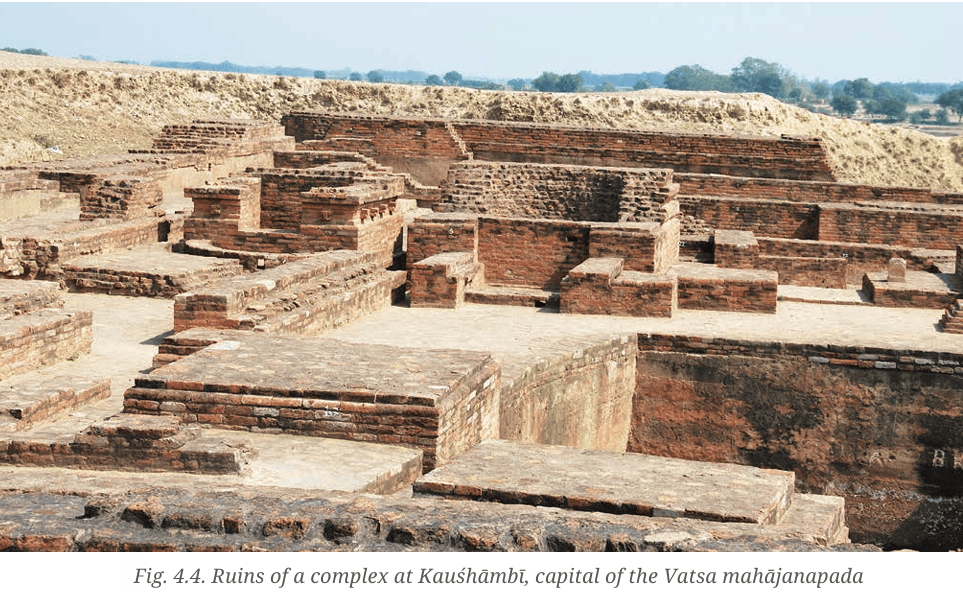
know this? Mainly from two sources: (1) archaeological
excavations that have confirmed the existence of those
ancient urban centres, and (2) ancient literature describing
them — late Vedic, Buddhist and Jain literatures are full of
references to these new urban centres.
This new phase is often called India’s ‘Second Urbanisation’ — which, incidentally, has continued right up to today! Let us see how this phase emerged.
Janapadas and Mahājanapadas
Towards the end of the 2nd millennium BCE, regional cultures gradually reorganised themselves in north India. As people formed clans or groups, probably sharing a common language and common customs, each clan came to be associated with a territory or janapada led by a rājā or ruler. (‘Janapada’ is a Sanskrit word which means ‘where the people (jana) have set foot (pada),’ that is, have settled down.)
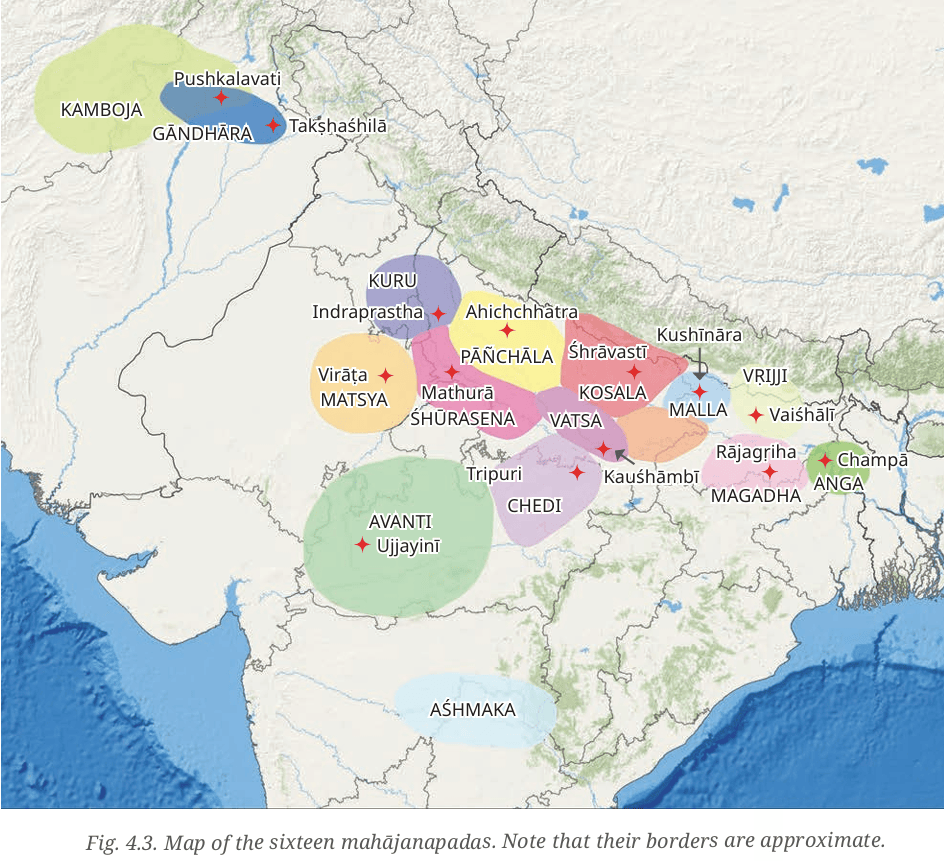
The janapadas grew as trade networks expanded and connected them. By the 8th or 7th centuries BCE, some of those early states had merged together; the resulting bigger units were known as mahājanapadas. Although the texts have different lists of them, the more frequent list gives the names of 16 mahājanapadas, extending from Gandhāra in the northwest to Anga in the east and to Aśhmaka in central India, close to the Godavari River (see map). There may have been a few more, along with some smaller janapadas continuing independently.
THINK ABOUT IT
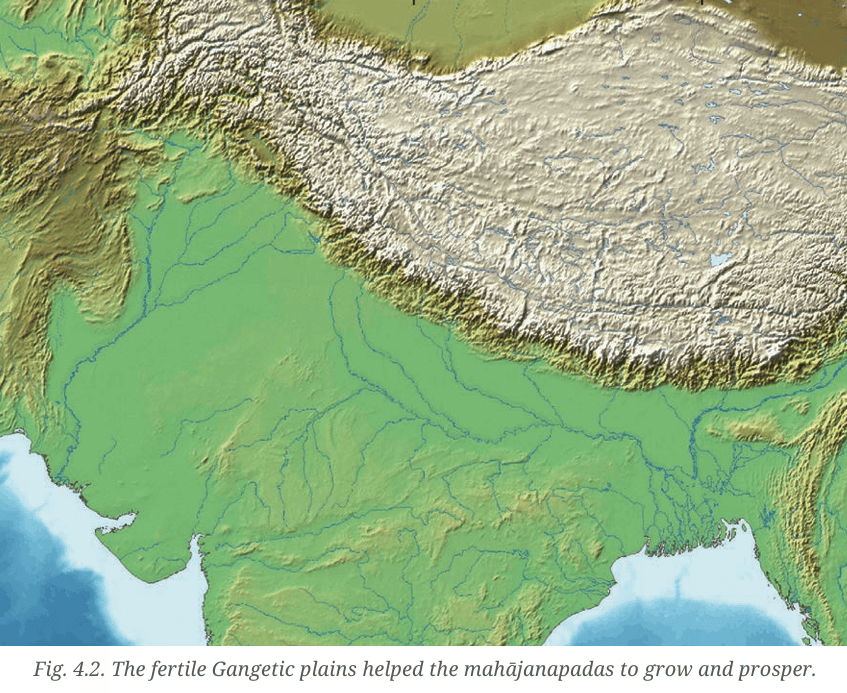
Notice how many of the mahājanapadas are concentrated in
the Ganga plains. There are several possible reasons for this,
including the growth of agriculture in the fertile Ganga plains,
the availability of iron ore in the mountains and hills (see
below about iron), and the formation of new trade networks.
- The most powerful of these new states were Magadha, Kosala, Vatsa and Avanti. Looking at the map, can you identify their capitals? Also, how many can you match with Indian cities of today?
- Compare this map with the map of the regions mentioned in the Mahābhārata (see Fig. 5.4 in the chapter ‘India, That Is Bharat’ in Grade 6) and list the names common to both maps. What do you think this implies?
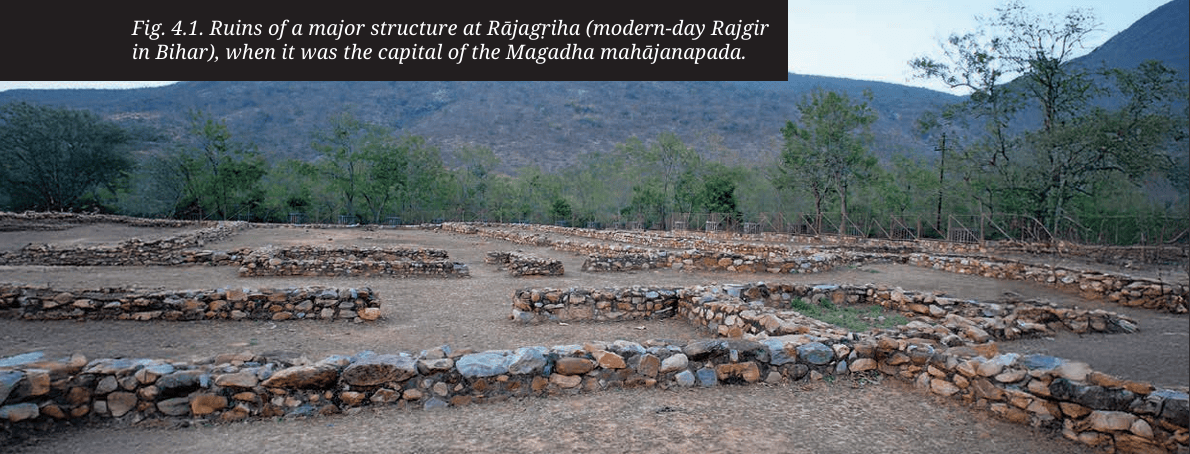
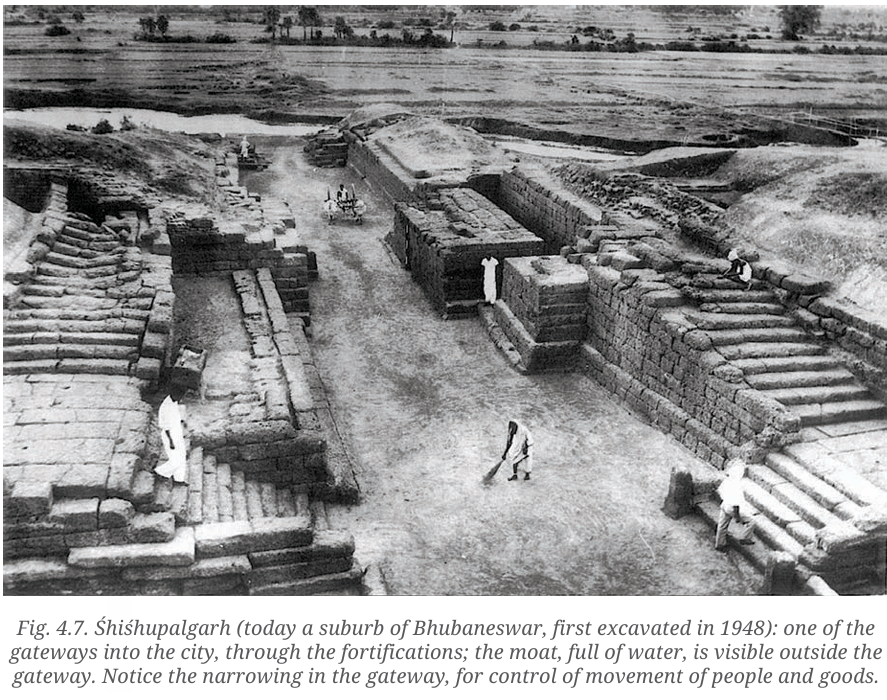
The map (Fig. 4.3) shows the mahājanapadas’ capitals. Most
were fairly large well-fortified cities, with a moat running
outside the fortifications as further defence. Often, the
gateways through the rampart walls would be deliberately
kept narrow, so guards may control the movement of people
and goods entering or leaving the city. It is fascinating to
note that most of those ancient capitals continue to be living
cities today — ‘modern’ cities that are often 2,500 years old!
Moat: A deep, wide ditch surrounding a fort or a fortified city and filled with water.
Early Democratic Traditions
Each janapada had an assembly or council, called sabhā
or samiti, where matters concerning the clan would be
discussed. (Remember, from the chapter on ‘India’s Cultural
Roots’, that the words sabhā and samiti first appear in the
Vedas, India’s most ancient texts.) We may assume that
most of the members were elders in the clan. The rājā
was not expected to rule independently or arbitrarily; a good ruler was supposed to take the advice from those
assemblies, apart from the ministers and administrators.
Indeed, according to some texts, an incompetent ruler
could be removed by the assembly. Of course, while such
mentions are significant, it does not mean that this was an
established law; let us remember that the data we have for
such remote periods is incomplete.
In their political systems, the mahājanapadas expanded
the basic principles of the janapadas. Some were, in effect,
monarchies, in the sense that the rājā was the ultimate
authority, supported by ministers and an assembly of elders. His position was hereditary, in the sense that a rājā
would usually be the son of the previous one. The king
would collect taxes or revenue, maintain law and order,
get impressive fortifications built around their capital, and
maintain an army to defend the territory or wage war with
neighbouring ones, as the case may be. Magadha (located
in part of today’s Bihar), Kosala (in part of today’s Uttar
Pradesh) and Avanti (in part of today’s Madhya Pradesh)
were among the most powerful such states.
However, at least two mahājanapadas, Vajji (or Vṛijji) and
the neighbouring Malla, had a different system: the sabhā
or samiti had more power and took important decisions
through discussion, and, if necessary, through vote.
Surprisingly, this included the selection of the rājā! This
means that those mahājanapadas, which were called gaṇas
or sanghas, were not monarchies — their functioning might
be called democratic, since members of the assembly were
the ones to select the ruler and take major decisions. In fact, scholars have often called them ‘early republics’, as they
are indeed one of the earliest such systems in the world.
More Innovations
The age of the janapadas and mahājanapadas was an age of
profound change, which would impact Indian civilisation
until present times. In the chapter ‘India’s Cultural Roots’
in Grade 6, we saw the emergence of several new schools
of thought — late Vedic, Buddhist, Jain in particular, and
their respective literatures. Those schools disseminated
their teachings and literature through scholars, monks
and nuns travelling across India or people undertaking
pilgrimages. Indian art also underwent a renewal; it will
blossom in the age of empires.
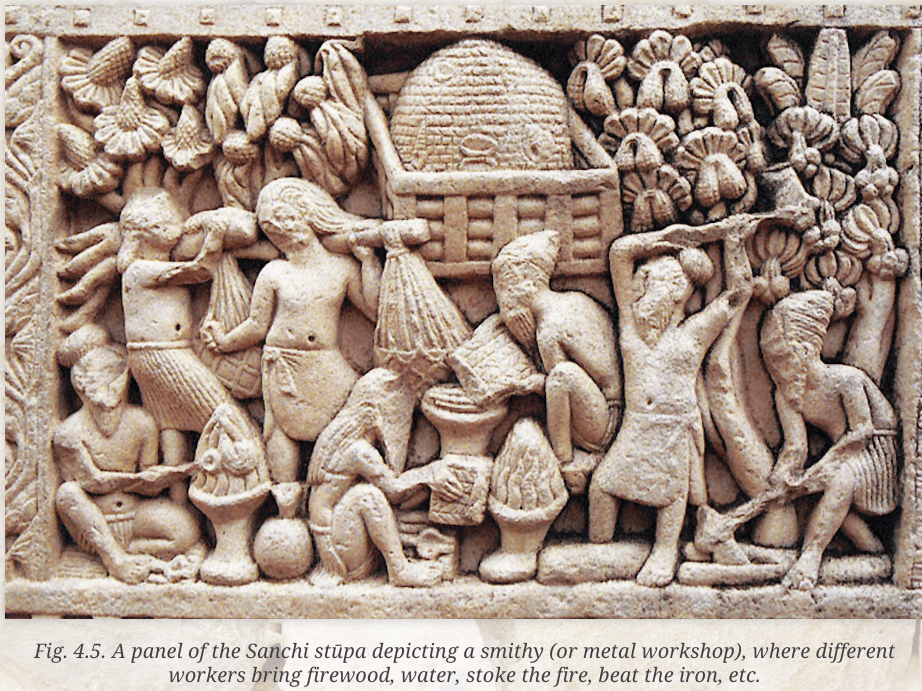
Urbanisation does not happen without technologies. Let us
remember that the Harappan civilisation mastered copper
and bronze metallurgy. Now, in this Second Urbanisation,
a major shift in technology involved iron metallurgy. In
several regions of India, the techniques of extracting and
shaping iron were actually perfected from the early 2nd
millennium BCE, but it took a few centuries for iron to
become a part of daily life. By the late 2nd millennium BCE,
iron tools had become widespread, facilitating agriculture
on a bigger scale. Iron also made better weapons than
bronze, lighter and sharper — swords, spears, arrows,
shields, etc. As it happens, there is some evidence of warfare
between neighbouring mahājanapadas — how frequent or
how intense it was, of course, is impossible to tell. Such
military campaigns, but occasionally alliances too, gave
rise to new kingdoms and empires, which we will turn to
later in our journey.
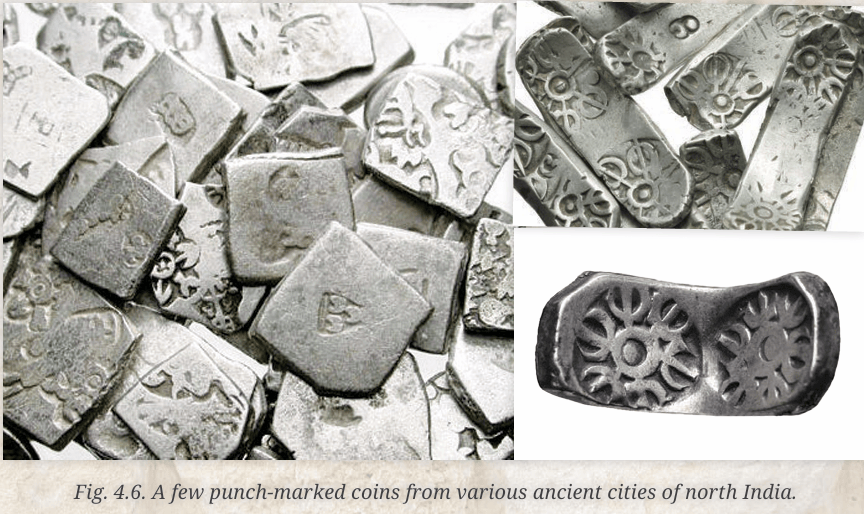
Another innovation was the first use of coins in India,
made necessary by growing trade. Very soon, coins were
exchanged across different regions and even with other
parts of the world. The first Indian coins were made of silver, a soft metal into which symbols could be
‘punched’; they are called ‘punch-marked coins’.
Later, coins of copper, gold and other metals were
also made. Generally, a mahājanapada issued its
own coins, but coins from neighbouring regions
were used as well as exchanged in trade.
Fill up the following table with a Yes (or tick mark) or No (or cross mark) in each square, which provides an interesting comparison between these two phases of Indian civilisation.
| First Urbanisation | Second Urbanisation | |
|---|---|---|
| Ganga plains | ||
| Monasteries | ||
| Literature | ||
| Trade | ||
| Warfare | ||
| Copper/Bronze | ||
| Iron |
The Varṇa–Jāti System
We saw earlier how human societies grew more complex with the rise of civilisation. Whenever this happens, a society organises itself in several groups based on class, occupation or some other criteria. For instance, there could be different groups concerned with governance, administration, religion, education, trade, town-planning, farming, crafts, arts and all kinds of other professions.
- Why should a complex society divide itself into such groups? Think about several possible factors why this happens.
- List other such professions you expect in a complex society of the 1st millennium BCE.
In an ideal society, all those groups would complement each
other and work in harmony. But most of the time, these
divisions also lead to inequalities: some groups acquire
more wealth, power or influence than others. In other
words, while equality is an ideal that human societies have
often aspired to, very few, if any, have ever achieved it.
In India, the society was organised in a two-fold system.
One category was the jāti, a group or community of people
with a specific professional occupation closely tied to their
livelihood. The skills that defined a particular jāti — for
instance, skill in agriculture, metallurgy, commerce or
any craft — was generally transmitted from generation to
generation. Often, a jāti would get further subdivided into
sub-jātis, each of which developed customs and traditions
of its own, for instance concerning marriage, rituals or food
habits.
You may have heard the English word ‘caste’. It comes from a Portuguese word, casta, as Portuguese travellers to India in the 16th century CE tried to make sense of Indian society. While a few scholars consider ‘caste’ to refer to varṇas, most take it to apply to jātis; yet others consider ‘caste’ to refer to the whole varṇa–jāti system.
There is historical evidence, both in texts and inscriptions, that in the early period individuals and communities changed their professional occupations if circumstances demanded. For instance, a long drought or some natural calamity could force a community of farmers to migrate to a city and take up other occupations, or some Brahmins would turn to trade or even military activities. This complex system structured Indian society, organised its activities, including economic ones, and therefore gave it some stability. In time, however, the system became rigid and led to inequalities and discrimination towards the lower jātis or some communities excluded from the varṇa-jāti system. This process will be studied in a higher grade.
The varṇa-jāti system has had a deep impact on Indian society, and generations of scholars have studied its countless aspects. There is a broad agreement that the system was significantly different (more flexible, in particular) in earlier periods and became more rigid with the passage of time, in particular during the British rule in India. Let us also keep in mind that while varṇa-jāti has been an important mechanism at work in Indian society, it is not the only one; there have been many others, some of which we will explore later, especially in the theme ‘Our Cultural Heritage and Knowledge Traditions’.
THINK ABOUT IT
Inequalities within society can exist in many forms. Have you
encountered any incident where you or anyone you know
might have been made to feel different from others? Do you
think equality is desirable in a society? If so, why? Have you
come across people or initiatives that lessened inequalities?
Developments Elsewhere in India
In this 1st millennium BCE, important communication
routes opened up for purposes of trade, pilgrimage, military
campaigns, etc. Two routes became widely used and are
often mentioned in the literature: the Uttarapatha and the
Dakṣhiṇapatha. The first connected the northwest regions
to the Ganga plains, all the way to eastern India; the second
started from Kauśhāmbī (near Prayagraj), then a capital of one of the mahājanapadas, and crossed the Vindhya Range
of hills to proceed all the way south. We will return to these
routes when we explore the formation of empires in India.
Many lateral roads also connected with other parts of India,
especially the important ports on the western and eastern
coasts, which were vibrant centres of trade. In the eastern
region, major cities emerged, such as Śhiśhupalgarh (today
Sisupalgarh, part of Bhubaneswar), which was the capital
of the Kalinga region and followed a strict square ground
plan, with imposing fortifications and broad streets.
In the Subcontinent’s southern regions, cities began
emerging from about 400 BCE, although recent excavations
claim to find some signs of commercial activities
going further back. Around this time, three kingdoms
emerged — the Cholas, the Cheras and the Pānḍyas.
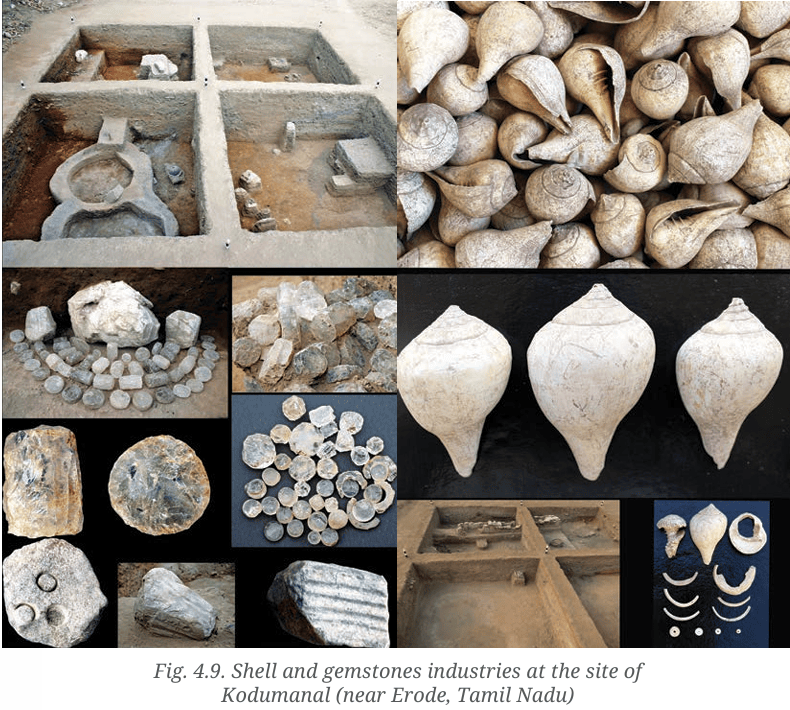
Apart from archaeological evidence, the most ancient Tamil literature mentions those kingdoms and several of their kings.
Because the southern regions are rich in resources such as precious and semiprecious stones, gold, and spices, they profitably traded not only with the rest of India but also with kingdoms and empires overseas.
By 300 or 200 BCE, almost the entire Subcontinent, including regions in the Northeast, was one vibrant interconnected land; goods and culture travelled from region to region, and often beyond India to parts of Central and Southeast Asia.
About the same time, the mahājanapadas ceased to exist,
leaving the place to fresh developments that were going to
reshape India.
Before we move on...
- From the end of the 2nd millennium BCE, janapadas rose in parts of north and central India; they were smaller states with a rājā at the head taking counsel from an assembly of elders.
- The 16 mahājanapadas were the first organised states
of the 1st millennium BCE; they witnessed the Second
Urbanisation of India, which spread in all directions from
the Ganga region, all the way to south India. By 300 BCE or
so, the mahājanapadas ceased to exist.
- In the same period, a vast network of roads connected
north and south, east and west, and eventually all regions
of the Subcontinent. People, goods, ideas and teachings
travelled along all those roads.
Questions and activities
1. Consider the quotation at the start of the chapter and discuss in several groups. Compare your observations and conclusions on what Kauṭilya recommends for a kingdom. Is it very different today?
2. According to the text, how were rulers chosen in early Vedic society?
3. Imagine you are a historian studying ancient India. What types of sources (archaeological, literary, etc.) would you use to learn more about the mahājanapadas? Explain how each source might contribute to your understanding.
4. Why was the development of iron metallurgy so important for the growth of urbanism in the 1st millennium BCE? You may use points from the chapter but also from your knowledge or imagination.