
7 The Gupta Era: An Age of Tireless Creativity
"Neither force nor mere diplomacy can eliminate evil; nor
is righteousness upheld by flattery alone. It is wisdom
and knowledge that truly strengthen a kingdom — not
indulgence in luxuries."
— Kālidāsa in Raghuvanśham
The Big Questions?
1. Who were the Guptas? Why is
the Gupta period sometimes
called the ‘classical age’ in
Indian history?
2. What was happening in the rest
of the subcontinent at this time?
3. Who were some great figures
of this period, and why do their
stories matter today?
Dhruv and Bhavisha had just returned from their journey to the Pānḍya kingdom. They had seen the splendid
markets, taken a short trip on a ship, and met some
Roman traders buying pearls. Now they were itching to
use Itihāsa again and jump a few centuries. “What would
that be like?” they wondered. “Will the cities be the same?
What about the people and society — would they have
changed? What kind of governance would they have?
Would there be new literature, new art?” They could not
wait to find out and were soon whisked away to …
Bhavisha: My head is spinning. There are so many kingdoms and
empires. How am I ever going to remember all of this?
Dhruv: Do not worry, Bhavisha! Let us understand what is
happening, and we’ll remember it.
Bhavisha: Is there anything in this period that we can see back
home?
Dhruv: Let us use our time machine and find out!
Bhavisha activates ‘Itihāsa’, and they jump to Mehrauli (in Delhi),
where the famous Iron Pillar of Delhi stands.
They overhear a tour guide nearby, who was explaining the
significance of this pillar.
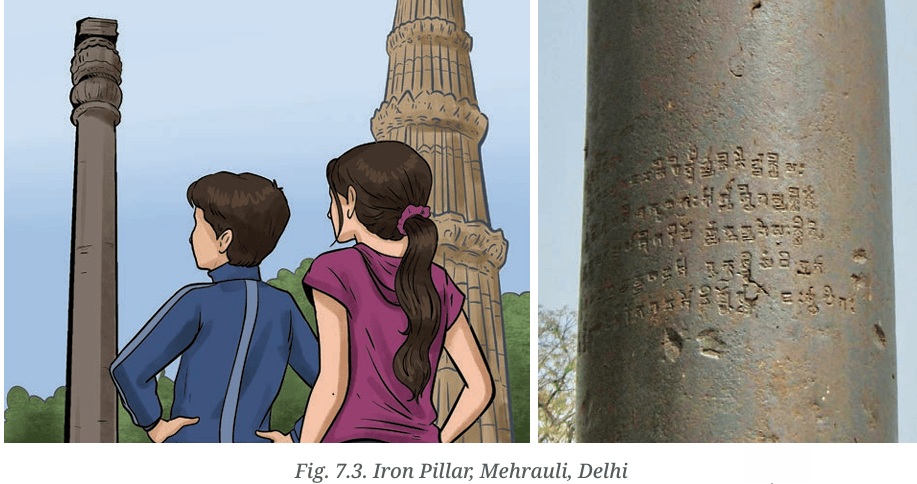
Tour Guide: This Iron Pillar of Delhi is over 1,600 years old and
still stands tall without rusting. It is a testament to the advanced
metallurgical skills of ancient India.
Bhavisha: 1,600 years old and not rusting! Let us go and see it.
Bhavisha: Look! Is this the famous ‘iron pillar’?
Dhruv: Oh wow! There is something written on it, but I cannot read it.
Bhavisha: I wonder who made this? And why? Let’s hear what
the guide uncle has to say about this.
Tour Guide: The 6-tonne pillar was erected during the reign of Chandragupta II, a ruler of the Gupta dynasty. It was probably erected first in front of the Udayagiri caves (Madhya Pradesh) and brought to Delhi a few centuries later. It was dedicated to Viṣhṇu, and its inscriptions celebrate the king’s achievements.
Both: That is so fascinating! We would love to learn more about
this king and his empire.
Let us begin this exciting journey into the history of the Gupta
Empire!
Picture leaving a bicycle out in the rain for just one year — it would soon show signs of rust. Yet this ancient pillar, standing under the open sky for centuries, remains unaltered. Scientists have tried to uncover its secret, and they believe it is because a unique thin layer, created by the special iron used and oxygen from the air, forms on the surface of the iron, protecting it from corrosion.
A New Power Emerges
By the 3rd century CE, the Kuṣhāṇa Empire, which spread over the north and northwest of the Subcontinent, started to weaken.
New kingdoms emerged, setting the stage for a fresh period of
consolidation, and the new actor on this stage was the Gupta
dynasty.
There are various theories on the origin of the Guptas. However,
it is widely believed that they emerged in a region near present
day Uttar Pradesh as regional rulers. Over time, they rose to
prominence and established a powerful empire. The Gupta
period is considered remarkable in Indian history and is
marked by significant developments in many areas. The fields of
art, architecture, literature and science flourished, particularly
during the time of Chandragupta II, and that legacy continues
even today.
The inscription on the iron pillar in Delhi speaks of a king named
‘Chandra’, who has been identified with Chandragupta II (not
to be confused with Chandragupta Maurya from the Maurya
dynasty, whom we met earlier). Chandragupta II, also known
as ‘Vikramāditya’, was one of the renowned rulers of the Gupta
dynasty. He was a devotee of Viṣhṇu and his mount (vāhana)
Garuḍa often appears on many inscriptions.
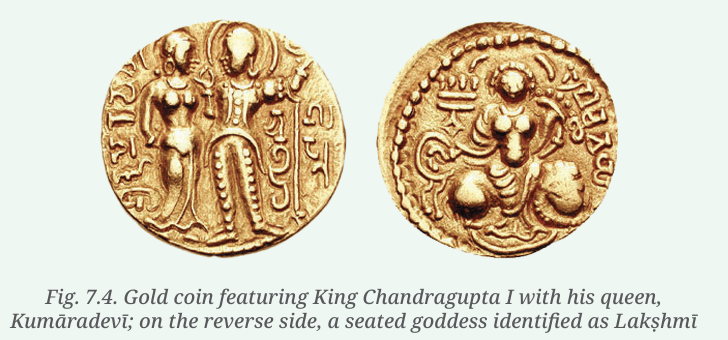
Have you noticed the ‘II’ in Chandragupta II’s name? Historians added this number because there was another ‘Chandragupta’ before him — his grandfather! (This tradition of naming the first son after his grandfather is followed by some Indian families even today.) Chandragupta I, as he is referred to, played a crucial role in the early expansion of the Gupta Empire; he is remembered for his coins and strategic alliances, which helped him consolidate his power and lay the foundation for a strong empire.
The warrior king
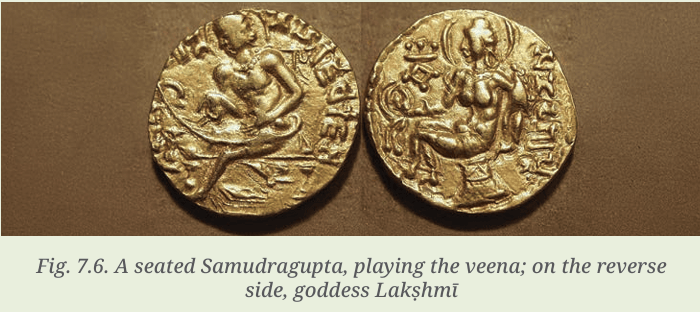
The prayāga praśhasti, a pillar inscription in Prayagraj, praises the achievements of Samudragupta, Chandragupta II’s father. According to the author of the inscription — the court poet Harisena — the king’s ambition was to be ‘dharaṇi-bandha’ or to ‘unify the Earth’. To this end, he fought many wars, defeating kings, taking over their kingdoms and expanding his empire. Many defeated kings were reinstated and offered tribute to Samudragupta, while others, fearing his might, submitted without protest.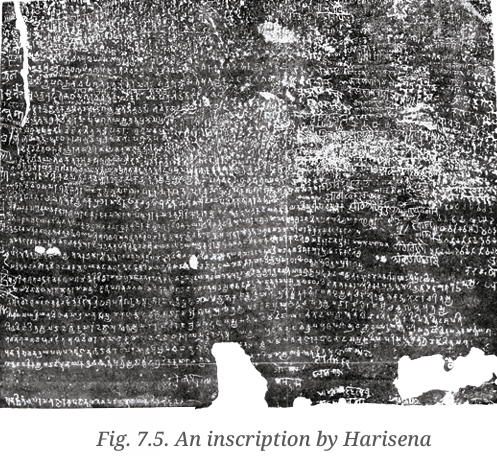 Harisena also wrote about how the
king supported art, learning and
trade, making his kingdom rich
and successful. Samudragupta
himself is portrayed as a veena
player in one of the coins he
minted (Fig. 7.6).
Harisena also wrote about how the
king supported art, learning and
trade, making his kingdom rich
and successful. Samudragupta
himself is portrayed as a veena
player in one of the coins he
minted (Fig. 7.6).
THINK ABOUT IT
Why do you think kings chose to proclaim their achievements
in the form of inscriptions?
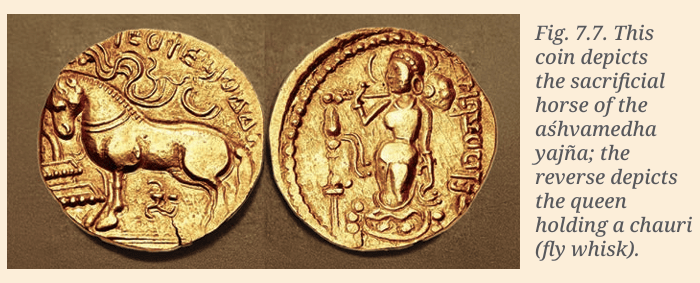
Ambitious kings sometimes performed the aśhvamedha yajn͂a to build mighty empires and leave a legacy for the future. Such a significant event was commemorated by minting special coins like the one shown in Fig 7.7.
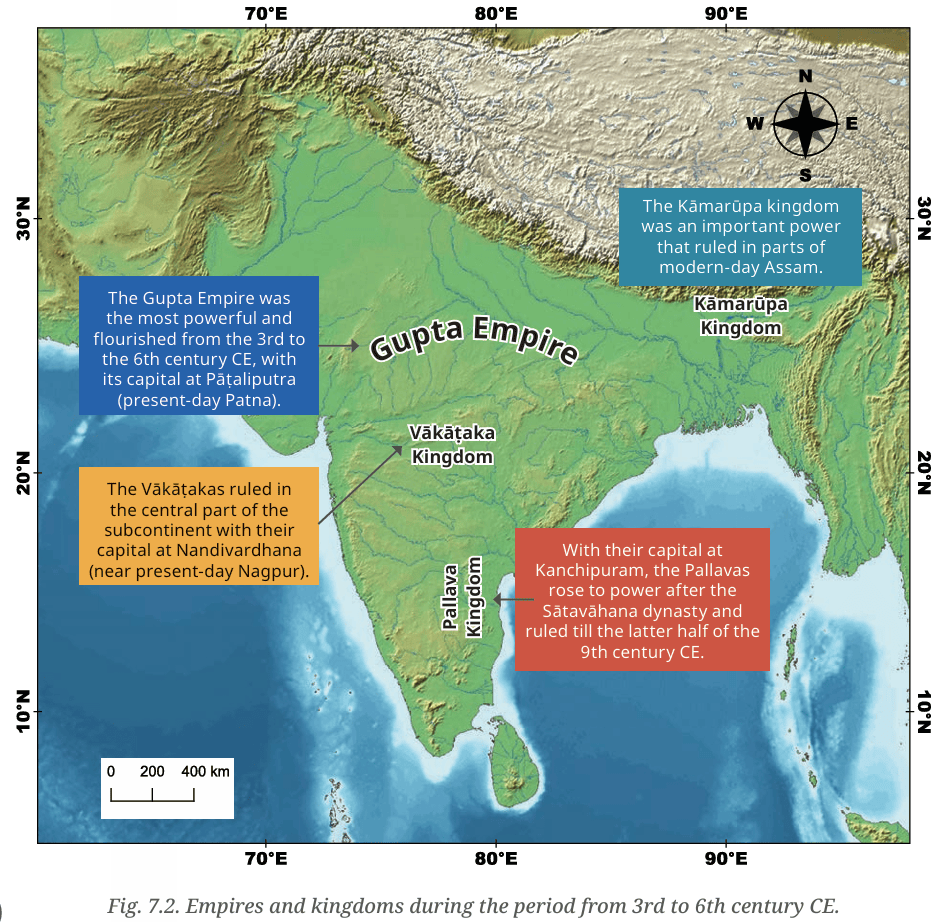
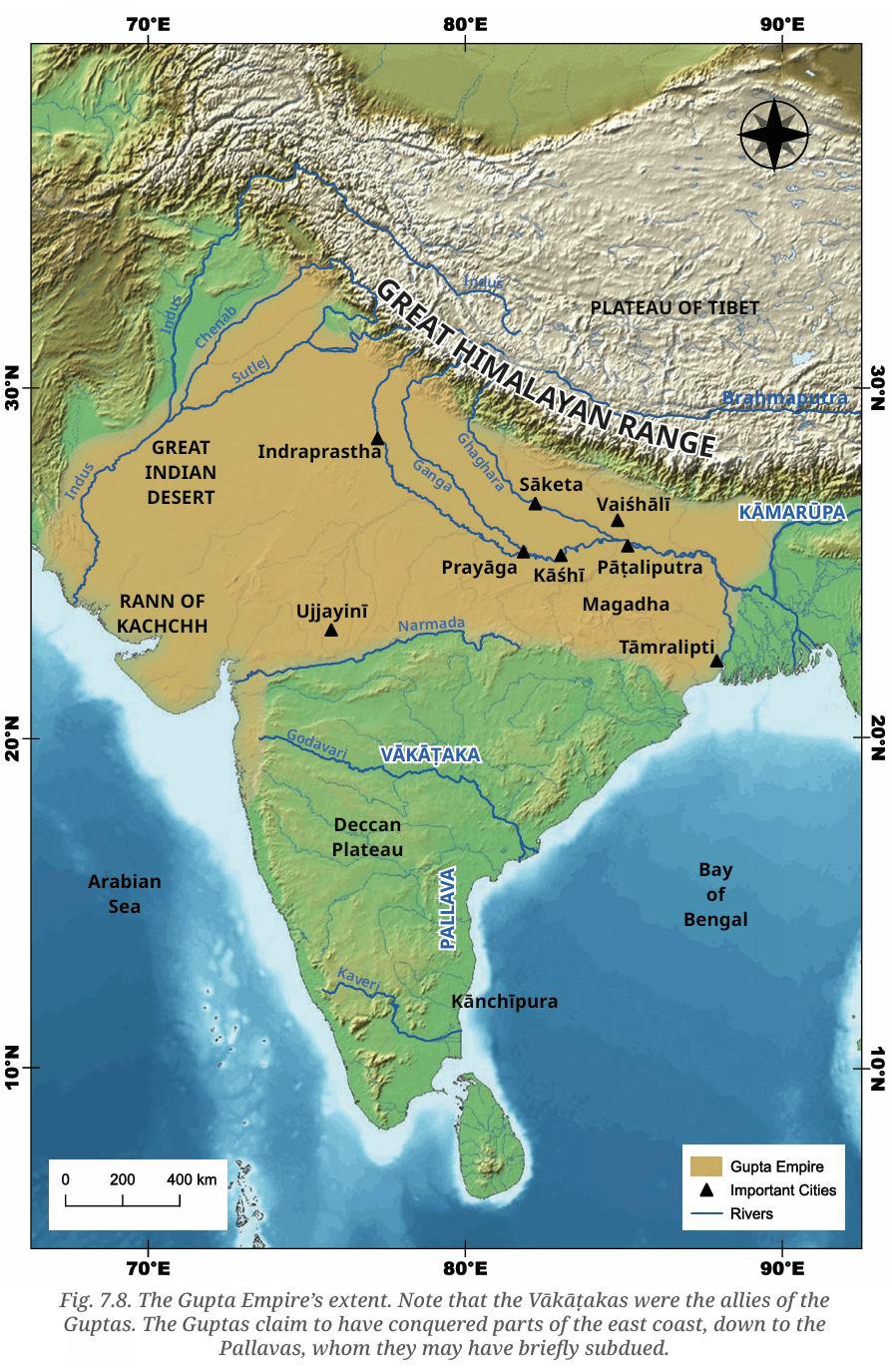
Some literary sources give us descriptive information about rulers, kingdoms and the people. The Viṣhṇu Purāṇa, for instance, specifies the key regions of the empire: “The Gupta dynasty will rule over Anugaṅga (the middle-Gangetic basin), Prayāga (present-day Prayagraj), Sāketa (Ayodhya), and Magadha (approximately Bihar) and all the surrounding regions.” But at its peak, the Gupta Empire covered a larger area than this — most of present-day north and west India, along with parts of central and east India.
In the Grade 6 chapter ‘Timeline and Sources of History’, we listed multiple sources that help us understand the past. Compile a list of the sources we have referred to so far in the chapter. What did we learn from each source?
Take a political map of India and locate the present-day states and Union territories where the Guptas ruled (see Fig. 7.8). Mark these states on the map and count how many you found. Then, compare your findings with your friends to see if everyone got the same number or discovered something different!
A Traveller’s Account of Indian Society in the Gupta Age
Chinese traveller Faxian (pronounced as Fa-Shi-Anne) visited India in the early 5th century CE. He set out on this long and difficult pilgrimage to visit sacred Buddhist sites, learn from renowned Indian scholars and collect manuscripts of Buddhist texts so he could take them back to China. Faxian travelled extensively across India, observing her culture, governance and society, and recorded his experiences and observations for the people of his homeland — and for us too — since his travelogue has survived to this day!Read the excerpt from Faxian given above and identify the key features of the society he describes. Write down your observations and compare your notes with your friends — you might be surprised to see how differently others interpret the same text!
Excerpts from historical accounts like Faxian’s are valuable sources, but they reflect only the writer’s perspective and focus at one point in time and for a limited portion of the society they describe. Let us not, however, forget that elsewhere in his travelogue, Faxian also describes the harsh treatment of the chanḍālas, who were regarded as outcastes and lived outside the city limits.
Just as you may have perceived the excerpt from Faxian’s travelogue differently from your friends, a group of historians may examine the same source and draw varied interpretations from it. Historians then look at more sources to corroborate their understanding. This reminds us of the need to assess multiple sources, perspectives and interpretations before drawing conclusions.Glimpses of the Gupta Empire
Governance and administration
Let us observe the map in Fig. 7.8. You will notice that many kingdoms coexisted during the same period. Some of them may have been at war with each other in their ambition to expand their control. Recall what we saw earlier about Kauṭilya’s ideas on ruling a kingdom. He advised rulers to form alliances (mitra) as one of the components of the saptānga.Inscriptions and coins provide valuable insights into the titles adopted by Gupta rulers, such as ‘mahārājadhirāja’, ‘samrāṭ’, and ‘chakravartin’. These titles reflected their claim to supreme authority and emphasised their superiority over earlier rulers who used simpler titles like ‘rājan’ and ‘mahārāja’.
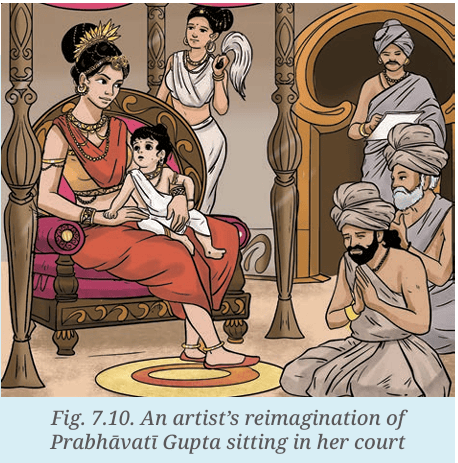
Observe the painting of Prabhāvatī Gupta sitting in her court (Fig. 7.10). Take note of the details — her attire, posture, the people around her, and the setting of the court. What do these elements tell you about her life, role, and the time she lived in? Discuss your observations in groups and share your insights with the class.
The Gupta Empire had a well-organised system of administration. Instead of controlling everything from a central authority, they divided the empire into provinces and granted land to local rulers, priests and chieftains. These land grants were carefully inscribed on copper plates to keep accurate records — many of which have been discovered by archaeologists in recent times. This system helped ensure proper tax collection and allowed the Gupta rulers to govern efficiently while still giving local leaders some control over their regions.
Thriving trade
The primary source of revenue of the Gupta’s was land tax. Other sources included fines, taxes on mines, irrigation, trade and crafts. This revenue was used for administration, maintaining the army, building temples and infrastructure, and supporting scholars and artists.As we see once again, for such an empire to sustain itself, it had to promote a vibrant internal and external trade. In the Gupta era, India traded with the Mediterranean world, Southeast Asia and China, exporting textiles, spices, ivory and gemstones. The Indian Ocean trade network connected Indian ports to distant markets. One significant stop on the way to the Mediterranean Exploring Society: India and Beyond | Grade 7 Part 1 156 markets was Socotra Island, strategically located in the Arabian Sea. Archaeological evidence, such as pottery, inscriptions in the Brahmi script, and designs such as a Buddhist stūpa, has established the presence of Indian traders there over several centuries, apart from traders from Egypt, Arabia, Rome and Greece. This small island carries evidence of the rich cultural exchanges that trade promoted in the Indian Ocean.
New Ideas and Wonders: The Classical Age
As we saw, Gupta rulers were devout followers of Viṣhṇu; this is often reflected in their coins and inscriptions. However, they also supported other traditions and schools of thought. They patronised Buddhist institutions, including the renowned Nālandā university and several other Buddhist vihāras (monastery). Their approach was inclusive and open. We will explore these institutions further in higher grades.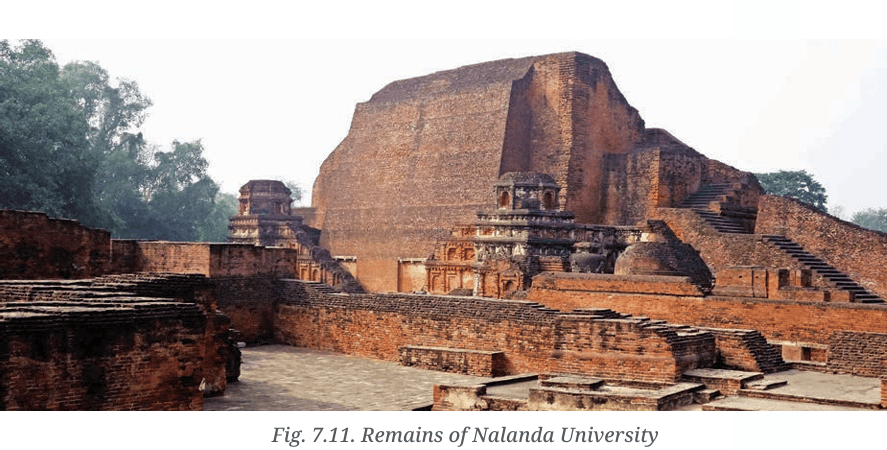 In deed, the prolonged period of peace and stability during the
Gupta period promoted notable achievements in various fields,
leading some historians to label this period the ‘classical age’
of India. It was also the time when knowledge from previous
eras was consolidated and compiled into numerous texts.
Sanskrit literature flourished, with Kālidāsa’s works and many
major Purāṇas. Āryabhaṭa and Varāhamihira recorded major
advancements in mathematics and astronomy, while medical texts
compiled and refined medical theories and practices. Metallurgy
also progressed, as we saw with the rust-resistant Iron Pillar.
This stability strengthened the
economy, allowing the state to
support scholars, artists, and
scientists, leading to cultural
and intellectual growth.
In deed, the prolonged period of peace and stability during the
Gupta period promoted notable achievements in various fields,
leading some historians to label this period the ‘classical age’
of India. It was also the time when knowledge from previous
eras was consolidated and compiled into numerous texts.
Sanskrit literature flourished, with Kālidāsa’s works and many
major Purāṇas. Āryabhaṭa and Varāhamihira recorded major
advancements in mathematics and astronomy, while medical texts
compiled and refined medical theories and practices. Metallurgy
also progressed, as we saw with the rust-resistant Iron Pillar.
This stability strengthened the
economy, allowing the state to
support scholars, artists, and
scientists, leading to cultural
and intellectual growth.
Chandragupta II kept himself surrounded by many learned men, poets and artists, and his patronage of such diverse talent enriched his court greatly.
Let us take a look at some of the remarkable figures of this period.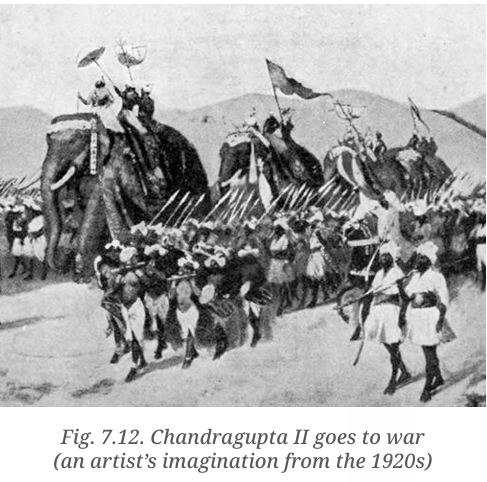
Āryabhaṭa: He lived in Kusumapura (near present-day Patna), a
famous centre of learning, around 500 CE and authored a short
treatise of mathematics and astronomy called Āryabhaṭīya. He
gave formulas to calculate the motions of the Sun, the Moon and
the planets, and proposed that the Earth spins on its axis, which
explains the alternation of day and night. He gave the length
of a year as 365 days, 6 hours, 12 minutes, and 30 seconds, just
a few minutes off from the modern value (365 days, 5 hours,
48 minutes, and 45 seconds). Āryabhaṭa also provided a fair
estimate of the size of the Earth and a correct explanation for
solar and lunar eclipses. His work became the foundation for
further scientific advances in India and beyond. In mathematics,
A
̄ryabhaṭa described a number of techniques of calculation and
equation-solving, some of which you learn at school without
knowing that they were first formulated 1500 years ago!
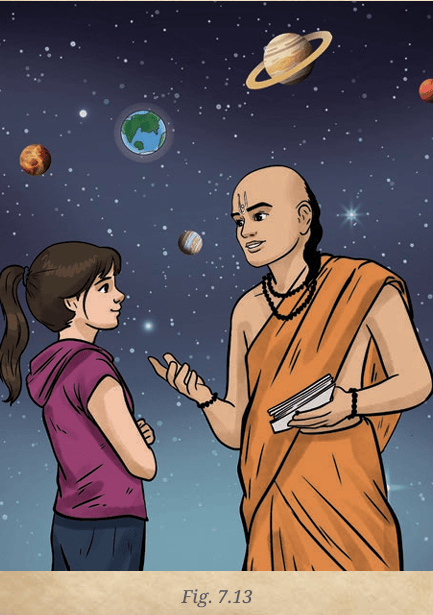 Varāhamihira: He was a
mathematician, astronomer
and astrologer from the same
period. He lived in Ujjayinī, a
city famous for its tradition
of learning and scholarship.
His encyclopedic work,
Bṛihat Samhitā, covered a
wide range of subjects from
astronomy and astrology
to weather forecasting,
architecture, town planning
and even farming. His
ability to observe the world,
apply logical reasoning, and
combine it with traditional
knowledge made him a
pioneer in science.
Varāhamihira: He was a
mathematician, astronomer
and astrologer from the same
period. He lived in Ujjayinī, a
city famous for its tradition
of learning and scholarship.
His encyclopedic work,
Bṛihat Samhitā, covered a
wide range of subjects from
astronomy and astrology
to weather forecasting,
architecture, town planning
and even farming. His
ability to observe the world,
apply logical reasoning, and
combine it with traditional
knowledge made him a
pioneer in science.
Let’s join Bhavisha and Dhruv with their time machine in the time of the Guptas. You are getting an opportunity to meet Āryabhaṭa and Varāhamihira—what would you ask them? Divide the class into two groups and create a series of questions for an interview with them.
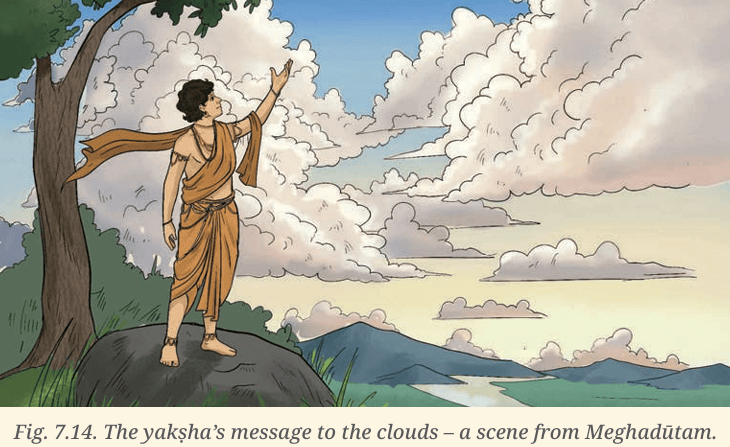 Kālidāsa: Little is known about Kālidāsa’s life; legends
suggest that he was once ridiculed by others, which
motivated him to work hard and transform his life. He
is renowned for his contributions to Sanskrit literature
and exquisitely refined poetry. One of his celebrated
compositions is Meghadūtam, or ‘The Cloud Messenger’.
It tells the story of a yakṣha (minor deity), who, after
being banished from his home by his master, sends a
message to his beloved through a passing cloud. Apart
from the many emotions of love, the poem describes in
great detail the landscapes and weather of north India
on its journey to the beloved.
Kālidāsa: Little is known about Kālidāsa’s life; legends
suggest that he was once ridiculed by others, which
motivated him to work hard and transform his life. He
is renowned for his contributions to Sanskrit literature
and exquisitely refined poetry. One of his celebrated
compositions is Meghadūtam, or ‘The Cloud Messenger’.
It tells the story of a yakṣha (minor deity), who, after
being banished from his home by his master, sends a
message to his beloved through a passing cloud. Apart
from the many emotions of love, the poem describes in
great detail the landscapes and weather of north India
on its journey to the beloved.
Did you know that Āyurveda got codified during the Gupta period? This Indian traditional system of medicine has much older roots, going back several centuries BCE. Texts like the Charaka Saṃhitā and Suśhruta Saṃhitā, which laid the foundation for Ayurvedic practices still in use today, were compiled and given their final shape during the Gupta period. They deal with a wide range of topics — the cataloguing and diagnosing of diseases, their treatments, the importance of diet in maintaining good health, the preparation of medicines, and surgical techniques advanced for their time. Importantly, A ̄yurveda emphasises holistic healing and a deep connection between the mind, body, and nature.
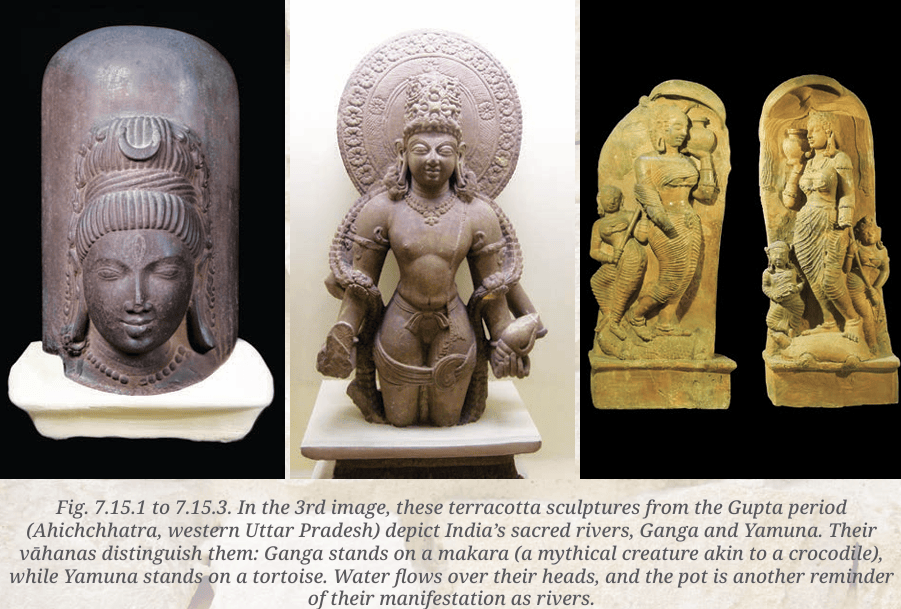
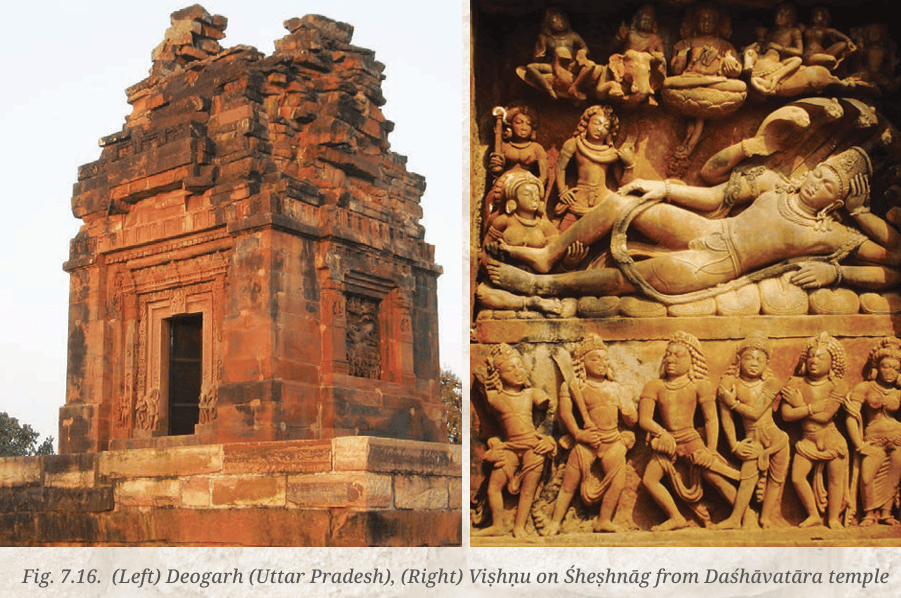
The Quest for Beauty
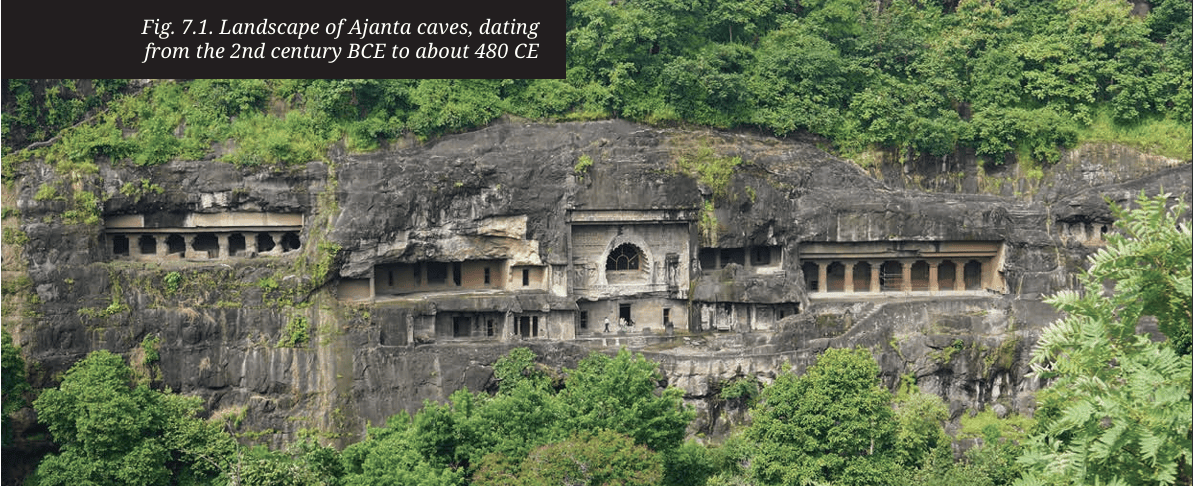
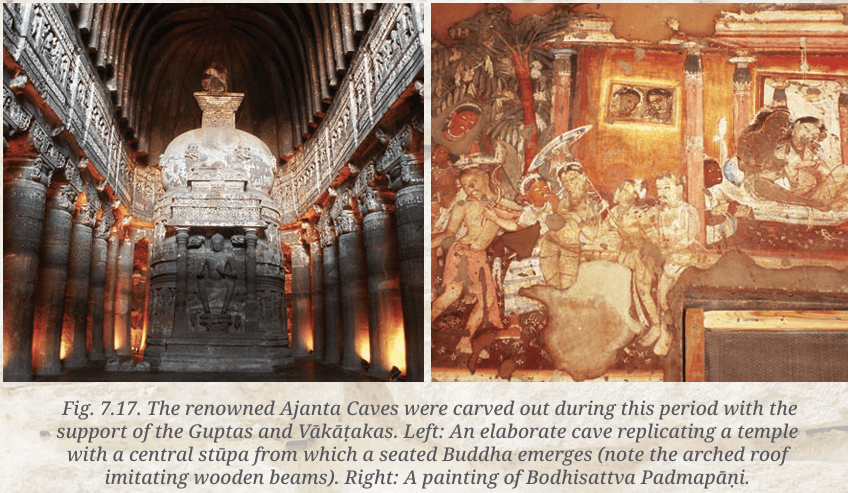
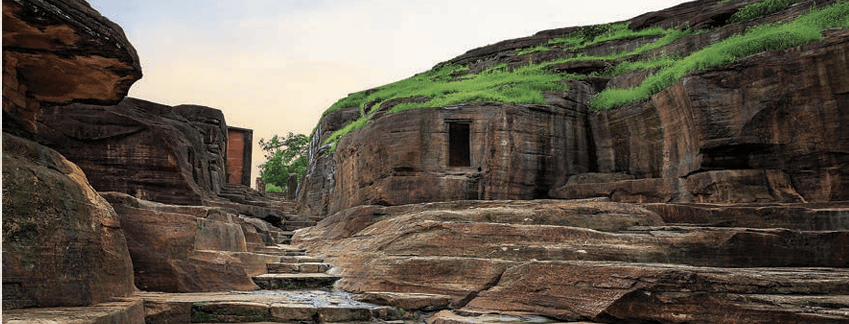
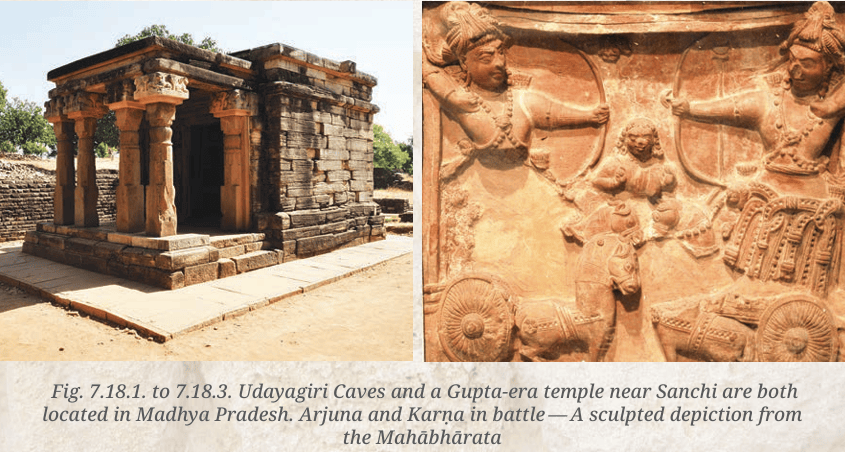
The Gupta rulers created a supportive environment where creativity and craftsmanship thrived; some of the iconic works of history were produced during this time. Many key centres of art emerged during these times, including Sārnāth (near Varanasi in present-day Uttar Pradesh), known for its exquisite sculptures of the Buddha, and the awe-inspiring Ajanta caves (in present-day Maharashtra). The rock-cut caves and detailed carvings of deities at Udayagiri (Madhya Pradesh) are another example of this abundant artistic production. ‘Gupta art’, as it is sometimes called, set high standards of aesthetics and beauty that left a lasting impact. (See Figures 7.15 to 7.18)Take a close look at the samples of Gupta sculptures shown in Fig 7.15.1. and 7.15.2. By looking at the attributes, can you guess which deities are depicted here? Write your observations in the space provided and share your thoughts during the class discussion!
The Decline of the Guptas
By the 6th century CE, the Gupta Empire began showing signs of decline as the later rulers faced challenges from external invasions. The fierce Hūṇa tribe from central Asia repeatedly attacked the empire, weakening its control over north India. At the same time, the rise of powerful regional rulers led to internal conflicts. However, was this truly the end, or the beginning of a period that marked a turning point in Indian history? We will explore this question in the next part of this book.Meanwhile in the South and Northeast ...
Let us go back to the map in Fig. 7.8. While the Guptas ruled in the north, the Pallavas emerged as a powerful dynasty in the south, gradually consolidating their power in parts of present day Tamil Nadu, Karnataka, Telangana and Andhra Pradesh. Their origins are not clearly known, but they appear to have been a tributary power under the Sātavāhanas, whom we encountered in the previous chapter, and to have gained power as the Sātavāhanas declined.The Pallavas were also great patrons of art and architecture. Most of them were devotees of Śhiva and are credited with constructing magnificent temples and rock-cut caves, some of which we will visit when we explore classical Indian architecture. The capital of the Pallavas, Kānchipuram (in present-day Tamil Nadu), often known as the ‘city of a thousand temples’, developed as one of the major centres of learning in the south. The establishment of ghaṭikās — centres of learning that emerged during the reign of the Sātavāhanas — fostered an environment for education and intellectual growth.
In the northeastern region, the Kāmarūpa kingdom, ruled by the Varman dynasty, extended over the Brahmaputra valley (broadly, present-day Assam) and northern parts of present-day Bengal and Bangladesh. An ancient name for the Brahmaputra valley of Assam is Prāgjyotiṣha, mentioned in the Rāmāyaṇa and Mahābhārata; the latter text mentions Bhagadatta, king of Prāgjyotiṣha (modern-day Assam), as fighting on the side of the Kauravas in the Great War, and some historical rulers claimed him among their ancestors. Be that as it may, the Kāmarūpa kingdom was a prominent cultural and political centre; temples and monasteries flourished as hubs of learning.Various aspects of Gupta art
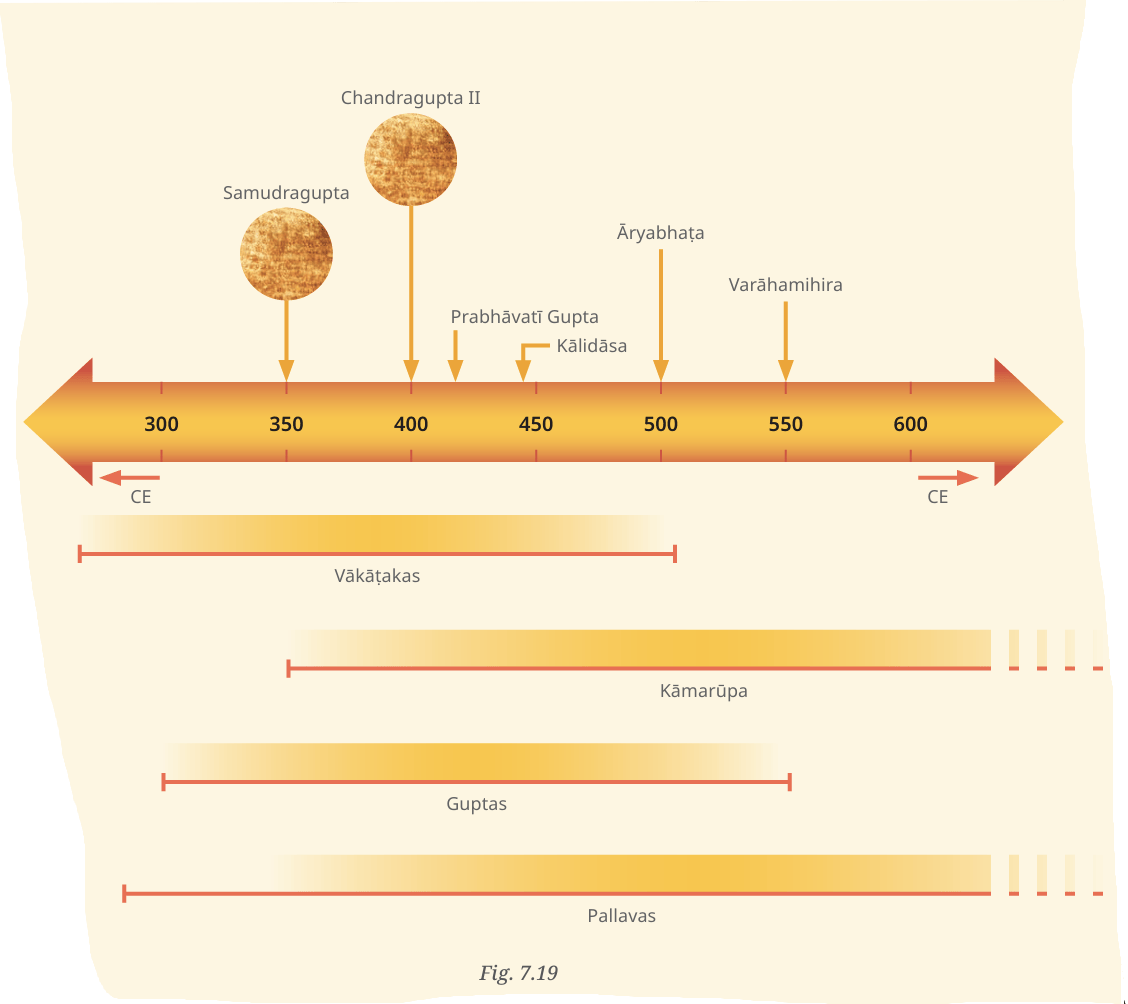
Both the Pallavas and Kāmarūpa are mentioned in the prayāga praśhasti we saw earlier. During his southern campaigns, Samudragupta defeated a Pallava ruler but did not take over the region. Instead, he let the local kings, including the Pallavas, keep their thrones as long as they accepted his rule and paid tribute. This helped maintain peaceful relations. Under similar conditions, in the northeast, Samudragupta defeated the ruler of Kāmarūpa but did not take direct control. By now, we have seen this pattern recur quite a few times.
The Gupta period was a time of remarkable progress. Its influence stretched far beyond the empire, shaping art, science, literature, and governance for centuries. Advances in mathematics, astronomy, medicine and metallurgy, among other fields, laid the foundation for future scientific and technological growth, while beautiful temples and Sanskrit literature continue to inspire today. The Guptas created a stable and prosperous society, setting a model for future rulers. Their legacy is still alive in India’s culture, traditions, and way of life, marking this era as one of the high points in Indian history.Before we move on …
- The Gupta kings consolidated their power through military campaigns, land grants and matrimonial alliances to ensure stability in the empire.
- The period saw remarkable contributions in the fields of
art, literature, science and mathematics.
- Other than the Guptas, dynasties like Vākāṭakas, Pallavas,
and Varmans ruled in their respective regions, making this
period full of cultural and intellectual vibrancy.
Questions and activities
1. Imagine you receive a letter from someone living in the Gupta Empire. The letter starts like this: “Greetings from Pāṭaliputra! Life here is vibrant and full of excitement. Just yesterday, I witnessed …” Complete the letter with a short paragraph (250–300 words) describing life in the Gupta Empire.
2. Which Gupta ruler was also known as the ‘Vikramāditya’?
3. “Periods of peace support the development of various aspects of sociocultural life, literature, and the development of science and technology.’ Examine this statement in the light of the Gupta empire.
4. Recreate a scene from a Gupta ruler’s court. Write a short script, assign roles like the king, ministers, and scholars, and enact a role play to bring the Gupta era to life!
5. Match the two columns:
| Column A | Column B |
|---|---|
| (1) Kāñchipuram | (d) Known as ‘a city of a thousand temples’. |
| (2) Ujjayinī | (e) A prominent centre of learning in ancient India. |
| (3) Udayagiri | (b) Famous for rock-cut caves featuring intricate carvings of Hindu deities, especially Viṣṇu. |
| (4) Ajanta | (a) Known for vibrant cave paintings that depict the Jātaka tales. |
| (5) Pāṭaliputra | (c) Capital of the Guptas. |
6. Who were the Pallavas and where did they rule?
7. Organise an exploration trip with your teachers to a nearby historical site, museum, or heritage building. After the trip, write a detailed report describing your experience. Include key observations about the site’s historical significance, the architecture, artefacts, and any interesting facts you learned during the visit. Reflect on how the trip enhanced your understanding of history.