
8 How the Land Becomes Sacred
"Ether, air, fire, water, earth, planets, all creatures,
directions, trees and plants, rivers and seas, are organs
of the supreme Lord’s body."
— Bhāgavata Purāṇa
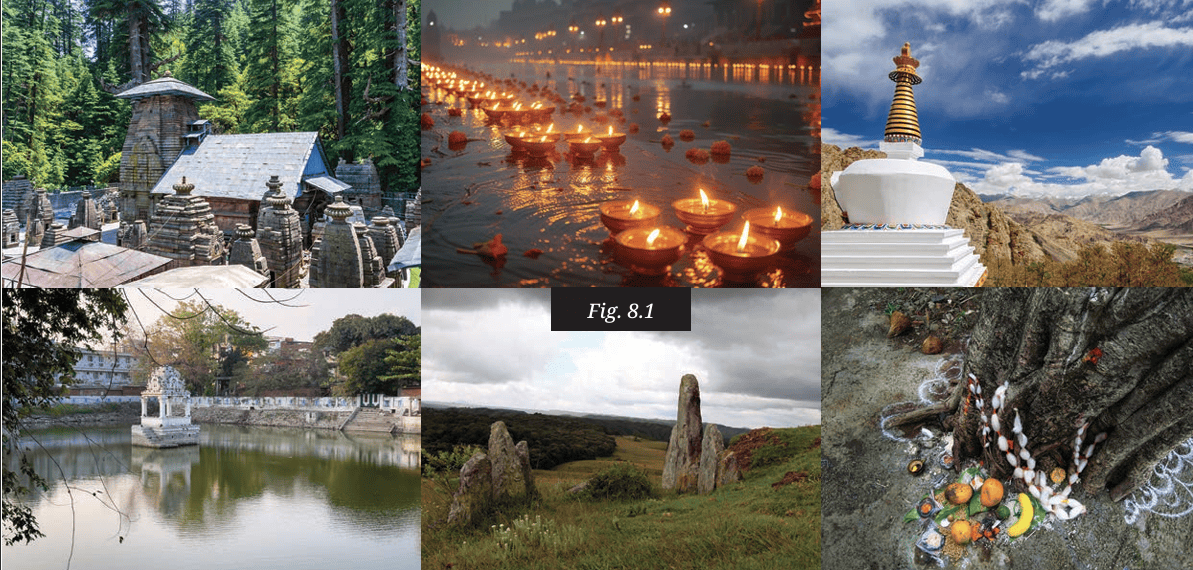
The Big Questions?
1. What is ‘sacredness’?
2. How does the land become sacred?
3. How do sacred sites and
pilgrimage networks connect with
the life and culture of the people?
4. What role did sacred geography
play in the cultural integration of
the Indian Subcontinent?
Do any of the pictures look familiar to you? Can you name similar places found in your neighbourhood?
What is ‘Sacredness’?
Sacredness can have many meanings. In the limited context of
this chapter, sacredness is finding something of deep religious or
spiritual significance, worthy of respect and reverence, holy or
divine. But what is this ‘something’? It can be a special location or
shrine that evokes such deep feelings, high thoughts or emotions.
It can also be, as we will see in this chapter, a journey of a special
kind (often called a ‘pilgrimage’), the route the journey takes, or
even the very land covered.
Sacredness, therefore, is not just connected with religion and
spirituality, but also with geography, all sorts of traditions, and, in
the case of India, with something more that we will discover soon.
Let us focus on sacred places first. You will find that almost every school of thought and religion in India has its own sacred places.
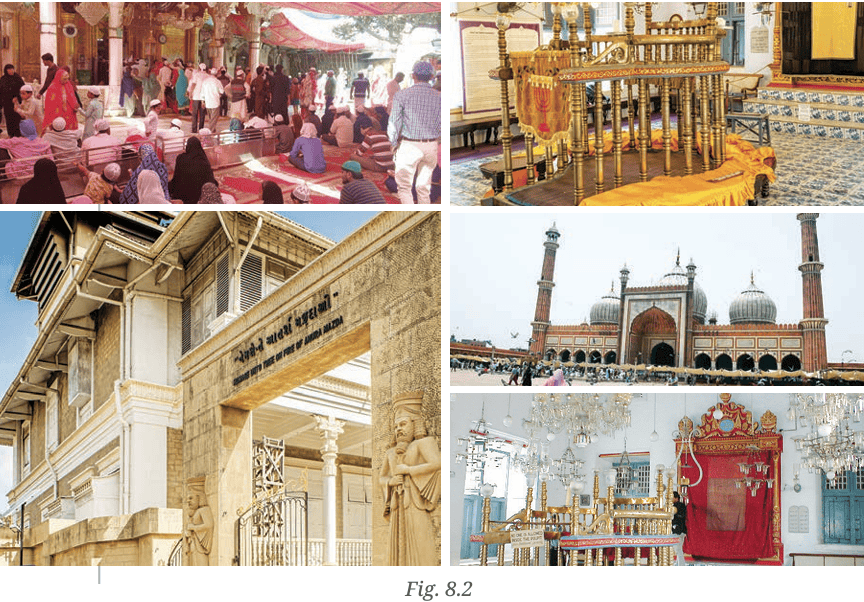 The places in these pictures are revered by followers of Islam,
Pilgrimage:
Christianity, Judaism and Zoroastrianism — religions that
originated outside India. People visit or congregate in these places
for prayer and worship. Followers from other faiths also visit
them, as can be seen at the Dargah Sharif of Ajmer (Rajasthan) or
the Velankanni Church in Tamil Nadu. People go on pilgrimages
to these shrines on special occasions.
The places in these pictures are revered by followers of Islam,
Pilgrimage:
Christianity, Judaism and Zoroastrianism — religions that
originated outside India. People visit or congregate in these places
for prayer and worship. Followers from other faiths also visit
them, as can be seen at the Dargah Sharif of Ajmer (Rajasthan) or
the Velankanni Church in Tamil Nadu. People go on pilgrimages
to these shrines on special occasions.
Naturally, when we turn to religions that originated in India,
we find that they have many more sacred sites. In the case of
Buddhism, those are often places that were visited by the Buddha
or where his relics are kept. Among them is the Great Stūpa at
Sanchi (Madhya Pradesh), which is a relic stūpa (you saw this in
the chapter on ‘The Rise of Empires’), and the Mahabodhi Stūpa
in Bodh Gaya (Bihar), where, according to Buddhist tradition,
the Buddha attained enlightenment. They are important sites
for pilgrims; Bodh Gaya, for instance, receives more than four
million visitors every year.
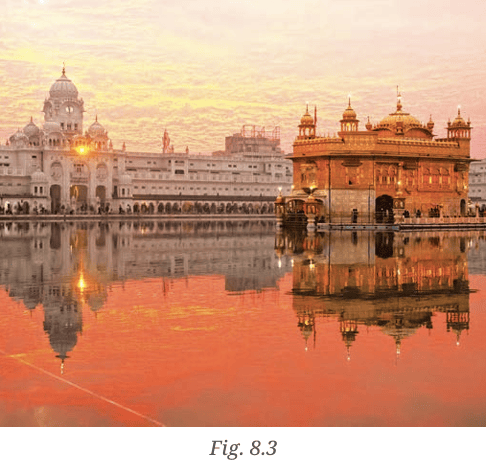
In Sikhism, takhts
are seats or
centres of spiritual
authority — for
example, the Takht
Sri Patna Sahib (in
Patna), the Akal Takht
(part of the Golden
Temple at Amritsar,
see Fig. 8.3), and Takht
Sri Keshgarh Sahib
(at Anandpur). Sikhs
aspire to undertake
pilgrimages to these
places at least once in their lifetimes, as they are associated with
important Sikh Gurus and therefore have special significance. In
addition, Sikh tradition records pilgrimages conducted by several
Gurus, such as Guru Nanak, to places like Haridwar, Prayag,
Mathura, Varanasi, Ayodhya, Puri and many more, besides a few
Muslim shrines.
"India has, for ages past, been a country of pilgrimages. All over the country, you find these ancient places, from Badrinath, Kedarnath and Amarnath, high up in the snowy Himalayas down to Kanyakumari in the south. What has drawn our people from the south to the north and from the north to the south in these great pilgrimages? It is the feeling of one country and one culture."
— Jawaharlal Nehru, 1961
Pilgrimages
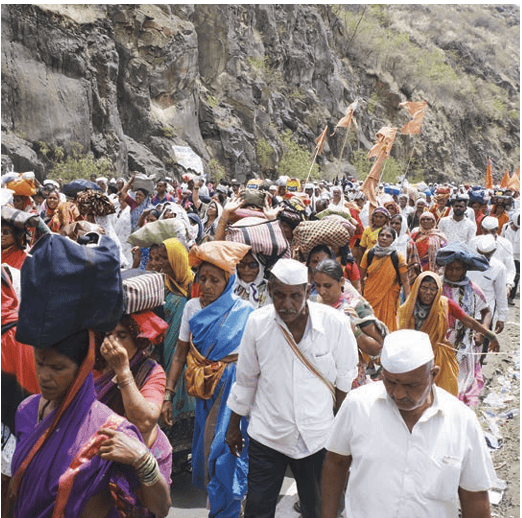
Many Indians undertake tīrthayātrās or pilgrimages to various
sacred sites (tīrthas) during their lifetime. This ancient and
continuous tradition of pilgrimage is not just a physical journey
but also an inner journey that requires a specified code of
conduct.
Tīrtha: Literally, a place where one can cross a river or other body of water. Symbolically, it becomes a place where one can cross from the ordinary worldly life to a higher, spiritual life. Such places are held in high reverence and regarded as sacred.
For at least 3,000 years, and with no modern means of
transportation available, Indians have been crisscrossing the
Subcontinent, resulting in its entire geography being considered
sacred. We will return to this soon.
Here’s an excerpt from the writings of Dharampal, a historian
and thinker:
“I was travelling from Gwalior to Delhi … when I met a group of
people … about twelve of them, some three or four women and
seven or eight men ... They said that they had been on a pilgrimage,
three months long, up to Rameswaram, among other places. They
came from two different villages north of Lucknow. They had
various bundles of things and some earthen pots with them ... They
had taken all the necessities for their food—atta, ghee, sugar—
with them … I asked them, “You are going to Delhi now?” “Yes!”,
they replied. “You will stop in Delhi?” “No, we only have to change
trains there. We’re going to Haridwar! ... We don’t have time … We
have to go to Haridwar. And then we have to get back home.”
- Read the excerpt. What are your observations? Locate the route the group must have taken from Rameswaram to Haridwar. Why do you think the group was going straight to Haridwar instead of stopping at Delhi?
- In ancient times, when people were travelling from Madurai in Tamil Nadu to Varanasi in Uttar Pradesh, what languages would they come across? How would they communicate with people in those places? Where would they stay? What food would they eat?
In the Jain tradition, the tīrthas are associated with places where the Tīrthankaras attained liberation or where significant events of their lives occurred. Trees, ponds, hills and mountains that the Tīrthankaras visited or meditated at are also considered sacred. Examples of such places include Mount Abu, Girnar and the Śhatruñjaya hill in Saurashtra (Gujarat).
Tīrthankara: Literally, someone who makes a tīrtha, that is, who guides the crossing from ordinary to higher life. In Jainism, the Tīrthankaras are the supreme preachers of dharma.
Another example is the pilgrimage to Sabarimala temple (Kerala), dedicated to the deity Ayyappa, which draws over ten million devotees every year. This hilltop shrine was traditionally reached by an immensely difficult trek through hills and forests. Such a challenging approach, common to many hilltop or mountain shrines all over the country, symbolises the difficulties of the inner path, with natural landmarks along the route being considered sacred.Tīrthankara: Literally, someone who makes a tīrtha, that is, who guides the crossing from ordinary to higher life. In Jainism, the Tīrthankaras are the supreme preachers of dharma.
More sacred sites
Hindu and many folk and tribal belief systems go further. In Grade 6 we learnt that in such belief systems, people regard elements of Nature, such as mountains, rivers, trees, plants and animals, and sometimes stones too, as sacred. In Hinduism, for instance, this includes countless geographical sites or features of Nature, such as specific mountains, rivers and forests, which are regarded as particularly divine and are worshipped as deities; many rivers are regarded as devīs, while some species of trees, animals and plants are particularly holy.This tradition comes from the perception of a divine presence in all of Nature. Ultimately, the whole of planet Earth is considered sacred — she is Mother Earth or Bhūdevī.
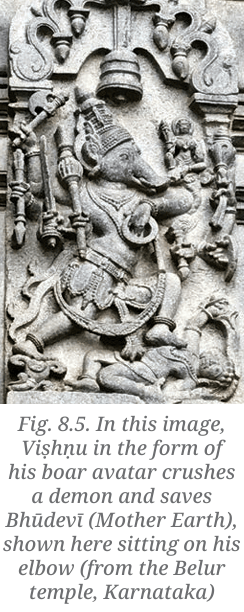
Here are a few more examples of such traditions:
- The Niyam Dongar hill in the Niyamgiri Range of Jharkhand is sacred to the Dongria Khond tribe. They believe that the hill is the abode of Niyam Raja, the supreme deity who provides everything they need for sustenance. Cutting trees here is prohibited and considered a sign of disrespect to the deity.
- In the early 2000s, the Government of Sikkim identified several sacred mountains, caves, lakes, rocks and hot springs that were to be protected against all forms of damage.
- In the Nilgiris of Tamil Nadu, the Todas, a tribal community, regard many mountain peaks as sacred and associate them with their gods. To them, this sense of sacredness extends to many plants (which often become part of their rituals), Shola forests, wetlands, and even specific stones and individual trees.
Becoming Aware of Sacred Geography
Some sacred places are marked on the map (Fig. 8.6) given on the next page. Though spread all over India, they are also interconnected. For example, some Hindus aspire to do the chār dhām yātrā, and those four sites appear to have been deliberately located in the southern, northern, eastern and western corners of India! A similar aspiration exists with respect to the 12 jyotirlingas, which are considered highly auspicious. The 51 Shakti pīṭhas, too, cover the entire map of India (even parts of present-day Bangladesh and Pakistan). And there are many more regional networks.The 12 jyotirlingas are sacred shrines dedicated to Śhiva, a major deity of Hinduism. Each shrine has its own unique mythology and name.
These networks crisscross India’s length and breadth, creating a sacred geography. As a result, the land itself becomes sacred.
There is a story about the 51 Shakti pīṭhas. Shakti, the divine mother in the form of Satī, and her consort, Śhiva, were insulted by her father. An angry Satī immolated herself. Shiva was so livid that he took her body and refused to allow the last rites. Śhiva’s anger was dangerous for the world and the cosmos. So Viṣhṇu used his chakra to cut up Satī’s body. The Shakti pīṭhas are the places across the Subcontinent where the body parts of the divine mother fell one by one. The symbol behind the story is clear: the whole land becomes the body of the divine mother.Note the locations of the chār dhām. What do you think it implied for the people when they travelled north-south and east-west?
While visiting the major sacred places connected to their respective faiths, pilgrims would naturally cover the geography of India. They would come across diverse languages, customs, clothing and foods along the way, but would notice the commonalities too.
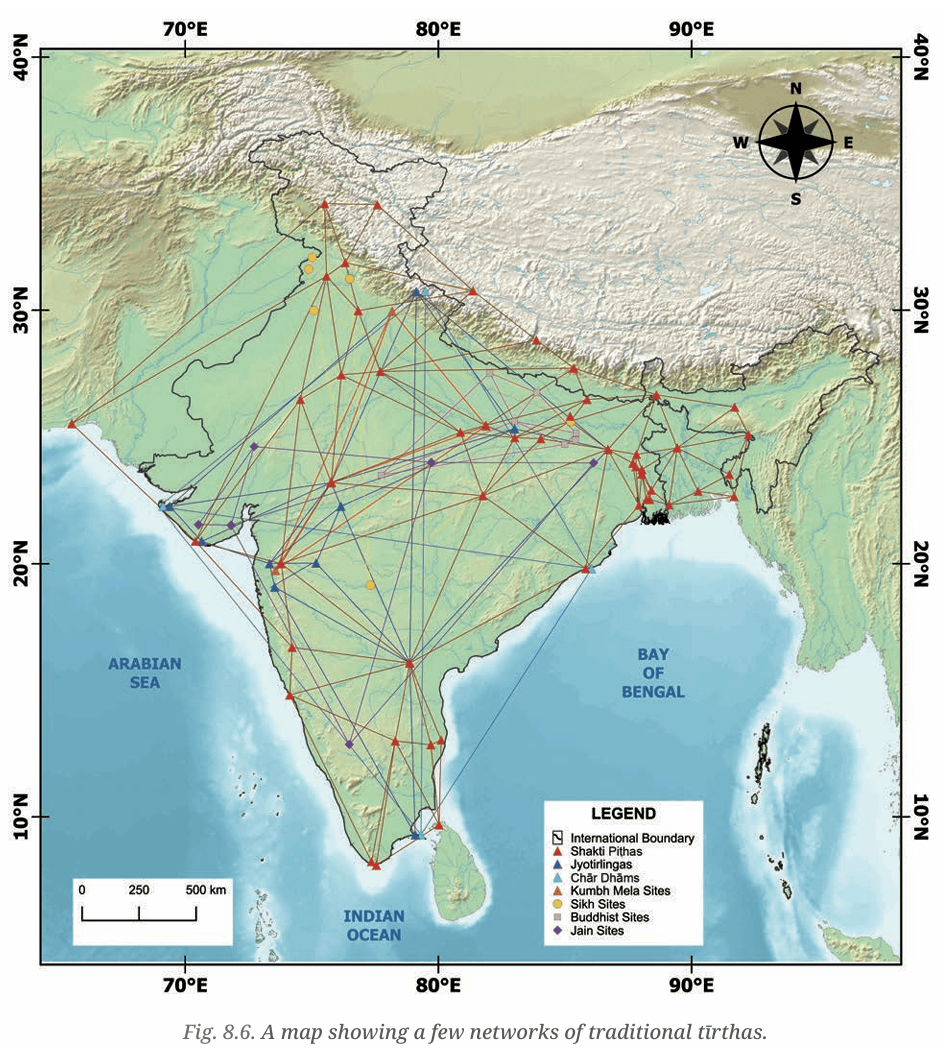
Can you identify the names of a few traditional tīrthas given in the map above? You can refer to the political map at the end of the book for help.
Why did people travel such long distances? Apart from religious motivations, some, like merchants and traders, travelled to exchange goods; others travelled to discuss, debate and popularise their beliefs or to learn and study from eminent teachers in different parts of the country. However, though they were travelling for different purposes, their routes often converged. Discussions and debates, sharing of goods, experiences, and tales, enriched everyone. New ideas emerged, and old ones were adapted. This complex process became a major factor in the cultural integration of the Indian Subcontinent.
Sacred Ecology
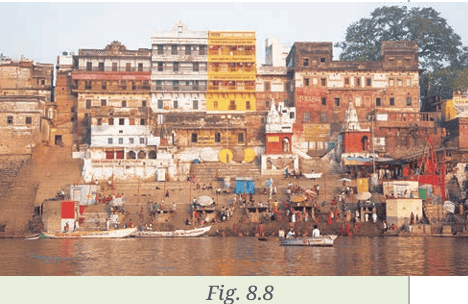
Tīrthas are usually located on the banks of a river or a lake, in a forest or on a mountain. As we saw above, the natural landscape itself is thus seen or perceived as sacred space, or puṇyakṣhetra. This perception has helped us to protect and preserve Nature, since we are not distinct from her. So geography, culture and spirituality fuse together in these kṣhetras.Rivers and sangams (confluence of rivers)
Rivers have been worshipped in India since Vedic times. The nadīstuti sūkta of the Ṛigveda is a hymn (sūkta) in praise of (stuti) rivers (nadī) that invokes 19 major rivers of ancient northwest India. Even today, many rituals involving water invoke the presence of some of the most important rivers of India:"gange cha yamune chaiva godāvarī sarasvatī
narmade sindhu kāverī jalesmin sannidhiṃ kuru
Ganga, Yamuna, Godavari, Sarasvati, Narmada, Sindhu,
and Kaveri, may you manifest in this water. "
- Prayagraj hosts the Kumbh Mela every six years. Prayag is located at the confluence of three rivers — Ganga, Yamuna and the invisible Sarasvati. A few years ago, UNESCO listed the Kumbh Mela as an ‘intangible heritage of the world’.
- An estimated 660 million people participated in the Kumbh Mela of 2025. What proportion of the population of India is this?
Kumbh Mela
The Kumbh Mela originates in the legend of amṛita manthana.
The devas and asuras (i.e., more or less, gods and demons),
traditional enemies, for once joined forces in churning the
cosmic ocean to extract amṛita, the divine nectar that would give
them immortality. To prevent the asuras from getting the amṛita,
Viṣhṇu, in the form of Mohini, a beautiful lady, snatched the
pitcher or kumbha which contained the amṛita. In the process,
a few drops fell over four places — Haridwar, Prayagraj, Nashik,
and Ujjain. These are the places where the Kumbh Mela has been
held, and a dip in the rivers there during a prescribed period is
considered most auspicious.
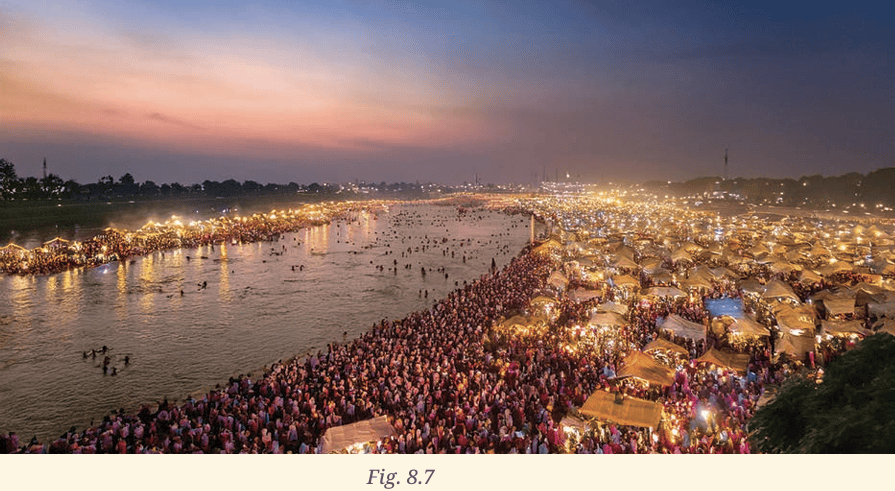
THINK ABOUT IT
How do you think these
sacred places are connected
with the people’s economic
lives and activities? Draw
a mind map to trace these
connections. (Hint: The
pictures above can provide
some clues.)
Mountains and Forests
All over the world, mountains are often associated with legends, deities or heroes. Also mountains are seen as a symbolic gateway from earth to heaven because of their height. That is why many tīrthas and temples in India are located on hilltops, as the physical journey to these peaks is seen as a symbolic journey to reach the divine. People would undertake arduous walks through mountain trails to those sites and shrines, which tested not only their physical abilities but also their mental strength. Today, such places are often accessible through roads and other modes of transport.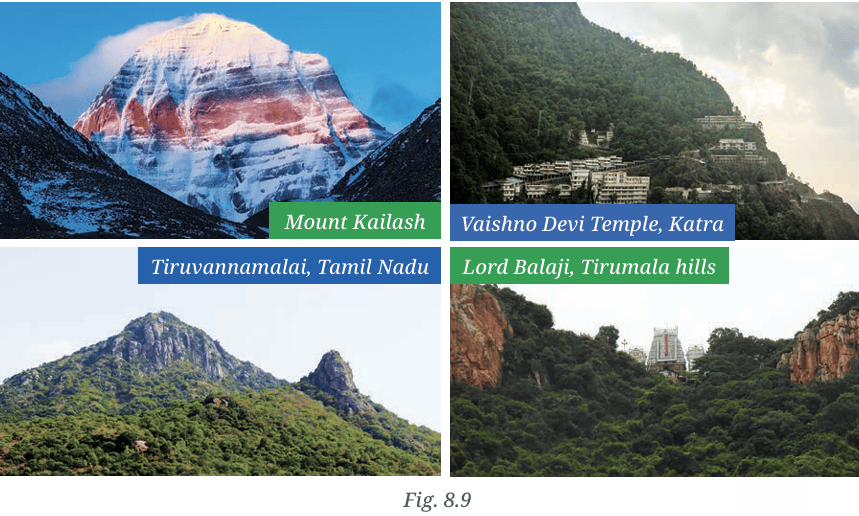
Trees, Forests and Sacred Groves
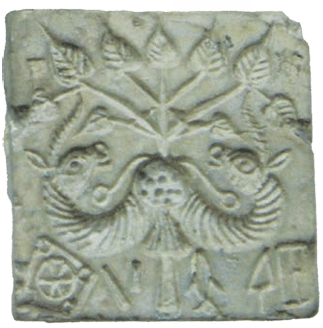
In many parts of India, trees are adorned with offerings like turmeric and kumkum. One species of fig tree commonly called ‘peepul’ (or ‘pipal’), ‘bo tree’ or ‘bodhi tree’ (aśhvattha in Sanskrit) is sacred to Hinduism, Buddhism, Sikhism and Jainism. In fact, its botanical name is Ficus religiosa (literally, in Latin, the ‘religious’ or sacred fig tree).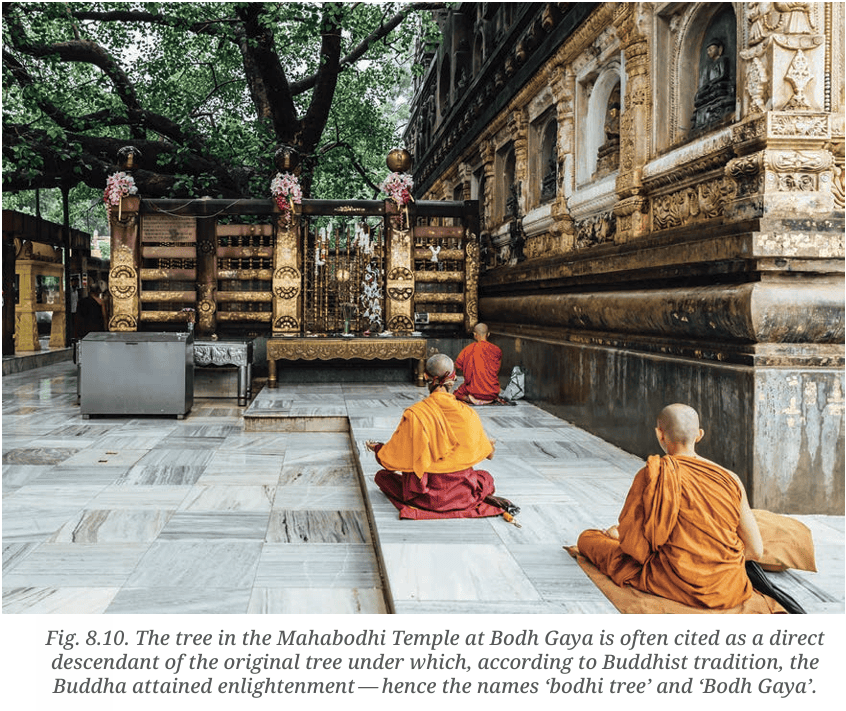
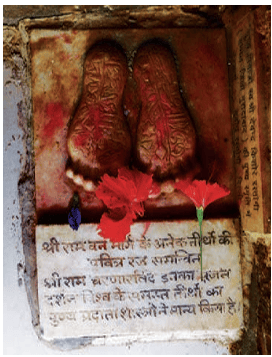
In Grade 6 we read about the two epics of India, the Mahābhārata and Rāmāyaṇa. These texts have vivid descriptions of pilgrimages undertaken and places visited, and of sacred rivers, forests and mountains. In almost every region of India, numerous rural and tribal traditions claim that the heroes of these texts passed through their locality, with shrines often marking such passages. Such legends allowed a wide diversity of communities to make the two epics their own.
THINK ABOUT IT
Many parts of the peepul tree have medical uses: the leaves
are used to treat some skin ailments while the bark is useful
for stomach ailments. Since it stays green almost through the
year, it provides food and shelter to many types of birds and
other animals.
There were many thousands of sacred groves in India. Sadly, these numbers have been shrinking as people have started encroaching on them for various purposes, from agriculture to industry. Still, sacred groves continue to be protected in many regions of India.
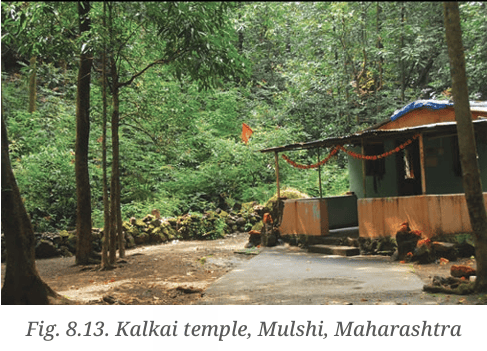
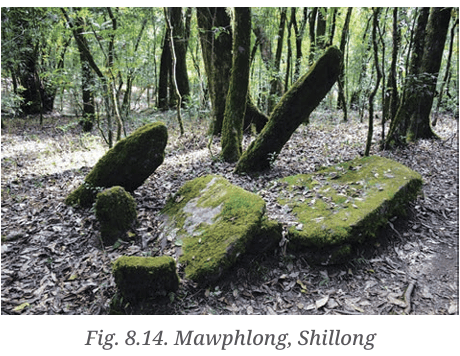
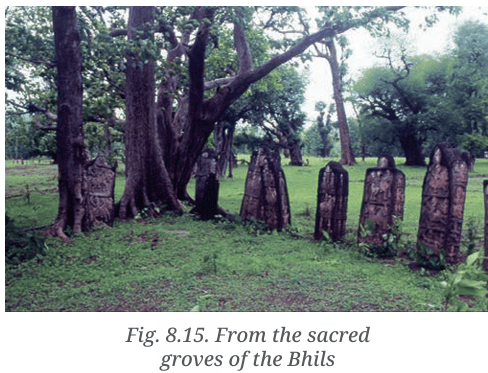
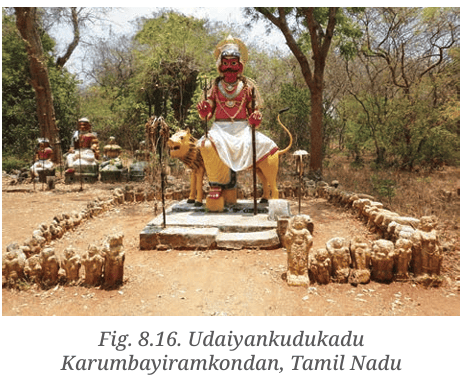
| Malayalam | kāvu |
| Tamil | kovilkādu |
| Kannada | devare kādu |
| Marathi | devarāī |
| Khasi (Meghalaya) | khlaw kyntang |
| Hindi (Himachal Pradesh) | dev van |
| Jharkhand | sarnā |
| Chhattisgarh | devgudī |
| Rajasthan | oraṇ |
From pilgrimage to trade
Pilgrims encounter traders and merchants along their journey. This interaction benefits both groups. Pilgrims need various items, which traders can provide. As a result, the pilgrimage routes and the trade routes often overlap. Some traders might also double as pilgrims, taking their wares to distant towns and cities while visiting sacred sites and shrines.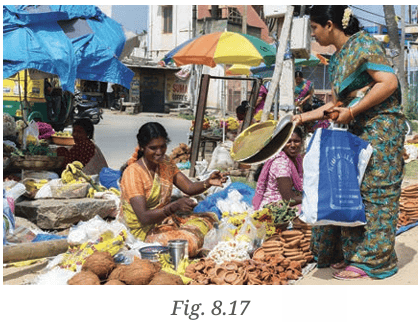 What routes did those traders use in ancient India? Revisit the
map of trade routes (Fig. 5.5) in the chapter ‘The Rise of Empires’.
Uttarapatha was a major trade route connecting the north
western and eastern parts of the Subcontinent; the Dakṣhinapātha
went from Kaushāmbī through Ujjayinī (Ujjain) to Pratiṣhthāna
(Paithan). As you know, some of the goods traded along these
routes included precious stones like shells and pearls, coins, gold
and diamonds, as well as cotton, spices, and sandalwood.
What routes did those traders use in ancient India? Revisit the
map of trade routes (Fig. 5.5) in the chapter ‘The Rise of Empires’.
Uttarapatha was a major trade route connecting the north
western and eastern parts of the Subcontinent; the Dakṣhinapātha
went from Kaushāmbī through Ujjayinī (Ujjain) to Pratiṣhthāna
(Paithan). As you know, some of the goods traded along these
routes included precious stones like shells and pearls, coins, gold
and diamonds, as well as cotton, spices, and sandalwood.
Take a sheet of transparent paper that can be used for tracing. Trace a map of the trade routes from the chapter ‘The Rise of Empires’. Place it on top of the map of the important tīrthas. What do you observe?
Sacred Geography beyond India
The concept and practice of sacred geography are not unique to India. Ancient Greece had many sacred landmarks, from mountains to sacred groves. The Native Americans used to have a special bond with Nature, which they viewed as sacred. The Maoris, the indigenous people of New Zealand, regard the Taranaki Maunga mountain as their ancestor and therefore as sacred; after many representations by the Maoris, a law recently granted this mountain the rights and responsibilities of a human being — an acknowledgement of the Maori worldview. The elders of the community represent the voice of the mountain or river threatened with destruction. This ensures that the sacred places are not exploited and degenerated.Restoring and conserving the sacred
THINK ABOUT IT
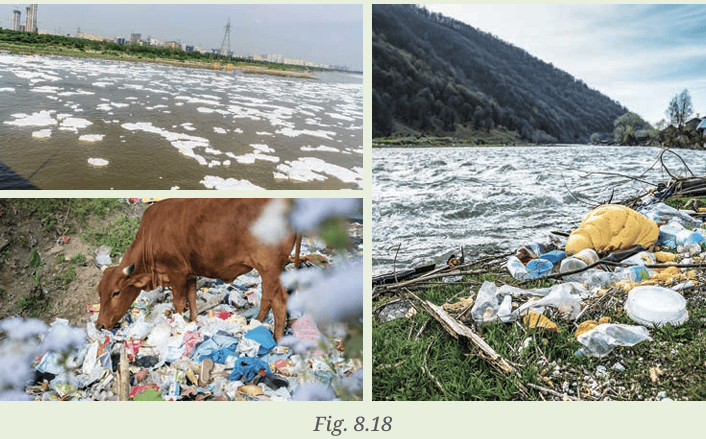 Look carefully at these pictures of places and animals that are
considered sacred. The Yamuna in the north, the Mahanadi in
the east or the Kaveri in the south are all sacred rivers. How
come they have become so polluted? Are there sacred places
in your locality or region that have been similarly polluted
or degraded by human activity? Whose responsibility is it to
preserve the sanctity of our sacred places? Discuss in class.
Look carefully at these pictures of places and animals that are
considered sacred. The Yamuna in the north, the Mahanadi in
the east or the Kaveri in the south are all sacred rivers. How
come they have become so polluted? Are there sacred places
in your locality or region that have been similarly polluted
or degraded by human activity? Whose responsibility is it to
preserve the sanctity of our sacred places? Discuss in class.
A harmonious relationship that once existed between people and the sacred geography sustained Indian civilisation over millennia, creating values that were shared all over the Subcontinent. But today it is under great strain.
Sacred geography continues to be relevant today. When there is a conflict in our relationship with Nature, when a river is overexploited to the point of disappearance, or a sacred mountain is challenged with competing ideas of development, people have spoken up to protect their environment, their deities and values. At a time when sustainability has become a global issue, a worldview that embeds sacred geography has a significant contribution to make.Before we move on …
- All religions in India have their sacred places dotted over the landscape. In Buddhism, Jainism and Sikhism, such places are usually associated with some of the great figures in these belief systems.
- Hinduism has dense networks of pilgrimage sites, covering
the entire geography of India. The practice of pilgrimage
is interwoven with the lives of people, as it serves the
individual development and spiritual growth, but also the
socio-economic purposes of trade expansion and pan-Indian
cultural integration.
- In many Hindu, tribal and folk traditions, the very land is
perceived as sacred.
- Our sacred places are being polluted owing to widespread neglect and a lack of concern. It is our duty to protect our national heritage, as our Constitution also reminds us.
Questions and activities
1. Read the following statement by a well-known environmental thinker, David Suzuki:
"The way we see the world shapes the way we treat it. If a mountain is a deity, not a pile of ore; if a river is one of the veins of the land, not potential irrigation water; if a forest is a sacred grove, not timber; if other species are biological kin, not resources; or if the planet is our mother, not an opportunity—then we will treat each other with greater respect. Thus is the challenge, to look at the world from a different perspective.”
Discuss in small groups. What do you think this statement
means? What implication does it have for our actions
with respect to the air, water, land, trees and mountains
around us?
2. List the sacred sites in your region. Enquire into why they are considered sacred. Are there stories connected with these sacred places? Write a short essay of 150 words. (Hint: You could speak to elders in your family and community, discuss with your teacher, read books and articles, etc., to gather relevant information.)
3. Why do you think natural elements like rivers, mountains and forests are considered sacred for the people? How do they contribute to our lives?
4. Why do people visit a tīrtha or other sacred sites?
5. How did the ancient pilgrimage routes help in fostering
trade during those times? Do you think the sacred sites
help in developing the economy of the region?
6. How do sacred places influence the culture and traditions of the people living near them?
7. From the various sacred sites of India, select two of your choice and create a project explaining their significance.
8. What is the two-fold significance of a tīrthayātrā or a pilgrimage?