
3Empires and Kingdoms:
6th to 10th Centuries
"India never spoke her last word. In all things, she continues,
survives and renews herself." — Louis Renou and Jean Filliozat (French Indologists)
The Big Questions?
- What major changes characterised this period?
- How did the political, cultural, and religious developments shape India during this period?
- What was the impact of foreign invasions and interactions on Indian society and polity during this period?
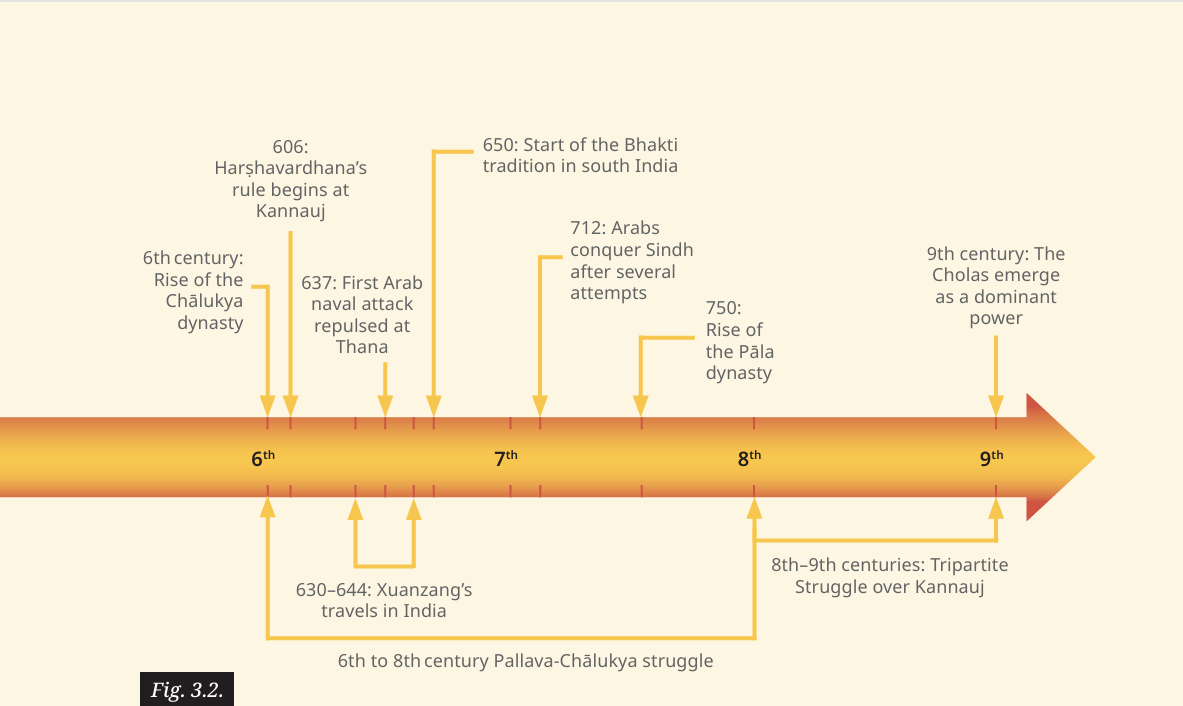
This chapter and the next together survey the scene in India from the end of the Gupta era about 600 CE to about 1200 CE. These six centuries together have received several names — ‘post-classical’, ‘late classical’ and ‘early medieval’ among others. We need not use any of those terms here, as long as we keep the broad chronology in mind. In Grade 8, we will explore the next centuries, leading up to the colonial era, dominated by British rule in India, and, ultimately, the struggle for freedom from the colonial rule, culminating in India’s independence.
Imagine you are in north India some 1,500 years ago. The mighty Gupta Empire (see the chapter on the ‘Gupta Era’ in Part 1 of this textbook) has lost its dominance. You are a young traveller setting off on an adventure across the subcontinent. Your first stop is Kannauj, a city by River Ganga where a powerful king hosts poets and scholars. A few weeks later, you reach the Chālukya kingdom in the Deccan, where you see magnificent temples and lively cities. In the far south, the Pallavas are carving entire temples out of rock at Māmallapuram (also known as Mahabalipuram), while in Bengal, the Pālas are supporting great universities such as Vikramaśhilā. You don’t see large empires in India now, but many strong kingdoms. Some call it a time of political rivalry and disorder, but as you travel, you see something different — a land buzzing with new ideas, art, and culture, different in each region, yet all part of one India.
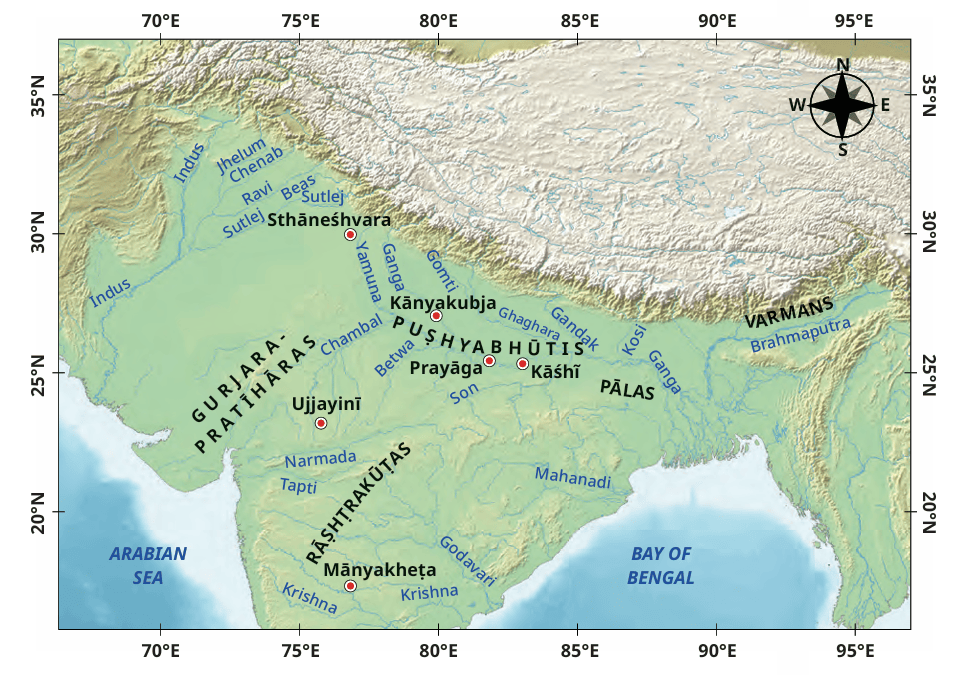
Is this really the end of an age of powerful empires … or the dawn of a new era? Let’s step back in time and see. As you can see on the map (Fig. 3.3), the Guptas are gone, but the land is still dynamic and vibrant with activity. Several regional powers have emerged.
The ‘Great King of Kings’
As we look at northern India at this time, we find a remarkable ruler, Harṣhavardhana, ascending the throne in 606 CE at Kannauj. He belonged to the Puṣhyabhūti (or Vardhana) dynasty, whose earlier capital was Sthāneśhvara (present-day Thanesar in Haryana).
LET'S EXPLORE
Do you recall where the capital of the earlier Maurya and Gupta empires was located?
How do you think this shift may have shaped the sub-continent’s politics in the years to come?
Ruling from Kannauj (or Kanauj, anciently known as Kānyakubja, in present-day Uttar Pradesh), Harṣhavardhana expanded his empire over large parts of northern and eastern India, although its precise extent is not known with certainty.

LET'S EXPLORE
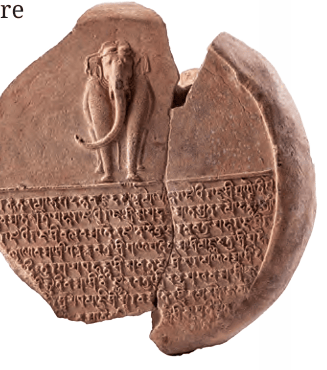
If you know the Devanagari script, with the help of your teacher try to identify some of the letters in Harṣha’s signature (Fig. 3.5).
Harṣha (as he is also known) was a fine poet and dramatist; he is assumed to be the author of three plays composed in classical Sanskrit, which weave love stories with courtly life, or themes of sacrifice and other high ethical values. While these are ‘stories’, historians use such literature to extract interesting details about the culture and society of those times — from systems of governance to social diversity, technologies, foods, and clothing. Harṣha also patronised scholars like Bāṇabhaṭṭa (also known as Bāṇa), who wrote Kādambarī, a beautiful literary work and one of the world’s first novels. Bāṇa also composed a biography of Harṣha titled Harṣhacharita. Inscriptions depict Harṣha as a devotee of Śhiva; according to other sources, he was also deeply attached to Buddhism, while showing respect for all schools of thought and belief.
DON'T MISS OUT
The 7th-century novel Kādambarī has a very elaborate and complex plot. It tells of the love story between a prince from Ujjayinī, and Kādambarī, a celestial being. Their romance runs across different births, dreams, and divine worlds, with a story often told within another story. On the way, we get glimpses of courtly life, philosophy, nature and aesthetics. Bāṇa died before completing the novel; it was completed by his son, and is regarded as a masterpiece of classical Indian literature.
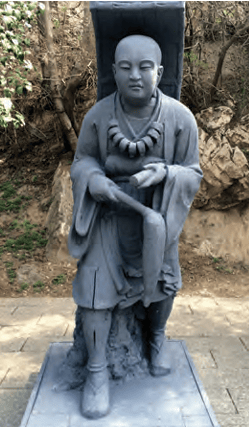
Apart from several inscriptions, an important historical source for the period is the travelogue kept by yet another Chinese pilgrim to India. Remember, in Part 1 of this textbook we met Faxian, who in the 5th century left a valuable account of the Gupta era. Now, two centuries later, Xuanzang (his name was earlier transcribed as Hsuan Tsang or Hiuen Tsang) set out on his journey to India and travelled around the subcontinent between 630 and 644. (We met him briefly in the chapter ‘The Story of Indian Farming’ in this textbook, and earlier in ‘India, That Is Bharat’ in Grade 6.) Just as Faxian, his motivation for undertaking such a long and difficult journey was to visit sacred Buddhist sites and learn doctrines from Indian teachers; he brought back to China more than 600 manuscripts of Buddhist texts in Sanskrit (carried by 20 horses!) and set about translating them into Chinese. He also left a meticulous account of his journey, in which he recorded important details about politics, diplomacy, culture and religion in the kingdoms he crossed. His travelogue is a major source of information for historians of this period.
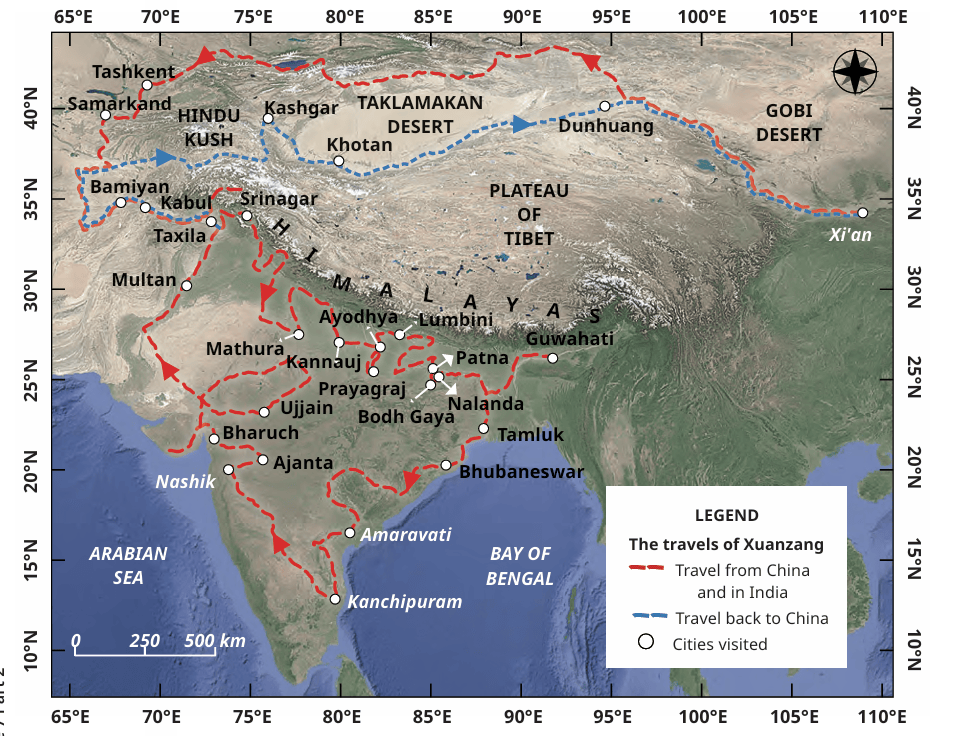
LET'S EXPLORE
Looking at the map (Fig. 3.7), can you identify a few mountain passes or desert areas that Xuanzang had to cross while travelling between China and India?
Can you also identify a few important Buddhist centres of learning that Xuanzang visited in India? Do you know something of their significance?
Harṣhavardhana welcomed this Chinese pilgrim to his court (apart from two more ambassadors from China). In Xuanzang’s honour, he held an assembly at Kannauj, attended by kings and leaders of many religious sects. Xuanzang described Kannauj as a beautiful and prosperous city, and Harṣha as a just and energetic ruler who maintained a vast army and was often engaged in military campaigns. Every five years, he held an assembly at Prayāga (present-day Prayagraj, at the confluence of the Ganga and Yamuna rivers) where, after performing sacred rites, he gave away much wealth, offering it to Buddhists, Brahmins, and the poor.
THINK ABOUT IT
Does the above ceremony remind you of a similar event discussed in Part 1 of this textbook?
Harṣha attempted to extend his empire southward beyond the Narmada, but was held in check by Pulakeśhin II of the powerful Chālukya dynasty, whom we will meet soon. Harṣha also dreamed of uniting northern India, but achieved only mixed success. Although he formed an alliance with the Varman dynasty of Kāmarūpa (in today’s Assam; their capital Prāgjyotiṣha was close to today’s Guwahati), conflicts with neighbouring kingdoms continued.
A Tripartite Struggle for Kannauj
After Harṣha’s death in 647, north India saw much political turmoil. Kannauj became the centre of a long, indecisive ‘Tripartite Struggle’, as it is often called. The three warring parties were the Pālas from the east, the Gurjara-Pratīhāras from the west, and the Rāṣhṭrakūṭas from the Deccan (see Fig. 3.3). During the 8th and 9th centuries, these three powers repeatedly warred against each other, with fluctuating outcomes and no lasting victor.
LET'S EXPLORE
Why was Kannauj so attractive to those powerful dynasties? Observe its location on the map (Fig. 3.3) and discuss in class.
The Pālas
After Harṣha’s death, the Bengal region fell into disorder until, according to an inscription, the people chose Gopāla in 750 CE to restore stability; he was the first king of the Pāla dynasty, which soon ruled over much of eastern India. His successor, Dharmapāla, expanded the Pāla Empire over much of eastern and northern India. He became known as a great patron of Mahāyāna Buddhism (see Chapter ‘India and Her Neighbours’ in this textbook), founding major monasteries such as Vikramaśhilā (in present-day Bihar) and Somapura (in present-day Bangladesh). Besides, just like Harṣha, the Pālas continued to patronise Nālandā (see Chapter 7, ‘The Gupta Era’ in Part 1 of this textbook). Those large monasteries were, in effect, the universities of those times and attracted numerous students, sometimes from far away, even beyond India.
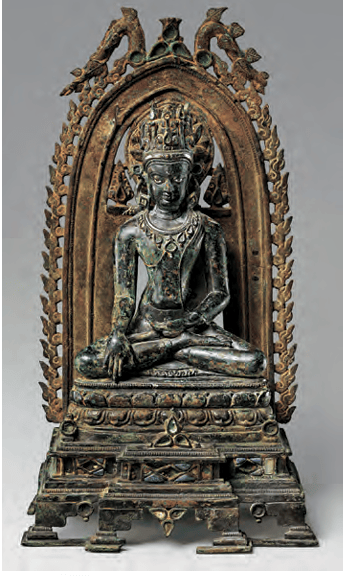
The Pāla Empire flourished economically thanks not only to internal trade, but also through brisk maritime trade through its seaports on the east coast, which provided pathways to Southeast Asia (see ‘India and Her Neighbours’ for some details). Though the empire later declined, it left a lasting legacy of strong governance and learning in parts of eastern and northern India.
THINK ABOUT IT
Some historians state that Dharmapāla was Buddhist; he certainly patronised Buddhist learning and institutions. But we should keep in mind that in ancient India, the concept of religion was more fluid than it is today, and except perhaps for monks and nuns, people could feel at ease with various belief systems and practise different modes of worship at the same time. Indeed, people often did not regard belief systems involving Hinduism, Buddhism, and Jainism as separate, but rather as branches of a common philosophical tree. Besides, rulers often took pride in patronising several schools of thought; we saw the case of the Guptas in Part 1 of this textbook, and Harṣha gives us one more example of such broad-mindedness. Similarly, several successors of Dharmapāla, though still patronising Buddhist institutions, were said to be devotees of Śhiva. The Rāṣhṭrakūṭas (p. 71) and other rulers will provide more examples of this.
A university with scholars as ‘gatekeepers’
Dharmapāla founded Vikramaśhilā in the late 8th century on the banks of the Ganga. It remained a great centre of learning for more than four centuries. The university had six colleges, monasteries, temples, lecture halls, and a vast library. Nearly 3,000 scholars studied subjects such as grammar, logic, Hindu and Buddhist philosophy, learning and rituals. Admission was highly selective as each college had a dvārapaṇḍita (‘scholar gatekeeper’) who tested students before allowing them entry. Vikramaśhilā was especially known for its ties with Tibet; one of its famous teachers travelled to Tibet, translated Sanskrit works into Tibetan and played a major role in shaping Tibetan Buddhism (also called Vajrayāna Buddhism, see Chapter ‘India and Her Neighbours’ in this textbook).Such important centres of learning — there were hundreds, if not thousands, spread across India — kept alive and enriched India’s long-standing knowledge traditions.
As we will see in the next chapter, Vikramaśhilā was plundered and destroyed by Bakhtiyār Khiljī in the 12th century.

The Gurjara-Pratīhāras
This dynasty, founded in the mid-8th century CE by Nāgabhaṭa I, probably originated from western India (‘Gurjara’ referred to a region between Gujarat and Rajasthan). As we will see later in this chapter, it gained fame for pushing back Arab invasions into northwest India. Their early capital was Bhillamāla (modern Bhinmal in western Rajasthan); it seems to have shifted later to Ujjayinī.
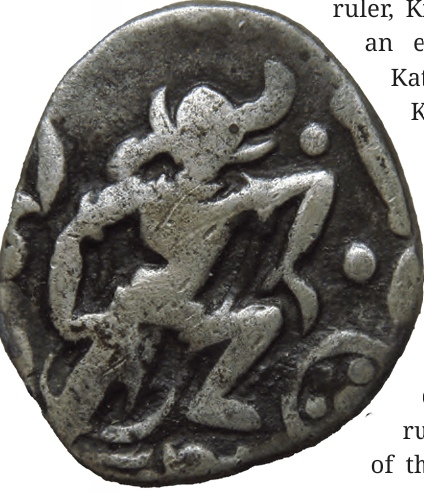
In the 9th century, the celebrated Pratīhāra ruler, King Bhoja, a devotee of Viṣhṇu, built an empire stretching from Punjab and Kathiawar (or Saurashtra) in the west to Kannauj in the east, controlling most of north India. Bhoja was also known as ‘Mihira’ (a name of the Sun) and Ādi Varāha (Varāha is an avatar of Viṣhṇu in the form of a boar, see Fig. 3.11), among other designations. However, a century later, the Gurjara-Pratīhāras suffered the destruction of Kannauj by Rāṣhṭrakūṭa rulers, which hastened the disintegration of their empire; it was finally eliminated in the early 11th century by the Ghaznavids, whom we will meet in the next chapter.
The Rāṣhṭrakūṭas
In the mid-8th century, Dantidurga became the first independent Rāṣhṭrakūṭa ruler when he overthrew the Chālukyas in the Deccan (whom we will meet later in this chapter). The Rāṣhṭrakūṭas shifted their power centre to present-day Karnataka, with their capital at Mānyakheṭa (modern Malkheda) and were one of the most dominant powers for nearly two centuries, their empire spanning much of the subcontinent. Dantidurga’s successors campaigned successfully in north India, briefly occupying Kannauj.
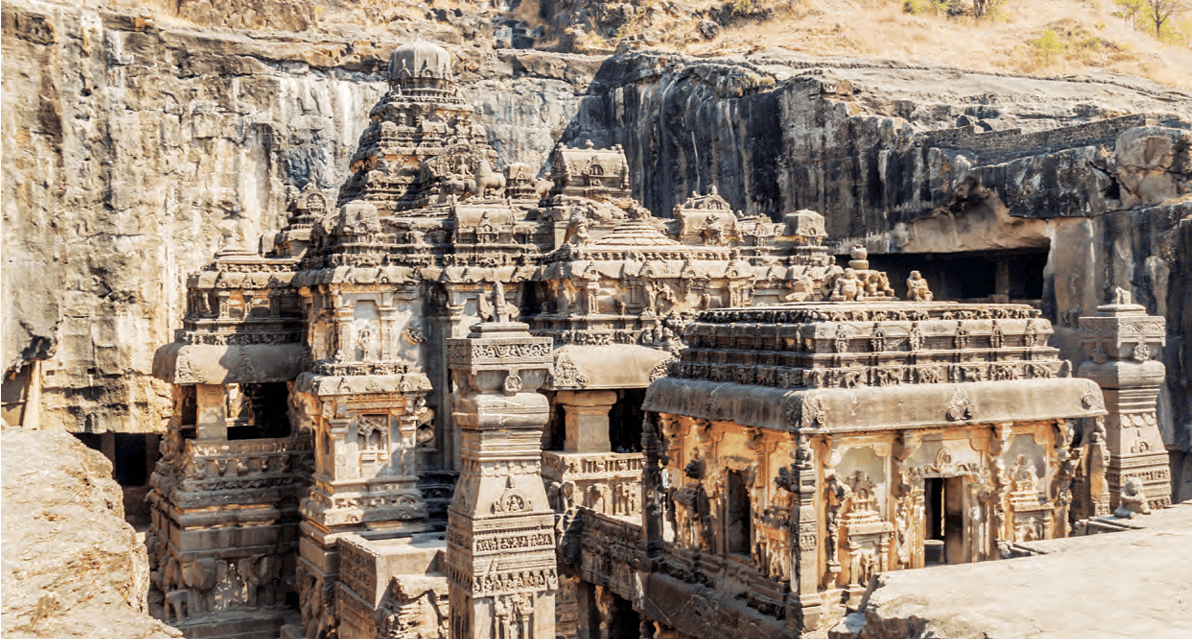
We should not imagine that the kings of such dynasties were constantly at war. In fact, they found time and resources to create wonders. The Rāṣhṭrakūṭa king Krishna I got the magnificent Kailaśhanātha temple, the largest rock-cut temple in India (Fig. 3.12), carved out of a hillside at Ellora (in present-day Maharashtra). The Rāṣhṭrakūṭas equally patronised Hindu, Buddhist, and Jain schools of thought, and encouraged learning and literature in Sanskrit, Prakrit, and Kannada.
In the 9th century, another Rāṣhṭrakūṭa ruler, Amoghavarṣha I, took on the title ‘Nṛipatunga’ or ‘peak of kings’. Despite frequent wars with neighbouring kingdoms, including those of the dynasties we surveyed above, he managed to ensure peace and prosperity in his empire — and stability, since his reign lasted for 64 years! Amoghavarṣha Nṛipatunga is sometimes called a ‘Jain king’ as he was strongly drawn to Jainism; however, he also patronised Hindu temples. He was a fine poet too, who composed works in Sanskrit and Kannada.
DON'T MISS OUT
‘Nrupatunga Road’ in central Bengaluru, home to several government buildings and institutions, is named after Amoghavarṣha I.
THINK ABOUT IT
Al-Masūdī, a 10th-century Arab historian and traveller from Baghdad, gave high praise to a Rāṣhṭrakūṭa ruler: “His troops and elephants are innumerable. … There is none among the rulers of Sindh and Hind who in his territory respects the Muslims [as he does]. In his kingdom, Islam is honoured and protected. And, for them, mosques and congregational mosques, which are always full, have been built for offering prayers five times.”
What does this tell us about the Rāṣhṭrakūṭas?
While these three powerful dynasties — the Pālas, the Gurjara Pratīhāras, and the Rāṣhṭrakūṭas — were involved in the tussle over Kannauj, that is, over central India and the Gangetic plains, other powers rose and fell in other parts of India. It is not possible to survey them all; let us briefly visit a few.
Kashmir
Far to the north, in the mid-8th century, a new power was stirring in the Himalayan kingdom of Kāśhmīra — present-day Kashmir. Apart from inscriptions and coins, we learn about its successive rulers from Kalhaṇa, who authored Rājatarangiṇī — literally ‘the River of Kings’ (see the Box below). Among the many kings and a few queens whose rule Kalhaṇa describes, Lalitāditya Muktāpīda of the Kārkoṭa dynasty is seen as a firm ruler. After him, however, Kashmir’s political scene experienced many internal conflicts and shifts of power, including some rulers seizing the throne by force. In the late 10th century, for instance, Queen Diddā consolidated her power through strategic alliances but also, according to Kalhaṇa, by ruthlessly eliminating rivals, including her own grandsons. She founded a few towns, built several temples, and restored many more.
DON'T MISS OUT
Kashmiri scholar and poet Kalhaṇa composed the epic poem Rājatarangiṇī in Sanskrit in the 12th century. In it, he narrated the history of Kashmir’s ruling dynasties from its beginnings to his own time.
Kalhaṇa also spells out his approach to history in these words: “My effort is to give a connected account where the narratives of past events have become fragmentary in many respects. … I have examined eleven earlier works composed by former scholars containing the chronicles of kings ... And by consulting inscriptions relating to temple consecrations, royal grants, laudatory records, and other written works, I have overcome many difficulties caused by errors.”
Through all these depictions, Kalhaṇa’s purpose was not merely to record history as he understood it, but also to highlight the rulers’ ethical values — or lack of them, as the case may be — so as to draw moral lessons from history. He wrote, “Those who are intent on harassing their subjects perish with their families; on the other hand, fortune waits on even the descendants of those who reinstate order where there is chaos.”
LET'S EXPLORE

The scene in Fig. 2.21 depicts the well-known Hindu myth of samudra manthana or the churning of the ocean. The devas (gods, on the right here) and the asuras (demons, on the left) decided to join forces to churn the cosmic ocean in search of amrita or the nectar of immortality, with the serpent Vāsuki as the churning rope and Viṣhṇu (above) presiding over the operation — he will eventually deceive the asuras to make sure that the amrita goes to the devas alone. Note also the airport’s official name of ‘Suvarnabhumi Airport’ — does it remind you of something?
LET'S EXPLORE
-> According to tradition, Ādi Śhankarāchārya, the
8th-century scholar and teacher of the advaita vedānta
school of philosophy, visited the hill shown in this sketch;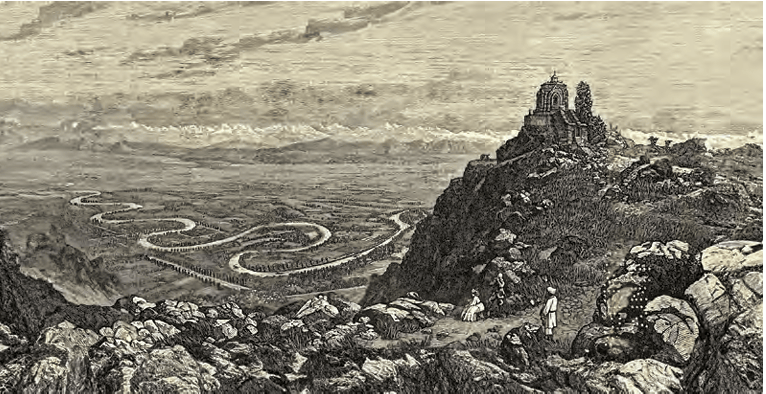
-> Śhankarāchārya taught that brahman is the ultimate reality or the pure consciousness, and that the world as we perceive it is māyā or illusion. He established four maṭhas (monasteries and centres of learning) at Badrinath, Puri, Dwarka, and Sringeri. Mark the location of these cities on a map; why do you think he chose four different corners of India rather than more central locations?
Despite Kashmir’s mountainous geography, throughout history
the kingdom remained well connected to the political and
cultural developments elsewhere in India. During the
period we consider here, Kashmir was a major centre
for Sanskrit learning, philosophy, and the arts. A school
of thought called Kashmir Śhaivism produced several
great scholars, such as Abhinavagupta,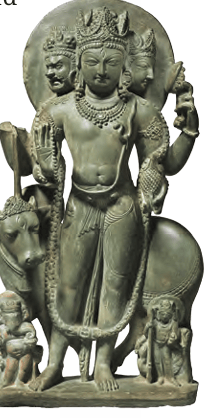
whose works on philosophy, poetry, arts and aesthetics had a vast influence across India. Kashmir also served as a crucial bridge for Buddhist scholarship, with scholars, monks and texts traveling between Kashmir and other parts of northern India, Tibet and Central Asia. Kashmiri artisans, sculptors, and manuscript painters were in demand across north India and beyond. In short, the region’s intellectual and artistic exchanges linked it closely with the cultural life of the entire subcontinent.
The Deccan and Beyond
We mentioned the Deccan Plateau in a few other chapters. Together with the southernmost tip of the subcontinent, it was equally alive during this time, and we have already surveyed the Rāṣhṭrakūṭas. Do you remember Queen Prabhāvatī Gupta of the Vākāṭakas (Chapter 7 of Part 1 of this textbook)? Once that dynasty came to an end, several mighty kingdoms were locked in a contest for supremacy (Fig. 3.16).
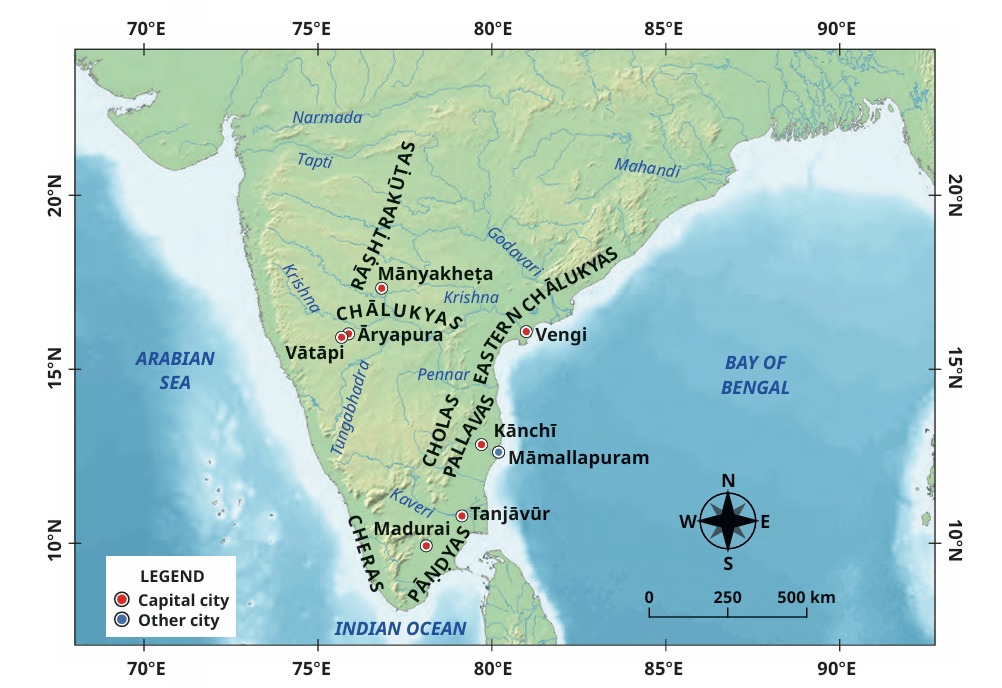
The Chālukyas
In the mid-6th century CE, Pulakeśhin I founded the Chālukya dynasty. Earlier in this chapter, we met his grandson, Pulakeśhin II, who not only stood in the way of Harṣha’s southward ambitions, but also considerably expanded the Chālukya kingdom. His capital was Vātāpi — present-day Badami in Karnataka, famous for its complex of magnificent Hindu and Jain cave temples.
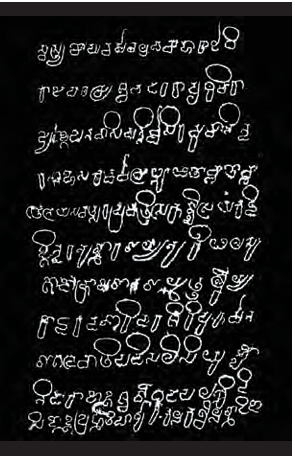
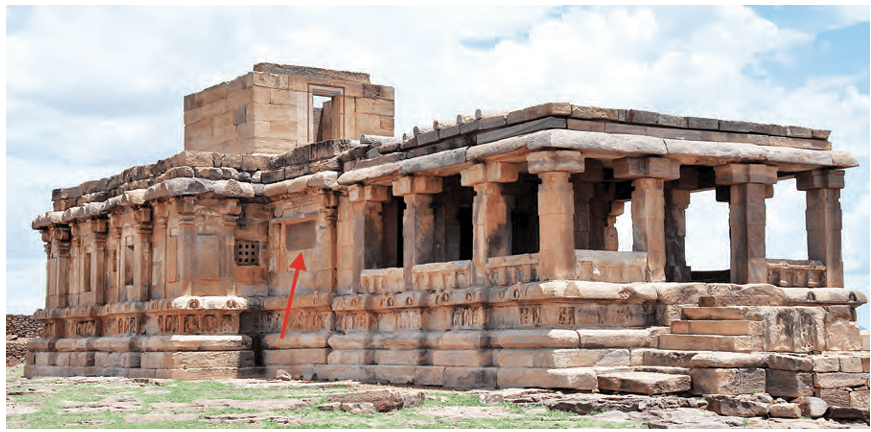
A little further away, the earlier Chālukya capital, Āryapura (later known as ‘Ayyavole’, present-day Aihole), is home to over a hundred Hindu, Buddhist and Jain temples. One of them, a 7th-century Jain temple atop Meguti Hill, displays on its east wall a lengthy Sanskrit inscription in praise of the Chālukyas, especially King Pulakeśhin II (Fig. 3.17). Its author, the court poet Ravikīrti, records Pulakeśhin II’s victories over Harṣha and several rival kingdoms in a highly poetical style. But this inscription is not free from exaggerations, as some of the ‘facts’ it presents are contradicted by other inscriptions! Let us note, however, that Xuanzang visited the Chālukya kingdom on his way to the South, and mentioned that Pulakeśhin II’s “beneficent actions are felt over a great distance and his subjects obey him with perfect submission.”
Still, there is no doubt that in the early 7th century the most of India was dominated by two great imperial powers — Harṣhavardhana north of the Vindhyas and Pulakeśhin II south of them. However, Pulakeśhin II eventually tasted defeat at the hands of the Pallavas of Kānchī. By the mid-8th century, the Rāṣhṭrakūṭas had replaced the Chālukyas in the Deccan, as we saw earlier. A later revival of the dynasty in the west, from the 10th century onward, is known as the Western Chālukyas of Kalyāṇī, their new capital (modern Basavakalyan in northern Karnataka). We will meet them again in the next chapter.
As the Chālukya empire of Badami declined, its eastern branch asserted independence and expanded its power in the eastern Deccan. They are known as the Eastern Chālukyas and ruled from Vengi in present-day Andhra Pradesh (see Fig. 4.10 in the next chapter). They often clashed with the Rāṣhṭrakūṭas, experiencing both victories and defeats, as well as occasional alliances. The Eastern Chālukyas promoted several Hindu and Jain sects, as well as Buddhist centres; Telugu and Kannada literature flourished under their rule.
The Pallavas
In the Grade 7 Part 1 textbook, we saw the emergence of the Pallavas. With its capital at Kānchī (or Kānchipura, present-day Kanchipuram in Tamil Nadu, Fig. 3.16), the dynasty reached its peak in the 7th century under Mahendravarman I and his son Narasimhavarman I. The latter was also known as ‘Mamalla’, which means ‘wrestler’ or ‘warrior’; indeed, it was he who defeated Pulakeśhin II and went on to capture Badami. However, he retreated, keeping the Tungabhadra River as an unwritten boundary between the two powers. He also sent a naval expedition to Sri Lanka to help a Sinhalese prince recover his lost throne
Kanchipuram was not only an important cultural centre but also an economic hub, with trade in goods such as spices, textiles (including silk), ivory and other luxury goods. The Pallavas developed trade relations not only with Sri Lanka but also with much of Southeast Asia via several seaports, in particular Māmallapuram (also known as Mahabalipuram, see Fig. 3.16), where ancient Chinese, Persian, and Roman coins were found during excavations.
We meet Xuanzang again in Kānchī, who speaks of the existence of 100 Buddhist monasteries with 10,000 priests (figures likely exaggerated) and also mentions 80 Hindu temples and the presence of many Jains. In his opinion, “the people are deeply attached to the principles of honesty and truth, and highly esteem learning.”
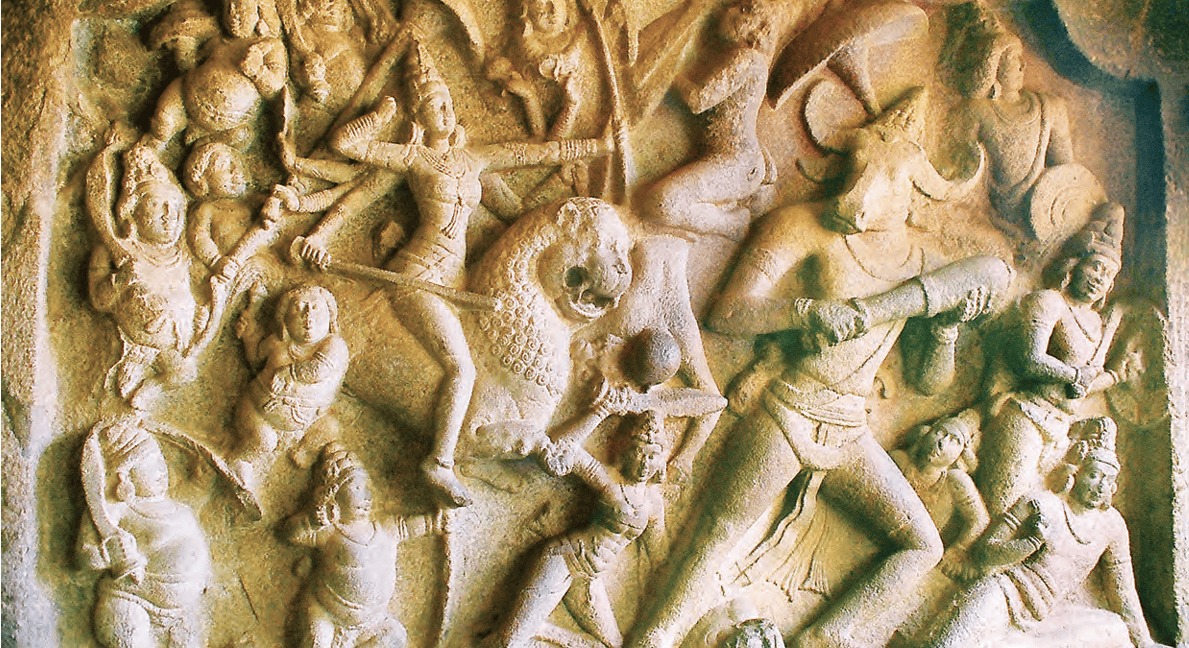
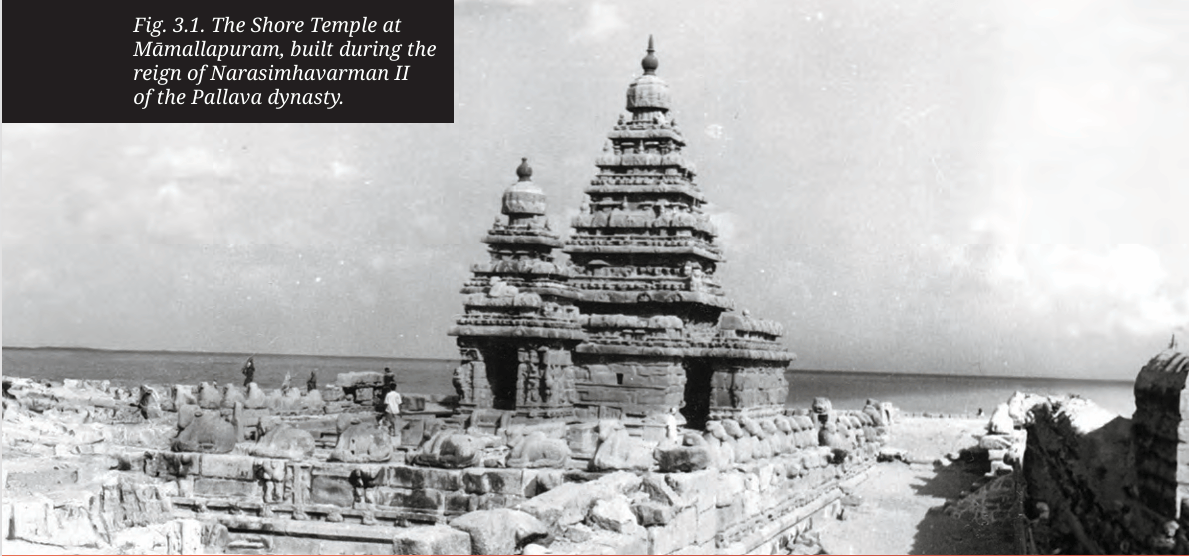
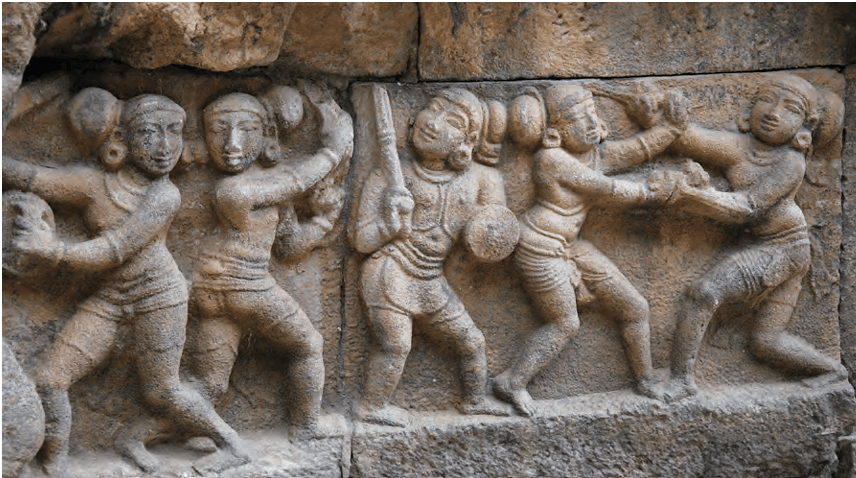
The Pallavas created many temples and other structures (Fig. 3.1). At Māmallapuram, elaborate rock-cut caves and monolithic temples were carved in a distinctive style, depicting deities (Fig. 3.18) or illustrating scenes associated with the Mahābhārata. The Pallavas were patrons of Jain, Vaishnavite and Shaivite schools of thought. They promoted both Sanskrit and Tamil literature and hosted great poets such as Daṇḍin, who wrote elaborate Sanskrit poetry; Mahendravarman I himself was a fine poet who left a satirical Sanskrit play.
LET'S EXPLORE
Note this panel’s (Fig. 3.18) highly dynamic three-dimensional composition, expressing Durga’s confident assault on the demon.
-> Can you identify some of Durga’s many weapons? And her vāhana?
-> What are the main differences between her attendants and the demon’s attendants?
-> What does the demon’s slanted posture and general attitude indicate?
The Pallavas ruled over much of northern Tamil Nadu and southern Andhra Pradesh until the late 9th century, when they were finally overthrown by the Chola king Aditya I.
Further South
Nearly a millennium before our period, the Pāṇḍya, Chola and Chera kingdoms were mentioned in an edict of Aśhoka as his southern neighbours; they also figured in the Sangam literature (the earliest collections of Tamil poetry), and we first mentioned them in Part 1 of this textbook (see ‘The Age of Reorganisation’, in particular Fig. 6.14). Then they seemed to disappear, eclipsed by other powers. Now they reemerge (Fig. 3.16), shaping the South’s political and cultural life — and often at war with each other.
The Pāṇḍyas rose to power by the 6th century. Allied with the Chālukyas and the Pallavas, they controlled much of southern Tamil Nadu and, for brief periods, northern parts of Sri Lanka. Their coins and inscriptions attest to maritime trade with Southeast Asia via ports such as Korkai. Their capital was Madurai, a vibrant cultural centre. They built many temples, created rock-cut temples, and patronised poets; a copper plate mentions their translation of the Mahābhārata into Tamil (which unfortunately has not survived). In the 10th century, the mighty Cholas swept them aside, but they would re-emerge some three centuries later.
Meanwhile, along the Kerala coast, the Cheras, also known as Chera Perumals, maintained their independence despite their neighbours’ military power.
Then came the Cholas, reborn under Vijayālaya in the 9th century. From his new capital at Tanjāvūr (now spelt ‘Thanjavur’), he laid the foundation for a strong and prosperous kingdom. His son Aditya I expanded it by defeat-ing the Pallavas, bringing most parts of present-day Tamil Nadu and parts of southern Andhra Pradesh under Chola control.
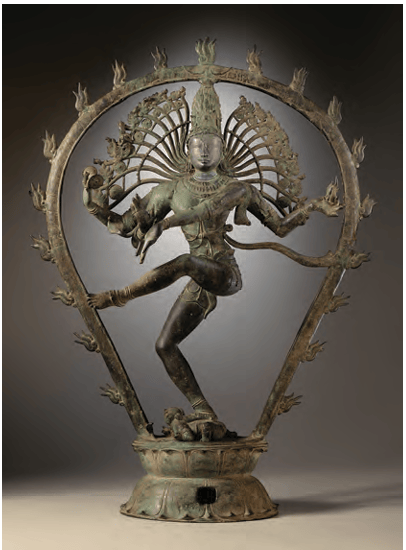
The Cholas ended up building one of the largest empires in south Indian history, known for its elaborate and efficient administration, its powerful navy, and grand temples. They patronised arts such as sculpture (Fig. 3.19 and 3.20) and architecture, and promoted Tamil as well as Sanskrit literatures; their inscriptions make use of both languages. The fertile Kāveri delta along with efficient irrigation techniques ensured a steady agricultural output and contributed to the prosperity of the empire’s heartland. As Chola dominance in south India lasted until the 13th century, we will meet them again in the next chapter.
DON'T MISS OUT
During this period, inscriptions began using both Sanskrit and regional languages simultaneously. In land grants, the ruler and his dynastic history were often praised in Sanskrit, while the operative details of the grant were recorded in the local language. Why do you think such inscriptions were written in two languages?
Other Developments
We have so far placed more emphasis on the rise and decline of the leading political powers of this period. What happened to the society in the meantime?
Polity and administration
As we saw several times, the fall of large, unified empires gave way to smaller, decentralised kingdoms. Kings like the Chālukyas and Rāṣhṭrakūṭas ruled their core regions directly, but governed other regions through subordinate rulers called sāmantas — the equivalent of tributaries or vassals. These sāmantas were indispensable, as they led armies and managed local administration. Yet, their loyalty could be fragile, especially when they felt that the empire’s central authority was weakening. Some, like the Rāṣhṭrakūṭas, once sāmantas under the Chālukyas, eventually grew powerful enough to overthrow their overlords.
Directly controlled territories were divided into provinces (bhuktis or rāṣhṭras), districts (maṇḍalas) and villages, with specific officials at every level. Villages, the lowest administrative units, were overseen by headmen, accountants, and local committees, and remained largely self-governed.
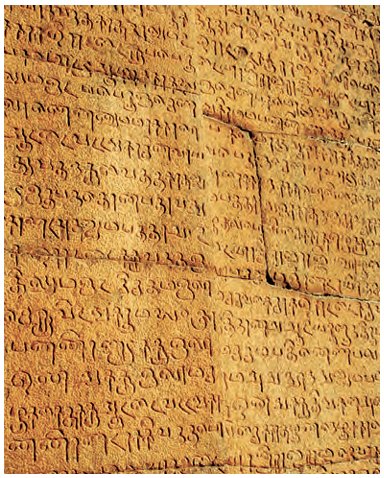
By the 9th century, south India saw the rise of assemblies at several levels. Let us recall, for example, the elaborate 10th-century inscriptions of the Cholas at Uttaramerur (or Uthiramerur) detailing the selection process of members to the village sabhā (see Part 1 of this textbook, Chapter ‘From the Rulers to the Ruled’). This showed the long continuity of democratic traditions in India, dating back 1,500 years to the janapadas.
Trade, economy and urbanisation
During this period, the land grant system that had begun under the Guptas expanded greatly. Kings, chiefs, royal family members, and vassals gave land to individuals, communities, and religious establishments, creating a new class of landholders. Many of these holders did not till the land themselves, suggesting that powerful intermediaries often exploited peasants, as several texts and inscriptions allude to.
Many grants aimed to bring uncultivated land under cultivation, expanding agriculture and crop diversity. Classical texts on agricultural techniques (see ‘The Story of Indian Farming’ in this textbook) reflect this era’s emphasis on farming. Many small-scale and some large state-supported irrigation works were undertaken. The Pallavas, for example, built numerous tanks in Tamil Nadu, many of which are still functional today. Many inscriptions record the sponsorship of a well, a pond, or a tank, thereby elevating the donor’s social status. With better irrigation and agricultural growth, cash crops thrived, supporting agro-based crafts and industries.
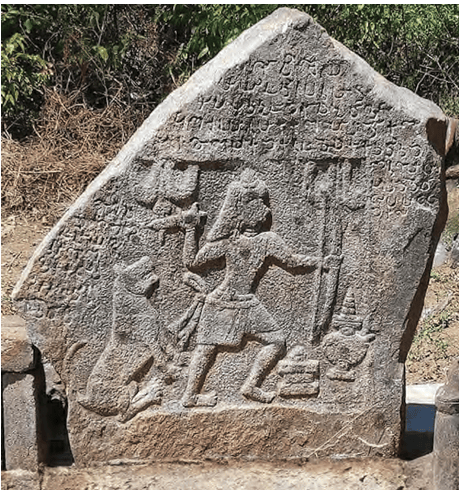
Alongside agriculture, trade and markets flourished in regional trade centres. Small traders handled local trade, while ship-owning merchants conducted long-distance commerce. From the 8th century onward, India’s west coast saw brisk shipping with ports in present-day Iran, Iraq, and Africa’s east coast, while India’s east coast connected with Sri Lanka, Southeast Asia and all the way to Chinese ports (see Fig. 2.2 earlier in this textbook). A similar activity prevailed on the east coast under the Cheras; a set of copper-plate inscriptions significantly refers to the presence of Christian, Muslim and Jewish traders from West Asia, showing again how India was a hub of international trade.
Overall, Indian society remained largely rural and agrarian during this period. Although some historians have suggested urban decline during this period, the evidence paints a different and more complex picture. In north India, most older cities remained occupied, while new ones emerged; Xuanzang noted the decline of Kauśhāmbī and Śhrāvastī, but described thriving cities like Sthāneśhvara, Kānyakubja, and Kāśhī. In south India, cities continued to flourish as political, economic, and religious hubs, with temples acting as centres of commerce and ports fuelling maritime trade.
LET'S REMEMBER
We briefly saw the rise of local merchant guilds, or associations (see ‘The Rise of Empires’ in Part 1 of this textbook). They continued to play a significant role, comprising traders, artisans, and moneylenders, and supporting religious and charitable activities. Inscriptions detail their structure and functions. In south India, two major merchant guilds operated prominently: one was active in coastal and inland trade, while the other became the largest inter-regional merchant association.
Social life
During this period, Indian society grew more complex and hence cannot be reduced to a simple description. The traditional jātis (see ‘New Beginnings: Cities and States’ in Part 1 of this textbook) multiplied, with many new ones based on occupation or region. This created communities in which most people married within their group. Some local tribes, border populations, foreign migrants, and occupational or religious groups were absorbed into the varṇa-jāti system, while some communities (such as foreign traders) remained as outsiders.
Much of the data on the jātis comes from texts, and some from inscriptions, but overall there are many gaps and unanswered questions. Moreover, the system varied widely across regions, showing that varṇa and jāti were flexible rather than rigid. For instance, several sources indicate that the Pālas and the Kākatīyas (whom we will meet in the next chapter), among other rulers, were originally Śhūdras (the varṇa of labourers, craftspeople, etc.), but in the course of time, they would have been regarded as Kṣhatriyas (the varṇa of rulers and warriors).
At the same time, terms like aspṛiśhya (literally, ‘not to be touched’) appeared in a few texts, pointing to discrimination against some communities regarded as ‘impure’. This is confirmed by other sources, such as Xuanzang, who noted, “Butchers, fishers, dancers, executioners, and scavengers, and so on, have their abodes without the city. ... Their houses are surrounded by low walls, and form the suburbs.”
Despite such divisions, different varṇas and jātis often functioned cooperatively, as they depended on each other’s work and function, at least at the economic level. We will also see below the so-called ‘Bhakti Movement’, which cut across all strata of the society; several bhakti saints, for instance, were Śhūdras.
THINK ABOUT IT
How does a professional group transform into a jāti? Such a process was complex and could vary from region to region. Let us look at one example.
The Kāyasthas, historically known as scribes or clerks, were initially a professional group open to different varṇas. In the 10th century, they became a distinct jāti. In parts of Bengal, certain Brāhmaṇa surnames such as Vasu, Ghosha, Datta, and Dama, later came to be associated with Kāyasthas, indicating a fusion of Brāhmaṇa and non-Brāhmaṇa families. Over time, they married mainly within their group, forming the Kāyastha jāti.
As regards the position of women, it would also vary widely from one region to another and from one social layer to another. It is however interesting to note that in his Harṣhacharita, Bāṇabhaṭṭa showed women participating in many economic and social activities, working in agriculture and crafts, and, in courts, serving as entertainers, musicians, storytellers, and attendants. Many inscriptions record women making offerings to temples or getting water structures constructed.
DON'T MISS OUT
During this period, several queens ascended to the throne. While most dynasties favoured male heirs (yuvarājas), some, like the Bhauma-Karas in present-day Odisha, saw multiple female rulers, the most notable being Tribhuvana Mahadevi I in the 9th century. She strengthened the dynasty, suppressed rebellions, demonstrated strong administrative skills, patronised Hindu and Buddhist institutions and temples, and issued land grants under the title ‘Paramabhaṭṭārikā Mahārājādhirāja Tribhuvana Mahādevī’, which means ‘supreme sovereign empress, great queen of the three worlds’.
Cultural life
By now, we have seen several rulers patronising different schools of thought — Hindu, Buddhist or Jain — regardless of their own inclinations. Those religious traditions interacted in complex ways, sharing central concepts (such as dharma and karma), sacred spaces, artistic motifs and sometimes deities. They coexisted peacefully most of the time, despite occasional rivalries, as between Shaivites and Jainas in south India.
Around the 6th century, Tantric schools of thought emerged, emphasising rituals, meditation, mantras, and the worship of powerful deities, especially Shakti. Buddhism, partly influenced by Tantricism, thrived in eastern India, especially under the Pālas, thanks to its monastic universities that drew scholars from across Asia. But elsewhere, during this period, it declined as temple-based Hinduism and bhakti practices rose.
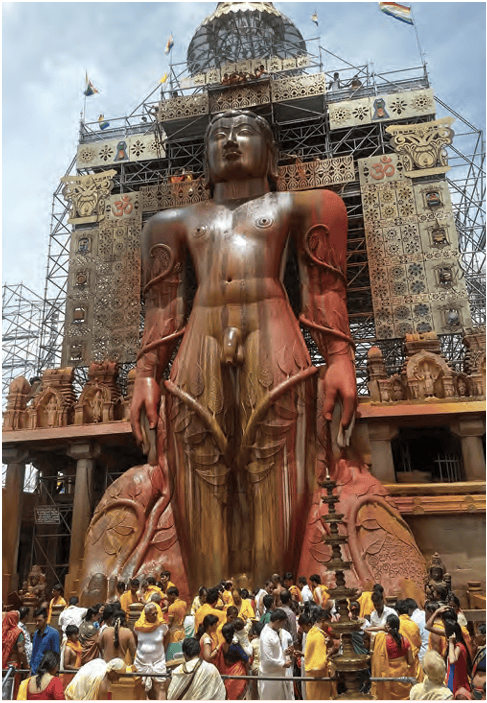
Supported by rulers and wealthy merchant communities, Jainism remained popular in western India and Karnataka. Monumental works from this period include the monolithic Bāhubalī at Shravanabelagola in Karnataka (Fig. 3.23) and the Jain cave temples at Ellora or Badami.
The Purāṇas, with their elaborate mythology and sacred geography (see ‘How the Land Becomes Sacred’ in Part 1 of this textbook), helped integrate local deities and regional myths into the broader pan-Indian cults, especially those of Śhiva, Viṣhṇu, Kṛiṣhṇa and various devīs. These traditions emphasised bhakti (personal devotion) over Vedic sacrifices and centred around temples, maṭhas, and pilgrimage sites.
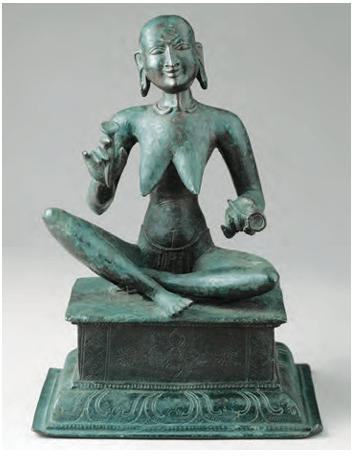
From the 6th century onward, these traditions crystallised into what has been called the ‘Bhakti Movement’. Bhakti, as devotion addressed to a deity, did exist much earlier, but what took place now, rather than an organised movement, was a massive spread among all layers of society and across India. The initial spark came from the South, where two groups of devotees and poets produced devotional literature (in Tamil) which had an enormous impact: the 12 Ālvārs, devotees of Viṣhṇu (one of them, Āṇḍāḷ, was a woman); and the 63 Nāyanārs or Nāyanmārs, devotees of Śhiva (including three women, Fig. 3.24).
More bhakti saints followed in several other parts of India. They emerged from diverse social backgrounds and their poetry, composed mostly in regional languages, invoked a direct personal relationship with the divine that was open to everyone — cutting across gender and social divisions and reshaping Indian society and literature. Its impact is lingering to this day.
A galaxy of mathematicians and astronomers
The period we deal with in this chapter saw brilliant advances in science and technology. Let us look at mathematics and astronomy here, which contributed to India’s renown in the ancient world.

Born in 598 CE in Bhillamāla (the first capital of the Gurjara-Pratīhāras, remember), Brahmagupta was an imposing figure, with remarkable achievements in mathematics and astronomy. In his major work, Brahmasphutasiddhānta, he introduced the rules of arithmetic operations with zero, negative numbers and fractions — the same that you now learn at school. He also pioneered new techniques for solving certain equations, establishing him as one of the founders of modern algebra. His works were translated into Persian and later Latin, contributing to the growth of mathematics in the Arab world and, later, Europe.
Other brilliant mathematicians and astronomers of this period included Bhāskara I, who did pioneering work in trigonometry and wrote a lengthy commentary on the Āryabhaṭīya and Virahānka, the first to establish the Virahānka-Fibonacci sequence (which you learned about in your Grade 7 Mathematics textbook). Mahāvīra, a Jain scholar (not to be confused with Mahāvīra, the great Jain teacher who lived over a millennium earlier), lived at the court of the Rāṣhṭrakūṭa king Amoghavarṣha Nṛipatunga and authored the first work of mathematics independent of astronomy. Except for him, many mathematicians of this period refined astronomical calculation techniques, particularly to predict the positions of the planets in the sky at any given time.
Many more scholars of those times could be mentioned. Together with their predecessors (see for instance Āryabhaṭa and Varāmihira in ‘The Gupta Era’ in Part 1 of this textbook) and their successors (see Bhāskarāchārya in the next chapter here), this constitutes an unrivalled knowledge tradition across centuries, motivated not only by a pure search for knowledge, but also by pragmatic objectives such as the preparation of reliable calendars or precise predictions of solar and lunar eclipses. As with art and literature, such a long tradition would not have been possible without royal patronage.
Foreign Invasions
For centuries, Indian rulers kept a close watch on the strategic northwestern frontier, yet the subcontinent faced many foreign invasions throughout its long history. In Part 1 of this textbook, we read about invasions by the Greeks, the Śhakas, and the Kuṣhāṇas. Let us now hear about the coming of the Hūṇas and of the Arabs.
The Hūṇas’ challenge
We need to go back a little in time. The Huns were a nomadic people originating from Central Asia in the 4th century. With their horse-riding and archery skills and lightning-fast attacks, they were fierce conquerors and overcame much of Europe, until, a century later, their empire disintegrated. The Hūṇas mentioned in Indian literature are thought to have been a branch of the Huns. They played a part in weakening the mighty Gupta Empire, as we saw in Part 1 of this textbook, but could not affect India much at that time.
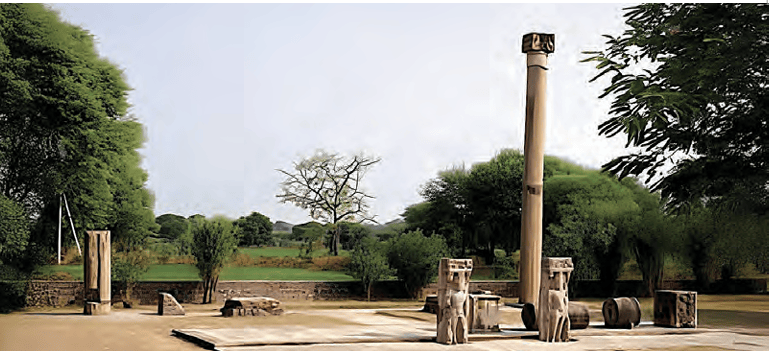
In the early 6th century, two Hūṇa leaders in succession pushed deep into the Ganga plains despite stiff resistance from several kings, until they were defeated by kings of the Aulikara dynasty whose capital was Daśhapura — modern-day Mandsaur in Madhya Pradesh (Fig. 3.25). These successive defeats effectively ended Hūṇa power in India.
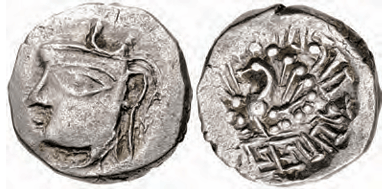
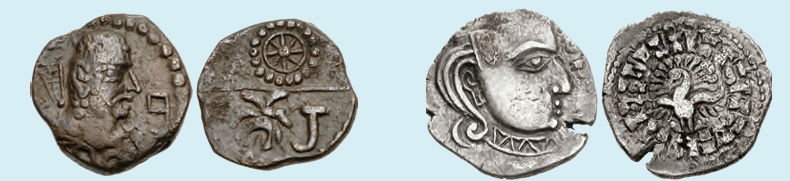
By the 7th century, the Hūṇas had assimilated into the very fabric of Indian society; many served as soldiers, others took up roles in local administrations. One inscription, for instance, records a Hūṇa serving on a temple’s administration council (goṣhṭhika)! They adopted Sanskrit and Prakrit for their inscriptions and used Gupta-style royal titles, coin designs, and religious symbols. Some of their coins, for instance, displayed the goddess Lakṣhmī and attributes of Viṣhṇu or Śhiva.
LET'S EXPLORE
What details do you observe in these coins (Fig. 3.26)? Why do the coins of Toramāṇa and Skandagupta appear so similar? What conclusions can you draw?
The Arabs arrive on India’s shores
Within a few years of the death of Islam’s founder, Muhammad, in 632 CE, the new religion had spread far into Asia and Africa. In 637, India’s western coast witnessed naval raids by Muslim Arabs on Thānā (present-day Thane), Bhārukachchha (present-day Bharuch) and Debal (a port city in the delta of the Indus), though without securing lasting territorial control. The first attempts to conquer Afghan kingdoms were also unsuccessful, as they met with fierce resistance.
However, things changed when the governor of Iraq sent an army under the command of his nephew and son-in-law, Muhammad bin Qasim. These forces swept into Sindh. Debal fell first, where, according to the 9th-century historian Al-Balādhurī, bin Qasim “kept up the slaughter of the inhabitants for three days” and had a “great temple … housing idols destroyed”. From there, bin Qasim moved eastward towards Aror (also Alor, present-day Rohri in Sindh), the capital of King Dāhar. According to the Chachnāma (a 13th-century Persian rendering of an older Arabic account), bin Qasim declared to Dāhar, “I consider it my bounden duty to carry on this religious war, in obedience to the orders of God who says in the Koran: ‘Wage war against the infidels’…” In a fierce battle, Dāhar, riding atop an elephant, was killed by an arrow, following which his army was routed.
LET'S EXPLORE
The Chachnāma records that when King Dāhar was killed, his widowed queen put up a brave resistance, and when the situation became hopeless, she immolated herself along with other ladies. Another queen ordered her treasure to be distributed among the brave soldiers and inspired them to stand against the invaders.
->What does this suggest about the way the indigenous people responded to invasions?
-> Why do you think the queen chose to give away her treasure?
-> What does this reveal about the role of women in warfare?
Within two years of Qasim’s death, Indian chiefs rebelled and regained most of the conquered territory. The Arabs did not give up easily and soon pushed into Rājputāna and the central region of Mālwā, but their gains were short-lived. An inscription at Gwalior records how the Gurjara-Pratīhāra king Nāgabhaṭa I, whom we met earlier, “crushed the large army of the powerful Mlechchha king.”
THINK ABOUT IT
Sulaiman, a 9th-century Arab merchant and traveller, makes this comment on a Gurjara-Pratīhāra ruler: “This king maintains numerous forces, and no other Indian prince has so fine a cavalry. He is unfriendly to the Arabs … there is no greater foe of the Muhammadan faith than he. ... He has riches, and his camels and horses are numerous. … There is no country in India safer from robbers.” Why do you think the author calls the ruler a ‘foe to the Muslim faith’?
The Arabs continued to be frustrated in their advances by the stubborn resistance of Indian rulers, who sometimes forged alliances to defeat them. Kashmir’s King Lalitāditya Muktāpīda, whom we met earlier, defeated an Arab chief three times, according to the Rājatarangiṇī. The geographer al-Istakhri observed that after three centuries of unremitting effort, the Arab dominion in India was limited to just two petty states in Sindh and Punjab. Even there, they survived only by giving up iconoclasm and using native Hindus and Buddhists (collectively called ‘Budds’) for political purposes.
Overall, the Arab conquest of Sindh had a limited political and religious impact compared to their conquests in other regions where Islam often replaced local institutions and led to mass conversions. In Sindh, whether for strategic reasons or by compulsion, the Arabs changed their policy: Hindus and Buddhists were allowed to rebuild temples, continue their worship, and temple priests were allowed to keep their share of revenue.
It is worth noting that long before the rise of Islam, India and Arabia were well connected through trade, with ships sailing back and forth with the monsoon winds — indeed, the word ‘monsoon’ is borrowed from the Arabic mawsim for ‘season’. Ships carried not only spices and textiles but also ideas, languages, and stories across the Arabian Sea.
THINK ABOUT IT
The table lists common everyday words, highlighting their similar pronunciation across the three languages. By comparing these sounds, you can identify words that are closely related or share common roots in all three languages. With the help of your teacher, use this observation to complete the table.
| Sanskrit | Arabic | English |
|---|---|---|
| sandal | sandalwood | |
| tāmbūla | tanbūl | |
| karpūra | camphor | |
| pippalī | filfil |
DON'T MISS OUT
The most significant cultural interactions are perhaps in the f ield of science, since, especially in the 9th century, Sanskrit texts of mathematics, astronomy and medicine were translated into Arabic, notably in Baghdad. Among many other things, the Arabs adopted India’s decimal numeral system with the zero, along with the Indian numerals. Their mathematicians acknowledged the Indian origin of this revolutionary numeral system, but once transmitted to Europe by the Arabs, these numerals became known as ‘Arabic numerals’. Nowadays, several dictionaries add the term ‘Hindu-Arabic numerals’. You will come across this important example of cultural transmission in your mathematics textbooks.
Taking Stock
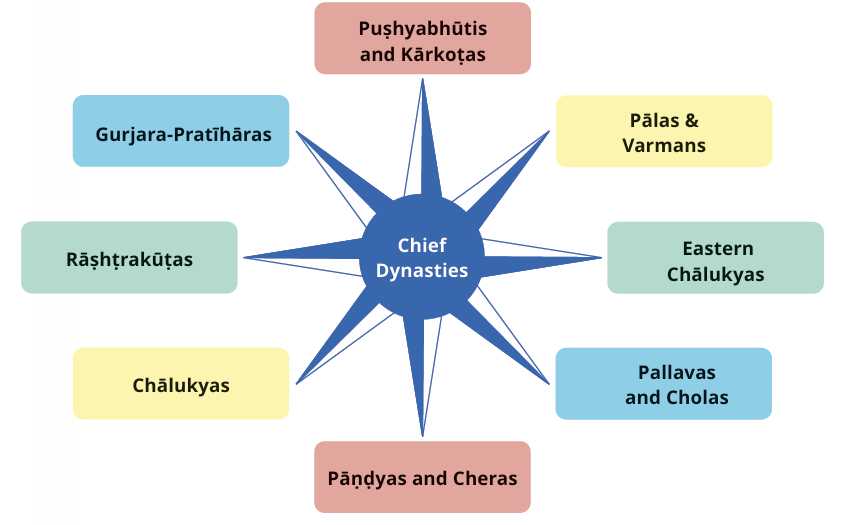
As we stated at the start, this chapter offers only a brief survey of the main figures and developments in this turbulent period. Numerous dynasties rose and fell, battling one another, but sometimes also in alliance with one another. A few of the more powerful kingdoms rose to the status of empires, but rarely managed to cover a large part of India or to last more than a couple of centuries.
THINK ABOUT IT
We have met some 12 dynasties in this chapter. During the same period, many more existed in India: the Bhanjas, Chāpas (or Chāvaḍās), Guhilas, Kalachuris, Kadambas, Maitrakas, Maukharis, Saindhavas, Śhilāhāras, Somavaṃśhīs, Tomaras, Utpalas, Paramāras, Chāhamānas, Gangas, most of them with several branches. You need not remember them (except that we will meet the last three in the next chapter). The list is merely to give a sense of the depth and richness of our country’s history.
At the same time, this was a period of transformation and regional consolidation. Far from being a historical void, it witnessed the dynamic integration of new social and political groups, the flourishing of literature in Sanskrit and regional languages, and major advances in temple architecture and sculpture. New philosophical schools of thought and new religious practices spread, redefining and enriching the subcontinent’s cultural and spiritual landscape, though on the same ancient foundations. Lastly, India showed resilience in the face of foreign invasions and a capacity for political renewal.
Before we move on …
-> The decline of the Gupta empire led to the rise of powerful regional kingdoms. No single power could maintain lasting supremacy, as rival states had comparable military strength, administrative systems, and strategic approaches.
-> Foreign invaders who came to India often assimilated and owned her cultural traditions. However, with the advent of Islam, the situation changed. While Arab armies achieved military successes elsewhere, they struggled for a long time before making their first significant breach into the subcontinent.
-> Regardless of their own inclination, rulers generally patronised Hinduism, Buddhism, and Jainism, promoting a vibrant cultural pluralism. The period saw the rise of the Bhakti tradition, which soon spread across India.
-> This period saw remarkable achievements in language, literature, art, sciences and technologies.
-> The multiplication of jātis made the society more complex, but the varṇa-jāti system remained flexible.
-> Trade during this period connected local economies with distant markets, both in India and abroad, spurring urban growth, fostering cultural exchange, and integrating India into broader trade networks.
Questions and activities
- If you lived in Kannauj during the struggle between the Pālas, the Pratīhāras and the Rāṣhṭrakūṭas, how would it change your daily life and your estimate of the rulers? Write a letter on this to your friend living in Kanchipuram.
- Emperors and kings during this period controlled only core regions and governed other regions through subordinate vassals. What would be the advantages and the challenges of such a system?
- In what ways were the invasions of the Hūṇas and the Arabs different in their aims, methods, and impact on the Indian subcontinent? Prepare a write-up, discuss and present it in the class.
- Imagine you are a common citizen watching the Prayāga assembly. How would you react to Harṣha giving away most of his wealth?
- Forming groups, let each group choose one Ālvār and one Nāyanār and prepare a biography poster or booklet. Include their life stories and a sample poem or two (in translation).
- You will notice that our maps show only ancient names for the kingdoms’ capitals and main cities. Using a pencil, mark the modern names next to their original names. Refer the current map of India and try to locate those cities on it.
- Match the ruler or the dynasty with the city.
(a) Rāṣhṭrakūṭas (i)Kānchī
(b) Gurjara-Pratīhāras (ii) Tanjāvūr
(c) Cholas (iii) Mānyakheṭa
(d) Harṣhavardhana (iv) Ujjayinī
(e) Pallavas (v) Kānyakubja