
4Turning Tides:
11th and 12th Centuries
"It is the same India which has withstood the shocks of
centuries, of hundreds of foreign invasions, of hundreds
of upheavals of manners and customs. It is the same land
which stands firmer than any rock in the world, with its
undying vigour, indestructible life. Its life is of the same
nature as the soul, without beginning and without end,
immortal; and we are the children of such a country." — Swami Vivekananda
The Big Questions?
- Why are the 11th and 12th centuries seen as a period of transition in Indian history?
- Which new powers emerged during this period? What were the essential features of their economic, military and administrative systems?
- What high accomplishments in art, architecture, literature, science, etc., do we come across during this period?
In the previous chapter, we saw the Arabs’ repeated attempts to invade and dominate north India and how, in the end, those incursions had little overall impact on India. The 11th and 12th centuries tell a different story: invasions by Turkic powers penetrated much deeper into north India, despite stubborn resistance from native kingdoms.
We begin the chapter with an invasion and end the chapter with another, with a very brief account of the wars and destruction that came in their wake. However, many Indian rulers also flourished in this time period, successfully battling the invaders at times (when they were not battling each other), conducting naval expeditions, creating astonishing monuments or projecting India’s influence abroad. Many poets, philosophers, saints and scientists belong to this period and their works continue to illuminate us even today.
In this chapter we will only explore a few of these important events, figures and accomplishments.
THINK ABOUT IT
A word of caution: In Grade 8 you will read a ‘Note on History’s Darker Periods’. Briefly, it explains how history has recorded war, conquest and destruction more than peace, good governance or creativity, and how, the world over, historians have sometimes hesitated to draw attention to such darker periods. Our approach is that it is better to face them and analyse them so as to understand what made such developments possible and, hopefully, help avoid their recurrence in future. In addition, we should not forget that while past events cannot be erased or denied, it would be wrong to hold anyone responsible for them today.
The Ghaznavid Invasions
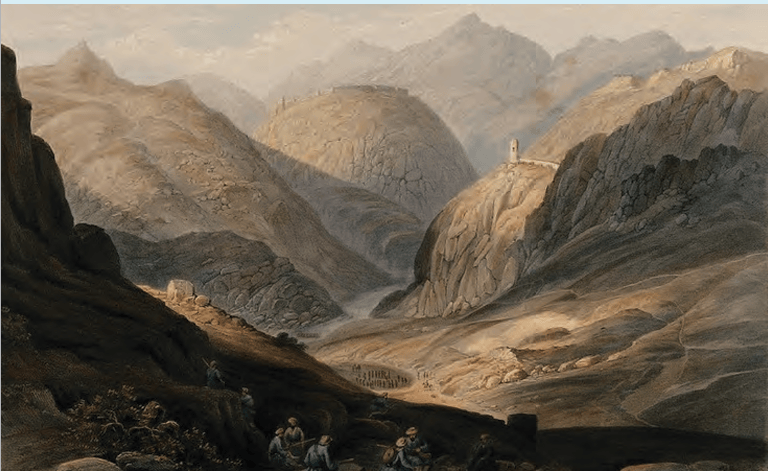
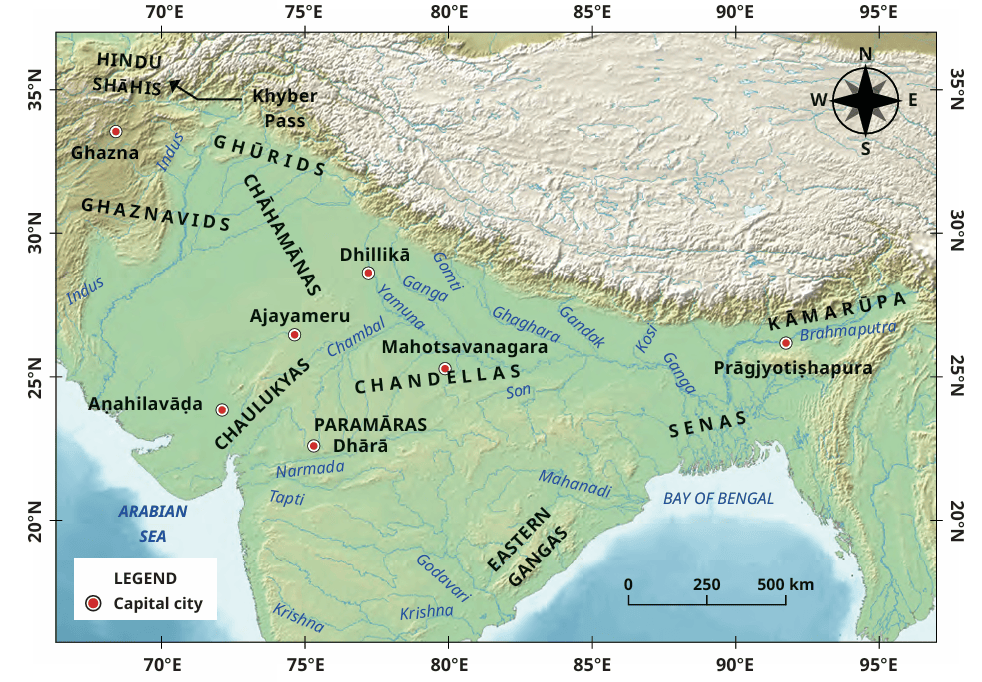
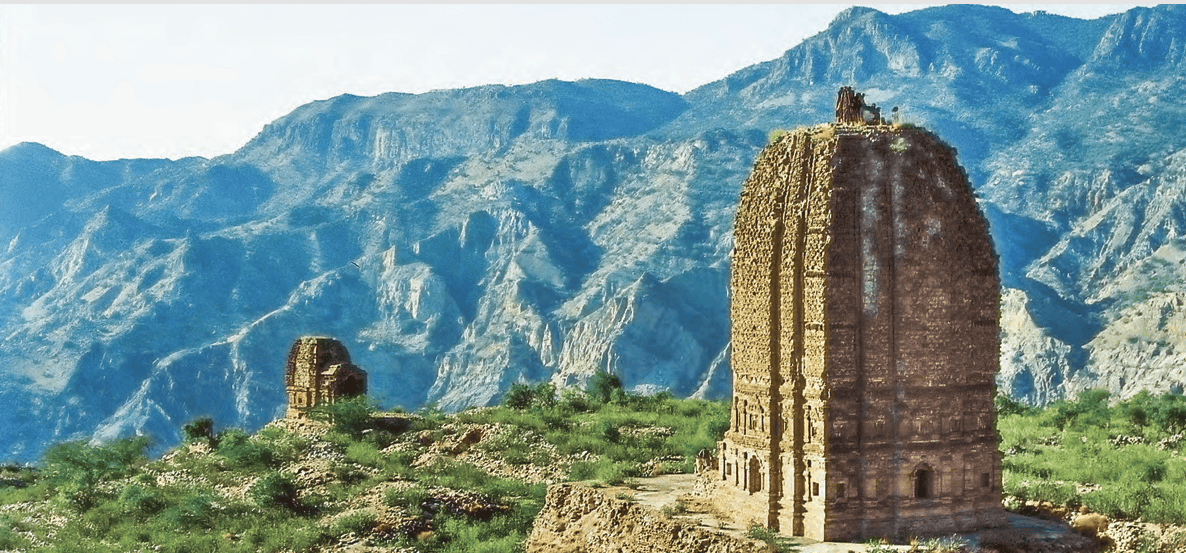
In the 9th and 10th centuries, several kingdoms confronted each other in present-day Afghanistan and northern Pakistan. Across those two regions and all the way to Punjab, there ruled a powerful dynasty known as Hindu Shāhis. With the help of several other Indian rulers, they resisted several attempted invasions. This resistance made a difference, since they controlled the Khyber Pass, one of the main mountain passes through the Hindu Kush range (see Fig. 4.3 and 4.4). In the course of India’s history, many invaders used this pass to enter the Subcontinent; for at least 2,500 years, it was also a major trade route, connecting the Subcontinent to Central Asia and beyond, and the route Buddhist scholars and monks travelled.
LET'S EXPLORE
Observe the sketch of the Khyber Pass (Fig. 4.3). What kind of terrain does it depict?
-> What advantages would it offer to an army trying to reach the Indus plains? But also, what dangers?
-> Thinking of the caravans of traders that passed through the Khyber Pass for many centuries, let’s ask the same questions about the advantages as well as dangers.
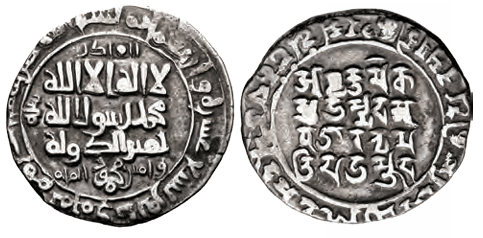
Ultimately, however, a Turkic power — the Ghaznavids — after defeating a rival Muslim kingdom, overran the Shāhis, ruled at the time by Jayapāla. As their name indicates, the Ghaznavids’ capital was Ghazna, today’s Ghazni in Afghanistan. In the first decade of the 11th century, their ruler Mahmūd (often referred to as ‘Mahmūd of Ghazni’) accomplished this final conquest, first defeating Jayapāla and, in 1008, overcoming Jayapāla’s son Ānandapāla after a long battle, despite the support Ānandapāla received from several rulers from north India. The outcome of that battle, waged in northern Punjab, meant that Mahmūd now had easy access to the Indus plains and beyond.
THINK ABOUT IT
We will meet later in this chapter the Persian scholar al-Bīrūnī, who accompanied Mahmūd in some of his campaigns. He wrote in his memoirs on India, “The Hindu Shāhiya dynasty is now extinct, and of the whole house there is no longer the slightest remnant in existence. We must say that, in all their grandeur, they never slackened in the ardent desire of doing that which is good and right, that they were men of noble sentiment and noble bearing.”
What conclusions can we draw from this remark by someone in Mahmūd’s entourage?
DON'T MISS OUT
Mahmūd assumed the title of ‘sultan’, a word of Arabic origin which means ‘authority’ or ‘power’; in the Muslim world, it came to refer to a sovereign ruler or king. In Grade 8, we will come across sultans who established their kingdoms or ‘sultanates’ in India, the dominant one being the Delhi Sultanate.
In all, Mahmūd conducted 17 campaigns in India; after each one, he would return to Ghazni with huge amounts of booty. Although he met with strong resistance (from the Chandellas of central India, among others) and was close to defeat on a few occasions, his large army’s rapid marches and daring cavalry attacks, with archers on horseback, were ultimately decisive.
When Mahmūd reached Mathura (in present-day western Uttar Pradesh) in 1018, he found it to be a city of enormous wealth, with a magnificent temple overlooking the city. Mahmūd’s court historian al-Utbi, who chronicled his campaigns, wrote that even “the pens of all writers and the pencils of all painters” would be unable to describe the temple’s “beauty and decoration”. Mahmūd destroyed it and plundered its treasure, then proceeded to Kannauj, where he took one of the last Pratihāra rulers by surprise, and looted and destroyed many temples. A few years later, another campaign took him to Gujarat and to Somnath (in present-day Saurashtra), which was then a bustling seaport. Despite strong resistance from the locals and severe losses to his army, after a few days of fighting Mahmūd gained the upper hand, destroyed the Somanātha Śhiva temple and looted its enormous treasures.
LET'S EXPLORE
In later centuries, the Somanātha temple was rebuilt and destroyed again several times; the existing temple was built in 1950 and inaugurated the next year by the then President of India, Rajendra Prasad. Why do you think it was decided to fund the construction entirely from public donations?
Mahmūd died in 1030 in Ghazni, at the age of 58. About this time, his nephew, Sālār Masūd, launched an attack on the Gangetic region. According to oral history and to a 17th-century Muslim chronicle, when he reached Bahraich (in modern-day Uttar Pradesh), the local ruler Suheldev (or Suhaldev) successfully resisted the attack and Sālār Masūd fell in the battle.
Mahmūd’s campaigns involved not only destruction and plunder, but also the slaughter of tens of thousands of Indian civilians and the capture of numerous prisoners, including children, who were taken to be sold on slave markets of Central Asia. His biographers depict him as a powerful but cruel and ruthless general, keen not only to slaughter or enslave ‘infidels’ (that is, Hindus or Buddhists or Jains), but also to kill believers from rival sects of Islam.
Al-Bīrūnī
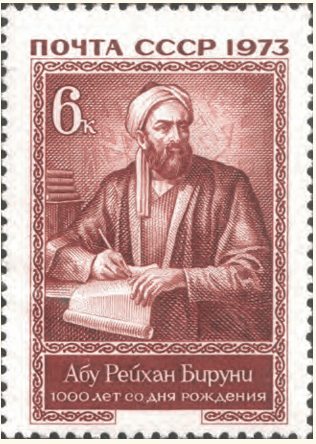
Abū Rayḥān al-Bīrūnī, a Persian scholar from Khwārizm (in present-day Uzbekistan), was a mathematician, astronomer, geographer, historian and linguist all rolled into one. He travelled widely and wrote prolifically, both in Arabic and Persian, on nearly every branch of knowledge known in his time.
Around 1017, al-Bīrūnī accompanied Mahmūd of Ghazni on his campaign into India. He learned Sanskrit, read Indian texts and conversed with Indian scholars. The result was an encyclopaedic survey of Indian religion, philosophy, literature, geography, and sciences, in which he discussed Indian intellectual achievements as best he could, often comparing them with those of Greek and Islamic traditions. In mathematics and astronomy, al-Bīrūnī compiled what he could gather from the works of Āryabhaṭa, Varāhamihira and Brahmagupta, among others. In another work, he translated into Arabic Patanjali’s Yogasūtras, a classic text on advanced concepts and techniques of yoga.
At the same time, al-Bīrūnī noted the impact of Mahmūd’s military campaigns on India’s scientific traditions: “Mahmūd utterly ruined the prosperity of the country, and performed there wonderful feats, by which the Hindus became like atoms of dust scattered in all directions. ... This is the reason, too, why Indian sciences have retired far away from those parts of the country conquered by us, and have fled to places which our hand cannot yet reach; to Kashmir, Varanasi, and other places.”
Bhāskarāchārya
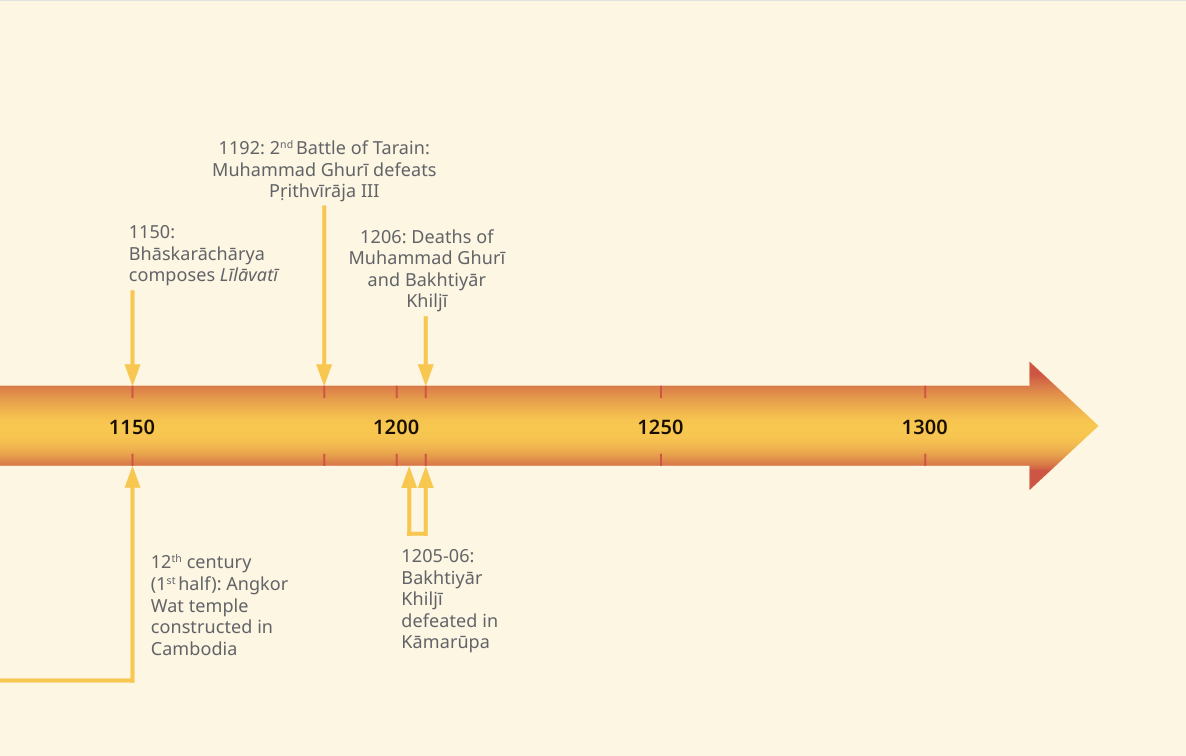
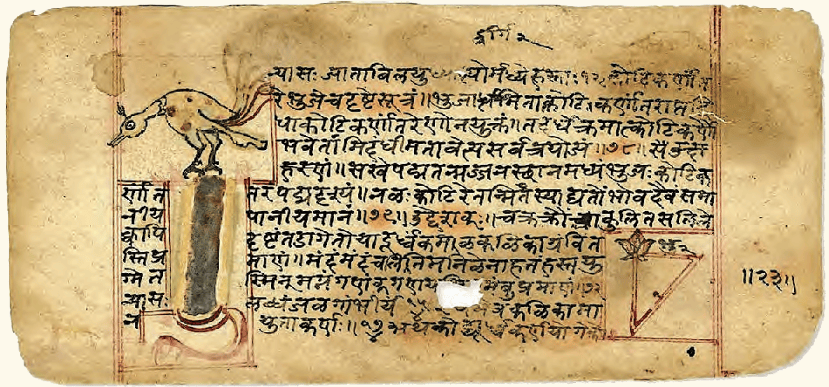
While the production and transmission of scientific knowledge did decline in north India a little later, they continued to flourish in other regions. Born in 1114, probably in present-day Maharashtra, Bhāskara II, better known as Bhāskarāchārya, was one of India’s greatest mathematicians and astronomers. His family counted several scholars and astronomers. His most famous works (all in Sanskrit) are Līlāvatī, which uses lively riddles and problems to teach basic mathematics; Bījagaṇita, on more advanced algebra; and Siddhāntaśhiromaṇi (‘Crown of Treatises on Mathematical Astronomy’), which deals with advanced astronomical calculations. Many later scholars wrote commentaries on those works, and several of them were translated into Persian during the Mughal period; as a result, his influence in India and beyond was long-lasting. It would take Europe a few centuries to rediscover some of Bhāskarāchārya’s pioneering techniques.
In addition to his scientific knowledge, Bhāskarāchārya had a gift for poetry and used this talent to make his writings enjoyable to scholars and students alike. His works were full of examples, with clear explanations, demonstrations and proofs, making them favourite texts with students for centuries. Remember that you saw such examples in your Mathematics textbooks of Grade 7. Here is an example from Līlāvatī — see if you can find the solution!
Of a herd of elephants, half and one-third of the half went into a cave, one-sixth and one-seventh of one-sixth were drinking water from a river. One-eighth and one-ninth of one-eighth were sporting in a pond full of lotuses. And the king of the elephants was leading three female elephants. Tell me, how many elephants were there in the herd?
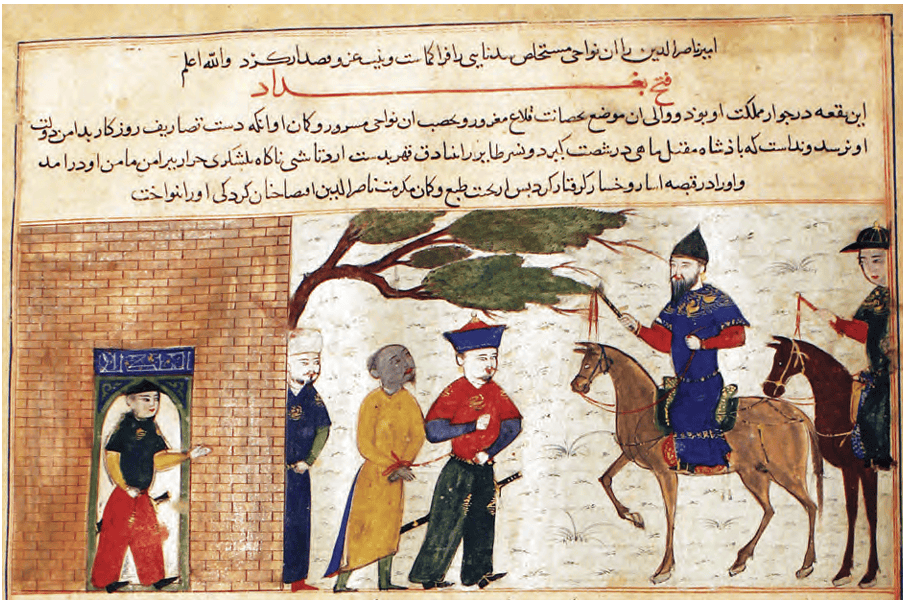
As Mahmūd did not attempt to establish a permanent base in India beyond Punjab, historians have debated his motives for conducting such destructive campaigns; they have often suggested that plunder was the chief reason for his destruction of temples in India. It is true that the larger temples often held immense wealth, accumulated from the devotees’ offerings over centuries, and would therefore be prime targets for plunder.
But it is also true that Mahmūd was keen to spread his version of Islam to non-Muslim parts of the world, as we find from contemporary evidence. Al-Utbi, for instance, noted, “Wherever he went, Mahmūd plundered and sacked the country until it was annihilated. He dug up and burnt down all its buildings, killed those infidels and carried away their children and cattle as booty. He mastered several other territories, and destroying their temples, their sacred buildings, built mosques instead, making the light of Islam visible.” Let us also refer again to al-Bīrūnī, who, after explaining the origin of the śhivalinga worshipped at the Somnath temple, recorded, “The image was destroyed by the Prince Mahmūd. He ordered the upper part to be broken and the remainder to be transported to his residence, Ghazni. [A part of the image] lies before the door of the mosque of Ghazni, on which people rub their feet to clean them from dirt and wet.”
Eastern India
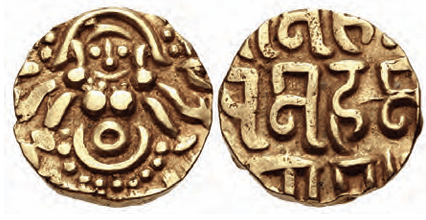
While north India bore the brunt of the Ghaznavid raids, during the 11th century the scene in eastern India was very different. After the decline of the Pālas, the Sena dynasty (Fig. 4.4) emerged as the dominant power over much of Bengal, with their capital at Nādīya (now the Nadia district, which shares a border with Bangladesh). Their relations with neighbouring Kāmarūpa (Assam) and Kalinga (more or less present-day Odisha) seem to have alternated between friendly and conflictual. While their predecessors, the Pālas, patronised Buddhist institutions, the Senas promoted Hindu thought and literature, hosting poets such as Jayadeva, author of the famous Gītagovindam, which tells the story of Kṛiṣhṇa and Rādhā.
Let us follow the coast southward, into Kalinga where we encounter the Eastern Gangas (Fig. 4.4), who had matrimonial alliances with the Cholas (whom we will meet soon), yet also clashed with them a few times, and with other neighbours as well. Nevertheless, by the end of the 12th century the Eastern Gangas emerged as one of the most stable powers of eastern India, with their kingdom extending ‘from the Gangā to the Godāvarī,’ as some of their inscriptions claim. This dynasty initiated the construction of the Jagannātha temple at Puri, and, in the mid-13th century, of the grand Sun temple at Konark.
Further South
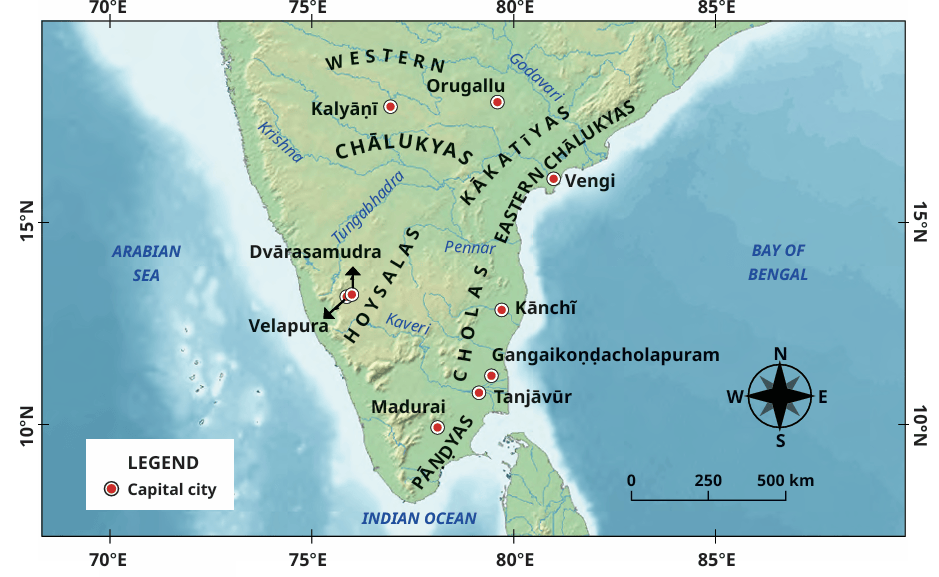
Let us continue our journey southward. From the previous chapter, do you remember the Western Chālukyas (with their capital at Kalyāṇī or Kalyāṇa) and the Eastern Chālukyas (Fig. 4.10)? The former was a major power in the Deccan, its rule extending at some point to the Narmada River in the north. As the Eastern Chālukyas were gradually absorbed into the Chola sphere of influence through marriage alliances, their capital Vengi and the fertile region around it became the object of fierce wars between the Cholas and the Western Chālukyas. As a result, the Western Chālukyas faded away, while the Kākatīyas and the Hoysalas grew stronger, eventually replacing them. Let us now turn to them.
The Kākatīyas
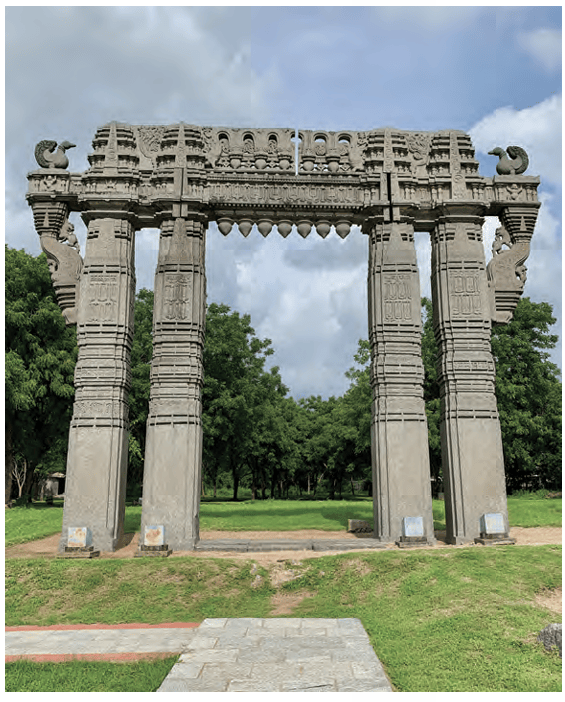
In 12th century, the Kākatīyas cemented their authority over much of present-day Telangana and Andhra Pradesh (Fig. 4.10), with their capital at Orugallu (today’s Warangal), where they built a fort with impressive stone toraṇas or gateways (Fig. 4.11). While some of their kings composed works in Sanskrit, they also patronised Telugu literature; the Thousand Pillar temple at Hanamkonda is a fine example of their temple architecture.
The Kākatīya rulers promoted a strong local administration based on village self-governance; they developed an efficient revenue system and an irrigation infrastructure that supported agricultural prosperity.
The Hoysalas
The Hoysalas originated in southern Karnataka. There is an interesting legend behind the name. When their founder Sāla went to a Jain temple for worship, he found an ascetic meditating; as a tiger appeared on the scene, the ascetic said “Poy, Sāla” — which, in old Kannada language, means “strike, Sāla”. Sāla promptly obeyed the ascetic and saved his life; in return, the ascetic blessed him with kingship.
According to this legend mentioned in inscriptions (and depicted in several temples), the name ‘Hoysala’ is said to originate from the ascetic’s command!
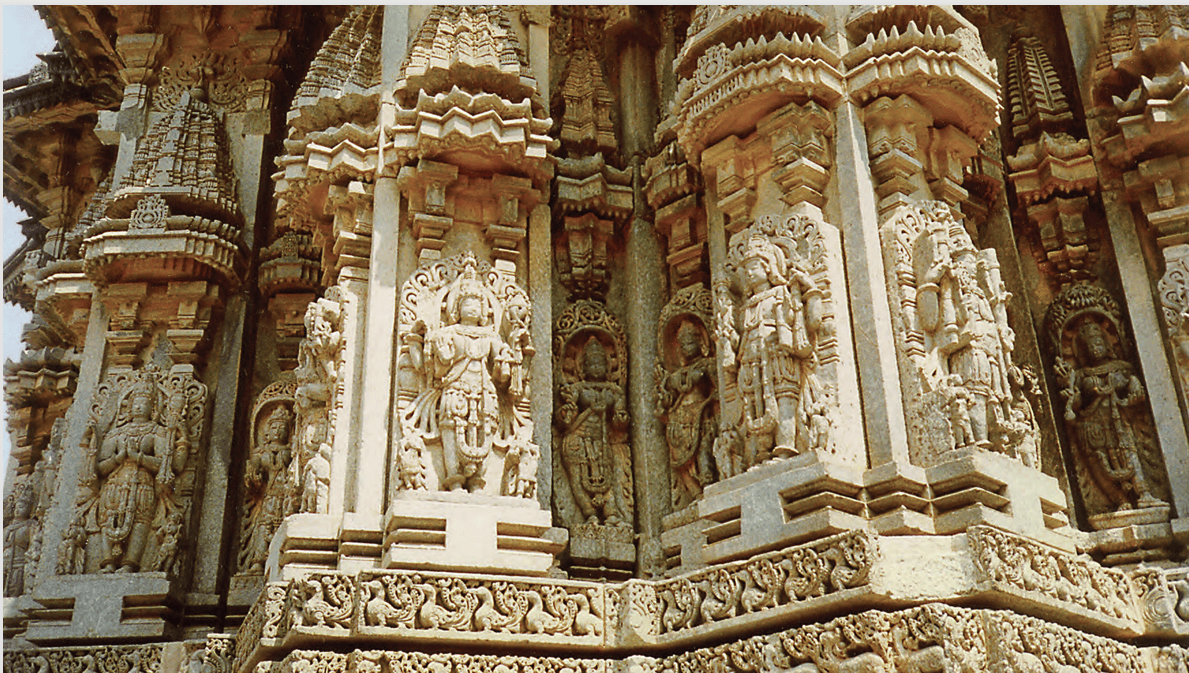
In our period, Velāpura (today’s Belur) and Dvārasamudra (Halebidu) became the Hoysalas’ capitals. Under King Viṣhṇuvardhana, they broke away from Chālukya overlordship, challenged the Cholas, and gradually extended their sway over most of present-day Karnataka. Their rule saw cultural and literary development in Kannada language, but their most visible legacy is their unique style of temple architecture, with intricately carved stone pillars, sculptures and panels. The temples at Belur and Halebidu are particularly famous, and are among three Hoysala temples recognised by the UNESCO as world heritage monuments.
The Cholas, masters of the seas
The Cholas, whom we briefly met in the previous chapter, were a powerful and influential dynasty that rose to prominence in present-day Tamil Nadu, with Tanjāvūr (present-day Thanjavur), Gangaikoṇḍacholapuram, and Kānchī (present-day Kanchipuram) as their capital cities (Fig. 4.10).
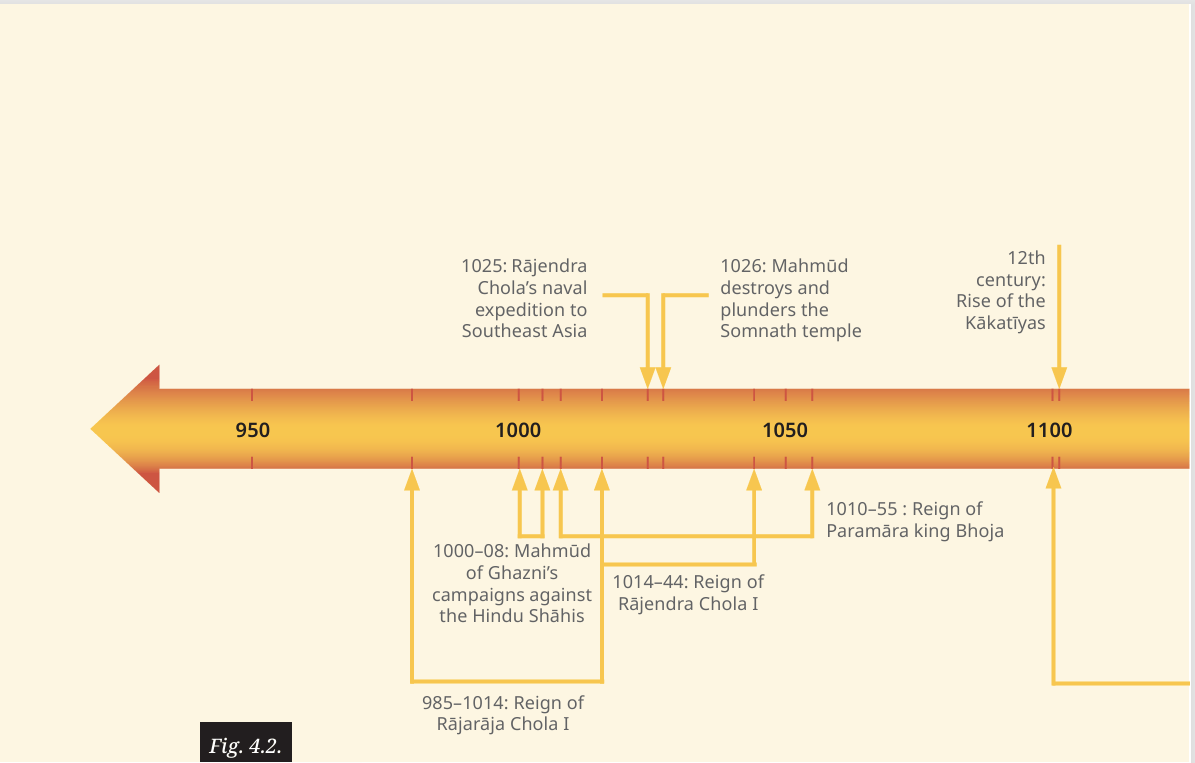
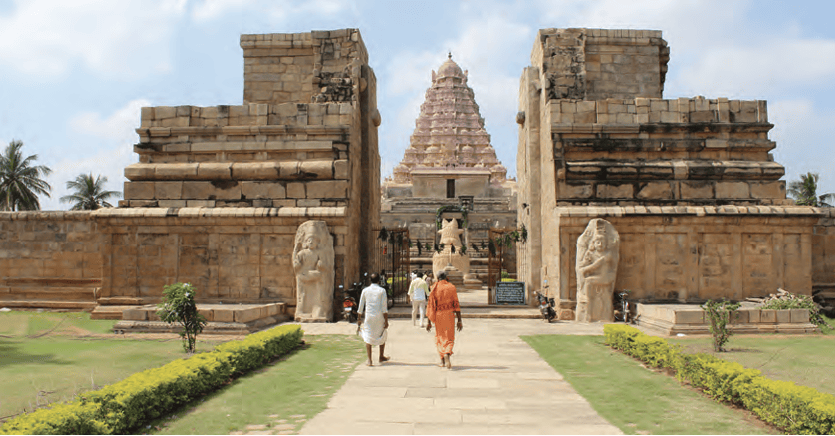
From 985, Rājarāja Chola ruled for some three decades and conquered parts of present-day Karnataka and Andhra Pradesh. His inscriptions record his conquest of ‘islands of the sea’, which most historians identify with the Maldives; and he conquered the northern part of Sri Lanka, including the kingdom of Anurādhapura. He built the Bṛihadīśhvara (also known as Rājarājeśhvaram, after Rājarāja) temple at Thanjavur, a masterpiece of architecture and engineering (we will visit it in Grade 8). And, although the Cholas were predominantly Shaivites, Rājarāja facilitated the construction of a Buddhist vihāra (monastery) at Nāgapaṭṭinam (then an important port of the Cholas) by the ruler of the Śhrīvijaya Empire across the Bay of Bengal (in parts of present-day Malaysia and Indonesia).
Rājarāja’s son Rājendra Chola I, who also ruled for nearly 30 years, expanded the empire further, conquering parts of present-day Odisha and Bengal. He commemorated those victories with the title ‘Gangaikoṇḍachola’, that is, “the Chola who seized (or brought) Gangā” — a reference both to his campaigns in the North and to the sacredness attached to Gangā. Rājendra also expanded his father’s conquest of northern Sri Lanka, which became an integral part of the Chola Empire for half a century or so, until the Sri Lankan king Vijayabāhu I managed to drive the Cholas out after several battles.
Rājendra I is celebrated for his successful naval expedition against the king of the Śhrīvijaya Empire. The conflict had its roots in the maritime trade with China: under the Cholas, trade relations with China thrived, as archaeological evidence and inscriptions confirm; Rājendra even sent a diplomatic mission to China. But one of the sea routes passed through the Strait of Malacca (a narrow strip of sea between Malaysia and the Indonesian island of Sumatra), which the Śhrīvijaya king controlled, and this created competition with the Cholas.
Rājendra sent his navy, which defeated the Śhrīvijaya forces and captured their capital. However, he did not try to occupy the defeated empire; it was a punitive expedition, conducted with the support of many Indian merchant guilds, and it seems to have achieved its objectives.
DON'T MISS OUT
We should not conclude from Rājendra’s expedition against the Śhrīvijaya Empire that the latter’s relations with India were conflictual. On the contrary, there were deep cultural and generally peaceful relations between these two regions of Asia. For instance, a Śhrīvijaya ruler made donations to Nālandā and asked the Pāla king for land to create one more monastery there; the request was granted, as a copper-plate found at Nālandā recorded.
Similarly, with Sri Lanka: strong cultural links apart, Vijayabāhu I married a princess from Kalinga.
LET'S EXPLORE
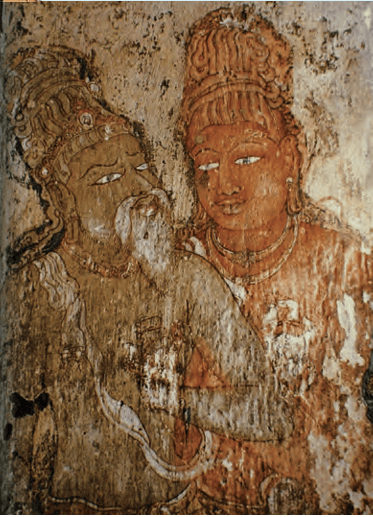
In the painting Fig. 4.14, can you make out who is the king and who is the guru? What does the king’s posture and general attitude express?
Back home, the Cholas engaged in large public works, such as roads to facilitate communications, tanks, wells and canals for irrigation, and artificial lakes. But their frequent and extensive conflicts with several neighbouring kingdoms, in particular the Western Chālukyas, the Pāṇḍyas and the rulers of Sri Lanka, drained their treasury and contributed to the decline of the empire. By the 13th century, the Chola empire had shrunk considerably and was finally absorbed by the Pāṇḍyas.
Back to the North
We now travel back to the north, as a second phase of foreign invasions was going to have a more lasting impact on India.
The Paramāras
The Paramāras were originally vassals of the Pratihāras and the Rāṣhṭrakūṭas; in the second half of the 10th century, they emerged as an independent power in Malwa (a region in present-day Madhya Pradesh), with Dhārā (present-day Dhar) as their capital. Their most famous king was Bhoja, who ruled from 1010 for almost half a century and led numerous campaigns, extending his kingdom from the Konkan region on the west coast to parts of Rajasthan; he was among the Indian rulers who sent their forces to assist the Hindu Shāhi rulers against Mahmūd of Ghazni.
After Bhoja’s death in 1055, the Paramāras gradually declined, partly because of conflicts with neighbouring powers.
The scholar-king
Bhoja Paramāra should not be confused with King Bhoja of the Gurjara-Pratīhāra dynasty, whom we met in the previous chapter and who lived in the 9th century. Bhoja Paramāra was known for his efficient governance and public works. He is credited with founding of the town of Bhojpur and constructed a vast lake between Bhojpur and the city of Bhopal (whose name comes from ‘Bhojpal’ — the ‘dam’ or ‘fort of Bhoja’) by harnessing the waters of several rivers; it served both irrigation and water management purposes. Only a small portion of that lake, called ‘Bhojtal’ remains near present-day Bhopal, while remains of earthen or stone embankments can still be seen further away. A local proverb (in Hindi) remembers the lake’s original size by declaring, “If there is a lake, it is Bhopal’s lake; all others are just ponds”!
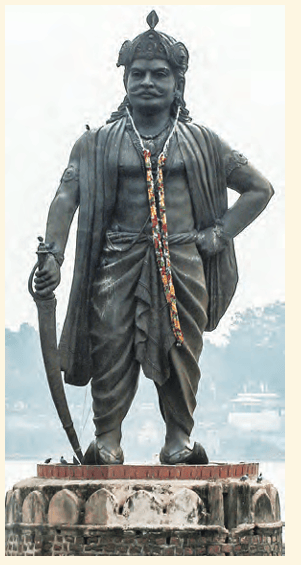
Bhoja also built the impressive Bhojeshwar Temple, which remains an architectural marvel even though it was never completed.
Bhoja was a generous patron who supported scholars and promoted Sanskrit literature. Under his patronage, arts and sciences flourished, so that his capital became a renowned centre of learning that attracted scholars, poets, and artists from across India.
Bhoja himself was a noted scholar and a prolific author who wrote on a wide range of subjects. His works include Samarāṅgaṇa Sūtradhāra a long treatise on architecture, town planning, temple construction, sculpture and mechanical devices; treatises on governance and on Sanskrit poetics; a commentary on Patanjali’s Yogasūtras; and texts of medicine, among other texts attributed to him.
His reputation as a wise and learned ruler became legendary, inspiring numerous stories and folk tales.
A turning point: the Ghūrids in India
As we saw, Mahmūd of Ghazni was the first notable invader of India in the period we are looking at. After him, his Ghaznavid Empire was under attack from several sides in Afghanistan and beyond, and soon disintegrated. The chiefs of Ghūr (present-day Ghor), a mountainous region in Afghanistan to the west of Ghazni, were earlier vassals of the Ghaznavids, but now seized the opportunity to take control of Ghazni and build up their power.
Their leader Muhammad, now the sultan of Ghūr (and often called ‘Muhammad Ghūrī’ or ‘Muhammad of Ghor’), soon brought parts of Punjab and Sindh under his rule. His attempts to expand into Gujarat failed, as he was defeated in 1178 by the Chaulukya king Mūlarāja II at the foot of Mount Abu. In another version of this battle, it was Queen Nāīkīdevī, Mūlarāja’s mother, who led the victorious army on horseback, with her son in her lap. Merutunga, a Jain scholar from Gujarat, recorded the event in a semi-historical chronicle, but as he wrote over a century later, historians are divided as to whether the queen or her son should be credited for this victory; anyhow, sources do record Muhammad’s defeat there.
DON'T MISS OUT
The Chaulukya dynasty, also known as the Solanki dynasty, which ruled parts of Gujarat and Rajasthan from the 10th to the 13th centuries, is distinct from the Chālukya dynasty of the Deccan, which we met in the previous chapter. Its capital was Aṇahilavāḍa, which is today’s Patan. (They are also sometimes called ‘Chālukyas of Gujarat’.)
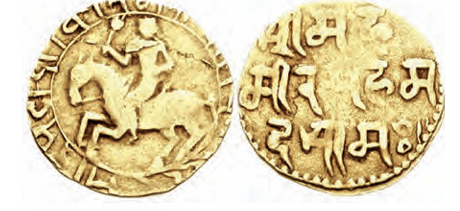
Meantime, the Chāhamānas, also known as Chauhāns, were a powerful Rajput dynasty that arose in nearby Rajasthan and neighbouring regions. Its kings, apart from battling other Indian dynasties, often repelled invaders such as Mahmūd of Ghazni. In the 12th century, their conquests of Delhi, Haryana, parts of Punjab and Uttar Pradesh, apart from most of Rajasthan, established their empire, with its capital at Ajayameru (today’s Ajmer).
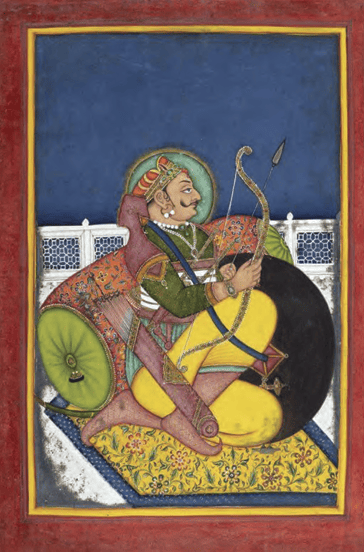
Pṛithvīrāja III, often known today as Prithviraj Chauhan, waged many battles with neighbouring kings, such as those of Gujarat and Malwa. In 1191, he also defeated Muhammad Ghūrī at Tarain (modern-day Taraori in Haryana), but within a year, Muhammad returned with a larger army, and the two clashed again. In this Second Battle of Tarain, which witnessed fierce fighting, Muhammad defeated Pṛithvīrāja and executed him.
Muhammad Ghūrī went on to capture Delhi. Unlike Mahmūd, who merely plundered and withdrew, he sought territorial conquest. Though he returned to Ghazni, he left behind trusted military commanders to consolidate his gains — most notably his general Qutb-ud-din Aibak, who later founded the Delhi Sultanate (as we will see in Grade 8).
DON'T MISS OUT
Delhi was a flourishing city under the Chāhamānas. Their inscriptions refer to it as ‘Dhillikā’, which was later shortened to ‘Dhilli’ and ultimately evolved into ‘Delhi’.
Aibak encountered much resistance in his campaigns in north India, but was able to expand the Ghūrids’ territory. His army commander Bakhtiyār Khiljī (or Khaljī) conducted campaigns in eastern India from the end of the 12th century,
conquering Bihar and Bengal. On his way to Bengal, he destroyed large Buddhist monasteries and universities such as Nālandā and Vikramaśhilā, collecting huge booty and slaughtering large numbers of monks. There is a consensus among historians of Buddhism that this destruction of its large centres of learning precipitated the decline of Buddhism in India, although a few other factors may have also played a role.
LET'S EXPLORE
Writing some 60 years after Bakhtiyār Khiljī’s campaign through Bihar, the historian Minhaj al-Siraj Jūzjānī, recorded in his Tabakāt-i-Nāsirī how Bakhtiyar’s forces captured a ‘fortress’ and “acquired great booty.” He adds, “The greater number of the inhabitants of that place were Brahmans, and all those Brahmans had their heads shaven; and they were all slain. There were a great number of books there. … It was found that the whole of that fortress and city was a college, and in [their] tongue, they call a college bihār.
-> Remembering the meaning of vihāra and noting that Nālandā was known in ancient inscriptions as ‘Nālandā Mahāvihāra’, can you find two more clues in the above passage to identify the ‘fortress’ near the Nālandā university? (Hint: Who do you think these ‘Brahmans’ actually were?)
DON'T MISS OUT
Nālandā’s famous library,
spread over three multi-storey
buildings, contained lakhs
of manuscripts. The Chinese
pilgrims Yijing and Xuanzang
spent some time there, studying
manuscripts and selecting
many to take back to China. 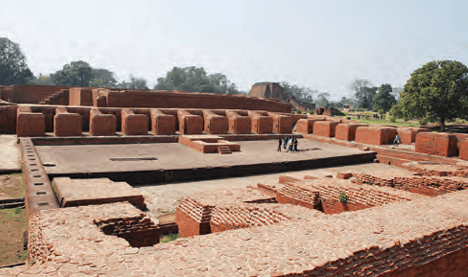
After Bakhtiyār Khiljī’s attack, the library is said to have burned for months. Tibetan scholars, who were both teaching and studying there, fled back to Tibet with as many manuscripts as they could carry. When Dharmasvāmin, a Tibetan monk, visited the site some three decades later, he found it half ruined. Yet, a 90-year-old teacher, Rāhula Śhrībhadra, was still instructing a class of about 70 students — perhaps Nalanda’s last class …
As Bakhtiyār Khiljī pushed further east into Bengal around 1203–04, he caught the Sena ruler unaware at Nādīya, ending the Senas’ control over much of Bengal. For reasons that are not too clear, he then decided to attempt an expedition into Tibet. However, on his way through Kāmarūpa in 1205, he was confronted by the local ruler’s forces, who inflicted severe losses on his army. The local population is said to have destroyed food and fodder, in effect starving the invading army. Bakhtiyār escaped with only a handful of his men and returned to Bengal much weakened.
Muhammad Ghurī was killed in 1206; the same year, Bakhtiyār Khiljī was assassinated, apparently by his own men. Their territory in north India remained under the control of Muhammad’s generals.
Governance, Trade and Cultural Life
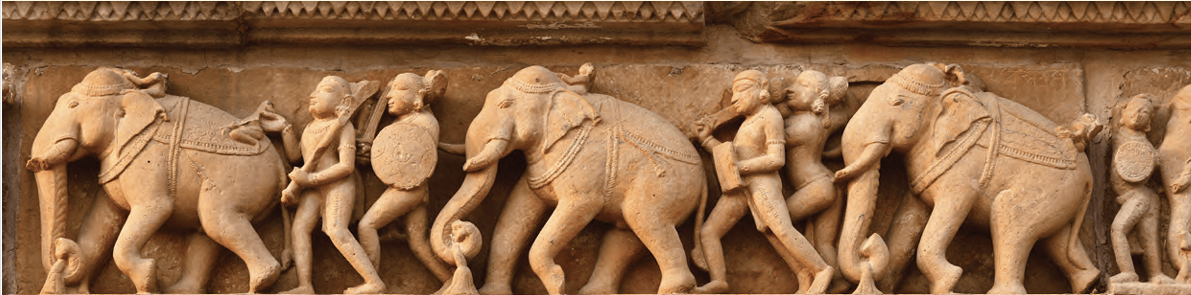
We have seen much warfare in this period, which means that every powerful king needed to keep a sizable army. This involved considerable resources to employ the soldiers, supply them with weapons, maintain horses and elephants (and, in parts of north India, camels for transport of provisions). Powerful kingdoms therefore needed an efficient administration to collect tributes from vassals and taxes from the traders. The previous chapter described the main features of such administrations; there is no major change in this one, except with respect to Muhammad Ghūrī’s system, which was more centralised and granted temporary land assignments to officers in return for revenue collection and military service. This would be further developed during the period of the Delhi Sultanate, as we will see in Grade 8.
Despite the political disturbances we have seen, India’s trade with China and Southeast Asia kept growing during this period. Among other evidences, coins and pottery from those overseas regions have been found at many locations on India’s west coast, which had many seaports as well as shipyards manufacturing seafaring ships. While there was a brisk trade within India and beyond, supported by a few powerful guilds, the mainstay of the economy was ultimately agriculture — which remains true even today. The ancient texts often refer to agricultural produce, whether it is rice and barley in the Ganga plains and Bengal, saffron from Kashmir, spices from Kerala, ginger from Bengal, wheat from northwest India, and cotton from western India and the Deccan. Many rulers — we mentioned a few examples in the previous chapter and this one — took care of irrigation works, which could, to some extent, mitigate the vagaries of seasonal rains.
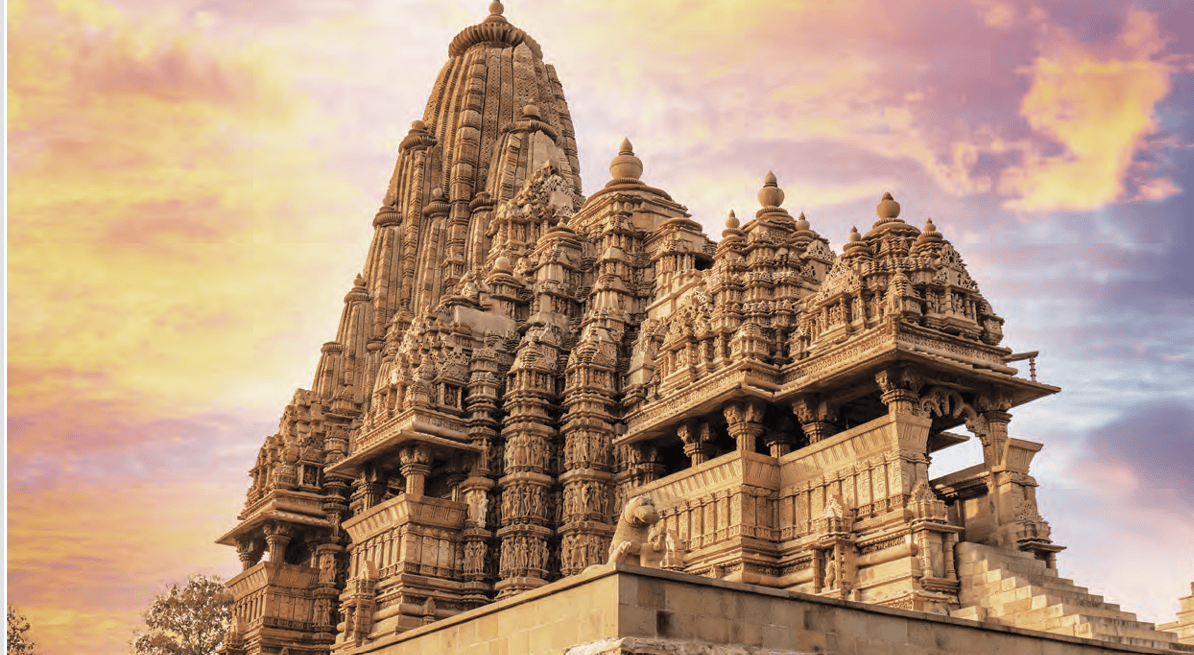
If the economy thrived, so did the arts, the literary production, science (as we saw with Bhāskarāchārya), religious life and other cultural aspects. In the previous chapter, we heard of Harṣha’s Sanskrit compositions, and, in the present chapter, those of Bhoja the scholar-king. We should add here the Chālukya ruler Someśhvara III who, in the 12th century, authored Mānasollāsa, an encyclopaedia covering topics ranging from astronomy and architecture to music, medicine, cooking, and games — in effect, a comprehensive guide to royal life and governance, with some emphasis of the duties of kings towards their subjects. Many large temples were built in this period across India; apart from those we saw earlier in this chapter, we should mention the Kandariya Mahādeva and the Lakṣhmaṇa temples, architectural marvels among dozens of temples constructed at Khajuraho by the Chandellas during these two centuries.
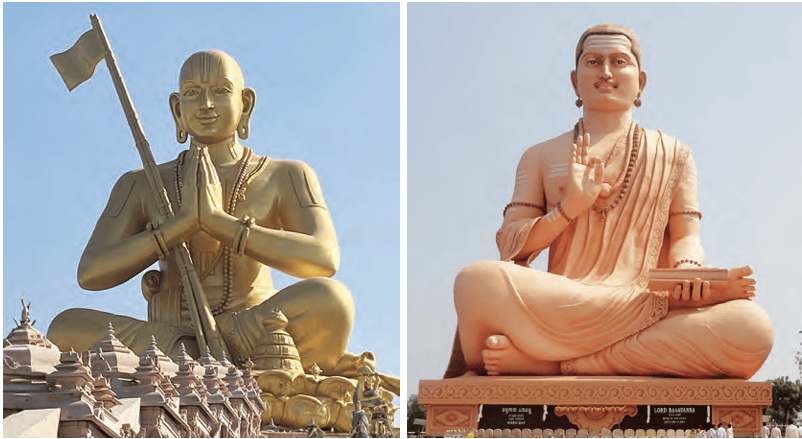
Several noteworthy thinkers appeared in these two centuries. Among them, Rāmānujāchārya of south India was a philosopher-saint who challenged the dominant philosophical school of his time, Ādi Śhankarāchārya’s advaita vedānta (briefly described in the previous chapter). Rāmānuja developed the school of viśhiṣhṭādvaita vedānta, which sees the world and individual souls as real, and emphasises bhakti and surrender to the divine as the path to liberation.
Basaveśhvara (also known as Basavaṇṇa, or Basava in short) was a royal minister at Kalyāṇī (modern Basavakalyana in Karnataka), who left his position to become a social and religious reformer. He founded the Lingāyat movement, which rejected caste distinctions and ritualism and, instead, taught personal devotion and dedicated work. Looking at the inner value of a person rather than his or her social rank, Basavaṇṇa promoted the equal spiritual potential of all men and women. His short poems in Kannada (known as vachanas) strikingly convey his spiritual and ethical vision as well as his firm devotion to his Lord
These two thinker-saints had a profound impact on the culture and society of south India in particular. Like other Bhakti saints elsewhere in the Subcontinent, they helped make spirituality more personal and accessible, breaking down some of the existing social barriers.
LET'S EXPLORE
In Kalyāṇī, Basavaṇṇa established an anubhava maṇḍapa (literally, ‘pavilion of experience’), where men and women from every social, economic, religious or linguistic background, including saints and philosophers, could assemble to discuss all aspects of life, including moral values and religion.
-> Why, in your opinion, did Basava want people from all backgrounds to come together and exchange ideas?
-> If something like an anubhava maṇḍapa existed today, what important topics do you think people ought to discuss there?
-> What lessons can we draw from the anubhava maṇḍapa spirit to create a just and civil society today?
Taking Stock
Like every transitional period, this one saw both change and continuity.
The most visible change was the military campaigns by Turkic invaders and the start of foreign rule in parts of north India, which involved considerable plunder and destruction of temples, cities and centres of learning. This altered the power equations in a profound way. It also marked the spread of Islam as a new creed in India’s religious landscape. At the same time, in the two centuries we focused on, large parts of northern India and all of south India remained outside the hold of the Turkic invaders. Neighbouring kingdoms often waged war against each other, though alliances were not uncommon; on a few occasions, native rulers even came together to form a coalition against a foreign invader.
DON'T MISS OUT
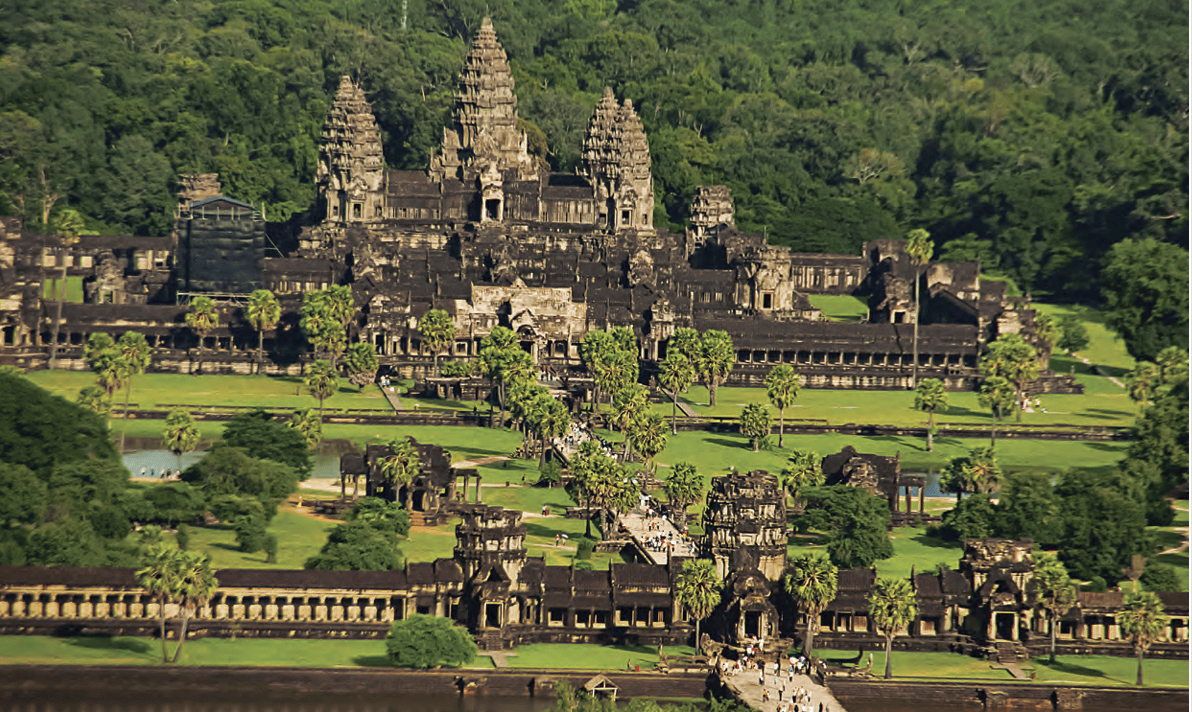
The Angkor Wat temple in Cambodia (Fig. 4.23), constructed in the 12th century by the Khmer king Sūryavarman II, is the largest religious monument in the world. It was originally dedicated to Viṣhṇu, with inscriptions in Old Khmer and in Sanskrit, and enormous bas-reliefs depicting scenes from the Rāmāyaṇa and Mahābhārata. The temple’s five huge śhikharas or towers symbolise Mount Meru, the mountain at the centre of the cosmos in Hindu mythology. Architecturally, Angkor Wat shares many features with south Indian temples, though on a grander scale. Later in the 12th century, following a change of political power, the temple was gradually converted into a Buddhist one. This temple is one of numerous examples of how India’s religious and aesthetic traditions profoundly influenced Southeast Asian cultures.
Despite disruptions in the north, internal and external trade continued and the merchant guilds survived and adapted.
External trade was also a vehicle for the spread of Indian culture in Southeast Asia and China. Cultural traditions persisted in much of India, with new schools of thought and belief, and many literary and scientific compositions, not only in Sanskrit but also in regional languages.
The lesson of the period, if there is one, is therefore resilience in the face of conflict and the enduring power of knowledge, learning and creativity.
Before we move on …
-> The 11th and 12th centuries marked a turning point in Indian history (hence the chapter’s title).
-> In the 11th century, Mahmūd of Ghazni, after defeating the Hindu Shāhis, conducting many raids into north India, extracting much plunder, destroying temples and taking away prisoners. He however did not seek to establish his rule in India.
->In the 12th century, Muhammad Ghurī and his generals conquered Delhi and large parts of the Gangetic plains, all the way to Bengal, causing much destruction. Important centres of learning, in particular, were left in ruins.
-> Still, large parts of northern India and all of south India remained outside the hold of the Turkic invaders. Powerful kingdoms often waged war against each other, though alliances were not uncommon.
-> Internal and external trade, art and literature, and monumental architecture continued to thrive, and elements of Indian culture travelled abroad, especially to Southeast Asia and China.
Questions and activities
- Why is the period under consideration in this chapter regarded as a major transition in Indian history? Give two examples each of change and continuity from this period.
- Observe Fig. 3.27 in the previous chapter and draw a similar ‘star of dynasties’ gathering all or most of the dynasties that appear in this chapter.
- Taking a map of the Subcontinent, draw a geographical tour that covers all or most dynasties in this chapter (you may draw inspiration from some of the ‘travels’ the chapter’s narration follows).
- With the help of a map of India and Southeast Asia, can you calculate the approximate distance that Rājendra I’s fleet of ships had to navigate to reach their objective?
- Match these two pairs:
(a) Eastern Gangas (i) Belur
(b) Chandellas (ii) Bṛihadīśhvara temple
(c) Paramāras (iii) Konark Sun temple
(d) Hoysalas (iv) Kandāriyā Mahādeva temple
(e) Cholas (v) Bhojeshwar temple
- Working in groups, compare the dynasties in this chapter and in the preceding one; create a table to list the dynasties present in both, those that disappear from the preceding period, and those that appear in this chapter’s period.
- Using the chapter and any additional reading, prepare a short note explaining (1) why centres of learning like Nālandā were important; (2) how their destruction may have affected education and culture in India.
- Why do you think Mahmūd of Ghazni carry out repeated raids from Afghanistan into India, while Muhammad Ghūrī sought territorial expansion into India and long-term control? Write a short note on how their motives shaped the outcomes of their campaigns.