
7Infrastructure: Engine
of India’s Development
"A developed India will be one where urban and rural
areas have the same infrastructure — roads, power, water,
and communication." — APJ Abdul Kalam
The Big Questions?
- What is physical infrastructure, and how has it transformed over the years in India?
- What is the role of infrastructure in the development and economic prosperity of the nation?
- How do citizens engage with the government in day-to-day life? How can one make government work for the people?
Introduction
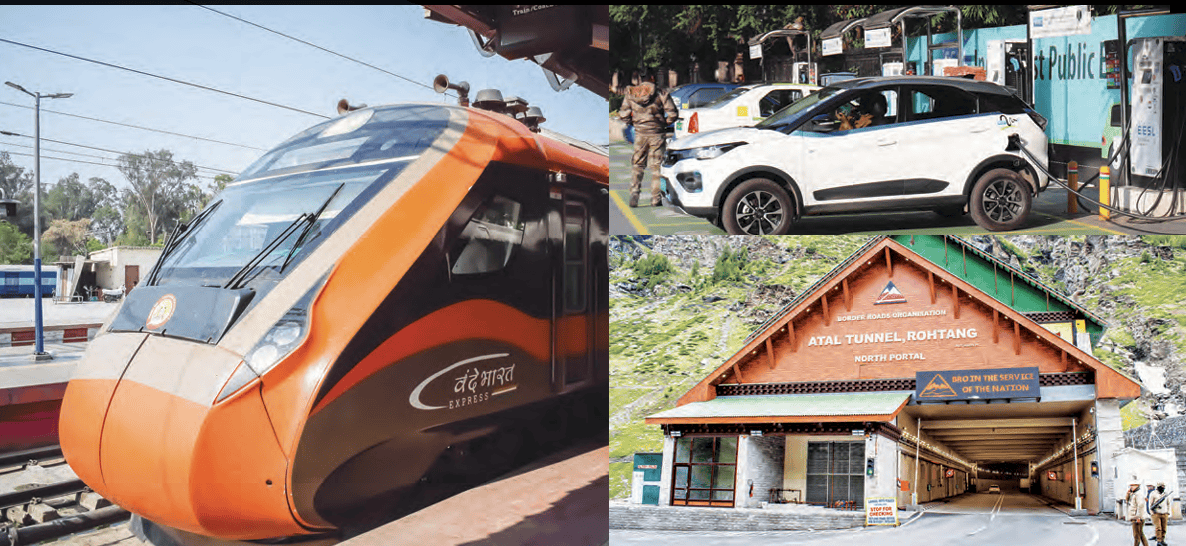
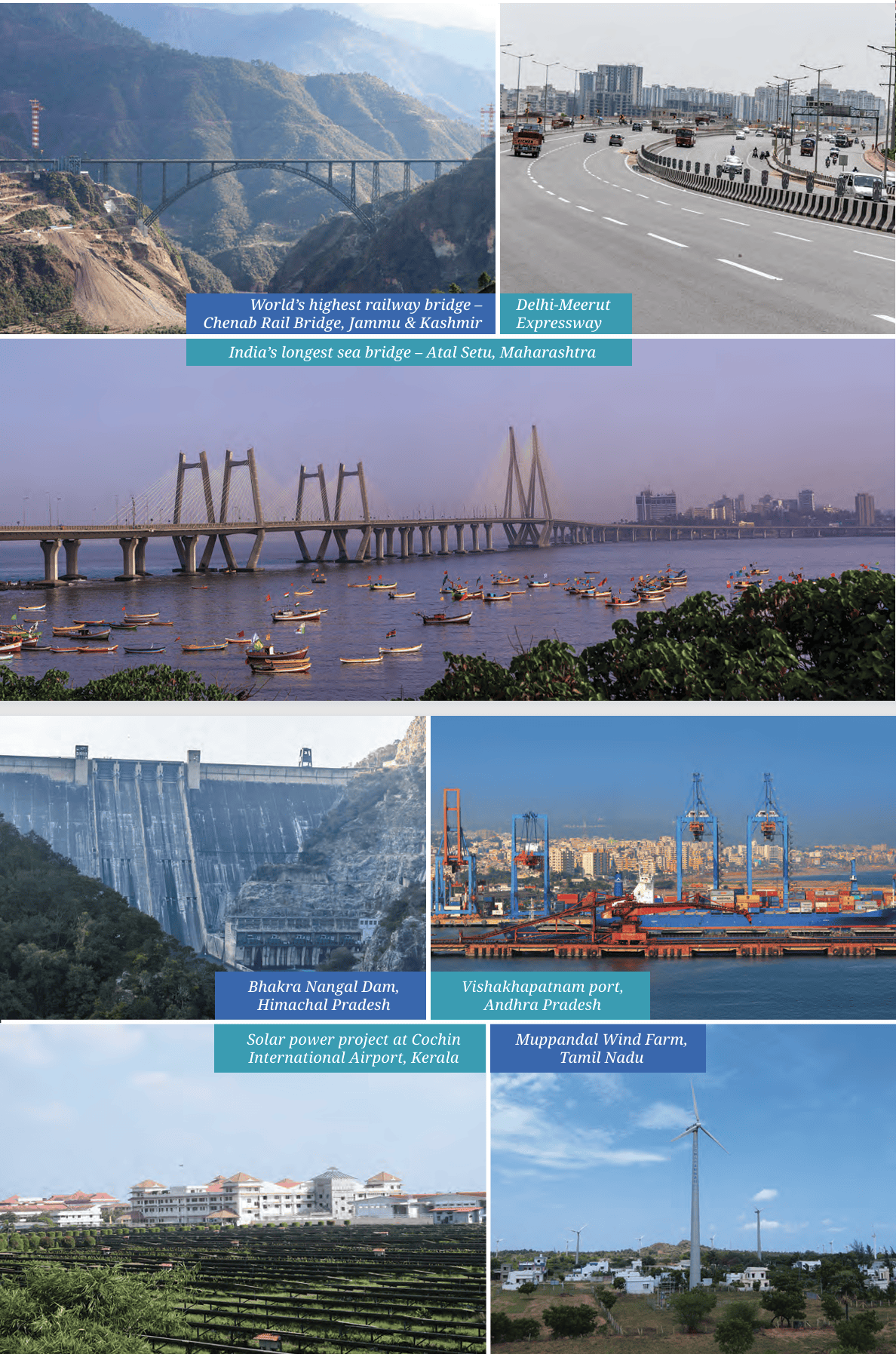
Imagine you wake up one morning, ready for school. But when you step outside, there are no roads. The buses are gone. No one’s mobile phone has any signal. The lights won’t turn on, the internet is gone, and the tap is running dry! How would you reach school? How would groceries, and stationery reach your nearest market and your home? How would you access utilities like electricity and water? This is what life might look like without physical infrastructure, which is a vast network of tangible structures built to keep our cities and villages functioning. It includes transportation systems (roads, bridges, railways, etc.), utilities (electricity, water pipelines), communication networks (internet, telephone lines, telecom towers, etc.), energy infrastructure (windmills, solar parks, oil and gas pipelines, etc.) and so on.
Why is physical infrastructure important?
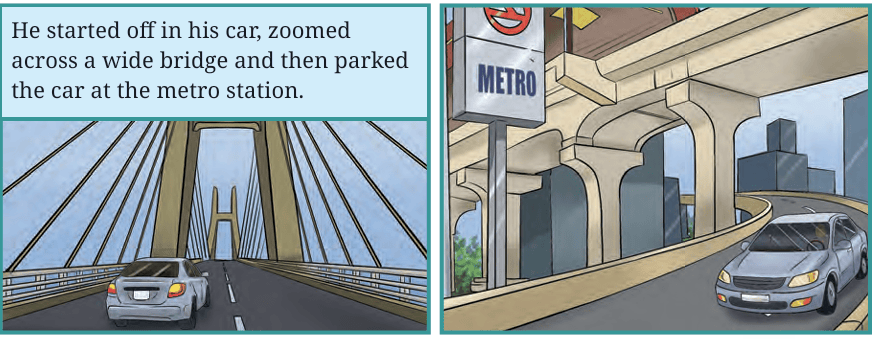
One bright morning, Rishabh packed his bags for a two-day trip from Delhi to his hometown, Talegaon in Nashik, Maharashtra.
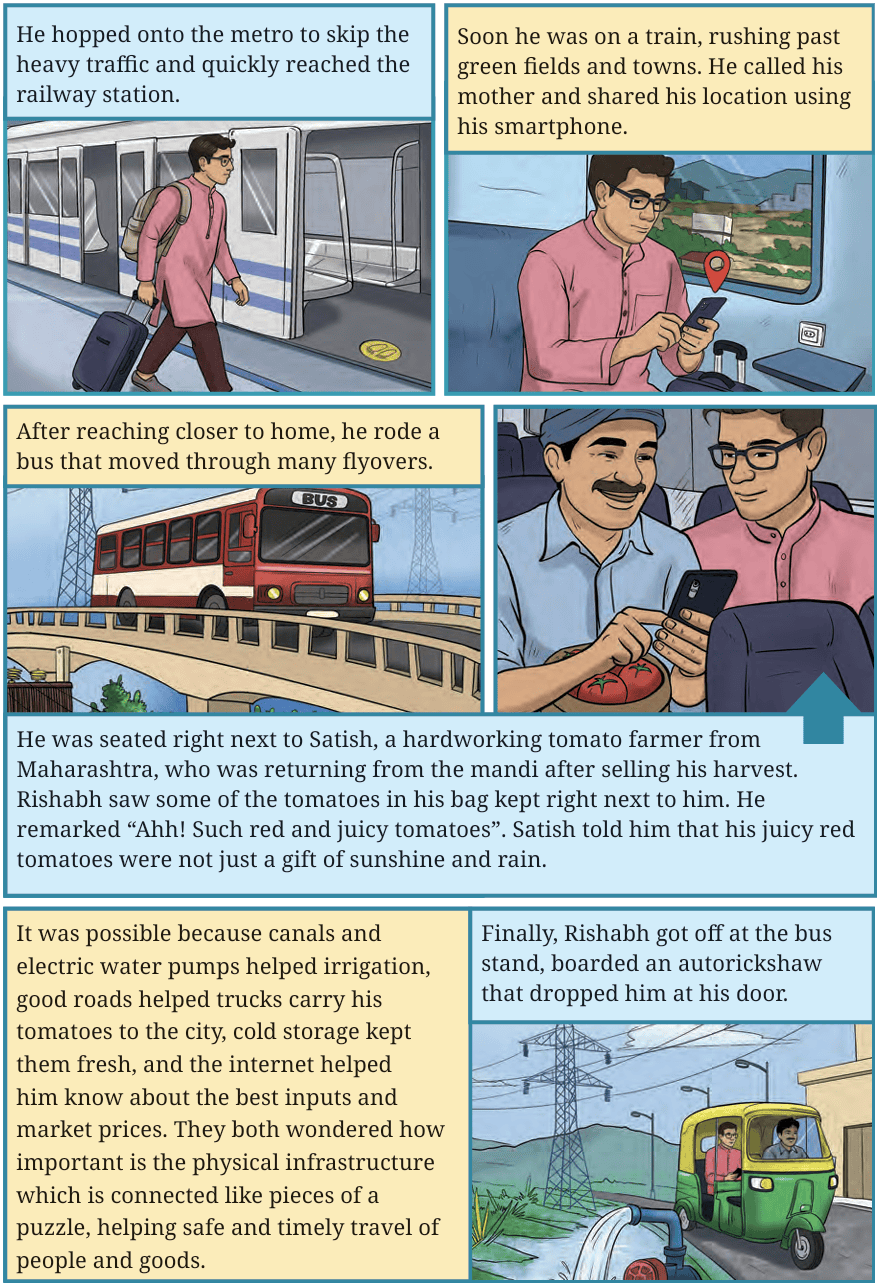
Physical infrastructure is the backbone of our nation — it makes life easier for people, communities, businesses, and enables government to function smoothly. For instance, transport systems like roads, railways, airways, and shipping connect places of origin or manufacturing of goods and services to the nearest markets. India has had a network of trade routes since ancient times, and today’s modern infrastructure has taken this forward to boost trade, both within and outside the country. Better infrastructure also supports tourism, connects remote areas, and helps during emergencies like floods or earthquakes. It also strengthens national security by improving access to all kinds of terrain for the defence forces.
Transportation Infrastructure
How do you and your family members commute to nearby and far-off places? Let’s learn about the transportation infrastructure that enables the mobility of people and goods.
a) Road and highway network
Did you know? India has the second-largest road network in the
world, only after the United States of America (2024). There are
many types of roads. The local roads near your home help children
reach school, farmers carry crops to markets, and ambulances
reach hospitals. Then there are the bigger roads like state highways
connecting towns and districts within a state along with other
bigger highways. These are built and maintained by states through 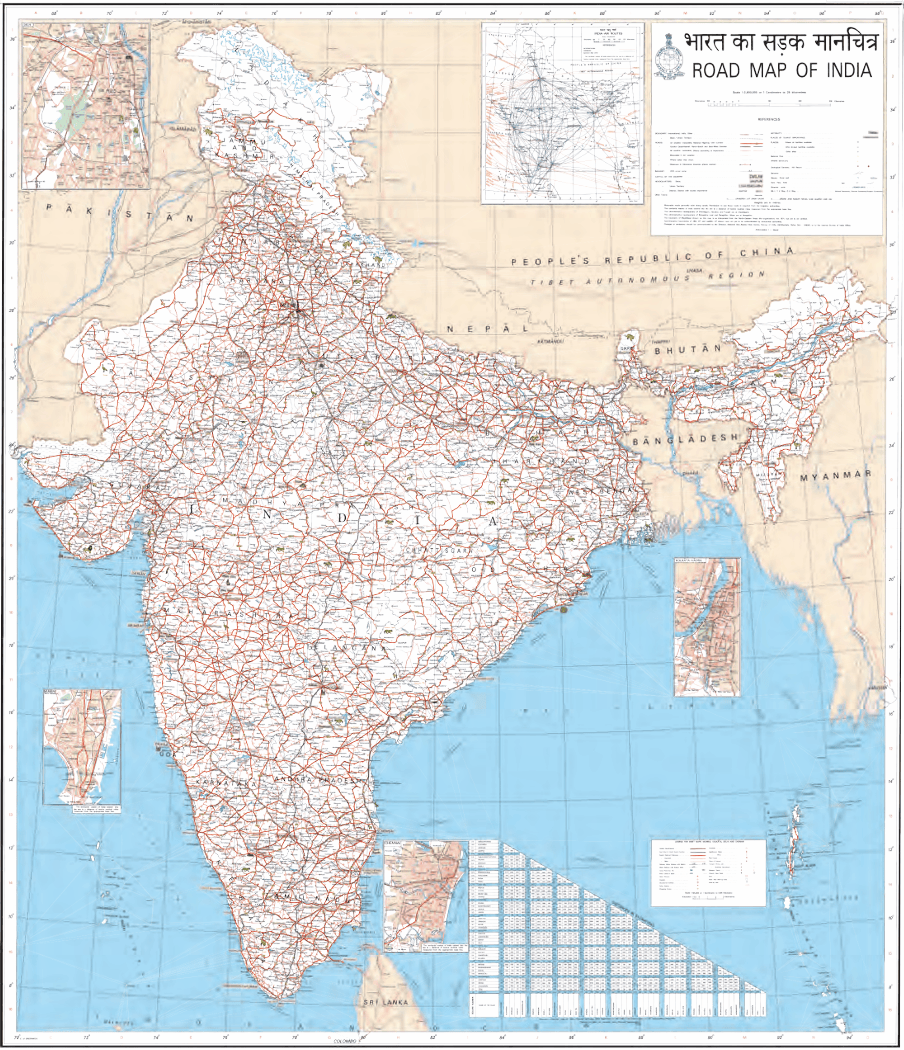
their public works departments. Then, national highways and expressways are like super fast roads that join cities across states, and are built and maintained by the central government. They connect with other infrastructure like railway stations, airports, and ports so that goods and people can travel smoothly.
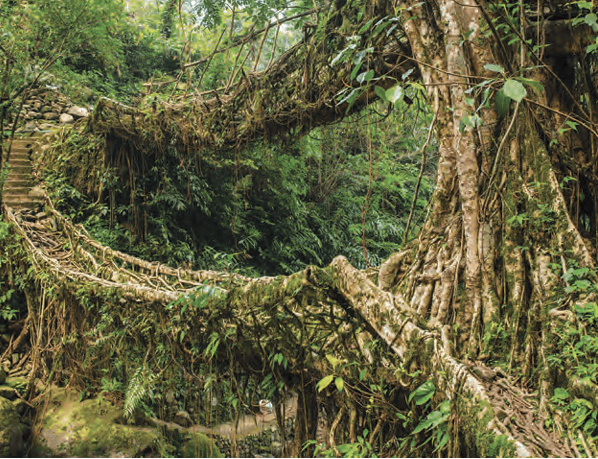
(called jingkieng jri in Khasi), Meghalaya
DON'T MISS OUT
As of 2025, the length of India’s national highways was around 150,000 km (Fig. 7.4) NH44 is the longest national highway in India at 4,112 km. It runs from Srinagar in the north to Kanyakumari in the south. In addition, the Golden Quadrilateral is an important highway network connecting four of India's major cities — Delhi, Mumbai, Chennai and Kolkata.
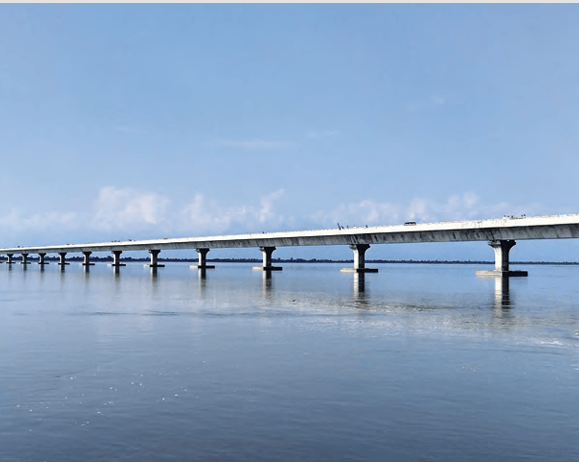
Highways cannot be built everywhere especially in difficult terrains like dense forests, wide river beds, and steep mountains. In such cases, bridges and tunnels enable ease of access. For instance, the Dhola Sadiya Bridge (or the Bhupen Hazarika Setu) connects Assam and Arunachal Pradesh across the Lohit River, a tributary of the Brahmaputra. At 9.15 km, it is the second longest bridge in India. Before it was built, people had to rely on ferries for travel, which did not work during floods. Now, the bridge provides year-round travel and has cut travel time by four hours. Farmers can take their vegetables and fruits to the market before they spoil, and people can access hospitals or medicines faster, even during floods.
Another infrastructure marvel closer to nature is the Meghalaya’s living root bridges which are crafted by the indigeneous Khāsi and Jaintia tribes using the roots of the Ficus elastica tree or the Indian rubber tree. They guide the roots across streams with bamboo and palm trunks, and over many years the roots grow stronger, twisting into natural bridges. Some take decades or even centuries to mature and can last for hundreds of years, standing 15–30 m high. These bridges are not just pathways but living and growing structures which have been nurtured over generations. They are a reflection of the knowledge that the local people have about Nature; these bridges have a cultural meaning too, connecting one generation to another.
b) Indian railway network
The British introduced railways in India in 1853 to transport raw materials like cotton and tea to ports for exporting them to Britain. Railways also helped British goods move across India
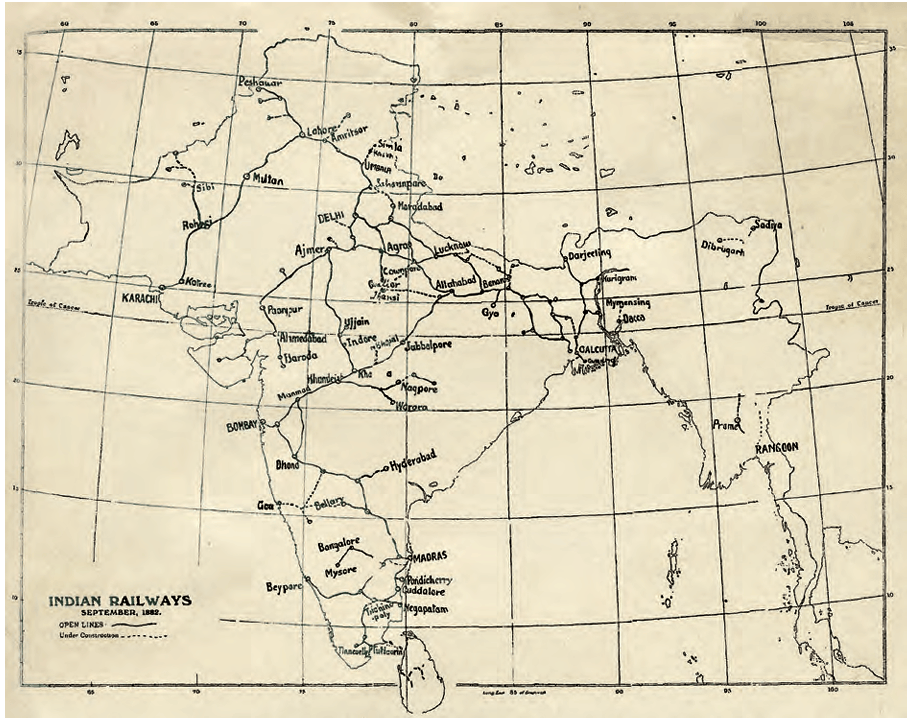
and created a market for them. In addition, the system allowed the exploitation of resources and quicker movement of troops, which helped the British ensure tighter control over the vast Indian territory.
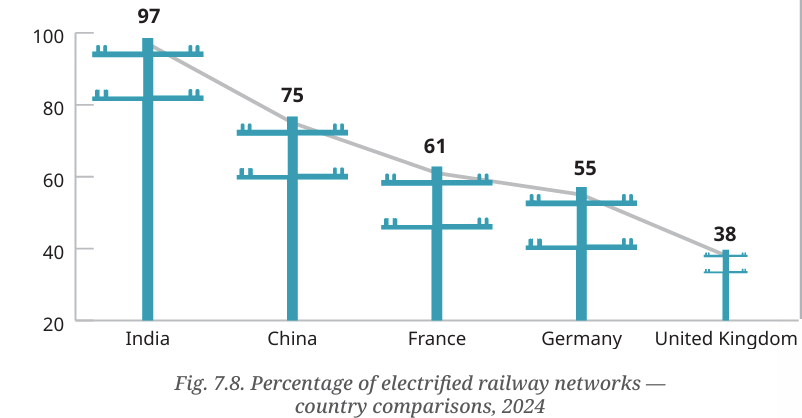
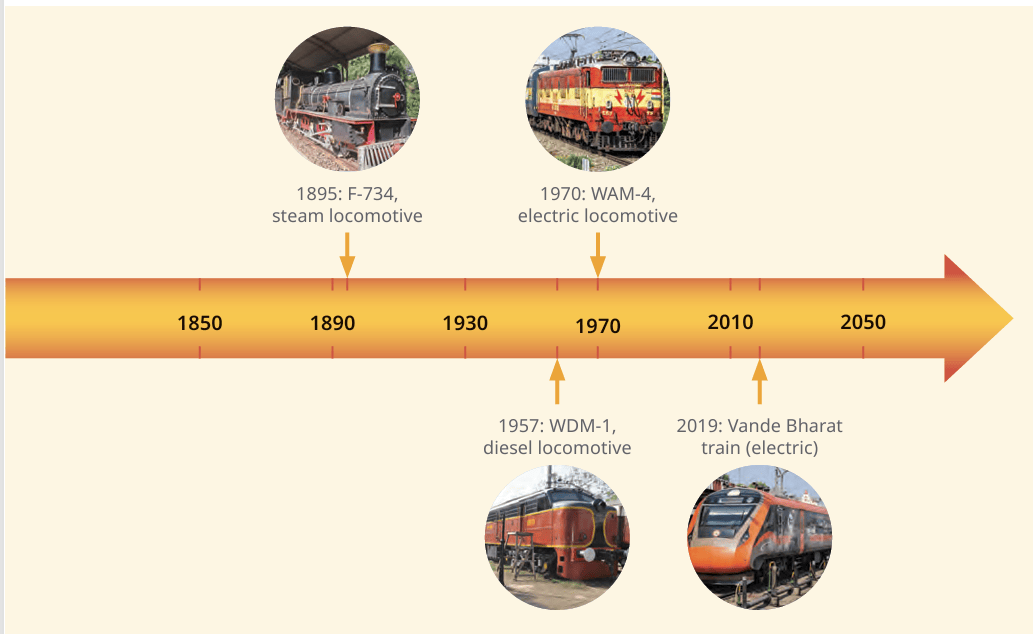
As the railway network expanded, trade grew, major markets developed, and new settlements emerged near stations. Railways became the lifeline for moving people and goods. Today, the Indian railways carry over 20 million passengers everyday, and is one of the cheapest train services in the world. Cargo trains carry items like coal, grains, textiles, and electronics, using 75–90 per cent less energy than road transport. Earlier, trains used coal and diesel, which caused a lot of pollution. Now, India is aiming to have 100 per cent trains running on electricity by 2025, which is better for the environment, and a huge achievement for the country, see Fig. 7.8.
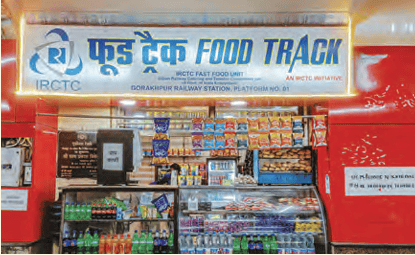
Indian Railways is also the largest employer with about 1.21 million employees in 2024, including engineers, ticket collectors, and service staff. Additionally, it also creates many indirect jobs like catering, vending, and taxi services.
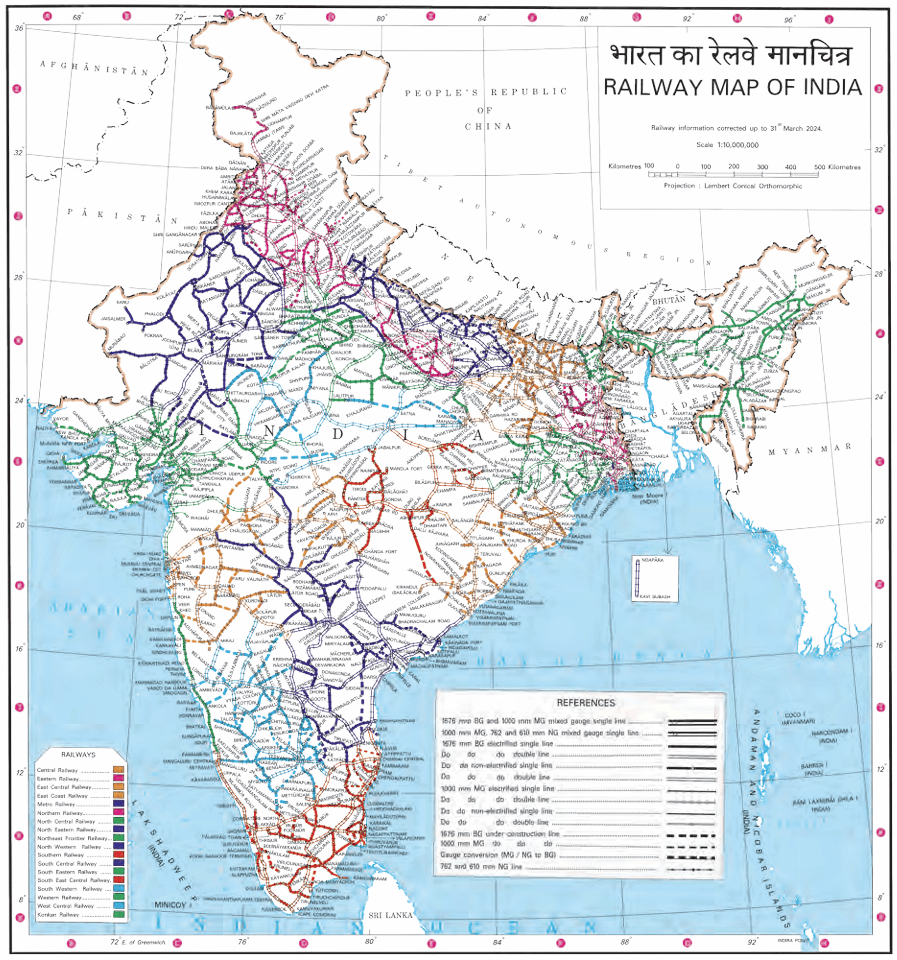
From 1853 to now, Indian railways have come a long way!
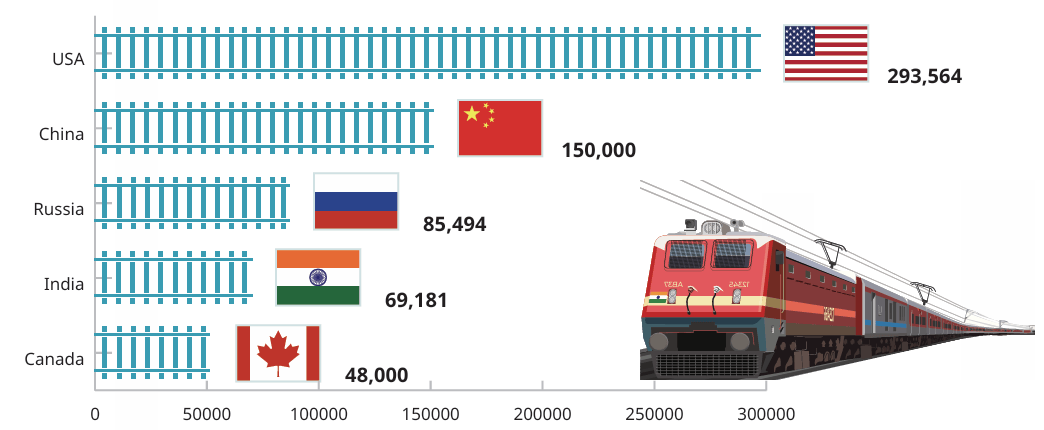
Today, Indian Railways is the fourth-largest railway system in the world.
c) Metro train systems
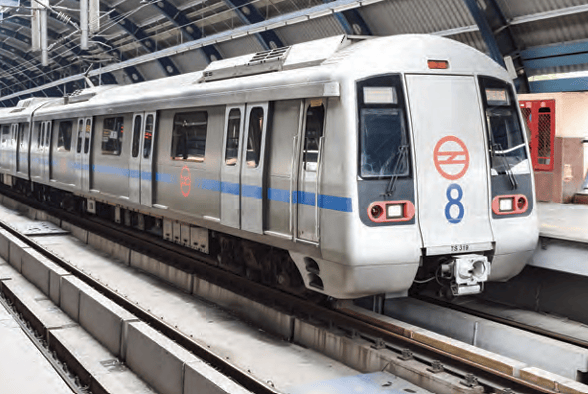
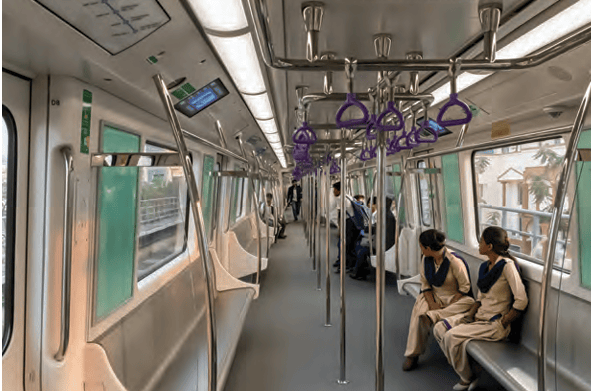
Metro trains operate in 23 Indian cities, with a total length of over 1,000 km. The network is expanding and soon India will have the third-largest network in the world, after China and the USA. They offer fast and reliable travel, easier daily commutes and help reduce road traffic. By running on underground and elevated tracks metro trains cut travel time, and also lower pollution by using cleaner fuels like electricity; some even use solar power, like the Delhi Metro.
LET'S EXPLORE
Have you or your family members ever taken a train or a metro? What sort of economic activities did you see around the stations? Share the experience with your classmates.
d) Air transport
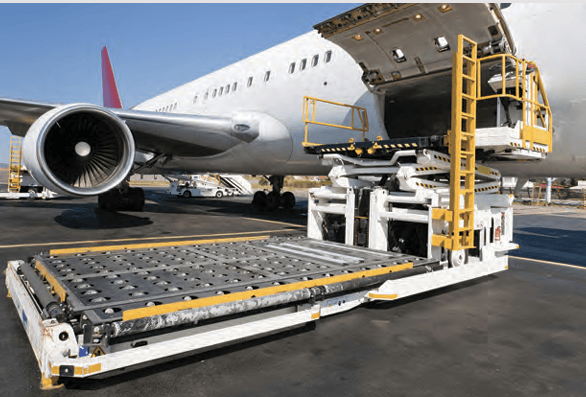
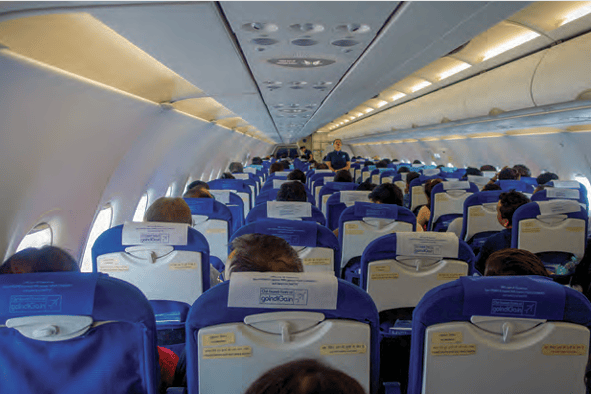
Air transport is the fastest way to connect people and places within and across countries. Passenger flights carry people and cargo flights move high-value or perishable goods like vaccines, chemicals, seafood, etc. These are particularly helpful in delivering aid to people during disasters like floods or earthquakes as they can reach difficult terrains like high mountains, deserts, dense forests, and long oceanic stretches easily.
DON'T MISS OUT
- India has the third-highest domestic air traffic in the world, after the USA and China, and handled around 376 million passengers in 2024–25!
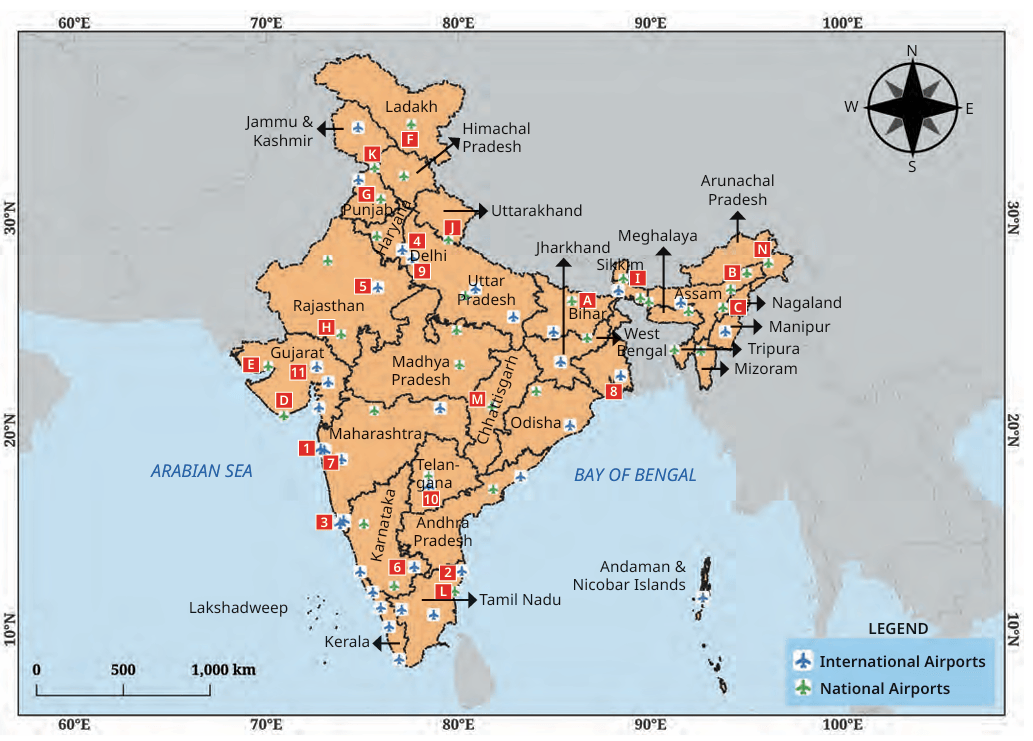
- Look at the Kempegowda International Airport in Bengaluru, Karnataka which is designed based on the concept of ‘garden city’. It is adorned with bamboo structures, plants and vibrant green spaces while also adopting the latest infrastructure to serve passengers.

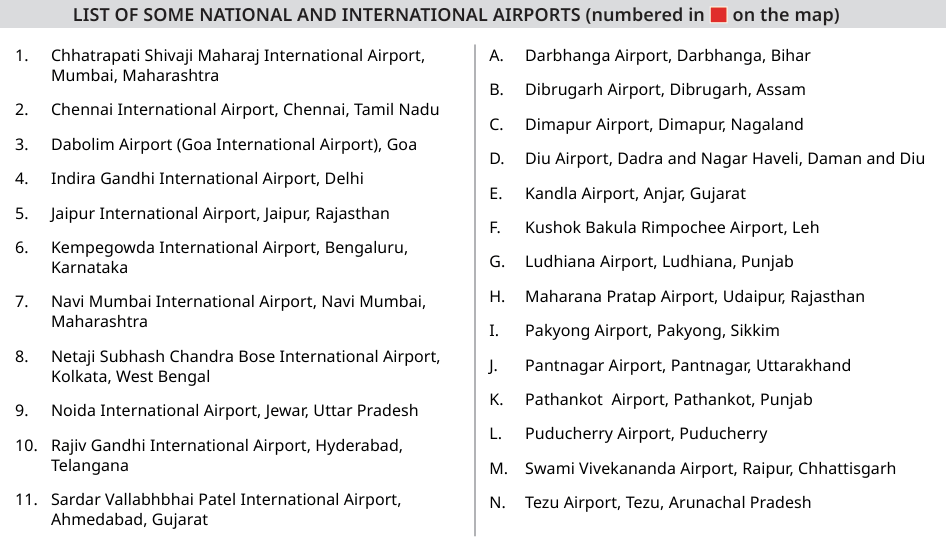
In 2025, India has 159 airports. Look at some of the international and domestic airports in the map Fig. 7.18. Which airport is closest to your home?
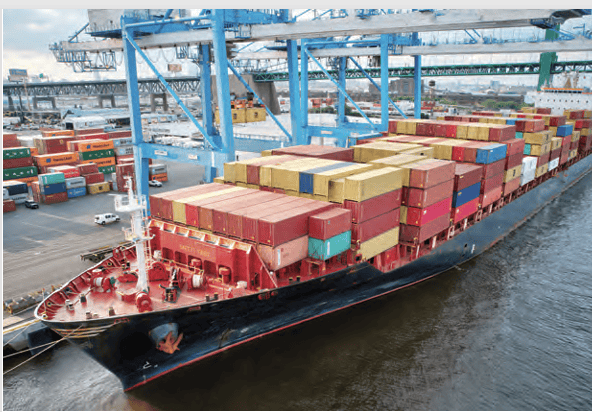
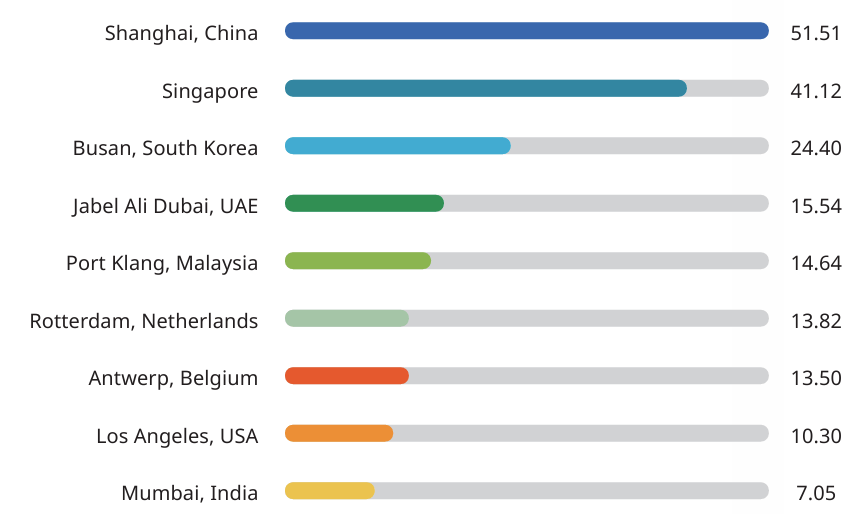
TEU stands for Twenty-foot Equivalent Units and measures the capacity of container ships and port activity. Generally, 1 TEU =33 cubic metres.
*These numbers need not be memorised by the students.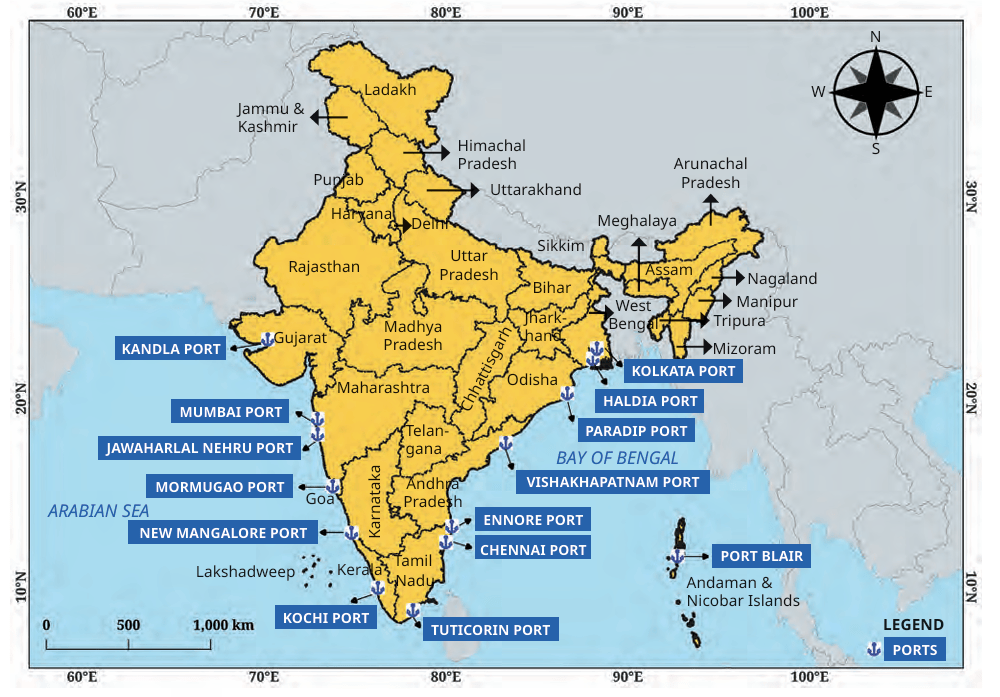
e) Shipping and ports
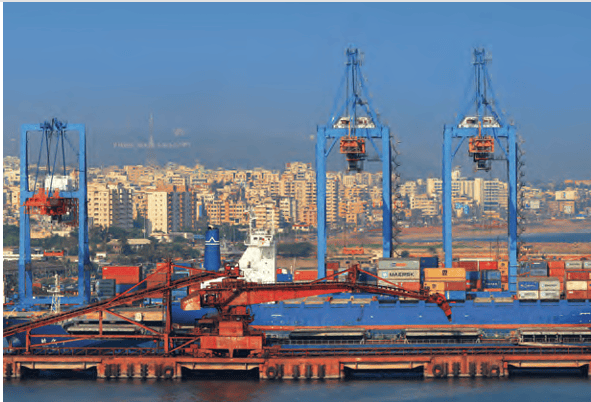
India's approximately 11,100 km of coastline is connected to regions like West Asia, Africa, and Europe, supporting trade through shipping. As a cheaper mode of transport, ships carry heavy goods like coal, cars, and cement over long distances. Ships dock at ports where goods are loaded and unloaded. India has 12 major ports and 217 minor ports. The volume of cargo handled has increased by 50 per cent in the past decade.
Communications Infrastructure
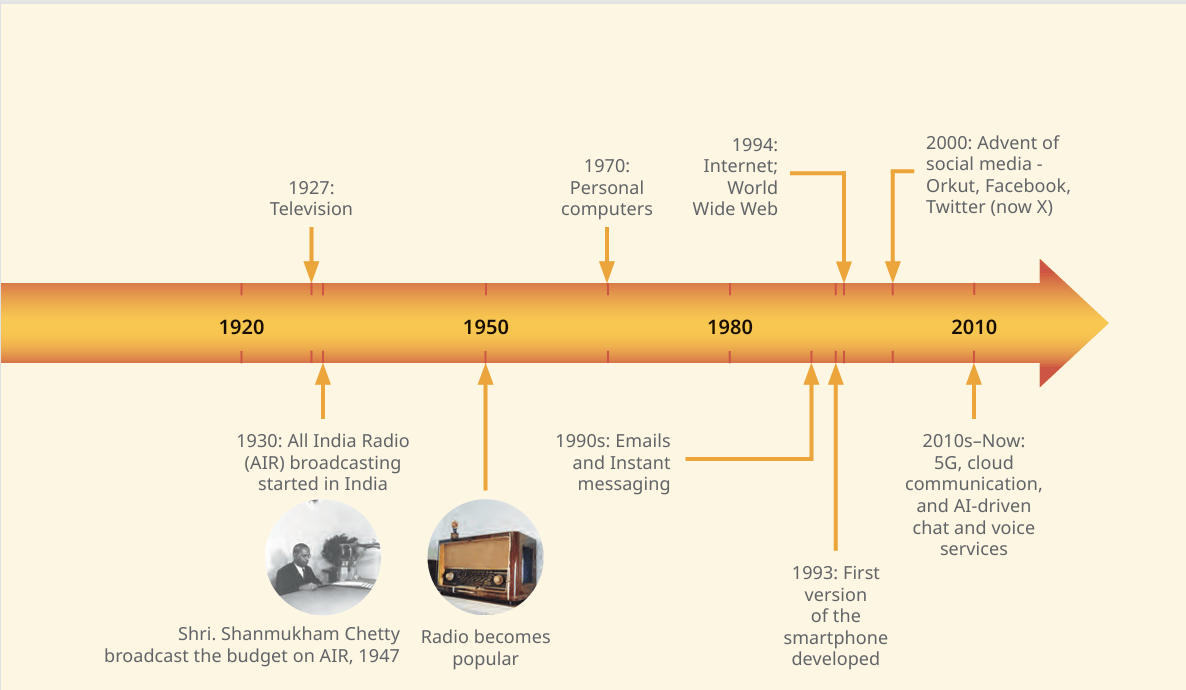
Technology has transformed how we communicate, making it faster and easier through devices like phones, computers, and tablets. Behind this is a communication infrastructure, including cables, wireless devices, towers, satellites, and data centres, that enables transmitting messages, images, and videos. Let us see how communication evolved from slow, manual methods to digital systems with instant global connectivity.
When Rani, from a village in Madhya Pradesh, sends a voice note to her cousin in Tamil Nadu, it feels so simple — just tap, record,send. But have you ever wondered what magical journey that tiny message takes? It’s not just the two phones. First, electricity powers the mobile tower near her village. Then, the message zips through fibre cables buried under fields and roads, gets Chhattisgarh transmitted to satellites in space, and travels through giant servers buzzing in distant cities — before finally popping up on her cousin’s phone. A whole invisible world is working together just so one little Namaste can reach across India.
THINK ABOUT IT
Which parts of this process do you think are easiest to see in real life, and which are completely invisible?
Through the advancements in communication, students can
access online classes, digital libraries, and educational videos,
even in remote areas. It aids emergency response during natural
disasters through quick mobile SMS alerts or apps. Small and
large businesses sell products across the world through
e-commerce. From quick online payments to e-governance
where citizens can apply for documents, file complaints, or get
information easily, progress in communication infrastructure
has promoted ease of living for communities. 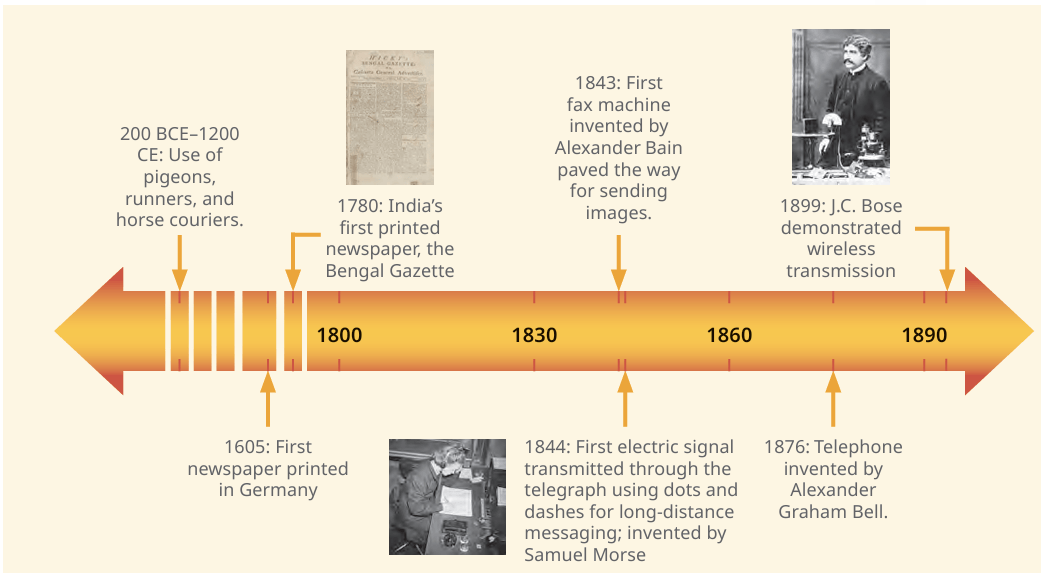
DON'T MISS OUT
J.C. Bose — The man who invented wireless transmission
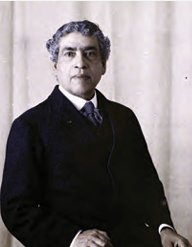
Jagadish Chandra Bose (1858–1937) was an Indian scientist who pioneered wireless transmission using microwaves in the millimetre range. In 1895, he showed in an experiment in Calcutta that signals could pass through a wall, using a bell and a remote-control gun. He also invented a new type of coherer, a key part of early wireless systems which decoded transmitted signals. Later, Guglielmo Marconi, an Italian physicist and inventor, patented a similar device in 1901 and, the same year, succeeded in transmitting a radio signal across the Atlantic; he won the Nobel Prize in Physics in 1909.
Despite the challenging research conditions Indian scientists had to face at that time, J.C. Bose invented many devices, such as a galena crystal detector (galena is a common lead ore), which was an early type of semiconductor, antennas, waveguides, etc., but rarely bothered to patent his inventions. This did not help his inventions gain international recognition, although he received several honours, also for his pioneering research on plant physiology. He created the Bose Institute in 1917, which has promoted much research in physics, biology and environmental sciences.
THINK ABOUT IT
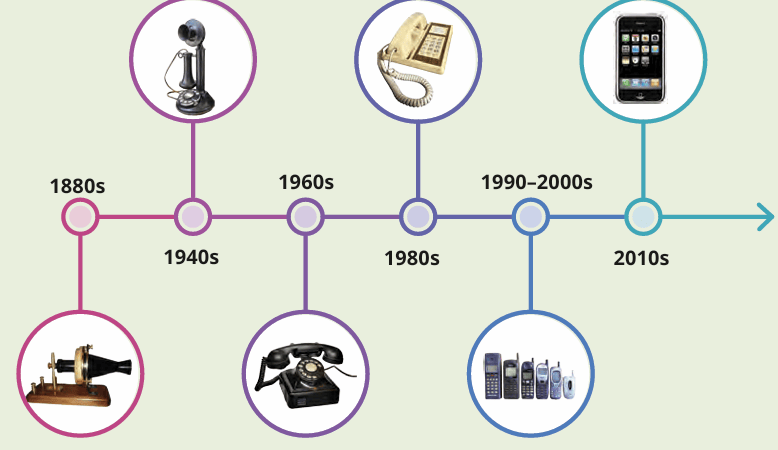
- In the 1990s, mobile calls in India cost up to ₹17 per minute, with charges even for incoming calls. Today, India has some of the world’s cheapest mobile and internet rates. How do you think this became possible?
- In 2025, there are 1,160 million wireless telephone subscribers and nearly 900 million internet connections in India.
- Ask your family or people in the neighbourhood how they sent long-distance messages before mobile phones were introduced. What has been their experience of using the first telephone or mobile phone?
THINK ABOUT IT
Do you see other types of infrastructure around you like schools, colleges, training centres, hospitals, health centres, police stations, fire stations, courts, parks, libraries, community centres and so on? This is known as social infrastructure. How do you think it supports the wellbeing and development of communities and society?
Collective Responsibility Towards Infrastructure
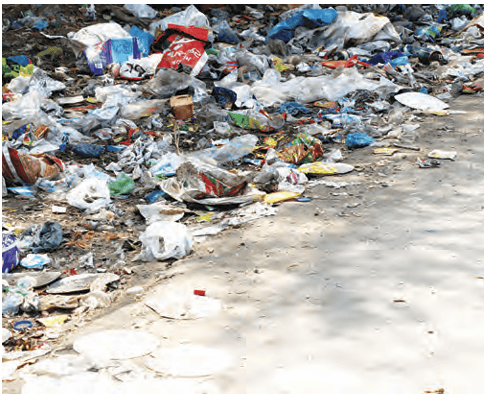
While India has developed major physical infrastructure in terms of airports, highways and so on, there still exist some challenges which need to be solved. We see roads being littered, stains on buildings, or writings on monuments. Such damage to public infrastructure reduces ease of living for people and becomes a burden for every citizen. Taking care of public infrastructure is a collective responsibility.
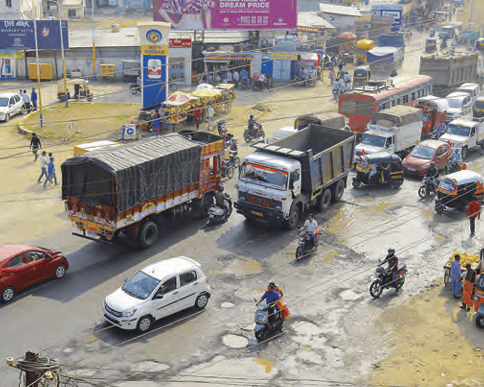
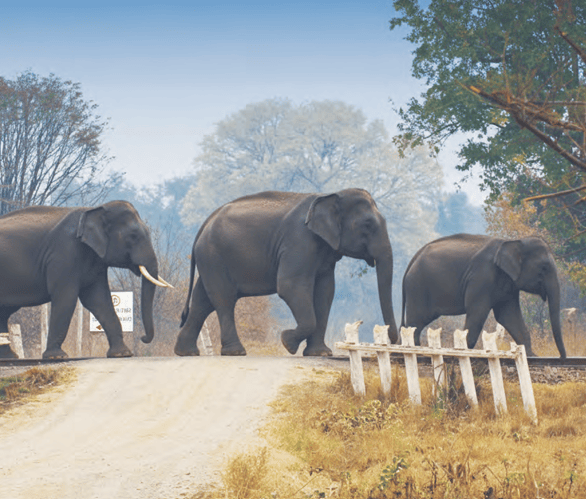
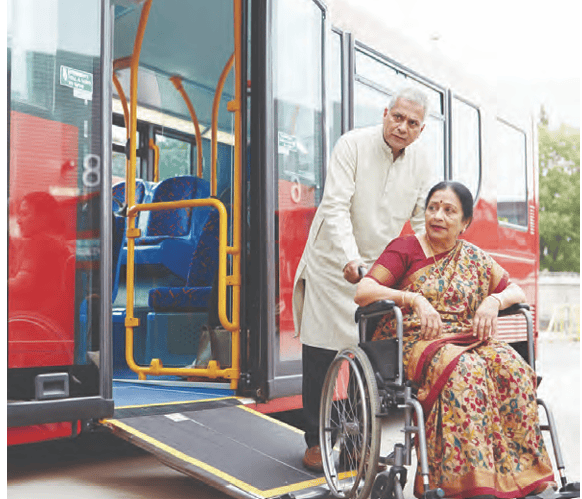
We also need to improve Panchayat and municipal administrative services for waste management, sewer systems, traffic management, provision of clean and safe drinking water, pedestrian-friendly footpaths. In addition, we need safe and sustainable infrastructure that uses cleaner energy and environment-friendly materials to minimise pollution and harm to bio-diversity — for instance, using solar panels for generating electricity for the buildings can reduce emissions. The design of the infrastructure should consider the needs of children, the elderly and disabled persons.
Infrastructure in the Arthaśhāstra
According to Kautilya’s Arthaśhāstra, the state, grāma, and sabhās were actively involved in the development and maintenance of roads and waterways. For instance, the text mentions detailed regulations for the construction of roads, where the janapadas were to have roads of different widths based on the nature of traffic that connected towns, villages, and neighbouring countries. For example, royal highways, roads in the countryside, port towns, and roads leading to villages should be 16 m wide. Forest roads and roads within the city should be 8 m; chariot roads should be 2.5 m in width, and so on (measurements simplified to the current metric system).
It also deterred damage to the physical infrastructure by recommending punishments and fines for individuals who violated the rules. For instance, it suggests a severe penalty for those damaging waterworks, such as breaking the dam of a reservoir, and fines for trespassing into public parks by breaking the hedge, and for obstructing paths to waterworks and forests.
While the government can impose penalties to deter damage to infrastructure, the role of citizens is equally important in maintaining it. Individuals need to use it responsibly and report any damage to the authorities such as in case of potholes or broken streetlights.
LET'S EXPLORE
- Create a ̒ Community Responsibility Pact ̓ on the board or as a poster. Come up with ideas on how individuals can develop a sense of responsibility towards public infrastructure.
- Can you think of ways in which infrastructure can become more sustainable around you? For example, what changes would you make to your school to make it more eco-friendly?
- Write down a list of five problems you have observed and their possible solutions on a sheet and discuss in class.
Before we move on …
-> Quality infrastructure is the backbone for all other economic activities taking place in a country. This enables better connectivity, employment opportunities for people and enhances ease of living.
-> Over time, India has witnessed phenomenal growth in physical infrastructure, and it is the duty of every citizen to preserve and maintain it.
Questions and activities
- Which form of physical infrastructure has been built in your area in the last decade? How do you think it has benefitted you or your family members? If you could build something for the community, what would it be?
- How does infrastructure like ports, highways, and airports create jobs in different parts of the country? Can you think of indirect ways people benefit from it?
- Why is it important to think about the environment when building new infrastructure like roads or airports? Can infrastructure development and environmental protection go hand in hand? If yes, how?
- How can better infrastructure (like roads, airports, communication systems) help during natural disasters like floods or earthquakes?
- Have you ever noticed people misusing public spaces, like scribbling on walls, breaking streetlights, or damaging benches? What are its consequences? Write your observations and suggest solutions to prevent it.
- Prepare ‘scenario posters’ for the following situations:
- A new factory is planned in an area. What form of infrastructure is required for its smooth operation?
- Self-cleaning roads, underground highways, and high-speed bullet trains could be part of a futuristic city! Imagine the kind of infrastructure that would be required in the future that could help ease the lives of the people and communities in your city, town or village for various day-to-day functions.
- Think about upgrades to the infrastructure near you, considering the terrain of your area, such as coastal, mountainous, plains, etc., and the type of natural calamities your region is prone to.
- If you could design a new railway or metro station, what would it look like and what features would you add to make it more fun and comfortable for the passengers?
- Today's modern infrastructure requires consistent technological innovations. For instance, electric vehicles are increasingly being used by people as a cheaper alternative to polluting fuel like diesel or petrol. Find out about other innovations in infrastructure that can improve ease of living or mobility for communities.