Chapter-2
ARITHMETIC EXPRESSIONS
2.1 Simple Expressions
You may have seen mathematical phrases like 13 + 2, 20 – 4, 12 × 5, and
18 ÷ 3. Such phrases are called arithmetic expressions.
Every arithmetic expression has a value which is the number it
evaluates to. For example, the value of the expression 13 + 2 is 15. This
expression can be read as ‘13 plus 2’ or ‘the sum of 13 and 2’.
We use the equality sign ‘=’ to denote the relationship between an
arithmetic expression and its value. For example:
13 + 2 = 15.
 Example 1: Mallika spends ₹25 every day for lunch at school. Write the expression for the total amount she spends on lunch in a week from Monday to Friday.
The expression for the total amount is 5 × 25.
5 × 25 is “5 times 25” or “the product of 5 and 25”.
Different expressions can have the same value. Here are multiple ways to express the number 12, using two numbers and any of the four operations +, – , × and ÷:
10 + 2, 15 – 3, 3 × 4, 24 ÷ 2.
Choose your favourite number and write as many expressions as you can having that value.
Comparing Expressions
Figure it Out
1. Fill in the blanks to make the expressions equal on both sides of the = sign:
- (a) 13 + 4 = ____ + 6
- (b) 22 + ____ = 6 × 5
- (c) 8 × ____ = 64 ÷ 2
- (d) 34 – ____ = 25
- (a) 67 – 19
- (b) 67 – 20
- (c) 35 + 25
- (d) 5 × 11
- (e) 120 ÷ 3
2. Arrange the following expressions in ascending (increasing) order of their values.
Example 2: Which is greater:1023 + 125 or 1022 + 128?
Imagining a situation could help us answer this without finding the actual values.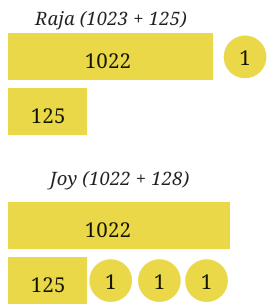 Raja had 1023 marbles and got 125 more today. Now he has 1023 + 125 marbles.
Joy had 1022 marbles and got 128 more today. Now he has 1022 + 128 marbles.
Who has more?
This situation can be represented as shown in the picture on the right.
To begin with, Raja had 1 more marble than Joy. But Joy got 3 more marbles than Raja today.
So, Joy has 2 more marbles than Raja now.
That is, 1023 + 125 < 1022 + 128.
Example 3: Which is greater: 113 – 25 or 112 – 24?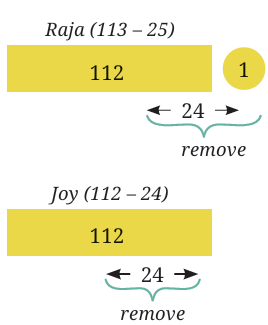 Imagine a situation: Raja had 113 marbles and lost 25 of them. He has 113 – 25 marbles.
Joy had 112 marbles and lost 24 today. He has 112 – 24 marbles.
Raja had 1 marble more than Joy, but he also lost 1 marble more than Joy did.
Therefore, they have an equal number of marbles now.
That is,
113 – 25 = 112 – 24.
Use ‘>’, ‘<’ or ‘=’ to compare the following expressions.
Can you do it without complicated calculations? Explain your thinking in each case.
(a) 245 + 289 ___ 246 + 285
(b) 273 – 145 ___ 272 – 144
(c) 364 + 587 ___ 363 + 589
(d) 124 + 245 ___ 129 + 245
(e) 213 – 77 ___ 214 – 76
2.2 Reading and Evaluating Complex Expressions
Sometimes, when an expression is not accompanied by a context, there can be more than one way of evaluating its value. In such cases, we need some tools and rules to specify how exactly the expression has to be evaluated.
To give an example with language, look at the following sentences:
- (a) Sentence: “Shalini sat next to a friend with toys”.
Meaning: The friend has toys and Shalini sat next to her.

- (b) Sentence: “Shalini sat next to a friend, with toys”.
Meaning: Shalini has the toys and she sat with them next to her friend.

This sentence without the punctuation could have been interpreted in two different ways. The appropriate use of a comma specifies how the sentence has to be understood.
Let us see an expression that can be evaluated in more than one way.
Example 4: Mallesh brought 30 marbles to the playground. Arun brought 5 bags of marbles with 4 marbles in each bag. How many marbles did Mallesh and Arun bring to the playground?
Mallesh summarized this by writing the mathematical expression —
30 + 5 × 4.
Without knowing the context behind this expression, Purna found the value of this expression to be 140. He added 30 and 5 first, to get 35,and then multiplied 35 by 4 to get 140.
Mallesh found the value of this expression to be 50. He multiplied 5 and 4 first to get 20 and added 20 to 30 to get 50.
In this case, Mallesh is right. But why did Purna get it wrong? Just looking at the expression 30 + 5 × 4, it is not clear whether we should do the addition first or multiplication.
Just as punctuation marks are used to resolve confusions in language, brackets and the notion of terms are used in mathematics to resolve confusions in evaluating expressions.
Brackets in Expressions
In the expression to find the number of marbles — 30 + 5 × 4 — we had to first multiply 5 and 4, and then add this product to 30. This order of operations is clarified by the use of brackets as follows:
30 + (5 × 4).
When evaluating an expression having brackets, we need to first find the values of the expressions inside the brackets before performing other operations. So, in the above expression, we first find the value of 5 × 4, and then do the addition. Thus, this expression describes the number of marbles:30 + (5 × 4 ) = 30 + 20 = 50.
Example 5: Irfan bought a pack of biscuits for ₹15 and a packet of toor
dal for ₹56. He gave the shopkeeper ₹100. Write an expression that can
help us calculate the change Irfan will get back from the shopkeeper.
Irfan spent ₹15 on a biscuit packet and ₹56 on toor dal. So, the total
cost in rupees is 15 + 56. He gave ₹100 to the shopkeeper. So, he should
get back 100 minus the total cost. Can we write that expression as—
100 – 15 + 56 ?
Can we first subtract 15 from 100 and then add 56 to the result? We will get 141. It is absurd that he gets more money than he paid the shopkeeper! We can use brackets in this case:100 – (15 + 56).
Evaluating the expression within the brackets first, we get 100 minus 71, which is 29. So, Irfan will get back ₹29.Terms in Expressions
Suppose we have the expression 30 + 5 × 4 without any brackets. Does it have no meaning?When there are expressions having multiple operations, and the order of operations is not specified by the brackets, we use the notion of terms to determine the order.
Terms are the parts of an expression separated by a ‘+’ sign. For example, in 12+7, the terms are 12 and 7, as marked below.
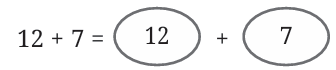
We will keep marking each term of an expression as above. Note
that this way of marking the terms is not a usual practice. This will be done until you become familiar with this concept.
Now, what are the terms in 83 – 14? We know that subtracting a number is the same as adding the inverse of the number. Recall that the inverse of a given number has the sign opposite to it. For example, the inverse of 14 is –14, and the inverse of –14 is 14. Thus, subtracting
14 from 83 is the same as adding –14 to 83. That is,
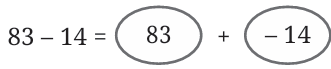
Thus, the terms of the expression 83 – 14 are 83 and –14.

Check if replacing subtraction by addition in this way does not change
the value of the expression, by taking different examples.
Can you explain why subtracting a number is the same as adding its inverse, using the Token Model of integers that we saw in the Class 6 textbook of mathematics? All subtractions in an expression are converted to
s in this manner to identify the terms.
Here are some more examples of expressions and their terms:
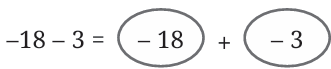


Note that 6 × 5, 4 × 6 are single terms as they do not have any ‘+’ sign. In the following table, some expressions are given. Complete the table.
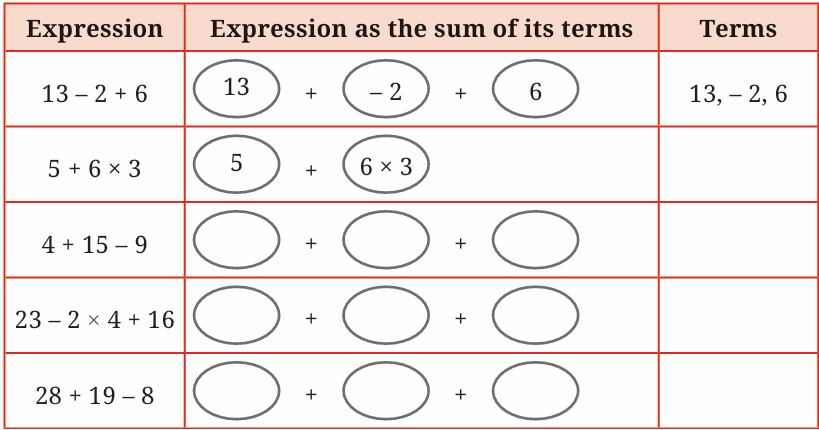
Now we will see how terms are used to determine the order of
operations to find the value of an expression.
We will start with expressions having only additions (with all the
subtractions suitably converted into additions).
Does changing the order in which the terms are added give different
values?
Swapping and Grouping
Let us consider a simple expression having only two terms.
Example 6: Madhu is flying a drone from a terrace. The drone goes 6 m
up and then 4 m down. Write an expression to show how high the final
position of the drone is from the terrace.
The drone is 6 – 4 = 2 m above the terrace. Writing it as sum of terms:
Will the sum change if we swap the terms?
We already know that swapping the terms does not change the sum
when both the terms are positive numbers.
Will this also hold when there are terms having negative numbers as
well? Take some more expressions and check.
Can you explain why this is happening using the Token Model of
integers that we saw in the Class 6 textbook of mathematics?
Thus, in an expression having two terms, swapping them does not
change the value.
Now consider an expression having three terms: (–7) + 10 + (–11). Let
us add these terms in the following two different orders: 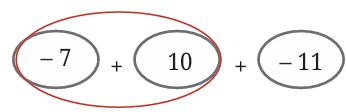 (adding the first two terms and then adding their sum to the third
term)
(adding the first two terms and then adding their sum to the third
term)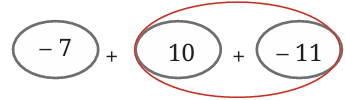 (adding the last two terms and then adding their sum to the first term)
What do you see? The sums are the same in both cases.
Again, we know that while adding positive numbers, grouping them
in any of the above two ways gives the same sum.
Will this also hold when there are terms having negative numbers as
well? Take some more expressions and check.
Can you explain why this is happening using the Token Model of
integers that we saw in the Class 6 textbook of mathematics?
Thus, grouping the terms of an expression in either of the following
ways gives the same value.
We see that adding the terms of the expression (–7) + 10 + (–11) in any order gives the same sum of –8.
Does adding the terms of an expression in any order give the same value? Take some more expressions and check. Consider expressions with more than 3 terms also.
Can you explain why this is happening using the Token Model of integers that we saw in the Class 6 textbook of mathematics?
Thus, the addition of terms in any order gives the same value.
Therefore, in an expression having only additions, it does not matter
in what order the terms are added: they all give the same value.
Now let us consider expressions having multiplication and division
also, without the order of operations specified by the brackets. The
values of such expressions are found by first evaluating the terms.
Once all the terms are evaluated, they are added.
For example, the expression 30 + 5 × 4 is evaluated as follows: The expression 5 × (3 + 2) + 78 + 3 is evaluated as follows:
 Where (3+2) is first evaluated and this sum is multiplied by 5 (= 25).
The expression 7 × 8 is evaluated (= 56). This simplifies to 25 + 56 + 3 =
84.
Where (3+2) is first evaluated and this sum is multiplied by 5 (= 25).
The expression 7 × 8 is evaluated (= 56). This simplifies to 25 + 56 + 3 =
84.
Manasa is adding a long list of numbers. It took her five minutes to add them all and she got the answer 11749. Then she realised that she had forgotten to include the fourth number 9055. Does she have to start all over again?
In mathematics we use the phrase commutative property of addition instead of saying “swapping terms does not change the sum”. Similarly, “grouping does not change the sum” is called the associative property of addition.
Swapping the Order of Things in Everyday Life
Manasa is going outside to play. Her mother says, “Wear your hat and shoes!”
  Which one should she wear first? She can wear her hat first and then her shoes. Or she can wear her shoes first and then her hat.
Manasa will look exactly the same in both cases. Imagine a different situation: Manasa’s mother says “Wear your socks and shoes!” Now the order matters. She should wear socks and then shoes. If she wears
shoes and then socks, Manasa will feel very uncomfortable and look very different.
More Expressions and Their Terms
Example 7: Amu, Charan, Madhu, and John went to a hotel and ordered
four dosas. Each dosa cost ₹23, and they wish to thank the waiter by
tipping ₹5. Write an expression describing the total cost.
Cost of 4 dosas = 4 × 23
Can the total amount with tip be written as 4 × 23 + 5? Evaluating it, we get
Thus, 4 × 23 + 5 is a correct way of writing the expression.
If the total number of friends goes up to 7 and the tip remains the same, how much will they have to pay? Write an expression for this situation and identify its terms.
Example 8: Children in a class are playing “Fire in the mountain, run, run, run!”. Whenever the teacher calls out a number, students are supposed to arrange themselves in groups of that number. Whoever is not part of the announced group size, is out.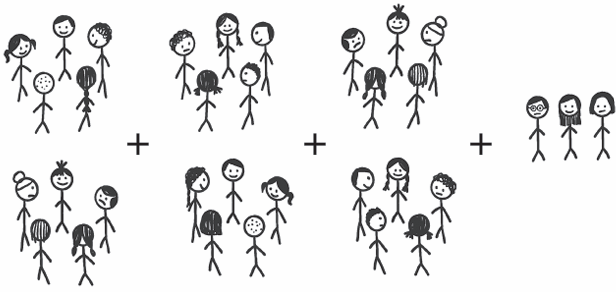 Ruby wanted to rest and sat on one side. The other 33 students were playing the game in the class. The teacher called out ‘5’. Once children settled, Ruby wrote 6 × 5 + 3
(understood as 3 more than 6 × 5)
Ruby wanted to rest and sat on one side. The other 33 students were playing the game in the class. The teacher called out ‘5’. Once children settled, Ruby wrote 6 × 5 + 3
(understood as 3 more than 6 × 5)
Think and discuss why she wrote this.
The expression written as a sum of terms is—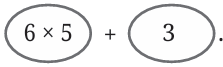
For each of the cases below, write the expression and identify its terms:
If the teacher had called out ‘4’, Ruby would write ____________
If the teacher had called out ‘7’, Ruby would write ____________
Write expressions like the above for your class size.
Example 9: Raghu bought 100 kg of rice from the wholesale market and packed them into 2 kg packets. He already had four 2 kg packets.Write an expression for the number of 2 kg packets of rice he has now and identify the terms.
He had 4 packets. The number of new 2 kg packets of rice is 100 ÷ 2, which we also write as 100/2.
The number of 2 kg packets he has now is 4 + 100/2 . The terms are—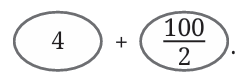
Example 10: Kannan has to pay ₹432 to a shopkeeper using coins of ₹1
and ₹5, and notes of ₹10, ₹20, ₹50 and ₹100. How can he do it?
There is more than one possibility. For example,
432 = 4 × 100 + 1 × 20 + 1 × 10 + 2 × 1
Meaning: 4 notes of ₹100, 1 note of ₹20, 1 note of ₹10 and 2 notes of ₹1432 = 8 × 50 + 1 × 10 + 4 × 5 + 2 × 1
Meaning: 8 notes of ₹50, 1 note of ₹10, 4 notes of ₹5 and 2 notes of ₹1 Identify the terms in the two expressions above.
Can you think of some more ways of giving ₹432 to someone?
Example 11:Here are two pictures. Which of these two arrangements
matches with the expression 5 × 2 + 3?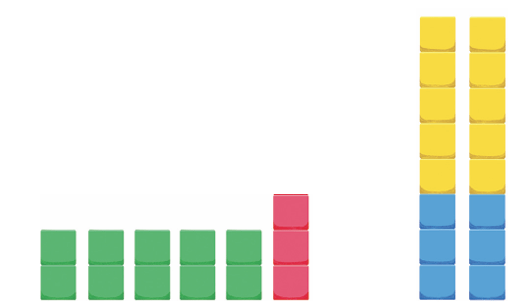
Let us write this expression as a sum of terms. This expression 5 × 2 + 3 can be understood as 3 more than 5 × 2, which describes the arrangement on the
.
This expression 5 × 2 + 3 can be understood as 3 more than 5 × 2, which describes the arrangement on the
.
What is the expression for the arrangement in the right making use of
the number of yellow and blue squares?
Do you recall the use of brackets? We need to use brackets for this.
2 × (5 + 3)
Notice that this arrangement can also be described using—5 + 3 + 5 + 3
OR
5 × 2 + 3 × 2
Figure it Out
1. Find the values of the following expressions by writing the terms in each case.
- (a) 28 – 7 + 8
- (b) 39 – 2 × 6 + 11
- (c) 40 – 10 + 10 + 10
- (d) 48 – 10 × 2 + 16 ÷ 2
- (e) 6 × 3 – 4 × 8 × 5
2. Write a story/situation for each of the following expressions and find their values.
- (a) 89 + 21 – 10
- (b) 5 × 12 – 6
- (c) 4 × 9 + 2 × 6
3. For each of the following situations, write the expression describing the situation, identify its terms and find the value of the expression.
- (a) Queen Alia gave 100 gold coins to Princess Elsa and 100 gold coins to Princess Anna last year. Princess Elsa used the coins to start a business and doubled her coins. Princess Anna bought jewellery and has only half of the coins . Write an expression describing how many gold coins Princess Elsa and Princess Anna together have.
- (b) A metro train ticket between two stations is ₹40 for an adult
 and ₹20 for a child. What is the total cost of tickets:
- (i) for four adults and three children?
- (ii)for two groups having three adults each?
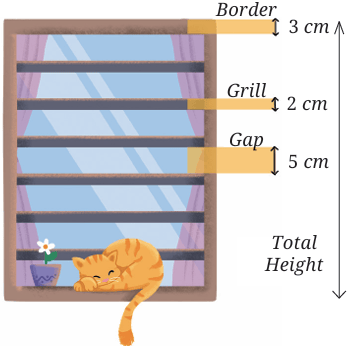
- (c) Find the total height of the window by writing an expression describing the relationship among the measurements shown in the picture.
Removing Brackets — I
Let us find the value of this expression,
200 – (40 + 3).
We first evaluate the expression inside the bracket to 43 and then subtract it from 200. But it is simpler to first subtract 40 from 200:200 – 40 = 160.
And then subtract 3 from 160:160 – 3 = 157.
What we did here was 200 – 40 – 3. Notice, that we did not do200 – 40 + 3.
So,200 – (40 + 3) = 200 – 40 – 3.
Example 12: We also saw this earlier in the case of Irfan purchasing a
biscuit packet (₹15) and a toor dal packet (₹56). When he paid ₹100, the
change he gets in rupees is:
100 – (15 + 56) = 29.
The change could also have been calculated as follows:(a) First subtract the cost of the biscuit packet (15) from 100:
100 – 15 = 85.
This is the amount the shopkeeper owes Irfan if he had purchased only the biscuits. As he has purchased toor dal also, its cost is taken from this remaining amount of 85.(b) So, to find the change, we need to subtract the cost of toor dal from 85.
85 – 56 = 29.
What we have done here is 100 – 15 – 56. So,100 – (15 + 56) = 100 – 15 – 56.
Notice how upon removing the brackets preceded by a negative sign, the signs of the terms inside the brackets change. Observe the signs of 40 and 3 in the first example, and that of 15 and 56 in the second. Example 13: Consider the expression 500 – (250 – 100). Is it possible to
write this expression without the brackets?
To evaluate this expression, we need to subtract 250 – 100 = 150
from 500:
500 – (250 – 100) = 500 – 150 = 350.
If we were to directly subtract 250 from 500, then we would have subtracted 100 more than what we needed to. So, we should add back that 100 to 500 – 250 to make the expression take the same value as 500 – (250 – 100). This sequence of operations is 500 – 250+100. Thus,500 – (250 – 100) = 500 – 250 + 100.
Check that 500 – (250 – 100) is not equal to 500 – 250 – 100. Notice again that when the brackets preceded by a negative sign are removed, the signs of the terms inside the brackets change. In this case, the signs of 250 and – 100 change to – 250 and 100. Example 14: Hira has a rare coin collection. She has 28 coins in one bag
and 35 coins in another. She gifts her friend 10 coins from the second
bag. Write an expression for the number of coins left with Hira.
This can be expressed by 28 + (35 – 10).
We know that this is the same as 28 + (35 + (–10)). Since the terms can be added in any order, this expression can simply be written as 28 + 35 + (–10), or 28 + 35 – 10. Thus,28 + (35 – 10) = 28 + 35 – 10 = 53.
When the brackets are NOT preceded by a negative sign, the terms within them do not change their signs upon removing the brackets. Notice the sign of the terms 35 and – 10 in the above expression. Rather than simply remembering rules for when to change the sign and
when not to, you can figure it out for yourself by thinking about the
meanings of the expressions.
Rather than simply remembering rules for when to change the sign and
when not to, you can figure it out for yourself by thinking about the
meanings of the expressions.
Tinker the Terms I
What happens to the value of an expression if we increase or decrease
the value of one of its terms?
Some expressions are given in following three columns. In each
column, one or more terms are changed from the first expression. Go
through the example (in the first column) and fill the blanks, doing as
little computation as possible.
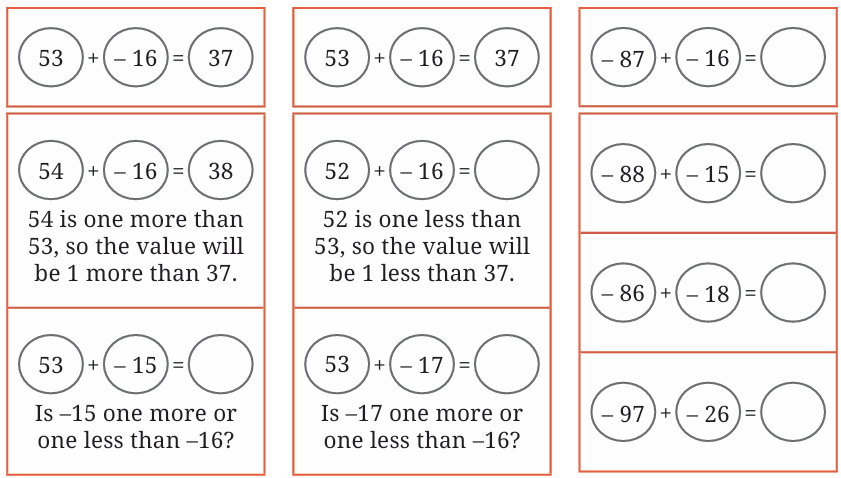
Figure it Out
1. Fill in the blanks with numbers, and boxes with operation signs such that the expressions on both sides are equal.
- (a) 24 + (6 – 4) = 24 + 6 _____ _____
- (b) 38 + (_____ _____ _____) = 38 + 9 – 4
- (c) 24 – (6 +4) = 24 ___ 6 – 4
- (d) 24 – 6 – 4 = 24 – 6 _____ _____
- (e) 27 – (8 + 3) = 27 8 3
- (f) 27– (_____ _____ _____) = 27 – 8 + 3
2. Remove the brackets and write the expression having the same value.
- (a) 14 + (12 + 10)
- (b) 14 – (12 + 10)
- (c) 14 + (12 – 10)
- (e) –14 + (12 – 10)
- (d) 14 – (12 – 10)
- (f) 14 – (–12 – 10)
3. Find the values of the following expressions. For each pair, first try to guess whether they have the same value. When are the two expressions equal?
- (a) (6 + 10) – 2 and 6 + (10 – 2)
- (b) 16 – (8 – 3) and (16 – 8) – 3
- (c) 27 – (18 + 4) and 27 + (–18 – 4)
4. In each of the sets of expressions below, identify those that have the same value. Do not evaluate them, but rather use your understanding of terms.
- (a) 319 + 537, 319 – 537, – 537 + 319, 537 – 319
- (b) 87 + 46 – 109, 87 + 46 – 109, 87 + 46 – 109, 87 – 46 + 109, 87 – (46 + 109), (87 – 46) + 109
5. Add brackets at appropriate places in the expressions such that they lead to the values indicated.
- (a) 34 – 9 + 12 = 13 (b) 56 – 14 – 8 = 34 (c) –22 – 12 + 10 + 22 = – 22
6. Using only reasoning of how terms change their values, fill the blanks to make the expressions on either side of the equality (=) equal.
- (a) 423 + ______= 419 + ______
- (b) 207 – 68 = 210 – ______
7. Using the numbers 2, 3 and 5, and the operators ‘+’ and ‘–’, and brackets, as necessary, generate expressions to give as many different values as possible. For example, 2 – 3 + 5 = 4 and 3 – (5 – 2) = 0.
8. Whenever Jasoda has to subtract 9 from a number, she subtracts 10 and adds 1 to it. For example, 36 – 9 = 26 + 1.
- (a) Do you think she always gets the correct answer? Why?
- (b) Can you think of other similar strategies? Give some examples.
9. Consider the two expressions: a) 73 – 14 + 1, b) 73 – 14 – 1. For each of these expressions, identify the expressions from the following collection that are equal to it.
- (a) 73 – (14 + 1)
- (b) 73 – (14 – 1)
- (c) 73 + (– 14 + 1)
- (d) 73 + (– 14 – 1)
Removing Brackets — II
Example 15: Lhamo and Norbu went to a hotel. Each of them ordered
a vegetable cutlet and a rasgulla. A vegetable cutlet costs ₹43 and a
rasgulla costs ₹24. Write an expression for the amount they will have
to pay.
As each of them had one vegetable cutlet and one rasagulla, each of their shares can be represented by 43 + 24.
What about the total amount they have to pay? Can it be described by
the expression: 2 × 43 + 24?
Writing it as sum of terms gives:
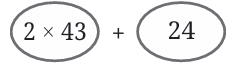
This expression means 24 more than
2 × 43. But, we want an expression
which means twice or double of 43 + 24.
We can make use of brackets to write
such an expression:
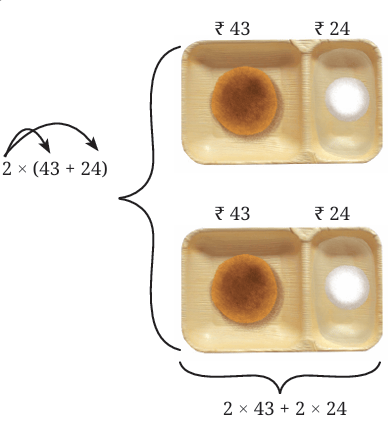
2 × (43 + 24).
So, we can say that together they have to pay 2 × (43 + 24). This is also the same as paying for two vegetable cutlets and two rasgullas:2 × 43 + 2 × 24.
Therefore,2 × (43 + 24) = 2 × 43 + 2 × 24.
Example 16: In the Republic Day parade, there are boy scouts and girl
guides marching together. The scouts march in 4 rows with 5 scouts in
each row. The guides march in 3 rows with 5 guides in each row (see
the figure below). How many scouts and guides are marching in this
parade?
The number of boy scouts marching is 4 × 5. The number of girl
guides marching is 3 × 5.
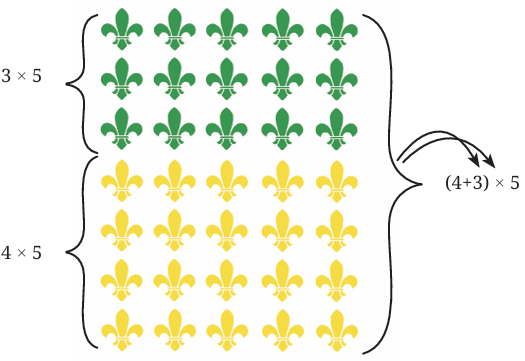
The total number of scouts and guides will be
4 × 5 + 3 × 5.
This can also be found by first finding the total number of rows, i.e., 4 + 3, and then multiplying
their sum by the number of children in each row. Thus, the number of boys and girls can be found by
(4 + 3) × 5.
Therefore, 4 × 5 + 3 × 5
= (4 + 3) × 5.
Computing these expressions, we get
 (4 + 3) × 5 = 7 × 5 = 35
5 × 4 + 3 ≠ 5 × (4 + 3). Can you explain why?
Is 5 × (4 + 3) = 5 × (3 + 4) = (3 + 4) × 5?
The observations that we have made in the previous two examples
can be seen in a general way as follows.
Consider 10 × 98 + 3 × 98. This means taking the sum of 10 times 98
and 3 times 98.
10 × 98 +3 × 98 = (10 + 3) × 98.
Writing this equality the other way, we get(10 + 3) 98 = 10 × 98 + 3 × 98.
Swapping the numbers in the products above, this property can be seen in the following form:98 × 10 + 9 × 83 = 98 (10 + 3), and 98 (10 + 3) = 98 × 10 + 98 × 3.
Similarly, let us consider the expression 14 × 10 – 6 × 10. This means subtracting 6 times 10 from 14 times 10. Clearly, this is 14 – 6 = 8 times 10. Thus,
14 × 10 – 6 × 10 = (14 – 6) × 10,
or
(14 – 6) × 10 = 14 × 10 – 6 × 10
The multiple of a sum (difference) is the same as the sum (difference) of the multiples.
Tinker the Terms II
Let us understand what happens when we change the numbers occurring in a product.Example 17: Given 53 × 18 = 954. Find out 63 × 18.
As 63 × 18 means 63 times 18,
63 × 18 = (53 + 10) × 18
= 53 ×18 + 10×18
= 954 + 180
= 1134.
Example 18: Find an effective way of evaluating 97 × 25.
97 × 25 means 97 times 25.
We can write it as (100 – 3) × 25
We know that this is the same as the difference of 100 times 25 and
3 times 25:
97 × 25 = 100 × 25 – 3 × 25
Find this value.Use this method to find the following products:
- (a) 95 × 8
- (b) 104 × 15
- (c) 49 × 50
Which other products might be quicker to find like the ones above?
Figure it Out
1. Fill in the blanks with numbers, and boxes by signs, so that the expressions on both sides are equal.
- (a) 3 × (6 + 7) = 3 × 6 + 3 × 7
- (b) (8 + 3) × 4 = 8 × 4 + 3 × 4
- (c) 3 × (5 + 8) = 3 × 5 ___ 3 × ____
- (d) (9 + 2) × 4 = 9 × 4 ___ 2 ×____
- (e) 3 × (____ + 4) = 3 ____+____
- (f) (____+ 6) × 4 = 13 × 4 + ____
- (g) 3 × (____+____) = 3 × 5 + 3 × 2
- (h) (____+____)×____= 2 × 4 + 3 × 4
- (i)5 × (9 – 2) = 5 × 9 – 5 × ____
- (j)(5 – 2) × 7 = 5 × 7 – 2 × ____
- (k) 5 × (8 – 3) = 5 × 8___ 5 × ____
- (l)(8 – 3) × 7 = 8 × 7 ___ 3 × 7
- (m) 5 × (12 –____) =____ ____ 5 ×____
- (n) (15 –____) × 7 =____ 6 × 7
- (o) 5 × (____–____) = 5 × 9 – 5 × 4
- (p) (____–____) × ____= 17 × 7 – 9 × 7
2. In the boxes below, fill '<', '>' or '=' after analysing the expressions on the LHS and RHS. Use reasoning and understanding of terms and brackets to figure this out and not by evaluating the expressions.
- (a) (8 – 3) × 29 ___ (3 – 8) × 29
- (b) 15 + 9 × 18 ____ (15 + 9) × 18
- (c) 23 × (17 – 9) ____ 23 × 17 + 23 × 9
- (d) (34 – 28) × 42 ____34 × 42 – 28 × 42
3. Here is one way to make 14: _2_ × ( _1_ + _6_ ) = 14. Are there other ways of getting 14? Fill them out below:
- (a) _____× (_____+_____) = 14
- (b) _____× (_____+_____) = 14
- (c) _____× (_____+_____) = 14
- (d) _____× (_____+_____) = 14
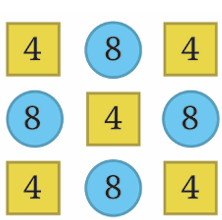
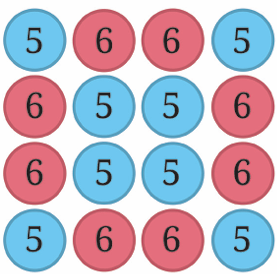
4. Find out the sum of the numbers given in each picture below in at least two different ways. Describe how you solved it through expressions
2. Melvin reads a two-page story every day except on Tuesdays and Saturdays. How many stories would he complete reading in 8 weeks? Which of the expressions below describes this scenario?
- (a) 5 × 2 × 8
- (b) (7 – 2) × 8
- (c) 8 × 7
- (d) 7 × 2 × 8
- (e) 7 × 5 – 2
- (f) (7 + 2) × 8
- (g) 7 × 8 – 2 × 8
- (h) (7 – 5) × 8
3. Find different ways of evaluating the following expressions:
- (a) 1 – 2 + 3 – 4 + 5 – 6 + 7 – 8 + 9 – 10
- (b) 1 – 1 + 1 – 1 + 1 – 1 + 1 – 1 + 1 – 1
4. Compare the following pairs of expressions using '<', '>' or '=' or by reasoning.
- (a) 49 – 7 + 8 ___ 49 – 7 + 8
- (b) 83 × 42 – 18 ___ 83 × 40 – 18
- (c) 145 – 17 × 8 ___ 145 – 17 × 6
- (d) 23 × 48 – 35 ___ 23 × (48 – 35)
- (e) (16 – 11) × 12 ___ –11 × 12 + 16 × 12
- (f) (76 – 53) × 88 ___ 88 × (53 – 76)
- (g) 25 × (42 + 16) ___ 25 × (43 + 15)
- (h) 36 × (28 – 16) ___ 35 × (27 – 15)
5. Identify which of the following expressions are equal to the given expression without computation. You may rewrite the expressions using terms or removing brackets. There can be more than one expression which is equal to the given expression.
(a) 83 – 37 – 12
- (i)84 – 38 – 12
- (ii)84 – (37 + 12)
- (iii) 83 – 38 – 13
- (iv) – 37 + 83 –12
(b) 93 + 37 × 44 + 76
- (i) 37 + 93 × 44 + 76
- (ii) 93 + 37 × 76 + 44
- (iii) (93 + 37) × (44 + 76)
- (iv) 37 × 44 + 93 + 76
6. Choose a number and create ten different expressions having that value.
SUMMARY
- We have been reading and evaluating simple expressions for quite some time now. Here we started by revising the meaning of some simple expressions and their values.
- We learnt how to compare certain expressions through reasoning instead of bluntly evaluating them.
- To help read and evaluate complex expressions without confusion, we use terms and brackets.
- When an expression is written as a sum of terms, changing the order of the terms or grouping the terms does not change the value of the expression. This is because the “commutative property of addition” and the “associative property of addition”, respectively.
- To evaluate expressions within brackets, we saw that when we remove brackets preceded by a negative sign, the terms within the bracket change their sign.
- We also learnt about the “distributive property” — multiplying a number with an expression inside brackets is equal to the multiplying the number with each term in the bracket
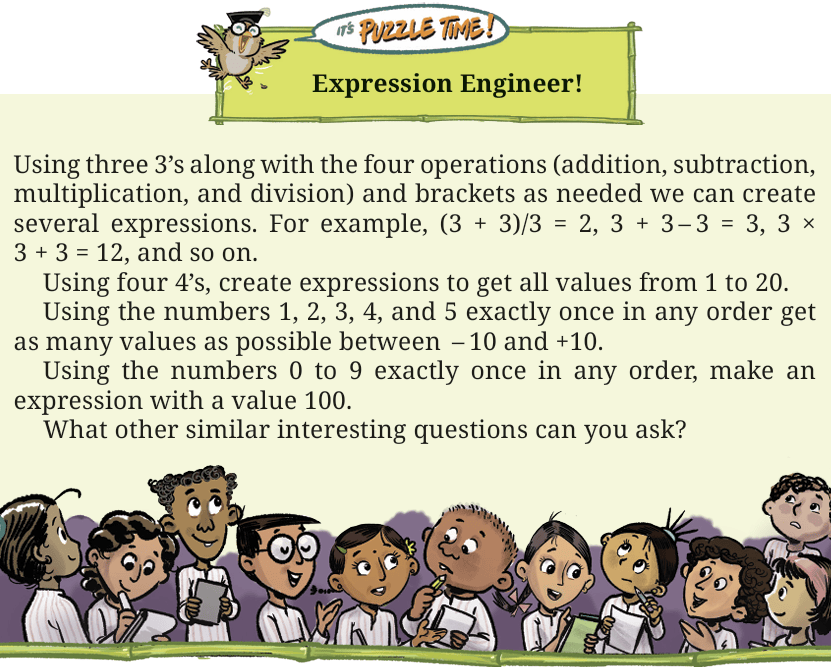
IT'S PUZZLE TIME
Using three 3’s along with the four operations (addition, subtraction,
multiplication, and division) and brackets as needed we can create
several expressions. For example, (3 + 3)/3 = 2, 3 + 3 – 3 = 3, 3 ×
3 + 3 = 12, and so on.
Using four 4’s, create expressions to get all values from 1 to 20.
Using the numbers 1, 2, 3, 4, and 5 exactly once in any order get
as many values as possible between – 10 and +10.
Using the numbers 0 to 9 exactly once in any order, make an
expression with a value 100.
What other similar interesting questions can you ask?