Chapter-5
PARALLEL AND INTERSECTING LINES
5.1 Across the Line
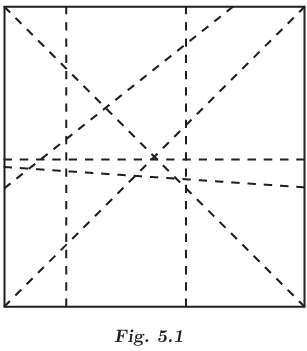
Take a piece of square paper and fold it in different ways. Now, on the creases formed by the folds, draw lines using a pencil and a scale. You will notice different lines on the paper. Take any pair of lines and observe their relationship with each other. Do they meet? If they do not meet within the paper, do you think they would meet if they were extended beyond the paper?
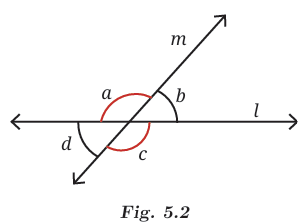
Let us observe a pair of lines that meet each other. You will notice that they meet at a point. When a pair of lines meet each other at a point on a plane surface, we say that the lines intersect each other. Let us observe what happens when two lines intersect.
 How many angles do they form?
In Fig. 5.2, where line l intersects line m, we can see that four angles
are formed.
How many angles do they form?
In Fig. 5.2, where line l intersects line m, we can see that four angles
are formed.
Can two straight lines intersect at more than one point?
Activity 1
Draw two lines on a plain sheet of paper so that they intersect. Measure
the four angles formed with a protractor. Draw four such pairs of
intersecting lines and measure the angles formed at the points of
intersection.
What patterns do you observe among these angles?
In Fig. 5.2, if ∠a is 120°, can you figure out the measurements of ∠b, ∠c
and ∠d, without drawing and measuring them?
We know that ∠a and ∠b together measure 180°, because when they
are combined, they form a straight angle which measures 180°. So, if
∠a is 120°, then ∠b must be 60°.
Similarly, ∠b and ∠c together measure 180°. So, if ∠b is 60°, then ∠c
must be 120°. And ∠c and ∠d together measure 180°. So, if ∠c is 120°,
then ∠d must be 60°.
Therefore, in Fig. 5.2, ∠a and ∠c measure 120°, and ∠b and ∠d
measure 60°.
When two lines intersect each other and form four angles, labelled
a, b, c and d, as in Fig. 5.2, then ∠a and ∠c are equal, and ∠b and ∠d
are equal!
Is this always true for any pair of intersecting lines?
Check this for different measures of ∠a. Using these measurements, can you reason whether this property holds true for any measure of ∠a? We can generalise our reasoning for Fig. 5.2, without assuming the values of ∠a.
Since straight angles measure 180°, we must have ∠a + ∠b = ∠a + ∠d = 180°. Hence, ∠b and ∠d are always equal. Similarly, ∠b + ∠a = ∠b + ∠c = 180°, so ∠a and ∠c must be equal.Adjacent angles, like ∠a and ∠b, formed by two lines intersecting each other, are called linear pairs. Linear pairs always add up to 180°.Opposite angles, like ∠b and ∠d, formed by two lines intersecting each other, are called vertically opposite angles. Vertically opposite angles are always equal to each other.
From the above reasoning, we conclude that whenever two lines intersect, vertically opposite angles are equal. Such a justification is called a proof in mathematics.Figure it Out
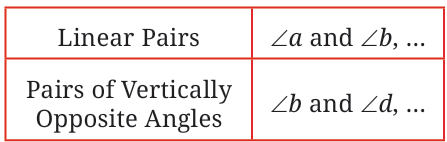
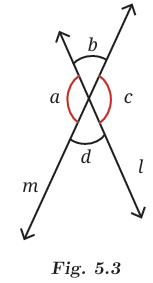
List all the linear pairs and vertically opposite angles you observe in Fig. 5.3:
Measurements and Geometry
You might have noticed that when you measure linear pairs, sometimes they may not add up to 180°. Or, when you measure vertically opposite angles they may be unequal sometimes. What are the reasons for this? There could be different reasons:- Measurement errors because of improper use of measuring instruments — in this case, a protractor
- Variation in the thickness of the lines drawn. The “ideal” line in geometry does not have any thickness! But it is not possible for us to draw lines without any thickness
5.2 Perpendicular Lines
Can you draw a pair of intersecting lines such that all four angles are
equal? Can you figure out what will be the measure of each angle?
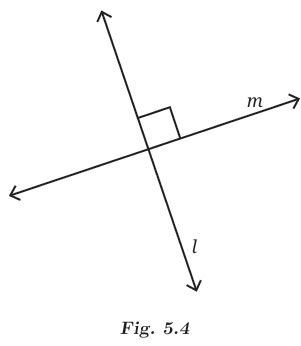
Perpendicular lines are a pair of lines which intersect each other at right angles (90°). In Fig. 5.4, we can say that lines l and m are perpendicular to each other.
5.3 Between Lines
Observe Fig. 5.5 and describe the way the line segments meet or cross each other in each case, with appropriate mathematical words (a point, an endpoint, the midpoint, meet, intersect) and the degree measure of each angle.For example, line segments FG and FH meet at the endpoint F at an angle 115.3°.
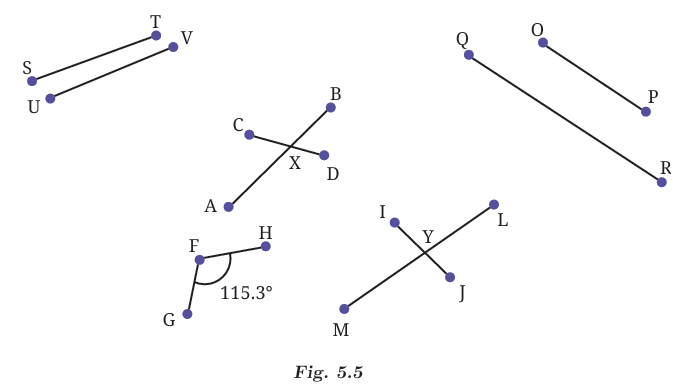
Are line segments OP and QR likely to meet if they are extended?
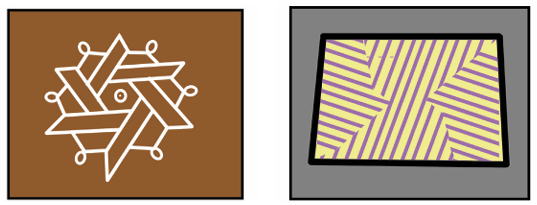
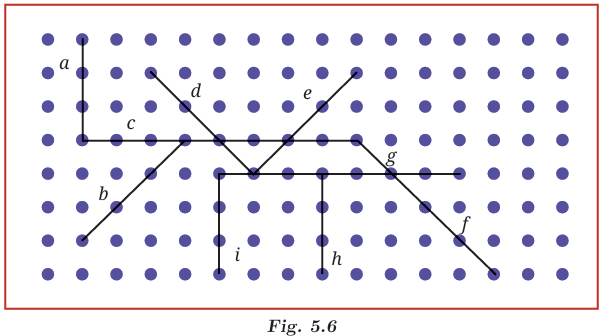
Here are some examples of lines we notice around us.
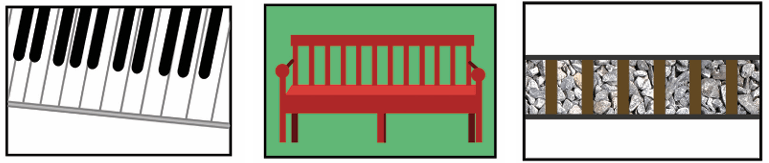
What is common to the lines in the pictures above? They do not seem likely to intersect each other. Such lines are called parallel lines.
5.4 Parallel and Perpendicular Lines in Paper Folding
Activity 2
Take a plain square sheet of paper (use a newspaper for this activity).- How would you describe the opposite edges of the sheet? They are _________________________ to each other.
- How would you describe the adjacent edges of the sheet? The adjacent edges are _________________________ to each other. They meet at a point. They form right angles.
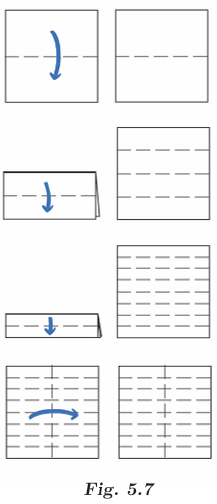
- Fold the sheet horizontally in half. A new line is formed (see Fig. 5.7).
- How many parallel lines do you see now? How does the new line segment relate to the vertical sides?
- Make one more horizontal fold in the folded sheet. How many parallel lines do you see now?
- What will happen if you do it once more? How many parallel lines will you get? Is there a pattern? Check if the pattern extends further, if you make another horizontal fold.
- Make a vertical fold in the square sheet. This new vertical line is ___________ to the previous horizontal lines.
- Fold the sheet along a diagonal. Can you find a fold that creates a line parallel to the diagonal line?
Here is another activity for you to try.
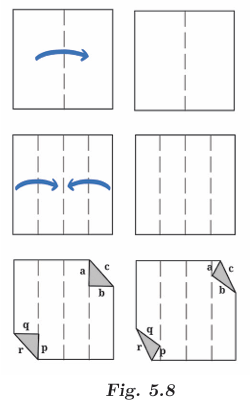
- Take a square sheet of paper, fold it in the middle and unfold it.
- Fold the edges towards the centre line and unfold them.
- Fold the top right and bottom left corners onto the creased line to create triangles. Refer to Fig. 5.8.
- The triangles should not cross the crease lines.
- Are a, b and c parallel to p, q and r respectively? Why or why not?
Notations
In mathematics, we use an arrow mark (>) to show that a set of lines is parallel. If there is more than one set of parallel lines (as in Fig. 5. 9), the second set is shown with two arrow marks and so on. Perpendicular lines are marked with a square angle between them.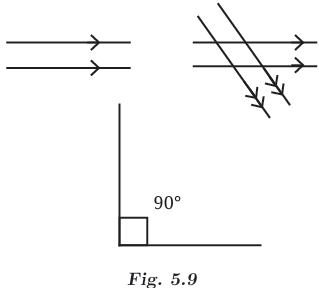
Figure it Out
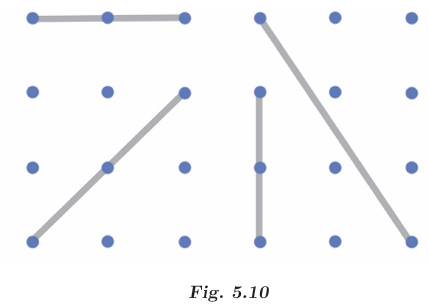
1. Draw some lines perpendicular to the lines given on the dot paper in Fig. 5.10.
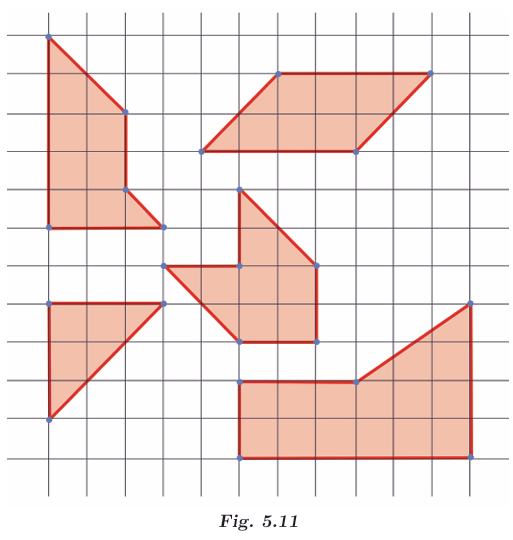
2. In Fig. 5.11, mark the parallel lines using the notation given above (single arrow, double arrow etc.). Mark the angle between perpendicular lines with a square symbol.
- (a) How did you spot the perpendicular lines?
- (b) How did you spot the parallel lines?
3. In the dot paper following, draw different sets of parallel lines. The line segments can be of different lengths but should have dots as endpoints.
4. Using your sense of how parallel lines look, try to draw lines parallel to the line segments on this dot paper.
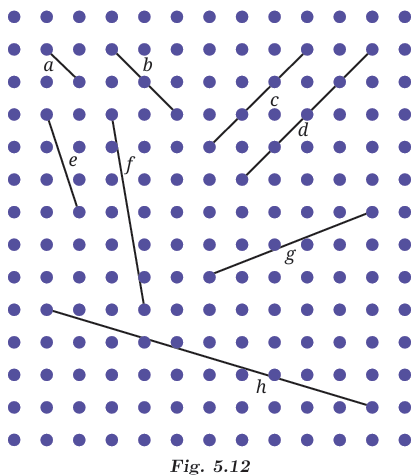
- (a) Did you find it challenging to draw some of them?
- (b) Which ones?
- (c) How did you do it?
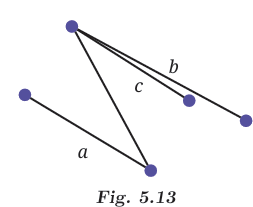
5. In Fig. 5.13, which line is parallel to line a —– line b or line c? How do you decide this?
5.5 Transversals
We saw what happens when two lines intersect in different ways. Let us explore what happens when one line intersects two different lines.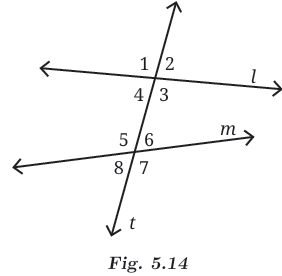
Is it possible for all the eight angles to have different measurements?
Why, why not?
What about five different angles — 6, 5, 4, 3 and 2?
In Fig. 5.14, since ∠1 and ∠3 are vertically opposite angles, they are
equal. Are there other pairs of vertically opposite angles? We can see
that there are a total of four pairs of vertically opposite angles and in
each pair, the angles are equal to each other.
Thus, when a transversal intersects two lines, it forms eight angles
with a maximum of four distinct angle measures.
5.6 Corresponding Angles
In Fig. 5.14, we notice that the transversal t forms two sets of angles — one with line l and another with line m. There are angles in the first set that correspond to angles in the second set based on their position. ∠1 and ∠5 are called corresponding angles. Similarly, ∠2 and ∠6, ∠3 and ∠7, ∠4 and ∠8 are the corresponding angles formed when transversal t intersects lines l and m. Activity 3
Draw a pair of lines and a transversal such that they form two
distinct angles.
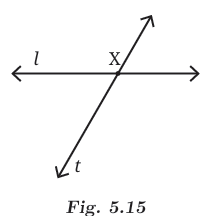
Step 1: Draw a line l and a transversal t intersecting it at point X.
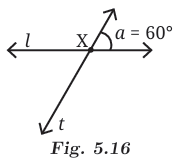
Step 3: Mark a point Y on line t.
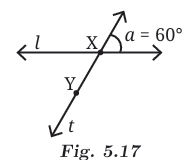
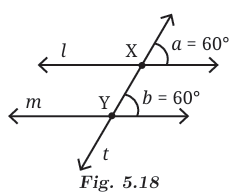
From this we can observe:
Suppose, we have a transversal intersecting two parallel lines. What can be said about the corresponding angles?
Activity 4
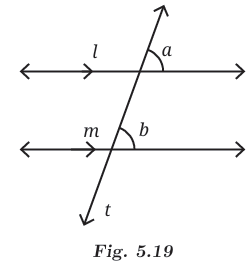
Fig. 5.19 has a pair of parallel lines l and m (what is the notation used
in the figure to indicate they are parallel?) . Line t is the transversal
across these two lines. ∠a and ∠b are corresponding angles. Take a
tracing paper and trace ∠a on it. Now place this tracing paper over
∠b and see if the angles align exactly. You will observe that the angles
match. Check the other corresponding angles in the figure using a
protractor. Are all the corresponding angles equal to each other?
Activity 5
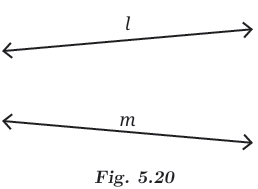
In Fig. 5.20, draw a transversal t to the lines l and m such that one pair
of corresponding angles is equal. You can measure the angles with a
protractor.
5.7 Drawing Parallel Lines
Can you draw a pair of parallel lines using a ruler and a set square?Fig. 5.21 shows how you can do it.
Draw a line l with a scale. By sliding your set square you can make two lines perpendicular to line l.
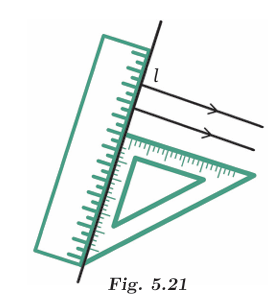
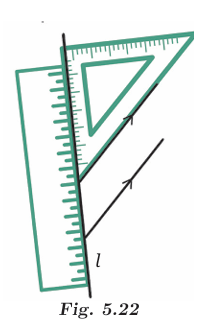
As we know these are corresponding angles and they are equal, we can be sure that the lines are parallel.
Draw two more parallel lines using the long side of the set square as shown in Fig. 5.22.How do you know these two lines are parallel? Can you check if the corresponding angles are equal?
Figure it Out
Can you draw a line parallel to l, that goes through point A? How will you do it with the tools from your geometry box? Describe your method.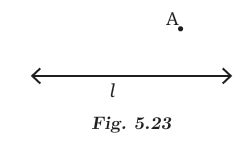
Making Parallel Lines through Paper Folding
Let us try to do the same with paper folding. For a line l (given as a crease), how do we make a line parallel to l such that it passes through point A?We know how to fold a piece of paper to get a line perpendicular to l. Now, try to fold a perpendicular to l such that it passes through point A. Let us call this new crease t.
Now, fold a line perpendicular to t passing through A again. Let us call this line m. The lines l and m are parallel to each other.
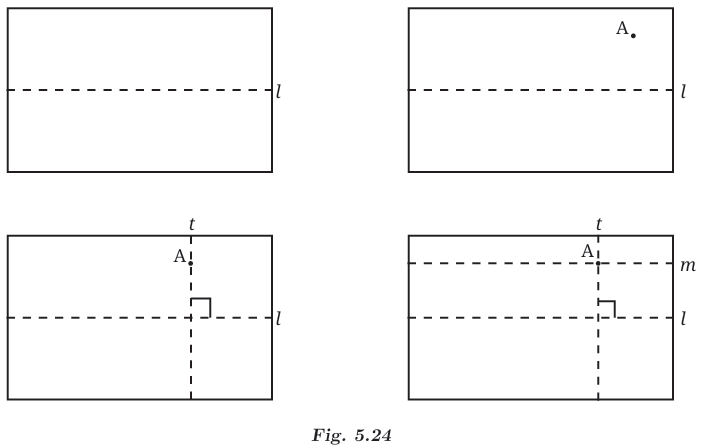
Why are lines l and m parallel to each other?
Is it possible for all the eight angles to have different measurements?
Why, why not?
5.8 Alternate Angles
In Fig. 5.25, ∠d is called the alternate angle of ∠f, and ∠c is the alternate angle of ∠e.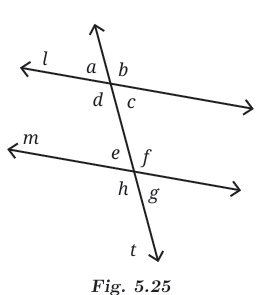
Activity 6
In Fig. 5.25, if ∠f is 120° what is the measure of its alternate angle ∠d?
We can find the measure of ∠d if we know ∠b because they are
vertically opposite angles. Remember, vertically opposite angles are
equal.
What is the measure of ∠b? It is 120° because it is the corresponding
angle of ∠f.
So, ∠d also measures 120°.
In fact, ∠f = ∠b irrespective of the measure of ∠f. Why? Because ∠b
is the corresponding angle of ∠f.
Similarly, ∠b = ∠d irrespective of the measure of ∠b. Why? Because
∠d is the vertically opposite angle of ∠b. So, it must always be the
case that
∠f = ∠d
Using our understanding of corresponding angles without any
measurements, we have justified that alternate angles are always equal.
Example 1: In Fig. 5.26, parallel lines l and m are intersected by the
transversal t. If ∠6 is 135°, what are the measures of the other angles?
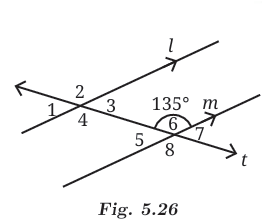
∠2 is also 135°, because it is the corresponding angle of ∠6 and the lines l and m are parallel.
∠8 is 135°, because it is the vertically opposite angle of ∠6. ∠4 is 135° because it is the corresponding angle of ∠8.
∠2 is 135° because is the vertically opposite angle of ∠4. So, ∠2, ∠4, ∠6, and ∠8 are all 135°.
∠5 and ∠6 are a linear pair, together they measure 180°. If ∠6 is 135°, then
∠5 = 180 – 135 = 45°
We can similarly find out that ∠1, ∠3, and ∠7 measure 45°.
Example 2: In Fig. 5.27, lines l and m are intersected by the transversal
t. If ∠a is 120° and ∠f is 70°, are lines l and m parallel to each other?
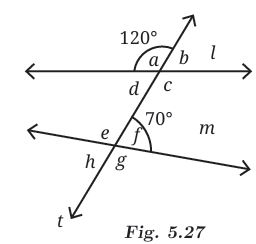
∠b is a corresponding angle of ∠f. If l and m are parallel, ∠b should be equal to ∠f, however, they are not equal.
Therefore, lines l and m are not parallel to each other as the corresponding angles formed by the transversal t are not equal to each other.
Example 3: In Fig. 5.28, parallel lines l and m are intersected by the
transversal t. If ∠3 is 50°, what is the measure of ∠6?
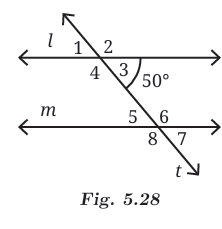
∠2 and ∠6 are corresponding angles, and they need to be equal since lines l and m are parallel.
So, ∠6 is 130°.
Angles ∠3 and ∠6 are called interior angles.
Example 4: In Fig. 5.29, line segment AB is parallel to CD and AD is
parallel to BC. ∠DAC is 65° and ∠ADC is 60°. What are the measures of
angles ∠CAB, ∠ABC, and ∠BCD?
Solution: Let us observe the parallel lines AB and CD. AD is a transversal of these two lines.
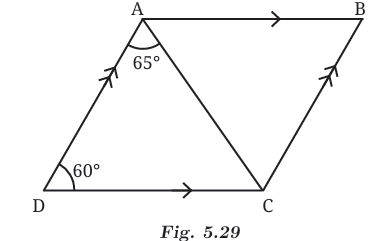
∠ADC + ∠DAB = 180°
60° + ∠DAB = 180°.
So ∠DAB = 120°.
Can we find ∠CAB from this?
∠DAB = ∠DAC + ∠CAB.
So 120° = 65° + ∠CAB.
So ∠CAB = 55°.
Let us observe the parallel line segments AD and BC. They are intersected by a transversal CD. So, ∠ADC + ∠BCD = 180°, because they are interior angles on the same side of the transversal. Since ∠ADC is given as 60°, ∠BCD = 120°
Similarly, we find ∠ABC = 60°.
Therefore, in Fig. 5.29, ∠CAB = 55°, ∠ABC = 60°, and ∠BCD = 120°.Figure it Out
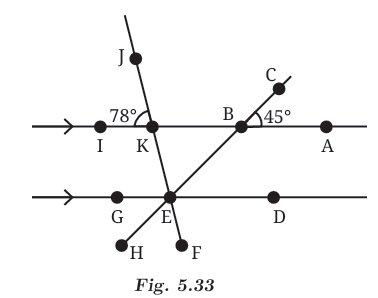
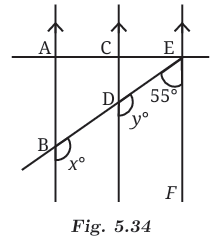
1. Find the angles marked below.
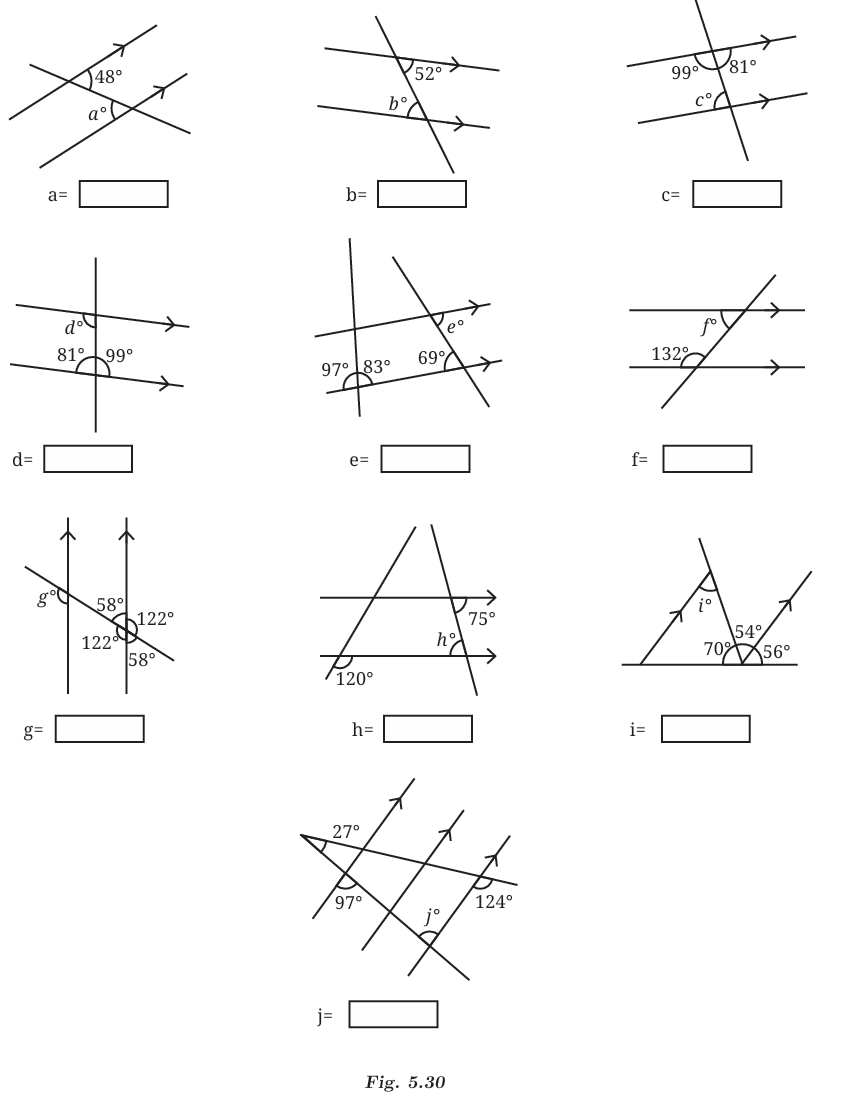
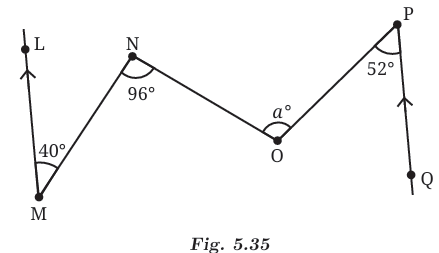
2. Find the angle represented by a.
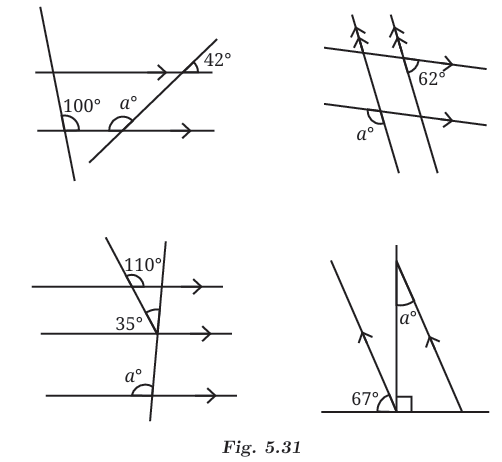
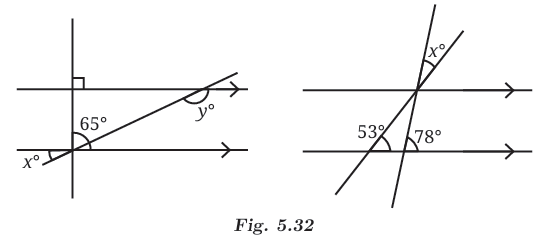
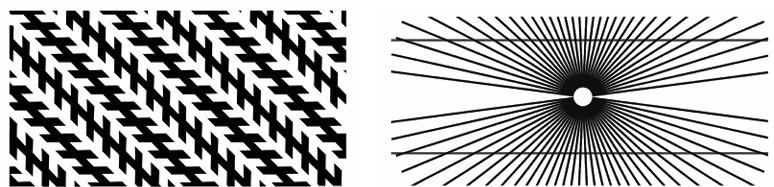
5.9 Parallel Illusions
There do not seem to be any parallel lines here. Or, are there?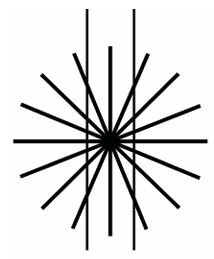
SUMMARY
- When two lines intersect, they form four angles. The vertically opposite angles are equal and the linear pairs add up to 180°.
- When two lines intersect and the angles formed are 90° (i.e., all four angles are equal), the lines are said to be perpendicular to each other.
- When two lines never intersect on a plane, they are called parallel lines.
- When a line t intersects another pair of lines, it is called a transversal and it forms 2 sets of 4 angles. Each of the 4 angles in the first set has a corresponding angle in the second set.
- When a transversal intersects a pair of parallel lines, the corresponding angles are equal. When a transversal intersects a pair of lines and the corresponding angles are equal, then the pair of lines is parallel.
- When a transversal intersects a pair of parallel lines, the alternate angles are equal.
- The interior angles on the same side formed by a transversal intersecting a pair of parallel lines always add up to 180°.