Chapter-6
NUMBER PLAY
6.1 Numbers Tell us Things
 What do the numbers in the figure below tell us?
Remember the children from the Grade 6 textbook of mathematics? Now, they call out numbers using a different rule.
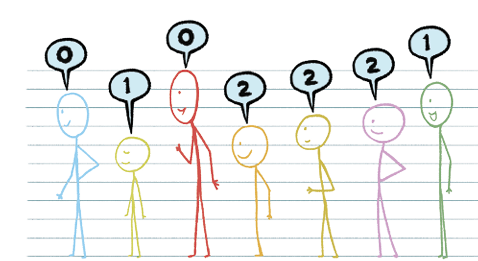
What do the numbers in the figure below tell us?
The children rearrange themselves and each one says a number
based on the new arrangement.
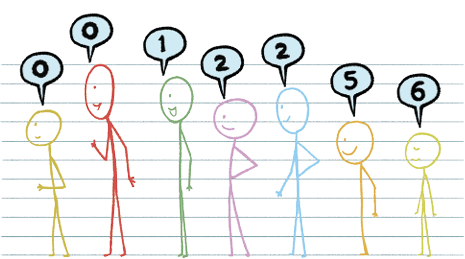
Could you figure out what these numbers convey? Observe and try to
find out.
The rule is — each child calls out the number of children in front of them who are taller than them. Check if the number each child says matches this rule in both the arrangements.
Write down the number each child should say based on this rule for
the arrangement shown below.
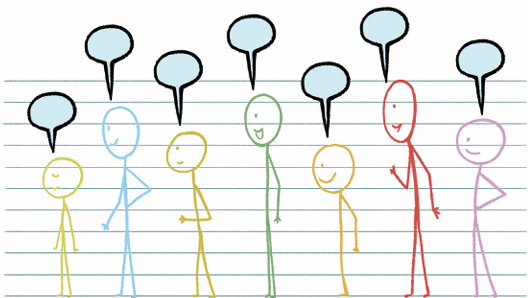
Figure it Out
1. Arrange the stick figure cutouts given at the end of the book or draw a height arrangement such that the sequence reads:
2. For each of the statements given below, think and identify if it is Always True, Only Sometimes True, or Never True. Share your reasoning.
6.2 Picking Parity
Kishor has some number cards and is working on a puzzle: There are 5 boxes, and each box should contain exactly 1 number card. The numbers in the boxes should sum to 30. Can you help him find a way to do it?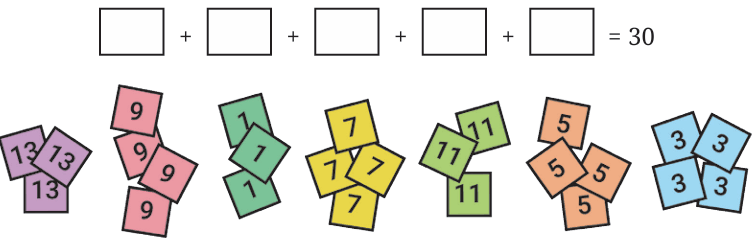
Add a few even numbers together. What kind of number do you get?
Does it matter how many numbers are added?
Any even number can be arranged in pairs without any leftovers.
Some even numbers are shown here, arranged in pairs.


Now, add a few odd numbers together. What kind of number do you
get? Does it matter how many odd numbers are added?
Odd numbers can not be arranged in pairs. An odd number is one
more than a collection of pairs. Some odd numbers are shown below

This figure shows that the sum of two odd numbers must always be even! This along with the other figures here are more examples of a proof!

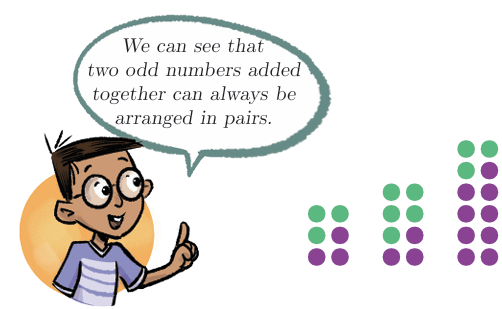
What about adding 3 odd numbers? Can the resulting sum be arranged in pairs? No.
Explore what happens to the sum of (a) 4 odd numbers, (b) 5 odd
numbers, and (c) 6 odd numbers.
Let us go back to the puzzle Kishor was trying to solve. There are 5 empty boxes. That means he has an odd number of boxes. All the number cards contain odd numbers.
They should add to 30, which is an even number. Since, adding any 5 odd numbers will never result in an even number, Kishor cannot arrange these cards in the boxes to add up to 30.
Two siblings, Martin and Maria, were born exactly one year apart.
Today they are celebrating their birthday. Maria exclaims that the sum
of their ages is 112. Is this possible? Why or why not?
As they were born one year apart, their ages will be (two) consecutive
numbers. Can their ages be 51 and 52? 51 + 52 = 103. Try some other
consecutive numbers and see if their sum is 112.
The counting numbers 1, 2, 3, 4, 5, ... alternate between even and odd
numbers. In any two consecutive numbers, one will always be even
and the other will always be odd!
What would be the resulting sum of an even number and an odd
number? We can see that their sum can’t be arranged in pairs and thus
will be an odd number.
Since 112 is an even number, and Martin’s and Maria’s ages are consecutive numbers, they cannot add up to 112. We use the word parity to denote the property of being even or odd. For instance, the parity of the sum of any two consecutive numbers is odd. Similarly, the parity of the sum of any two odd numbers is even.
Figure it Out
1. Using your understanding of the pictorial representation of odd and even numbers, find out the parity of the following sums:
2. Lakpa has an odd number of ₹1 coins, an odd number of ₹5 coins and an even number of ₹10 coins in his piggy bank. He calculated the total and got ₹205. Did he make a mistake? If he did, explain why. If he didn’t, how many coins of each type could he have?
3. We know that:
- (a) even + even = even
- (b) odd + odd = even
- (c) even + odd = odd Similarly, find out the parity for the scenarios below:
- (d) even – even = ___________________
- (e) odd – odd = ___________________
- (f) even – odd = ___________________
- (g) odd – even = ___________________
Small Squares in Grids
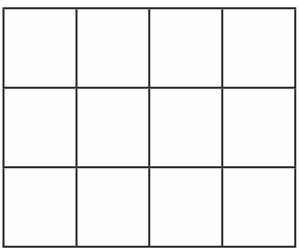 In a 3 × 3 grid, there are 9 small squares,
which is an odd number. Meanwhile, in
a 3 × 4 grid, there are 12 small squares,
which is an even number.
In a 3 × 3 grid, there are 9 small squares,
which is an odd number. Meanwhile, in
a 3 × 4 grid, there are 12 small squares,
which is an even number. Given the dimensions of a grid, can you tell the parity of the number of small squares without calculating the product?
Find the parity of the number of small squares in these grids:
- (a) 27 × 13
- (b) 42 × 78
- (c) 135 × 654
Parity of Expressions
Consider the algebraic expression: 3n + 4. For different values of n, the expression has different parity: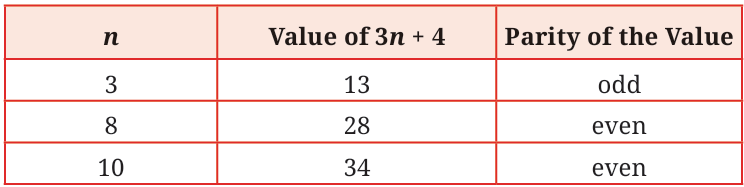
Find the parity of the number of small squares in these grids:
Some examples are: 100p and 48w – 2. Try to find more.
Come up with expressions that always have odd parity.:
Come up with other expressions, like 3n + 4, which could have either
odd or even parity
Are there expressions using which we can list all the even numbers?
Hint: All even numbers have a factor 2.:
Are there expressions using which we can list all odd numbers?
We saw earlier how to express the nth term of the sequence of multiples of 4, where n is the letter-number that denotes a position in the sequence (e.g., first, twenty third, hundred and seventeenth, etc.).
What would be the nth term for multiples of 2? Or, what is the nth even
number?
Let us consider odd numbers.
What is the 100th odd number?
To answer this question, consider the following question:
What is the 100th even number?
This is 2 × 100 = 200.
Does this help in finding the 100th odd number? Let us compare the sequence of evens and odds term-by-term.
Even Numbers: 2, 4, 6, 8, 10, 12,...
Odd Numbers: 1, 3, 5, 7, 9, 11,...
We see that at any position, the value at the odd number sequence is one less than that in the even number sequence. Thus, the 100th odd number is 200 – 1 = 199.
Write a formula to find the nth odd number.
Let us first describe the method that we have learnt to find the odd number at a given position:
- (a) Find the even number at that position. This is 2 times the position number.
- (b) Then subtract 1 from the even number.
- (a) 2n
- (b) 2n – 1
6.3 Some Explorations in Grids
Observe this 3 × 3 grid. It is filled following a simple rule — use numbers from 1 – 9 without repeating any of them. There are circled numbers outside the grid.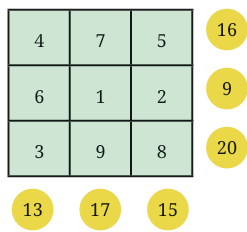
Are you able to see what the circled numbers
represent?
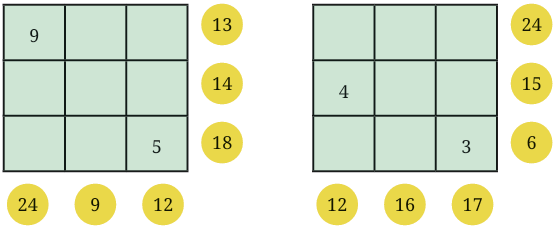
The numbers in the yellow circles are the sums of the corresponding rows and columns.
Fill the grids below based on the rule mentioned above:
Make a couple of questions like this on your own and challenge your
peers.
Try solving the problem below.
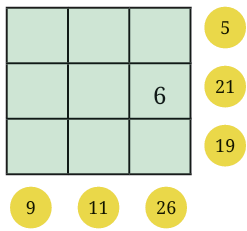
You might have realised that it is not possible to
find a solution for this grid. Why is this the case?
The smallest sum possible is 6 = 1 + 2 + 3. The
largest sum possible is 24 = 9 + 8 + 7. Clearly, any
number in a circle cannot be less than 6 or
greater than 24. The grid has sums 5 and 26.
Therefore, this is impossible!
In the earlier grids which we solved,
Kishor noticed that the sum of all the
numbers in the circles was always 90. Also,
Vidya observed that the sum of the circled
numbers for all three rows, or for all three
columns, was always 45. Check if this is true
in the previous grids you have solved.
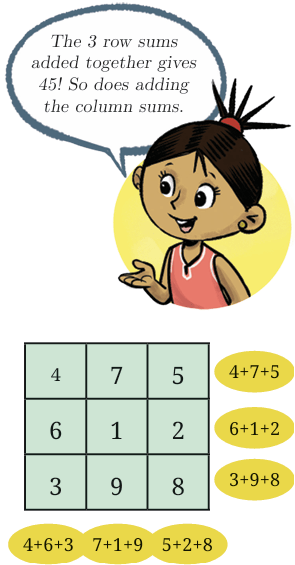
Why should the row sums and column sums
always add to 45?
From this grid, we can see that all the row sums added together will be the same as the sum of the numbers 1 – 9. This can be seen for column sums as well. The sum of the numbers 1 – 9 is
1 + 2 + 3 + 4 + 5 + 6 + 7 + 8 + 9 = 45.
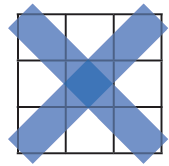
A square grid of numbers is called a magic square if each row, each column and each diagonal, add up to the same number. This number is called the magic sum. Diagonals are shown in the picture.
Trying to create a magic square by randomly filling the grid with numbers may be difficult! This is because there are a large number of ways of filling a 3 × 3 grid using the numbers 1 – 9 without repetition. In fact, it can be found that there are exactly 3,62,880 such ways. Surprisingly, the number of ways to fill in the grid can be found without listing all of them. We will see in later years how to do this. Instead, we should proceed systematically to make a magic square. For this, let us ask ourselves some questions.
Let us focus, for the moment, only on the row sums. We have seen that in a 3 × 3 grid with numbers 1 – 9, the total of row sums will always be 45. Since in a magic square the row sums are all equal, and they add up to 45, they have to be 15 each. Thus, we have the following observation.
1. What can the magic sum be? Can it be any number?
Observation 1: In a magic square made using the numbers 1 – 9, the magic sum must be 15.
2. What are the possible numbers that could occur at the centre of a
magic square?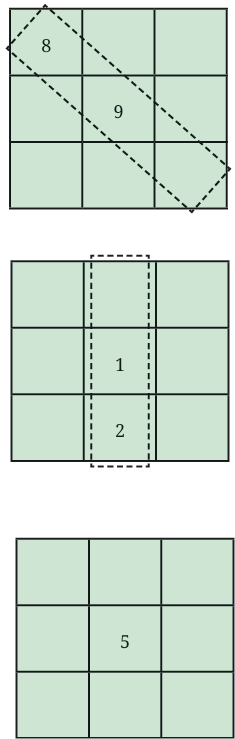 Let us consider the possibilities one by one.
Can the central number be 9? If yes, then 8 must
come in one of the other squares. For example,
In this, we must have 8 + 9 + other number = 15.
But this is not possible! The same issue will
occur no matter where we place 8.
So, 9 cannot be at the centre. Can the central
number be 1?
If yes, then 2 should come in one of the other
squares.
Here, we must have 2 + 1 + other number = 15.
But this is not possible because we are only
using the numbers 1 – 9. The same issue will
occur no matter where we place 1.
So, 1 cannot be at the centre, either.
Let us consider the possibilities one by one.
Can the central number be 9? If yes, then 8 must
come in one of the other squares. For example,
In this, we must have 8 + 9 + other number = 15.
But this is not possible! The same issue will
occur no matter where we place 8.
So, 9 cannot be at the centre. Can the central
number be 1?
If yes, then 2 should come in one of the other
squares.
Here, we must have 2 + 1 + other number = 15.
But this is not possible because we are only
using the numbers 1 – 9. The same issue will
occur no matter where we place 1.
So, 1 cannot be at the centre, either.
Using such reasoning, find out which other
numbers 1 – 9 cannot occur at the centre.
This exploration will lead us to the following
interesting observation.
Observation 2: The number occurring at the centre of a magic square, filled using 1 – 9, must be 5.
Let us now see where the smallest number 1 and the largest number 9 should come in a magic square. Our second observation tells us that they will have to come in one of the boundary positions. Let us classify these positions into two categories:
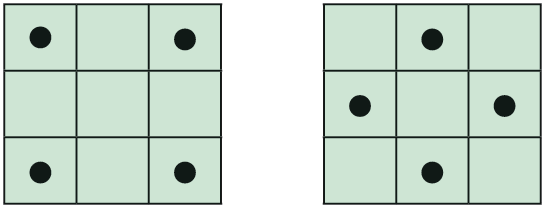
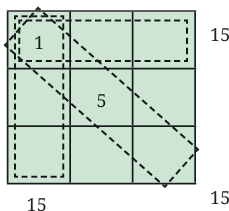 can it be placed as follows?
Similarly, can 9 can be placed in a corner position?
Observation 3: The numbers 1 and 9 cannot occur in any corner, so they should occur in one of the middle positions.
Can you find the other possible positions for 1 and 9?
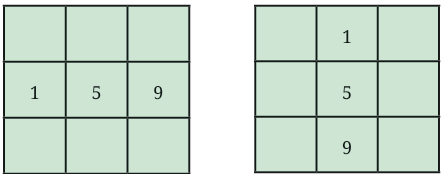
Now, we have one full row or column of the magic square! Try completing it!
[Hint: First fill the row or columns containing 1 and 9]
1. How many different magic squares can be made using the numbers 1 – 9?
2. Create a magic square using the numbers 2 – 10. What strategy would you use for this? Compare it with the magic squares made using 1 – 9.
3. Take a magic square, and
- (a) increase each number by 1
- (b) double each number
4. What other operations can be performed on a magic square to yield another magic square?
5. Discuss ways of creating a magic square using any set of 9 consecutive numbers (like 2 – 10, 3 – 11, 9 – 17, etc.).
Generalising a 3 × 3 Magic Square
We can describe how the numbers within the magic square are related to each other, i.e., the structure of the magic square. Choose any magic square that you have made so far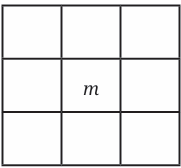 using consecutive numbers. If m is the letter-number
of the number in the centre, express how other
numbers are related to m, how much more or less
than m.
using consecutive numbers. If m is the letter-number
of the number in the centre, express how other
numbers are related to m, how much more or less
than m.
[Hint: Remember, how we described a 2 × 2 grid of a calendar month in the Algebraic Expressions chapter].
Once the generalised form is obtained, share your observations
with the class.
Figure it Out
- 1. Using this generalised form, find a magic square if the centre number is 25.
- 2. What is the expression obtained by adding the 3 terms of any row, column or diagonal?
-
3. Write the result obtained by—
- (a) adding 1 to every term in the generalised form.
- (b) doubling every term in the generalised form
- 4. Create a magic square whose magic sum is 60.
- 5. Is it possible to get a magic square by filling nine non-consecutive numbers?
The First-ever 4 × 4 Magic Square
The first ever recorded 4 × 4 magic square is found in a 10th century inscription at the Pārśhvanath Jain temple in Khajuraho, India, and is known as the Chautīsā Yantra.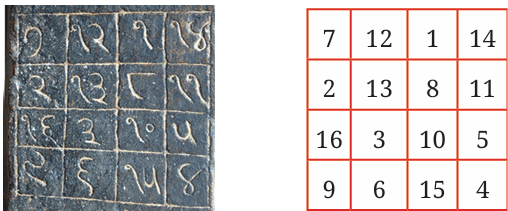
The first ever recorded 4 × 4 magic square, the Chautīsā Yantra, at Khajuraho, India
Magic Squares in History and Culture
The first magic square ever recorded, the Lo Shu Square, dates  back over 2000 years to ancient China. The legend tells of a
catastrophic flood on the Lo River, during which the gods sent
a turtle to save the people. The turtle carried a 3 × 3
grid on its back, with the numbers 1 to 9 arranged in
a magical pattern.
back over 2000 years to ancient China. The legend tells of a
catastrophic flood on the Lo River, during which the gods sent
a turtle to save the people. The turtle carried a 3 × 3
grid on its back, with the numbers 1 to 9 arranged in
a magical pattern.
Magic squares were studied in different parts of the world at different points of time including India, Japan, Central Asia, and Europe.
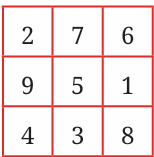
Indian mathematicians have worked extensively on magic squares, describing general methods of constructing them. The work of Indian mathematicians was not just limited to 3 × 3 and 4 × 4 grids, which we considered above, but also extended to 5 × 5 and other larger square grids. We shall learn more about these in later grades.
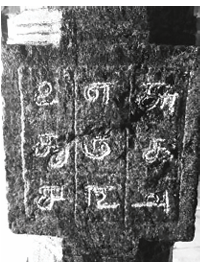
The occurrence of magic squares is not limited to scholarly mathematical works. They are found in many places in India. The picture to the right is of a 3 × 3 magic square found on a pillar in a temple in Palani, Tamil Nadu. The temple dates back to the 8th century CE.
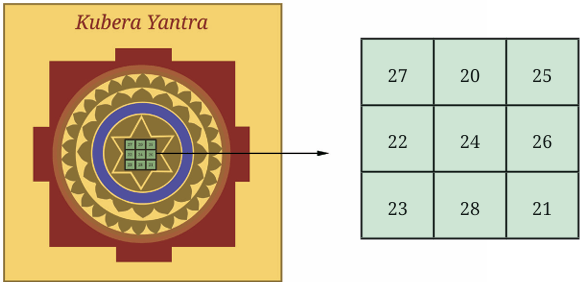
3 × 3 magic squares can also be found in homes and shops in India. The Navagraha Yantra is one such example shown below.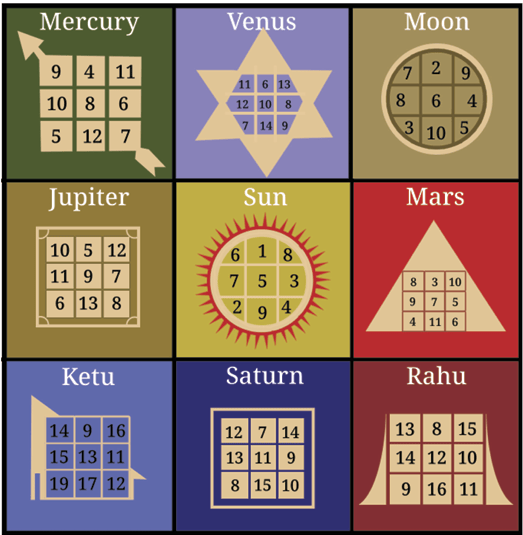
6.4 Nature’s Favourite Sequence: The Virahāṅka Fibonacci Numbers!
The sequence 1, 2, 3, 5, 8, 13, 21, 34, . . . (Virahāṅka–Fibonacci Numbers) is one of the most celebrated sequences in all of mathematics — it occurs throughout the world of Art, Science, and Mathematics. Even though these numbers are found very frequently in Science, it is remarkable that these numbers were first discovered in the context of Art (specifically, poetry)! The Virahāṅka–Fibonacci Numbers thus provide a beautiful illustration of the close links between Art, Science, and Mathematics.Discovery of the Virahāṅka Numbers
The Virahāṅka numbers first came up thousands of years ago in the works of Sanskrit and Prakrit linguists in their study of poetry!In the poetry of many Indian languages, including, Prakrit, Sanskrit, Marathi, Malayalam, Tamil, and Telugu, each syllable is classified as either long or short.
A long syllable is pronounced for a longer duration than a short syllable — in fact, for exactly twice as long. When singing such a poem, a short syllable lasts one beat of time, and a long syllable lasts two beats of time.This leads to numerous mathematical questions, which the ancient poets in these languages considered extensively. A number of important mathematical discoveries were made in the process of asking and answering these questions about poetry.
One of these particularly important questions was the following. How many rhythms are there with 8 beats consisting of short syllables (1 beat) and long syllables (2 beats)? That is, in how many ways can one f ill 8 beats with short and long syllables, where a short syllable takes one beat of time and a long syllable takes two beats of time.Here are some possibilities:
long long long longshort short short short short short short short
short long long short long
long long short short long
.
.
.
Phrased more mathematically: In how many different ways can one write a number, say 8, as a sum of 1’s and 2’s? For example, we have:
8 = 2 + 2 + 2 + 2,
8 = 1 + 1 + 1 + 1 + 1 + 1 + 1 + 1,
8 = 1 + 2 + 2 + 1 + 2,
8 = 2 + 2 + 1 + 1 + 2,
etc.
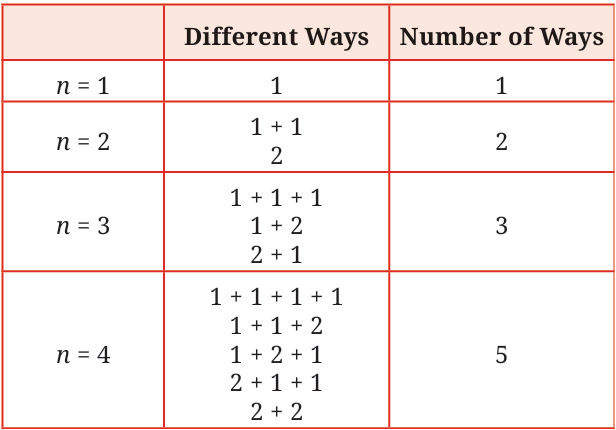
Here is a systematic way to write down all rhythms of short and long syllables having 5 beats. Write a ‘1+’ in front of all rhythms having 4 beats, and then a ‘2+’ in front of all rhythms having 3 beats. This gives us all the rhythms having 5 beats:
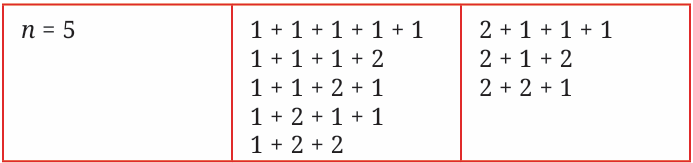
How many 6-beat rhythms are there? By the same reasoning, it will be the number of 5-beat rhythms plus the number of 4-beat rhythms, i.e., 8 + 5 = 13. Thus, there are 13 rhythms having 6 beats.
Use the systematic method to write down all 6-beat rhythms, i.e., write
6 as the sum of 1’s and 2’s in all possible ways. Did you get 13 ways?
This beautiful method for counting all the rhythms of short syllables
and long syllables having any given number of beats was first given by
the great Prakrit scholar Virahāṅka around the year 700 CE. He gave
his method in the form of a Prakrit poem! For this reason, the sequence
1, 2, 3, 5, 8, 13, 21, 34, . . . is known as the Virahāṅka sequence, and
the numbers in the sequence are known as the Virahāṅka numbers.
Virahāṅka was the first known person in history to explicitly consider
these important numbers and write down the rule for their formation.
Other scholars in India also considered these numbers in the
same poetic context. Virahāṅka was inspired by earlier work of the
legendary Sanskrit scholar Piṅgala, who lived around 300 BCE. After
Virahāṅka, these numbers were also written about by Gopala (c. 1135
CE) and then by Hemachandra (c. 1150 CE).
In the West, these numbers have been known as the Fibonacci
numbers, after the Italian mathematician who wrote about them in
the year 1202 CE — about 500 years after Virahāṅka. As we can see,
Fibonacci was not first, nor the second, not even the third person to
write about these numbers! Sometimes the term “Virahāṅka–Fibonacci
numbers” is used so that everyone understands what is being referred
to.
So, how many rhythms of short and long syllables are there having
8 beats? We simply take the 8th element of the Virahāṅka sequence:
1, 2, 3, 5, 8, 13, 21,
34, 55, ...
Thus, there are 34 rhythms having 8 beats.
Write the next number in the sequence, after 55.
We have seen that the next number in the sequence is given by
adding the two previous numbers. Check that this holds true for the
numbers given above. The next number is 34 + 55 = 89.
Write the next 3 numbers in the sequence:
1, 2, 3, 5, 8, 13, 21, 34 , 55, 89, ____, ____, ____, …
If you have to write one more number in the sequence above, can you tell whether it will be an odd number or an even number (without adding the two previous numbers)?
What is the parity of each number in the sequence? Do you notice any
pattern in the sequence of parities?
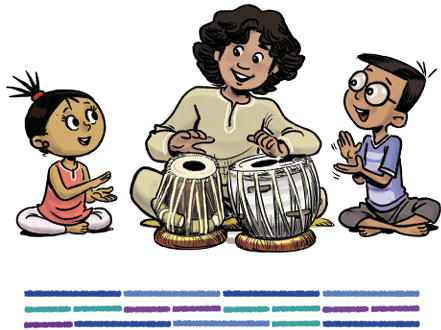
Today, the Virahāṅka–Fibonacci numbers form the basis of many
mathematical and artistic theories, from poetry to drumming, to
visual arts and architecture, to science. Perhaps the most stunning
occurrences of these numbers are in nature. For example, the number
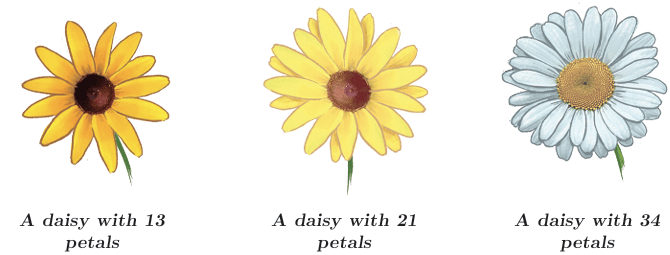
of petals on a daisy is generally a Virahāṅka number.
How many petals do you see on each of these flowers?
 There are many other
remarkable mathematical properties of the Virahāṅka Fibonacci numbers that we will see later, in mathematics as well as in other subjects. These numbers truly exemplify the close connections between Art, Science, and Mathematics.
There are many other
remarkable mathematical properties of the Virahāṅka Fibonacci numbers that we will see later, in mathematics as well as in other subjects. These numbers truly exemplify the close connections between Art, Science, and Mathematics.6.5 Digits in Disguise
You have done arithmetic operations with numbers. How about doing the same with letters?In the calculations below, digits are replaced by letters. Each letter stands for a particular digit (0 – 9). You have to figure out which digit each letter stands for.
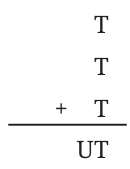
What could U and T be? Can T be 2? Can it be 3?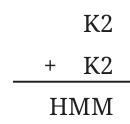
Once you explore, you will see that T = 5 and UT = 15. Let us look at one more example shown on the right. Here K2 means that the number is a 2-digit number having the digit ‘2’ in the units place and ‘K’ in the tens place. K2 is added to itself to give a 3-digit sum HMM. What digit should the letter M correspond to?
Both the tens place and the units place of the sum have the same digit.What about H? Can it be 2? Can it be 3?
These types of questions can be interesting and fun to solve! Here are some more questions like this for you to try out. Find out what each letter stands for.
Share how you thought about each question with your classmates; you may find some new approaches.
Figure it Out
1. A light bulb is ON. Dorjee toggles its switch 77 times. Will the bulb be on or off? Why?
2. Liswini has a large old encyclopaedia. When she opened it, several loose pages fell out of it. She counted 50 sheets in total, each printed on both sides. Can the sum of the page numbers of the loose sheets be 6000? Why or why not?
3. Here is a 2 × 3 grid. For each row and column, 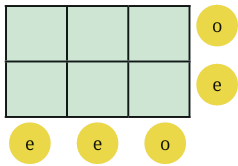 the parity of the sum is written in the circle; ‘e’
for even and ‘o’ for odd. Fill the 6 boxes with 3
odd numbers (‘o’) and 3 even numbers (‘e’) to
satisfy the parity of the row and column sums.
the parity of the sum is written in the circle; ‘e’
for even and ‘o’ for odd. Fill the 6 boxes with 3
odd numbers (‘o’) and 3 even numbers (‘e’) to
satisfy the parity of the row and column sums.
4. Make a 3 × 3 magic square with 0 as the magic sum. All numbers can not be zero. Use negative numbers, as needed.
5. Fill in the following blanks with ‘odd’ or ‘even’:
- (a) Sum of an odd number of even numbers is ______
- (b) Sum of an even number of odd numbers is ______
- (c) Sum of an even number of even numbers is ______
- (d) Sum of an odd number of odd numbers is ______
6. What is the parity of the sum of the numbers from 1 to 100?
7. Two consecutive numbers in the Virahāṅka sequence are 987 and 1597. What are the next 2 numbers in the sequence? What are the previous 2 numbers in the sequence?
8. Angaan wants to climb an 8-step staircase. His playful rule is that he can take either 1 step or 2 steps at a time. For example, one of his paths is 1, 2, 2, 1, 2. In how many different ways can he reach the top?
9. What is the parity of the 20th term of the Virahāṅka sequence?
10. Identify the statements that are true.
- (a) The expression 4m – 1 always gives odd numbers.
- (b) All even numbers can be expressed as 6j – 4.
- (c) Both expressions 2p + 1 and 2q – 1 describe all odd numbers.
- (d) The expression 2f + 3 gives both even and odd numbers.
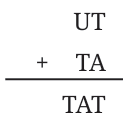
11. Solve this cryptarithm:
SUMMARY
In this chapter, we have explored the following:
- In the first activity, we saw how to represent information about how a sequence of numbers (e.g., height measures) is arranged without knowing the actual numbers.
- We learnt the notion of parity — numbers that can be arranged in pairs (even numbers) and numbers that cannot be arranged in pairs (odd numbers).
- We learnt how to determine the parity of sums and products.
- While exploring sums in grids, we could determine whether filling a grid is impossible by looking at the row and column sums. We extended this to construct magic squares.
- We saw how Virahāṅka numbers were first discovered in history through the Arts. The Virahāṅka sequence is 1, 2, 3, 5, 8, 13, 21, 34, 55, ...
- We became math-detectives through cryptarithms, where digits are replaced by letters.