
Chapter-7
A TALE OF THREE INTERSECTING LINES
A triangle is the most basic closed shape. As we know, it consists of:
- three corner points, that we call the vertex of the triangle, and
- three line segments or the sides of the triangle that join the pairs of vertices.
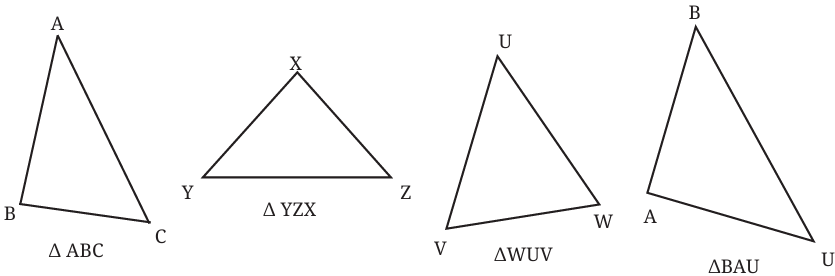
The three sides meeting at the corners give rise to three angles that we call the angles of the triangle. For example, in ∆ABC, these angles are ∠CAB, ∠ABC, ∠BCA, which we simply denote as ∠A, ∠B and ∠C, respectively.
 What happens when the three vertices lie on a straight line?
7.1 Equilateral Triangles
Among all the triangles, the equilateral triangles are the most symmetric ones. These are triangles in which all the sides are of equal lengths. Let us try constructing them. Construct a triangle in which all the sides are of length 4 cm.
How did you construct this triangle and what tools did you use? Can this construction be done only using a marked ruler (and a pencil)?
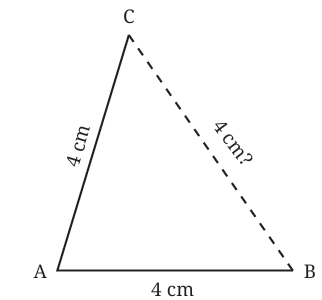
Constructing this triangle using just a ruler is certainly possible. But this might require several trials. Say we draw the base — let us call it AB — of length 4 cm (see the figure below), and mark the third point C using a ruler such that AC = 4 cm. This may not lead to BC also having a length of 4 cm. If this happens, we will have to keep making attempts to mark C till we get BC to be 4 cm long.
How do we make this construction more efficient?
Recall solving a similar problem in the previous year using a compass (in the Chapter ‘Playing with Constructions’). We had to mark the top point of a ‘house’ which is 5 cm from two other points. The method we used to get that point can also be used here.
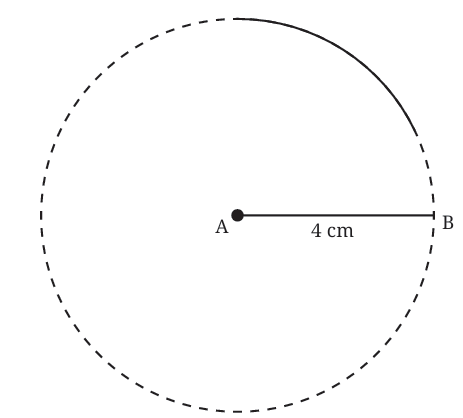
After constructing AB = 4 cm, we can do the following.Step 1: Using a compass, construct a sufficiently long arc of radius 4 cm from A, as shown in the figure. The point C is somewhere on this arc. How do we mark it?
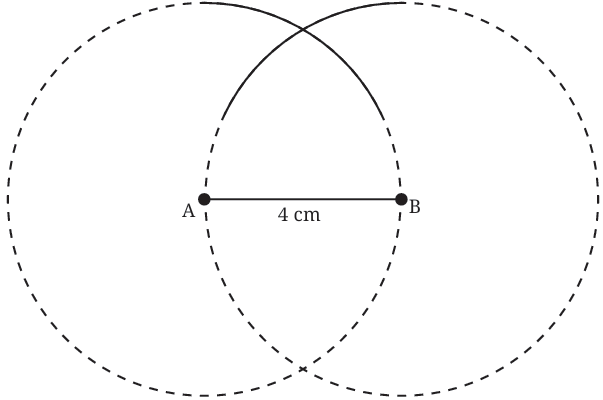
The construction ensures that both AC and BC are of length 4 cm. Can
you see why?
Step 3: Join AC and BC to get the required equilateral triangle.
7.2 Constructing a Triangle When its Sides are Given
How do we construct triangles that are not equilateral? Construct a triangle of sidelength 4 cm, 5 cm and 6 cm.
As in the previous case, this triangle can also be constructed using just a marked ruler. But it will involve several trials.
How do we construct this triangle more efficiently?
Choose one of the given lengths to be the base of the triangle: say 4 cm. Draw the base. Let A and B be the base vertices, and call the third vertex C. Let AC = 5 cm and BC = 6 cm.

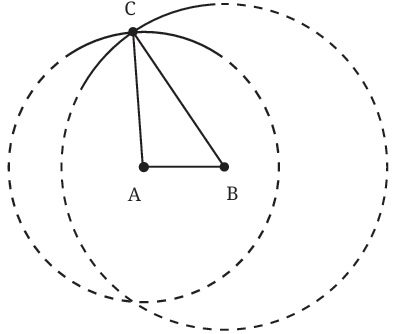 The reason why the point of
intersection is the third vertex is the
same as for equilateral triangles. This
point lies on both the circles. Hence
its distance from A is the radius of
the circle centred at A (5 cm) and its
distance from B is the same as the
radius of the circle centred at B (6 cm).
The reason why the point of
intersection is the third vertex is the
same as for equilateral triangles. This
point lies on both the circles. Hence
its distance from A is the radius of
the circle centred at A (5 cm) and its
distance from B is the same as the
radius of the circle centred at B (6 cm).
Step 1:Construct the base AB with one of the side lengths. Let us choose AB = 4 cm (see Fig. 7.1).
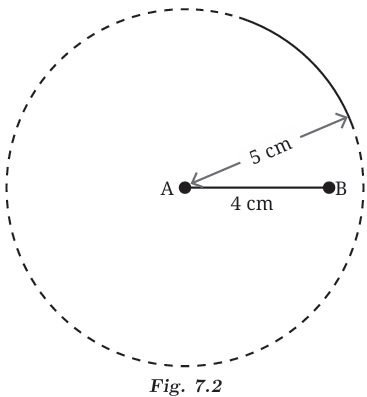
Step 2: From A, construct a sufficiently long arc of radius 5 cm (see Fig. 7.2).
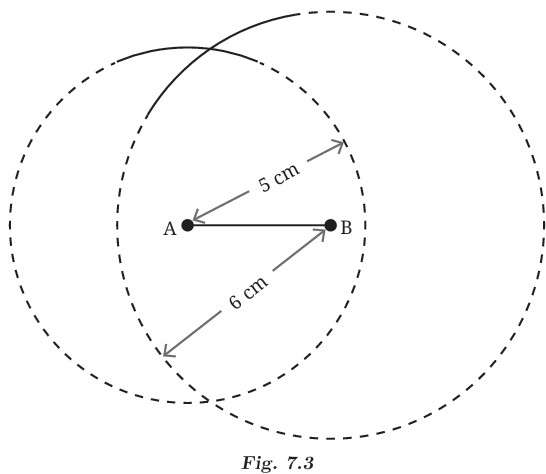
Step 3: From B, construct an arc of radius 6 cm such that it intersects the first arc (see Fig. 7.3).
Step 4: The point where both the arcs meet is the required third vertex C. Join AC and BC to get ∆ABC.
Construct
Construct triangles having the following sidelengths (all the units are
in cm):
- (a) 4, 4, 6
- (b) 3, 4, 5
- (c) 1, 5, 5
- (d) 4, 6, 8
- (e) 3.5, 3.5, 3.5
Figure it Out
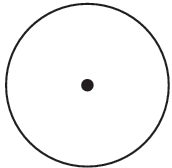
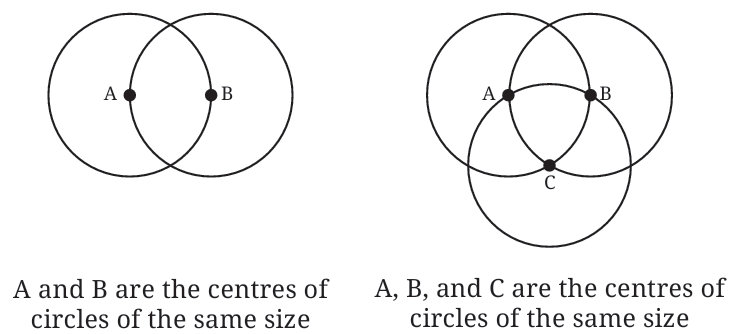
1. Use the points on the circle and/or the centre to form isosceles triangles.
2. Use the points on the circles and/or their centres to form isosceles and equilateral triangles. The circles are of the same size.
Are Triangles Possible for any Lengths?
Can one construct triangles having any given sidelengths? Are there lengths for which it is impossible to construct a triangle? Let us explore this. Construct a triangle with sidelengths 3 cm, 4 cm, and 8 cm.
What is happening? Are you able to construct the triangle?
Here is another set of lengths: 2 cm, 3 cm, and 6 cm. Check if a triangle
is possible for these sidelengths.
Try to find more sets of lengths for which a triangle construction
is impossible. See if you can find any pattern in them.
We see that a triangle is possible for some sets of lengths and not possible for others. How do we check if a triangle exists for a given set of lengths? One way is to actually try to construct the triangle and check if it is possible. Is there a more efficient way to check this?
Triangle Inequality
Consider the lengths 10 cm, 15 cm and 30 cm. Does there exist a triangle having these as sidelengths?
To tackle this question, let us study a property of triangles. Imagine a small plot of plain land having a tent, a tree, and a pole. Imagine you are at the entrance of the tent and want to go to the tree. Which is the shorter path: (i) the straight-line path to the tree (the red path) or (ii) the straight-line path from the tent to the pole, followed by the straight-line path from the pole to the tree (the yellow path)? Clearly, the direct straight-line path from the tent to the tree is shorter than the roundabout path via the pole. In fact, the direct straight-line path is the shortest possible path to the tree from the tent.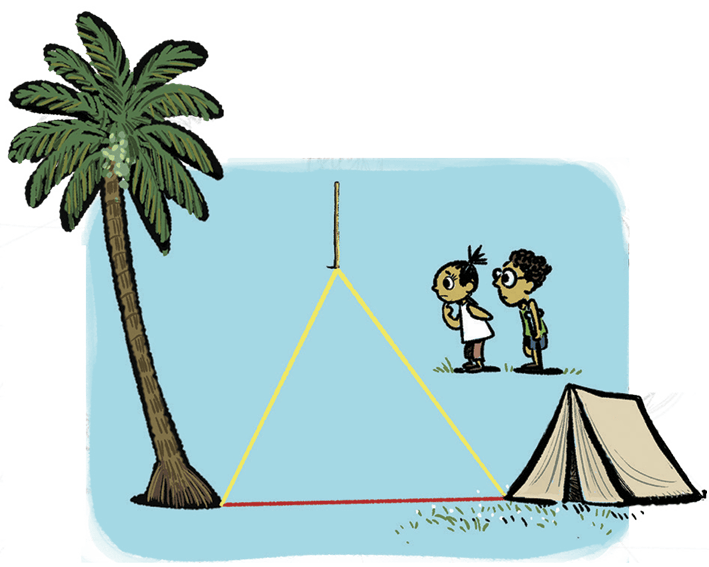
Can this understanding be used to tell something about the existence
of a triangle having sidelengths 10 cm, 15 cm and 30 cm?
Let us suppose that there is a triangle for this set of lengths. Remember that at this point we are not sure about the existence of the triangle but we are only supposing that it exists. Let us draw a rough diagram.
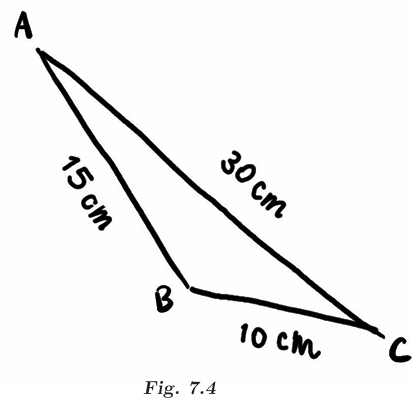
Does everything look right with this triangle?
If this triangle were possible, then the direct path between any two
vertices should be shorter than the roundabout path via the third
vertex. Is this true for our rough diagram?
Let us consider the paths between B and C.
Direct path length = BC = 10 cm What is the length of the roundabout path via the vertex A? It is the sum of the lengths of line segments BA and AC.
Roundabout path length = BA + AC = 15 cm + 30 cm = 45 cm
Is the direct path length shorter than the roundabout path length? Yes. Let us now consider the paths between A and B.
Direct path length = AB = 15 cm
Finding the length of the roundabout path via the vertex C, we get Roundabout path length = AC + CB = 30 cm + 10 cm = 40 cm
Is the direct path length shorter than the roundabout path length? Yes. Finally, consider paths between C and A.
Direct path length = CA = 30 cm
Roundabout path length = CB + BA = 10 cm + 15 cm = 25 cm
Is the direct path length shorter than the roundabout path length? In this case, the direct path is longer, which is absurd. Can such a triangle exist? No.
Therefore, a triangle having sidelengths 10 cm, 15 cm and 30 cm cannot exist.
We are thus able to see without construction why a triangle for the set of lengths 10 cm, 15 cm and 30 cm cannot exist. We have been able to figure this out through spatial intuition and reasoning.
Recall how we used similar intuition and reasoning to discover properties of intersecting and parallel lines. We will continue to do this as we explore geometry. Can we say anything about the existence of a triangle having sidelengths
3 cm, 3 cm and 7 cm? Verify your answer by construction.
“In the rough diagram in Fig. 7.4, is it possible to assign
lengths in a different order such that the direct paths are
always coming out to be shorter than the roundabout
paths? If this is possible, then a triangle might exist.”
Is such rearrangement of lengths possible in the triangle?
Figure it Out
1. We checked by construction that there are no triangles having sidelengths 3 cm, 4 cm and 8 cm; and 2 cm, 3 cm and 6 cm. Check if you could have found this without trying to construct the triangle.
2. Can we say anything about the existence of a triangle for each of the following sets of lengths? (a) 10 km, 10 km and 25 km (b) 5 mm, 10 mm and 20 mm (c) 12 cm, 20 cm and 40 cm You would have realised that using a rough figure and comparing the direct path lengths with their corresponding roundabout path lengths is the same as comparing each length with the sum of the other two lengths. There are three such comparisons to be made.
3. For each set of lengths seen so far, you might have noticed that in at least two of the comparisons, the direct length was less than the sum of the other two (if not, check again!). For example, for the set of lengths 10 cm, 15 cm and 30 cm, there are two comparisons where this happens:
10 < 15 + 30
15 < 10 + 30
But this doesn’t happen for the third length: 30 > 10 + 15.
Will this always happen? That is, for any set of lengths, will there be at
least two comparisons where the direct length is less than the sum of
the other two? Explore for different sets of lengths.
Further, for a given set of lengths, is it possible to identify which
lengths will immediately be less than the sum of the other two, without
calculations?
[Hint: Consider the direct lengths in the increasing order.]
Given three sidelengths, what do we need to compare to check for the
existence of a triangle?
When each length is smaller than the sum of the other two, we say that the lengths satisfy the triangle inequality. For example, the set 3, 4, 5 satisfies the triangle inequality whereas, the set 10, 15, 30 does not satisfy the triangle inequality.
We have seen that lengths such as 10, 15, 30 that do not satisfy the triangle inequality cannot be the sidelengths of a triangle. Does a triangle exist with sidelengths 4 cm, 5 cm and 8 cm?This satisfies the triangle inequality:
8 < 4 + 5 = 9
Why do we not need to check the other two sides?
This means that all the direct path lengths are less than the roundabout path lengths. Does this confirm the existence of a triangle? If one of the direct path lengths had been longer, we could have concluded that a triangle would surely not exist. But in this case, we can only say that a triangle may or may not exist. For the triangle to exist, the arcs that we construct to get the third vertex must intersect. Is it possible to determine that this will happen without actually carrying out the construction?
Visualising the construction of circles
Let us imagine that we start the construction by constructing the longest side as the base. Let AB be the base of length 8 cm. The next step is the construction of sufficiently long arcs corresponding to the other two lengths: 4 cm and 5 cm.Instead of just constructing the arcs, let us complete the full circles. Suppose, we construct a circle of radius 4 cm with A as the centre.
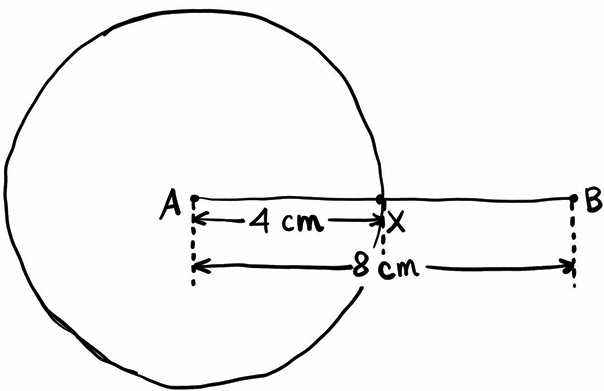
Now, suppose that a circle of radius 5 cm is constructed, centred at B.
Can you draw a rough diagram of the resulting figure?
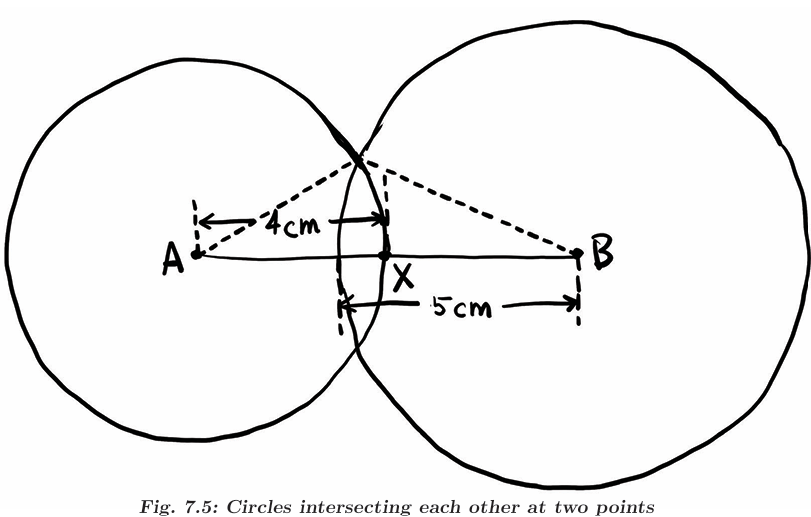
Note that in the figure below, AX = 4 cm and AB = 8 cm. So, what is
BX? Does this length help in visualising the resulting figure?
Since BX = 4 cm, and the radius of the circle centred at B is 5 cm, it is
clear that the circles will intersect each other at two points.
Will triangles always exist when a set of lengths satisfies the triangle
inequality? How can we be sure?
We can be sure of the existence of a triangle only if we can show that the circles intersect internally (as in Fig. 7.5) whenever the triangle inequality is satisfied. But are there other possibilities when the two circles are constructed? Let us visualise and study them. The following different cases can be conceived:
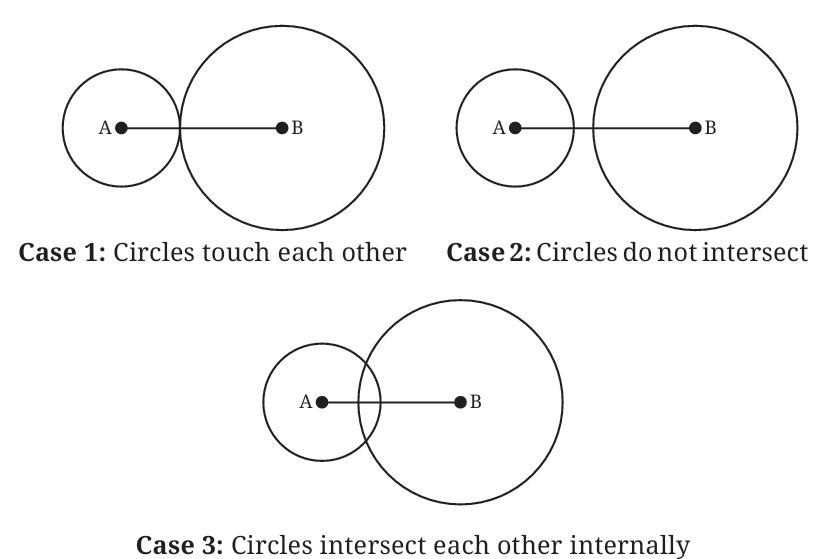
(a) the length of the base AB = longest of the given length
(b) the radii of the circles to be the smaller two lengths.
Which of the above-mentioned cases will lead to the formation of a triangle? Clearly, triangles are formed only when the circles intersect each other internally (Case 3). Let us study each of these cases by finding the relation between the
radii (the smaller two lengths) and AB (longest length).
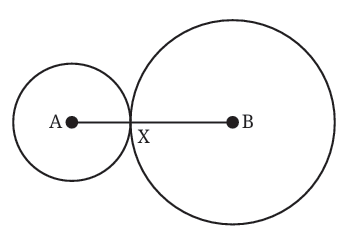
Case 1: Circles touch each other at a point
For this case to happen, sum of the two radii = AB
or
sum of the two smaller lengths = longest length
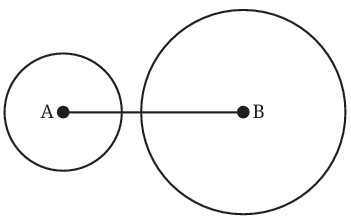
For this case to happen, what should be the relation between the radii
and AB?
Sum of the two radii < AB
or
Sum of the two smaller lengths < longest length
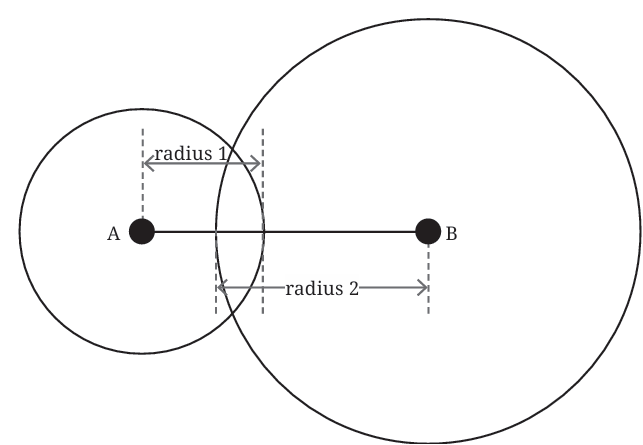
AB is composed of one radius and a part of the other. So,
Sum of the two radii > AB,
or
Sum of the two smaller lengths > longest length
Can we use this analysis to tell if a triangle exists when the lengths
satisfy the triangle inequality?
If the given lengths satisfy the triangle inequality, then the sum of the two smaller lengths is greater than the longest length. This means that this will lead to Case 3 where the circles intersect internally, and so a triangle exists.
How will the two circles turn out for a set of lengths that do not satisfy
the triangle inequality? Find 3 examples of sets of lengths for which
the circles:
- (a) touch each other at a point,
- (b) do not intersect.
Frame a complete procedure that can be used to check the existence of
a triangle.
Conclusion
If a given set of three lengths satisfies the triangle inequality, then a triangle exists having those as sidelengths. If the set does not satisfy the triangle inequality, then a triangle with those sidelengths does not exist.
Figure it Out
1. Check if a triangle exists for each of the following set of lengths:
- (a) 1, 100, 100
- (b) 3, 6, 9
- (c) 1, 1, 5
- (d) 5, 10, 12
2. Does there exist an equilateral triangle with sides 50, 50, 50? In general, does there exist an equilateral triangle of any sidelength? Justify your answer.
3. For each of the following, give at least 5 possible values for the third length so there exists a triangle having these as sidelengths (decimal values could also be chosen):
- (a) 1, 100
- (b) 5, 5
- (c) 3, 7
See if you can describe all possible lengths of the third side in each case, so that a triangle exists with those sidelengths. For example, in case (a), all numbers strictly between 99 and 101 would be possible.
7.3 Construction of Triangles When Some Sides and Angles are Given
We have seen how to construct triangles when their sidelengths are given. Now, we will take up constructions where in place of some sidelengths, angle measures are given.Two Sides and the Included Angle
How do we construct a triangle if two sides and the angle included between them are given? Here are some examples of measurements showing the included angle.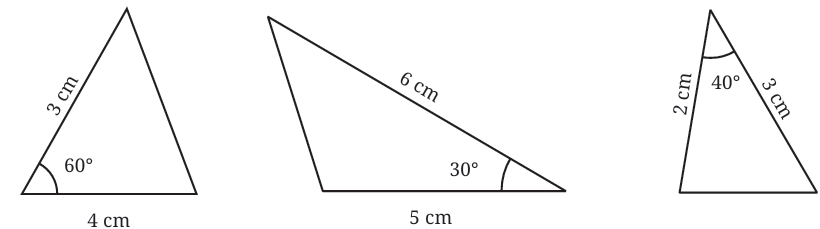
Construct a triangle ABC with AB = 5 cm, AC = 4 cm and ∠A= 45°.
Let us take one of the given sides, AB, as the base of the triangle.
Let us take one of the given sides, AB, as the base of the triangle.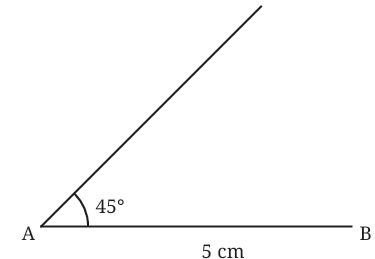
Step 1: Construct a side AB of length 5 cm.
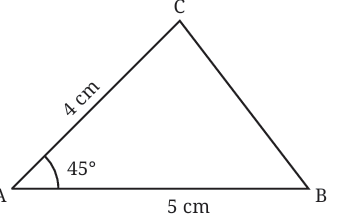
Step 2:Construct ∠A = 45° by drawing the other arm of the angle.
Step 3: Mark the point C on the other arm such that AC = 4 cm.
Step 4: Join BC to get the required triangle.
Figure it Out
1. Construct triangles for the following measurements where the angle is included between the sides:
- (a) 3 cm, 75°, 7 cm
- (b) 6 cm, 25°, 3 cm
- (c) 3 cm, 120°, 8 cm
We have seen that triangles do not exist for all sets of sidelengths. Is
there a combination of measurements in the case of two sides
and the included angle where a triangle is not possible? Justify
your answer using what you observe during construction.
Two Angles and the Included Side
In this case, we are given two angles and the side that is a part of both angles, which we call the included side. Here are some examples of such measurements: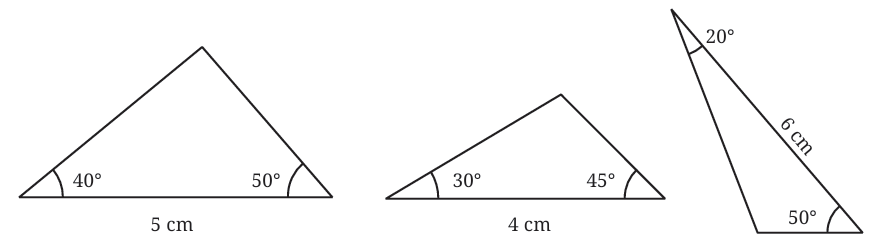
Construct a triangle ABC where AB = 5 cm, ∠A = 45° and ∠B = 80°.
Let us take the given side as the base.
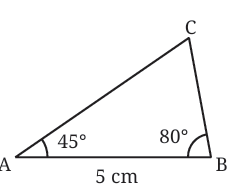
Step 1: Draw the base AB of length 5 cm.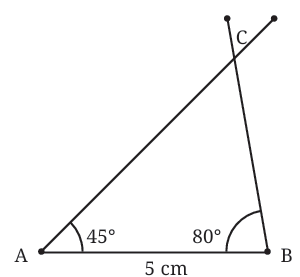
Step 2:Draw ∠A and ∠B of measures 45°, and 80° respectively.
Step 3: The point of intersection of the two new line segments is the third vertex C.
Figure it Out
1. Construct triangles for the following measurements:
- (a) 75°, 5 cm, 75°
- (b) 25°, 3 cm, 60°
- (c) 120°, 6 cm, 30°
Do triangles always exist?
Do triangles exist for every combination of two angles and their
included side? Explore.
As in the case when we are given all three sides, it turns out that there is not always a triangle for every combination of two angles and the included side.
Find examples of measurements of two angles with the included side
where a triangle is not possible.
Let us try to visualise such a situation. Once the base is drawn, try to imagine how the other sides should be so that they do not meet. Here are some obvious examples.

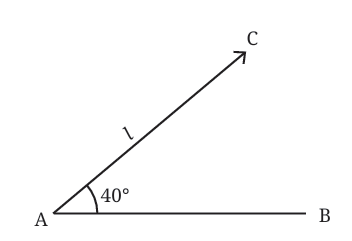
It is clear that if the line from B is “inclined” sufficiently to the right,
then it will not meet the line l.
- (a) Try to find a possible ∠B (marked in the figure) for this to happen.
- (b) What could be smallest value of ∠B for the lines to not meet?
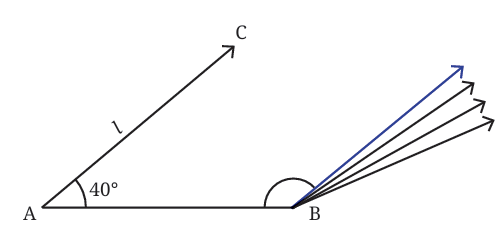
The blue line is the line with the least rightward bend that doesn’t meet the line ‘l’
Visually, it is clear that the line that creates the smallest ∠B has to be the one parallel to l. Let us call this parallel line m. Can you tell the actual value of ∠B be in this case?[Hint: Note that AB is the transversal.] We have seen that when two lines are parallel, the internal angles on the same side of the transversal add up to 180°. So ∠B = 140°. So, for what values of ∠B, does a triangle not exist? Does the length AB play any part here?
From the discussion above, it can be seen that the length AB does not play any part in deciding the existence of a triangle. We can say that a triangle does not exist when ∠B is greater than or equal to 140°
Figure it Out
1. For each of the following angles, find another angle for which a triangle is (a) possible, (b) not possible. Find at least two different angles for each category:
- (a) 30°
- (b) 70°
- (c) 54°
- (d) 144°
2. Determine which of the following pairs can be the angles of a triangle and which cannot:
- (a) 35°, 150°
- (b) 70°, 30°
- (c) 90°, 85°
- (d) 50°, 150°
Like the triangle inequality, can you form a rule that describes the two
angles for which a triangle is possible?
Can the sum of the two angles be used for framing this rule?
When the sum of two given angles is less than 180°, a triangle exists with these angles. If the sum is greater than or equal to 180°, there is no triangle with these angles. Let us take two angles, say 60° and 70°, whose sum is less than 180°. Let the included side be 5 cm. What could the measure of the third angle be? Does this measure
change if the base length is changed to some other value, say 7 cm?
Construct and find out.
In general, once the two angles are fixed, does the third angle depend
on the included sidelength? Try with different pairs of angles and
lengths.
The measurements might show that the sidelength has no effect (or a very small effect) on the third angle. With this observation, let us see if we can find the third angle without carrying out the construction and measurement.
Try experimenting with different triangles to see if there is a
relation between any two angles and the third one. To find this
relation, what data will you keep track of and how will you
organise the data you collect?
Consider a triangle ABC with ∠B= 50° and ∠C= 70°. Let us see how we
can find ∠A without construction.
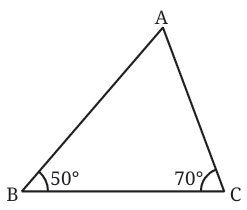
We saw that the notion of parallel lines was useful to determine that 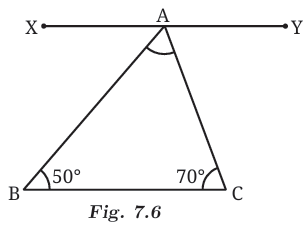 the sum of any two angles of a triangle is
less than 180°. Parallel lines can be used to
find the third angle, ∠BAC as well.
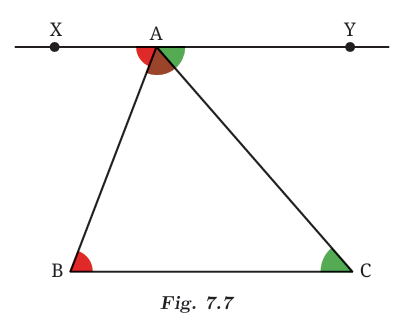
Let us suppose we construct a line XY
parallel to BC through vertex A.
the sum of any two angles of a triangle is
less than 180°. Parallel lines can be used to
find the third angle, ∠BAC as well.
Let us suppose we construct a line XY
parallel to BC through vertex A.
We can see new angles being formed here:
∠XAB, and ∠YAC. What are their values?
Since the line XY is parallel to BC, ∠XAB = ∠B and ∠YAC = ∠C, because they are alternate angles of the transversals AB and AC.
Therefore, ∠XAB = 50°, and ∠YAC = 70°. Can we find ∠BAC from this? We know that ∠XAB, ∠YAC and ∠BAC together form 180°. So
∠XAB + ∠YAC + ∠BAC = 180°
50° + ∠BAC + 70° = 180°
120° + ∠BAC = 180°
Thus, ∠BAC = 60°
Figure it Out
1. Find the third angle of a triangle (using a parallel line) when two of the angles are:
- (a) 36°, 72°
- (b) 150°, 15°
- (c) 90°, 30°
- (d) 75°, 45°
2. Can you construct a triangle all of whose angles are equal to 70°? If two of the angles are 70° what would the third angle be? If all the angles in a triangle have to be equal, then what must its measure be? Explore and find out.
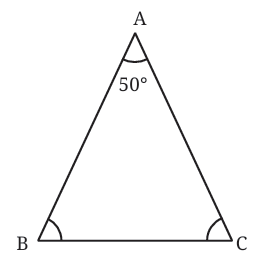
3. Here is a triangle in which we know
∠B = ∠C and ∠A = 50°. Can you find ∠B and ∠C?
Angle Sum Property
What can we say about the sum of the angles of any triangle?
Consider a triangle ABC. To find the sum of its angles, we can use the same method of drawing a line parallel to the base: construct a line through A that is parallel to BC.
We need to find ∠A + ∠B + ∠C.We know that ∠B = ∠XAB, ∠C = ∠YAC.
So, ∠A + ∠B + ∠C = ∠A + ∠XAB + ∠YAC
= 180° as together they form a straight angle.
Thus we have proved that the sum of the three angles in any triangle is 180°! This rather surprising result is called the angle sum property of triangles.
This solution is yet another example of how creative thinking plays a key role in mathematics!
There is a convenient way of verifying the angle sum property by folding a triangular cut-out of a paper. Do you see how this shows that the sum of the angles in this triangle is 180°?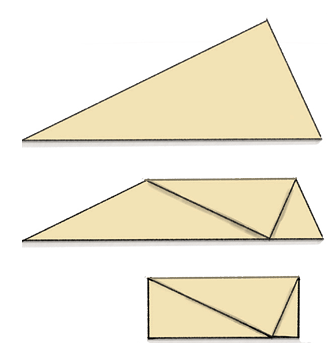
Exterior Angles
The angle formed between the extension of a side of a triangle and the other side is called an exterior angle of the triangle. In this figure, ∠ACD is an exterior angle.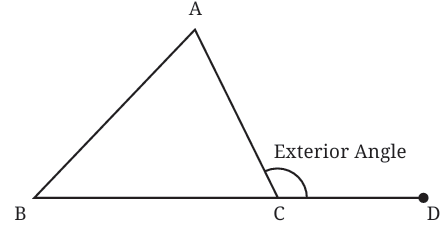
From the angle sum property, we know that 50° + 60° + ∠ACB = 180° 110° + ∠ACB = 180°
So, ∠ACB = 70°
So, ∠ACD = 180 ° – 70° = 110°, since, ∠ACB and ∠ACD together form a straight angle. Find the exterior angle for different measures of ∠A and ∠B. Do you see any relation between the exterior angle and these two angles?
[Hint: From angle sum property, we have ∠A + ∠B + ∠ACB = 180°.] We also have ∠ACD + ∠ACB = 180°, since they form a straight angle. What does this show?
7.4 Constructions Related to Altitudes of Triangles
There is another set of useful measurements with respect to a triangle — the height of each of its vertices with respect to the opposite sides. In the world around us, we talk of the heights of various objects: the height of a person, the height of a tree, the height of a building, etc. What do we mean by the word ‘height’?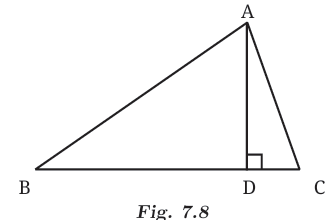
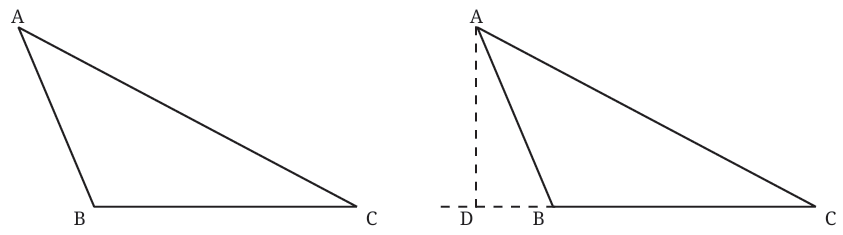
Consider a triangle ABC. What is the height of the vertex A from its opposite side BC, and how can it be measured?
Let AD be the line segment from A drawn perpendicular to BC. The length of AD is the height of the vertex A from BC. The line segment AD is said to be one of the ‘altitudes’ of the triangle. The other altitudes are BE and CF in the figure below: the perpendiculars drawn from the other vertices to their respective opposite sides.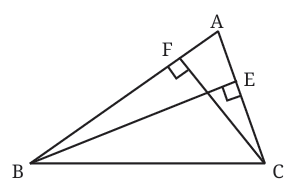
Altitudes Using Paper Folding
Cut out a paper triangle. Fix one of the sides as the base. Fold it in
such a way that the resulting crease is an altitude from the top vertex
to the base. Justify why the crease formed should be perpendicular to
the base.
Construction of the Altitudes of a Triangle
Construct an arbitrary triangle. Label the vertices A, B, C taking BC to be the base. Construct the altitude from A to BC,
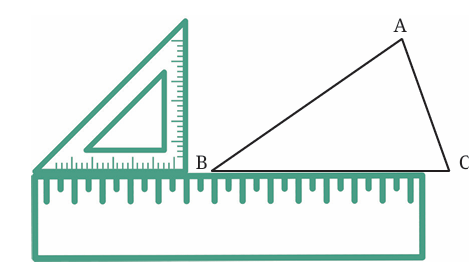
Constructing the altitude using just a ruler is not accurate. To get a more precise angle of 90°, we use a set square along with a ruler.
Can you see how to do this?
Step 1: Keep the ruler aligned to the base. Place the set square on the ruler as shown, such that one of the edges of the right angle touches the ruler.
Step 2: Slide the set square along the ruler till the vertical edge of the set square touches the vertex A.
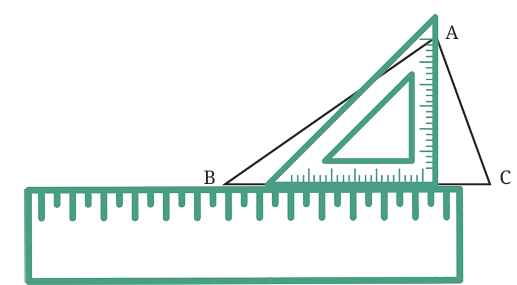
Step 3: Draw the altitude to BC through A using the vertical edge of the set square.
Does there exist a triangle in which a side is also an altitude?
We see that this happens in triangles where one of the angles is a right angle. Triangles having one right angle are called right-angled triangles or simply right triangles.
Altitude from A to BC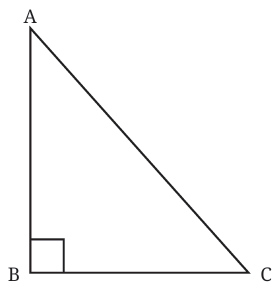
7.5 Types of Triangles
In our study of triangles, we have encountered the following types of triangles; equilateral, isosceles, scalene and right-angled triangles. Did you spot any other type of triangle?
The classification of triangles as equilateral and isosceles was based on equality of sides.
Equilateral triangles have sides of equal length. Isosceles triangles have two sides of equal length. Scalene triangles have sides of three different lengths.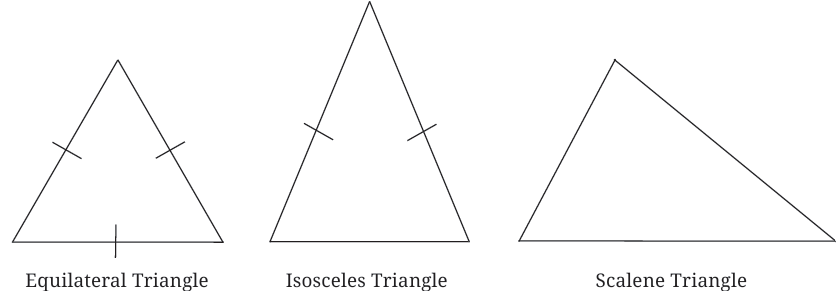
What are the other types of triangles based on angle measures?
A classification of triangles based on their angle measures is acute angled, right-angled and obtuse-angled triangles. We have already seen what a right-angled triangle is. It is a triangle with one right angle. Similarly, an obtuse-angled triangle has one obtuse angle.
What could an acute-angled triangle be? Can we define it as a
triangle with one acute angle? Why not?
In an acute-angled triangle, all three angles are acute angles.
Figure it Out
1. Construct a triangle ABC with BC = 5 cm, AB = 6 cm, CA = 5 cm.
Construct an altitude from A to BC.
2. Construct a triangle TRY with RY = 4 cm, TR = 7 cm, ∠R = 140°.
Construct an altitude from T to RY.
3. Construct a right-angled triangle ∆ABC with ∠B = 90°, AC = 5 cm. How many different triangles exist with these measurements?
[Hint: Note that the other measurements can take any values. Take AC as the base. What values can ∠A and ∠C take so that the other angle is 90°?]
4. Through construction, explore if it is possible to construct an equilateral triangle that is (i) right-angled (ii) obtuse-angled. Also construct an isosceles triangle that is (i) right-angled (ii) obtuse-angled.
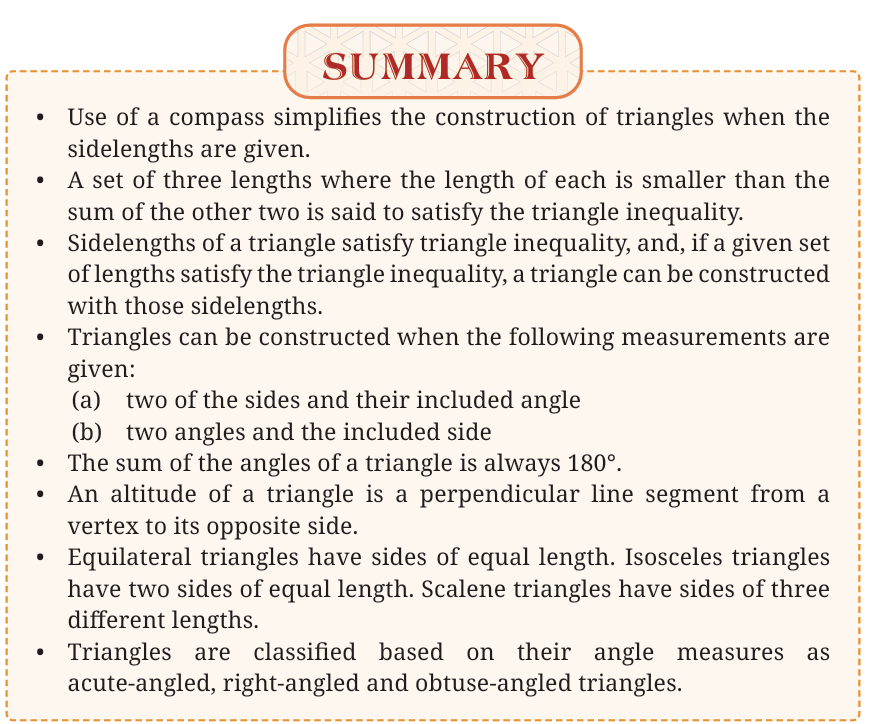
SUMMARY
- Use of a compass simplifies the construction of triangles when the sidelengths are given.
- A set of three lengths where the length of each is smaller than the sum of the other two is said to satisfy the triangle inequality.
- Sidelengths of a triangle satisfy triangle inequality, and, if a given set of lengths satisfy the triangle inequality, a triangle can be constructed with those sidelengths.
- Triangles are classified based on their angle measures as acute-angled, right-angled and obtuse-angled triangles.
- Triangles can be constructed when the following measurements are
given:
- (a) two of the sides and their included angle
- (b) two angles and the included side
- The sum of the angles of a triangle is always 180°.
- An altitude of a triangle is a perpendicular line segment from a vertex to its opposite side.
- Equilateral triangles have sides of equal length. Isosceles triangles have two sides of equal length. Scalene triangles have sides of three different lengths. Triangles are classified based on their angle measures as acute-angled, right-angled and obtuse-angled triangles.
(Reference test of image shown above:)
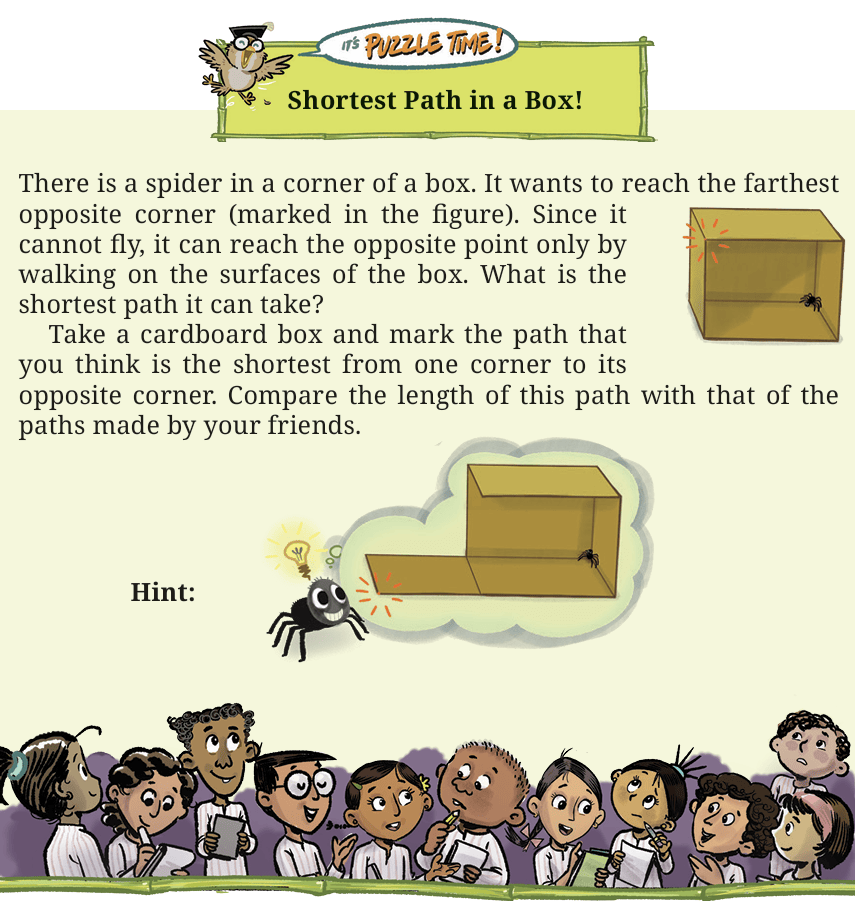
IT'S PUZZLE TIME
Shortest Path in a Box!
There is a spider in a corner of a box. It wants to reach the farthest opposite corner (marked in the figure). Since it cannot fly, it can reach the opposite point only by walking on the surfaces of the box. What is the shortest path it can take? Take a cardboard box and mark the path that you think is the shortest from one corner to its opposite corner. Compare the length of this path with that of the paths made by your friends.