3 FINDING COMMON GROUND
3.1 The Greatest of All
Sameeksha is building her new house. The main room of the house is 12 ft by 16 ft. She feels that the room would look nice if the floor is covered with square tiles of the same size. She also wants to use as few tiles as possible, and for the length of the tile to be a whole number of feet. What size tiles should she buy?
Let us explore how to find the largest square tile that can be used. The breadth of the room is 12 ft and the length is 16 ft.
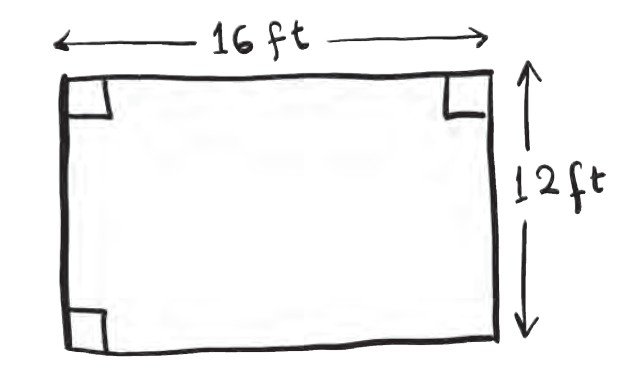
For the tiles to fit the breadth of the room exactly, the side of the tile should be a factor of 12. Similarly, for the tiles to fit the length of the room exactly, the side should be a factor of 16. So the side of the tile should be a factor of both 12 and 16. What are the common factors of 12 and 16?
The factors of 12 are 1, 2, 3, 4, 6, 12. The factors of 16 are 1, 2, 4, 8, 16. The common factors are 1, 2, and 4. So, the square tiles can have sides 1 ft, 2 ft, and 4 ft. Among these, she should use the largest sized square tile. Can you explain why? Therefore, she needs tiles of size 4 ft.
How many tiles of this size should she purchase?
What if Sameeksha did not insist on the length of the tile to be a whole number of feet and the length could be a fractional number of feet? Would the answer change?
The Highest Common Factor (HCF) of two or more numbers, is the highest (or greatest) of their common factors. It is also known as the Greatest Common Divisor (GCD).
In the previous problem, 4 is the HCF of 12 and 16.
We can draw rough diagrams like the one shown on the previous page to visualise the given scenario. It may help in understanding and solving.
Lekhana purchases rice from two farms and sells it in the market. She bought 84 kg of rice from one farm and 108 kg from the other farm. She wants the rice to be packed in bags, so each bag has rice from only one farm and all bags have the same weight that is a whole number of kg. If she wants to use as few bags as possible, what should the weight of each bag be?
To divide 84 kg of rice into bags of equal weight, we need the factors of 84. Similarly, for 108, we need the factors of 108.
Factors of 84 — 1, 2, 3, 4, 6, 7, 12, 14, 21, 28, 42, and 84.
Factors of 108 — 1, 2, 3, 4, 6, 9, 12, 18, 27, 36, 54, and 108.
Since, Lekhana wants to use bags of the same weight for both farms, the weight of the bag should be a common factor. The common factors of 84 and 108 are
1, 2, 3, 4, 6, and 12.
She can use any of these weights to pack rice from both farms in bags of equal weight. But, she wants to minimise the number of bags. Which weight should she choose to minimise the number of bags?
Do you remember the ‘Jump Jackpot’ game from Grade 6 (see the chapter ‘Prime Time’)? Grumpy places a treasure on a number and Jumpy chooses a jump size and tries to collect the treasure. In each case below, the two numbers upon which treasures are kept are given. Find the longest jump size (starting from 0) using which Jumpy can land on both the numbers having the treasure.
Is the longest jump size for the numbers the same as their HCF? Explain why it is so.
So far, we have been listing all the factors to find the HCF. This can become cumbersome for numbers with many factors, as you would have observed for the numbers 30 and 50, and 28 and 42.
Sometimes, we may also miss some factors which can lead to errors.
Can this process be simplified? Can it be made more reliable?
It turns out that using prime factorisation can simplify the process. We will start by revisiting primes and prime factorisation.
Primes
Recall that a prime is a number greater than 1 that has only 1 and the number itself as its factors. Last year, we tried to find patterns amongst primes between 1 to 100. We also came across the Sieve of Eratosthenes — a method to list all primes.
Prime Factorisation
Any number can be written as a product of primes — keep rewriting composite factors until only primes are left.
Recall that we call this the prime factorisation of a given number. For example, we can find the prime factorisation of 90 as follows:
90 = 3 × 3 × 2 × 5.
The number 90 could also have been factorised as 3 × 30 or 2 × 45 or in a few other different ways. Will these all lead to the same prime factors? Remarkably, the resulting prime factors are always the same with perhaps only a change in their order. For example, if we consider factorising 3 × 30 further, we get
90 = 3 × 30 = 3 × 2 × 15 = 3 × 2 × 3 × 5,
and we have arrived at the same prime factors, just in a different order. Note that the prime factorisation of a prime number is the prime number itself.
Procedure for Prime Factorisation
Can you see what is happening below?
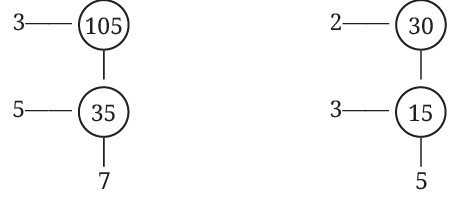
Each circled number is the product of the numbers that are to its left and below. For example, 30 = 2 × 15, 15 = 3 × 5. Each time, a composite number is factorised so that, at least one factor is prime. We stop when we reach a prime number.
Can you write the prime factorisation of 105 and 30 using these two figures?
We collect the prime factors along the left and the one at the bottom. We then construct the prime factorisation as shown in the figure.
While carrying out factorisation, the circles are usually left out and the steps are carried out in this format:
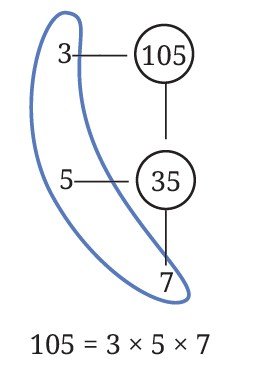
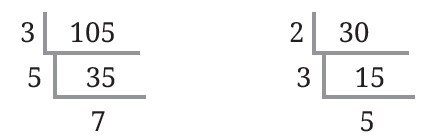
Let us call this method the division method. Try finding the prime factorisation of 1200 using the method above.
If we had used the earlier method, our calculation would have been as follows:
1200 = 40 × 30 = 5 × 8 × 5 × 6 = … Which calculation is easier to carry out?
Factors of a Number Using Prime Factorisation
From the prime factorisation of a number, we can construct all its factors. This can be used to simplify the procedure for finding the HCF of two numbers.
Consider the number 840 and its prime factorisation 2 × 2 × 2 × 3 × 5 × 7.
Is 2 × 2 × 7 = 28 a factor of 840?
If yes, what should it be multiplied by to get 840?
To answer these questions, we can reorder the prime factors of 840 as follows (recall that reordering factors does not change the product): 840 = (2 × 2 × 7) × (2 × 3 × 5).
So,
840 = 28 × 30.
Thus, (2 × 2 × 7) = 28 is a factor of 840, and it should be multiplied by 30 (2 × 3 × 5) to get 840.
Similarly, is 2 × 7 = 14 a factor of 840? Why or why not?
Is 2 × 2 × 2 a factor of 840? Why or why not?
Is 3 × 3 × 3 a factor of 840? Why or why not?
Can we use this idea to list down all the possible factors of a number using just its prime factors?
Find the factors of 225 using prime factorisation. Factorising 225 to its primes, we get
225 = 5 × 5 × 3 × 3.
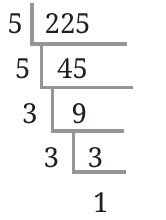
We have seen that any ‘subpart’ of this factorisation gives us a factor. Let us systematically form these subparts.
Prime factors: 3, 5.
Combination of two prime factors: 3 × 3 = 9, 5 × 5 = 25, 3 × 5 = 15.
Combination of three prime factors: 3 × 3 × 5 = 45, 3 × 5 × 5 = 75.
Combination of four prime factors: 3 × 3 × 5 × 5 = 225. Adding 1 to this list of factors, we see that the factors of 225 are 1, 3, 5, 9, 15, 25, 45, 75, 225.
Check that all the factors of 225 occur in this list.
Figure it Out
List all the factors of the following numbers:
(a) 90
(b) 105
(c) 132
(d) 360 (this number has 24 factors)
(e) 840 (this number has 32 factors)
After observing a few prime factorisations, Anshu claims “The larger a number is, the longer its prime factorisation will be”.
What do you think of Anshu’s claim?
We can see that it is not true. For example, look at the prime factorisations of 96 and 121.
96 = 2 × 2 × 2 × 2 × 2 × 3
121 = 11 × 11.
In mathematics, statements or claims made without proof or verification are called ‘conjectures’. Anshu’s claim is a conjecture. We disproved this conjecture by finding a counterexample, i.e., an example where the conjecture is false.
Finding the HCF of Numbers Using Prime Factorisation
We now see how to make use of the observations made so far to find common factors and the Highest Common Factor (HCF).
Example 1: Find the common factors, and the HCF of 45 and 75. Calculate the prime factorisation for both numbers:
45 = 3 × 3 × 5
75 = 3 × 5 × 5.
We have seen:
Factors of 45 are subparts of factors occurring in 3 × 3 × 5 and factors of 75 are subparts of factors occurring in 3 × 5 × 5.
So the common factors should be subparts of both the factorisations. Can you write them down?
While exploring or solving problems you might also get some conjectures. You can try to reason and verify these and also share with the class.
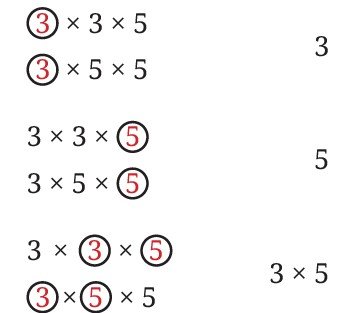
3, 5, 3 × 5 = 15 are subparts of both, and hence, they are the common factors along with 1. The highest among them is 15. So, their HCF = 15.
Example 2: Find the common factors, and the HCF of 112 and 84. Calculating prime factorisations, we get,
112 = 2 × 2 × 2 × 2 × 7 and
84 = 2 × 2 × 3 × 7.
Finding the common subparts, we get
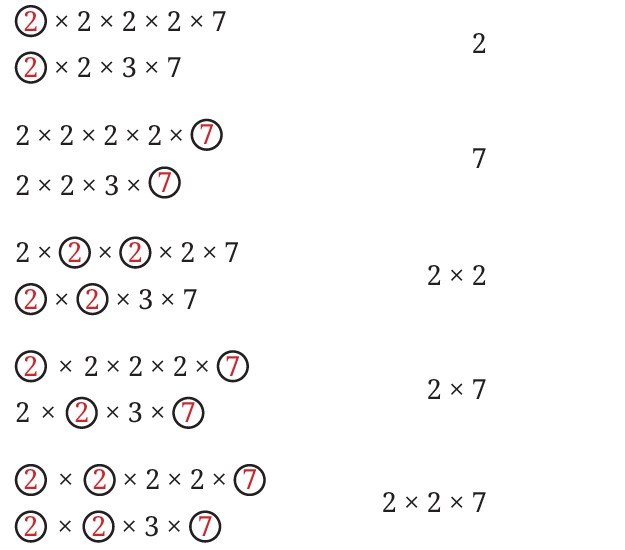
The highest among the common factors, HCF, is 2 × 2 × 7 = 28.
Example 3: Find the common factors and the HCF of 96 and 275. We have
96 = 2 × 2 × 2 × 2 × 2 × 37
275 = 5 × 5 × 11.
There is no subpart that is common amongst these two factorisations. So, 1 is the only common factor. It is also their HCF.
Figure it Out
Find the common factors and the HCF of the following numbers:
(a) 50, 60
(b) 140, 275
(c) 77, 725
(d) 370, 592
(e) 81, 243
How do we directly find the HCF without listing all the factors?
Example 4: Find the HCF of 30 and 72.
30 = 2 × 3 × 5
72 = 2 × 2 × 2 × 3 × 3
We need the largest common subpart to find the HCF. Clearly, it will contain only those primes that occur in both the factorisations: 2 and 3 in this case.
How many 2s will it contain?
The prime factorisation of 30 has only one 2. So, the largest common subpart should contain only one 2.
How many 3s will it contain?
The prime factorisation of 30 has only one 3. So, the largest common subpart should contain only one 3.
This has been carried out below.
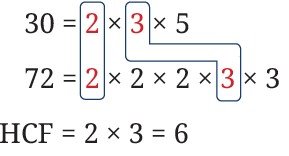
Thus, to find the HCF, we identify the common primes and find the minimum number of times each of them appear in the factorisations of the given numbers.
Example 5: Find the HCF of 225 and 750
225 = 3 × 3 × 5 × 5
750 = 2 × 3 × 5 × 5 × 5
Common primes: 3 and 5. Let us find the largest common subpart. How many 3s will it contain?
750 contains only one 3, which is the minimum number of 3 across both numbers. So the largest common subpart should contain only one 3. How many 5s will it contain?
225 contains the minimum number of 5s which occurs two times. So, the largest common subpart should contain two 5s, i.e., 5 × 5.
To find the HCF of more than 2 numbers, a similar method of finding the largest common subpart of the common primes can be followed.
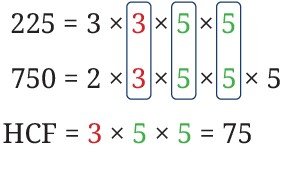
Figure it Out
- 1. Find the HCF of the following numbers:
- (a) 24, 180
- (b) 42, 75, 24
- (c) 240, 378
- (d) 400, 2500
- (e) 300, 800
- 2. Consider the numbers 72 and 144. Suppose they are factorised into composite numbers as: 72 = 6 × 12 and 144 = 8 × 18. Seeing this, can one say that these two numbers have no common factor other than 1? Why not?
3.2 Least, but not Last!
Anshu and Guna make torans out of strips of cloth. Multiple strips are placed one next to another to make a toran. Anshu uses strips of length 6 cm and Guna uses strips of 8 cm length. If both have to make torans of the same length, what is the smallest possible length the torans could be? What is the length of the shortest toran that they can both make?
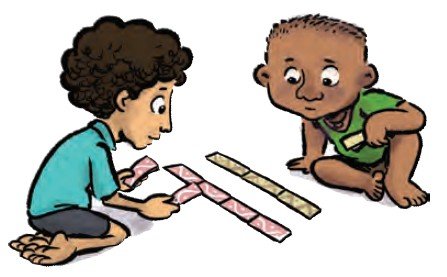
Anshu uses cloth strips of 6 cm each. Any toran he makes will be a multiple of 6. So, the length of the toran could be 6, 12, 18, 24, 30, 36, 42, 48, 54 cm, and so on.
Similarly, any toran Guna makes should be a multiple of 8. So, the length of the toran he makes could be 8, 16, 24, 32, 40, 48, 56, 64, 72 cm, and so on.
From this, we can see that if both have to make torans of the same length, the length of the toran should be a common multiple of 6 and 8.
From the two lists, we can see that 24 and 48 are two of the common multiples of 6 and 8. So, 24 cm and 48 cm are lengths of toran that Anshu and Guna can both stitch.
24 is the smallest among them. So, 24 cm is the length of the shortest toran that both can stitch. 24 is the lowest number among all the common multiples of 6 and 8.
What about the largest common multiple? Does such a number exist?
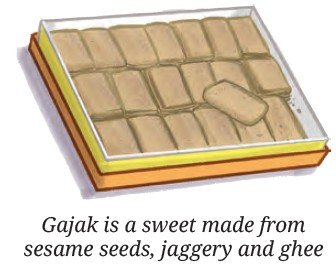
A sweet shop gives out free gajak to school children on Mondays. Today is a Monday and Kabamai enjoyed eating the gajak. But she visits the sweet shop once every 10 days. When is the next time she would be able to get free gajak from Sweet shop? (Answer in number of days.)
As we saw before, imagining or visualising the scenario helped us to see that it can be solved using multiples of the strips’ lengths.
Since the shop gives free sweets every Monday, it will give free sweets again after
7, 14, 21, 28, 35, 42, 49, 56, 63, 70, 77, ... days.
These are multiples of 7.
Kabamai will arrive at the sweet shop again after
10, 20, 30, 40, 50, 60, 70, ... days.
These are multiples of 10.
When will Kabamai eat free sweets again? It will happen on days common to the sequences of multiples above. It can be seen that this will first happen after 70 days.
Notice that, here too, 70 is the lowest among all the common multiples of 7 and 10.
For both these problems the solution was the lowest common multiple. The Lowest Common Multiple (LCM) of two or more given numbers is the lowest (or smallest or least) of their common multiples.
Do you remember the ‘Idli-Vada’ game from Grade 6 (see chapter ‘Prime Time’)? Two numbers are chosen and whenever players come to their multiples, ‘idli’ or ‘vada’ should be called out depending on whose multiple the number is. If the number happens to be a common multiple, then ‘idli-vada’ should be called out. In each problem below, the two numbers corresponding to ‘idli’ and ‘vada’ are given. Find the first number for which ‘idli-vada’ will be called out:
(a) 4 and 6
(b) 7 and 11
(c) 14 and 30
(d) 15 and 55
Is the answer always the LCM of the two numbers? Explain.
As in the case of the HCF, the process of finding the LCM by listing down the multiples may get tedious for larger numbers, as you would have seen for questions (c) and (d) above.
Prime factorisation can simplify the process of finding the LCM as well.
How do we find the LCM of two numbers using their prime factors?
Finding LCM through Prime Factorisation
We have seen that every factor of a number is formed by taking a subpart of its prime factorisation. We used this fact to come up with a method to find the HCF of two numbers. In a similar manner, we can come up with a method to find the LCM.
We begin by comparing the prime factorisations of a number and a multiple of that number. For example, let us take 36 and its multiple 648 (=36 × 18).
We get,
36 = 2 × 2 × 3 × 3,
648 = 36 × 18 = (2 × 2 × 3 × 3) × (2 × 3 × 3).
What do you observe? We can see that the prime factors of the multiple contain the prime factors of the number along with some more prime factors. Will this happen with every multiple?
Can this be used to find the LCM?
Example 6: Find the LCM of 14 and 35.
We get,
14 = 2 × 7
35 = 5 × 7.
Common multiples should contain each prime factor as a subpart: 2 × 7 as a subpart and 5 × 7 as a subpart. For example,
2 × 7 × 5 × 7 × 3 is a common multiple of 14 and 35.
2 × 2 × 5 × 7 × 7 × 11 is another common multiple.
Is 2 × 3 × 5 × 7 also a common multiple?
What is the lowest among all the common multiples of 14 and 35?
It is 2 × 5 × 7 = 70 because 2 × 5 × 7 contains 14 = 2 × 7 as well as 35 = 5 × 7, and removing any number from 2 × 5 × 7 will give a number that is not a common multiple of 14 and 35.
Example 7: Find the LCM of 96 and 360. We have,
96 = 2 × 2 × 2 × 2 × 2 × 3
360 = 2 × 2 × 2 × 3 × 3 × 5.
Every common multiple should contain the prime factors of both 96 and 360. For the LCM, we will need the smallest such number. Let us build the LCM looking at each prime factor.
The prime factors appearing in both the numbers are 2, 3 and 5. Now, we shall find out how many occurrences there are for each prime factor.
How many 2s should the LCM contain?
The factorisation of 96 contains 2 × 2 × 2 × 2 × 2 (five occurrences of 2s) and the factorisation of 360 contains 2 × 2 × 2 (three occurrences of 2s). Choosing five occurrences of 2s as part of LCM will contain both these subparts.
Choosing more than five occurrences of 2s will give a common multiple; but it will not be the lowest. Are you able to see why?
How many 3s should the LCM contain?
The factorisation of 96 contains 3 (one occurrence of 3) and the factorisation of 360 contains 3 × 3 (two occurrences of 3s). Choosing two occurrences of 3s as part of LCM will contain both these subparts.
How many 5s should the LCM contain?
The factorisation of 96 doesn’t have any 5s and the factorisation of 360 has one occurrence of 5. So, we choose one occurrence of 5 to be a part of the LCM.
Thus, the LCM of 96 and 360 will be 2 × 2 × 2 × 2 × 2 × 3 × 3 × 5 = 1440.
To build the LCM of two numbers, we can identify all the prime factors and find the maximum number of times each of them occur in either of the factorisations. This process can be extended to find the LCM of two or more numbers.
Figure it Out
Find the LCM of the following numbers:
(a) 30, 72
(b) 36, 54
(c) 105, 195, 65
(d) 222, 370
3.3 Patterns, Properties, and a Pretty Procedure!
The HCF of 6 and 18 is 6, which is one of the two given numbers.
Find more such number pairs where the HCF is one of the two numbers. How can we describe such pairs of numbers?
We can see that it happens when one number is a factor of the other. This also means the other number will be a multiple of the first number! Such a statement describing a pattern or a property that holds in all possible cases is called a general statement. This process is called generalisation.
Such a generalisation can also be described using algebra. Let us see how.
If n is a number, then any multiple of n can be written as a positive integer multiplied by n. For example, if we take n and 5n (short for 5 × n), then 5n is a multiple of n, and n is a factor of 5n. The HCF of n and 5n = n.
For number pairs satisfying this property (i.e., one of the numbers is the HCF),
(a) if m is a number, what could be the other number?
(b) if 7k is a number, what could be the other number?
Figure it Out
- 1. Make a general statement about the HCF for the following pairs
- of numbers. You could consider examples before coming up
- with general statements. Look for possible explanations of why
- they hold.
- (a) Two consecutive even numbers
- (b) Two consecutive odd numbers
- (c) Two even numbers
- (d) Two consecutive numbers
- (e) Two co-prime numbers Share your observations with the class.
- (a) Two multiples of 3
- (b) Two consecutive even numbers
- (c) Two consecutive numbers
- (d) Two co-prime numbers
2. The LCM of 3 and 24 is 24 (it is one of the two given numbers).
(a) Find more such number pairs where the LCM is one of the two numbers.
(b) Make a general statement about such numbers. Describe such number pairs using algebra.
3. Make a general statement about the LCM for the following pairs of numbers. You could consider examples before coming up with these general statements. Look for possible explanations of why they hold.What happens to the HCF of two numbers if both numbers are doubled? Take some pairs of numbers and explore. Are you able to see why the HCF will also double?
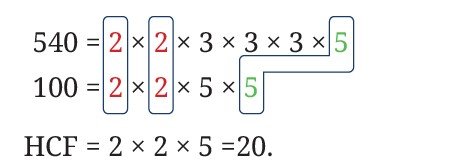
If both numbers are doubled, then both numbers get an extra factor of 2 in their prime factors. This 2 will be included as a factor in the largest common subpart, and so the HCF will double. For example, consider the numbers 270 and 50.
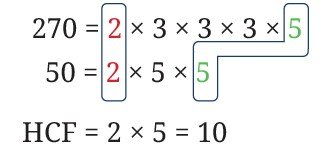
Let us double these numbers to get 540 and 100.