04
ANOTHER PEEK BEYOND THE POINT
4.1 A Quick Recap of Decimals
Recall that decimals are the natural extension of the Indian place value system to represent decimal fractions ( 1/10, 1/100, 1/1000, and so on) and their sums.
For example, 27.53 refers to a quantity that has:
• 2 Tens
• 7 Units (Ones)
• 5 Tenths
• 3 Hundredths
We have already learned how to multiply and divide fractions. In this chapter, we will learn how to perform these operations with decimals.
You will see that the procedures for multiplying and dividing decimals are natural extensions of the procedures for multiplying and dividing counting numbers.
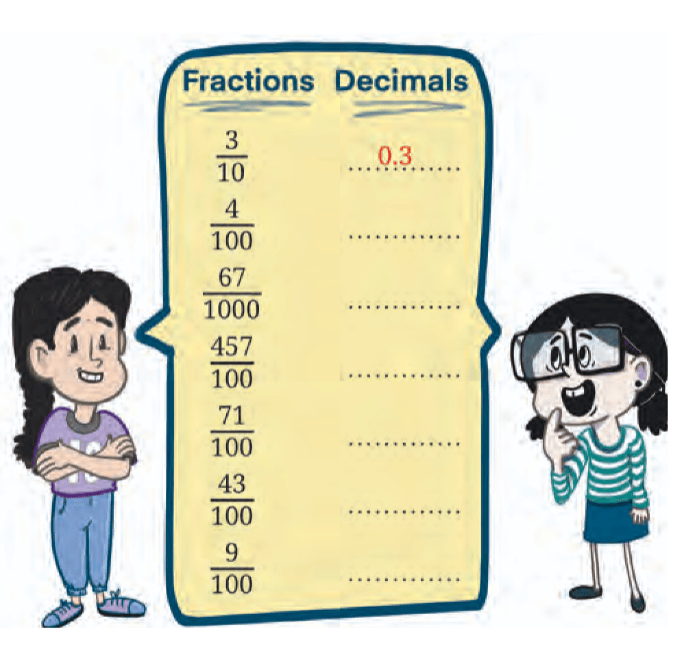
Jonali and Pallabi play a game. Jonali says a fraction and Pallabi gives the equivalent decimal. Write Pallabi’s answer in the blank spaces.
Jonali goes to the market to buy spices. She purchases 50 g of Cinnamon, 100 g of Cumin seeds, 25 g of Cardamom and 250 g of Pepper.
Express each of the quantities in kilograms by writing them in terms of fractions as well as decimals.
The fractions Jonali gave Pallabi have denominators 10, 100, 1000, and so on.
Write the following fractions as a sum of fractions and also as decimals:
| Fraction | Expanding the Numerator | Sum of one-tenths, one-hundredths, one-thousands,... | Decimals |
|---|---|---|---|
| 254/1000 | 200/1000 + 50
1000 + 4/1000 = 2/10 + 5/100 + 4/1000 |
0.2 + 0.05 + 0.004 | 0.254 |
| 847/10000 | |||
| 173/100 | |||
| 23/1000 |
Can you give a simple rule to divide any number by a number of the form 1 followed by zeroes — 10, 100, 1000, etc.? For example, 123/10 , 24/100 or 678/1000 ? Look for a pattern in the previous problems.
Here is one such rule. Let us consider the example 123 ÷ 10.
Step 1: Write the dividend as it is and place a decimal point at the end. 123.
Step 2: Count the number of zeroes in the divisor. 10 - 1 zero
Step 3: Move the decimal point from Step 1 left by the same number of
places as the count from Step 2. Add zeroes in front if needed.
12.3
Examples:
| 24 ÷ 100 = 0.24 | 678 ÷ 1000 = 0.678 |
| 12÷1000 = 0.012 | 12345÷1000 = 12.345 |
4.2 Decimal Multiplication
Example 1: Arshad goes to a stationery shop and purchases 5 pens. If one pen costs ₹9.5 (9 rupees and 50 paisa), how much should he pay the shopkeeper?
What operation must we use here?
We have to multiply 9.5 by 5, which is the same as adding 9.5, 5 times.
That is 9.5 × 5 = 9.5 + 9.5 + 9.5 + 9.5 + 9.5 = 47.5.
We can also directly multiply the numbers by converting them into fractions.
9.5 is 95/10 and 5 is 5 1 as a fraction.
The cost of 5 pens = 5/1 × 95/10 .
Recall that, to find the product of two fractions, we multiply the numerators and multiply the denominators.
5/1 × 95
10 = 5 × 95/1 × 10
= 475/10
= 47.5.
The cost of 5 pens is ₹47.5.
Example 2: A car travels 12.5 km per litre of petrol. What is the distance covered with 7.5 litres of petrol?
We have to multiply 12.5 by 7.5.
The distance covered = 12.5 × 7.5
= 125/10 × 75/10 = 125×75/10×10 = 9375/100 = 93.75
The distance covered is 93.75 km.
Can the product of two decimals be a natural number?
Can the product of a decimal and a natural number be a natural number?
Example 3: The distance between Ajay's school and his home is 827 m.
He walks to school in the morning and then walks back home in the evening, 6 days a week. How much does he walk in a week? Answer in kilometres.
Each way between school and home, Ajay walks 827 metres, i.e., 0.827 km.
So, in a day he walks,
0.827 × 2 = 827/1000 × 2 = 827 × 2/1000 = 1654/1000 = 1.654
He goes to school 6 days a week. So, in a week, he walks 1.654 × 6 = 1654/1000 × 6 = 1654 × 6/1000 = 9924/1000 = 9.924 Ajay walks 9.924 km a week.
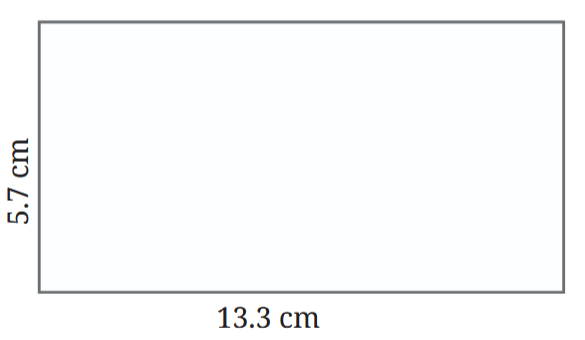
Example 4: Find the area of the given rectangle.
Area of the rectangle =
5.7 × 13.3 = 57/10 × 133/10 = 7581/100 = 75.81
The area is 75.81 sq cm.
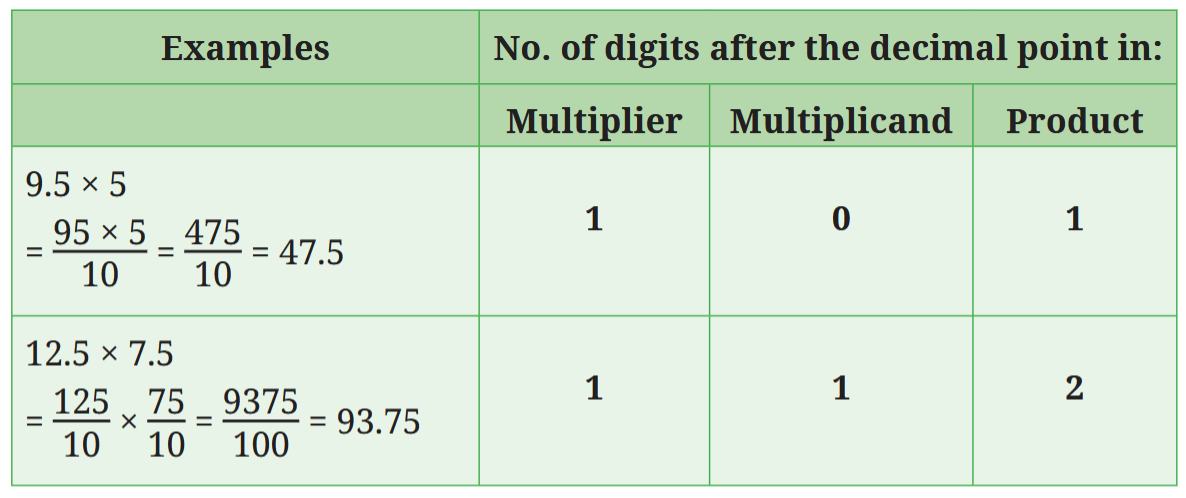
Observe the number of digits after the decimal point in the multiplier, the multiplicand and the product. Also note the number of zeroes in the denominator.
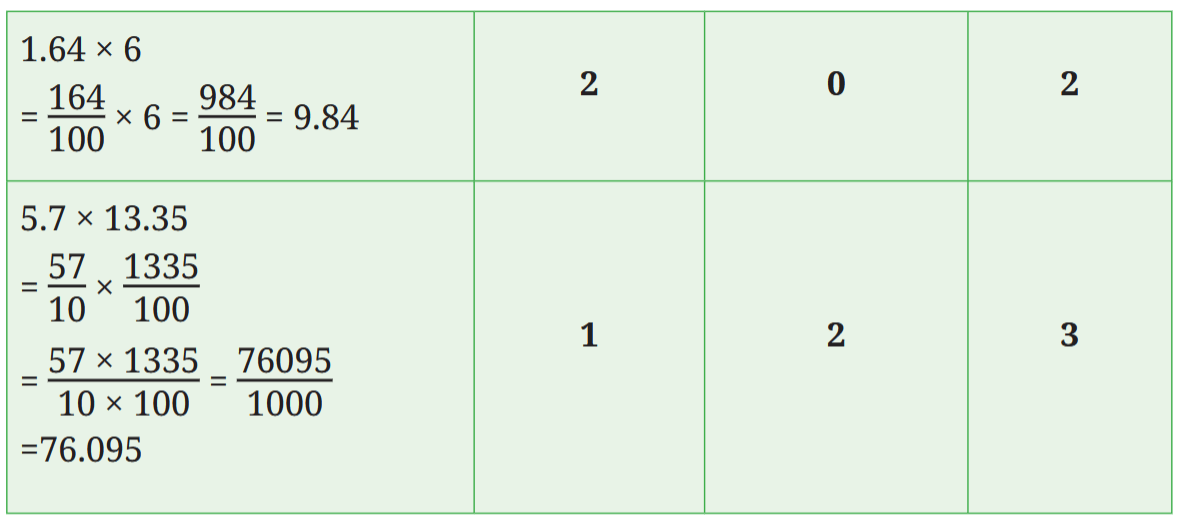
Suppose we know that 596 × 248 = 147808, can you immediately write down the product of 5.96 × 24.8?
By looking at the above examples, can you frame a rule to multiply two decimals?
Multiplication of decimals is the same as the multiplication of their corresponding fractions. When multiplying fractions, we multiply the numerators and denominators, respectively.
The product of the numerators = Product of the numbers with the decimal points removed.
Since both the denominators are of the form 1, 10, 100, 1000, … , the product of the denominators is also of the form 1 followed by zeroes.
The number of zeroes in the product is the sum of the number of zeroes in each denominator.
In the product, the decimal point is placed based on the total number of zeroes in the denominator.
So, to multiply two decimals, we can multiply the two numbers obtained by removing the decimal point, and then place the decimal point appropriately as shown below. To evaluate 5.96 × 24.8:
596 × 248 = 147808
5.96 × 24.8 = 147.808
2 decimal places | 1 decimal place | 3 decimal places
2 + 1 = 3 decimal places
Example 5: Let us use the above rule to find the product of 5.8 and 1.24.
Let us first multiply 58 and 124.
The product is 7192.
The sum of the number of digits after the decimal point in the multiplier and multiplicand is 3. So, the product is 7.192.
Verify this by converting the multiplier and multiplicand into fractions.
Is the Product Always Greater than the Numbers Multiplied?
Recall multiplication of two fractions. Unlike counting numbers, when two fractions are multiplied the product is not always greater than or equal to both numbers. Let us examine the case of the product of two decimals.
2.25 × 8 = 18.
In the above multiplication, the product (18) is greater than 2.25 and 8.
But in, 0.25 × 8 = 2, the product (2) is greater than 0.25 but less than 8.
In the case of 0.25 × 0.8 = 0.2, the product (0.2) is less than both 0.25 and 0.8.
When is the product of two decimals greater than both the numbers?
When is it less than both the numbers? Since decimals are just representations of fractions, the relationship between the numbers multiplied and the product are similar to fractions.
| Situation | Multiplication | Relationship |
|---|---|---|
| Situation 1 | Both numbers are greater than 1 (e.g., 3.4 × 6.5) | The product (22.1) is greater than both the numbers. |
| Situation 2 | Both numbers are between 0 and 1 (e.g., 0.75 × 0.4) | The product (0.3) is less than both the numbers. |
| Situation 3 | One number is between 0 and 1 and one number is greater than 1 (e.g., 0.75 × 5) | The product (3.75) is less than the number greater than 1 and greater than the number between 0 and 1. |
Figure it Out
1. Recall that a tenth is 0.1, a hundredth is 0.01, and so on. Find the following products in tenths, hundredths and so on:
(a) 6 × 4 tenths = 24 tenths
(b) 7 × 0.3
(c) 9 × 5 hundredths
2. Find the products:
(a) 27.34 × 6
(b) 4.23 × 3.7
(c) 0.432 × 0.23
3. Thejus needs 1.65 m of cloth for a shirt. How many metres of cloth are needed for 3 shirts?
4. Meenu bought 4 notebooks and 3 erasers. The cost of each book was ₹15.50 and each eraser was ₹2.75. How much did she spend in all?
5. The thickness of a rupee coin is 1.45 mm. What is the total height of the cylinder formed by placing 36 rupee coins one over the other? Write the answer in centimeters.
6. The price of 1 kg of oranges is ₹56.50. What is the price of 2.250 kg of oranges? Can we write 56.50 as 56.5 and 2.250 as 2.25 and multiply? Will we get the same product? Why?
7. Dwarakanath purchases notebooks at a wholesale price of ₹23.6 per piece and sells each notebook at ₹30/-. How much profit does he make if he sells 50 books in a week?
8. Given that 18 × 12 = 216, find the products:
(a) 18 × 1.2
(b) 18 × 0.12
(c) 1.8 × 1.2
(d) 0.18 × 0.12
(e) 0.018 × 0.012
(f) 1.8 × 12
In which of the cases above is the product less than 1?
9. In which of the following multiplications is the product less than 1? Can you find the answer without actually doing the multiplications?
(a) 7 × 0.6
(b) 0.7 × 0.6
(c) 0.7 × 6
(d) 0.07 × 0.06
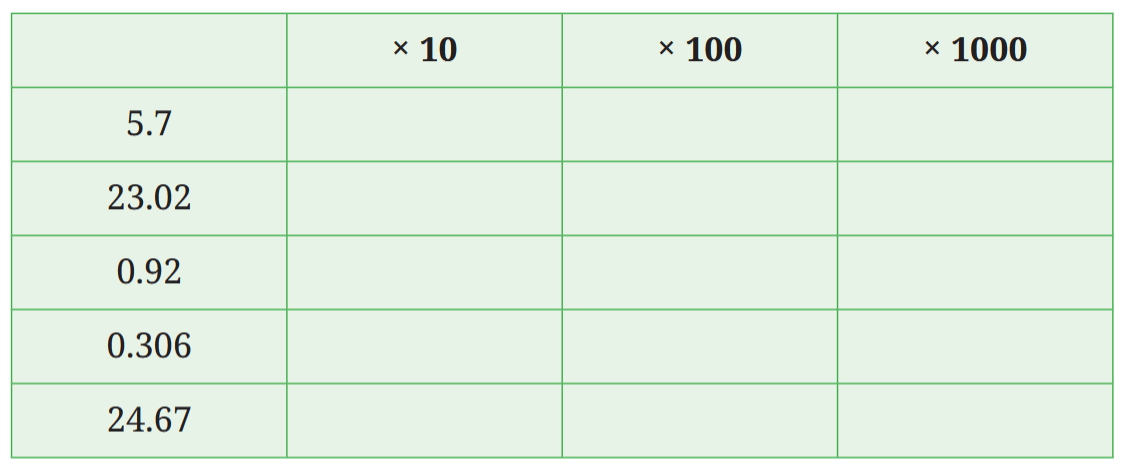
10. Multiplying the following numbers by 10, 100 and 1000 to complete the table.
4.3 Decimal Division
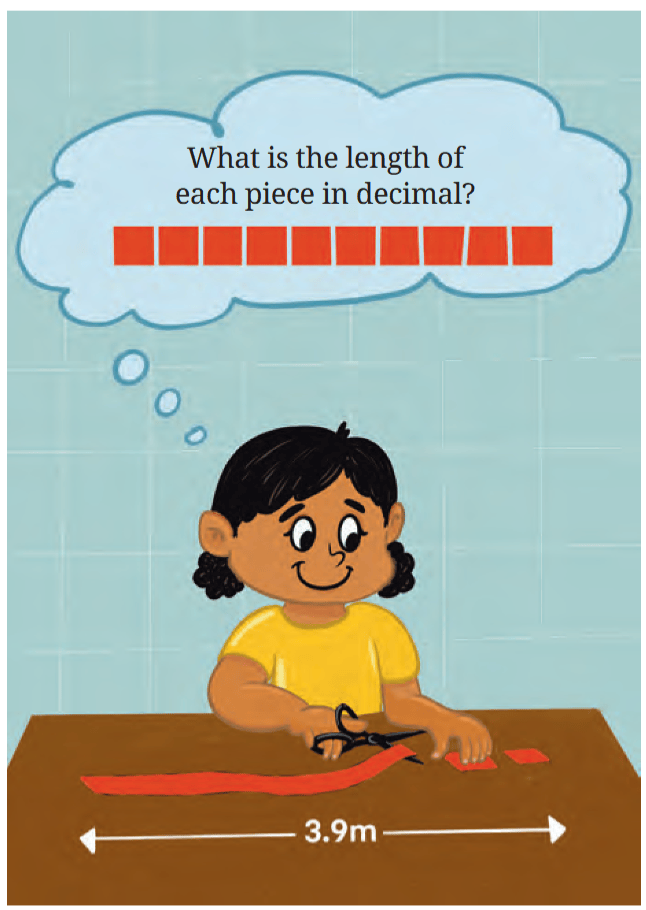
Example 6: Anuja has a 3.9 m length of ribbon and she wants to cut it into 10 equal pieces. What is the length of each piece in decimal? Since there are 10 pieces, we can find the length of each piece by dividing 3.9 by 10.
So, what is 3.9 ÷ 10?
Let’s convert 3.9 into fraction 3.9 = 39/10.
Hence, 3.9 ÷ 10 is the same as dividing 39/10 by 10. Recall that, dividing a fraction by a divisor is the same as multiplying the fraction by the reciprocal of the divisor. The reciprocal of 10 is 1/10.
So, 39/10 ÷ 10 = 39/10 × 1/10 = 39/100 = 0.39.
Thus, the length of each piece of ribbon is 0.39 m.
What is the length of each piece if the ribbon is cut into 100 equal pieces?
3.9 ÷ 100 = 39/10 × 1/100 = 39/1000 = 0.039.
When the ribbon is cut into 100 equal pieces, the length of each piece is 0.039 m.
What is 0.039 m in centimetres and millimetres?
By looking at these divisions, we can frame a simple rule for dividing decimals by 1, 10, 100, 1000, and so on.
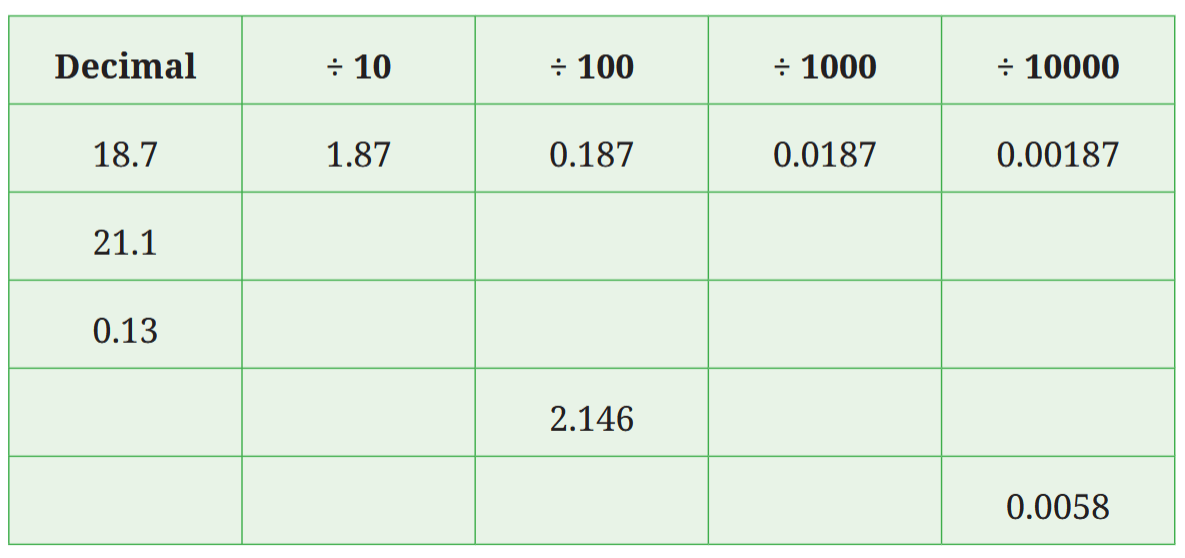
When we divide a decimal by 1, 10, 100, 1000, and so on, we can just move the decimal point to the left by as many places as there are zeroes in the divisor!
Example 7: Neenu has 29 metres of red ribbon and wants to share it equally with Anu. What is the length of ribbon that each of them will get?
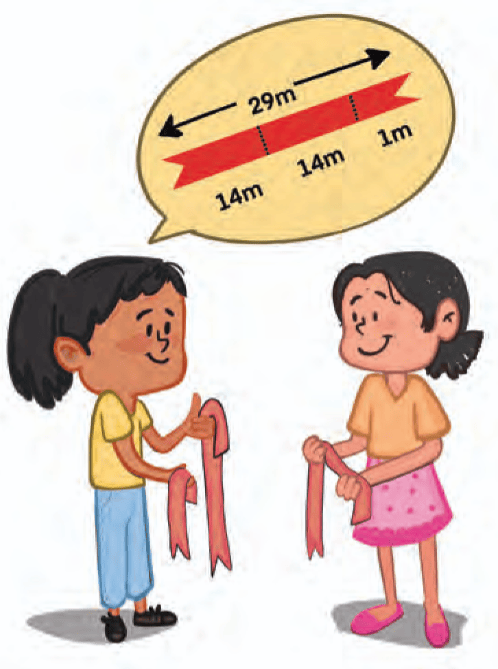
Since the ribbon needs to be divided into two equal parts, each girl will get a piece of 29 ÷ 2 metres.
If each of them gets 14 m, then 1 m remains. If we divide 1 m among the two, each will get another 1/2 m.
How do we convert 1/2 into a decimal?
It is easy to express a fraction as a decimal if the denominator is 1, 10, 100, 1000, etc.
So, can we find a fraction equivalent to 1/2 with such a denominator?
1/2 = 1 × 5/2 × 5 = 5/10 (multiplying the numerator and denominator by 5).
We know that the fraction 5/10 can be represented as a decimal 0.5.
So, each girl will get 14 m and an additional 0.5 m of ribbon.
Hence, the length of ribbon each will get is 14 + 0.5 = 14.5 m.
Now, what if the ribbon was shared between four friends instead
of 2?
So, each will get 29 ÷ 4 m, that is 29/4 m.
Now, the denominator of the fraction is 4. To convert a fraction to a decimal, it helps if the denominator is of the form 1, 10, 100, 1000, and so on. Can we find a fraction equivalent to 29/4 with such a denominator?
Is 4 a factor of 10? No. Is it a factor of 100? Yes. 4 × 25 = 100. So we can get an equivalent fraction of 29/4 by multiplying the numerator and denominator by 25.
29 × 25/4 × 25 = 725/100 = 7.25
So each of the 4 friends will get 7.25 m of ribbon.
Division Using Place Value
We have seen how to divide two counting numbers to get a decimal quotient. We first represented the division as a fraction. Then we found an equivalent fraction, with the denominator being of the form 1, 10, 100, 1000, and so on. It was then easy to represent this equivalent fraction as a decimal.
Now, let us look at the division using place value procedure to calculate the decimal quotient.
Suppose we want to write the quotient 10/3 as a decimal. Can we convert this fraction to an equivalent fraction with a denominator such as 1, 10, 100, 1000, etc.?
It is not possible. So, we need a more general method to divide any two counting numbers. Let us see how we can use division using place value for this.
Let us start with a quick recap of division using place value.
Example 8: Find the value of 1324 ÷ 4.
1324 ÷ 4 → Divide 1324 into 4 equal parts.
1 Thousand + 3 Hundreds + 2 Tens + 4 Ones
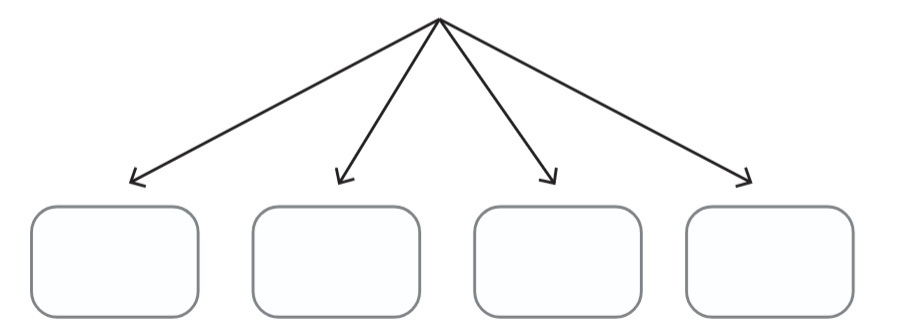
1 Thousand ÷ 4 → Not possible without regrouping.
Regroup 1 Thousand into 10 Hundreds.
10 Hundreds + 3 Hundreds = 13 Hundreds.
13 Hundreds + 2 Tens + 4 Ones
13 Hundreds ÷ 4 → Each part gets 3 Hundreds, and 1 Hundred remains.
13 Hundreds + 2 Tens + 4 Ones
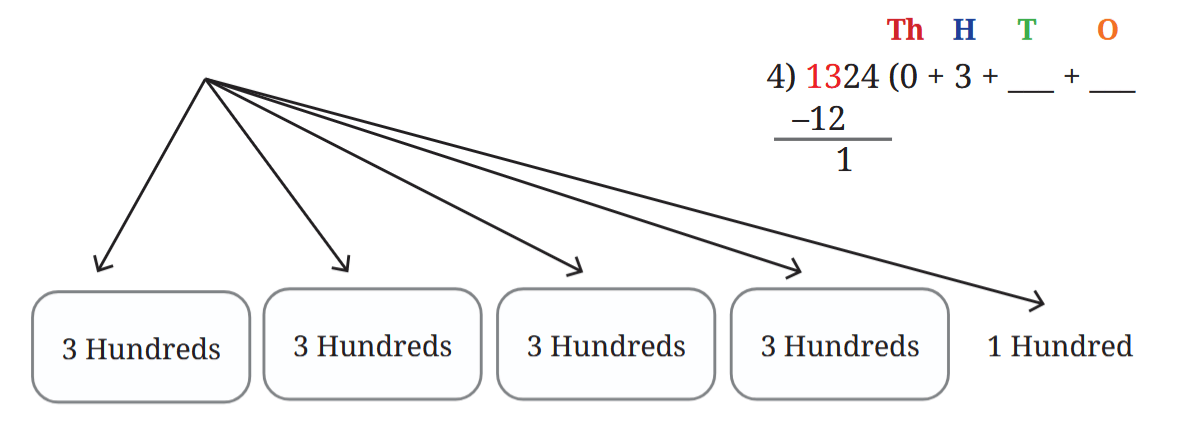
Regroup 1 Hundred into 10 Tens.
10 Tens + 2 Tens = 12 Tens.
12 Tens ÷ 4 → Each part gets 3 Tens.
12 Tens + 4 Ones
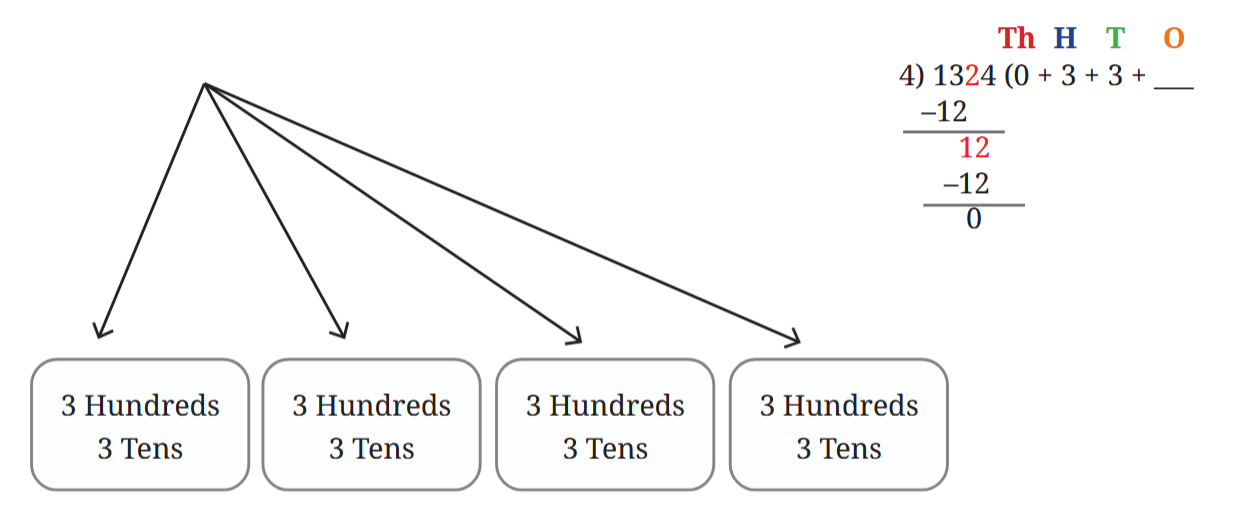
4 Ones ÷ 4 → Each part gets 1 Ones.
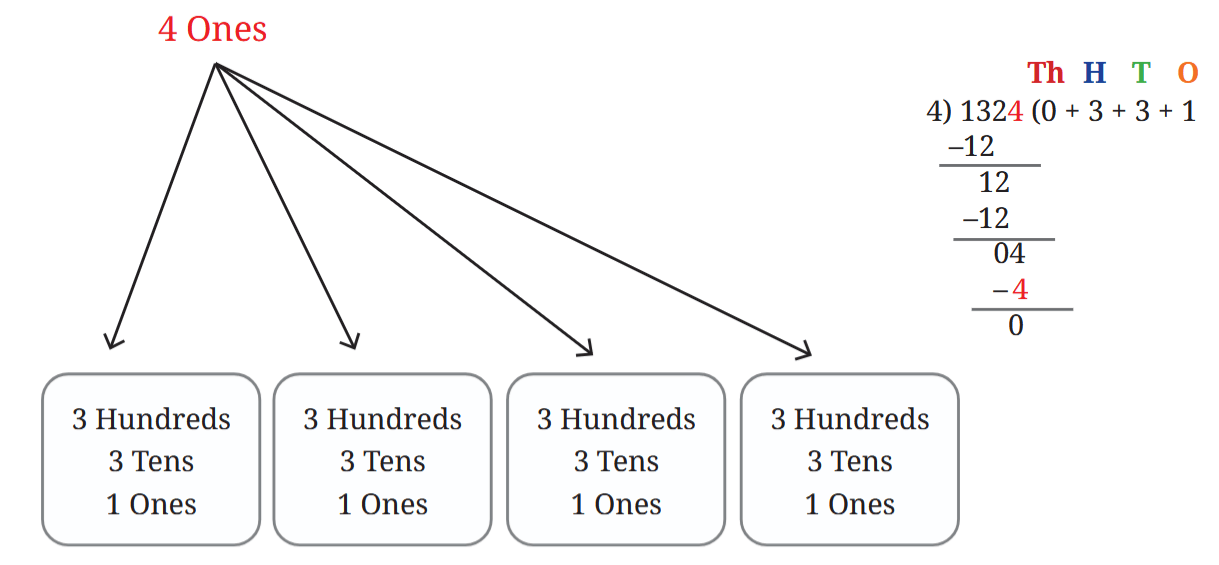
So, 1324 ÷ 4 = 0 Thousands + 3 Hundreds + 3 Tens + 1 Ones = 331.
We also call this division using place values as ‘long division’.
Division with a Decimal Quotient
Now, let us use this understanding of long division to find the value of 1325 ÷ 4.
1325 ÷ 4 → Divide 1325 into 4 equal parts.
We can follow the same steps as in the previous problem.
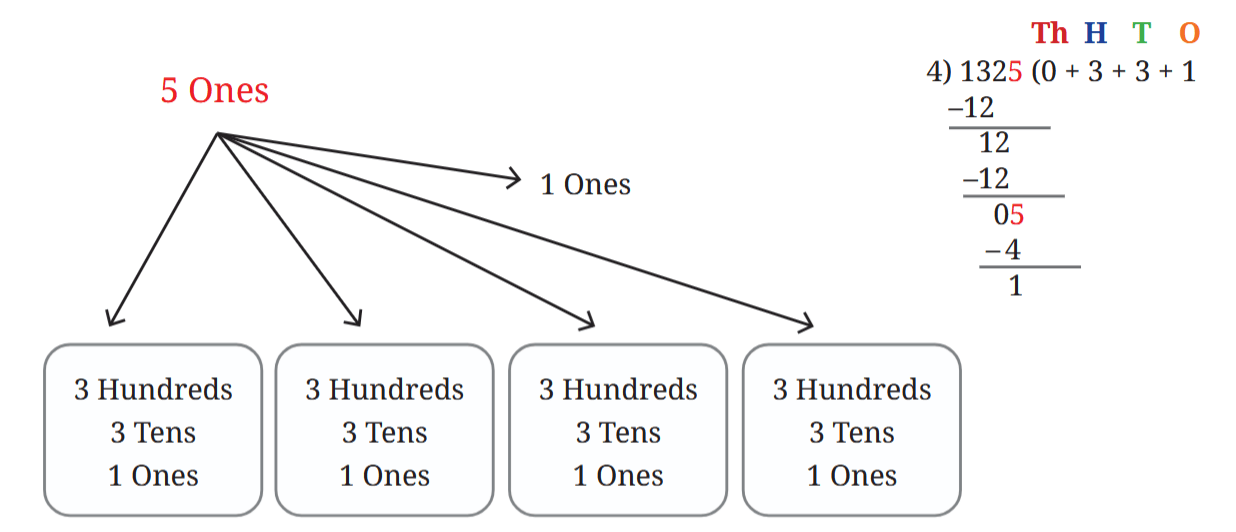
We are left with 1 Ones.
It is not clear how to divide 1 Ones into 4 equal parts. But we can regroup this as 10 tenths.
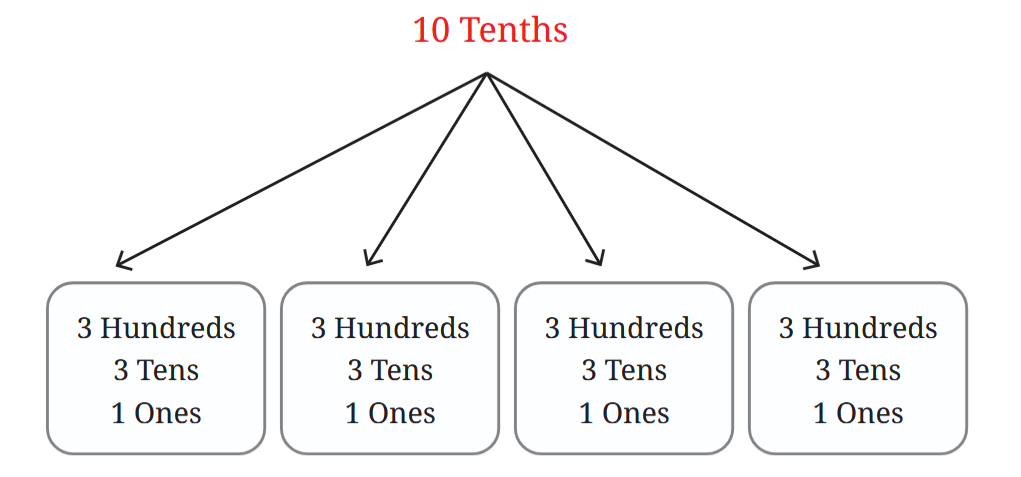
10 Tenths ÷ 4 → Each part gets 2 Tenths and 2 Tenths remain.
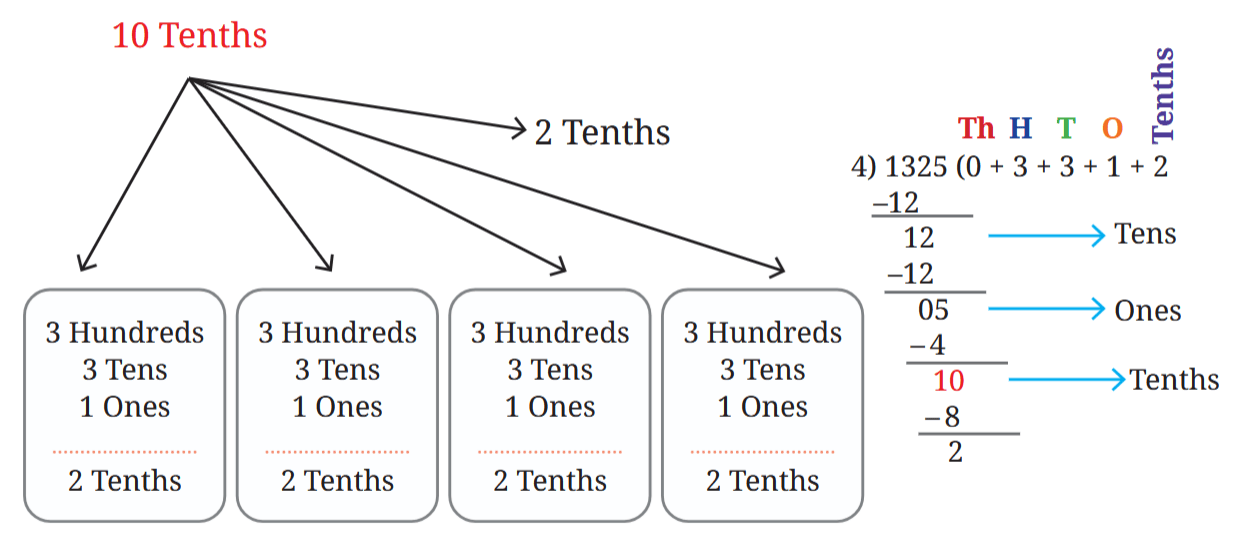
We are left with 2 tenths.
To divide 2 Tenths into 4 equal parts, we have to regroup them as 20 Hundredths.
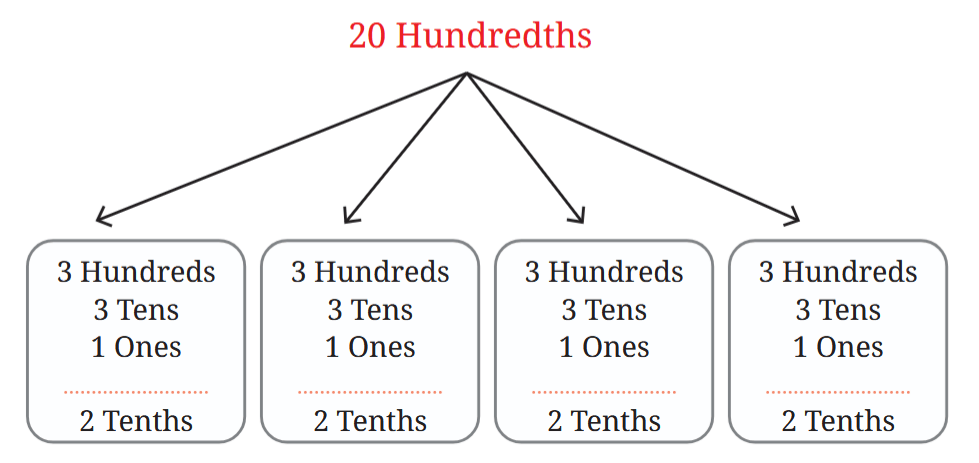
20 Hundredths ÷ 4 → Each part gets 5 Hundredths.
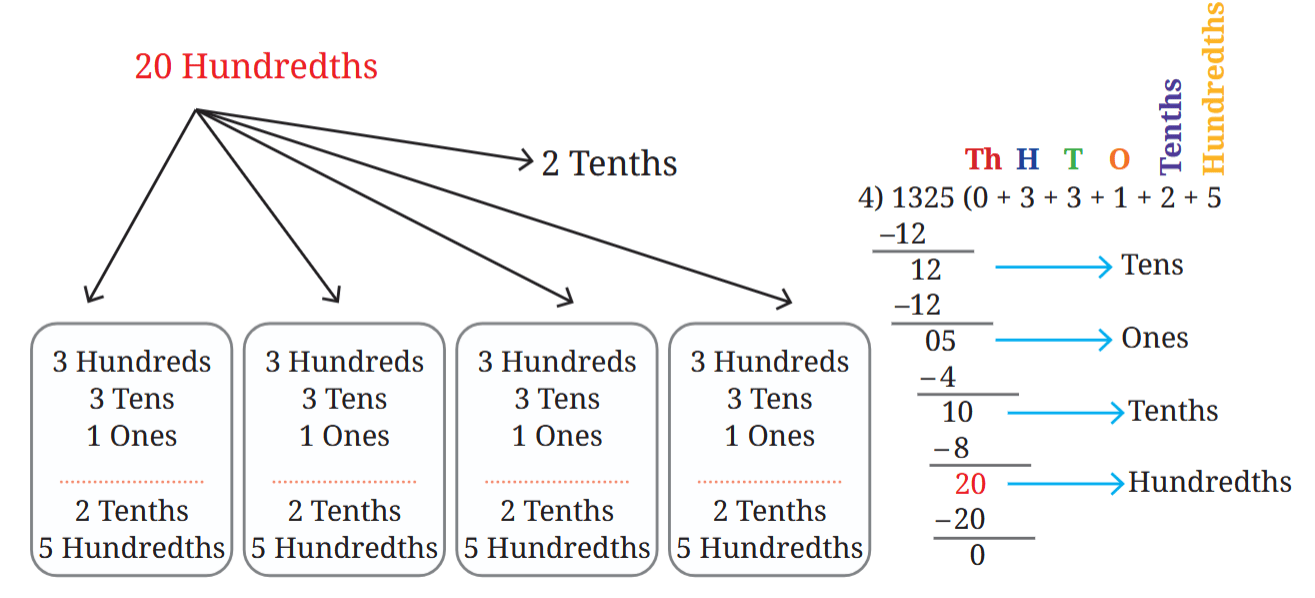
So, 1325 ÷ 4 = 0 Thousands + 3 Hundreds + 3 Tens + 1 Ones + 2 Tenths + 5 Hundredths. This we know is 331.25, thus,
1325 ÷ 4 = 331.25.
Can we verify this by finding an equivalent fraction for 1325/4 ?
To get an equivalent fraction such that the denominator is of the form 1, 10, 100, 1000, and so on, we can multiply the numerator and denominator by 25.
1325 × 25/4 × 25 = 33125/100 = 331.25.
Thus, the procedure of division using place value can be extended to find quotients with decimal values. Ones can be regrouped as tenths, tenths can be regrouped as hundredths and so on.
Example 9 : Find the value of 237 ÷ 8. 237 ÷ 8 → Divide 2 Hundreds + 3 Tens + 7 Ones into 8 equal parts.
To divide 2 Hundred into 8 equal parts we need to regrouped them as 20 Tens.
20 Tens + 3 Tens = 23 Tens.
23 Tens ÷ 8 → 2 Tens, and 7 Tens remain.
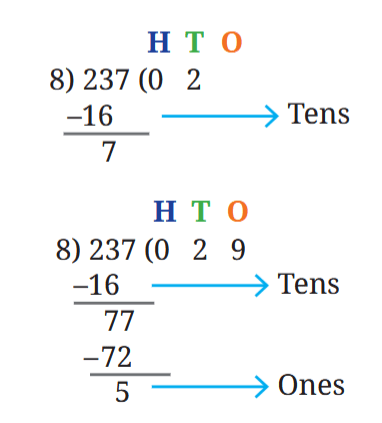
7 Tens can be regrouped as 70 Ones.
70 Ones + 7 Ones = 77 Ones.
77 Ones ÷ 8 → 9 Ones, and 5 Ones remain.
To divide 5 Ones into 8 equal parts we need to regroup them as 50 Tenths.
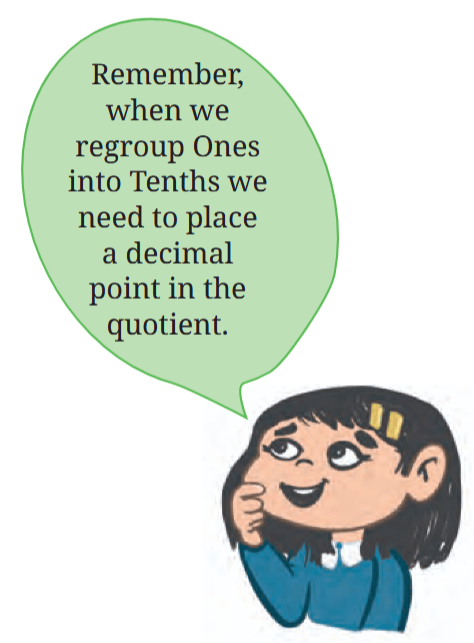
When we regroup Ones into Tenths, we place a decimal point in the quotient.
50 Tenths ÷ 8 → 6 Tenths, and 2 Tenths remain.
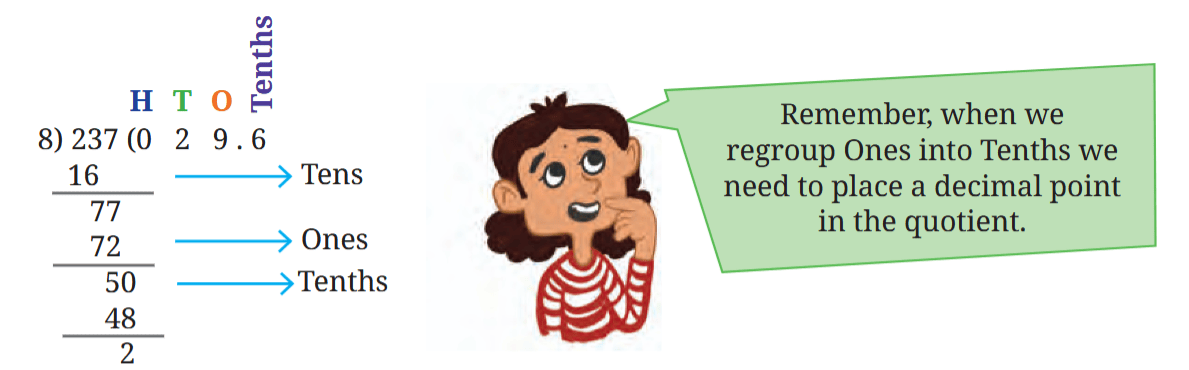
2 Tenths cannot be divided into 8 equal parts. So we need to regroup them as 20 Hundredths.
20 Hundredths ÷ 8 → 2 Hundredths, and 4 Hundredths remain.
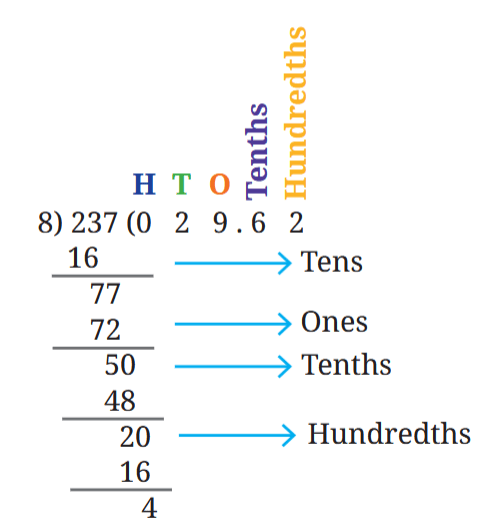
To divide 4 Hundredths into 8 equal parts we need to regroup them as 40 Thousandths.
40 Thousandths ÷ 8 → 5 Thousandths.
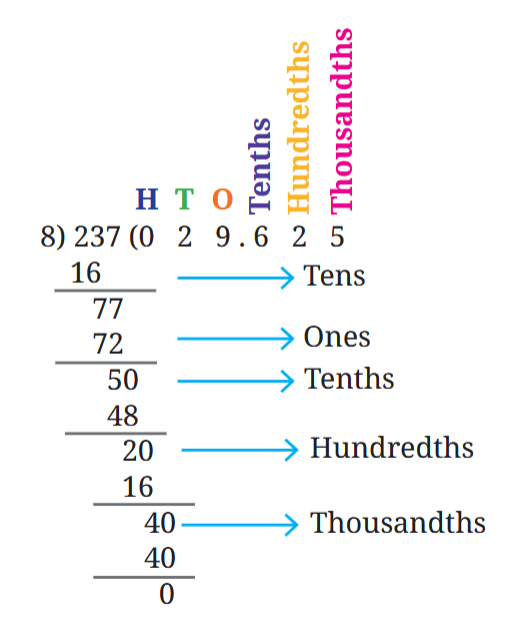
Thus, 237 ÷ 8 = 29.625.
Division with a Decimal Dividend
Example 10: A shopkeeper has 9.5 kg of sugar and he wants to pack it equally in 4 bags. What is the weight of each bag of sugar?
To find the weight of each bag we need to divide 9.5 by 4.
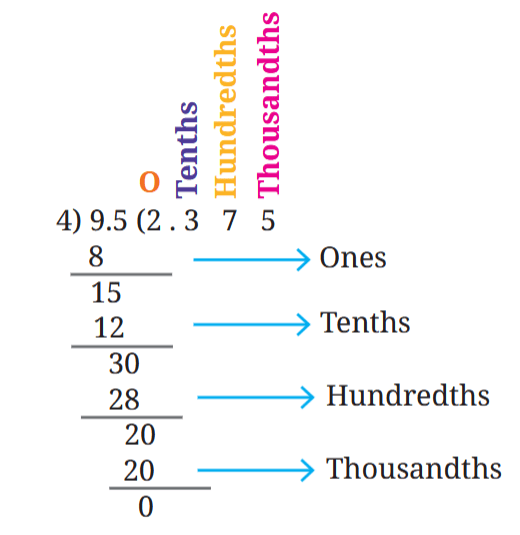
Again, we place the decimal point in the quotient before we divide the tenths.Each bag of sugar weighs 2.375 kg.
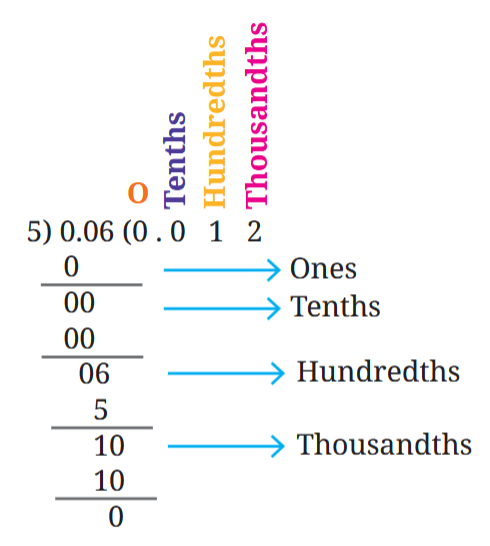
Example 11: What is the value of 0.06 ÷ 5? 0.06 → 0 Ones + 0 Tenths + 6 Hundredths 0 Ones ÷ 5 → 0 Ones.
When we move from Ones to Tenths we need to place the decimal point in the quotient. 0 Tenths ÷ 5 → 0 Tenths.
6 Hundredths ÷ 5 → 1 Hundredths, and 1 Hundredth remains. We need to regroup 1 Hundredth into 10 Thousandths.
10 Thousandths ÷ 5 → 2 Thousandths.
So, the quotient is 0.012.
Figure it Out
1. Find the quotient by converting the denominator into 1, 10, 100 or 1000 and verify the solution by the long division method (division by place value).
(a) 18/5
(b) 415/4
(c) 1217/2
(d) 4827/8
2. Choose the correct answer:
(a) 1526/4 =
(i) 38.15 (ii) 380.15
(iii) 381.5 (iv) 381.05
(b) 3567/8 =
(i) 4458.75 (ii) 44.5875
(iii) 445.875 (iv) 4458.75
3. What is the quotient?
(a) 132 ÷ 4 =
(b) 13.2 ÷ 4 =
(c) 1.32 ÷ 4 =
(d) 0.132 ÷ 4 =
4. What is the quotient?
(a) 126 ÷ 8 =
(b) 12.6 ÷ 8 =
(c) 1.26 ÷ 8 =
(d) 0.126 ÷ 8 =
(e) 0.0126 ÷ 8 =
Division with a Decimal Divisor
Example 12: Ravi went from Pune to Matheran by scooter in 2.5 hours.
The distance was 126 km. What was his average speed?
We can get the average speed by dividing the distance by the time taken.
126 ÷ 2.5.
When the divisor is a decimal, we convert the divisor into a fraction.
126 ÷ 25/10 = 126 × 10/25 = 1260/25 .
With the long division procedure we find the quotient is 50.4.
So, the average speed at which Ravi travelled was 50.4 km per hour.
Example 13: Find 4.68 ÷ 1.3.
Again converting the divisor into a fraction we get
4.68 ÷ 13/10 = 4.68 × 10/13 = 46.8/13 .
Now, what about 4.68 ÷ 0.13?
4.68 ÷ 0.13 = 4.68 ÷ 13/100 = 4.68 × 100/13 = 468/13 .
What do you notice in these cases?
When the divisor is a decimal, we can convert it into a counting number by suitably multiplying it by 10, 100, 1000, and so on. We must also multiply the dividend by the same number. Thus,
4.68/0.13 = 4.68 × 100/0.13 × 100 = 468/13 .
Once we convert the divisor into a counting number, we can then follow the division using place value procedure to find the quotient.
Does This Ever End?
Can you calculate 10 ÷ 3? Try dividing using long division.
10 → 1 Tens + 0 Ones.
Step 1: Regroup 1 Tens into 10 Ones. 10 Ones ÷ 3 → 3 Ones, and 1 Ones remain.
Step 2: Regroup 1 Ones as 10 Tenths. 10 Tenths ÷ 3 → 3 Tenths, and 1 Tenths remain.
Step 3: Regroup 1 Tenths as 10 Hundredths. 10 Hundredths ÷ 3 → 3 Hundredths , and 1 Hundredths remain.
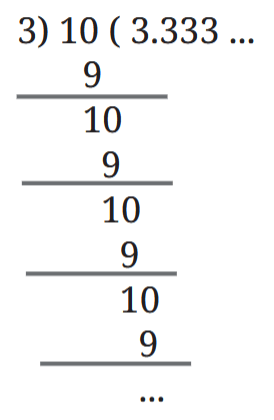
Step 4: Regroup 1 Hundredths as 10 Thousandths. 10 Thousandths ÷ 3 → 3 Thousandths, and 1 Thousandths remain. Regroup 1 Thousandths as 10 TenThousandths.
This never seems to end! Each time we divide by 3, there is a remainder of 1.
Will this process end?
In long division, we see that at each step we get a remainder of 1. So, the process will never end!
So, 10 ÷ 3 cannot be expressed using a finite number of digits in the decimal form.
10 ÷ 3 = 3.333 ...
There are decimal divisions where the quotient never ends! We will explore such numbers in greater detail in a later class.
Can you find the quotients of 10 ÷ 9, and 100 ÷ 11?
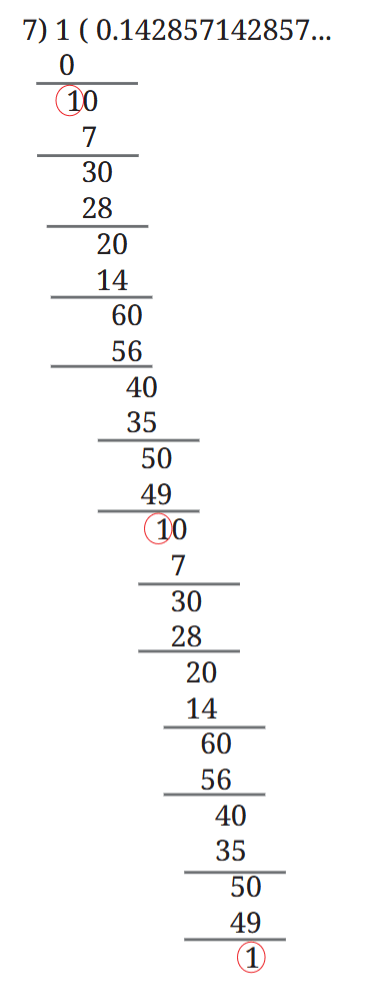
Now divide 1 by 7 (1 ÷ 7).
Will this end?
Note all the remainders we get. It starts with 1, then 3, then 2, then 6, and so on. Let us represent this as a chain.
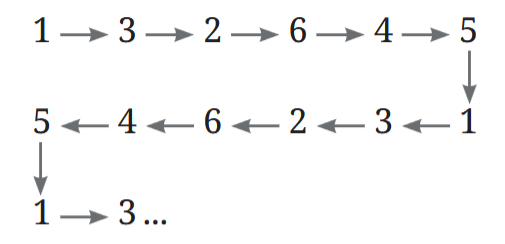
What do you observe? Can you explain why this division never ends?
Not only do the remainders repeat in a cycle, the digits of the quotient also repeat in a cycle! 0.142857 142857 14…
A Magic Number: 142857
Let us consider the number 142857 that arose when dividing 1 by 7. Multiply 142857 by numbers from 1 to 6.
What are the products? What do you notice?
You get the same number back, but with the digits cycled around!
Multiply 142857 by 7. What do you observe?
Are there other such numbers? Yes!
To find one such number, you can find 1 ÷ 17 in decimal, and use the repeating block of digits.
Are there infinitely many such “cyclic” numbers? That is, can we keep finding more cyclic numbers, or do they eventually stop? In 1927, the Austrian mathematician Emil Artin conjectured (guessed) that there must be infinitely many such numbers. However, even today, nearly a century later, this conjecture remains unsolved—despite a lot of research on the question by many mathematicians!
Dividend, Divisor, and Quotient
When we divide two counting numbers, the quotient is always less than the dividend. For example, 128 ÷ 4 = 32, and 32 (quotient) < 128 (dividend).
But what happens when we divide 128 by 0.4?
128 ÷ 0.4 = 320.
The quotient is greater than the dividend.
Will the quotient be always greater than the dividend when the divisor is a decimal? Try it out with different values of the divisor.
Describe the relationship between the dividend, divisor, and the quotient. Create a table for capturing this relationship in different situations, like we did for multiplication.
Figure it Out
1. Express the following fractions in decimal form:
(a) 2/5
(b) 13/4
(c) 4/50
(d) 5/8
2. Find the quotients:
(a) 24.86 ÷ 1.2
(b) 5.728 ÷ 1.52
3. Evaluate the following using the information 156 × 12 = 1872.
(a) 15.6 × 1.2 = __________
(b) 187.2 ÷ 1.2 = __________
(c) 18.72 ÷ 15.6 = __________
(d) 0.156 × 0.12 = __________
4. Evaluate the following:
(a) 25 ÷ ______ = 0.025
(b) 25 ÷ ______ = 250
(c) 25 ÷ ______ = 2.5
(d) 25 ÷ 10 = 25 × _____
(e) 25 ÷ 0.10 = 25 × ______
(f) 25 ÷ 0.01 = 25 × ______
5. Find the quotient:
(a) 2.46 ÷ 1.5 =
(b) 2.46 ÷ 0.15 =
(c) 2.46 ÷ 0.015 =
Is the quotient obtained in 24.6 ÷ 1.5 the same as the quotient obtained in 2.46 ÷ 0.15?
6. A 4 m long wooden block has to be cut into 5 pieces of equal length. What is the length of each piece?
7. If the perimeter of a regular polygon with 12 sides is 208.8 cm, what is the length of its side?
8. 3 litres of watermelon juice is shared among 8 friends equally. How much watermelon juice will each get? Express the quantity of juice in millilitres.
9. A car covers 234.45 km using 12.6 litres of petrol. What is the distance travelled per litre?
10. 13.5 kg of flour (aata) was distributed equally among 15 students. How much flour did each student receive?
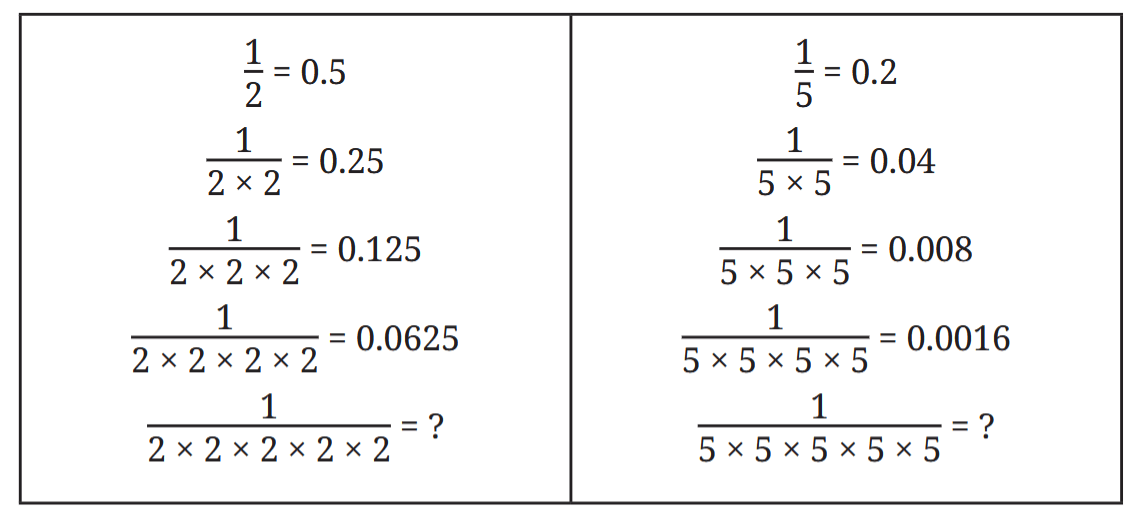
What pattern do you observe? Why are 2 and 5 related in this way?
4.4 Look Before You Leap!
Did you know that it takes the Earth 365.2422 days to go around the Sun and not 365 days? For our convenience, we consider 365 days as a year in a calendar. We are talking about Gregorian calendar.
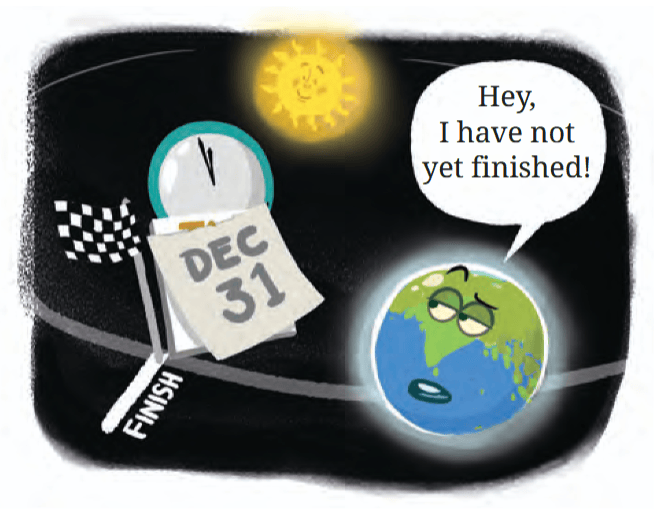
This means that, after one calendar year or 365 days, the Earth still needs 0.2422 more days to complete one full revolution around the Sun. This doesn’t seem like much. But what happens after 100 such calendar years?
Using our understanding of decimal multiplication,
0.2422 × 100 = 24.22 days.
After 100 calendar years, the Earth will need 24.22 more days to complete its 100th revolution around the Sun.
In your Science classes, you have learnt that we experience seasons because of the Earth’s tilt in axis and its revolution around the Sun. If our calendar does not accurately indicate the position of the Earth around the Sun, our seasons and our annual calendar will not match!
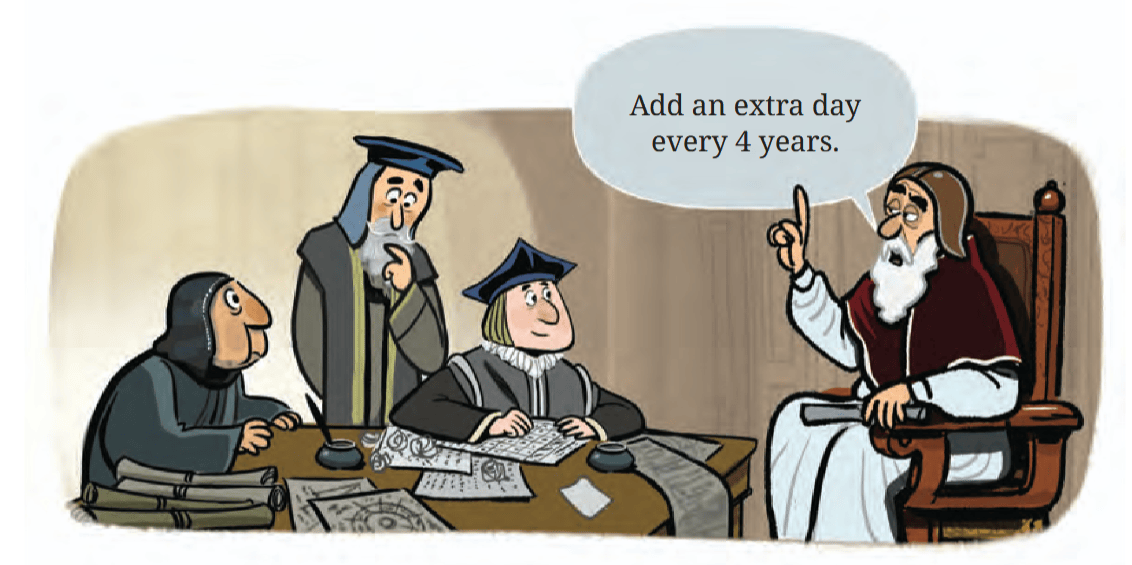
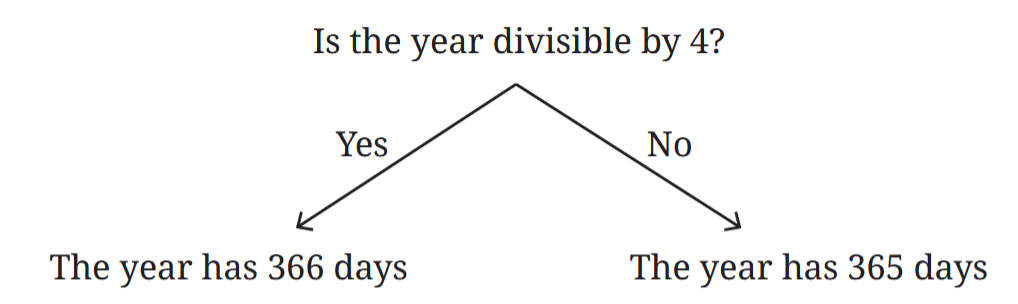
To correct this problem, the idea of a leap year was introduced. Every fourth year, one additional day is added to the calendar year.
Making an Adjustment
Is the year divisible by 4?
The year has 366 days The year has 365 days
Do you know which month has this extra day?
Let us see how this solution works.

Looking at the above sequence, the number of days after 4 calendar years is
4 × 365 + 1 = 1461 days.
What is the number of days that the Earth needs to make 4 full revolutions around the Sun?
4 × 365.2422 = 1460.9688 days.
With this new scheme of adding one extra day every 4th year, what is the number of days in 100 calendar years? Can you write an expression to calculate that number?
Here is one way to form the expression. Each calendar year has 365 days. In 100 calendar years, the number of days is 100 × 365. But years that are divisible by 4 have one extra day.
How many years are divisible by 4 in 100 years?
So, the number of days in 100 calendar years is,
(100 × 365 + 100/4 × 1) = 36,525 days.
Can you form different expressions for the same question?
The actual number of days that the Earth takes to go around the Sun 100 times is,
100 × 365.2422 = 36,524.22 days.
Thus, by adding a day every fourth year, after 100 years, the calendar days are more than the actual number of days taken by the Earth to go around the Sun. We have overcompensated.
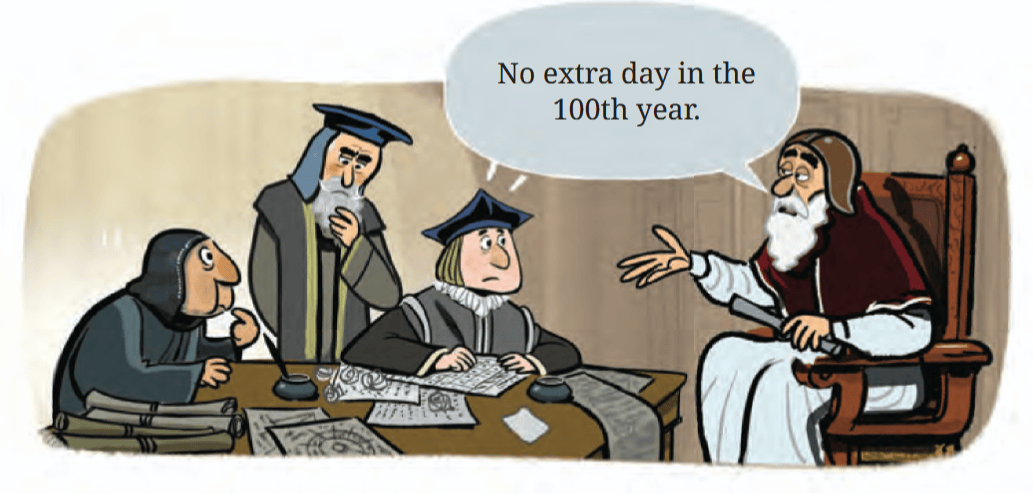
So, the good people who designed calendars decided that they will not add 1 extra day in every hundredth year!
Making Another Adjustment
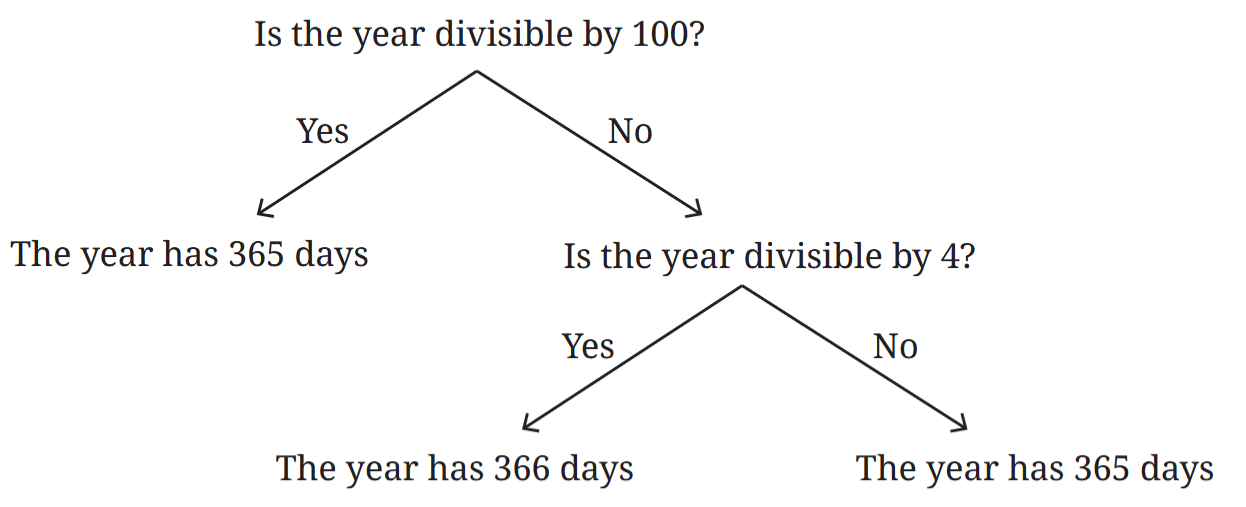
Is the year divisible by 100?
The year has 365 days Is the year divisible by 4?
The year has 366 days The year has 365 days
Can you write an expression for the number of days in 100 calendar years with this new adjustment?
We saw that there are 25 years divisible by 4 in 100 years. 100 is also divisible by 4, but we have to exclude it. So only 24 years have 366 days, and the rest (76 years) have 365 days. So the expression can be written as,
( 100/4 – 100/100 ) × 366 + (100 – ( 100/4 – 100/100 ))× 365
= (24 × 366) + (76 × 365) = 36,524 days.
This is close to 36524.22 days but is it close enough? What happens after 1000 years with this adjustment?
If we follow this new scheme of adding 1 day every four years, but not in the 100th year, the number of calendar days in 1000 years is
36524 × 10 = 3,65,240 days.
The number of days the Earth takes to go around the Sun 1000 times is
1000 × 365.2422 = 3,65,242.2 days.
So, there is a difference of 2.2 days.
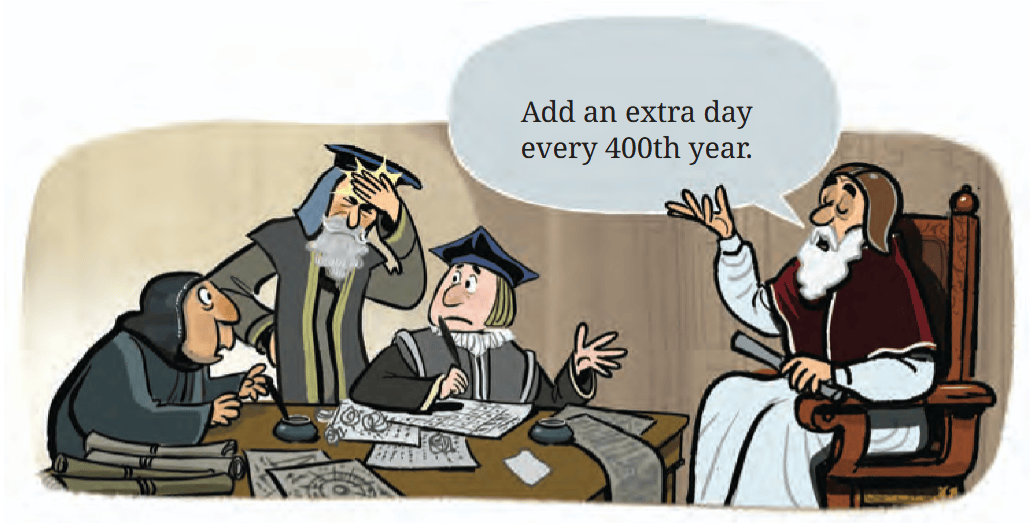
To bridge this gap, it was decided that every 400th year would be a leap year!
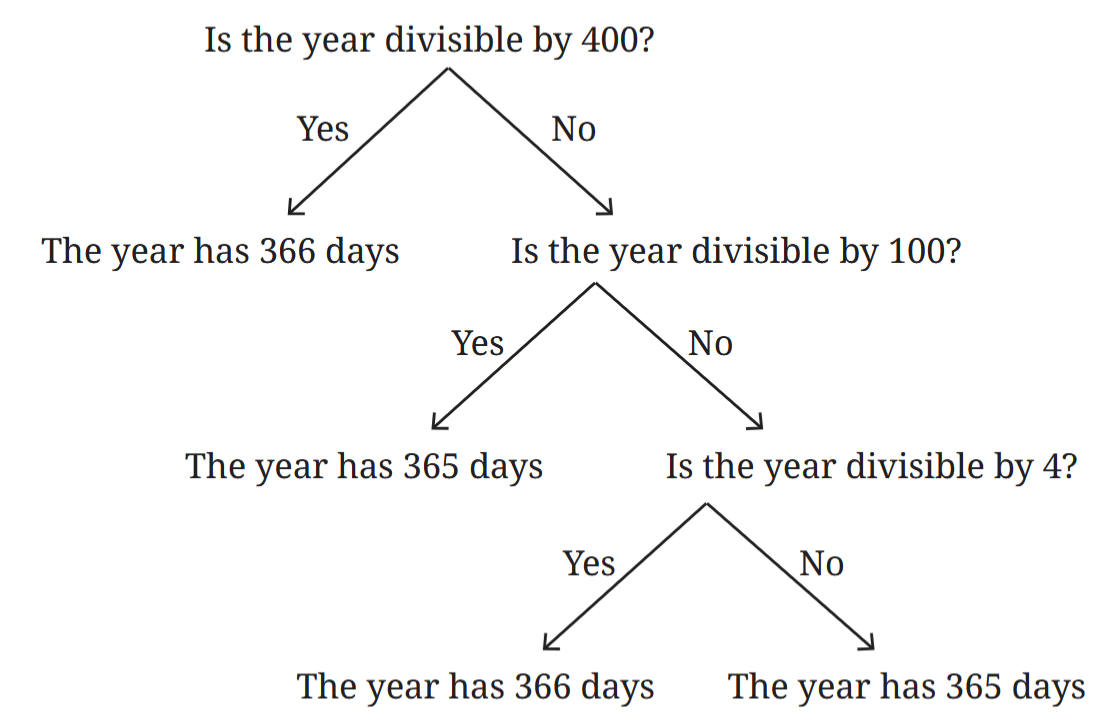
Is the year divisible by 400?
The year has 366 days Is the year divisible by 100?
The year has 365 days Is the year divisible by 4?
The year has 366 days The year has 365 days
With this scheme, let us calculate the number of days in 1000 calendar years.
In 1000 calendar years, how many years are divisible by 400? 2.
In 1000 calendar years, how many years are divisible by 100 but not divisible by 400? 10 – 2 = 8.
In 1000 calendar years, how many years are divisible by 4 but not divisible by 100 and 400? 250 – 10 = 240.
The rest of the years are 1000 – (2 + 8 + 240) = 750.
So, the total number of days in 1000 calendar years is
(750 × 365) + (240 × 366) + (8 × 365) + (2 × 366) = 3,65,242 days.
The Earth needs 3,65,242.2 days to go around the Sun 1000 times. Hence, in 1000 years, the calendar year is slightly shorter (by 0.2 days) than the actual number of days the Earth takes to go around the Sun.
The calendar makers did not want to bother about a small difference that would happen in 1000 years! So, they left the scheme of leap years as is …
Making Yet Another Adjustment

With this final scheme of leap years can you calculate the number of calendar days in 10,000 years and the number of actual days the Earth will take to make 10,000 revolutions around the Sun? What is the difference? If there is a big difference, can you suggest a way to fix this problem?
Do you wonder how people figured out that the Earth completes one revolution around the Sun in exactly 364.2422 days?
Investigate how traditional calendars in India managed to consistently align the days in the calendar with astronomical events like the Earth going around the Sun or even the positions of the stars in the sky accurately.
Figure it Out
1. A 210 gram packet of peanut chikki costs ₹70.5, while a 110 gram packet of potato chips costs ₹33.25. Which is cheaper?
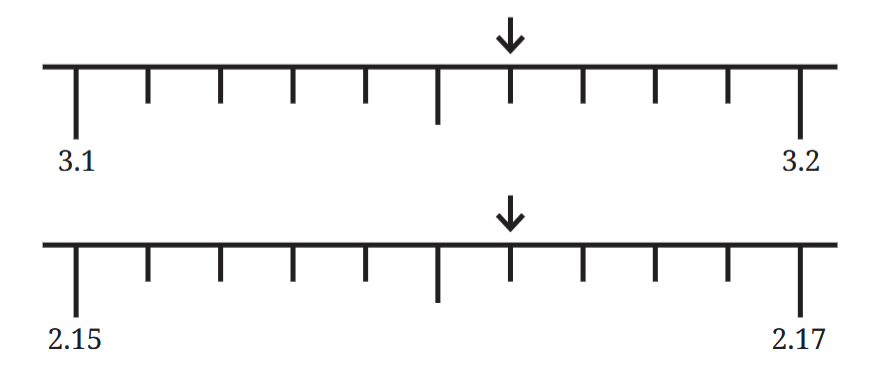
2. Write the decimal number at the arrow mark:
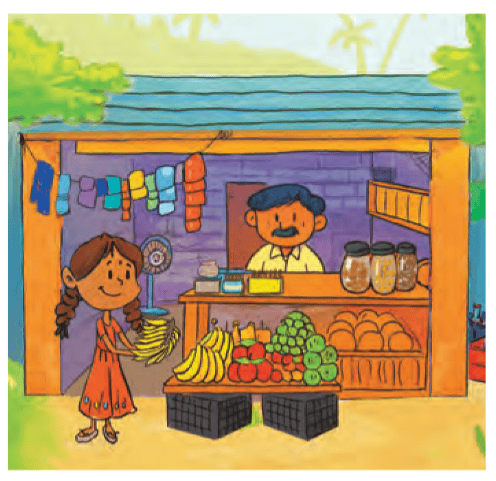
3. Shyamala bought 3 kg bananas at ₹30/- per kg. She counted 35 bananas in all. She sells each banana for ₹5/-. How much profit does she make selling all the bananas?
4. A teacher placed textbooks that are 2.5 cm thick on a bookshelf. The teacher wanted to place 80 textbooks on the shelf. The bookshelf is 160 cm long. How many books could be placed on the shelf? Was there any space left? If yes, how much?
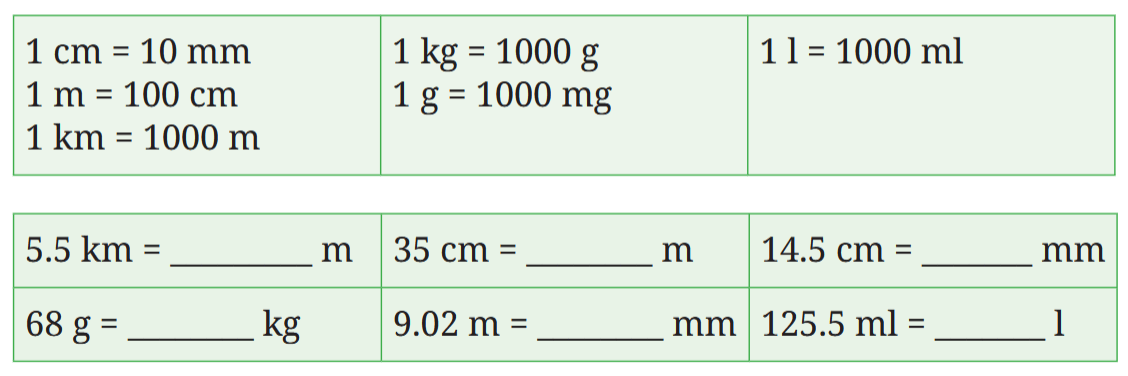
5. Fill in the following blanks appropriately:
6. The following problem was set by Sridharacharya in his book, Patiganita. “6 * 1/4 is divided by 2 * 1/2, and 60 * 1/4 is divided by 3 * 1/2. Tell the quotients separately.” Can you try to solve it by converting the fractions into decimals?
7. Fill the boxes in at least 2 different ways:
(a) × = 2.4
(b) × = 14.5
8. Find the following quotients given that 756 ÷ 36 = 21:
(a) 75.6 ÷ 3.6
(b) 7.56 ÷ 0.36
(c) 756 ÷ 0.36
(d) 75.6 ÷ 360
(e) 7560 ÷ 3.6
(f) 7.56 ÷ 0.36
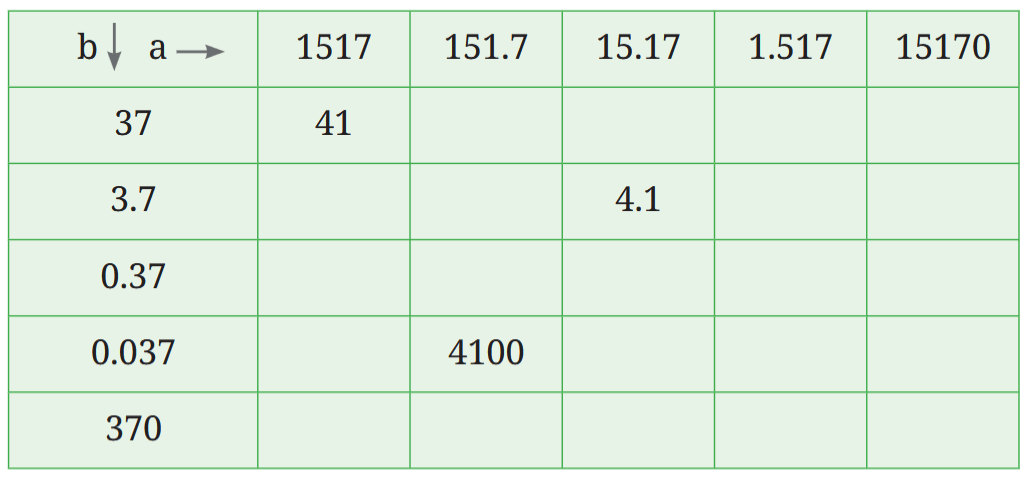
9. Find the missing cells if each cell represents a÷b:
10. Using the digits 2, 4, 5, 8, and 0 fill the boxes __._ × _._ to get the:
(a) maximum product
(b) minimum product
(c) product greater than 150
(d) product nearest to 100
(e) product nearest to 5
11. Sort the following expressions in increasing order:
(a) 245.05 × 0.942368
(b) 245.05 × 7.9682
(c) 245.05 ÷ 7.9682
(d) 245.05 ÷ 0.942368
(e) 245.05
(f) 7.9682
SUMMARY
• In this chapter, we learnt procedures to perform decimal multiplication and division.
• For decimal multiplication, we first multiply the multiplier and multiplicand as counting numbers. The number of decimal digits in the product is the total number of decimal digits in the multiplier and multiplicand.
• Division of decimals uses the same procedure, i.e., division using place value (long division), as with counting numbers. The regrouping continues after the Ones place to Tenths, Hundredths, Thousandths, and so on. When the Ones are regrouped to Tenths, a decimal point is placed in the quotient.
• There are decimal divisions where the quotient never ends. After each regrouping and dividing there is always a remainder!
Hidato
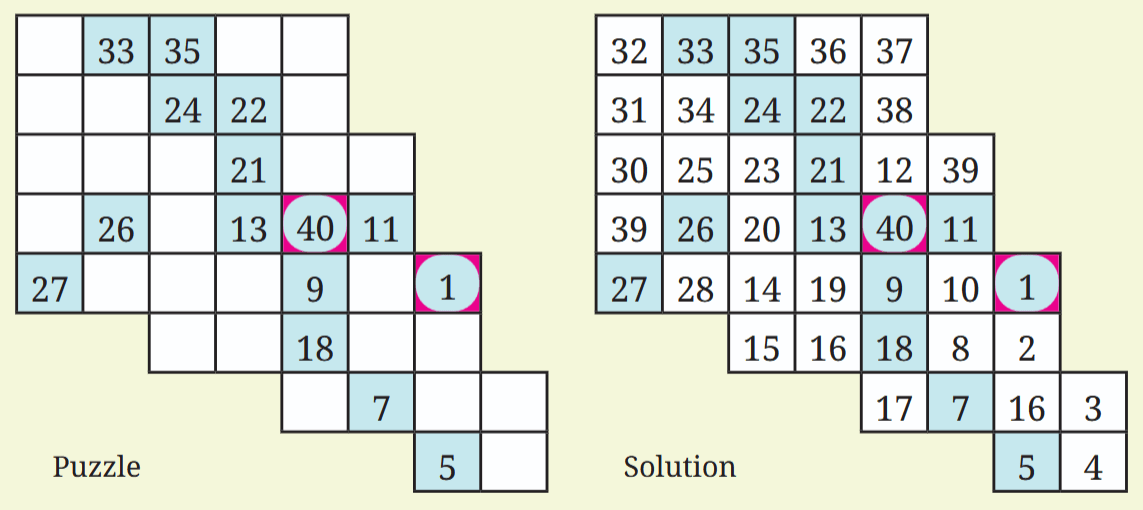
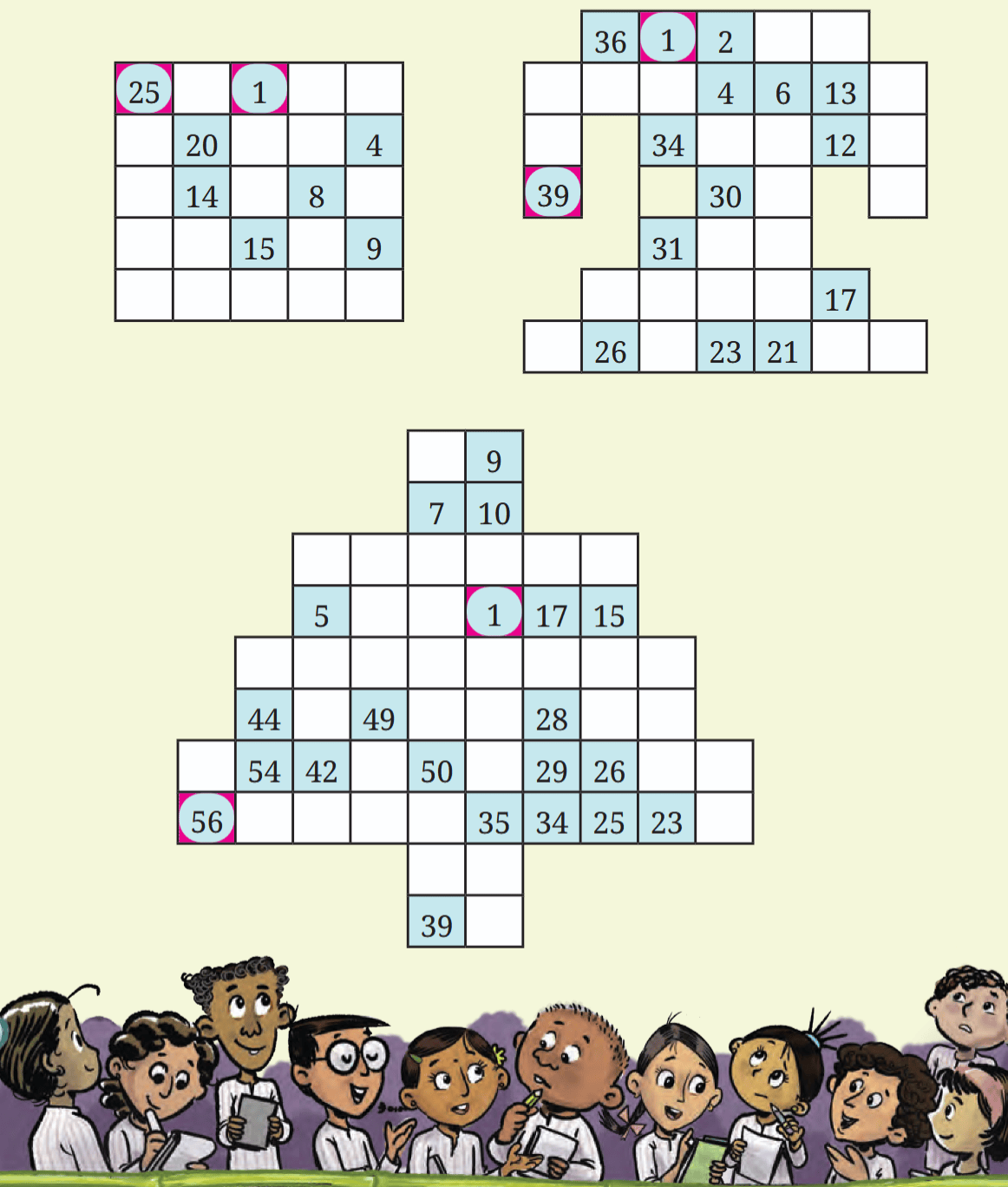
In Hidato, a grid of cells is given. It is usually square-shaped, like Sudoku or Kakuro, but it can also include hexagons or any shape that forms a tessellation. It can have inner holes (like a disc), but it is made of only one piece.
Usually, in every Hidato puzzle the lowest and the highest numbers are given on the grid.
Your task is to fill the grid such that there is a continuous path of consecutive numbers from the lowest to the highest number. The next number must be in any one of the adjacent cells, including diagonally adjacent cells.
The grid comes pre-filled with some numbers (with values between the smallest and the highest) to ensure that these puzzles have a single solution.
Try solving the following Hidato puzzles.