07
FINDING THE UNKNOWN
7.1 Find the Unknowns
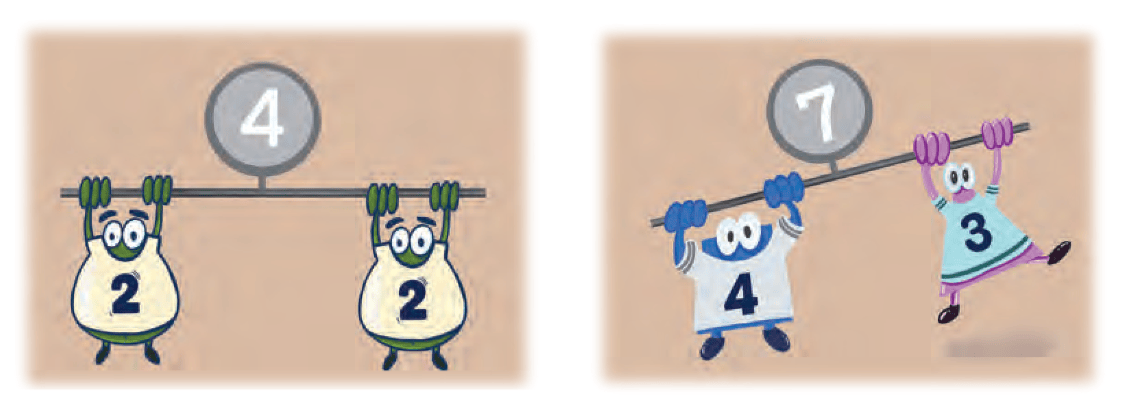
Unknown Weights
We have a weighing scale that behaves as follows. The numbers represent same units of weight:
Find the unknown weights in the following cases:
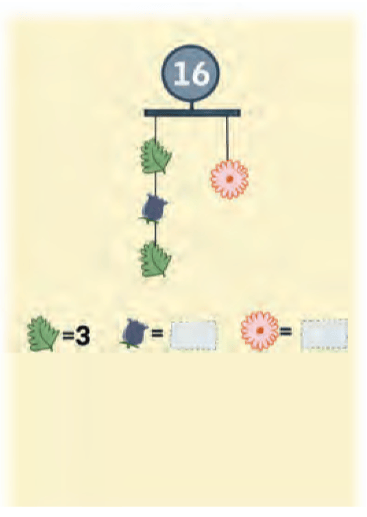
Fig. 7.1
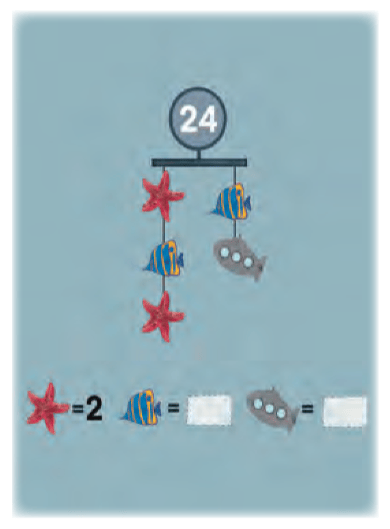
Fig. 7.2
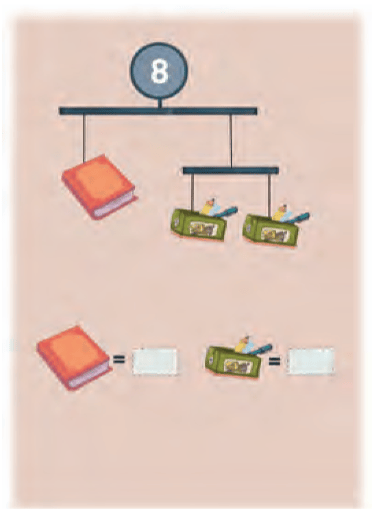
Fig. 7.3
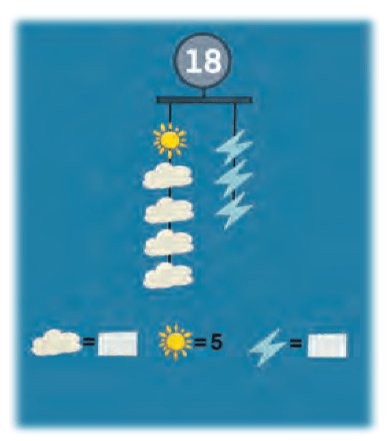
Fig. 7.4
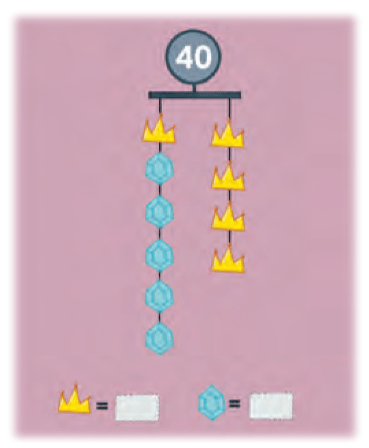
Fig. 7.5
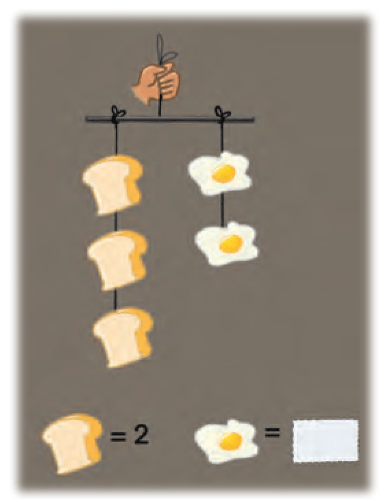
Fig. 7.6
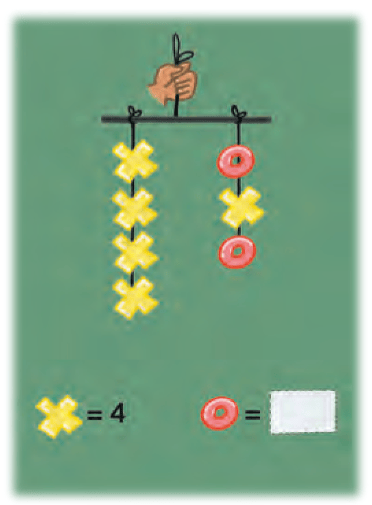
Fig. 7.7
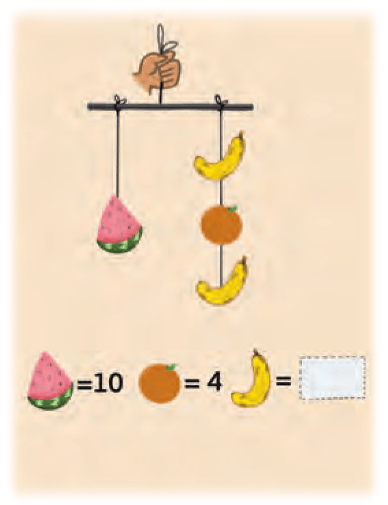
Fig. 7.8
Discuss the answers with your classmates. Give reasons why you think your answer is right.
Find the unknown weight of the sack in the following cases. In Fig. 7.10, all the sacks have the same weight.
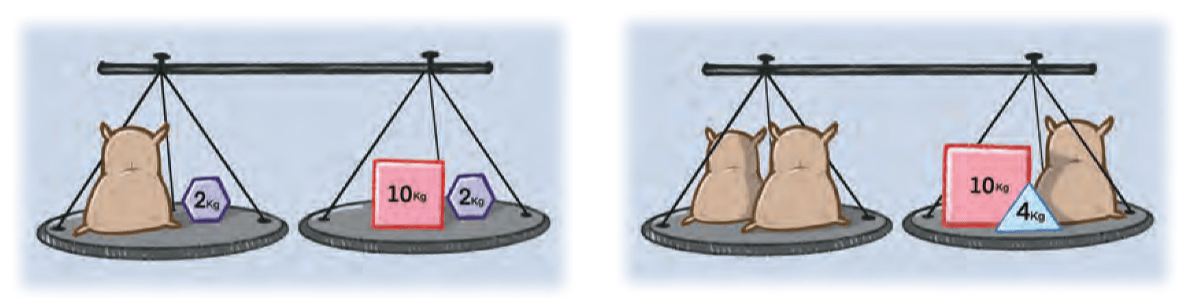
Fig. 7.9 & Fig. 7.10
[Hint: If we remove equal weights from both the plates, will the weighing scale still be balanced? Remove one sack from each plate for Fig. 7.10.]
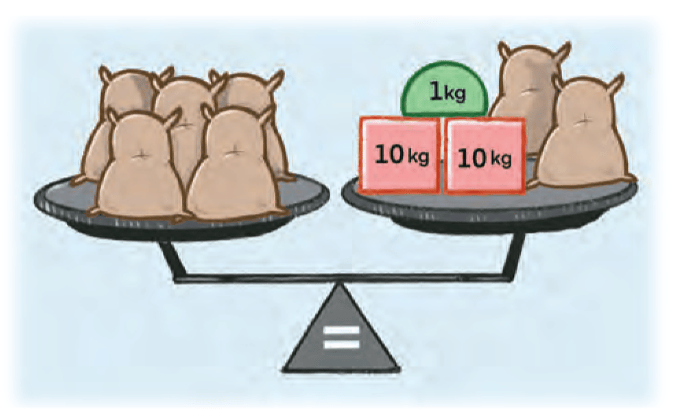
Fig. 7.11
[Hint: Can you remove objects so that the sacks are only on one plate?]
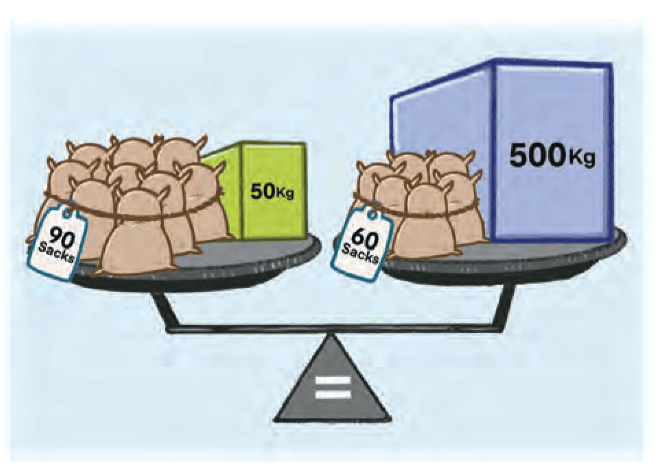
Fig. 7.12
Let us find an unknown value in a different setting.
Matchstick Pattern
Consider this sequence of matchstick arrangements.

Recall that we have studied this sequence in an earlier chapter.
The figure shows the first 4 matchstick arrangements along with their position numbers in the sequence.
Jasmine decides to make a matchstick arrangement that appears in this sequence, using exactly 99 sticks. What will be the position number of this arrangement in the sequence?
To answer this question, it is useful to know the number of matchsticks in each position.
We see that
the arrangement at position 1 has 2 × (1) + 1 = 3 matchsticks,
the arrangement at position 2 has 2 × (2) + 1 = 5 matchsticks,
the arrangement at position 3 has 2 × (3) + 1 = 7 matchsticks,
and so on.
So, the nth position will have 2n+1 matchsticks.
To answer Jasmine’s question, we have to find the value of n such that 2n + 1 has the value 99, or, 2n + 1 = 99.
Can you find ways to get the value of n, such that 2n + 1 = 99?
Is it possible to make a matchstick arrangement that appears in this sequence using exactly 200 sticks?
A statement of equality between two algebraic expressions is called an equation. Nowadays, when using symbols, we write an equation as two algebraic expressions with an equal sign ‘=’ between them.
Here are some more examples of equations:
3x + 4 = 7,
20 = y – 3,
a/3 = 50,
2z + 4 = 5z – 14 etc.
The process of finding the value(s) of the letter−numbers for which the equality holds, or for which the value of the Left Hand Side (LHS) of the equation becomes equal to the Right Hand Side (RHS) of the equation, is called solving the equation.
As we saw in the matchstick problem, framing an equation using an unknown quantity as a letter−number can help us find its value.
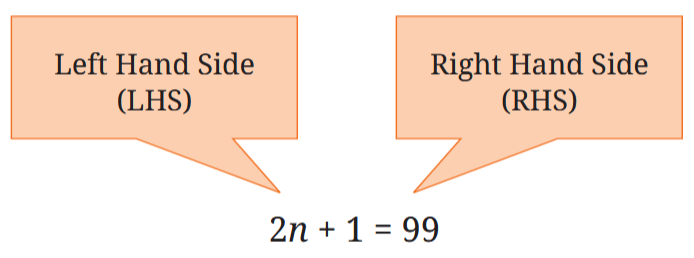
2n + 1 = 99
Left Hand Side
(LHS) and Right Hand Side
(RHS)
For the weighing scale problems in figures 7.6, 7.7, 7.8, 7.9, 7.10, and 7.11, frame equations by using letter-numbers to denote the unknown weight.
For the problem in Fig. 7.6, let us denote the weight of one fried egg as e.
Since each slice of bread is 2, we have 2 + 2 + 2 = 6 on one side and e + e on the other side. Since they are equal, we have
6 = e + e, or
2e = 6.
For the problem in Fig. 7.7, = 4, and we can denote the weight of one as y. So, we have 16 on one side, and 4 + 2y on the other side. Thus, we have the equation
4 + 2y = 16.
Solve the equations that you frame and check if you get the same value for the unknown weight as you got previously.
Frame 5 equations. Find methods to solve them.
7.2 Solving Equations Systematically
How did you solve the various equations framed in the previous section?
One way to solve an equation is to substitute different values in place of the letter−number and to check which value makes LHS = RHS. For example, consider the equation 2n + 1 = 99.
If we substitute n = 5, we get LHS = 2 × (5) + 1 = 11. It is far away from 99, the RHS.
We can try n = 10. The LHS is 21. It is still not equal to 99.
Can we try n = 30? The LHS is now 61, still much lower than 99.
Let us try n = 40. The LHS is 81. We are getting closer to 99.
When n = 50, the LHS is 101. This is just a bit too high.
When n = 49, the LHS is 99!
Therefore, the solution to the equation 2n + 1 = 99 is n = 49.
Can this equation have any other solution?
This method is called the trial and error method.
The trial and error method can be inefficient.
Try solving 5x – 4 = 7 using trial and error.
Recall that in the case of the weighing scale, we didn’t use the trial and error method! For some problems, finding the solution was straightforward. For others, we used the fact that when we remove equal weights from both the plates of a balanced weighing scale, it remains balanced. Do equations have a similar property?
Consider an equation 15 + 8 = 23. If we add, subtract, multiply or divide the same number on both sides, will it still preserve the equality of LHS and RHS?
For example, you can check by adding 10 to both sides.
Since the LHS and the RHS of an equation have the same value,
performing the same operation on both sides will clearly not change
their equality.
In the weighing scale problems, we removed equal weights so that all the unknown weights were on only one plate of the scale. This made the problem easier to solve. We can use this same strategy to solve an equation as well! Let us first solve some arithmetic problems.
Example 1: It is known that 14593 – 1459 + 145 – 14 + 88 = 13353. What
is the value of 14593 – 1459 + 145 – 14?
To find the value, do we need to evaluate 14593 – 1459 + 145 – 14?
No, we can get it by subtracting 88 from 13353.
Why can we do this?
We can do this because addition and subtraction are inverse
operations. So, the value of the required expression can be found by
subtracting 88 from both sides (LHS and RHS), which removes the term
88 and leaves only the expression to be evaluated on the LHS.
14593 – 1459 + 145 – 14 + 88 – 88 = 13353 – 88
Example 2: It is known that 23 × 41 × 11 × 8 × 7 = 5,80,888. What is the value of the expression 23 × 41 × 11 × 8?
Using the fact that multiplication and division are inverse operations, we can simply divide 5,80,888 by 7 to get the value of the expression.
Is this the same as dividing both sides by 7, which removes the factor 7 and leaves only the expression to be evaluated on the LHS?
Example 3: It is known that 12345 – 5432 + 135 – 24 – (–67) = 7091. What is the value of the expression 12345 – 5432 + 135 – 24?
This problem also can be solved using the fact that addition and subtraction are inverse operations. However, we can use the following method that is perhaps easier to visualise.
To retain only the expression to be evaluated on the LHS, we need to remove the term –(–67). We can remove this term by adding (–67) to both sides of the equation.
12345 – 5432 + 132 – 24 – (–67) + (–67) = 7091 + (–67)
12345 – 5432 + 132 – 24 – (–67) + (–67) = 7091 + (–67)
Thus, 12345 – 5432 + 132 – 24 = 7024.
Example 4: It is known that (35/113) × 24 × 14 × (8/9) = 94080/1017 . What is the
value of the expression (35/113) × 24 × 14?
Solution: To retain only the expression to be evaluated on the LHS we need to remove the factor (8/9). We can do that by dividing both sides by (8/9).
[(35/113) × 24 × 14 × (8/9)] ÷ (8/9) = 94080/1017 ÷ (8/9)
(35/113) × 24 × 14 × (8/9)× (9/8)= 94080/1017 × (9/8)
Thus,
( 35/113) × 24 × 14 = 11760/113 .
Let us use these ideas to solve the equation 5x – 4 = 7.
What can we do so that 5x is on one side and the equality between the LHS and the RHS still holds?
To retain only 5x on the LHS, we need to remove the term – 4. This can be done by adding 4 to both sides.
Thus, 5x – 4 + 4 = 7 + 4.
Hence, 5x = 11.
To retain only the unknown x on the LHS, we need to remove the factor 5. This can be done by dividing both sides by 5.
Thus, 5x/5 = 11/5 .
So, x = 11/5 .
Can we check that x = 11 5 is the correct solution to the equation?
We can check this by substituting x with the value 11 5 in the equation 5x – 4 = 7, and checking if the LHS = RHS.
Substituting x with 11 5 in the LHS we get,
LHS = 5 (11/5 ) – 4
= 5 (11/5 ) – 4
= 11 – 4
= 7
This is the same as the RHS.
So, 11/5 is indeed the correct solution to the equation.
Example 5: Solve the equation 11y + (–5) = 61.
To retain only the unknown term 11y on one side, we need to remove the term –5. This can be done by subtracting (–5) from both sides.
11y + (–5) – (–5) = 61 – (–5).
That is,
11y = 66.
We can directly find the value of y, seeing that 11 × 6 = 66.
We can also divide both sides by 11 to find y.
11y ÷11 = 66 ÷ 11.
So y = 6 is the solution to the equation 11y + (–5) = 61.
Can you check that this solution is correct?
Example 6: Solve 6y + 7 = 4y + 21.
In this equation, expressions with an unknown are on both sides.
We have seen how to solve equations when the unknown term is on one side. What can be done to bring the unknown terms to the same side?
Subtracting 4y from both sides, we get
6y + 7 – 4y = 4y + 21 – 4y.
So,
2y + 7 = 21.
Subtracting 7 from both sides we get 2y + 7 – 7 = 21 – 7, which gives 2y = 14.
We can directly find the value of y, seeing that 2 × (7) = 14.
We can also divide both sides by 2 to find y.
2y ÷ 2 = 14 ÷ 2, which gives y = 7.
Remember, it is always good to check your solution.
Figure it Out1. Solve these equations and check the solutions.
(a) 3x – 10 = 35
(b) 5s = 3s
(c) 3u – 7 = 2u + 3
(d) 4 (m + 6) – 8 = 2m – 4
(e) u/15 = 6
2. Frame an equation that has no solution.
[Hint: 4 more than a number, and 5 more than a number can never be equal!]
The procedure to systematically solve an equation can be made
efficient if we make an observation. Consider the equation 11y + (–5) = 61,
which we solved.
As the first step, we subtracted – 5 from both sides to remove the term –5.
11y + (– 5) – (–5) = 61 – (– 5).
Since this action removes the term – 5 from the LHS, we could have written this step as:
11y = 61 – (–5).
Note that we could also have arrived at this step by seeing addition and subtraction as inverse operations, as in the case of Example 1.
Similarly, when we had 11y = 66, we divided both sides by 11 to remove the factor 11 from the LHS.
11y ÷ 11 = 66 ÷ 11.
Since this action removes the factor 11 in the LHS, we can write this step as:
y = 66 ÷ 11.
Again, we could have arrived at this by seeing multiplication and division as inverse operations, as in the case of Example 2.
Let us write down both these ways of solving an equation.
| 11y + (– 5) = 61 11y + (– 5) – (– 5) = 61 – (– 5). 11y = 66 11y ÷ 11 = 66 ÷ 11 y = 6 |
11y + (– 5) = 61 11y = 61 – (– 5) 11y = 66 y = 66 ÷ 11 y = 6 |
Let us consider another equation that we solved earlier.
| 6y + 7 = 4y + 21 6y + 7 – 4y = 4y + 21 – 4y 2y + 7 = 21 2y + 7 – 7 = 21 – 7 2y = 14. 2y ÷ 2 = 14 ÷ 2 y = 7 |
6y + 7 = 4y + 21 6y + 7 – 4y = 21 2y + 7 = 21 2y = 21 – 7 2y = 14. y = 14 ÷ 2 y = 7 |
What happens in cases like u/15 = 6?
Multiplying both sides by 15 leaves only u in the LHS —
u = 6 × 15
u = 90.
Thus, we can make the following observations —
(a) When a term that is added or subtracted on one side of an equation is removed from that side, its additive inverse should appear as a term on the other side for the equality to hold. For example, 2y + 7 = 21 becomes 2y = 21 – 7.
(b) If one side of an equation is the product of two or more numbers or expressions, and we remove one of the factors, then the other side should be divided by this factor for the equality to hold. For example, 2y = 14 becomes y = 14 ÷ 2.
(c) If one side of an equation is the quotient of two numbers or
expressions, and we remove the divisor, then the other side should
be multiplied by this divisor for the equality to hold. For example,
u/15 = 6 becomes u = 6 × 15.
Solving Problems
Forming and solving equations gives us the ability to find solutions to many problems in our lives. Let us see a few such examples.
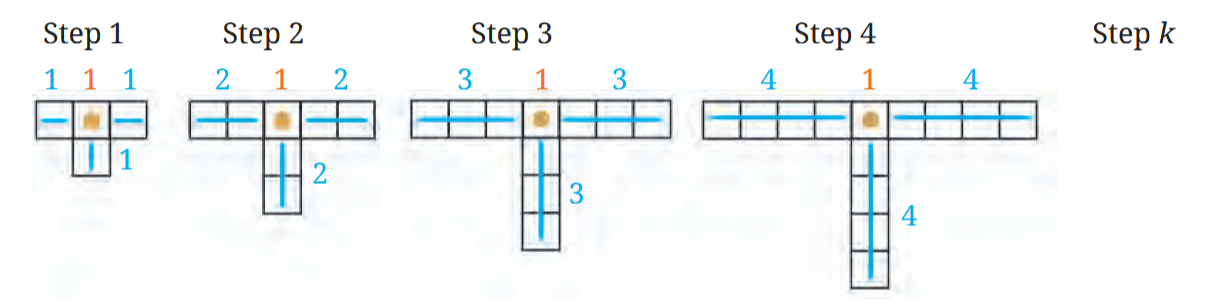
Example 7: Ranjana creates a sequence of arrangements with square tiles as shown below. Can she extend the sequence and make an arrangement using 100 tiles? If yes, which step in the sequence will it be?
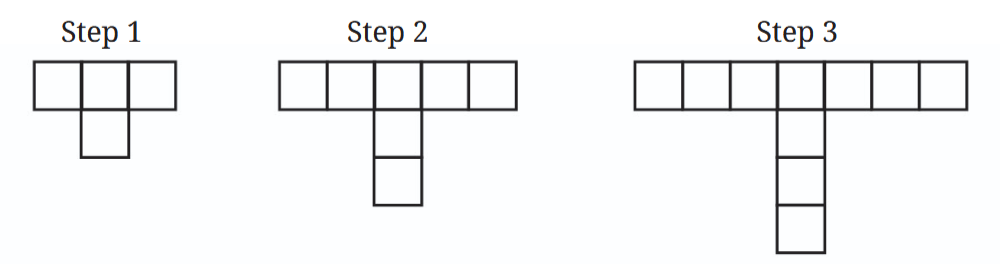
She can look at the pattern in different ways. They are shown below.
Method 1
1 + 1 + 1 + 1
= 4
2 + 2 + 2 + 1
= 7
3 + 3 + 3 + 1
= 10
4 + 4 + 4 + 1
= 13
k + k + k + 1
= 3k + 1
Method 2
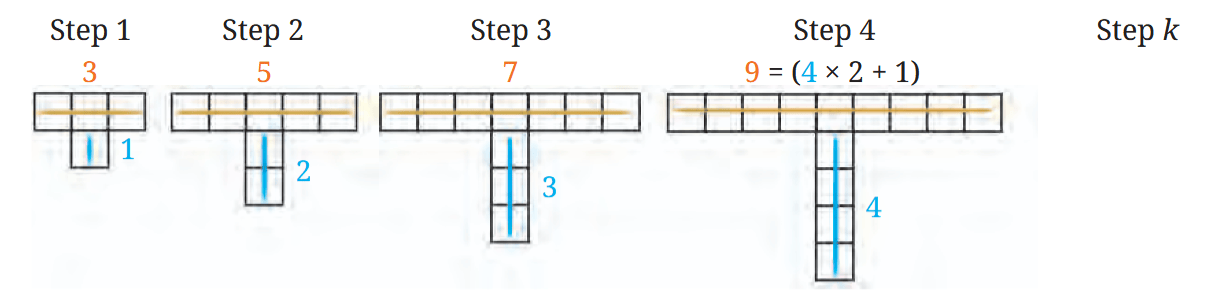
1 + 3
= 4
2 + 5
= 7
3 + 7
= 10
4 + 9
= 4 + (4 × 2 + 1)
= 13
k + (2k + 1)
= 3k + 1
We have the expression 3k + 1 which gives the number of tiles needed to make an arrangement in Step k.
To check whether an arrangement is possible using 100 tiles at some Step k, we can solve the equation: 3k + 1 = 100. Find the value of k.
Example 8: Madhubanti wants to organise a party. She decides to buy snacks for the party from the chaat shop in town. Each plate of snacks costs ₹25. The shop charges an additional fixed amount of ₹50 to deliver the snacks to Madhubanti’s house.
There are 5 members in Madhubanti’s family, including herself. Her parents tell her she can spend ₹500 on this party. How many friends can she invite to the party if she wants to give a plate of snacks to each person, including her family and friends?
Fatima’s method of solving this problem is shown below.
She represented the situation using a rough diagram.
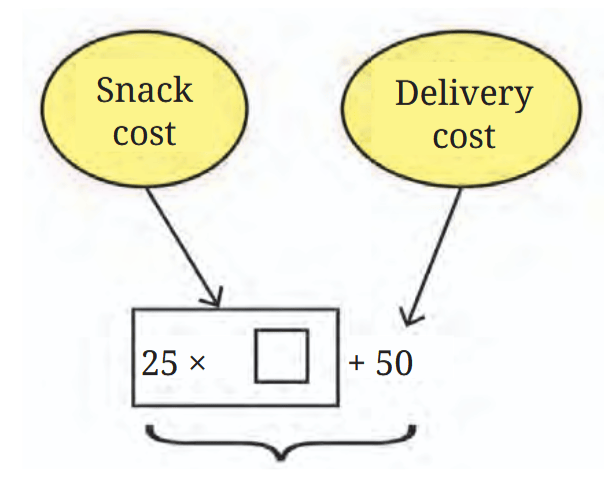
Out of ₹500, if we subtract the fixed delivery charge, then Madhubanti is left with ₹450.
So the question becomes “How many plates of snacks, each costing
₹25, can be bought for ₹450?”.
The answer to this is 450 ÷ 25 = 18.
18 plates of snacks can be bought for ₹450. Considering her 5 family members, she can invite 18 – 5 = 13 friends to her party.
| Mahesh represented the unknown
quantity of the total number
of people who can attend the
party, including Madhubanthi
and her family members, as p. Cost incurred = 25p + 50. Since this cost should be 500, we have the equation 25p + 50 = 500. Subtracting 50 from both sides, we get 25p = 500 – 50. 25p = 450. Dividing both sides by 25, we get p = 450 ÷ 25 = 18. 18 people can be at her party, including her 5 family members. That means 13 friends can be invited. |
Srikanth decided to represent the
unknown quantity of the total number
of friends Madhubanthi can invite as f.
What will be the cost in this case? Cost incurred = 25 (f + 5). Since Madhubanthi has ₹450 for snacks, we have the equation 25 (f + 5) = 450. Dividing both sides by 25, f + 5 = 18. Subtracting 5 from both sides, f = 13. |
Example 9: Two friends want to save money. Jahnavi starts with an initial amount of ₹4000, and in addition, saves ₹650 per month. Sunita starts with ₹5050 and saves ₹500 per month. After how many months will they have the same amount of money?
Let m denote the number of months after which their savings are equal.
What are Jahnavi’s savings after m months?
Jahnavi’s savings = 4000 + 650 m.
What are Sunita’s savings after m months?
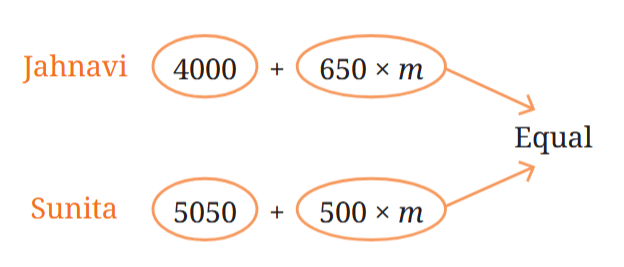
Sunita’s savings = 5050 + 500 m.
As these amounts are equal after m
months, we get the following equation:
4000 + 650 m = 5050 + 500 m
4000 + 650 m – 500 m = 5050 (subtracting 500 m from both sides)
4000 + 150 m = 5050
150 m = 5050 – 4000 (subtracting 4000 from both sides)
150 m = 1050
m = 1050 ÷150 (dividing both sides by 150)
m = 7.
So, after 7 months, both will have the same amount of money.
Check the answer.
Let us solve a few equations.
Example 10: Solve 28 (x + 4) + 300 = 1000.
Here are some ways to solve this equation.
| Subtracting 300 from
both sides, we get 28 (x + 4) = 1000 – 300 28 (x + 4) = 700. Dividing both sides by 28, we get x + 4 = 700 ÷ 28 x + 4 = 25. So x = 25 – 4, which gives x = 21. |
28 (x + 4) + 300 = 1000
Since 28, 300, and 1000
are divisible by 4, we get
a simpler equation if we
divide both sides by 4. 28 (x + 4) + 300 4 = 1000 4 Using the rules of fraction addition, we get 28 (x + 4) 4 + 300 4 = 1000 4 7 (x + 4) + 75 = 250 Subtracting 75 from both sides, 7 (x + 4) = 175 7x + 28 = 175 Subtracting 28 from both sides, 7x = 147 x = 147 7 = 21. |
28 (x + 4) + 300 = 1000 Simplifying the LHS, 28x + 112 + 300 = 1000 28x + 412 = 1000 Subtracting 412 from both sides, we get 28x = 1000 – 412 28x = 588 Dividing both sides by 28, x = 588 ÷ 28 x = 21. |
Example 11: Riyaz created a math trick, which he tries out on his friend Akash.
Riyaz asked Akash to perform the following steps without revealing the answer to any of the intermediate steps.
1. Think of a number.
2. Subtract 3 from the number.
3. Multiply the result by 4.
4. Add 8 to the product.
5. Reveal the final answer.
The final answer revealed by Akash was 24. Using this, Riyaz correctly figured out the starting number that Akash had thought of. Find this number.
Try the steps using different numbers as the starting number. Do you see any relation between the starting number and final answer?
The answer can be found by algebraically modeling this scenario. In other words, we can form an equation using an unknown. Let the unknown starting number be x.
What are the expressions we get after each step?
| Steps | Expression |
|---|---|
| Think of a number. | x |
| Subtract 3 from the number. | x – 3 |
| Multiply the result by 4. | 4 (x – 3) = 4x – 12 |
| Add 8 to the product. | 4x – 12 + 8 = 4x – 4 |
Since Akash’s final answer was 24, we have the equation:
4x – 4 = 24
4 (x – 1) = 24
x – 1 = 6 (Dividing both sides by 4)
Thus, Akash thought of the number 7.
Can you think of a simple rule that you can use to get the starting number from the final answer?
Example 12: Ramesh and Suresh have 60 marbles between them.
Ramesh has 30 more marbles than Suresh. How many marbles does each boy have?
In this problem, we have two unknowns. If we denote the number of marbles with Ramesh as x and the number of marbles with Suresh as y, then what are the different equations that we have?
1. The total number of marbles is 60.
x + y = 60.
2. Ramesh has 30 marbles more than Suresh.
x = y + 30.
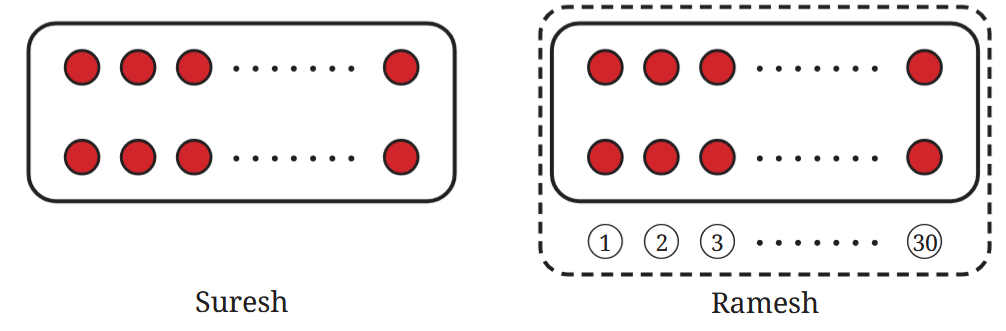
How do we find the unknowns using these equations? So far, we have only developed a strategy to solve an equation with one unknown!
To get such an equation, we can do the following.
Denote the number of marbles with Suresh as y, and the number of marbles with Ramesh as y + 30.
Since the total number of marbles is 60, we have the equation:
y + (y + 30) = 60
2y + 30 = 60.
Use this to find both the unknowns.
Generating Equations
So far, we have solved a given equation to find the value of the letter−number. Can we do the reverse — write equations using a given value of the letter−number?
Write equations whose solution is y = 5. Share the equations you made with each other and discuss the methods used.
Two such equations are y + 1 = 6 and 3y = 15.
Consider the following chains of equations, where one is obtained from the previous one by performing the same operation on both sides.
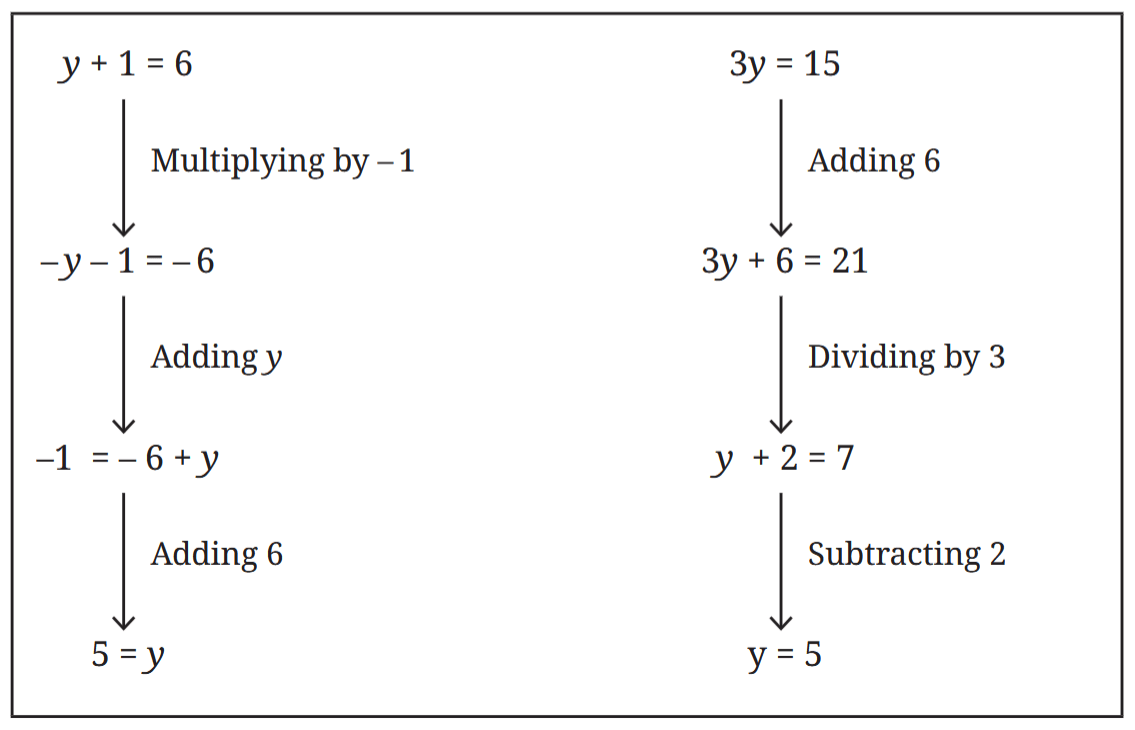
Can you form a chain going from the bottom equation to the top?
Compare the operations used when going from the top to the bottom and from the bottom to the top.
Without calculating, can you find the value of the unknown in each equation in the chains above?
[Hint: We have seen that the value that satisfies an equation also satisfies the new equation obtained by performing the same operation on both sides of the original equation.]
Example 13: Can you give a real-life situation that can be modelled as the equation, 100x + 75 = 250?
Solution: If we think of these numbers as representing money, we can see that the total money is ₹250.
There are two terms that are adding to ₹250. The second term in the LHS, ₹75, is fixed and does not change. The value of the first term would change based on ‘x’. So we can think of 100 as the number of units and ‘x’ as the cost per unit. For instance, x could represent the cost of a plate of snacks and 75 could be the delivery charge.
Figure it Out
1. Write 5 equations whose solution is x = – 2.
2. Find the value of each unknown:
(a) 2y = 60 (b) – 8 = 5x – 3
(c) – 53w = –15 (d) 13 – z = 8
(e) k + 8 = 12 – k (f) 7m = m – 3
(g) 3n = 10 + n
3. I am a 3-digit number. My hundred’s digit is 3 less than my ten’s digit.
My ten’s digit is 3 less than my unit’s digit. The sum of all the three digits is 15. Who am I?
4. The weight of a brick is 1 kg more than half its weight. What is the weight of the brick?
5. One quarter of a number increased by 9 gives the same number. What is the number?
6. Given 4k + 1 = 13, find the values of:
(a) 8k + 2 (b) 4k (c) k (d) 4k – 1 (e) – k – 2
7.3 Mind the Mistake, Mend the Mistake
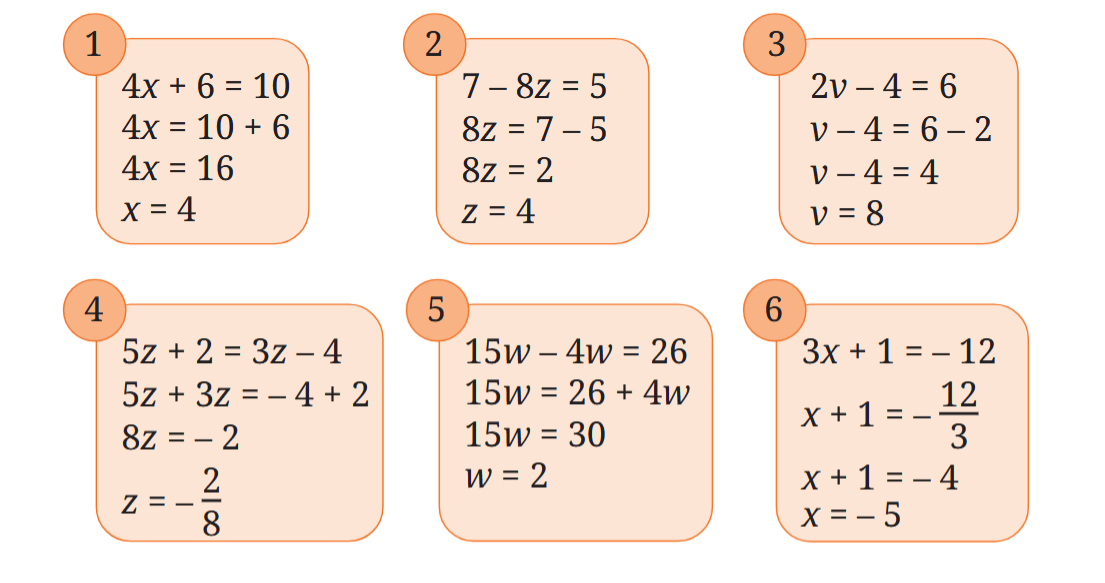
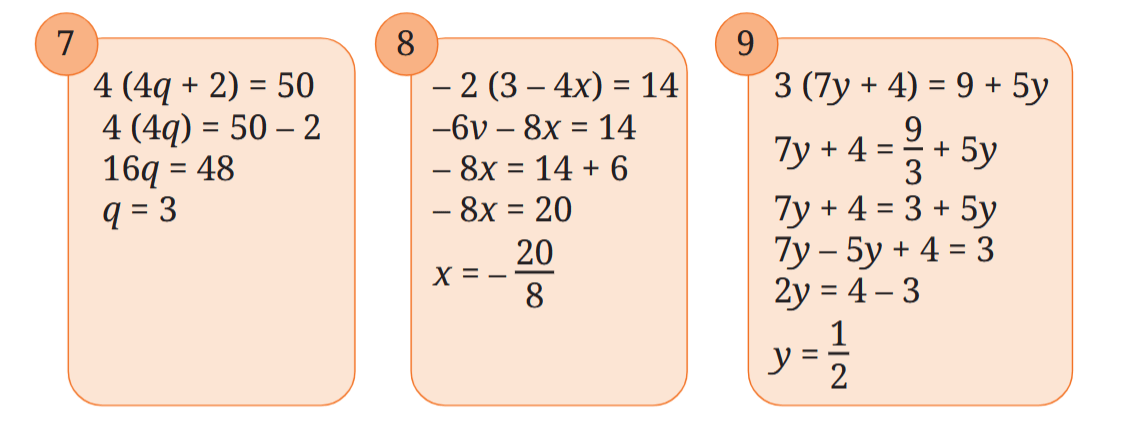
The following are some equations along with the steps used to solve them to find the value of the letter−number. Go through each solution and decide whether the steps are correct. If there is a mistake, describe the mistake, correct it and solve the equation.
7.4 A Pinch of History
Forming expressions using symbols and solving equations with such expressions was an important component of mathematical explorations in ancient India. This area of mathematics was termed bījagaṇita, also now known as algebra. The word bīja means seed. Just as a tree is hidden inside a seed, the answer to a problem is hidden inside an unknown number. Solving the problem is like helping the tree grow — step by step, we discover what is hidden.
We have seen Brahmagupta’s contributions to different areas of mathematics like integers and fractions. In Chapter 18 of his book Brāhmasphuṭasiddhānta (628 CE), he also explained how to add, subtract, and multiply unknown numbers using letters — similar to how we use x or y today. This chapter was one of the earliest known works in algebra in history. As renowned mathematician and Fields Medalist David Mumford remarked, ‘Brahmagupta is the key person in the creation of algebra as we know it’.
In the 8th century, Indian mathematical ideas were translated into Arabic. They influenced a well-known mathematician named Al-Khwarizmi, who lived in present-day Iraq. Around 825 CE, he wrote a book called Hisab al-jabr wal-muqabala, which means ‘calculation by restoring and balancing’.
These ideas spread even further. By the 12th century, Al-Khwarizmi’s book was translated into Latin and brought to Europe, where it became very popular. The word al-jabr from his book gave us the word algebra, which we also still use today.
Similar to how we use letters from the alphabet today to represent unknowns, ancient Indian mathematicians from the time of Brahmagupta used distinct symbols like yā, kā, nī, pī, lo, etc., for different unknowns. The symbol yā was short for yāvat-tāvat (meaning ‘as much as needed’). Others like kā and nī referred to as the first letters of the names of colours — kālaka (black), nīlaka (blue), and so on. In contrast to these unknowns, the known quantities in an expression had a specific form (rūpa) and were denoted by rū.
Here are some examples of how algebraic expressions in modern notation were written in ancient Indian notation:
| Modern Notation | Ancient Indian Notation |
|---|---|
| 2x + 1 | yā 2 rū 1 (in each term the indication of unknown/known came first) |
| 2x – 8 | yā 2 rū 8 . (a dot over the number indicated that it was negative) |
| 3x + 4 = 2x + 8 | yā 3 rū 4 yā 2 rū 8 (the two sides of an equation were presented one below the other) |
Example 16: Bījgaṇita by Bhāskarāchārya (1150 CE) mentions this problem.
One man has ₹300 rupees and 6 horses. Another man has 10 horses and a debt of ₹100. If they are equally rich and the price of each horse is the same, tell me the price of one horse. Solution:
Let price of one horse = ₹ x
According to the problem
300 + 6x = 10x – 100
300 + 6x + (100) = 10x
400 + 6x = 10x
400 = 10x – 6x
400 = 4x
400 ÷ 4 = x
100 = x
Therefore, the price of one horse = ₹ 100.
Such problems and solutions were well understood in ancient India.
In fact, a very systematic way to solve problems with single unknowns was first proposed by Aryabhata (499 CE) and Brahmagupta has outlined it in his Brāhmasphuṭasiddhānta (628 CE). Let us understand his method.
Let us look at a few equations of the following form:
5x + 4 = 3x + 8, or 3x – 6 = 2x + 4.
Can we come up with a formula to solve these equations? That is, for the first equation, can we perform some operations using 5, 4, 3, and 8 that will directly give us the solution? Using a similar method, can you solve the second equation using the numbers 3, – 6, 2 and 4?
To get a formula, we can generalise equations of this form by taking the four numbers as A, B, C, and D. That is,
Ax + B = Cx + D.
Brahmagupta gives the solution to equations of this form with this formula:
x = D – B/A – C .
Using this approach, we can find the solution to the equation:
650m + 4000 = 500m + 5050
simply by calculating, m = 5050 – 4000/650 – 500 .Using this formula can you solve this equation 2x + 3 = 4x + 5?
Ancient Indian mathematicians were excellent at converting complex mathematical ideas into simple procedures so that everyone could use these procedures to solve problems!
Bījagaṇita or algebra is the branch of mathematics that uses letter symbols to solve mathematical problems. We have seen some examples in previous pages. By studying algebra, we learn to generalise patterns — in numbers, shapes, and situations. We express these generalisations using the language of algebra, which is both precise and powerful.
Bījagaṇita also gives us a way to justify mathematical claims (like why the sum of two odd numbers is always even) and to solve problems of many kinds.
The power of algebra was well recognised by ancient Indian mathematicians. We hope you recognise it too — and enjoy using it!
Figure it Out
1. Fill in the blanks with integers.
(a) 5 × ___ – 8 = 37
(b) 37 – (33 – ____ ) = 35
(c) – 3 × (– 11 + ____ ) = 45
2. Ranju is a daily wage labourer. She earns ₹ 750 a day. Her employer pays her in 50 and 100 rupee notes. If Ranju gets an equal number of 50 and 100 rupee notes, how many notes of each does she have?
3. In the given picture, each black blob hides an equal number of blue dots. If there are 25 dots in total, how many dots are covered by one blob? Write an equation to describe this problem.
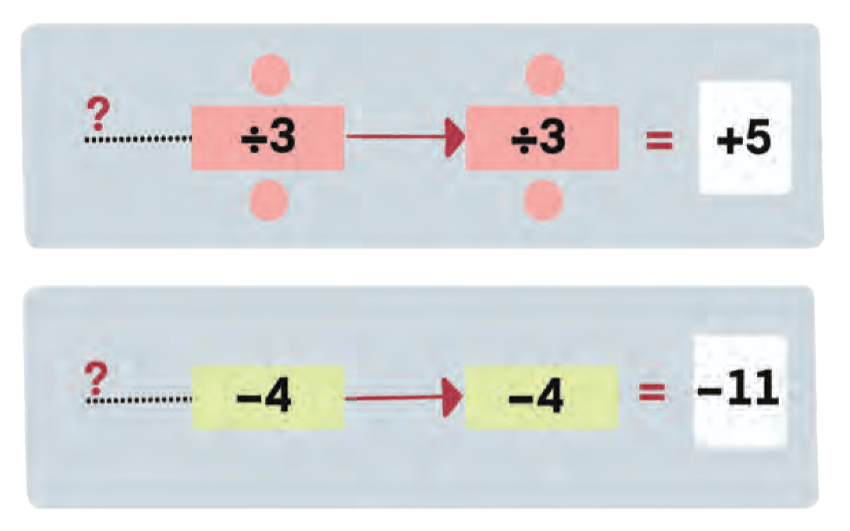
4. Here are machines that take an input, perform an operation on it and send out the result as an output.
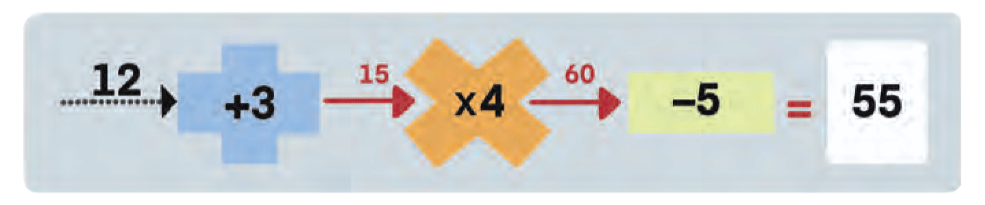
Find the inputs in the following cases:
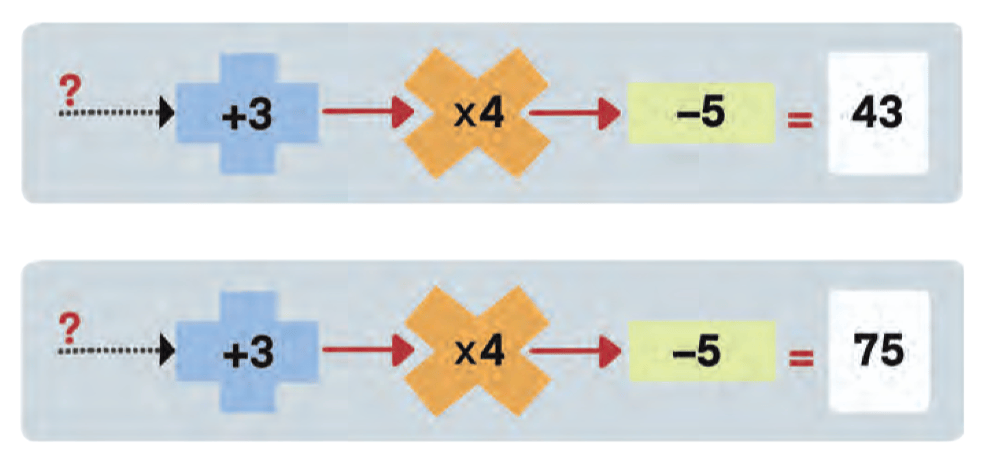
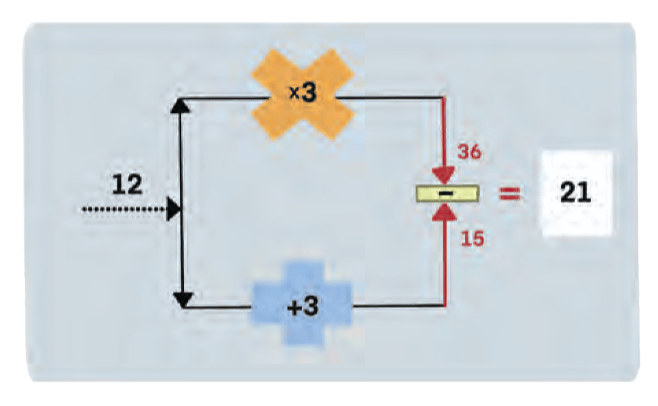
Find the inputs in the following cases:
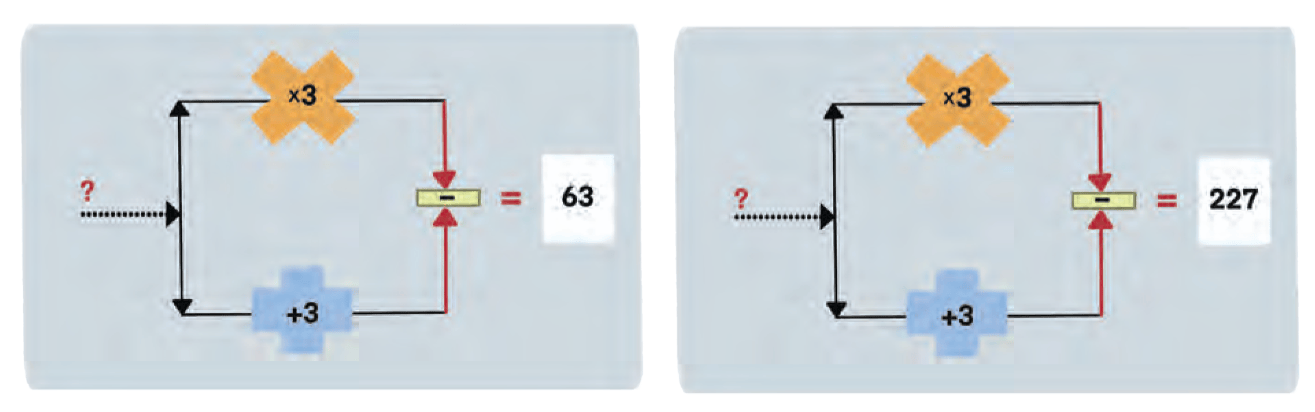
5. What are the inputs to these machines?
6. A taxi driver charges a fixed fee of ₹800 per day plus ₹20 for each kilometer traveled. If the total cost for a taxi ride is ₹2200, determine the number of kilometres traveled.
7. The sum of two numbers is 76. One number is three times the other number. What are the numbers?
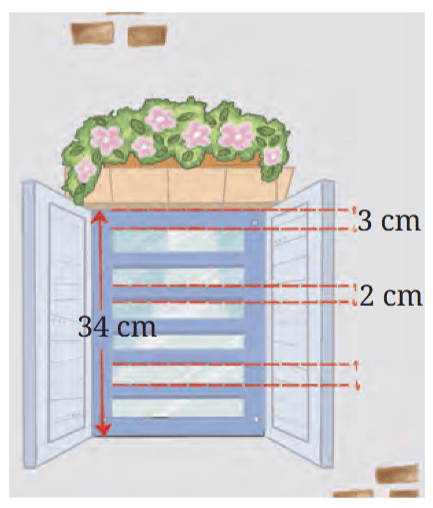
8. The figure shows the diagram for a window with a grill. What is the gap between two rods in the grill?
9. In a restaurant, a fruit juice costs ₹15 less than a chocolate milkshake.
If 4 fruit juices and 7 chocolate milkshakes cost ₹600, find the cost of the fruit juice and milkshake.
10. Given 28p – 36 = 98, find the value of 14p – 19 and 28p – 38.
11. The steps to solve three equations are shown below. Identify and correct any mistakes.
(a) 6x + 9 = 66
x + 9 = 11
x = 11 – 9
x = 2
(b) 14y + 24 = 36
7y + 12 = 18
7y = 6
y = 6/7
(c) 4x – 5 = 9x + 8
4x = 9x + 8 – 5
4x = 9x + 3
4x – 9x = 3
–5x = 3
x = – 5/3
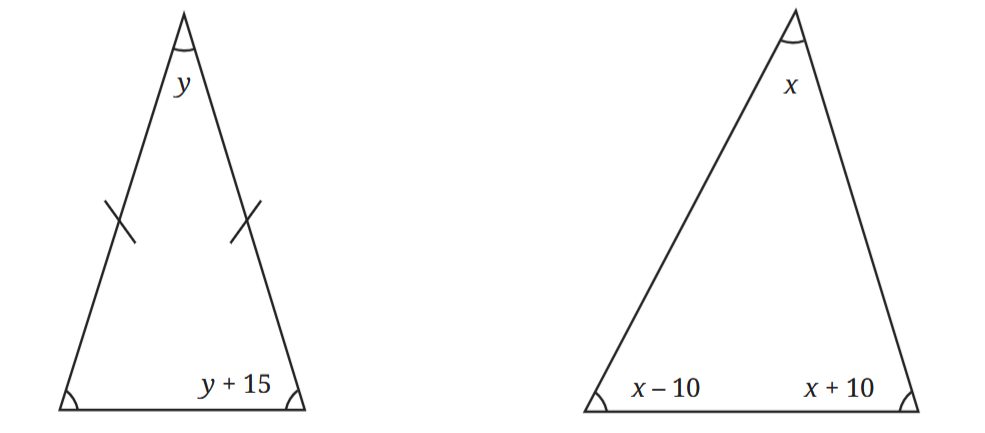
12. Find the measures of the angles of these triangles.
13. Write 4 equations whose solution is u = 6.
14. The Bakhśhāli Manuscript (300 CE) mentions the following problem.
The amount given to the first person is not known. The second person is given twice as much as the first. The third person is given thrice as much as the second; and the fourth person four times as much as the third. The total amount distributed is 132. What is the amount given to the first person?
15. The height of a giraffe is two and a half metres more than half its height. How tall is the giraffe?
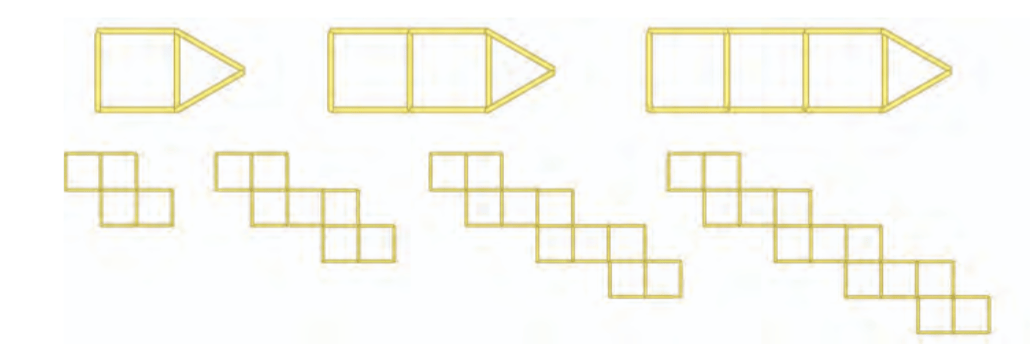
16. Two separate figures are given below. Each figure shows the first few positions in a sequence of arrangements made with sticks. Identify the pattern and answer the following questions for each figure:
(a) How many squares are in position number 11 of the sequence?
(b) How many sticks are needed to make the arrangement in position number 11 of the sequence?
(c) Can an arrangement in this sequence be made using exactly 85 sticks? If yes, which position number will it correspond to?
(d) Can an arrangement in this sequence be made using exactly 150 sticks? If yes, which position number will it correspond to?
17. A number increased by 36 is equal to ten times itself. What is the number?
18. Solve these equations:
(a) 5(r + 2) = 10
(b) – 3(u + 2) = 2(u – 1)
(c) 2(7 – 2n) = – 6
(d) 2(x – 4) = – 16
(e) 6(x – 1) = 2(x – 1) – 4
(f) 3 – 7s = 7 – 3s
(g) 2x + 1 = 6 – (2x – 3)
(h) 10 – 5x = 3(x – 4) – 2(x – 7)
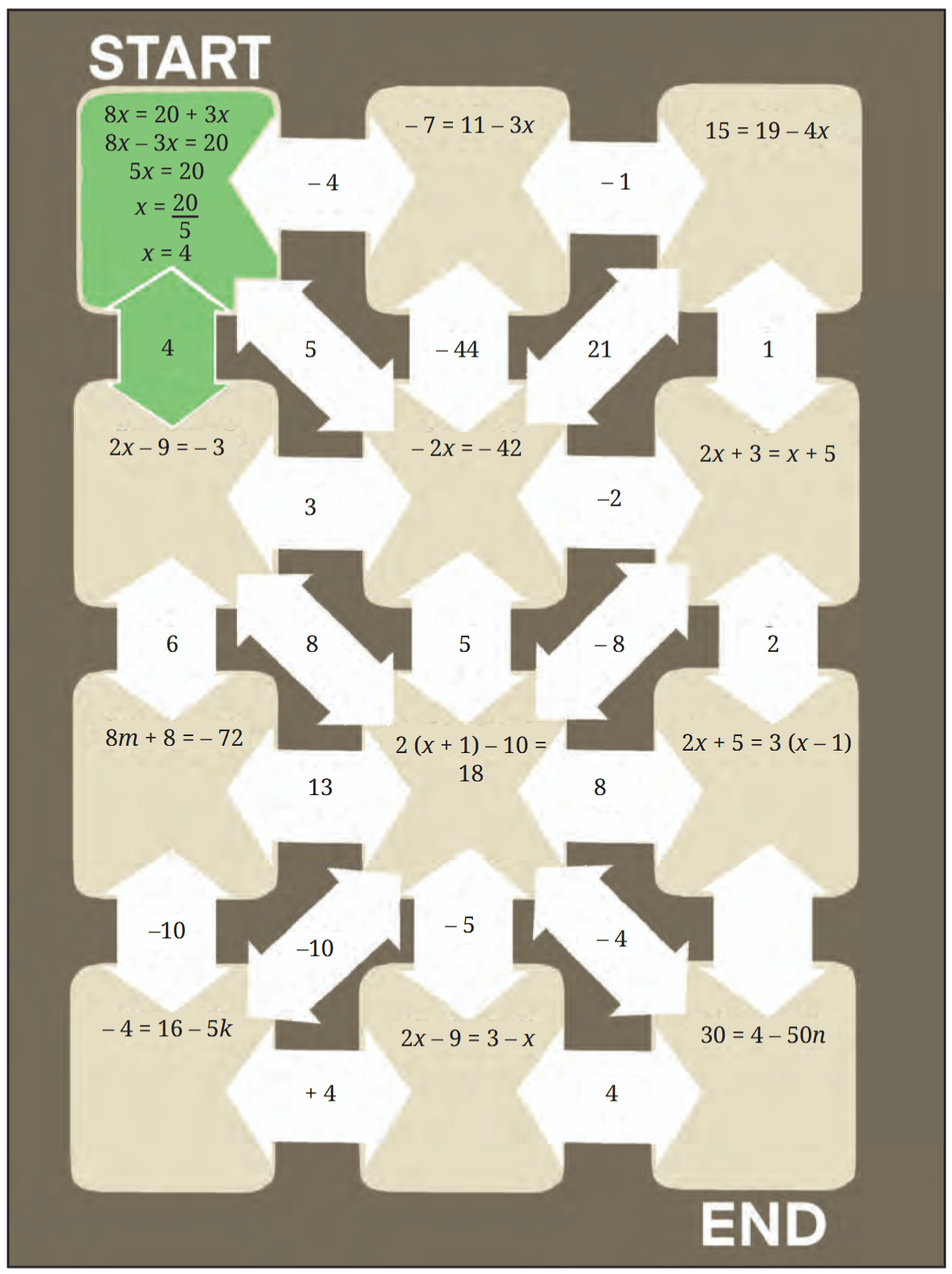
19. Solve the equations to find a path from Start to the End. Show your work in the given boxes provided and colour your path as you proceed.
20. There are some children and donkeys on a beach. Together they have 28 heads and 80 feet. How many donkeys are there? How many children are there?
SUMMARY
• An algebraic equation is a mathematical statement that indicates the equality of two algebraic expressions.
• When the same operation is performed on both sides of an equation, equality is maintained.
• Finding a solution to an equation means finding the values of the unknowns in the expressions such that the LHS is equal to the RHS.
• Equations can often be solved by performing the same operation on both sides so that the value of the unknown becomes evident.
A Magic Trick
Think of any number.
Now multiply it by 2.
Add 10.
Divide by 2.
Now subtract the original number you thought of.
Finally, add 3.
I predict that you now have 8. Am I correct?
Try the trick on your friends and family!
Can you explain why the trick works?
[Hint: Denote the first number thought of by x.]
Can you make your own such tricks?

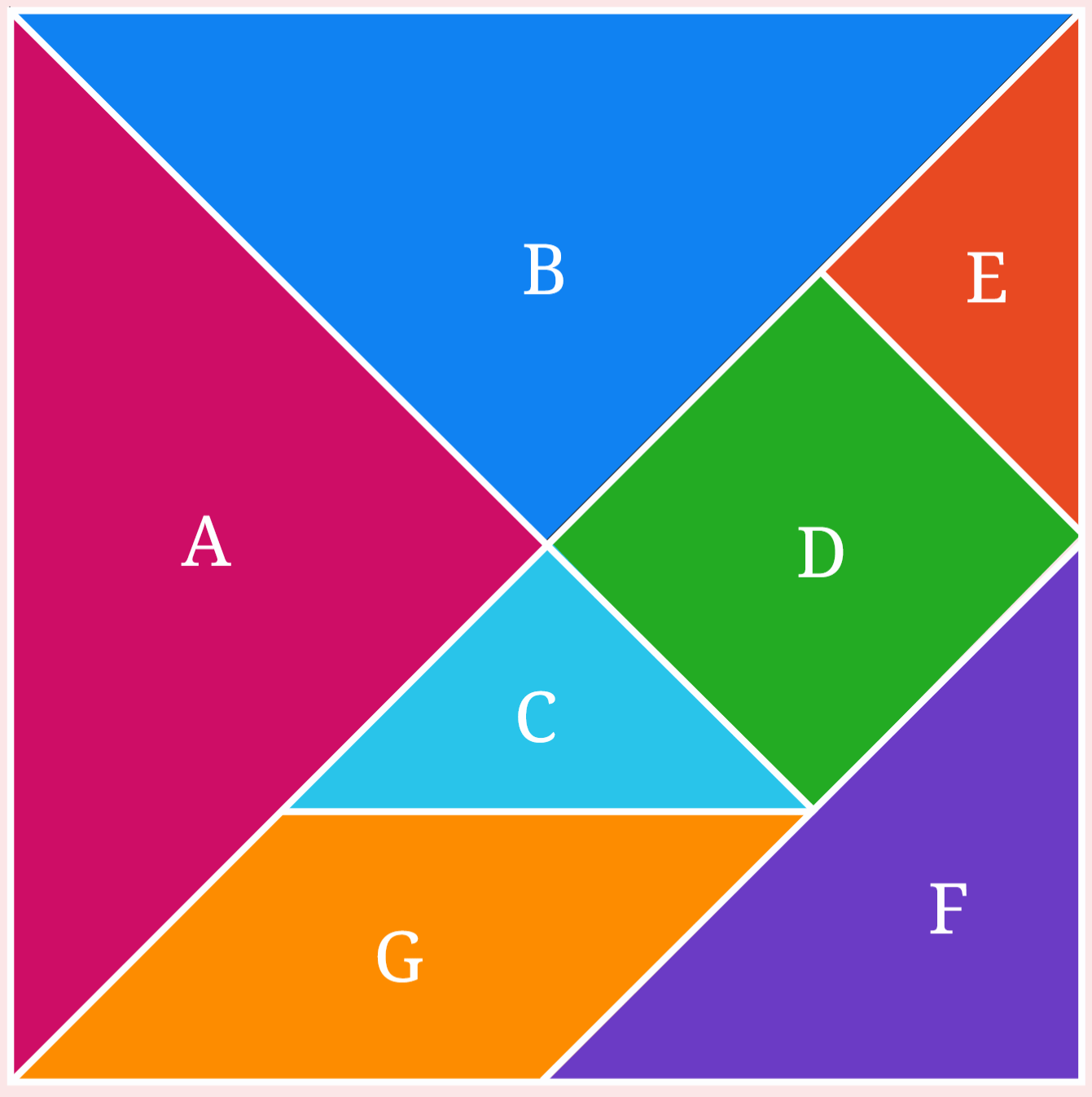
TANGRAM
Note: Cut each shape along the white border.