THEATRE
NOTE TO THE TEACHERS
Dear Theatre Teacher,
As we work together to build the spirit of theatre in children — with creativity, fun and joy on the one hand, and hard work, rigour and discipline on the other — here is a note that intends to share the vision of this textbook with you.
The theatre section for Grade 7 has been written to take the children to the next level of understanding from Grade 6. It blends numerous activities, along with the theoretical knowledge of the concepts introduced. While they get foundational knowledge and the historical understanding in the text, the activities included in it enhances their confidence and skills. Here are some requirements to ensure theatre classes are fruitful and enjoyable.
Free space to work
The primary requirement of the children is to move around freely as they do their activities. It is, therefore, important to have a free space where children explore the possibilities and try various activities without hinderance.
Connect to real world applications
The content in this book aims to make learning relevant to their everyday lives. From building empathy and acceptance through emotions, to enhancing discipline, planning and management skills through backstage activities — theatre can have a role to play in everyone’s lives. As a teacher, if such references are brought up in classroom discussions, it would make the lessons much more fruitful.
Assessment
This is a crucial part of the entire process of studying theatre in school as a mainstream subject. Though it is important to have marks or grades like every subject, it is essential to keep the spirit of theatre intact and not reduce it to a mere pen-paper exam with a question paper. The final outcome or presentation is not the only benchmark. The efforts, thoughts and processes behind it also need to be considered along with this —
Knowledge application
Effort and participation
Creativity and presentation
Team work and collaboration
Read the section on time allocation and assessments at the beginning of the book for better clarity. Assessment for theatre has been planned in different levels as mentioned below.
Formative Assessment
This is to be done in class after completing the activities and chapters at two levels:
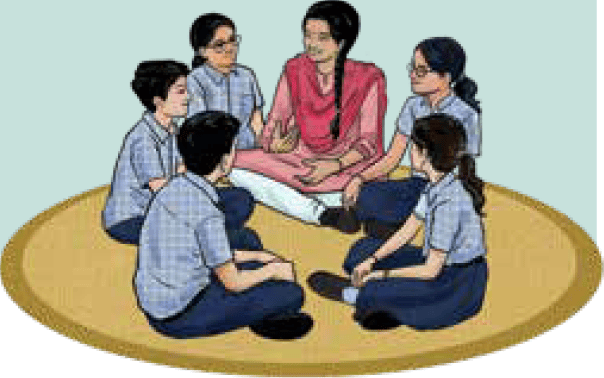
Circle Time — A process followed after every class and every activity. The teacher sits with the students in an informal setting (to get honest responses from children) to ask questions about what they did. They share their thoughts and experiences, based on which the teacher makes notes about each child. Some questions are given in the textbook. The teacher can explore more questions based on the response of class.
CIRCLE TIME
- Share move examples of pictures, paintings or other instances where you have seen emotions.
- If you were given the work of creating such a temple, how would you prepare for it?
- How much time would you spend practising it? Can you apply it to your work in school?
Brain Booster — Practical activities have been provided for the children to try what they have learnt in the chapter. The outcome of these could be used to assess the children and fill in the rubrics provided. Outcome of each activity is not about how ‘good’ or ‘bad’ the final product is, rather, about whether Brain Booster — Practical activities have been provided for the children to try what they have the process has been understood well and the skills are well-developed.
Rubrics — Upon the completion of each chapter, a rubric has been given with the desired learning outcomes that the teacher can mark. The children are also asked to give grades to themselves, based on their perception of their performance in that chapter. This self analysis can also act as feedback for the teacher.
Summative Assessment
This will be an activity based test conducted at the end of the year. The activities need to be a combination of the lessons learnt during the year. The assessment is conducted at individual and group level to assess different skills and competencies. A sample set of activities has been given at the end of the section.

UNDERSTANDING EMOTIONS
Emotions have always played a very important role in our lives. Since time immemorial, we have tried to understand the depth of what, why and how emotions exist in our lives.
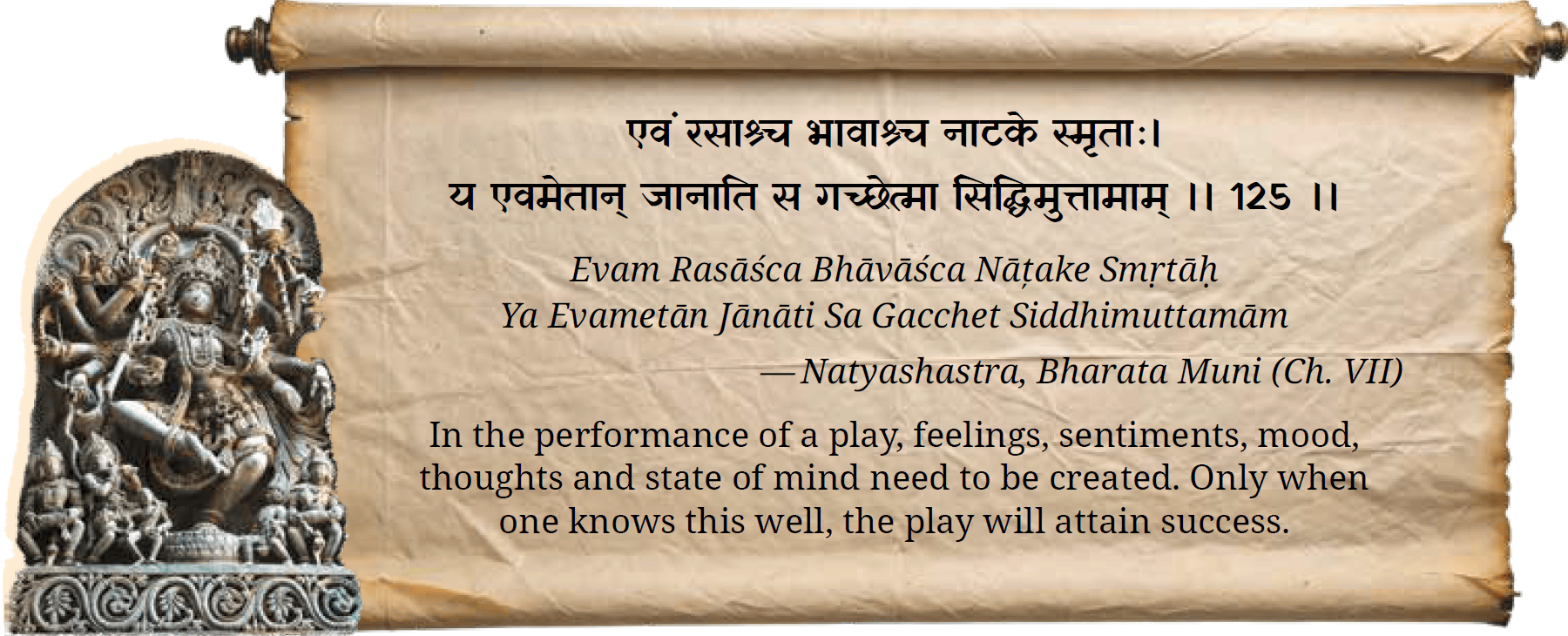
As this Sanskrit line from Bharata’s Natyashastra says —
You will learn
- Emotions in different intensities.
- Lokadharmi and Natyadharmi — realistic and stylised.
- Representation in ancient architecture.
It implies emotions are the most important thing to connect not just for the audience, but people in general. It is, therefore, crucial to understand how emotions work in order to make the right connections and live a positive life. Let us do a quick recap of what we have learnt so far.
In the previous year, we discussed about the concept of —
Understanding Emotions
- Bhava — The inherent attitude and state of mind of the individual.
- Rasa — The feeling that is felt in a situation as a result of the bhava within.
- Experiencing two or more emotions in a situation.
- Your feelings being different from your friends, in the same situation.
Expressing Emotions
- Navarasa — Indian view on emotions.
- Tragedy-Comedy — Greek view on emotions.
- Game of Hot Seat — Combines storytelling and emotional expression.
- Mask-making — Emoting through masks.
Based on the concepts we already discussed, we shall now go deeper into understanding and expressing emotions. As we have already learnt, Bharata Muni researched and analysed to conclude that there are eight predominant emotional experiences, and the ninth was added later making it the Navarasa. With our own little research and understanding, we can add to this knowledge. Sounds exciting?
To start with, let us pick one Rasa.
............
Now, list (or draw) different levels of that Rasa (emotion)
1. ________________
2. ________________
3. ________________

Here is an example to demonstrate this —
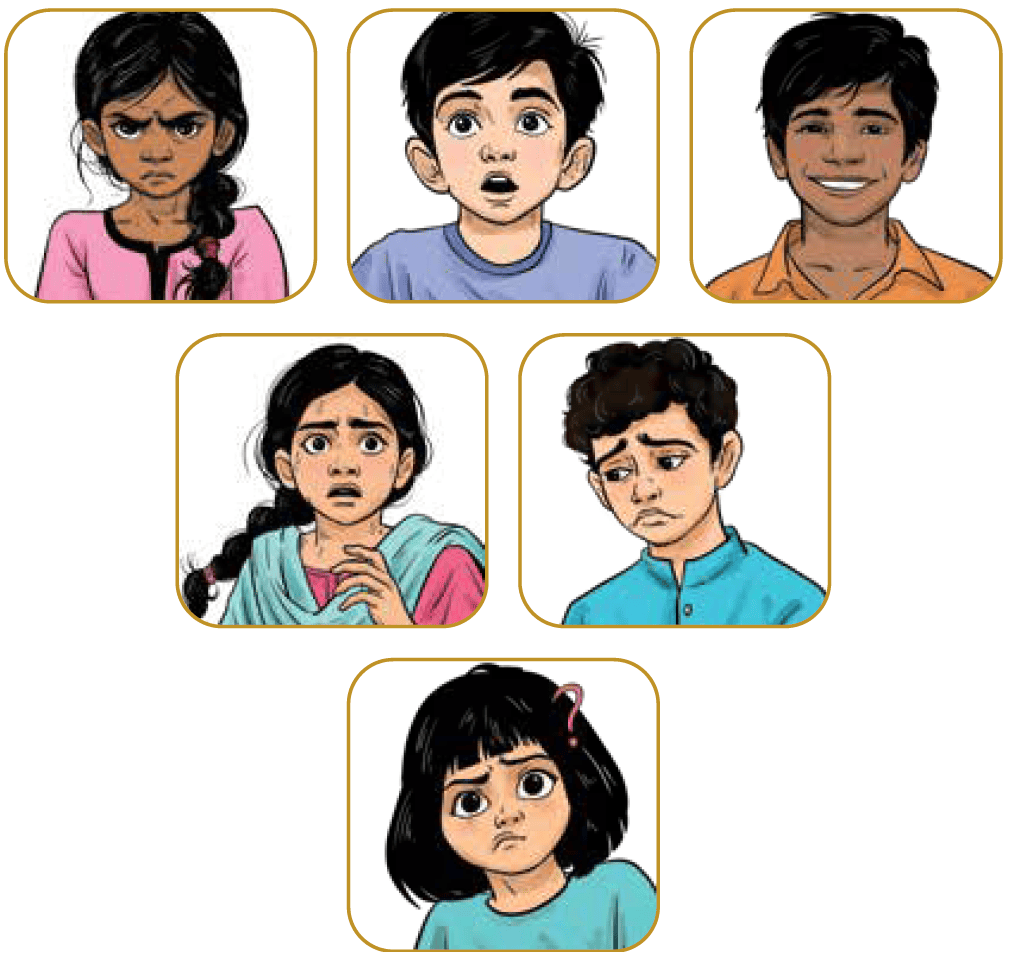
Rasa — Roudra (Anger)
Different levels
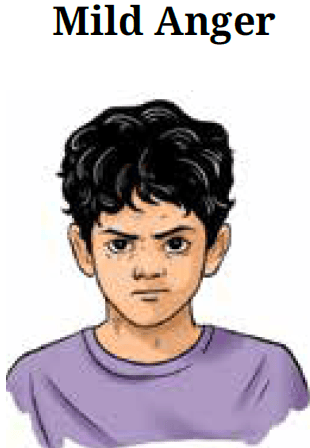

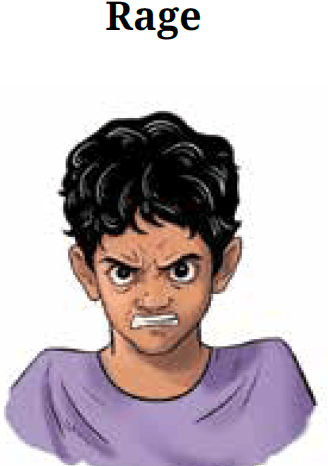
Here we are looking at different levels of intensity of each emotion. To understand this better, let us play a game that will let you think about each emotion, as you have fun with your friends.
Intensity is the measurable quality or degree of a property or condition.
ACTIVITY 1.1: EMOTIONAL CORNERS
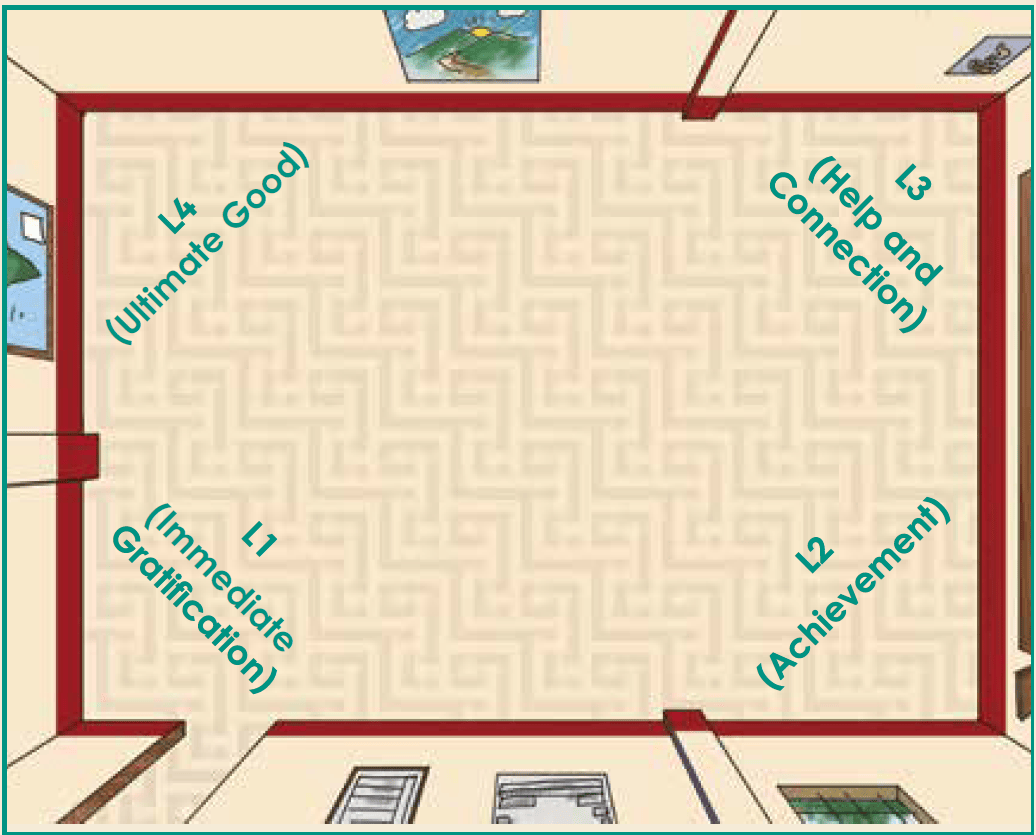
Every corner of the room is assigned different emotions and anyone who stands in that corner has to express that emotion — in speech, facial expression and body language. Placards or posters are placed at different places to identify emotions. It starts with all children standing at the centre of the room. Play a trial round to understand better.
TRIAL ROUND
The placards are placed in the room as shown. Children shall stand in the centre, ready to start.
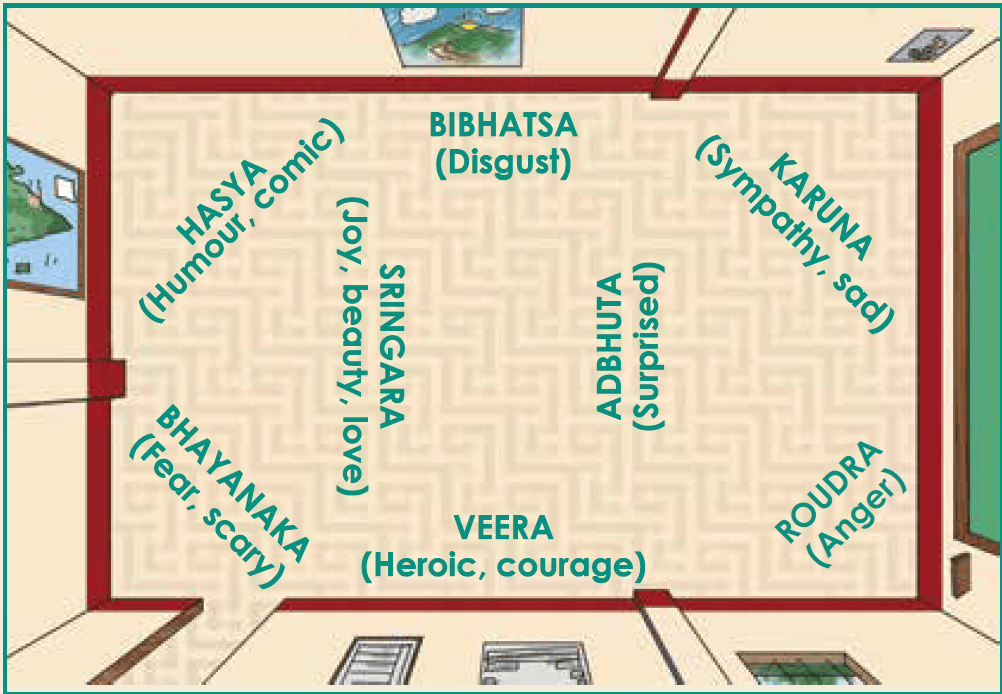
INSTRUCTIONS
Each of you take turns to go to an emotion of your choice, say one or two lines that depict the feeling and act it out as well.
EXAMPLE
One child chooses veera. Stands in its place. Depicts it in voice, expression and action. The next child chooses a different emotion, stands in its place, depicts it in voice, expression and action, and so on.
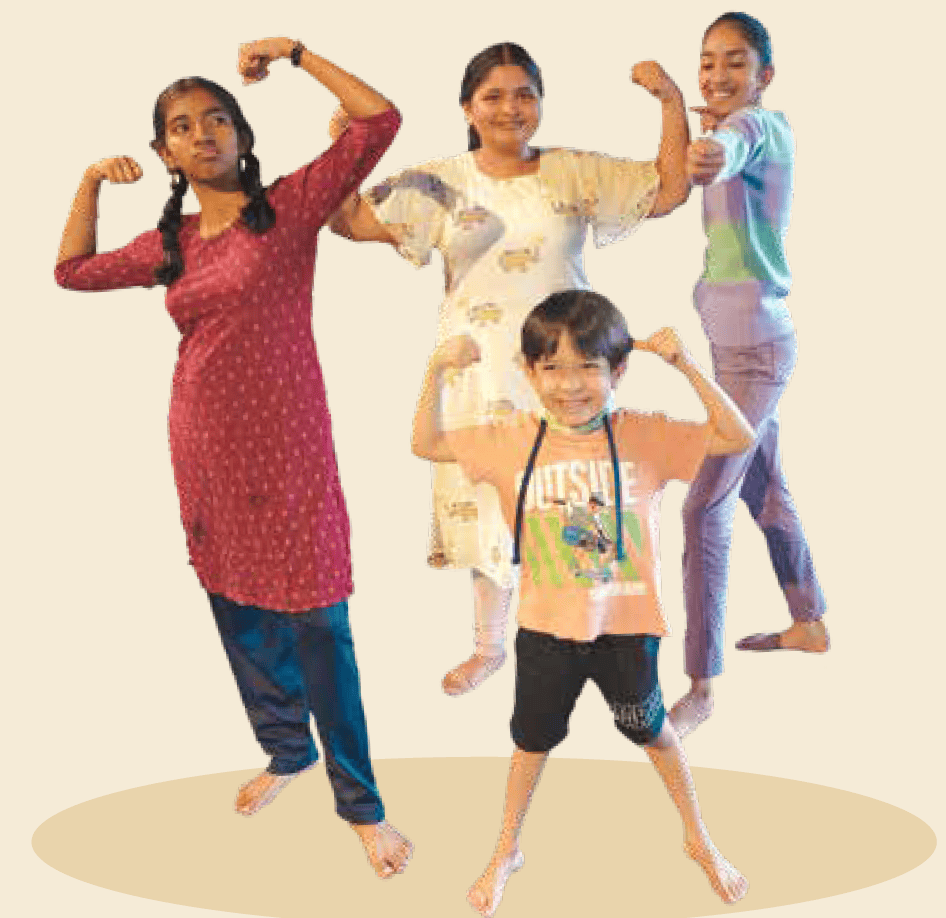
Now we come to the actual part!
Since, we are all familiar with the various emotions, let us start working on specific details of each emotion. Just like the example given on page 6 — where anger has been shown in three levels — pick another emotion, discuss in class about its various levels and make placards accordingly. You can even add a fourth level if you can identify it. Here is another example —
EMOTION: HAPPINESS
LEVELS
1. Immediate gratification (you get to eat your favourite ice cream).
2. Personal achievement (you won a prize in a difficult competition).
3. Help and connection (you help your friend with notes as he was ill).
4. Ultimate good (you donate books and clothes to a nearby orphanage).
Now, with new names to the corners, everyone can stand in the centre and play the game using speech, action and expression. Repeat the same for each emotion.
You can try doing it without voice. It will help in focusing on expression and body language. You can skip action to focus only on voice and expression. All variations with all emotions can be explored in class.
Note to the Teacher:
It is important to have a discussion among the children regarding the levels of each emotion. The children have to think and arrive at different levels each time. It may not be the same for every batch or class. Each group of children can arrive at different names and levels. There is no correct or wrong answer here. The teacher is advised not to give the names of variable intensities to children, but only help and support them in arriving at the final names of levels.
ADVANCED
Now that you all have mastered the names and varying intensities of each emotion, let’s try putting it in the form of a story. Now, the corners will only have names of levels. It could be the level of any emotion depending on the situation of the story.
Example: Once upon a time there was a queen who ruled over a huge province in India. She fought many battles and protected her people bravely (calls out Veera rasa, L3. The rest of the children go to L3 and emote it). One day, two children came to her and said they can defeat her easily (calls out — Adbhuta rasa, L2. The children go to L2 and emote it). She laughs and agrees to the challenge (Hasya rasa, L1).
And so, it goes on. Everyone can take turns in narrating stories. They can either be given time to prepare or have them say it spontaneously. They can also narrate popular stories of the Panchatantra or Puranas.
Note to the Teacher:
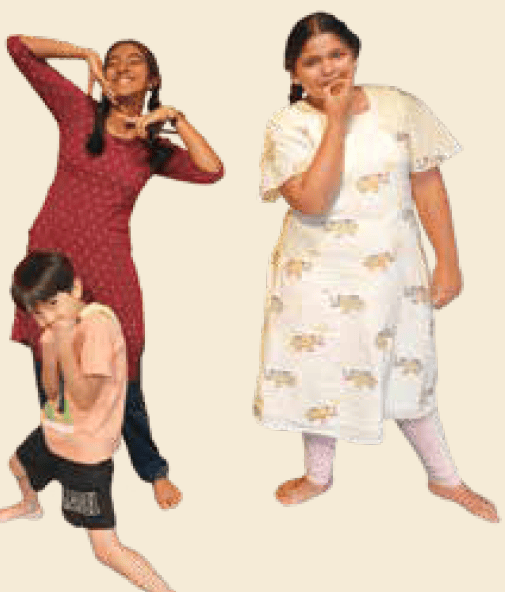
It is highly beneficial to ask each child to write the three or four levels of emotion as they perceive. Each child would have their own experience that would determine this. It is important to have every child think on their own (for better self-awareness) and actively participate in the group (for peer validation). Emphasising the importance of voice and volume to convey emotions will help in better communication, and enable children with visual impairment to connect better.
CIRCLE TIME
- How many new additions did you make to Bharata Muni’s list of emotions?
- Do you think you can have more than three or four levels of intensity?
- What are those emotions?
- Do you actually feel or experience the emotion and its intensities as you express them? Or is it just external?
EXPLORING EXPRESSION STYLES
As you played the game of Emotional Corners, did you notice how each one of you had a different way of showing the emotion? Though the situation and feeling was the same, why is it that some people close their eyes when they are scared and others open their eyes wide in the same fear?
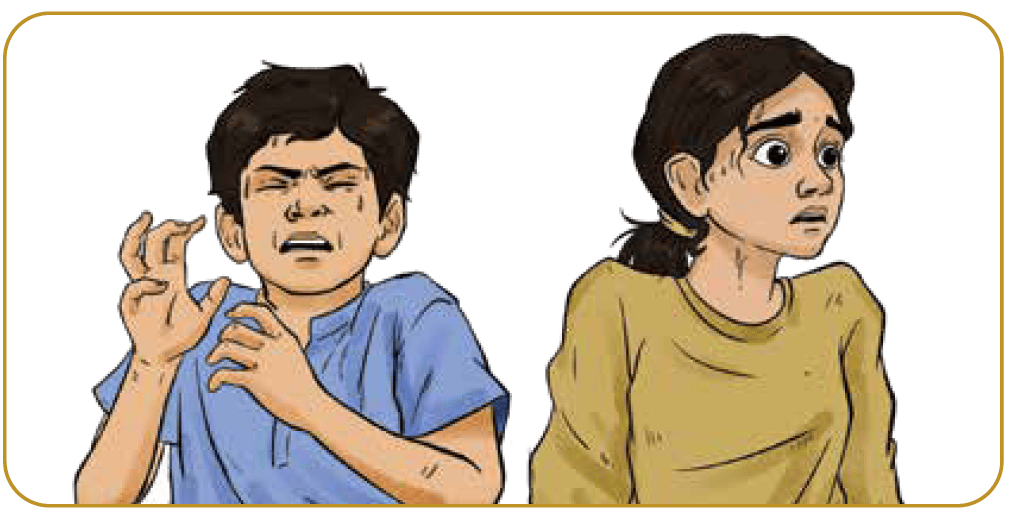
List a few other examples where you think the same emotion was shown in very different ways in the table in the next column.
Add more lines if you need to write about more emotions or styles. But it is important to observe others intently, before doing this exercise. You can also include actions (body language) and sound (voice) under styles.
|
Emotion |
Style 1 |
Style 2 |
|
FEAR (Bhayanaka) |
Close eyes tightly |
Open eyes wide |
|
ANGER (Roudra) |
|
|
What are these styles of expression? Is acting and performance also categorised into different styles? What is it based on? Read on, to get all your answers.
STYLES OF ACTING
Acting has been explored by many experts and artists, across the world for many centuries. The style of performance usually depends on their local culture. But there are few styles that go beyond this and are universally followed, even to this day. Some of the ancient cultures that created their own styles are mentioned on the right.
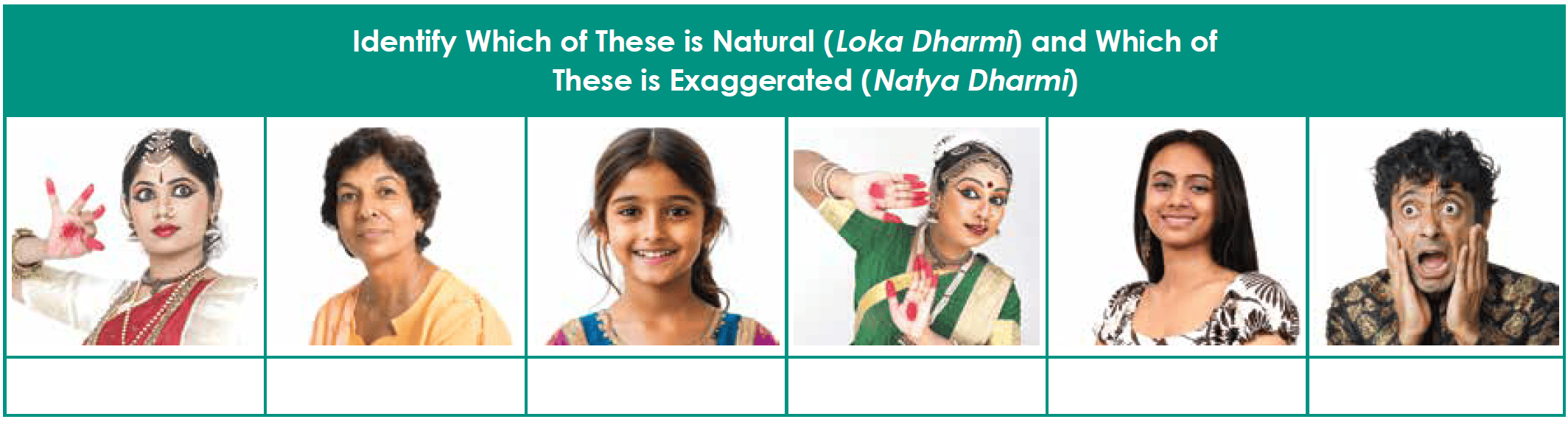
In the pictures on the right, do you see the variety in the styles of presentation? Each one looks completely different from the other. You see variety in costume, properties, music, dialogues and even the kind of stories they tell. With so much variety, how do we find styles that can be applied universally, no matter where it is performed? This is achieved by creating styles that are more natural and closer to real life. Brecht style and method acting are some examples.
Now, look at the these pictures and try to identify the country or the culture. It is difficult, right? It could be any part of the world, but mostly set in the present context. So, these styles are very different when compared to the previous set of culture-based style. These styles are based on techniques of acting and direction that can be applied to any script or story. You will learn in detail about these styles in the upcoming grades.
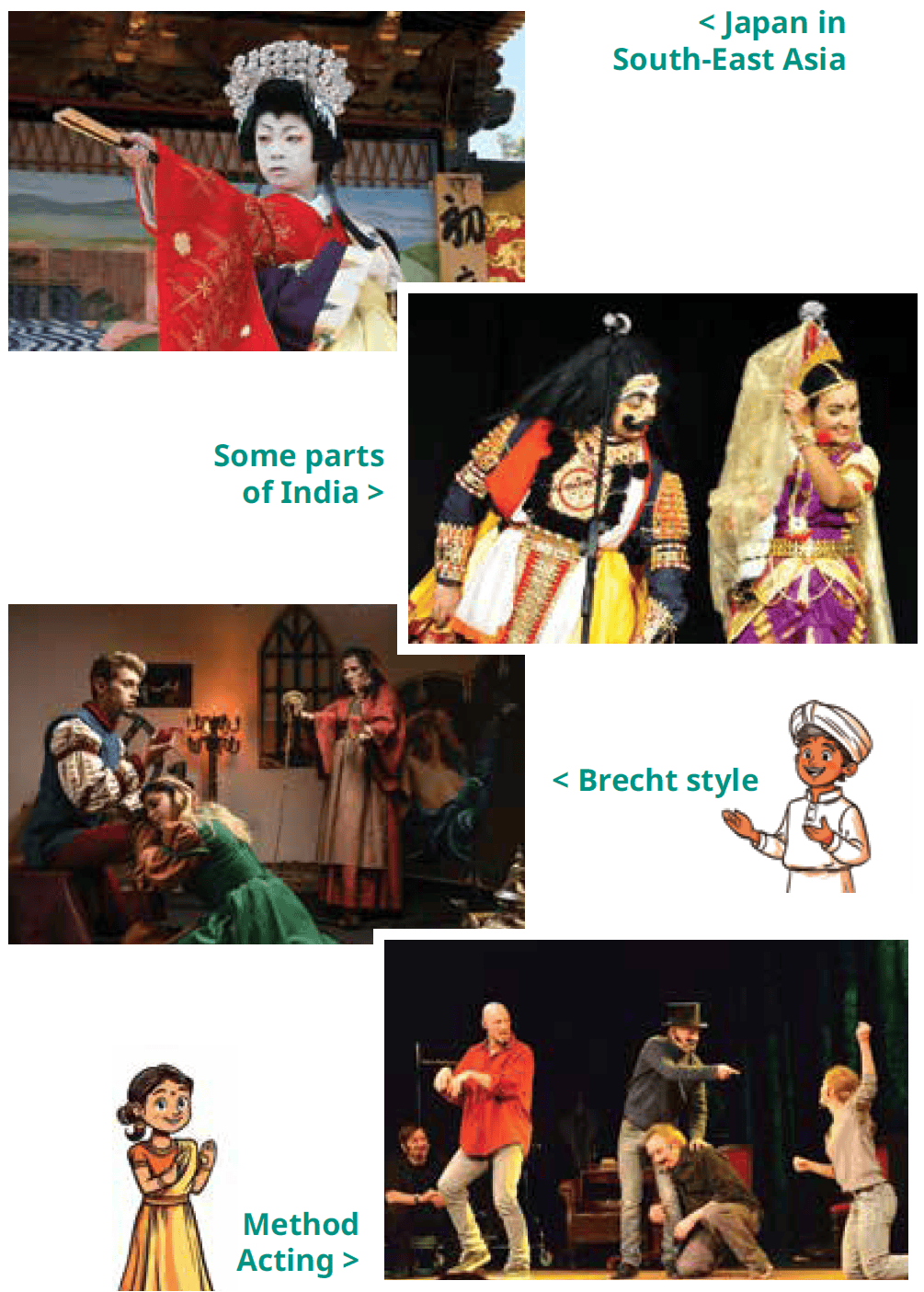
As we have observed, there are two major styles of acting:
1. With elaborate costumes, make up and music, dramatic acting, bigger gestures and loud voices.
2. Costumes and make up that are close to everyday life, minimal music, actors in their normal behaviour.
Do we have names for these? Who gave them their names?
As we studied in Grade 6, more than 2500 years ago, Bharata Muni, a great sage from India studied, researched and analysed the performing arts and defined all these elements. Though it was written 2500 years ago we still use it today as it is still relevant!
The level of detail and expertise in his work Natyashastra is astonishing.
The two styles as defined by Bharata Muni are Natya Dharmi and Loka Dharmi.
Natya Dharmi —bigger, exaggerated movement, over-the-top expressions, loud voice, elaborate bright costume and make up, lots of jewellery, and accessories
Loka Dharmi — perform like in real life. Actions, expressions, costume are all natural and resemble reality. It appears like the situation is naturally happening on stage and not acting.
Here is the actual stanza from the Natyashastra that talks about natural and stylised acting.
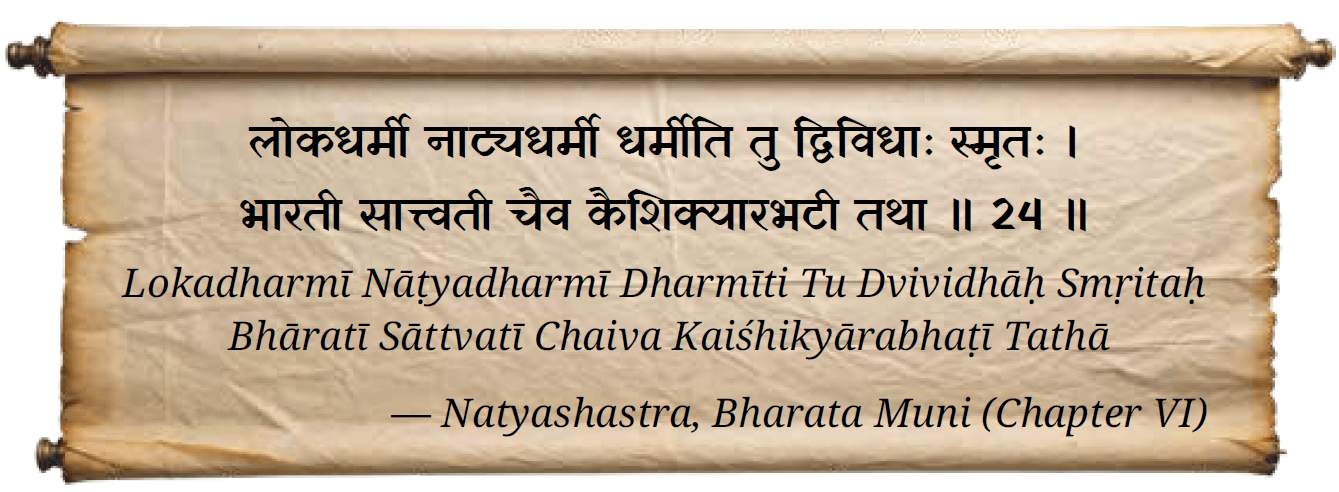
Meaning: Practice of representation (dharmi) in a dramatic performance is twofold: Lokadharmi or realistic and Natyadharmi or theatrical.
ACTIVITY 1.2: PICK YOUR STYLE!
This activity is done in order to get familiar with the two styles of acting. Keep a few chits prepared with simple actions written on each one.
Example: Walking on the road with many potholes, taking a gift out of the bag, eating your favourite chocolate.
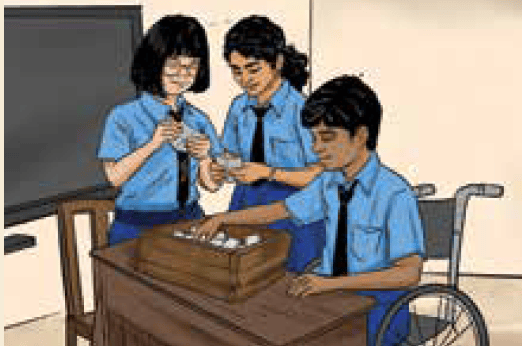
BASIC
A set of folded chits are kept on a table. Each child picks up one chit. Reads the action written on it. The child gets to choose if it wants to do the action in a natural style or stylised. All children get a chance to try realistic acting, stylised acting or both!
ADVANCED
Another set of chits is kept alongside this set of actions. It has ‘realistic’, ‘stylised’ and ‘both’ written in them. The children pick one chit each from the two bundles and follow what is written. They can try multiple times with different combinations each time.
CIRCLE TIME
- What are the differences observed in both styles of acting?
- Which method is more effective? Why?
- Share examples of where you have seen stylised acting (movies, TV, etc.).
As we discuss the representation of stylised art forms, the first thing that comes to one’s mind is the rich and beautiful sculptures and carvings we see on the walls of ancient buildings, including temples. Can you recall some of the artistic carvings that you have seen recently?
Name of the building.................
Location.................
Name one unique thing you remember about the art works
...............................
This brings us to the next part of exploring emotions.
ANCIENT ARCHITECTURE
The uniqueness of Indian culture is that — though such heritage sculptures are ancient, but they are still relevant and apply to everyday life.
Indian architecture, with its breathtaking sculptures, serves as a timeless gallery of human emotion, depicting the essence of Navarasas in stone. Every part of the country has these sculptures in different styles that also represent the dynasty and its history. Each building, temple and sculpture has a unique story to tell. The sculptures depicting emotions have stories that have more emotions hidden within them. Here are some of them.
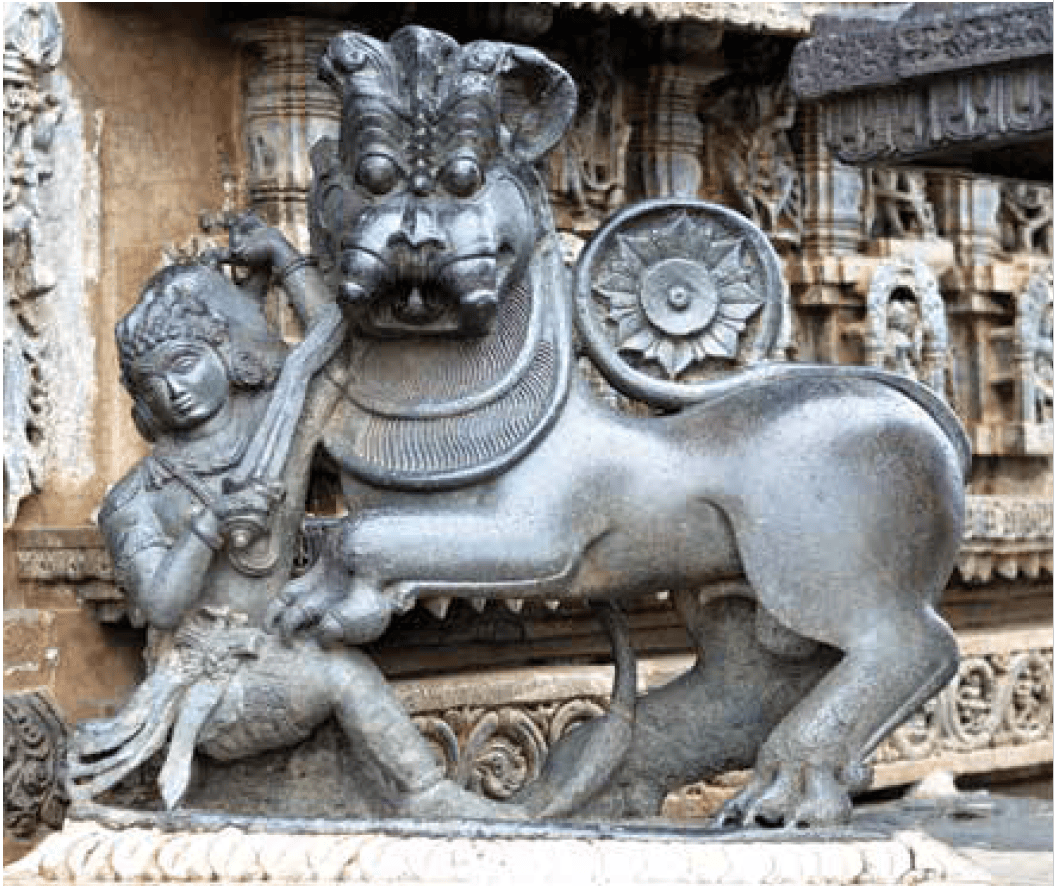
A sculpture of a young boy — Saḷa, fighting a lion. What emotion does it evoke? Bravery and courage, Veera rasa.
This is from the Chennakeshava Temple, Belur, Karnataka. The Hoysḷa dynasty that ruled the place got the name from this — Hoy-Saḷa, meaning, kill the lion, Saḷa! (1006 – 1346 CE).
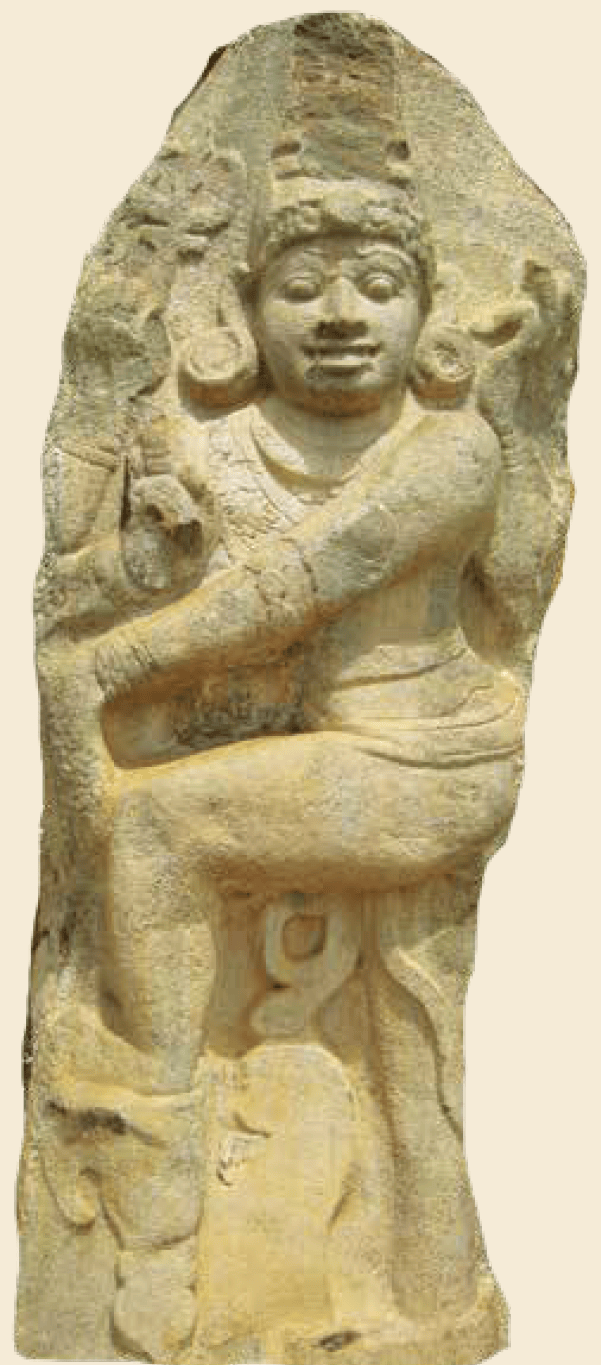
A sculpture of Dvarapalaka (guardian of the entrance). The emotion it evokes — fear. Does it not look scary? This sculpture in Bhayanaka rasa is meant to scare off the negative forces.
You can see more such sculptures at the Brihadeeshwara temple, Tanjavur, Tamil Nadu. This was built by the Chola Dynasty (815 – 1280 CE).
DO YOU KNOW?
No binding agents such as cement or soil were used to keep the stones of the temple together. It does not even have the conventional foundation under the ground, like most modern buildings. Yet, not only is this temple one of the tallest of its kind, it has also stood strong against earthquakes and storms for over a 1000 years!
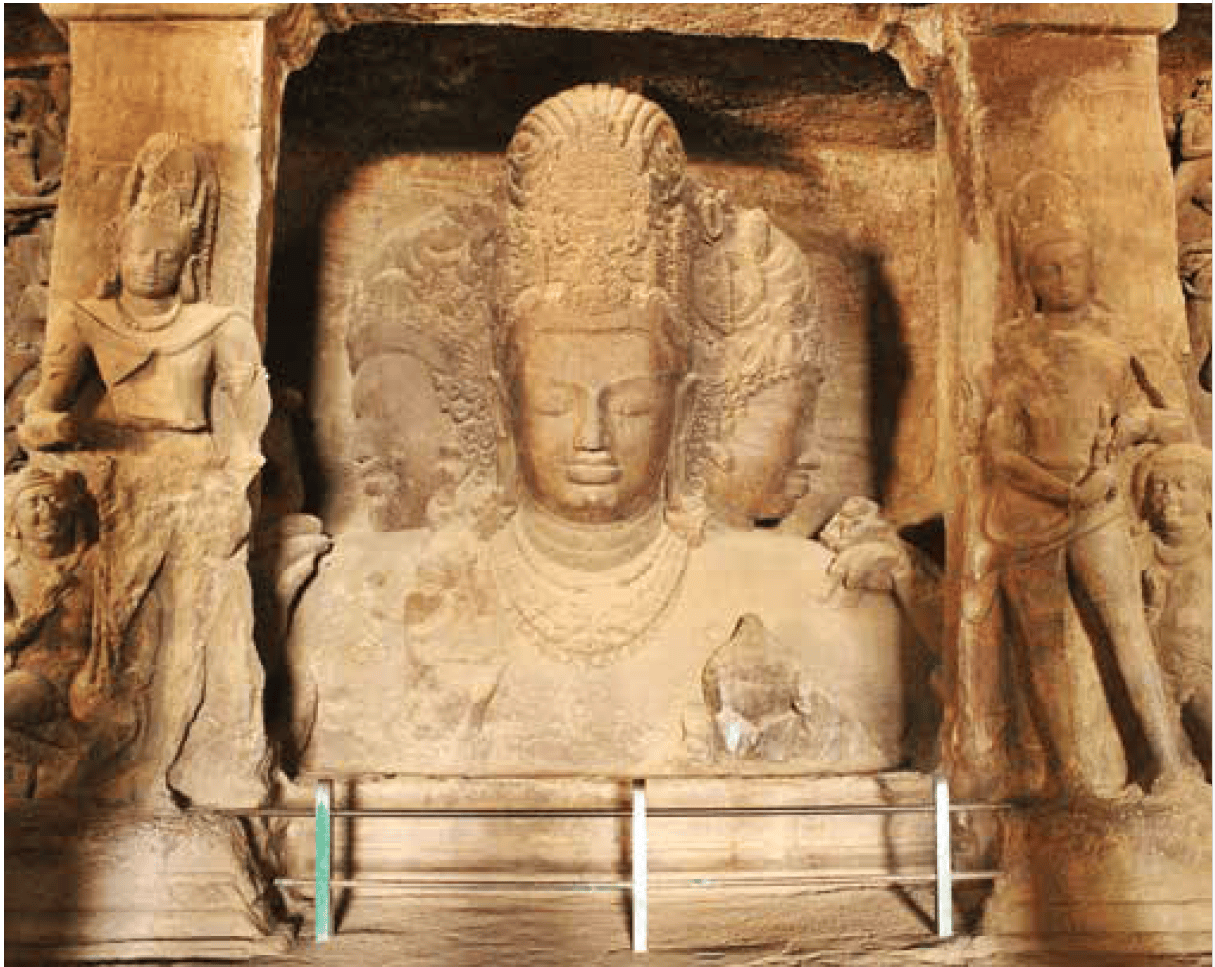
This is an interesting sculpture with three emotions in one. This is the Trimurti in the Elephanta Caves in Maharashtra. It has three faces of Shiva, each depicting a different emotion and a meaning — creation, sustenance and destruction. This was built during the Rashtrakuta Dynasty (755 – 975 CE).
ACTIVITY 1.3: FIND A PICTURE!
Find a picture of a temple sculpture that you have seen and paste it in the box below.
Write about the emotion in the sculpture and the story behind it.

DEDICATION OF A LIFETIME!
If you notice the time period, all these sculptures that are artistically perfect have survived for hundreds of years, while today’s buildings might not last a few decades. What is the difference? The time and effort put by every individual artist involved in making these sculptures was wholehearted, as they believed this was God’s work. Even a minor scratch or a glitch was considered bad as nothing could go wrong in God’s work. That was the level of dedication. It was never considered as just a ‘job’ for which a salary was paid, as it is the case today.
Here is an interesting story that tells us about the level of dedication the artists had. It is believed to be true.
Master craftsman Jakaṇachārī, was ordered by the Hoysaḷa King, Nṛipa Haya to build a grand temple. His dedication to work was such that he left home and immersed himself in making sculptures. It is said that he chose each stone after a blessing from God. He had stayed away from home for so many years that he didn’t know anything about his family. One day, a young artist joined his team and immediately spotted a major flaw in one of the stone statues. A flaw by Jakaṇachārī was unheard of as he was a perfectionist. But a test was conducted and a cavity was found in the navel part of the sculpture, where a frog was living! This was a huge blow on the great artist’s work. As promised, he cut off his hands as he considered himself incapable of the God’s work he was assigned. It was later discovered that the young boy was none other than the artist’s son Daṅkaṇāchāri! Hearing this, Jakaṇachārī felt proud and thankful for such a blessing of a dedicated expert son. He later took over to complete the temple work. It is also said that God blessed him to regain his hands and the father-son duo completed the temple in Belur, Karnataka. We still look up to these works in awe. Do you think any of today’s buildings match the kind of detailing and artistic work done in those days?
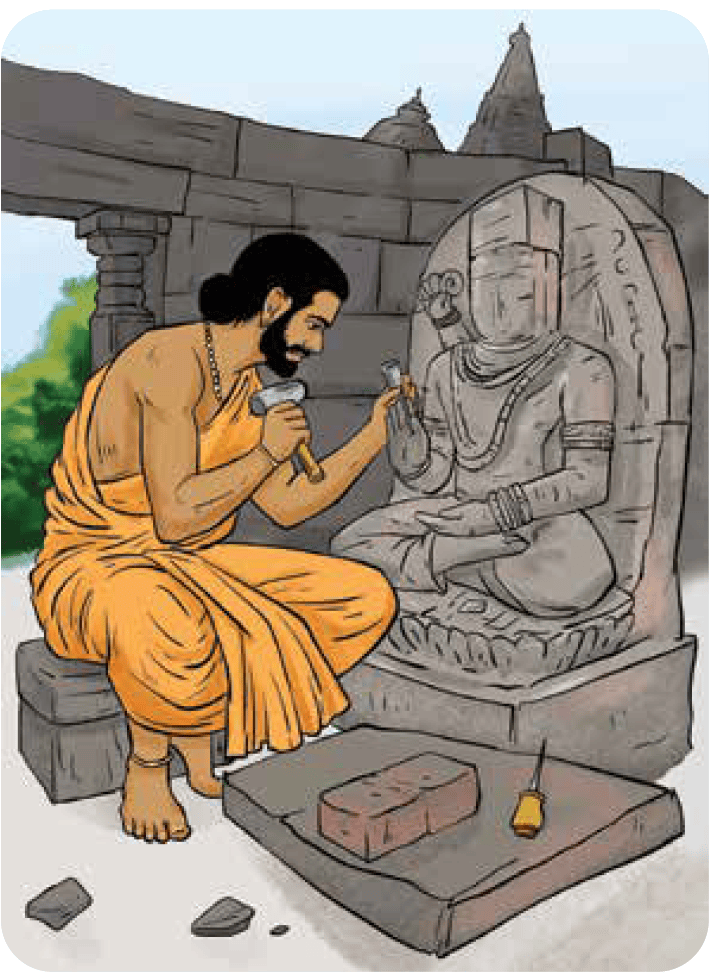
It was all possible only through the dedication, commitment and persistence of thousands of artists.
CIRCLE TIME
- Share more examples of pictures, paintings or other instances where you have seen emotions.
- If you were given the work of creating such a temple, how would you prepare for it?
- How much time would you spend practicing for it? Can you apply the same to your work in school?
KEY TAKEAWAYS — LESSONS FOR LIFE
Theatre and Life
Have you noticed how different people express emotions in different ways? While some may smile when they are nervous, others may become silent when sad. Theatre helps us understand these emotions and their ways of expression. This in turn helps in building better emotional understanding of others or empathy.
- As you play games like ‘Emotional Corners’ or ‘Hot Seat’ (in Grade 6), you learn that there is no ‘correct’ way to feel or express yourself. As you observe others in the game, you notice that different people not only express differently, but also perceive and experience situations differently! Your ability to understand and accept this will make you emotionally strong.
- These activities in theatre also help you understand that all emotions are equal. The stories you choose have situations of both humour and joy, as well as anger or jealousy. This is true in real life also. As the ancient scriptures and sculptures point out, it is important that we accept all emotions, and express them freely, without inhibitions. Just as theatre activities do not expect you to show only comic situations and leave out the unhappy ones, in life too, you must be able to experience, share and express all emotions equally. But, as in theatre, it is important not to over-do anything.
Theatre is not just about acting on stage. It is about feeling, growing and connecting with people in better ways. This is called emotional intelligence. Just like theatre, life is full of surprises. But with empathy, confidence and an open heart, you are ready to face anything!
ASSESSMENT
CHAPTER 1: UNDERSTANDING EMOTIONS
|
CG |
C |
Learning Outcomes |
Teacher |
Self |
|
1 |
1.1 |
Identifies and expresses action, expression, and dialogue in varying intensities of emotions |
||
|
1 |
1.1 |
Can identify and recall sculptures or artwork that show emotions in expression and action |
||
|
1 |
1.1, 1.2 |
Shows empathy in understanding and accepting the differences in how a situation is perceived by the classmates, and discusses on this |
||
|
1 |
1.2 |
Can build stories independently, connecting the various emotional levels and narrates it to class effectively |
||
|
1 |
1.2 |
Can distinguish Lokadharmi (realistic) and Natyadharmi (stylised) acting (in action and expression) |
Teacher’s Comments and Student’s Observations
...............
...............
...............