
Chapter - 2
Say more without Speech—MIME
“Mime as an art form speaks the universal language of silence. It can make the invisible become visible and make silence the most powerful and loudest form of communication.”
— Marcel Marceau (a well-known French mime artist)
Imagine a situation where you are at an important event and nobody is allowed to talk. You suddenly remember that you had kept your umbrella outside as you were waiting for your friend, before the event began. But forgot to bring it inside with you. You are in the middle of the hall and cannot walk outside. You have to tell your friend sitting near the entrance door to go out and bring it in for you. How would you communicate it?
Sit in pairs in the class and communicate this to each other. You can take turns doing this. If possible, you can also continue the conversation, for example, the friend replies by saying it is not possible to walk out. You request again, saying it is important—and so on. But all in silence!
What did you just do? Communicate using actions and expressions. Right? You just did a mime bit, that was miming!
You will learn
- What is mime?
- Basic features of mime.
- Advantages of mime.
- Preparing for a show.
Called Mukaabhinaya in India, let us first get familiar with the words used in this form of performance.
Here are some basic terms that you might be familiar with.
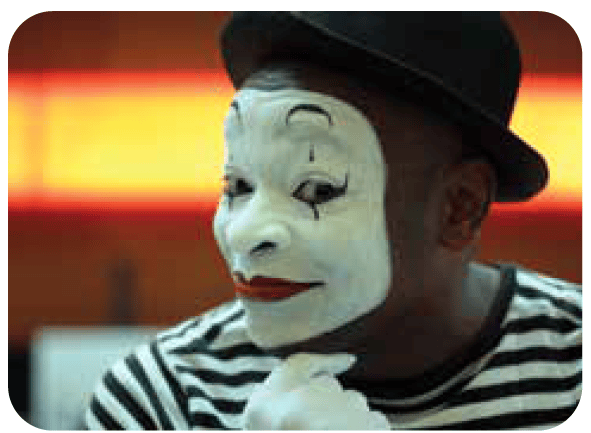
Facial Expression The emotion and reaction shown on the face
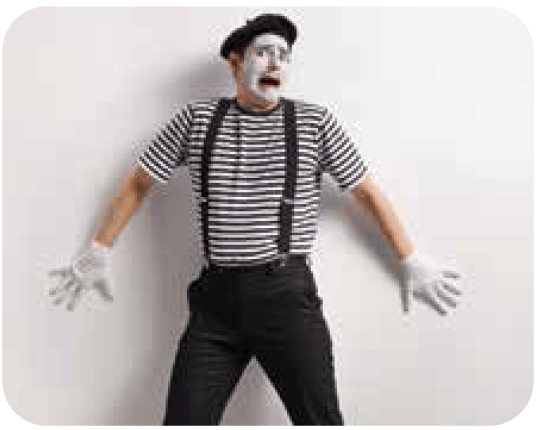
Body Language Hand gestures, body postures and actions made
Energy Intensity and focus behind each action
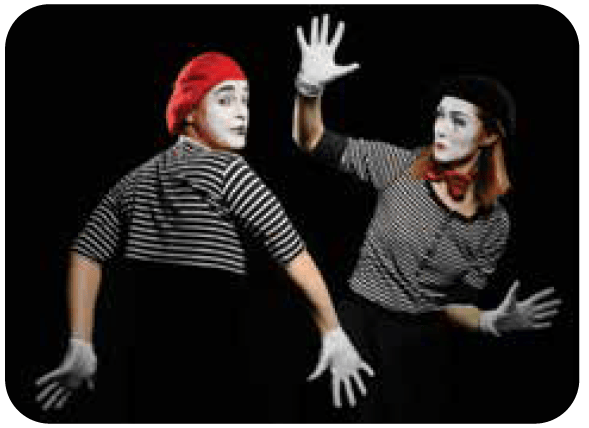
Technique-based terms
Mime: A form of acting that uses no words or sound. Could be a part of a bigger play with dialogues.
The person performing this is also called a ‘mime’.
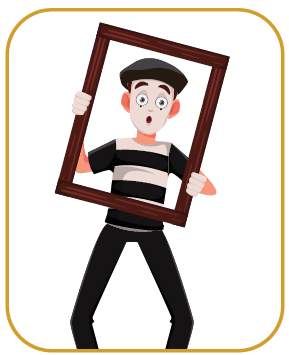
Pantomime: A theatrical performance that involves multiple actors and music. The show involves acting, mostly in comedy.

Interactive: Incorporating audience participation to make them ‘a part of the illusion’ for more impact.
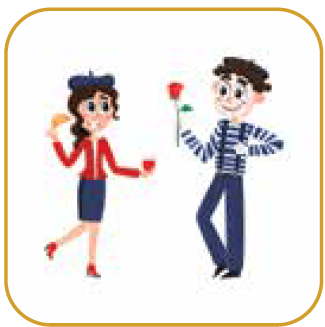
So let us jump right in and try doing some mime.
ACTIVITY 2.1: INDIVIDUAL ACTIVITY
Since mime is all about performing without using a specific set or props, first you have to learn how to create an imaginary world and convince the audience of its existence. Think of an object that you use every day, say your pencil box. Now pretend you are holding it in your hand. You have to remember the size and shape of it as you ‘mime’ its presence in your hand. Now, try and enact how you would hold the pencil box as if it is filled with iron (same size and shape). Now, imagine it is fully empty. How would you show these changes? Try different options to experience an object without touching it.
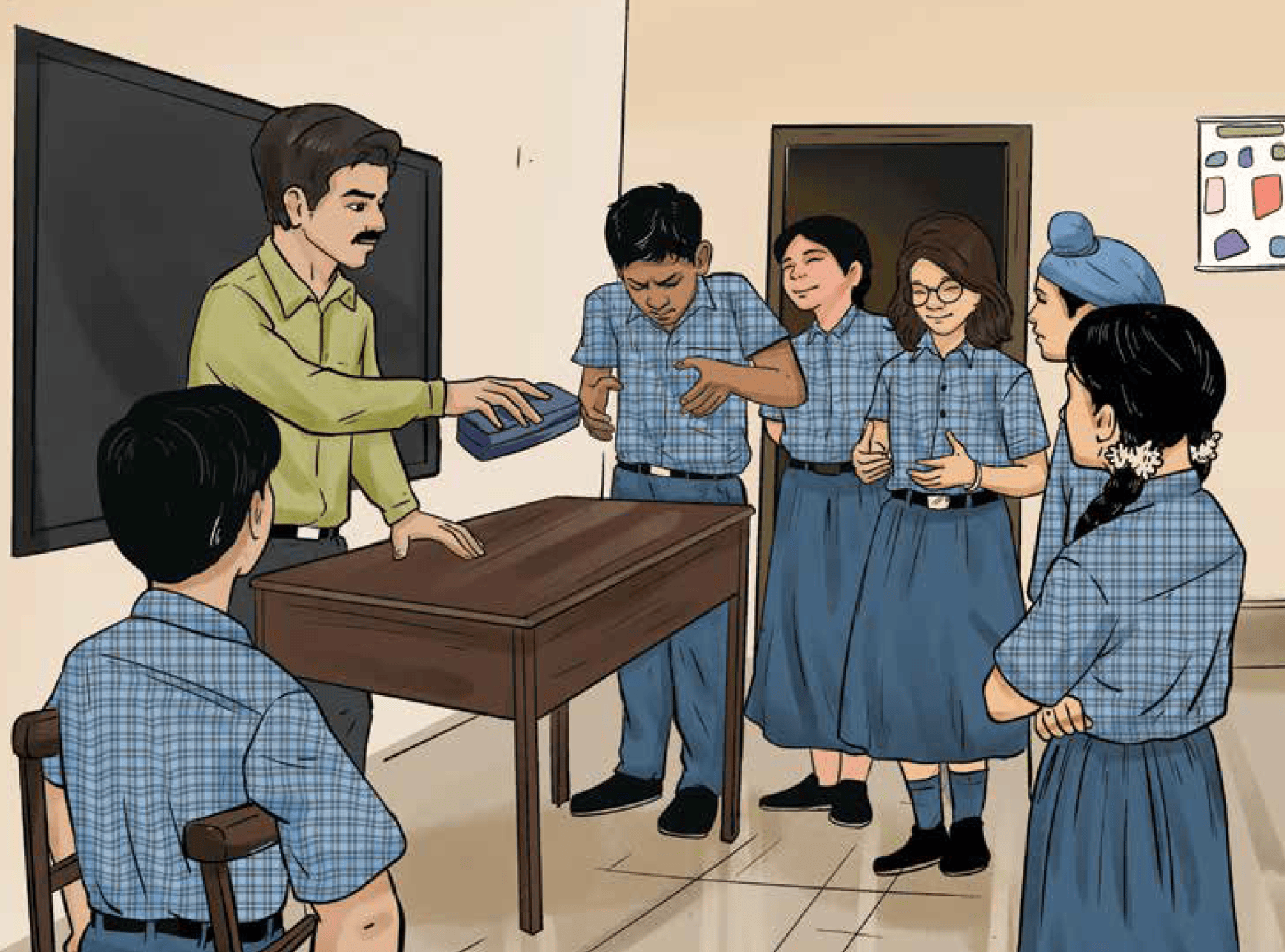
Now, before we actually begin mime work, here are some basic tips to help you.
1. DO NOT become the object, Use the object
This is a common mistake made while showing an object. You have to show how you hold the object and not make your hand into the object. Here are some examples—
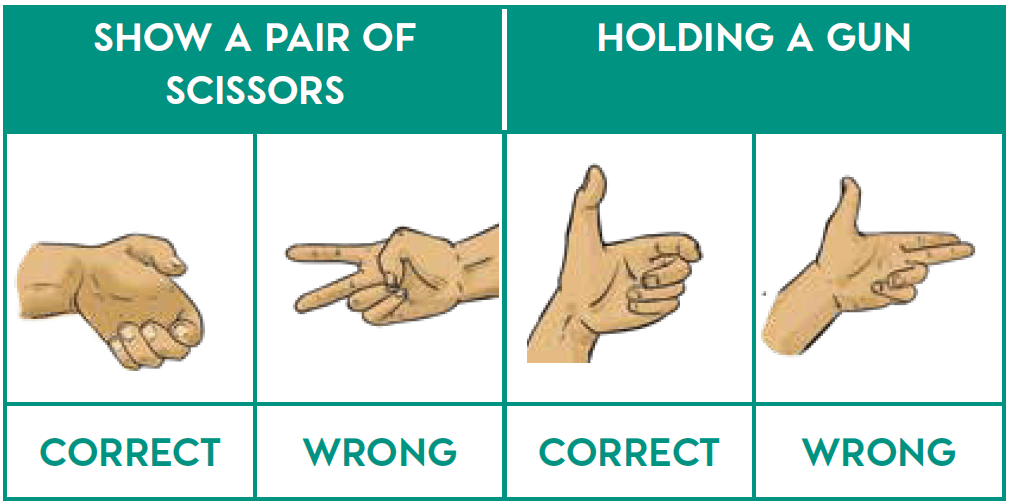
If you just pointed two fingers and moved them like a pair of scissors moved, then it is a mistake. If we can modify our fingers to create a gun, then how would we show a larger object? Say, a train or a car or a fridge? Hence, the first rule of mime is to use the object.
2. Establish the space (size) and weight of the object
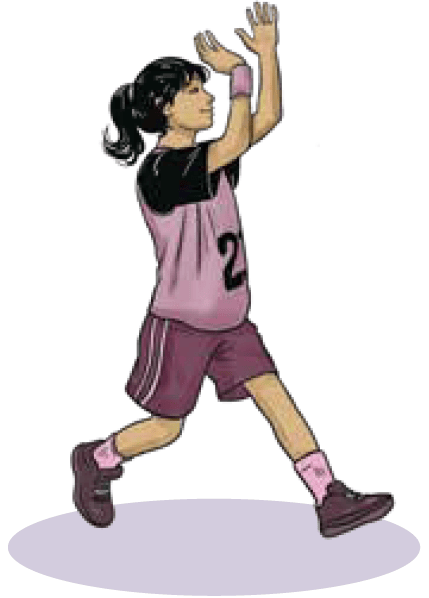
To make imaginary objects more believable, a mime has to ensure that the actions are in line with the quality of object they are handling. A cricket ball, a basketball, a balloon— the size, weight and the experience of each one is very different from the other.
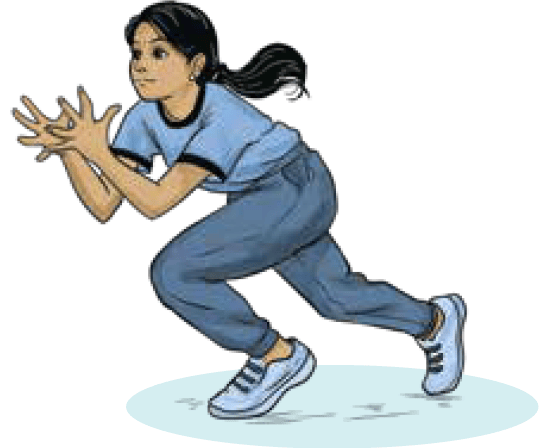
Try doing actions of holding each one separately. With this in mind, let us play a fun game to learn this better.
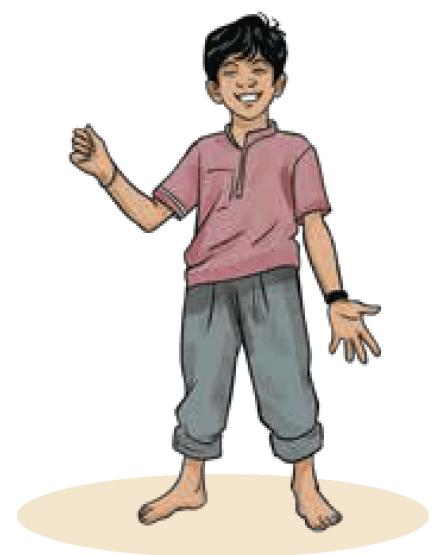
ACTIVITY 2.2: TEAM ACTIVITY (FULL CLASS)
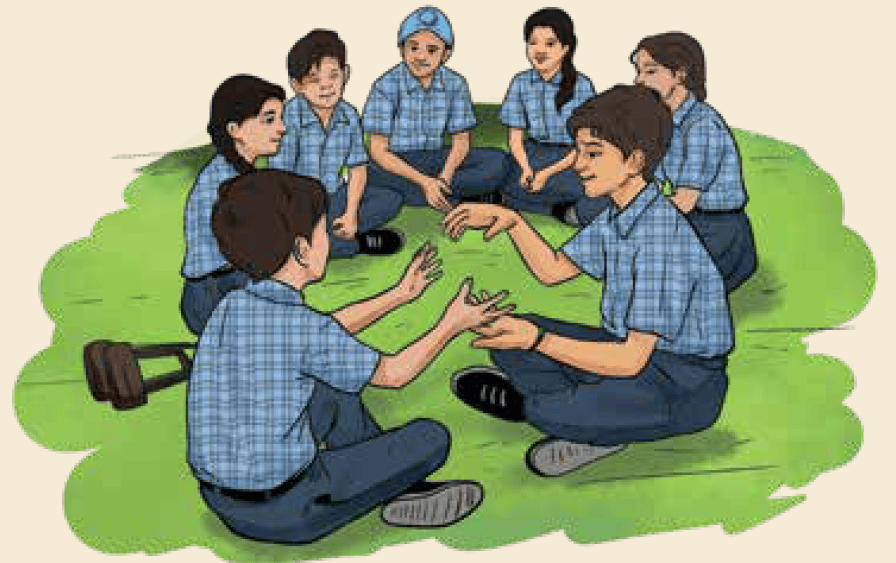
All of you sit in a circle. One of you volunteers to start with an imaginary object. The first person imagines an object, does an action to clearly depict it in terms of its shape, size and weight. The object is then passed on to the next one. Next person receives it, does another action to add to the understanding of the object and passes it on.
Nobody can use sound or speech. Nobody must announce the name of the object. It is upto the understanding of the students and each one’s ability to communicate.
Basic —Everyday objects like pen, a pair of scissors or a watch can be shown. When the object is received, each one of you does a unique action that is n o t done before and then passes it on.
Advanced —This also has everyone passing the object. But the object changes slightly with time. So, the action done by the first person would not be the same for the last person. For example, a huge ice cube (melts with time) or a handful of sand (keeps reducing in quantity as it slips through the fingers).
CIRCLE TIME
- What is the most enjoyable aspect of performing without speech or props?
- What is most difficult about performing mime? No use of speech or no use of props?
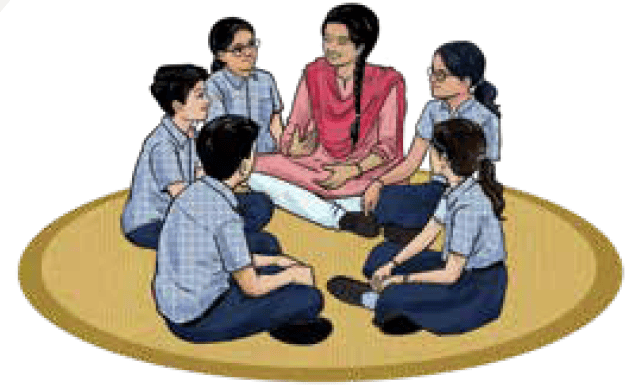
THREE PILLARS OF A MIME SHOW
Any successful mime show must have the following three aspects. Remember, all these have to be practiced both individually and as a group.
1. Imagination
For a mime show, along with working on your body language and expressions, the most crucial one is imagination. While the first two are entirely about the performer and their effort, imagination involves both performer and the audience.
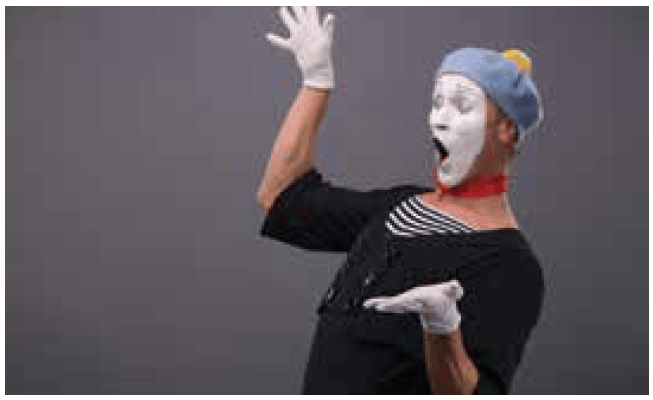
Unless the audience participates in the imagination of the objects, situations and the environment of the story, it cannot be a successful show. This ‘give and take’ between the audience and actor— making the show unique and enjoyable—is facilitated by imagination!
2. Exaggeration
This is the technique of making movement, actions and expressions larger than life. Since mime relies on silent communication, it becomes important to ensure subtle details are visible and understood. This is specifically important when performances are held for a large audience. This is similar to the Natyadharmi style of acting, from Chapter 1, which includes dramatic and stylised techniques like slow motion, repetition, and over expression to bring about this impact.

3. Costume and Make up
Unlike drama or dance, costume and make up in mime do not directly depict the character. It is primarily neutral, with subtle differences to show variation in character.

Costume—shirt and pant is fully black (if the backdrop is white) or a mix of black and white in the form of stripes on shirt or accessories like gloves, socks or suspenders.
Make up—highlighted facial features with contrasting colours of white, black and red is the main feature of make up. This is to ensure good visibility and exaggeration of expressions.
Character—specific indications are subtly present in make up.
MIME—A UNIVERSAL LANGUAGE FOR EQUALITY
The most striking quality of mime is—no speech. This breaks all barriers of language across the world. Emotions are universal. So the situations depicted in mime from any state in the country or any country in the world are understood by any person from any corner of the world. Is it not amazing?
The next quality that stands out in mime is—black and white costumes, and a common white make up for all. This has a powerful quality of eliminating the bias that comes with stereotypes of people based on the clothes they wear. It is pure story telling by people who could be from any society, from any part of the world. It can even break gender stereotypes, for example, a scene with mining underground or building construction could have women carrying loads of weight, as the costume they wear is the same in mime.
Mime is also used as a powerful tool to help people come out of their trauma or get over bad experiences, as it gives them the freedom to express and share without the fear of being judged.
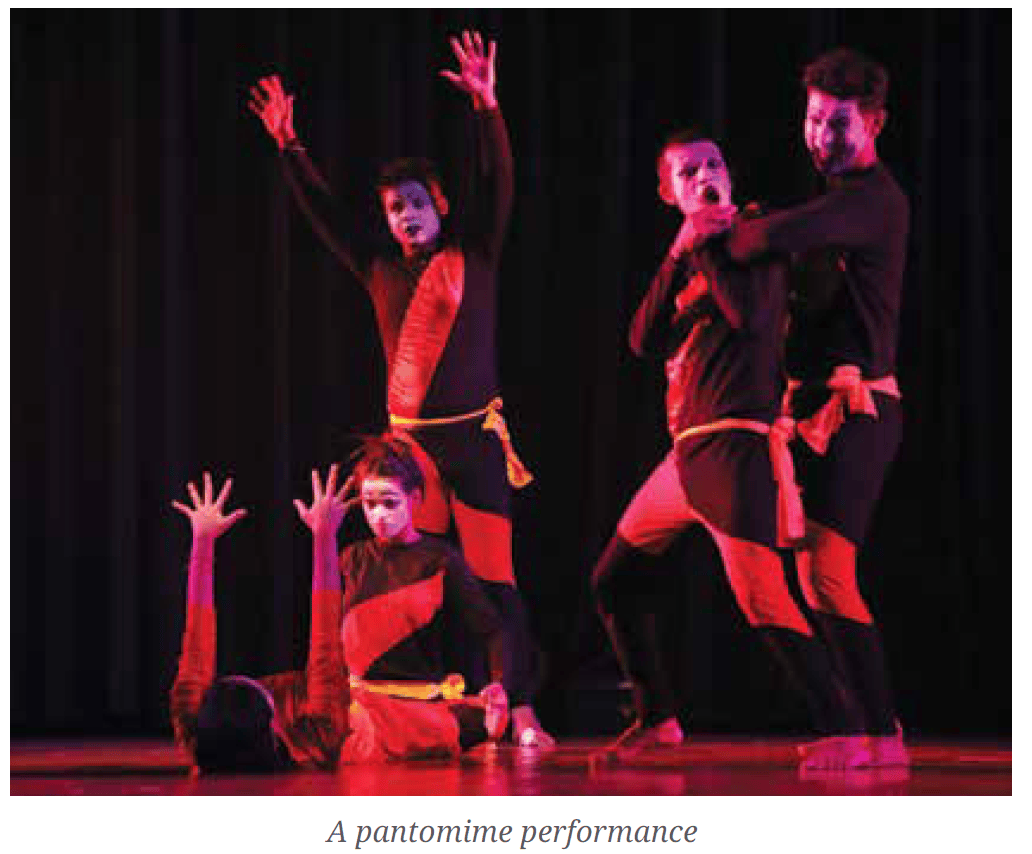
A pantomime performance
ACTIVITY 2.3: GROUP MIME
The class is divided into groups of 5– 10. You will be given a scene to enact. You can use all the properties and sets that are necessary for the scene. Enact it like a regular play by your group.
Now, your team has to mark the set placements in your minds and remove the chairs, tables, etc. You now enact the whole scene without any sets. The props (held in your hand like walking stick, bow and arrow, etc.) can still be used. Once you are familiar with the sets, the props are also removed. Enact the whole scene without any sets or props.
Practise—perform your daily routine from when you wake up in the morning till you get to bed at night, in mime. Try and remember the minor details and depict it in your actions.
Music—you can have background music to suit the situation of your act. But make sure it is instrumental music with no lyrics or speech.
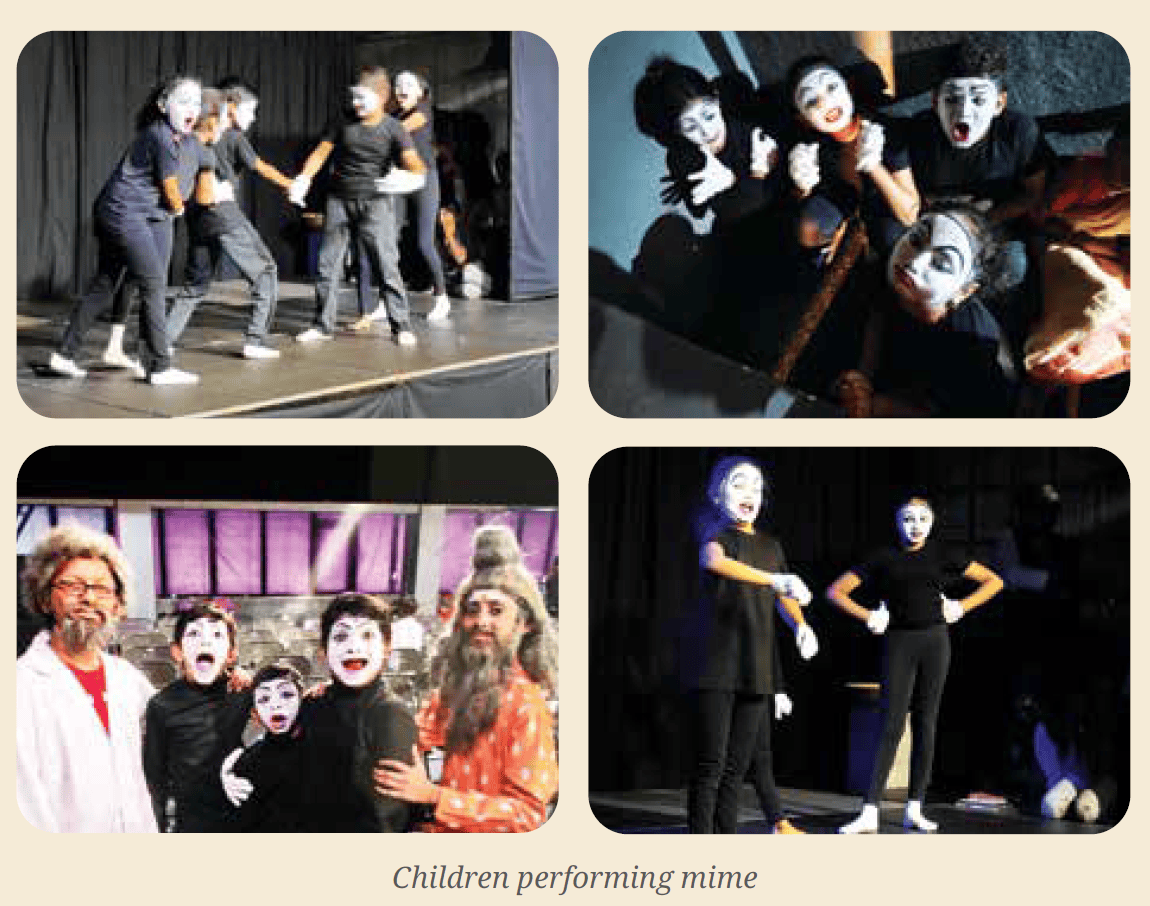
Children performing mime
Note to the Teacher:
The scene they pick for enactment can be their own creation or any familiar scene. Encourage the groups to come up with scenes and situations that break stereotypes or promote inclusivity among them.
Brain Booster
Make up Magic: Create a Mime!
- Make teams of two.
- Try to show expressions for these situations.
- Look at your friend’s face and draw their expression in the space given. Observe and note the details of eyebrows, forehead, cheeks and eyes.
- Discuss how you can exaggerate more and improve on the expression.
- Try enacting the situation with the entire body. How do your actions help in communicating better?
- Make a small story around it and enact it with your friends.

Opening a stuck jar lid
Lifting a heavy suitcase
Eating a sour lemon
Pulling a heavy rope
ASSESSMENT
CHAPTER 2: SAY MORE WITHOUT SPEECH — MIME
|
CG |
C |
Learning Outcomes |
Teacher |
Self |
|
2 |
2.1 |
Understands the uniqueness of mime and its difference and similarities with drama |
||
|
2 |
2.2 |
Can visualise objects accurately in shape, size and weight, and use it in performance |
||
|
2 |
2.3 |
Can bring in stories from personal experience to interpret in mime |
||
|
2 |
2.4 |
Uses the advantages of mime and its universality to perform on themes based on inclusivity or breaking gender stereotypes |
||
|
2 |
2.5 |
Can put together group performance integrating music and humour |
Teacher’s Comments and Student’s Observations
...............
...............
...............