MUSIC
Hello musicians! Let us embark on an exciting year of learning and making music.
SOME COMMON MUSICAL TERMS
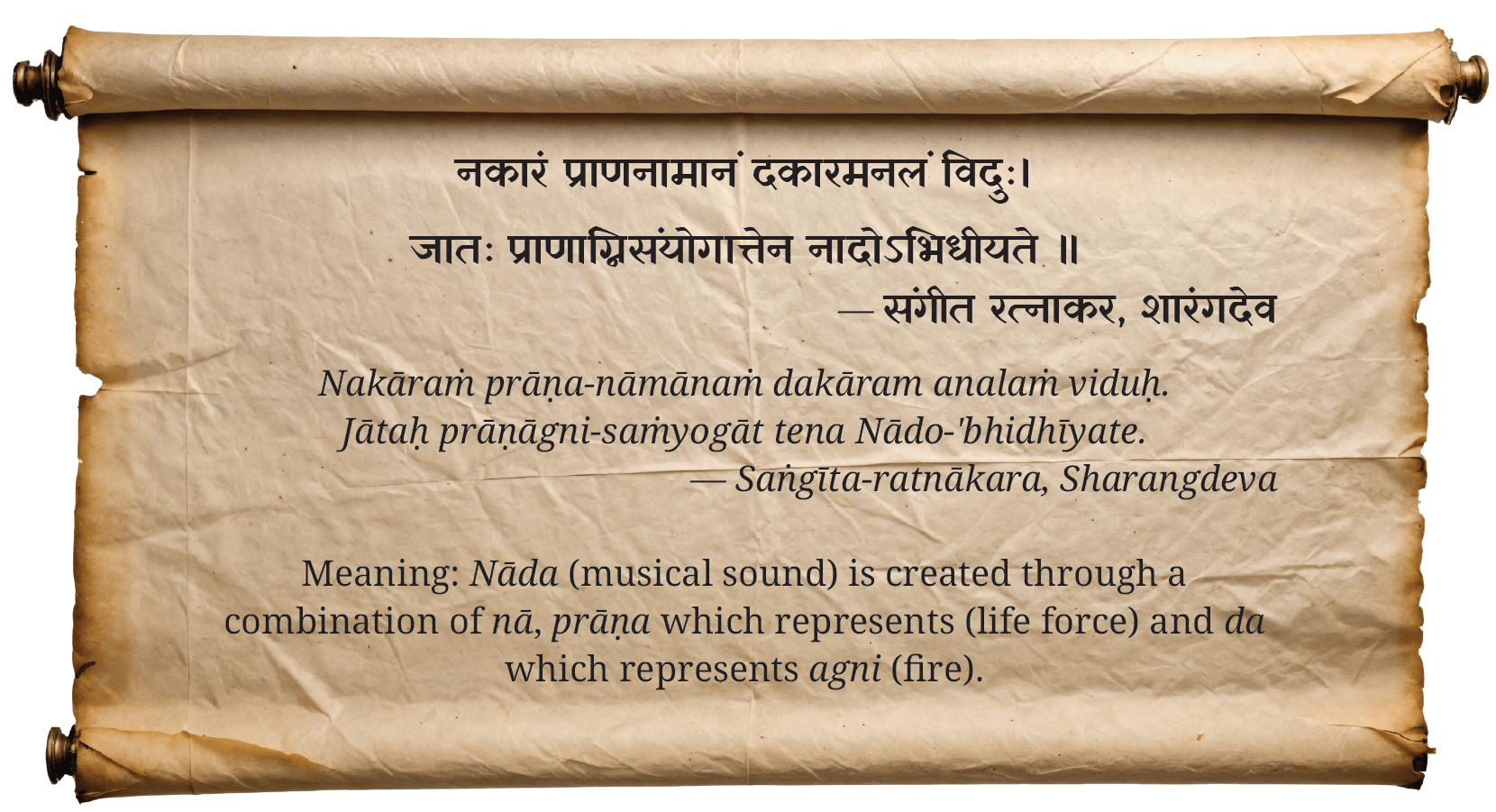
Aadhara Shruti/Aadhar Swar
The base note according to which music is played or sung.
Swara
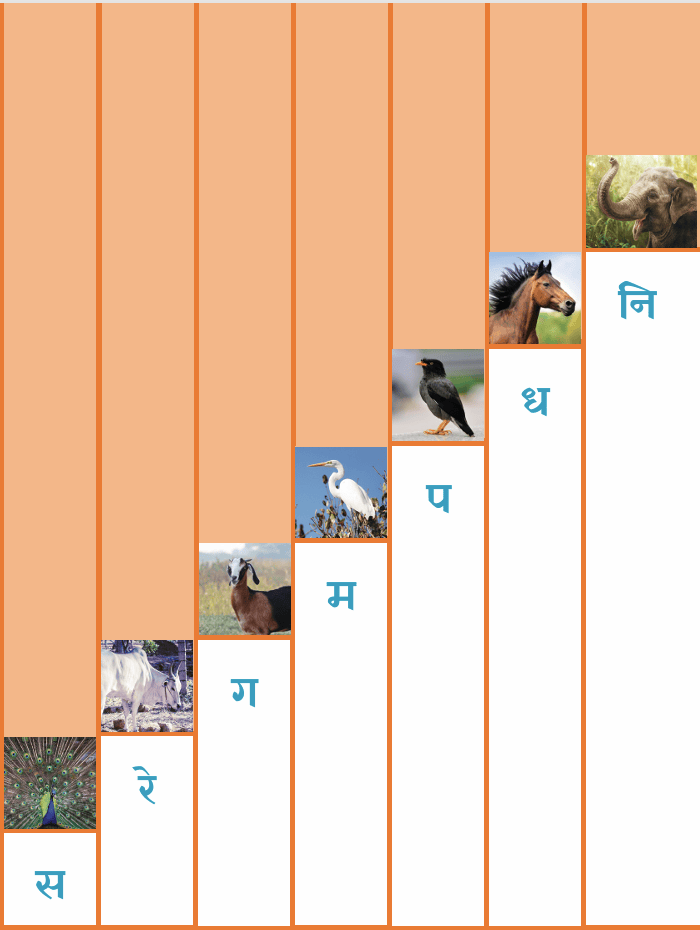
A note in music. There are seven notes in Indian music — Sa Ri/Re Ga Ma Pa Dha Ni.
Raga
A group of notes that come together as per certain rules to create a melody.
Tala/Taal
A rhythm cycle, comprising a number of beats.
Laya
Tempo or speed. It can vary from slow to fast.
Aroh/Arohana
The ascending scale of a raga.
Avroh/Avarohana
The descending scale of a raga.
Sargam
A pattern of notes.
NOTE TO THE TEACHERS
The world of music is all about sur, laya and shabd. These elements are woven to express lyrical compositions which express myriad emotions of love, devotion, patriotism, chivalry, appreciation of nature, grief, etc. Music is boundless and is popular among the people of all ages. A crowded and noisy assembly of children in a school suddenly echoes with melody and harmony of musical expression in a peaceful manner. The music curriculum aspires that you and the students thoroughly enjoy the journey of music which has the capacity to unfold immense possibilities. The teachers should aim to instil a lifelong love for music among the learners, fostering a deep appreciation that will grow beyond the classroom. Also, the syllabus of Grade 7 aims to enable students to gain deeper insights to unfold multiple aspects connected to this popular and ever engaging art form.
This section unfolds to let the learners know the different stages of making music. Music has layers, which comprise varied forms of expression through moderation in voices, pitch, tempo, parts of musical instruments, orchestration, and many other elements. A critical review of the songs will help the learners comprehend the varied factors that contribute to creating a composition.
All compositions sung on different occasions are significant. Music can be a resource to propagate many types of messages in a society including — importance of varied occupations and skills, social reforms, health-related issues, etc. It is related to dance and movement, playback music in theatre, film-making, etc. The ‘music’ section will help the learners unravel such aspects.
Examples of some basic skills of practising sargams, traditional folk and classical forms of music have been given. While the teachers should stick to the curriculum and basic guidelines, they have the liberty to introduce the topics in their own way. Also, let the students research and find out more from the sources available to them.
There are many opportunities to experience different genres of music in everyday life. Enthusiastic participation will help them love the art form genuinely and discover the diversity in the Indian context. This book aims to motivate students to appreciate music.
- Consider taking students to live musical performances for exposure.
- Invite a musician to your school and interact with the artist.
There are guidelines for Formative Assessments at the end of each chapter, which should be conducted in a relaxed and engaged manner, and mainly through observation in the classroom. The suggestions for Summative Assessments are provided at the end of the music section. The competencies required to be fulfilled at this stage are given below. The aim of assessments is mainly to see whether children are able to reach the competencies laid out, or whether more support is needed. Give children qualitative feedback to help them develop further.
CG-1 Develops openness to explore and express themselves through various art forms.
C-1.1 Expresses confidently, their personal and everyday-life experiences through a variety of musical activities.
C-1.2 Demonstrates flexibility in the process of collaboratively developing music practices.
CG-2 Applies their imagination and creativity to explore alternative ideas through arts.
C-2.1 Creates and performs songs and musical compositions that challenge stereotypes observed in their surroundings (such as gender roles).
C-2.2 Connects elements of music (lyrics, raagas, rhythms, volume, tempo and patterns) with personal experiences, emotions, and imaginations.
CG-3 Understands and applies artistic elements, processes, and techniques.
C-3.1 Demonstrates stage etiquette and care for musical instruments and makes informed choices while using resources and techniques in music.
C-3.2 Refines ideas and methods of musical expression from the stage of planning to the final performance, and reviews the entire process.
CG-4 Acquaints themselves with a range of aesthetic sensibilities in regional arts and cultural practices.
C-4.1 Demonstrates familiarity with various local and regional forms of music.
C-4.2 Describes the life and work of a few local musicians and performers in their region and across India.

Chapter - 5
MAKING MUSIC
Let us start by singing a popular song together. Here are some suggestions:
1. Barso re megha megha
2. Bharat humko jaan se pyaara hai
3. Aa chalke tujhe main lekey chaloon
4. Zindagi ek safar hai suhana
5. O palan haarey nirgun aur nyaare
Note to the Teacher:
The above film songs are suggestions. However, you are free to choose other suitable and age-appropriate songs for this activity.
There are many elements that contribute to making music. When you listen to music, think about how it is created or made. Focus on —
- Vocals
- Musical instruments
- Melody
- Harmony
- Lyrics
All the different types of sounds you hear in a song are called layers. Can you hear different drum beats, various instruments, voices? All of these are layers and they have their own role in a song.
- What are the layers you can hear?
- Have you noticed how different styles of music have a variety of sounds and instruments?
- What are the layers you hear in a film song?
- What are the layers you hear in a devotional song?
ACTIVITY 5.1: EXPLORING SONGS
Students, make four groups in your class and give musical names to each group. Choose three different songs of different styles that you like listening to. Fill in this template for each of them, and discuss similarities and differences with your classmates.
Title of the song: ________
Year of release: ________
Theme: ________
Form/Style/Genre: ________
Artist(s): ________
Composer: ________
Lyricist: ________
Musical elements — voice, instruments, pitch and tempo
- Has the song been sung in a male voice or a female voice or is it a duet?
- What are the instruments you can hear?
- What is the tempo of this song? Is it fast or slow? Does it change during the song?
- Is it mostly in a high, medium or low pitch? Does it change during the song?
Mood — emotions (rasa) and theme
- What is the mood of the song?
- What do you like about the song?
- Would you like to change the mood of the song? How?
- Is the arrangement heavy (with lots of instruments and beats) or light?
- How many layers and different lines can you hear at the same time?
ACTIVITY 5.2: MEASURE YOUR ACCURACY
- Sing a song that you are comfortable singing.
- You can use a karaoke track if you have one.
- Record yourself singing and listen back — see where you are in pitch and rhythm, and where you are not.
- Compare your version to the original audio and note the areas of improvement.
- Identify someone else (like a classmate, friend, teacher or family member) listen and give you a constructive feedback.
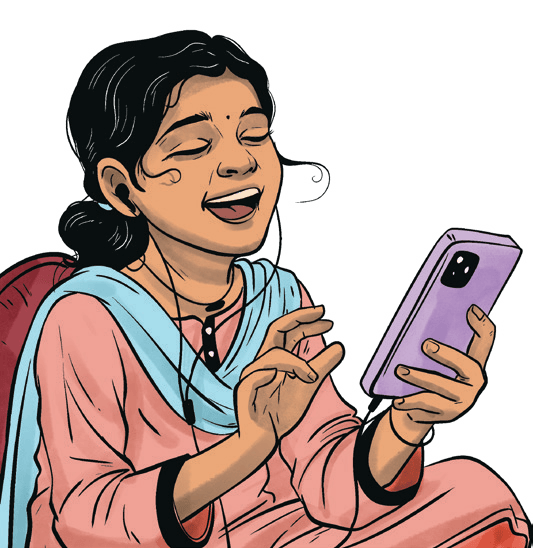
Use this information to improve your performance.
Note to the Teacher:
This activity can be done as an individual or group activity. Students can record their voices and either assess it themselves or ask for peer assessment.
MAKING MUSIC TOGETHER
Harmony and Canon
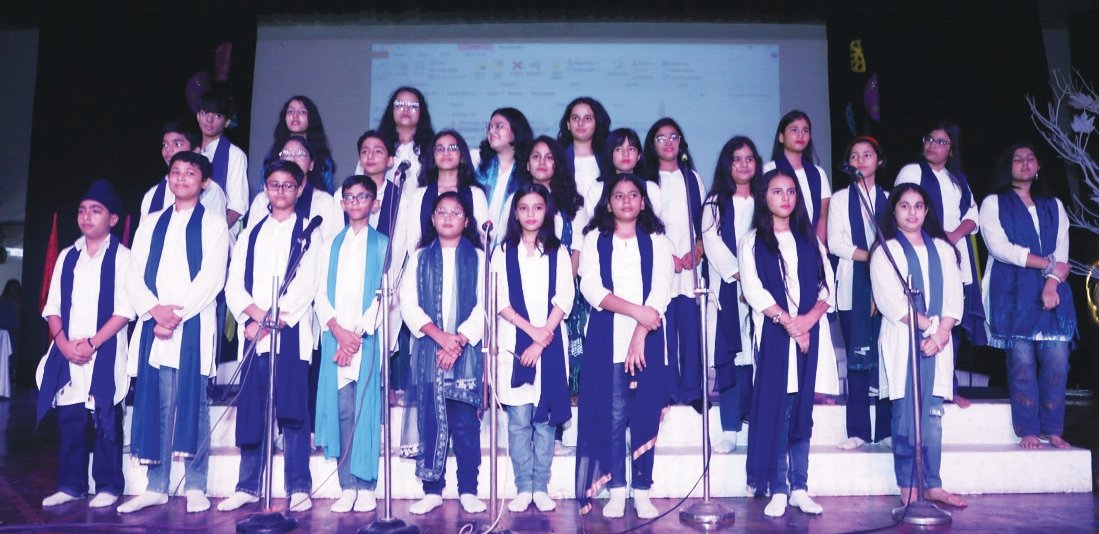
When you hear multiple voices of people singing together, creating a pleasing blend of different notes, it is called singing in harmony. Harmony is common in many styles of music, both instrumental and vocal.
There is an easy way to start singing in harmony, and that is, by singing a canon. A canon is where different groups of singers sing the same melody but start at different times. Songs that are written as canons, are written so that the different notes you hear at the same time, sound good together.
You can select any patriotic song, folk song, for example —
- Kuṭṭanaḍan punjayile kochu peṇṇe kuyilale (you learnt in Grade 6)
- Hum honge kaamyaab (you learnt in Grade 3)
First, sing the song together. Remember to keep time, so you are all singing together. Then divide the class into two groups.
Group 1: Hum Honge Kamyaab (2)
Group 1: Hum Honge Kamyaab ek din
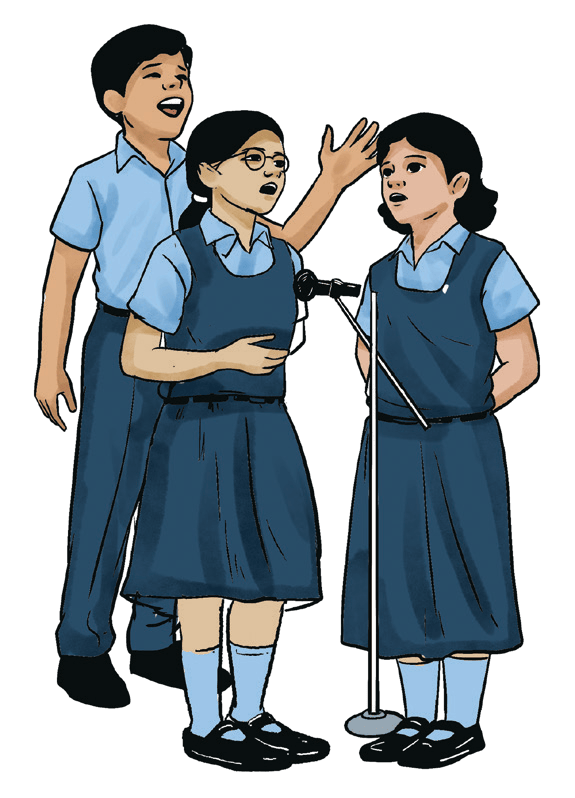
Group 2: Hum Honge Kamyaab ek din
Group 2: Hum Honge Kamyaab (2)
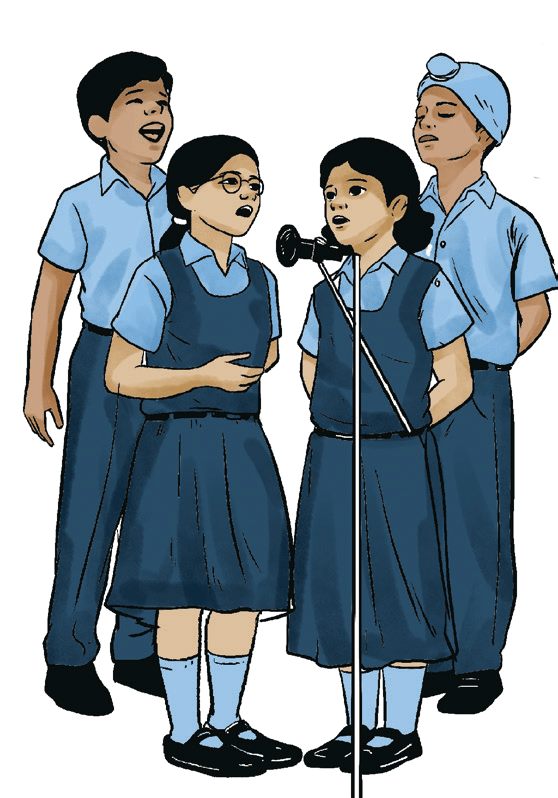
Group 1 sings the first line, and continues to the second line.
When Group 1 starts the third line, Group 2 starts singing the first line. Repeat the song a few times, so that you can hear all the harmonies.
If this feels easy, try making four groups! Group 1 starts with the first line, and when they sing the second line, Group 2 starts with the first line and so on. How does it sound when everyone is singing together?
MUSIC AS TEAMWORK
This era was a time imbued with deep spiritual and musical traditions. As the first rays of dawn painted the horizon, a team of Vedic priests — Ritvijs, guardians of the sacred hymns, from the four Vedas, assembled in the morning with the institutor, Yajamāna and his wife — Yajamāna-patnī, in the Yāga-śhālā, to begin the sacred Vedic fire ceremony — the Śhrauta-Yajña.
Amongst this team of ritvijs, there is a unique sub-team of four ritvijs specialised in the Sāma-Vēda. They are led by the main Sāma-Vēdī-Ritvij — the Udgātā, and together they are known as the Udgātṛi Gaṇa. Alongside the Sāma-Vēda, they are highly skilled in devotional music, both singing and playing traditional musical instruments. They harmonize verses from Sāma-Vēda Saṁhitā, the divine texts that form the cornerstone of Vedic ceremonies. In the Yāga-śhālā, facing East (the direction of the rising sun) — an eternal symbol of divinity and renewal — the Sāma-Vēdī-Ritvijs divided themselves into distinct roles. Each role contributes to the intricate structure and harmonious nature of Sāma-Vēda chanting known as Sāma-gāna. The singing of the Sāma-gāna composition is generally divided into five sections called bhaktis.
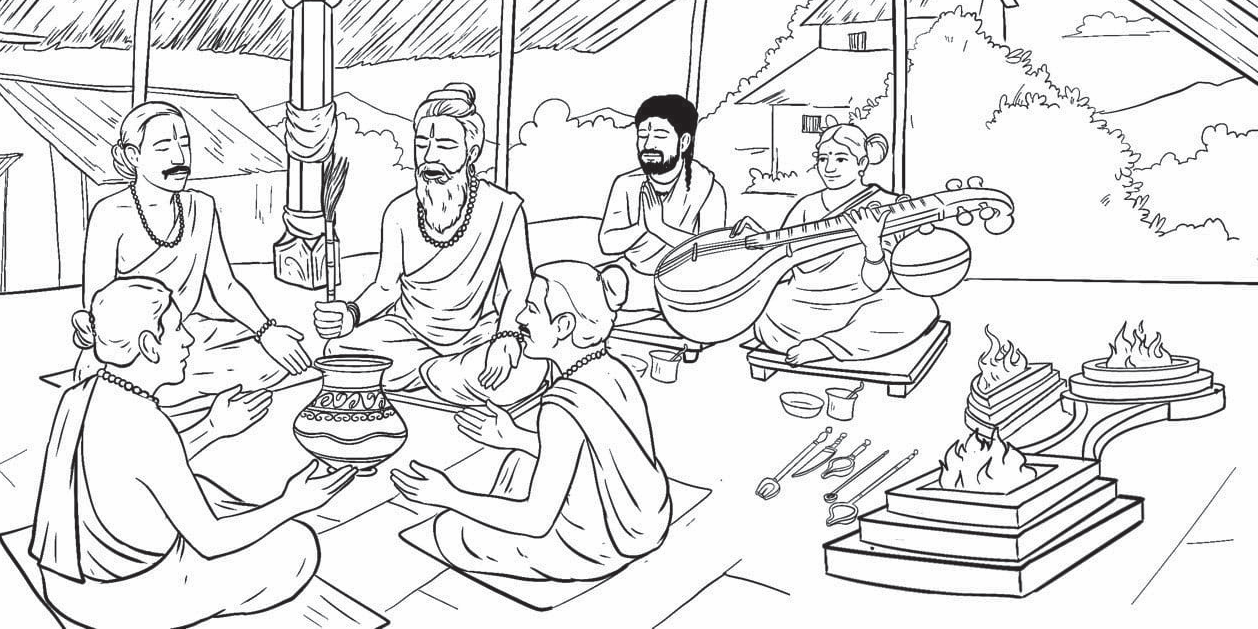
1. Prastāva: The introduction of the composition is initiated by the Prastotā.
2. Udgītha: The primary section, which forms the core of the Sāma-gāna recitations, and is sung by the head Ritvij Udgātā.
3. Pratihāra: It is sung by continuing from the last line of the Udgītha, by the Pratihartā.
4. Upadrava: The connective musical interlude, i.e., the instruments and the rhythmic interpretations, which is again rendered by the Udgātā.
5. Nidhana: The concluding section, it is sung in unison by all ritvijs, creating a profound and unified culmination.
In addition, the fourth Sāma-Vēdī Ritvij — Subrahmaṇya — has the specific duty of chanting the Subrahmaṇyāhvāna. Alongside, the Yajamāna-patnī plays an important role by playing the Śhatatantrī Vīṇā, during the Sāma-gāna and also singing important sections of the Sāma-gāna.
This morning ritual was far more than a musical exercise; it was a spiritual offering, a harmonious bridge between humanity and divinity. The symphony of voices and the disciplined roles of the ritvijs exemplified the Vedic pursuit of unity in diversity, reflecting the profound connection between sound, spirituality, and nature.
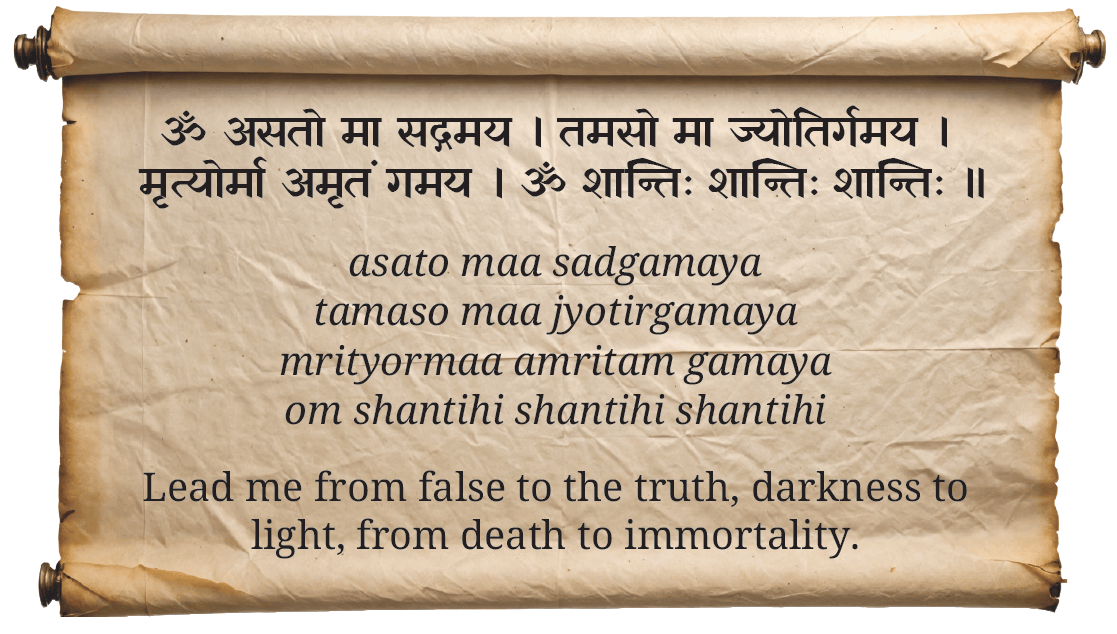
ACTIVITY 5.3: CHANT SHLOKAS IN A GROUP
Important concepts: Layers, harmony, canon, chanting, ritvij, upagayak
ASSESSMENT
CHAPTER 5: MAKING MUSIC
|
CG |
C |
Learning Outcomes |
Teacher |
Self |
|
1 |
1.1 |
Participates in chanting shlokas with clear enunciation and coordination |
||
|
1 |
1.2 |
Understands the concept of a canon, and is able to participate in singing a simple canon |
||
|
1 |
2.2 |
Is able to analyse a song of their choice and identify its musical elements |
Teacher’s Comments and Student’s Observations
...............
...............
...............