
Chapter - 6
MUSIC, EMOTIONS AND CREATIVITY
Music expresses various emotions (rasas). When you sing or play music, you are communicating a feeling or an emotion. In the Indian performing arts, emotions are referred to as rasas. This emotion is simultaneously experienced by the artists and audience. It is this emotion that connects the artists with the audience. So, always remember to sing with passion and expression. Let us continue this journey of learning various forms of music and the rasas they express.
The Abhinaya Darpana written by Nandikeshvara says, ‘sabha kalpataru bhaati’ which means, the audience is like a tree which fulfills your inner wishes. Though this has been written in the context of dance, it applies to all art forms.
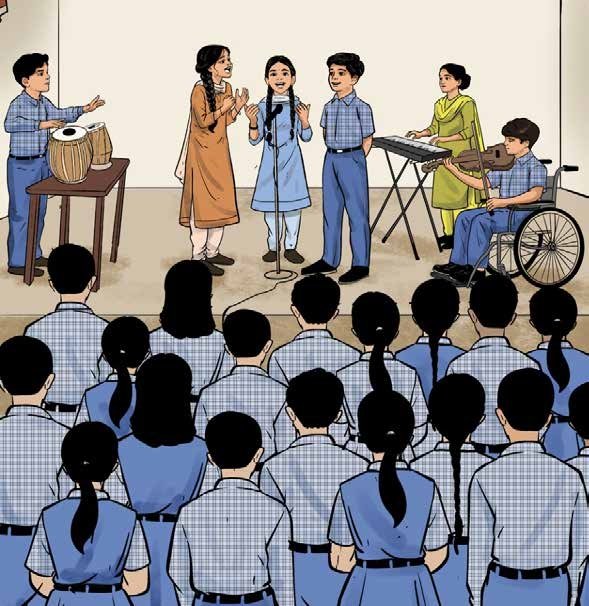
DEVOTIONAL MUSIC
People pray in different ways. Music allows people to express the feeling of devotion. People often come together in groups and sing devotional songs, in different styles of singing, using a variety of words, tunes and rhythms. Let us understand how the words, tune and rhythm come together when we sing a devotional song.
Here are some examples.
Shabad — Shabads are musical prayers in the Sikh religion and are sung in the Gurudwara. Let us learn this song.
koi boley raam raam koi khudaye
koi sevai gosayya koi alaahey
kaaran karan karan kareem,
kirapaa dhaar raheem ||1||
koi naaveye teerthh koi haj jaye ||
koi karey poojaa koi sir navaaey ||2||
koi padey ved koi kataeb
koi odey neel koi supedh ||3||
koi kahe turk koi kahey hindu
koi baanchey bisth koi seer bindu ||4||
kahey naanak jin hukam pachhataa
prabh saaheb kaa teen bhed jaataa ||5||
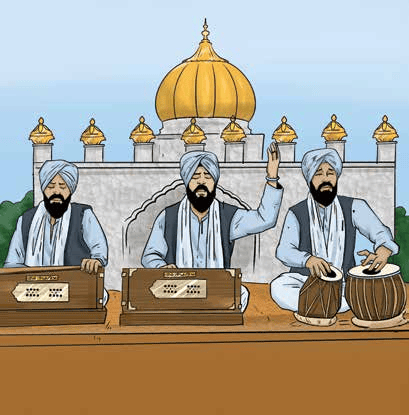
Shabad Kirtan in progress in a Gurudwara
Meaning
We pray with different names, such as Rama, Guru, Allah and others, the aim is to thank the almighty for giving us such a beautiful world.
Urdu song
This is a devotional and patriotic song in Urdu.
Lab Pe Aati Hai Dua Ban Ke Tamanna Meri
Zindagi shamma ki surat ho, khuda ya meri
Lab pe pati pai dua ban ke tamanna meri
ho mere dum se yun hi mere watan ki zeenat
Jis tarah phool se hoti hai chaman ki zeenat
Zindagi ho meri parwaane ki surat ya rab
Ilm ki shamma se ho mujh ko muhabbat ya rab
Ho mera kaam gareebon ki himaayat karna
Dardmandon se, zayifon se muhabbat karna
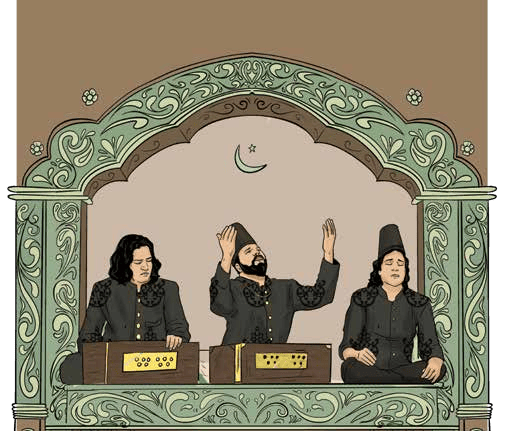
Meaning
I carry a wish in my heart with words on my lips to enable life to shine brightly for everyone, like a guiding light. May my work have the power to uplift the lives of the less fortunate, just as flowers bring beauty to nature. My duties should be able to enhance the lives of others. Let life be marked by care and compassion, and let my purpose be to offer a beacon of hope to my companions.
ACTIVITY 6.1
For the devotional song that you have learnt, think about—
- What is the emotion in the song that you have sung?
- What is the language in which it is sung?
- Make a note of the important words in the song and understand their meaning. This is a great way to increase your vocabulary in a language.
Note to the Teacher:
Students can learn one or both songs, or choose devotional songs from their own culture or faith.
CREATIVITY AND STORYTELLING
ACTIVITY 6.2: UNDERSTANDING A PAINTING THROUGH MUSIC
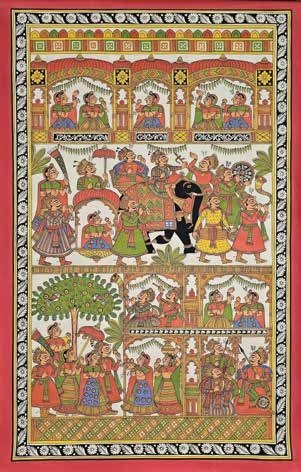
Phad painting by Prakash Joshi
Look at the picture on your left —
- Observe it carefully. Based on the style of this painting, can you identify the state or region it is from?
- Create two lines which will describe the plates one by one. It can be in your native language. The lines should be rhythmic and easy to sing. For example, “Dekho dekho sakhi dwar pe suj sanwar kay kaun khada”.
- Sing it in groups and observe the next plate.
- Continue creating lines according to visual images and sing the whole composition.
- You can work in groups.
- As you create and sing lines in a particular tune and rhythm, you will find the exercise interesting. Document and record the entire process and you will be able to understand how words and music work together to evoke emotions.
Note to the Teacher:
- This painting is provided as a reference.
- You can select any painting of your choice or from your region.
- In the activity, use music as a way to explore the themes in the painting.
- Try to see some ragamala paintings exhibited in various museums.
ACTIVITY 6.3: MUSICAL NARRATIVE
- Choose a topic from the history section of your Social Science textbook. Here are some choices:
- Write a paragraph that describes any story related to the empire of the rulers.
- Draw a picture to illustrate the story.
- Describe the scene in a few sentences using any language you like.
- Sing the lines you have written in a tune of your choice. Wonderful! This is how musicals and musical storytelling is created.
- There are many forms of musical storytelling in India, including Powada, Kaavad Katha, Alha-Udal and others. You can research and read more about them.
- Connect this with other art forms you have been learning and share your experience.
1.Chandragupta Maurya and Kautilya
2. Prabhavati Gupta
3. Chandragupta II, Vikramaditya and his nine jewels
4. Prithviraj Chauhan
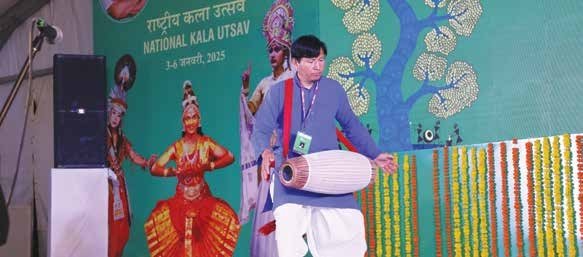
Sobha Mani playing the Nata Pung
Note to the Teacher:
“Art integration is a cross-curricular pedagogical approach that utilises various aspects and forms of art and culture as the basis for learning concepts across subjects. As a part of the thrust on experiential learning, art-integrated education will be embedded in classroom transactions not only for creating joyful classrooms but also for imbibing the Indian ethos through integration of Indian art and culture in the teaching and learning process at every level. This art-integrated approach will strengthen the linkages between education and culture.” [NEP 2020, 4.7]
Plan this session as per the above directive. Let it be a collaboration with the History lesson, so that the students imbibe the artistic traditions prevalent in the country and link it with other curricular areas.
ACTIVITY 6.4: ACTIVE LISTENING
‘Active listening’ is a term used when you listen to something carefully and try to understand it. Active listening is very important in music. The more you listen to a wide range of music, the more you start to pick up on different styles, structures, and techniques that you might not notice at first. It opens up your ear to different genres, rhythms, or even nuances in production that you would not have recognised otherwise.
- Actively listen to a folk, tribal, modern or contemporary song of your choice, or from a list provided by your teacher.
- Explore how the lyrics and the tune tell a story.
- What are the moods and emotions of the lyrics and the tune?
- Now try the same activity with a piece of instrumental music.
- What are the differences you notice in the mood and emotions?
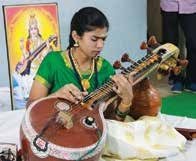
An artist playing the Veena
ACTIVITY 6.5: ACT IT OUT
- Listen to an instrumental musical piece or background music from a film.
- Take turns to analyse and interpret the piece of music.
- What are the emotions that you can recognise?
- Try to enact the expressions in different compositions.
- Feel free to use elements that you have learned in Theatre and Dance to communicate the emotions and story of the music.
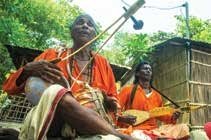
An artist playing the Ektara
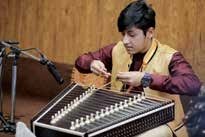
An artist playing the Santoor
Note to the Teacher:
For this activity, you can use an instrumental music piece from albums by Shakti, Pandit Ravi Shankar, Dr L Subramaniam or folk orchestras from different states.
ASSESSMENT
CHAPTER 6: MUSIC, EMOTIONS AND CREATIVITY
|
CG |
C |
Learning Outcomes |
Teacher |
Self |
|
1 |
1.2 |
Is able to understand storytelling through lyrics and music |
||
|
1 |
1.2 |
Is able to creatively act out the emotions expressed in a piece of music |
||
|
2 |
2.1 |
Is eager to learn new songs and forms of music |
||
|
2 |
2.2 |
Is able to interpret a painting in words and stories |
||
|
3 |
3.1 |
Understands and articulates the various roles of music |
Teacher’s Comments and Student’s Observations
...............
...............
...............