Chapter - 7
Ragas and Talas/Taal
Every year, we build on our understanding of both styles of Indian Classical Music — Carnatic and Hindustani. This year, we will explore more compositions, Ragas and Talas/Taals. See how you can draw connections between the two styles of classical music, and between classical music and other styles of music that you listen to.
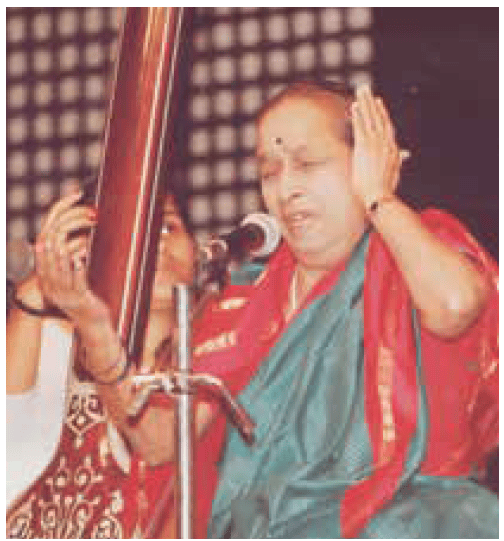
Gangubai Hangal
DO YOU KNOW?
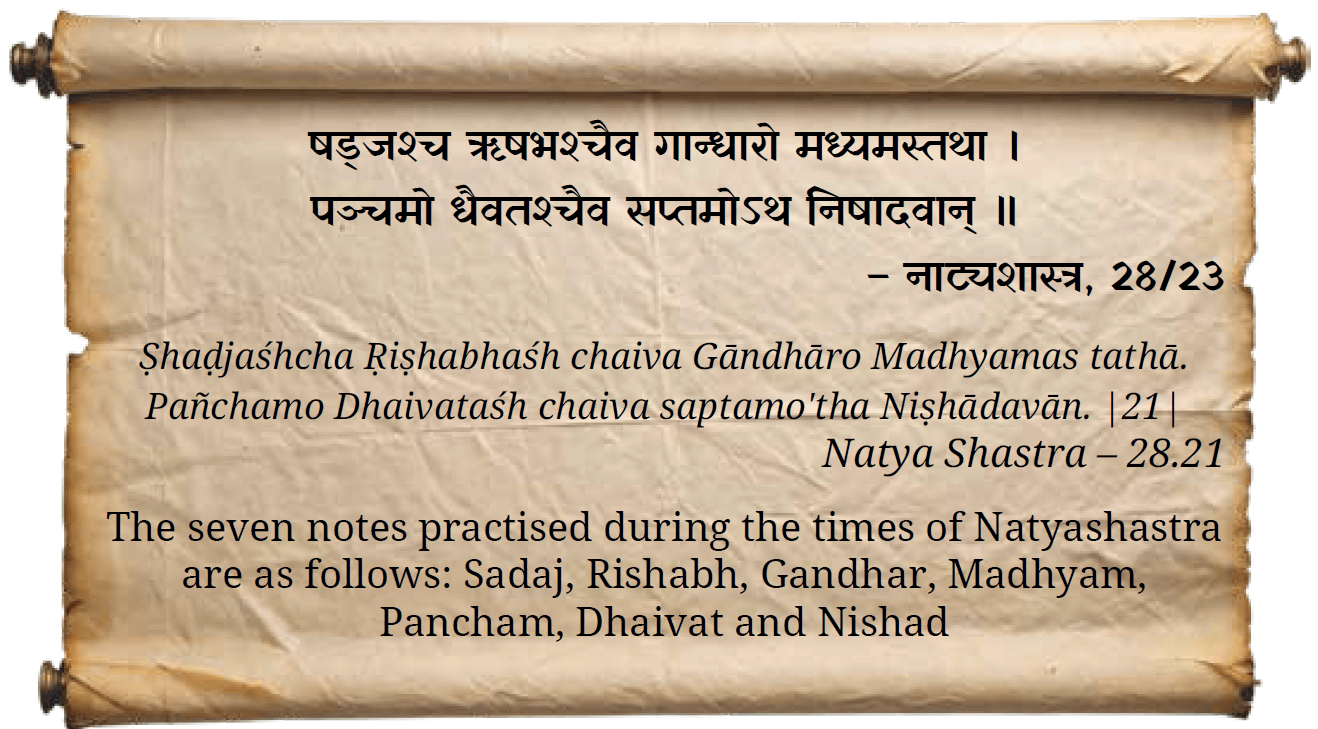
The notes of Indian Classical Music evolved from the ritual chanting of the Samaveda. Initially, the Vedas were chanted with three notes, namely, Udatta (normal or medium tone), Anudatta (not raised, or lower note) and Svarita (raised pitch or higher). These gradually evolved into the seven notes (sapta swara) that we use in music.
CARNATIC MUSIC
Sapta Tala Alankaras
A popular set of vocal exercises to build vocal strength and understand talas is the sapta tala alankaras.
CARNATIC TALAS
There are seven main talas in Carnatic Music.
They are:
1. Dhruva
2. Matya
3. Rupaka
4. Jhampa
5. Triputa
6. Ata
7. Eka
The three main parts or angas that make up a tala are:
1. Laghu (clap and finger counts*): notated I
2. Drutam (clap and wave): notated as O
3. Anudrutam (beat): notated as U
Note: There can be different number of beats in a laghu, which is known as jathi. For this level, each laghu has four beats.
In this chapter, we will learn to sing the first three alankaras and keep tala:
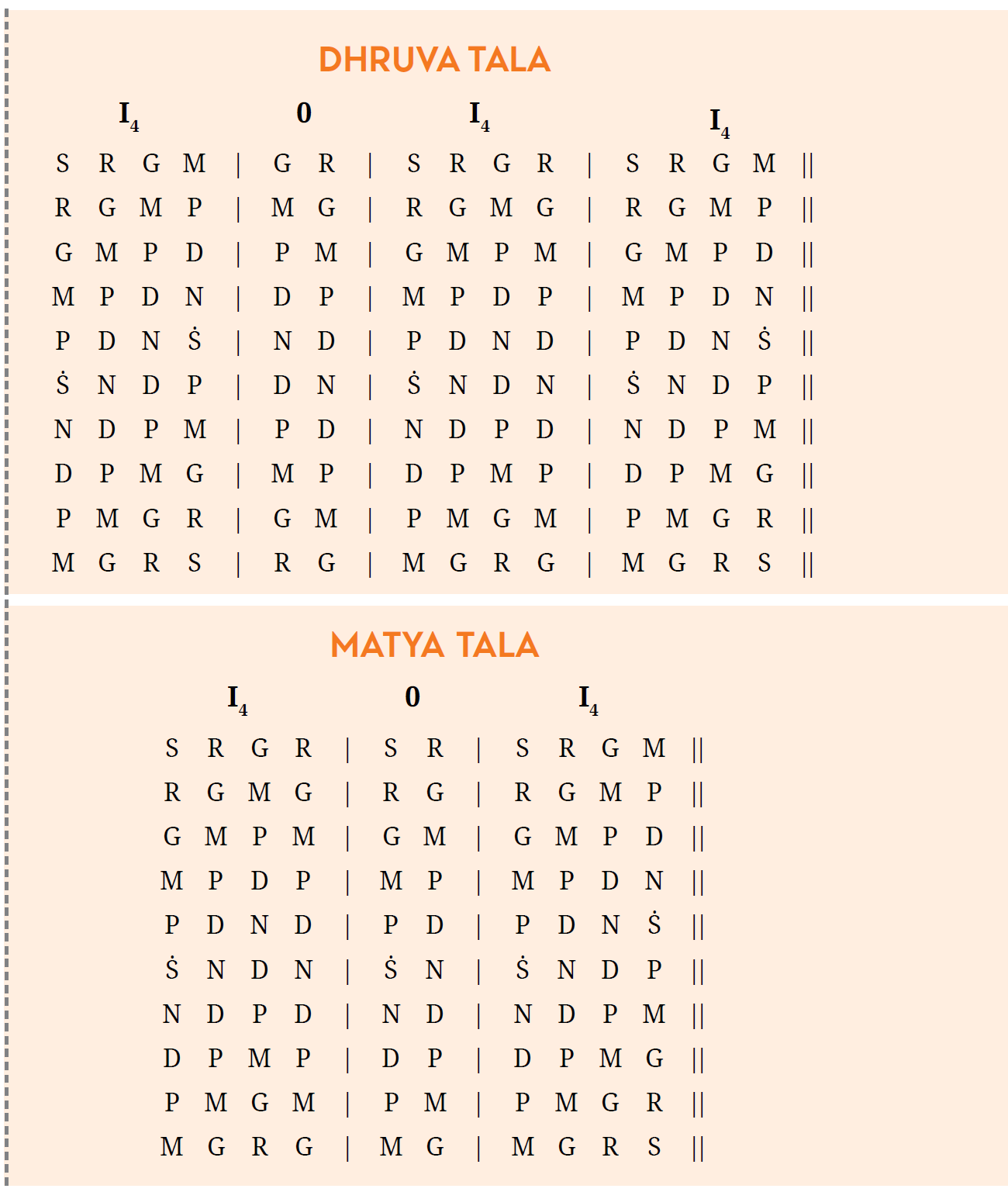
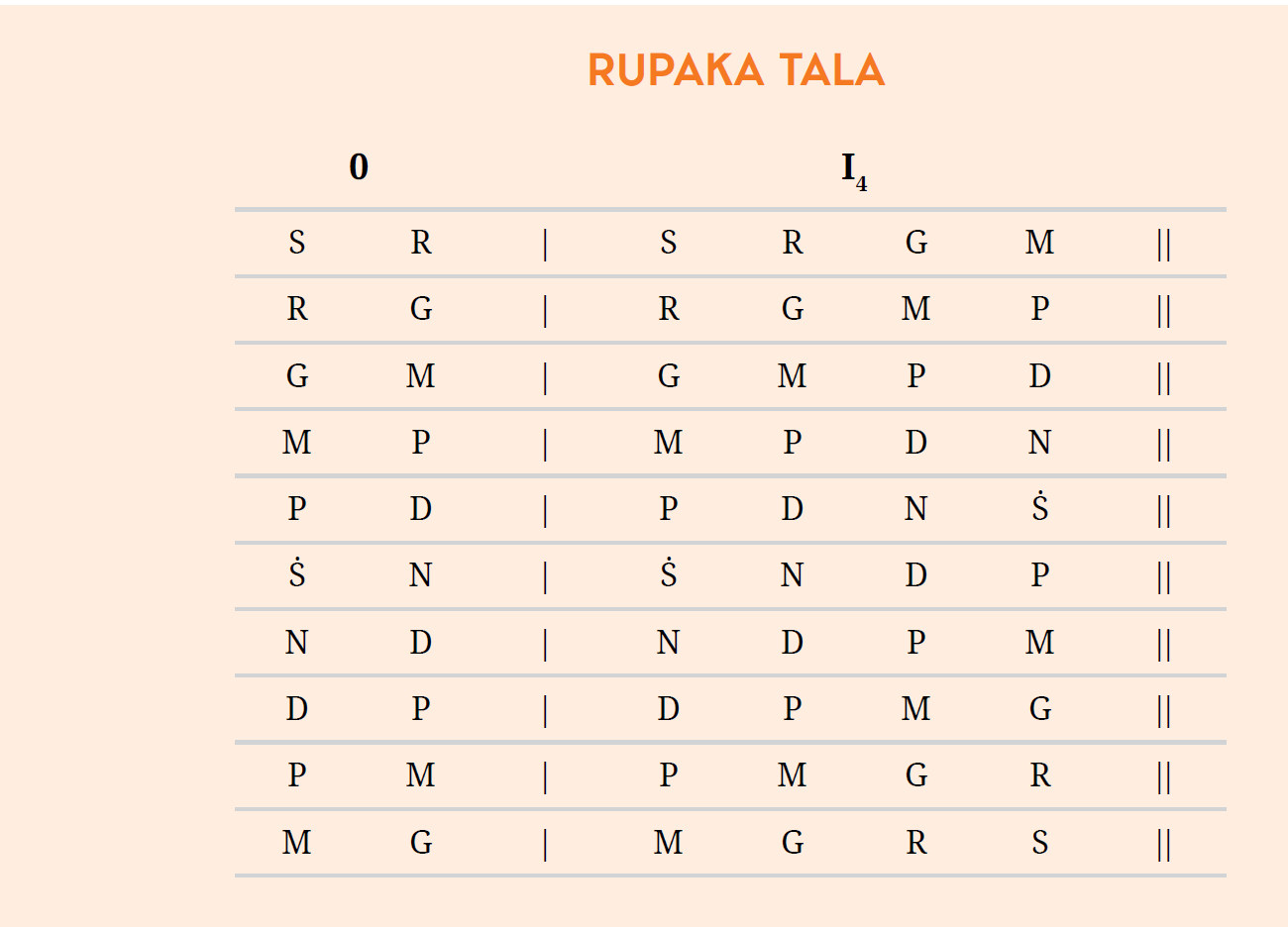
As you can see, all these alankaras are built on patterns. Can you try making your own patterns of sargams or notes as vocal exercises?
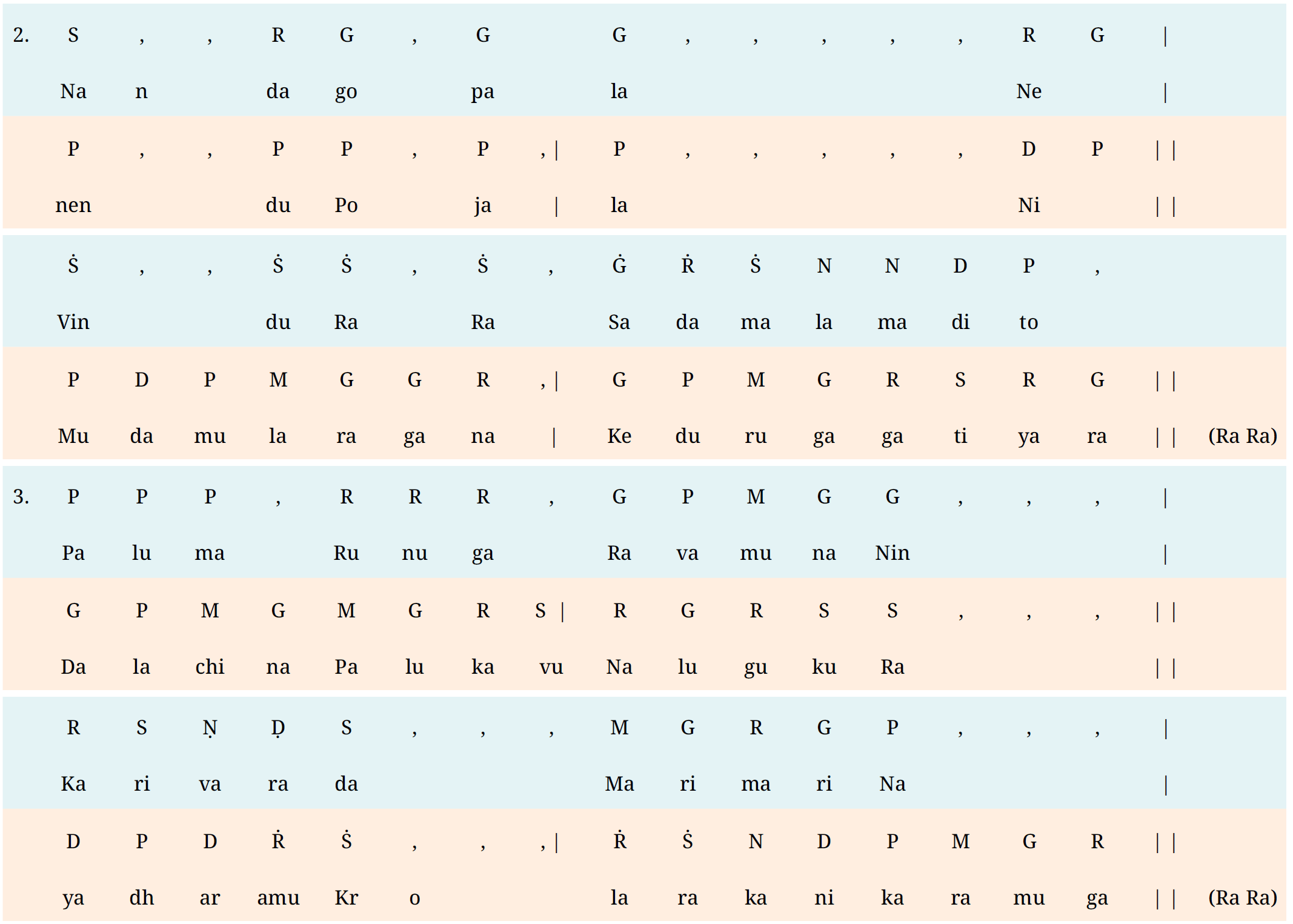
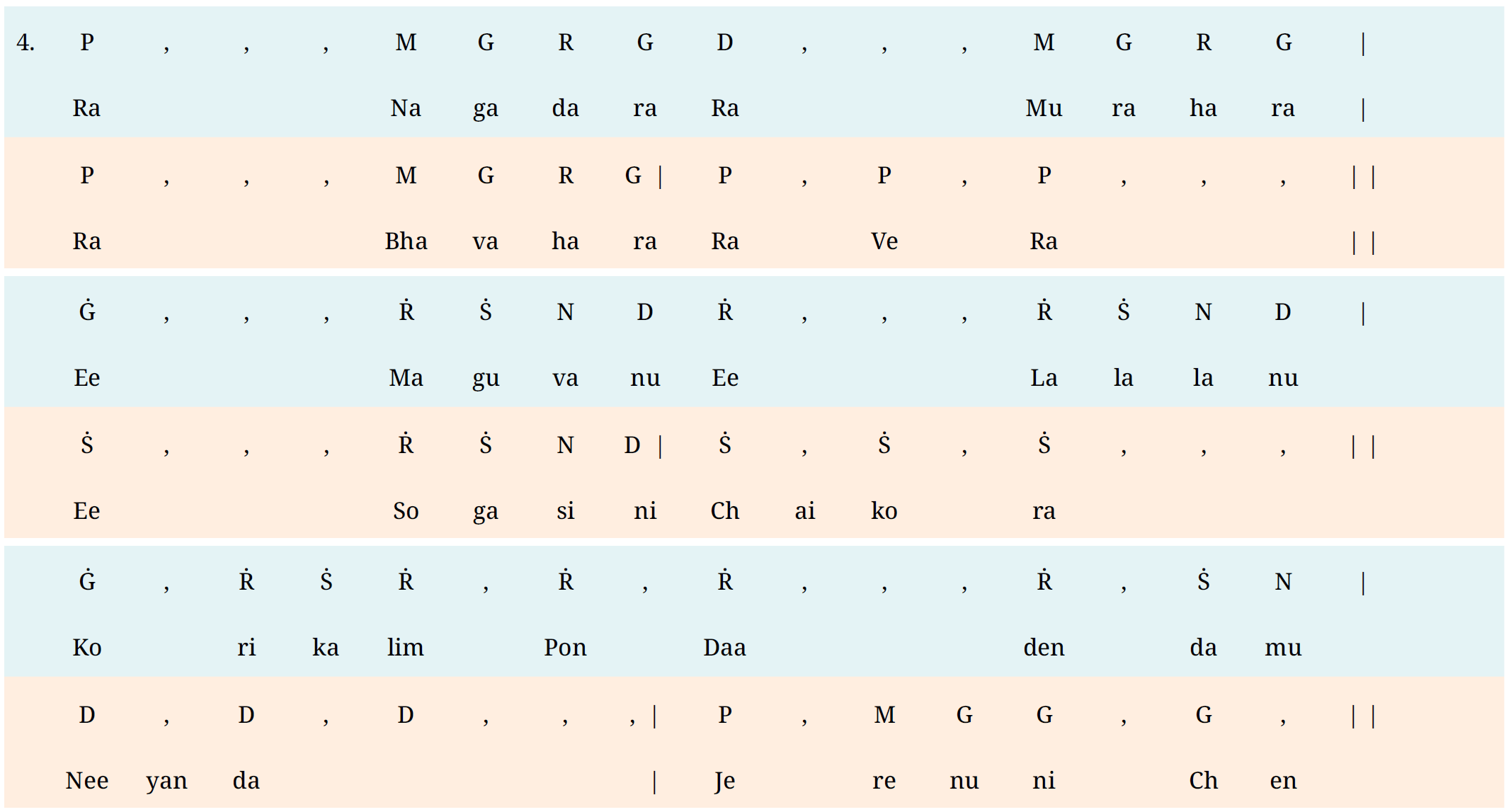
Now let us sing a swarajati.
Before singing this composition, sing the Arohana and the Avarohana. Try keeping tala as you sing the composition. Adi Tala is a rhythm cycle of 8 beats.
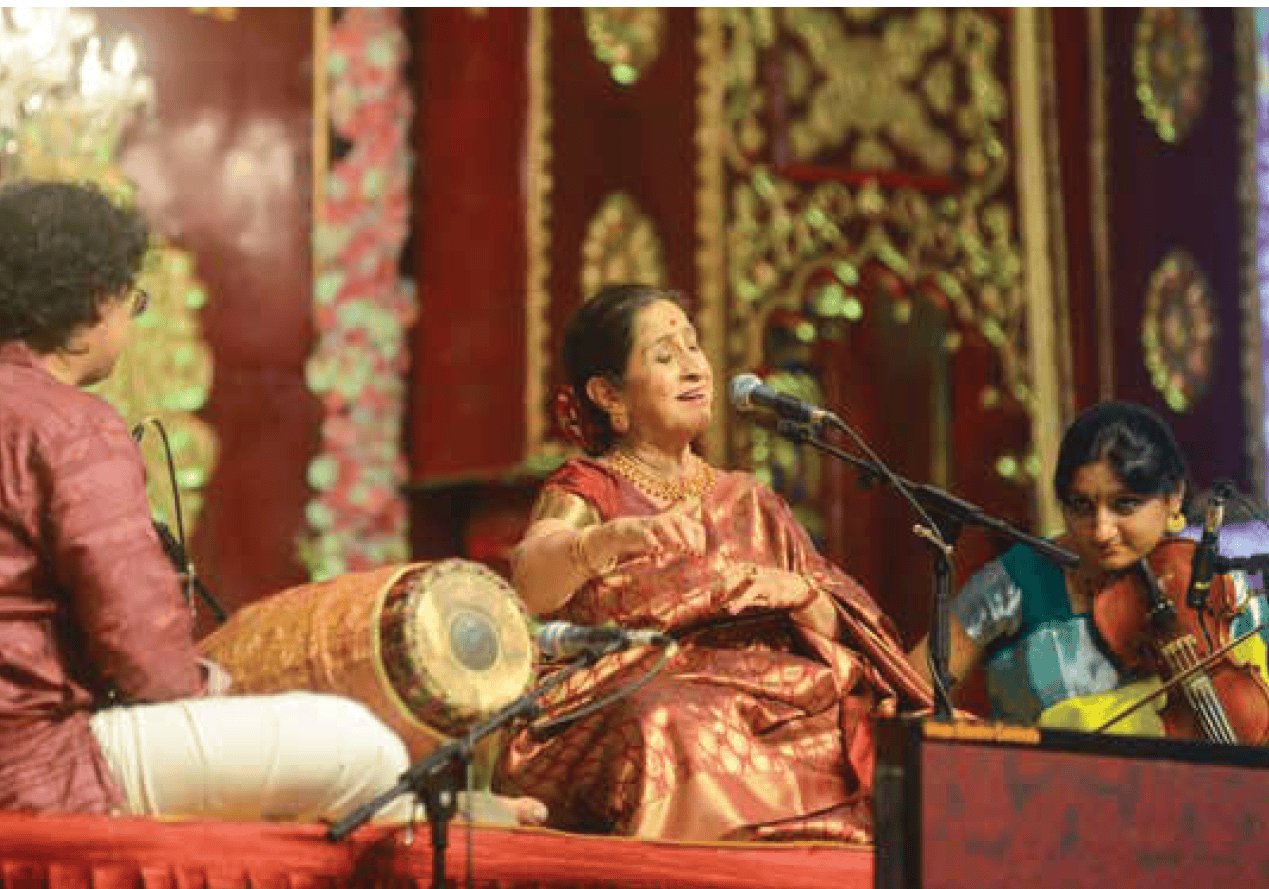
Carnatic vocalist Aruna Sairam at a concert
DO YOU KNOW?
A swarajati is a very old musical form in Carnatic Music comprising swaras and sometimes lyrics. Usually, it has three parts — pallavi (refrain or chorus), anupallavi (small section after the pallavi) and one or more charanams (verses).
RA RA VENU
Ragam: Bilahari
Talam: Adi |
Language: Telugu
Composer: Patnam Subramania Iyer
Arohanam: S R2 G3 P D2 Ṡ
Avrohanam: Ṡ N3 D2 P M1 G3 R2 S
Pallavi

Anupallavi

Charanam

HINDUSTANI MUSIC
Taal/Tala
Here are a few basic talas of Hindustani music. Learn to count them and recite the syllables (bols) with the help of your teacher.
Tala — Jhaptala — This tala has 10 units/matras.
|
Matra/Counting |
1 2 |
3 4 5 |
6 7 |
8 9 10 |
|
Theka/Bol/ Syllables |
Dhee Naa |
Dhee Dhee Naa |
Tee Naa |
Dhee Dhee Naa |
|
Chinha/Signs |
x |
2 |
0 |
3 |
Tala — Rupak — This tala has 7 units.
|
Matra/Counting |
1 2 3 |
4 5 |
6 7 |
|
Theka/Bol/ Syllables |
Tee Tee Naa |
Dhee Naa |
Dhee Naa |
|
Chinha/Signs |
0 |
1 |
2 |
Tala — Ektaal — This tala has 12 units/matras.
|
Matra |
1 2 |
3 4 |
5 6 |
7 8 |
9 10 |
11 12 |
|
Taal |
Dhin Dhin |
DDhage Tirkit |
Tu Naa |
Kat Taa |
Dhage Tirkit |
Dhi Naa |
|
Signs |
x |
0 |
2 |
0 |
3 |
4 |
Ragas
Do you remember that there are 12 notes in the Hindustani music system?
Seven shuddha — S R G M P D N
Four komal — R G D N (The underlined notes indicate komal swaras.)
One teevra — M (denoted as M)
Samay Chakra (Time Theory of Hindustani ragas)
Classical Music is a dharohar, a treasure passed from one generation to another. Ragas in music express emotions and create moods. In Hindustani music, different ragas are sung at different times of the day. A pattern of notes sounds effective if you sing it at a particular time of the day. For example, Raga Bhairav is a morning raga, while Raga Yaman is generally sung in the evening.
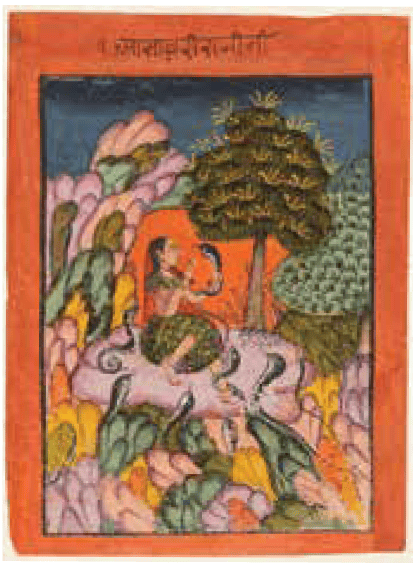
Raga Mala Painting
Raga Bhairavi
Thaat — Bhairavi
Aroh — S, R, G, M, P, D, N, Ṡ
Avroh — Ṡ, N, D, P, M, G, R, S
Pakad — M, G, S, R, S, D, N, Ṡ
Varjit Swar — no swar
Jati — Sampoorn - Sampoorn
Komal Swar —R, G, D, N
Vadi Swar — Madhyam
Samvadi Swar — Shadaj
Singing time — Early Morning
Raga – Bhairavi Sargam Geet (Ektaal)

Sthayi

Antara

Raga Bhairavi — Teentaal (Chota Khayal)
Sthayi: Kaisi ye bhalai rey kanhai paniyaa bharat mori gagari girayee kara ke larai
Antara: Sanad kahe aiso dheeta bha yo kanhai kaa karun maney naahi manat kanhai karat larai
RagA Bhairavi — Teentaal
(Kramik Pustak Mallika Part – 2)
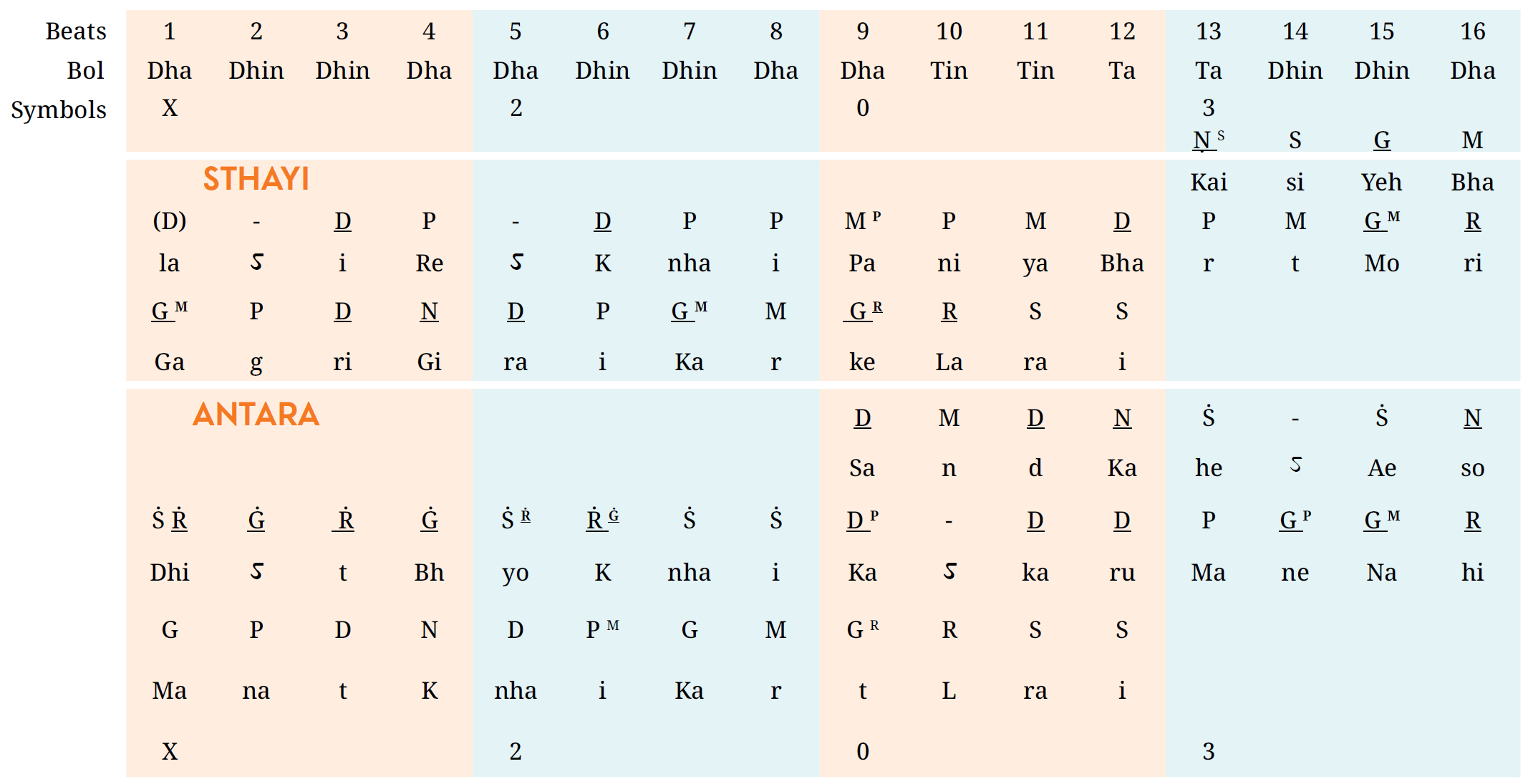
RagA – Bhairavi — Tarana (Teentaal)
Sthayi — Dir Dir Ta Na De Re Na Ta Na Dim Ta Na Ta Na De Re Ta Na na na Ta Dim Ta de Re Na
Antara — Alali Alali Tom Tan de Re Na Ta Dim Ta De Re Na Ta Dim Ta De Re Na
Dha Kit Dhum Kit Ta Ka Dhe Tat - ṠN DP ND PM DP MG RR SS
USTAD ZAKIR HUSSAIN (1951–2024)
Zakir Hussain was a renowned tabla maestro of India. He was the son of Ustad Alla Rakha, a well-known Tabla player. Zakir Hussain started playing the tabla at a very young age. His study with his father was intensive, “You grow up in a musical atmosphere”, he said, “and you don’t have to do anything else”. He began playing at concerts around the age of seven and started touring at the age of twelve.
\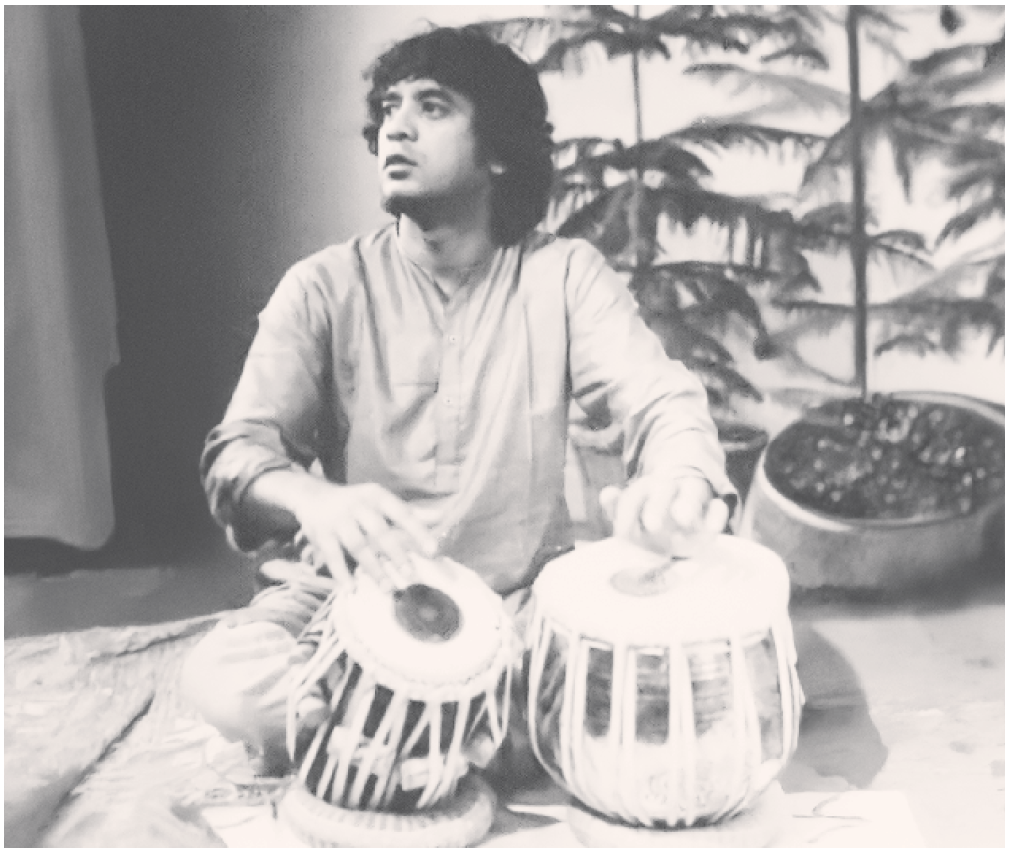
He played across a wide range of formats, from accompanying legendary Hindustani musicians like Pandit Ravi Shankar to solo tabla concerts. He was a founding member of the pathbreaking world music band, Shakti. He toured with the band for several decades. He collaborated with a range of musicians from around the world and performed in some of the most prestigious venues of music. He received countless awards, including the Padma Vibhushan and the Sangeet Natak Akademi Award from the Government of India, and three Grammy awards.
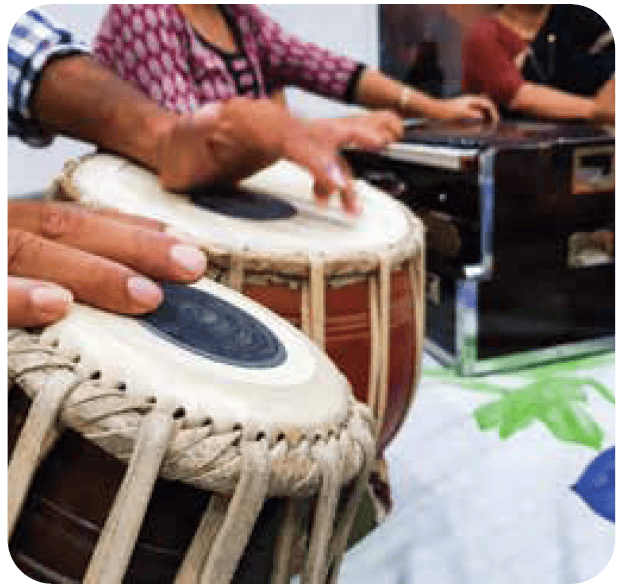
ACTIVITY 7.1: PLAYING THE TABLA
If there is a tabla teacher in your school, learn some simple rhythms from them.
EXERCISES
1. (a) How many sections are there in teentala?
(i) 3
(ii) 2
(iii) 6
(iv) 4
(b) How many sections are there in rupak?
(i) 6
(ii) 2
(iii) 3
(iv) 4
(c) The bols of rupak are:
(i) Ti Ti Na Dhi Dhi Na
(ii) Ti Ti Na Dhi Na Dhi Na
(iii) Na Dhi Na Dhi Na
(iv) Na Tin Tin
2. Identify the Carnatic tala from the angas (parts):
(a) I 0 I I
(b) I 0 I
(c) 0 I
3. Unscramble the names of ragas:
(a) I R V B H A A
(b) A A Y N M
(c) K J A M A H
(d) A M A O H N
(e) I L H A A B I R
(f) A A A A A A S B N H K R H N M R
ASSESSMENT
CHAPTER 7: RAGAS AND TAAL/TALAS
|
CG |
C |
Learning Outcomes |
Teacher |
Self |
|
1 |
1.1 |
Understands basic music terminologies, such as naada, dhwani |
||
|
1 |
1.1 |
Is familiar with the notes of Carnatic and Hindustani music |
||
|
1 |
1.1 |
Is able to sing selected compositions of Indian classical music using the correct notes of the raga, and in the correct tala |
||
|
1 |
1.1 |
Has a basic understanding of some Carnatic and Hindustani talas |
Teacher’s Comments and Student’s Observations
...............
...............
...............