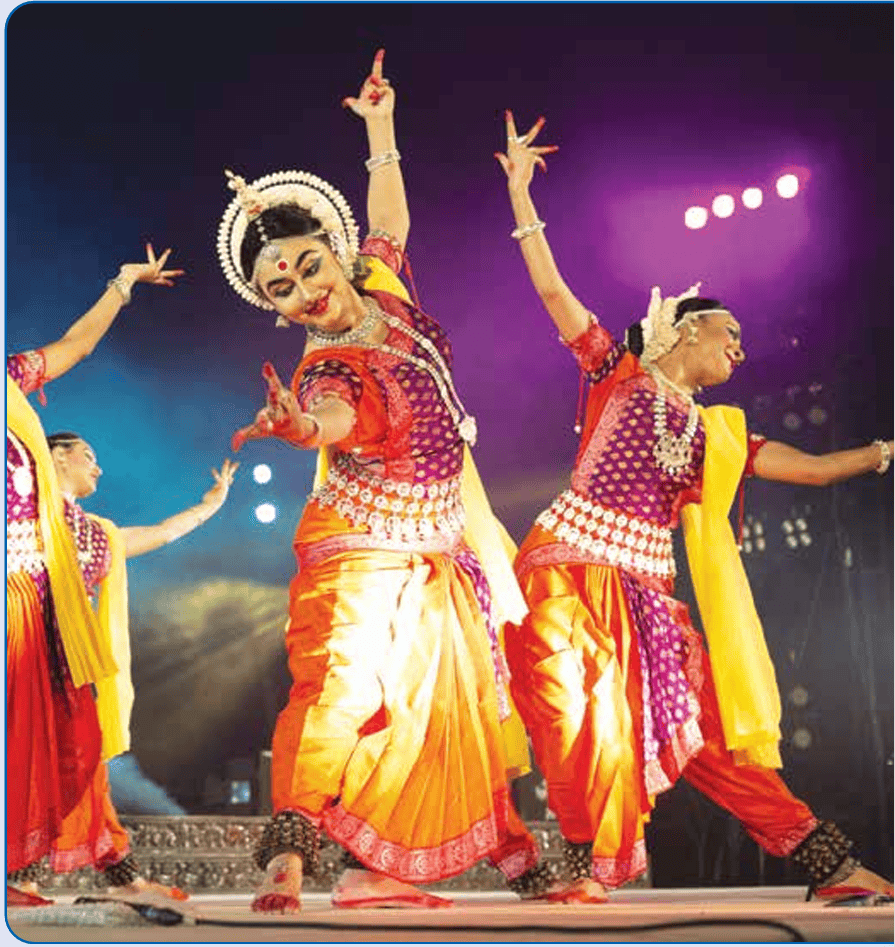
NATYA
Natya is storytelling through performance. You have read the
description of this earlier in the book and read about two natya
traditions.
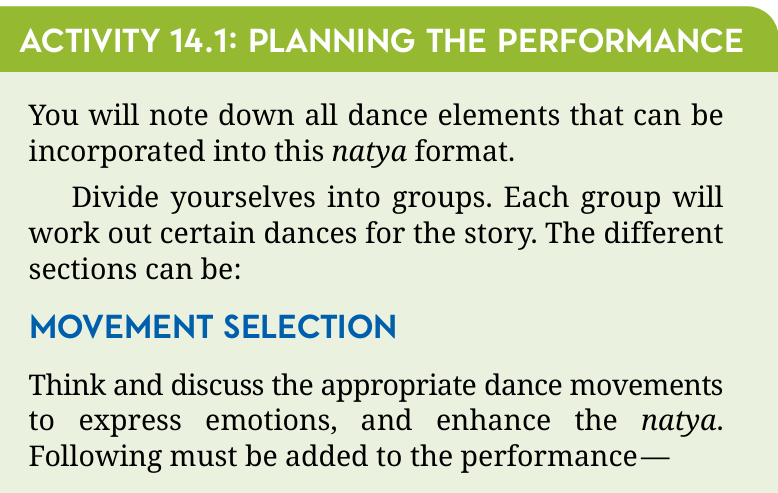
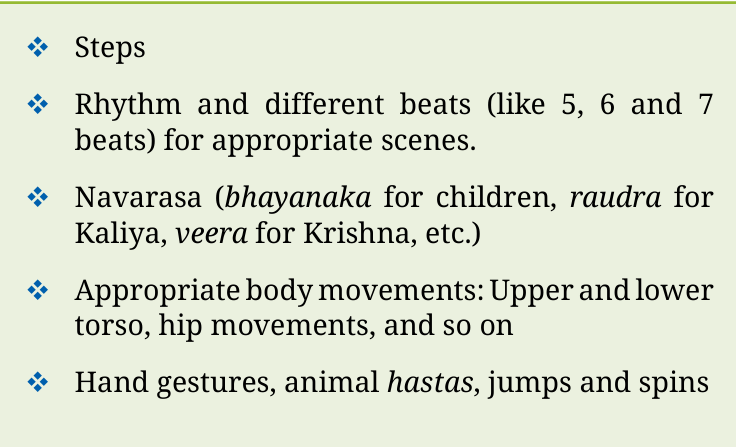
In this chapter, you will explore how dance elements can be
incorporated into natya.
A story can be made into a performance
with elements of dance and choreography,
dialogues, musical elements with songs,
musical instruments, and costumes and
make up. Discuss about telling a story and
how you can incorporate dance movements
in natya with your friends. A story is given
below for you to consider or you can choose
your own story for presentation and have
fun putting it together with choreography.
So, let us dive into this chapter by reading
a story and then dancing to the story. That
will be interesting and enjoyable.
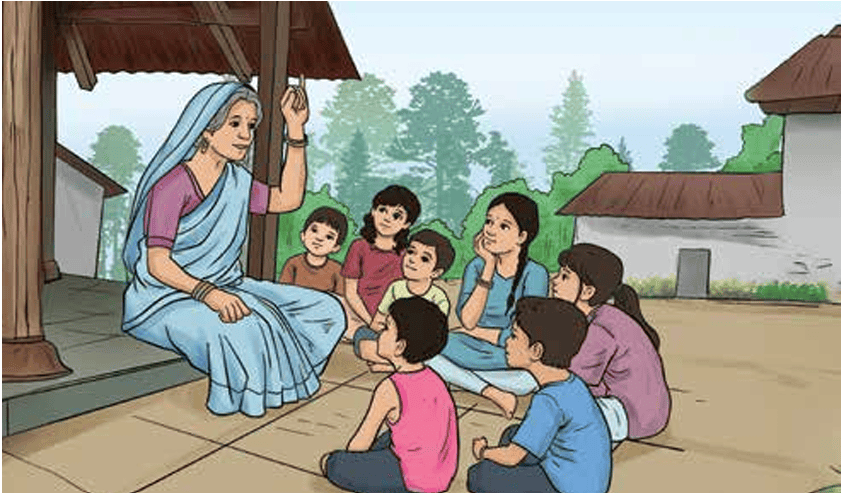
One lazy afternoon, Grandma gathered the children to tell
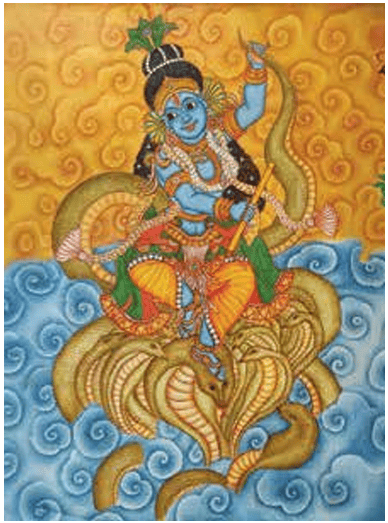
them the story of Krishna and the snake Kaliya. She began her
story in a soft animated voice bringing the story alive with her
dramatic narration.
 “Long ago, on the
banks of the river
Kalindi,
there lived
a monstrous serpent
called Kaliya Naag. He
was a terrible creature,
hissing and coiling,
frightening everyone
who came near him.
Even birds would not
fly over the river, and
children were too
scared to play by its
banks. But one day,
little Krishna arrived.”
“Now, Krishna was not afraid of anything. He saw
the frightened children and decided to help them.
He climbed the tallest tree by the river, flute in hand,
and began to play it. The music was so sweet and
enchanting that it flowed over the water like sunlight
on ripples. Even Kaliya couldn’t resist. The great
serpent rose from the river, swaying to the melody,
his anger forgotten and his eyes shut in joy. Then,
Krishna leapt onto Kaliya’s hood and began to dance.
Oh, how he danced! His tender feet moved nimbly
with such grace and rhythm that even Kaliya, fierce
as he was, couldn’t help but join in. Soon, birds were The children listened with rapt attention and then
excitedly asked grandma to help them enact this natya.
She replied, “Yes we have to plan and design
the whole story, choreograph it with dance, music,
enactment, costumes and stage design. You see
children, through music and dance, even the wildest
heart can be calmed. Natya — our beautiful art of
storytelling — isn’t just for entertainment. It teaches,
it heals, and it brings peace”.
All
traditional performances begin with a
salutation to seek blessings of the Almighty. Here you
will see references of salutation and benediction with
reference to natya.
She said, “In our traditions, every play begins and
ends with gratitude. Before the performance, we seek
blessings for its success — just as we start our day
with a prayer or sing during the morning assembly
at school. It helps us focus our mind and brings a
sense of calm. The salutation is an essential part of
any play’s preliminaries in the Indian natya tradition.
Let us learn some prayers which can be recited as a
salutation to the almighty and as benediction after
the conclusion of the natya”.
Here is one example which you can use as a salutation
in your performance or you can select your own.
“Long ago, on the
banks of the river
Kalindi,
there lived
a monstrous serpent
called Kaliya Naag. He
was a terrible creature,
hissing and coiling,
frightening everyone
who came near him.
Even birds would not
fly over the river, and
children were too
scared to play by its
banks. But one day,
little Krishna arrived.”
“Now, Krishna was not afraid of anything. He saw
the frightened children and decided to help them.
He climbed the tallest tree by the river, flute in hand,
and began to play it. The music was so sweet and
enchanting that it flowed over the water like sunlight
on ripples. Even Kaliya couldn’t resist. The great
serpent rose from the river, swaying to the melody,
his anger forgotten and his eyes shut in joy. Then,
Krishna leapt onto Kaliya’s hood and began to dance.
Oh, how he danced! His tender feet moved nimbly
with such grace and rhythm that even Kaliya, fierce
as he was, couldn’t help but join in. Soon, birds were The children listened with rapt attention and then
excitedly asked grandma to help them enact this natya.
She replied, “Yes we have to plan and design
the whole story, choreograph it with dance, music,
enactment, costumes and stage design. You see
children, through music and dance, even the wildest
heart can be calmed. Natya — our beautiful art of
storytelling — isn’t just for entertainment. It teaches,
it heals, and it brings peace”.
All
traditional performances begin with a
salutation to seek blessings of the Almighty. Here you
will see references of salutation and benediction with
reference to natya.
She said, “In our traditions, every play begins and
ends with gratitude. Before the performance, we seek
blessings for its success — just as we start our day
with a prayer or sing during the morning assembly
at school. It helps us focus our mind and brings a
sense of calm. The salutation is an essential part of
any play’s preliminaries in the Indian natya tradition.
Let us learn some prayers which can be recited as a
salutation to the almighty and as benediction after
the conclusion of the natya”.
Here is one example which you can use as a salutation
in your performance or you can select your own.
Salutation
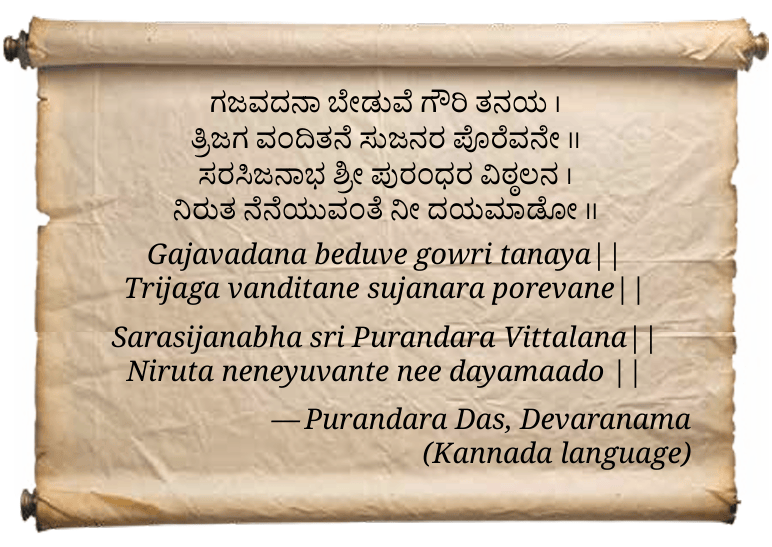
Meaning
Gajavadana — one who has elephant face (Ganesha)
Beduve — I pray
Gowri Tanaya — son of Gowri
Trijaga — the three worlds
Vanditane — worshipped
Sujanara — by good people
Porevane — protector
Oh elephant faced god! I pray for you. You are
the Son of Goddess, Gowri (Parvati). You are
worshiped by all the three worlds. You are the
protector of all good people such as sages.
Meaning of last stanza
Sarasija Nabha — one who has lotus in his navel
Sri Purandara Vittalana — Lord Vishnu (pen
name of purandara daasa)
Niruta — always
Neneyuvante — make me remember
Nee — you
Dayamaado — shower blessings
Oh Lord Vishnu (Purandara Vittala) the one who
has lotus in his navel, shower your blessings to
remember you at each and every movement.
Benediction
Similarly, all performances ends with a
benediction. She ended by saying, “And when the
play ends, we bow to the audience to thank them
for their time, and attention. After all, what is a
performance without those who come to watch it? This exchange of respect is what makes natya so
special — it is not just about the story but about the
connection it creates between those who perform
and those who watch.”
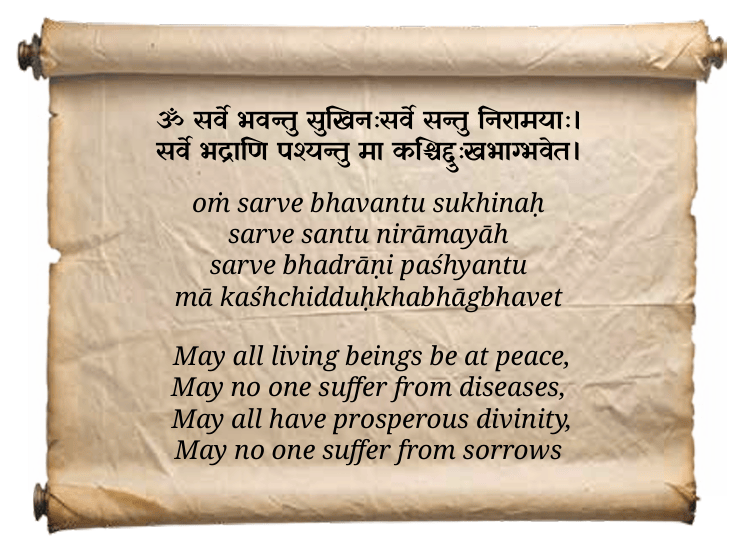
Here is an example of a benediction.
ASSESSMENT
Chapter 14: Natya
|
CG |
C |
Learning Outcomes |
Teacher |
Self |
|
3 |
3.1 |
Understands storytelling |
||
|
3 |
3.1 |
Actively participates in making of natya |
||
|
3 |
3.1 |
Shares and collaborates with eagerness |
||
|
3 |
3.1 |
Imaginatively uses all aspects of performance in making this presentation |
Teacher’s Comments and Student’s Observations
...............
...............
...............
SUMMATIVE ASSESSMENT
|
Examples of Assessment |
Criteria for Assessment |
|
|
Individual |
|
|
|
Group of 3 or 4 |
|
|
Teacher’s Comments and Student’s Observations
...............
...............
...............