
17
HOW YOU FEEL ...
In this chapter, you will study many aspects of the human body and facial expressions.
You will discover hidden ratios and proportions as you learn to draw faces and depict emotions.
You will travel through time to explore a rock-cut sculpture in Mahabalipuram.
You will learn to make clay reliefs depicting facial expressions.
Finally, you will examine the stereotypes that exist in popular culture and create artwork that shows them in new ways.
ACTIVITY 17.1: ACT AND GUESS
You have learnt about navarasa in theatre and dance. Let us play a game with facial expressions based on the same.
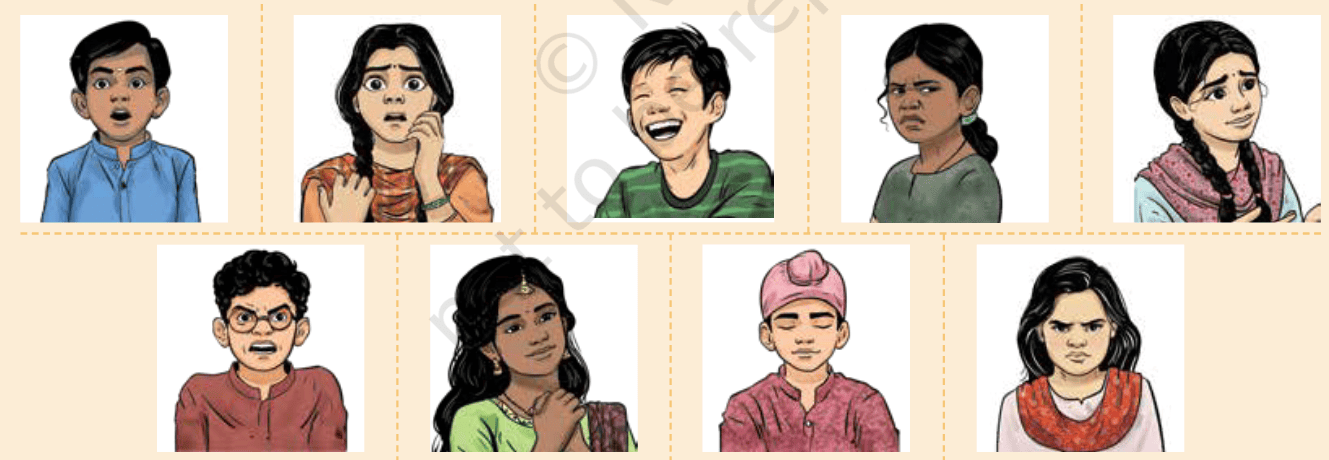
Step 1: Make teams and use the prompts provided in the box.
Step 2: One person from each team will enact a prompt
Step 3:The others will observe their body movements and facial expressions.
Can you guess the prompt they are enacting?


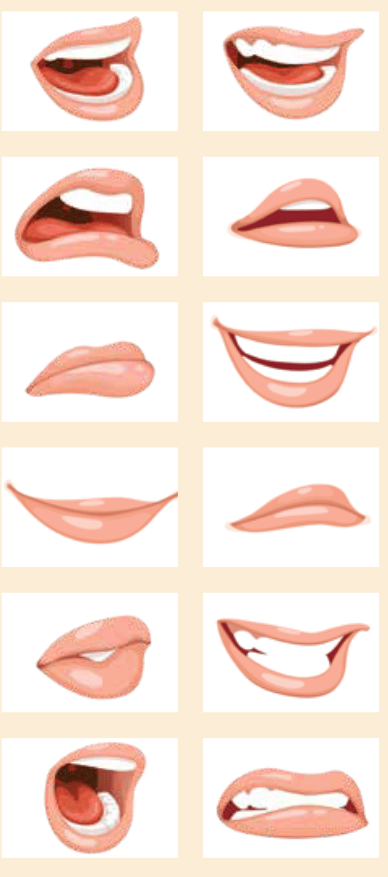
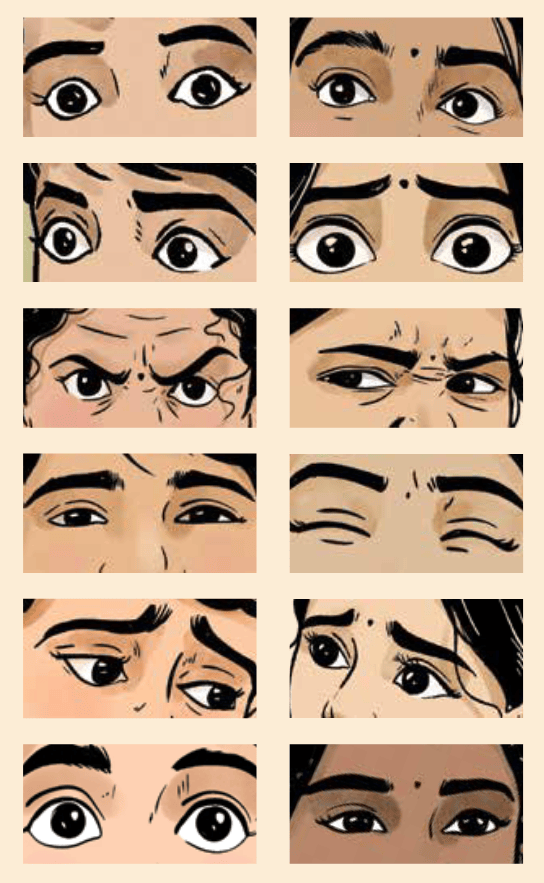
Your expressions when …

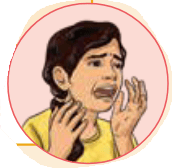
ACTIVITY 17.2: PROPORTIONS OF THE HUMAN HEAD
What makes a baby’s face appear different from an adult’s face?
It is the proportion.
See the image and analyse how the proportions change as a person grows.
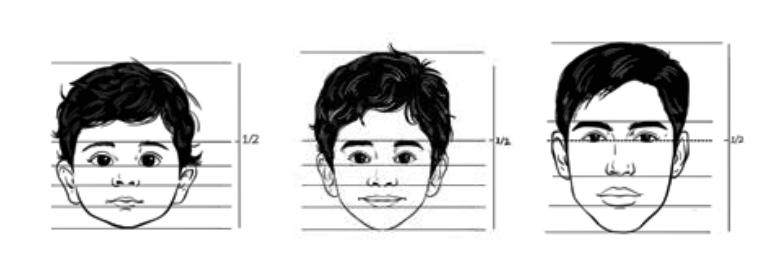
Draw a face using the guidelines for proportion. Use the same proportions to draw the head in different angles.
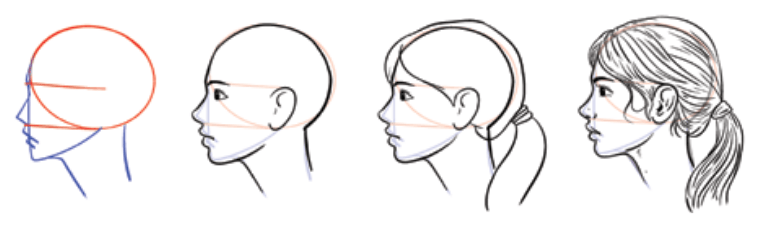
You can use your index finger to measure various parts of your face.
Measure the length of your nose and use the same to measure your ears, eyes, forehead, etc.
Here are some interesting things that you will discover:
- The space between two eyes is another eye.
- The ears are positioned between the level of your eyebrows and the tip of your nose.

ACTIVITY 17.3: DRAWING FACIAL EXPRESSIONS
Step 1: Ask your friends to pose for a few minutes in different expressions. They can show a funny face, sad face, laughing face, worried face, etc. Observe how the eyes, eyebrows, mouth and jawline change for each expression.
Step 2:Draw four to five faces while paying attention to the proportions.
Step 3:Modify the eyes, eyebrows and mouth to create different facial expressions.
Step 4:sHave fun creating your own emojis.
ASSESSMENT
- Observe and depict the ratios and proportions of the human head.
- Depict a variety of facial expressions to express emotions.
ACTIVITY 17.4: LET US TRAVEL BACK IN TIME!
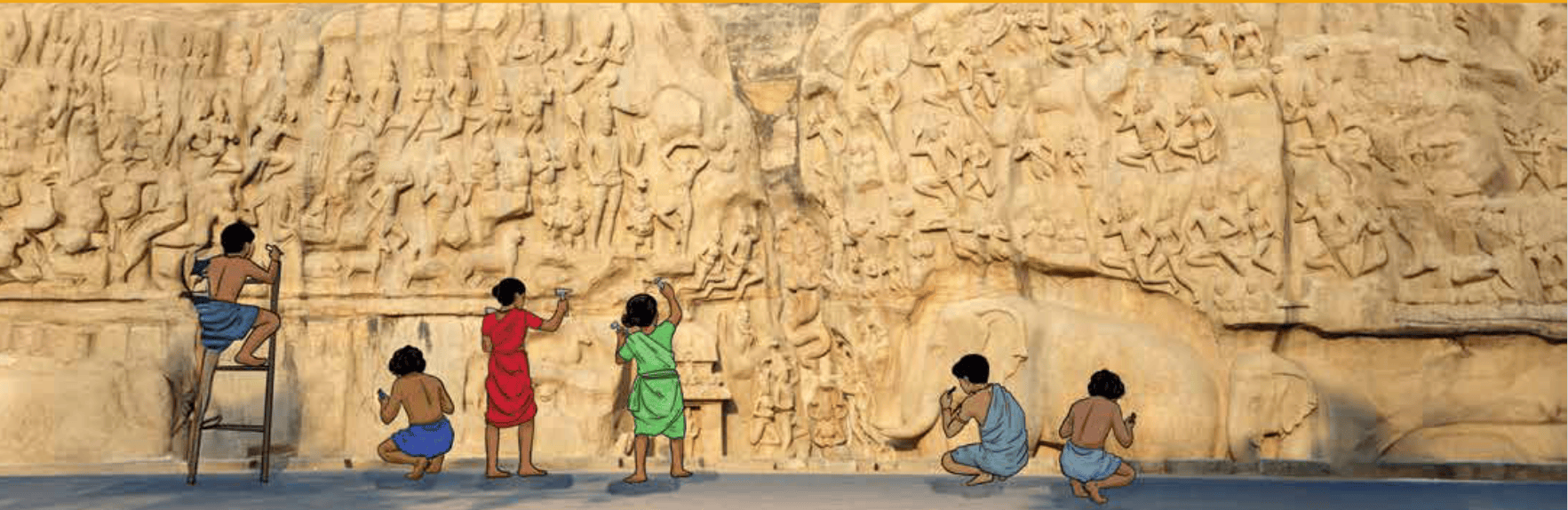
Imagine you have entered a time machine and have been transported to 8th century CE. You find yourself in front of this massive rock-cut temple sculpture at Mahabalipuram, Tamil Nadu.
You see the sculptors at work. They tell you that they are carving the ‘Descent of Ganga’. Some others tell you the story of ‘Arjuna’s Penance’.
As you watch them work, you imagine the river flows down the cleft between the two boulders and all life gathering around the river. The sculpture brings alive the stories and myths celebrating life around water. Although some figures can be seen very clearly, others look unfinished. Each scene draws you in and you see more.
FACES IN RELIEF USING CLAY
Swishhhh! ... The time machine snapped back to the 21st century and you have this book in your hand.
The sculptures in the Shore temple of Mahabalipuram have eroded over time. You see various body movements and props in the hands of people carved on this rock. The characters can be identified, however, the facial expressions are not clear.
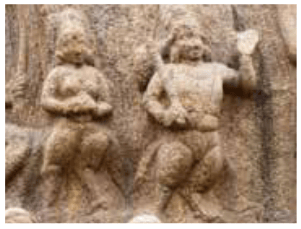
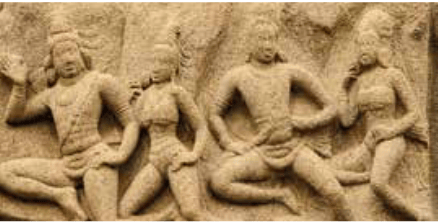
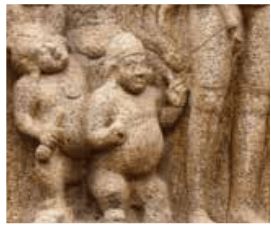
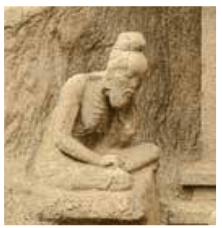
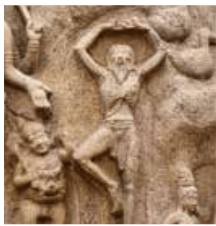
Look at the pictures carefully. Locate the same characters in the bigger picture on the previous page.
Since you have learnt to draw facial expressions, reimagine their faces.
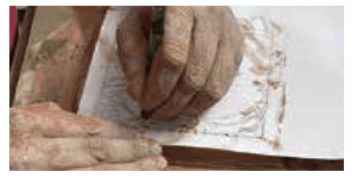
Sketch each face with expressions on separate sheets of 15 cm × 15 cm size
After completing your drawings, choose one, cut it out and keep it ready for your clay relief.
Field Trip
Visit a heritage monument that has sculptures. Observe the body postures, expressions and emotions they show. Make drawings as you study these.Process of making relief in clay
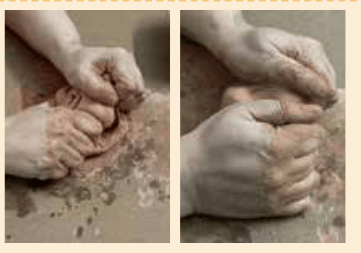
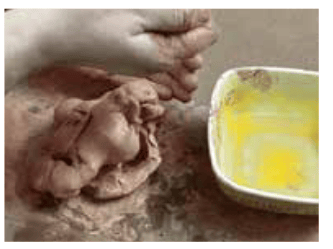
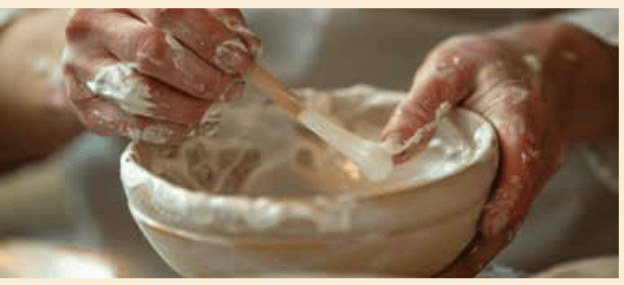
- Take some natural clay. If it is dry, you need to soak it in some water for a day so that it becomes soft and moist.
- Knead your clay (just like you knead dough), and remove stones, pebbles and other impurities in the process.
- Your clay should be of a suitable consistency to work with. Too much water will make it sticky and too little water will make it crack.
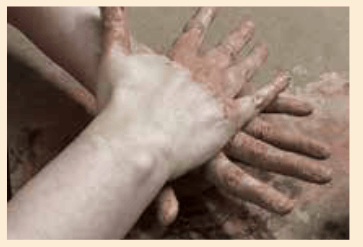
- Make a ball with the clay and flatten it with your palm.
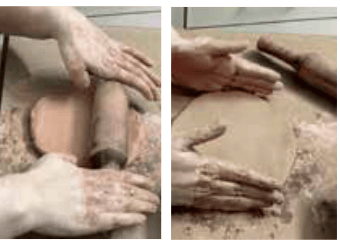
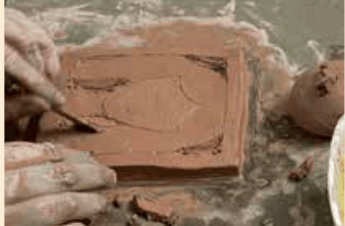
- Roll it smoothly using a rolling pin to create a slab of approximately 15 cm length, 15 cm width and 3 cm height.
- For modelling, use tools made of clay, or experiment with blunt kitchen cutlery like spoons, butter knives, icecream sticks, etc.
- With a pointed tool, gently trace your paper cut out onto the slab.
- Start removing a thin layer of clay from the background, so that the surface of the face looks raised.
- Gather the clay that you have removed in the shape of a ball and keep it moist.
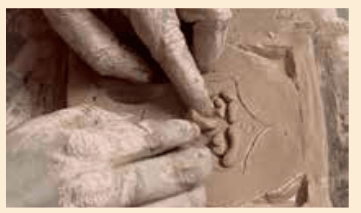
- Add this clay to build facial features like the forehead, eyebrows, eyelids, eyes, cheeks, nose, mouth, chin, etc.
- Moisten your slab by sprinkling water lightly every now and then.
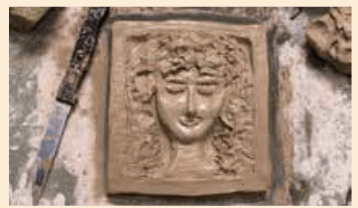
- Use your tools to refine the features, add textures and create expressions that you want on the face.
- Complete your work and make a hole on the top of the slab with a pencil. This will help you hang your relief.
- Allow it to dry for a few days.
Optional: You can paint your clay relief after it is completely dry.
Technical Tip
Different clay parts can be joined by making the clay into a smooth paste called slip.Marks are made on the desired area to make the surface rough. Slip is applied (which acts like a glue) and the other part is joined.
Reflect on your process and respond to these questions below.
- Did your artwork develop cracks during the process?
- What could the reasons be?
ACTIVITY 17.5: EVERYBODY HAS A BEAUTIFUL STORY
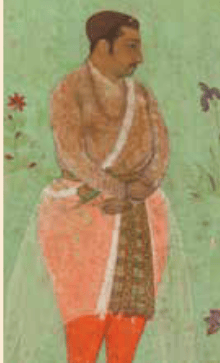
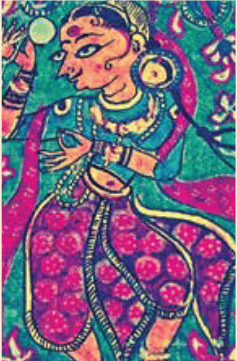
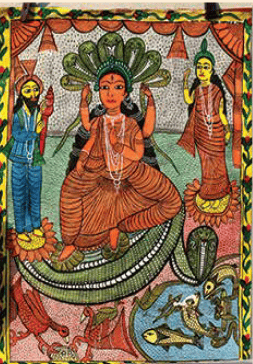
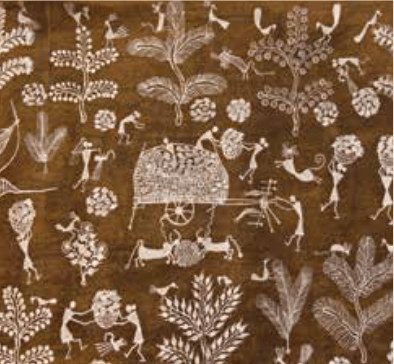
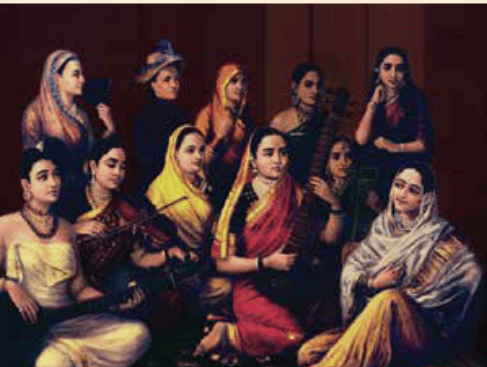
The ‘Descent of Ganga’ shows a wide variety of people with different body types. Look at how people have been depicted in different styles of painting.
Look at people with various body types around you — short, tall, thin, fat, dark-skinned, light- skinned, bald, hairy, hunched, etc. Observe your own body. What thoughts run through your mind?
A stereotype is a widely accepted idea, generalising a person, place or community. It is not factual. Discuss common assumptions that are made about body types, promoting certain stereotypes.
For example, it is assumed that a person with a large body cannot run fast or a person with a slender body is weak or that one skin colour is more beautiful than another.
The images we see in magazines, hoardings, films, videos and social media influence the way we think about our bodies. Gather more examples of body stereotypes. You may find these in advertisements, story illustrations, videos, films, etc.
Note down your thoughts. Create sketches of your own version that challenge the stereotypes you come across.
| CHAPTER 18: TEXTILEs AND TRADITIONS | ||||
|---|---|---|---|---|
| CG | C | Learning Outcomes | Teacher | Self |
| 1 | 1.1 | Observes and depicts the ratios and proportions of the human head | ||
| 1 | 1.1 | Depicts a variety of facial expressions to express their emotions and experiences | ||
| 2 | 2.1 | Recognises stereotypes in representing the body and creates alternatives in artwork | ||
| 2 | 2.2 | Recognises navarasas and emotions seen in Indian sculptures | ||
| 3 | 3.2 | Makes a clay relief using appropriate tools and techniques (rolling, coiling, pinching, patting, scooping, making a slab, using slip, etc.) | ||
Teacher’s Comments and Student’s Observations