19
THE ART OF
CALLIGRAPHY
Scripts have the power to record people’s languages and expressions.
India’s writing systems can be traced from the 5000-year old Indus-Sarasvati civilisation. But the earliest decoded inscriptions in Brahmi script from the Ashokan edicts are almost 2300 years old. The original Constitution of India was handwritten by two expert calligraphers. Prem Behari Narain Raizada wrote the English version and Vasant Krishan Vaidya wrote it in Hindi. It was signed on 26 January 1950, the day we observe as Republic Day. Today, the Indian constitution officially recognises 22 languages. Look at the beautiful forms and variations in Indian scripts in the tree on the left.
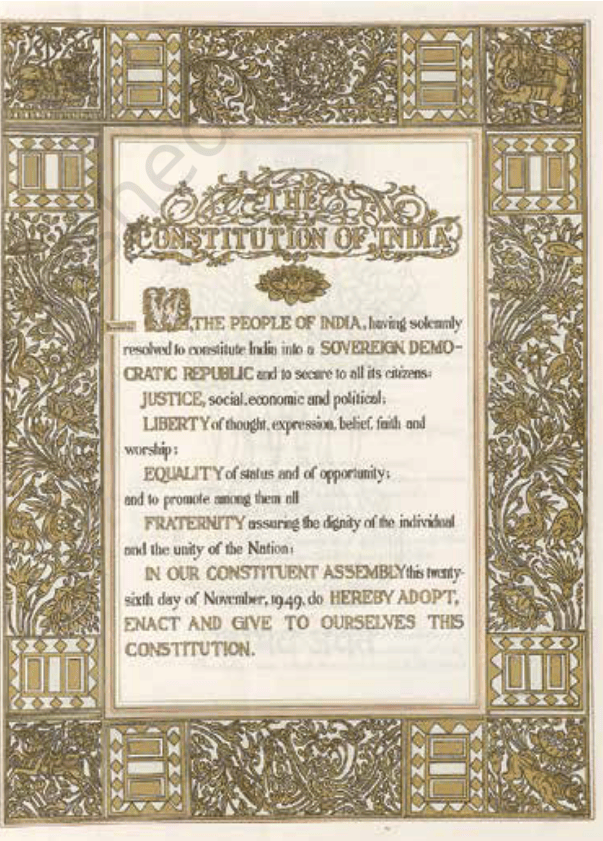
You will learn and discover more about calligraphy in this chapter.
Letters are the smallest unit of any script. An unknown script looks like a string of small drawings. The letters we use today were all initially drawings, which evolved into pictograms and then into organised systems of writing.
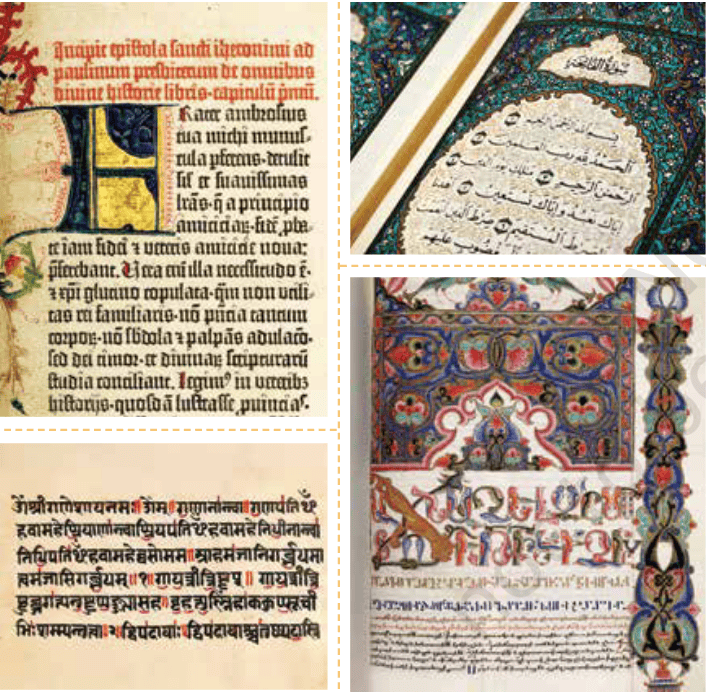
Calligraphy is much more than the art of writing letters to spell words. Artists pour emotions into each letter to create a variety of expressions. They spend a lot of time and effort in writing, inscribing and carving by hand. Each letter style has a purpose. In ancient manuscripts, letters were decorative and flowed with life. Some letters were creatively placed to look like a frame or picture. Today’s newspapers use bold and clear letters to draw our attention and help readers read information quickly.
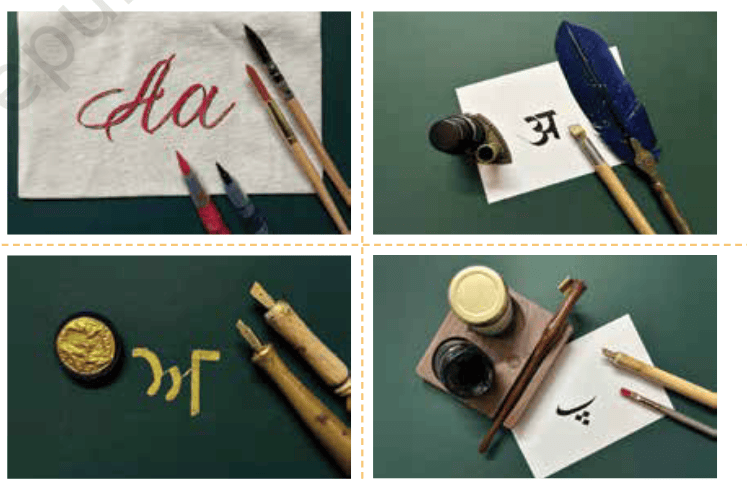
The materials and tools used in calligraphy include a variety of quills, brushes, nibs, inks and paints on surfaces like palm leaf, cloth, paper, and so on.
ACTIVITY 19.1: LOOKING AT LETTERS
Which letters can you find in the Indian Rupee symbol?
The symbol of the Indian rupee is derived from the letter र from the word Rupiah in the Devanagari script. The top horizontal line also known as the Shiro-Rekha of the Devanagari script, gives it an Indian identity. Seen along with the second horizontal line, it represents the three bands of the tricolour of our Indian flag.
Just by playing around with lines and shapes of letters, you can enhance an idea.
Observe the ‘Incredible India’ logo. The exclamation mark in place of the letter ‘I’ makes it more expressive. What kind of letter play do you observe in the other logos? Discuss and note your observations.

ACTIVITY 19.2: LETTER HUNT
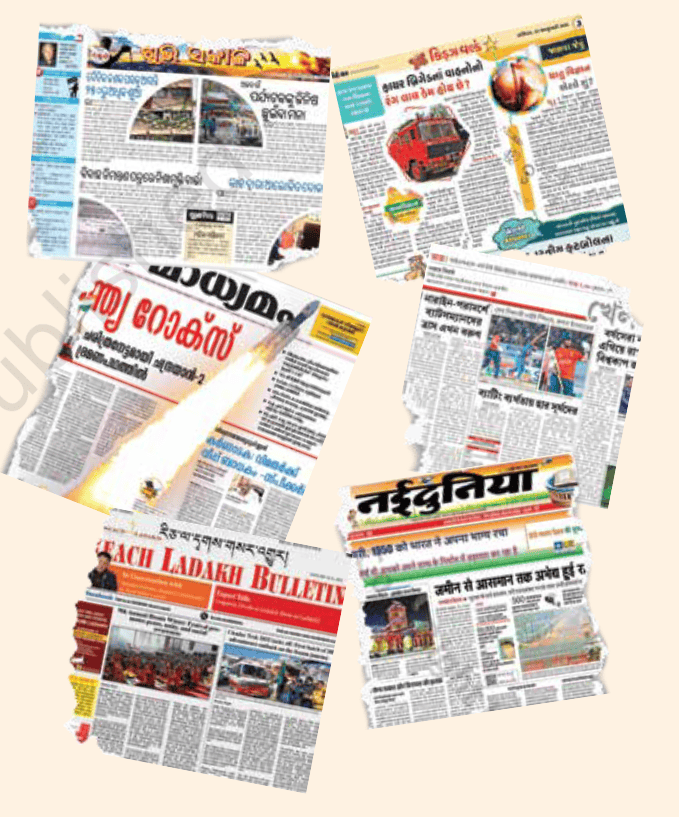
Before digital technology, printing involved long processes. Visit a newspaper office or print studio to find out more about the printing processes.
Let us begin a treasure hunt activity using print material found in our surroundings.
Step 1: Collect a few newspapers, and printed material including invitation cards, food packaging material and old magazines.
Step 2:Discuss and write your thoughts about —
- How are the words or letters arranged?
- Why do you think the letters are printed in different colours and sizes?
- What do you find attractive in the style of letters or words?
- Which words on the printed material are most important? Why?
Step 3:Cut out words and letters of different sizes and styles.
Step 4:Work in groups to find similar letter styles. For example, decorative, bold, italic, thin, narrow, etc.
Step 5:Arrange and paste them on an A3-size paper by grouping similar letter styles.
ACTIVITY 19.3: SIMILAR BUT DIFFERENT
Are you able to read the same letter written in so many ways?
This is similar to human or animal bodies. We have the same body parts, yet we look unique. Human anatomy is about the number of bones, muscles, joints, etc. Similarly, the anatomy of letters reveals the different parts of a letter.
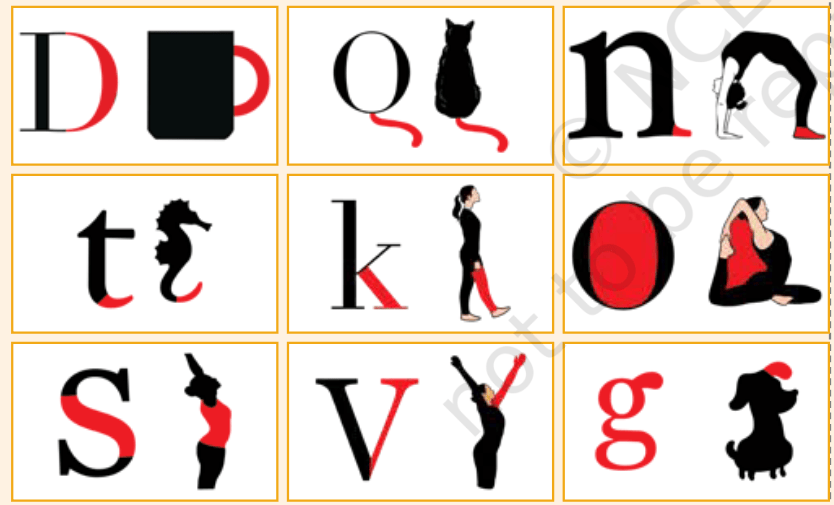
Step 1: Choose a letter from any script you are familiar with.
Step 2:Take a sheet of paper and write the letter you have chosen in different ways.
Step 3:Start by writing letters freely. Use your non-dominant hand, and see the lines and shapes that are formed. Use different kinds of pens, pencils and other writing tools. Make the letters big and small.
Step 4:Take another sheet of paper. To structure the same letter, mark a baseline, top line and a middle line.
Step 5:Mark vertical lines to create a grid. This will help you estimate the width of each alphabet, as well as the space between each letter.
Step 6:Create five variations of the same letter. Use the guidelines to alter the height, width, angles and line-thickness of the letters to achieve different styles. Begin writing the letter, keeping in mind its anatomy.
Step 7:Share your work with your peers. Discuss how you wrote one letter in different ways.
ACTIVITY 19.4: WRITING LIKE WE SPEAK
When you speak to people, you modulate your voice which creates a variation in the volume. Doing this conveys various emotions. For example, when you wish your friend “Happy Birthday!” you say it with excitement and joy, whereas when you say, “Get well soon”, you say it calmly and show concern.
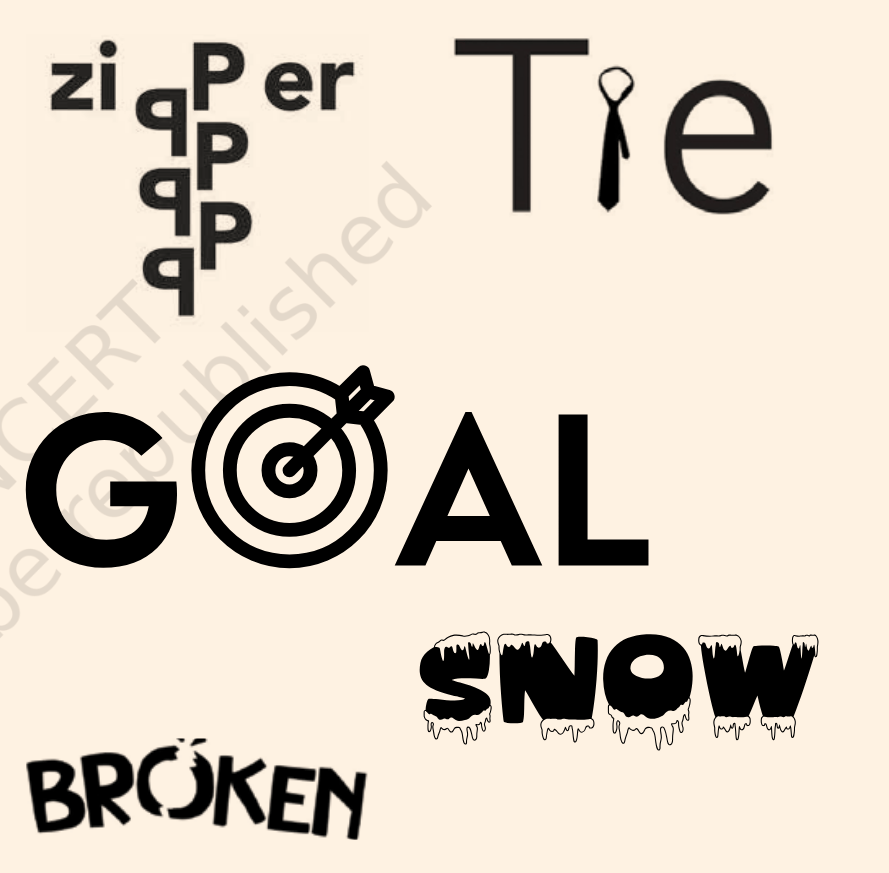
If we relate it to writing, it could be that a loud voice is written in big, bold letters, whereas softer voice is written in small letters.
Now, why don’t you try to shape letters in a variety of ways to convey the meanings and emotions of words?
Look at the examples on the right side and try creating your own in a language or script that you are comfortable with.
Note to the Teacher:

Calligraphy skills are used in a variety of professions and vocations — tattooing, graphic art, illustration, animation, and so on.
ACTIVITY 19.5: CALLIGRAPHY IN POSTERS
All In A Name
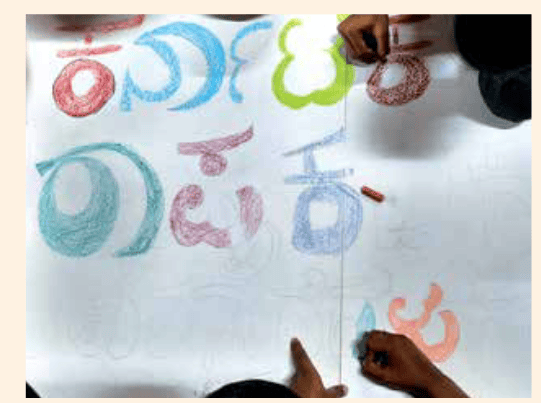
A lot of thought goes into naming a newly born child, similarly, a lot of effort is put for titles of books, plays, films and awareness campaigns. Letter styles, types and fonts play an important role in promotional materials. Recall various posters you have seen. Discuss the different kinds of information they contain and the text arrangement in the poster layout. Apply your calligraphy skills to make a poster for a play or any other school event.
Step 1: Choose a name or title for your play or event.
Step 2:Decide the letter style, size and colours for the title. The way you style letters can give readers an insight into the nature of the event. If it is a play, you can convey whether the play is happy, sad or contains suspense.
Step 3:Mark the guidelines and margins while writing the text.
information in a poster
After finalising the letter style of the title, proceed to write other information on the poster like:
- Date, time and venue;
- Contact information, and
- Names of people, organisations, institutions, performing troupes, etc.
For these, your letter styles should be clear and easily readable. Choose suitable sizes to indicate their importance and use guidelines while writing.
Add visuals and complete your poster for display.
| CHAPTER 19: The art OF CALLIGRAPHY | ||||
|---|---|---|---|---|
| CG | C | Learning Outcomes | Teacher | Self |
| 1 | 1.1 | Writes letters and words in different styles to convey feelings and emotions | ||
| 2 | 2.2 | Connects letter styles with personal ideas and emotions | ||
| 3 | 3.1 | Experiments with different mediums and tools while doing calligraphy | ||
| 3 | 3.2 | Identifies and copies from familiar lettering styles while making their artwork | ||
| 3 | 3.2 | Cautious towards margins, alignment and spacing in calligraphy projects | ||
Teacher’s Comments and Student’s Observations
| Activity for Assessment (Example) | Criteria for Assessment | |
|---|---|---|
| Individual | Self-portrait with object or word
|
Pays attention to
|
| Group |
|
|
Teacher’s Comments and Student’s Observations