
Unit 1: Foundational Basis of Physical Education and Well-being
This unit highlights the connection between physical activity and personal growth, emphasizing fitness, mental resilience, teamwork, and the importance of safety rules. Students will develop motivation, courage, and discipline to take on physical challenges, track their progress, and stay committed to self-improvement. They will also learn to recognize and report bullying, mental health concerns, and inappropriate behavior, helping to create a safe and respectful environment.
IPE - 1
The Ball Progression Game
The Ball Progression Game is a fun and engaging activity that helps in improving coordination, teamwork, and ball-handling abilities. It challenges us to work together as we progress along a series of markers while passing the ball back and forth.
|
Warm-up |
Skill |
Cool-down |
Circle Time |
|
Wrist Rotation Hip Circles |
The Ball Progression Game |
Slow/Static stretching |
Feel the muscle |
How to play?
• Draw a rectangle measuring 20 by 10 metres on the playground.
• Place markers at regular intervals from the centre line of the rectangle.
• Divide the students into pairs.
• Three pairs will play at a time, while the other pairs stand on the markers behind the end line.
• Each pair stands facing one another at the marker nearest to the centre line.
• The ball is passed to a partner by the student holding it.
• The partner catches the ball and throws it back.
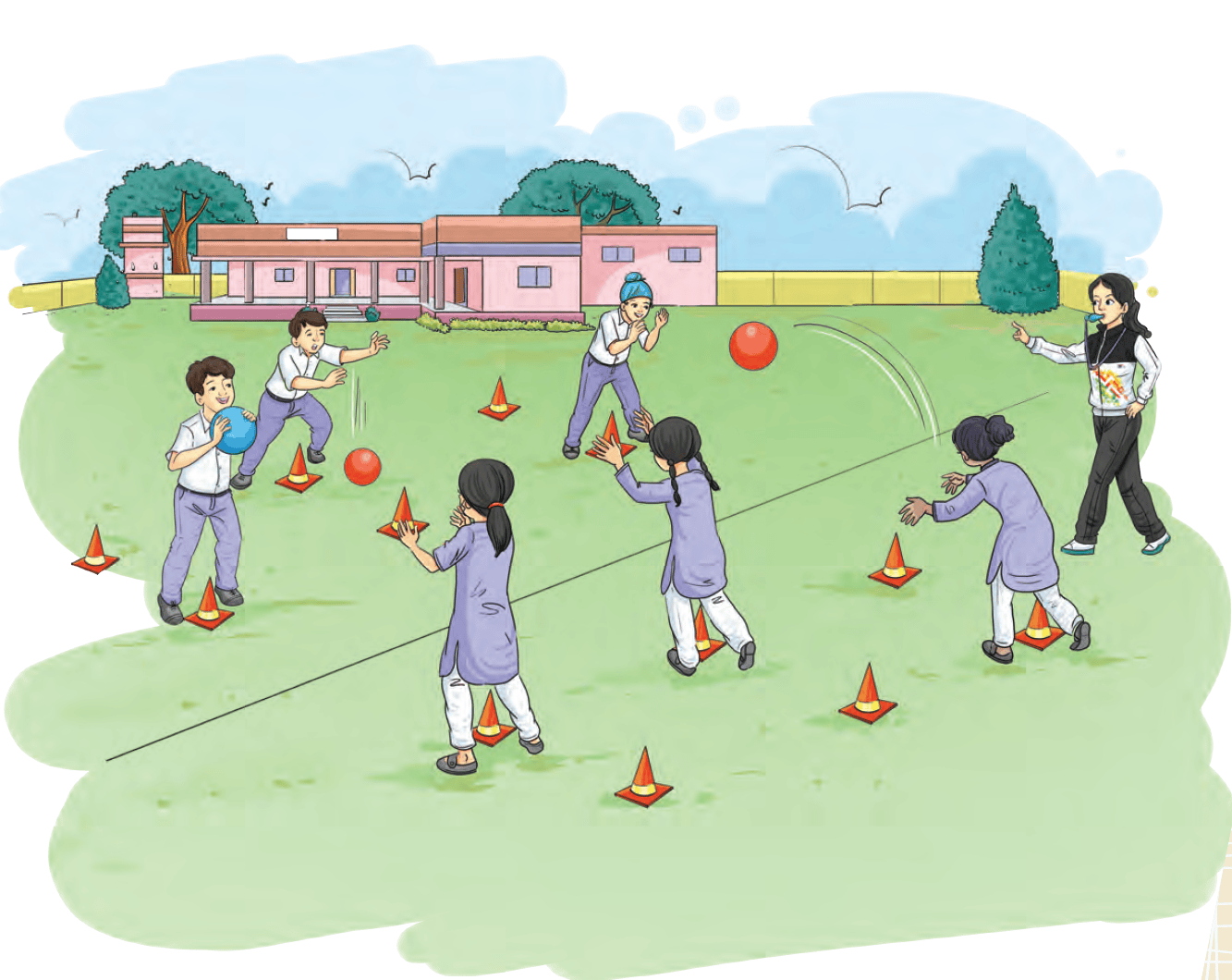
• Following a well-executed catch and pass, both students move on to the second marker.
• After every throw and catch, the students will move in the direction of the marker.
• When a pair reaches the final marker, the students pass the ball to the next pair.
• The game keeps going until each pair gets their turn.
Circle Time – Feel the muscle
• Stand in a circle and take a throwing stance.
• Feel your own muscles in the legs, that are tight and soft, by gently touching them.
• Ask your teacher about the name of the muscle and write it down.
• You can also perform this activity in pairs and ask your partner to identify the muscles which tighten while performing an action.
Note for the teacher
Encourage students to observe and identify the forearm and other muscles during the activity, emphasising awareness and respect for personal boundaries while fostering gender sensitivity.
Pop UP
Did you feel the different muscles in your upper and lower body while throwing and receiving the ball?
IPE - 2
Ghorpadiche Shepoot
Ghorpadiche Shepoot is a thrilling and enjoyable approach to improve cooperation and physical capabilities. Get ready to run with the ghorpad (also known as goh or goyra) and enjoy the excitement of the chase!
|
Warm-up |
Skill |
Cool-down |
Circle Time |
|
Side Walk, Back Walks, Jogging Drills |
Ghorpadiche Shepoot |
Single-leg Knee Hugs, Double-leg Knee Hugs |
Working together |
How to play?
• Students should be divided into groups of five to eight students each.
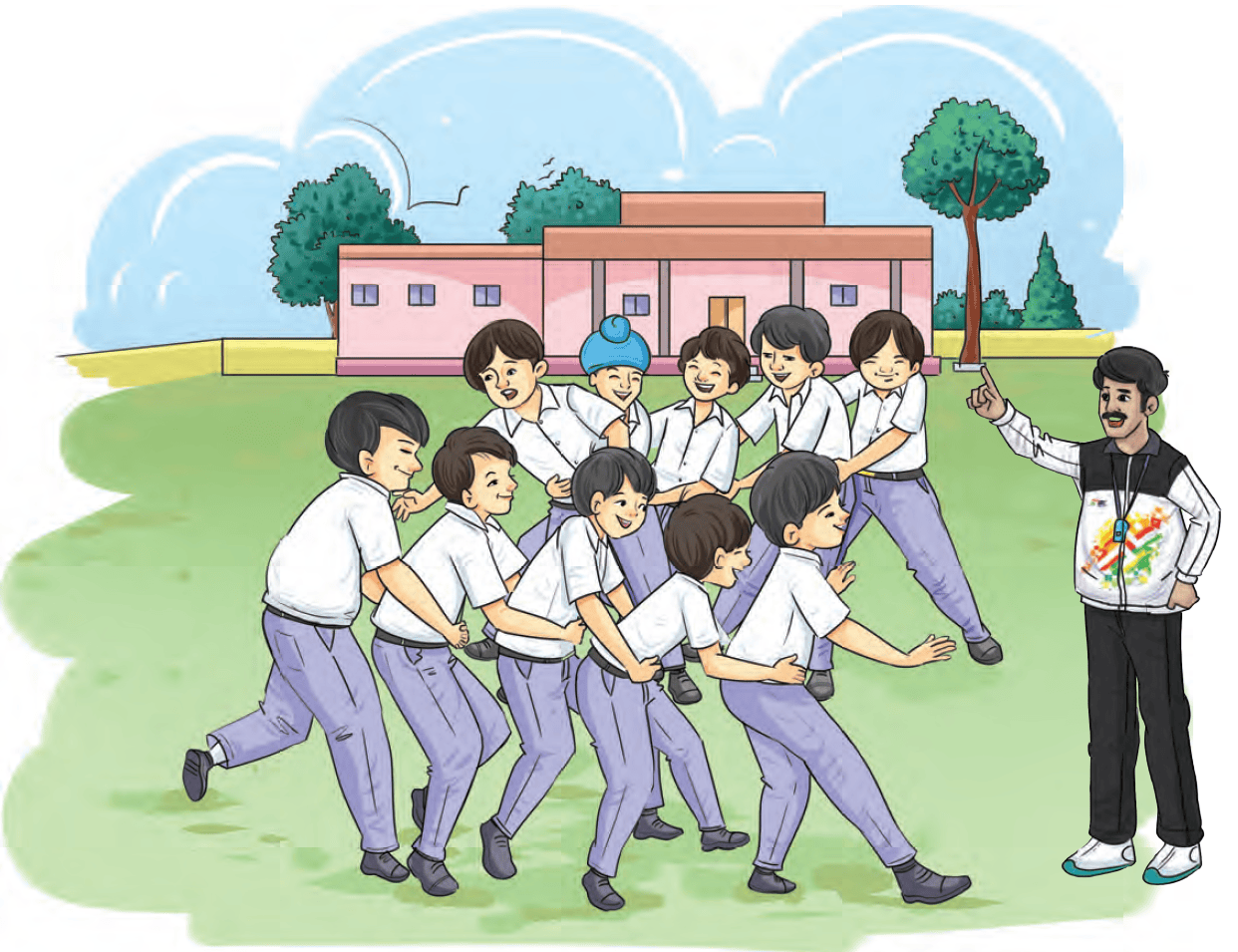
• Each team lines up, holding the person in front of them by the waist to form a Ghorpad.
• Draw boundaries for the play area with cones or markers.
• One team’s “head” (the person at the front of the line) must be in contact with the other team's "tail" (the student at the back of the line) without letting their own tail getting touched.
• Teams start moving together at the teacher's signal, with heads attempting to touch the tails of other teams.
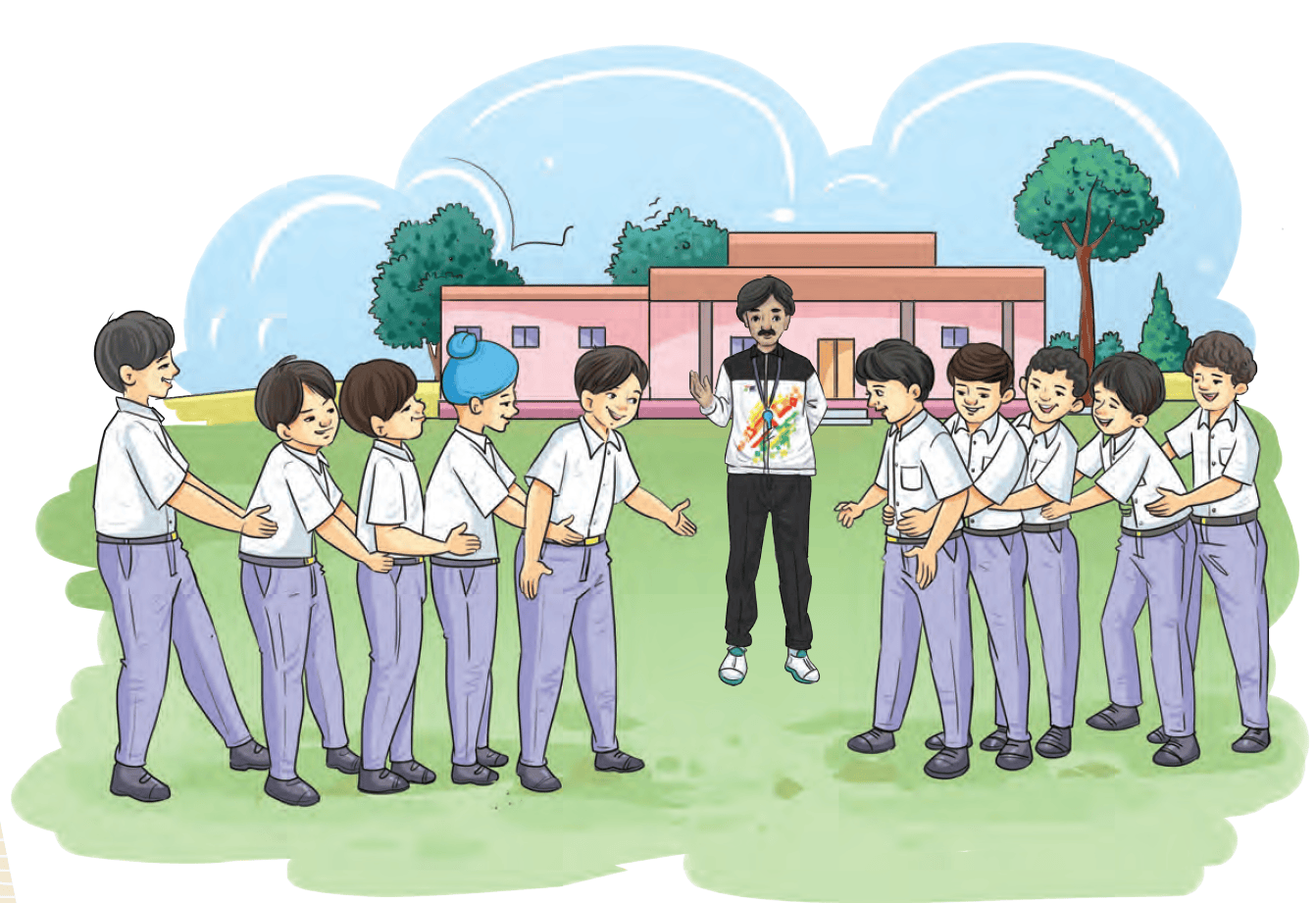
• Students need to maintain communication and unity within their team.
• When a team’s head successfully touches another team's tail, they score a point.
• Students can choose to keep playing without resetting their positions when a point is scored.
• The game will be played for a set duration of time (let’s say 10 minutes).
• The team with the most points at the end of the given time frame wins.
Circle Time – Working together
• Ghorpadiche Shepoot is about moving together and moving fast. Discuss what helped you move fast and better.
• Have you seen a centipede (Kanchala)? Observe how it moves its legs. How would you move your legs together to move fast?
• Discuss how Marathi warrior Tanaji Malusare used Ghorpad to win the castles.
Pop Up
In a team game, coordinated movements help you achieve better results.
IPE - 3
Nalugu Rallu Ata
Nalugu Rallu Ata is a traditional Indian game, popular in the southern regions, especially in Andhra Pradesh and Telangana. The name means ‘Four Stones Game’. Played by five participants, this game involves strategic movement and teamwork to avoid being caught by the ‘denner’ while collecting stones.
|
Warm-up |
Skill |
Cool-down |
Circle Time |
|
Leg Stretches, Ankle Rotations, Arm Swings, Alternate Toe Raise |
Nalugu Rallu Ata |
Quadriceps Stretch, Forearm Stretches (Wrist Flexors and Extensors Stretching) |
Growing mentally strong |
How to play?
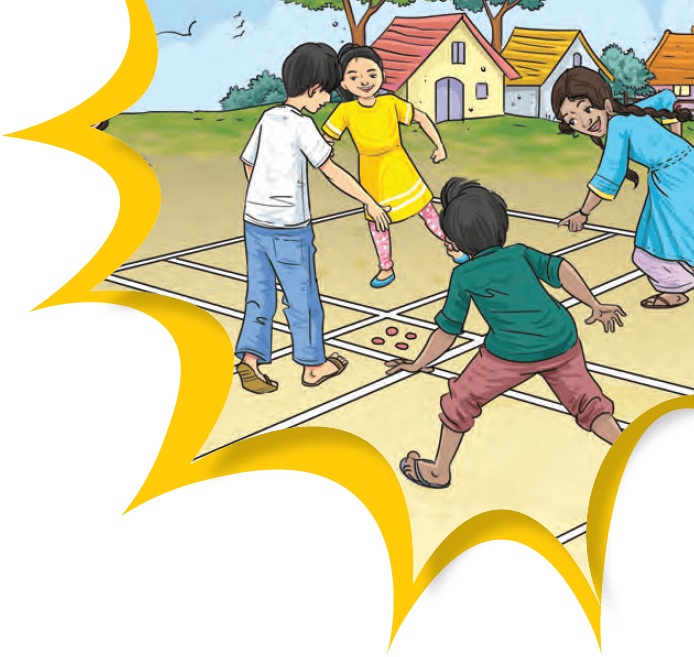
• Draw the court as shown in the figure having boxes and a path.
• Place four stones right at the centre of the path.
• Four students take their positions inside their respective boxes, and four stones are placed at the centre of the path as shown in the figure. The fifth person will be the denner.
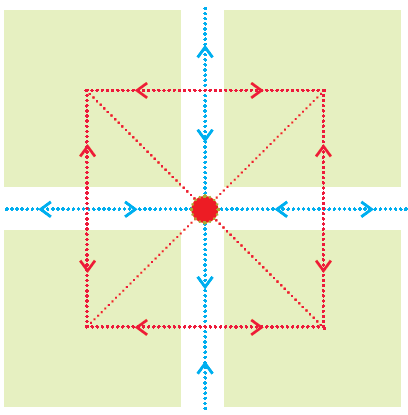
............Students movements
............Denner's movements
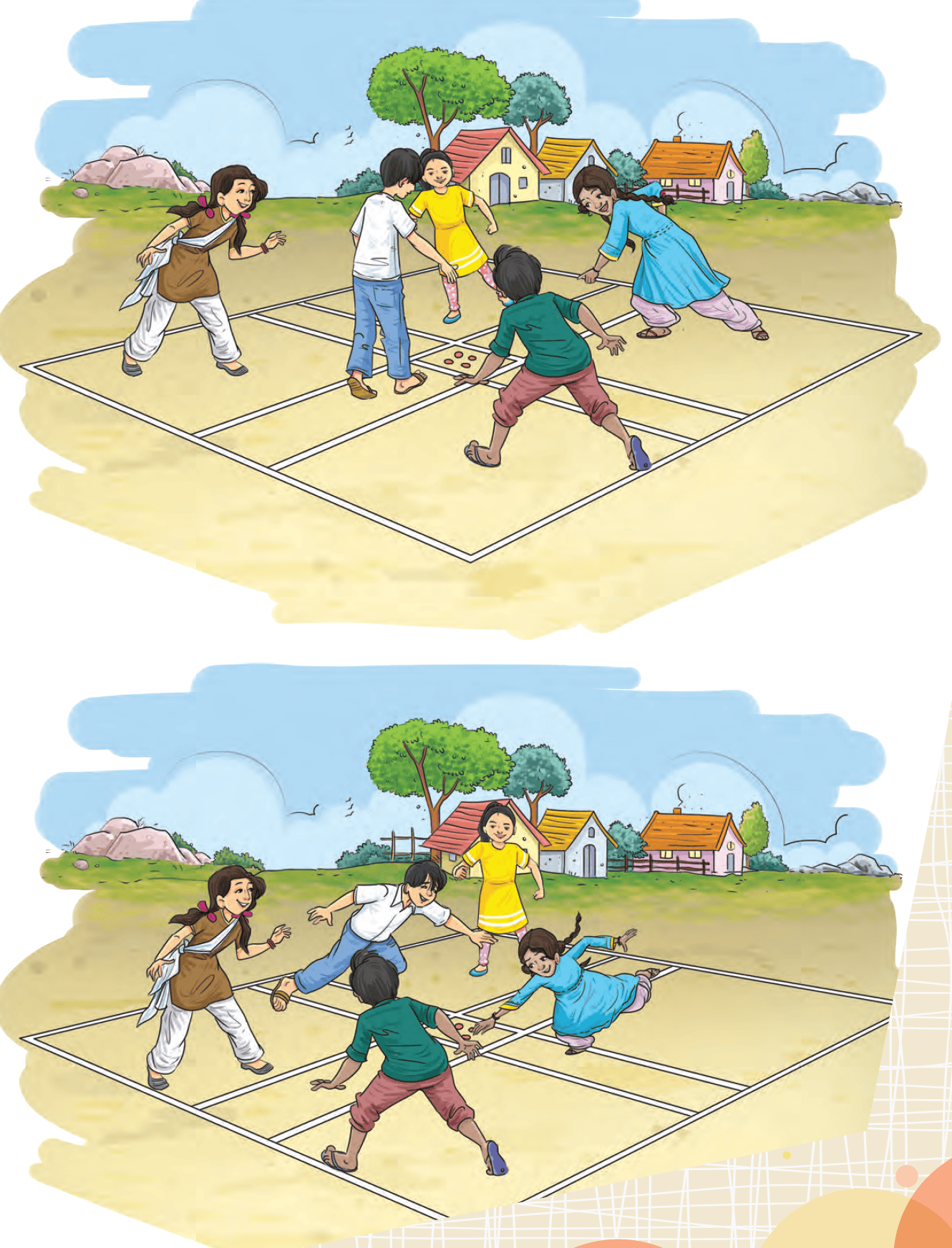
• The objective of the students is to pick up the stones without being caught by the denner, who cannot enter the boxes but can move in this path.
• Students can collaborate or act independently to pick up the stones and distribute them amongst each other, with each student ultimately having one stone.
• Once all students have their stones, they ask the denner to choose either ‘Gumpu’ (Group) or ‘Chuttu’ (Circling).
• If the denner chooses ‘Gumpu’, all students gather in one selected box with their stones.
• If the denner chooses ‘Chuttu’, each student must make three rounds around the boxes and return to their original position, while avoiding the denner’s touch.
• Students are out if they are touched by the denner while moving between boxes. The game continues until one student is out.
Circle Time – Growing mentally strong
• Discuss with your classmates who all had the fear of being caught while crossing the boxes.
• How did you handle the fear of being caught, failure or being eliminated from the game?
Pop Up
Focus on learning new skills and process of playing the game and not on the outcome of the game. This will help you grow mentally strong.
IPE - 4
Gidhada Gudkavan
Gidhada Gudkavan is a traditional Indian game that replicates a chase between a hawk (gidhada) and chickens (gudkavan). The game, popular in rural areas, encourages agility, teamwork, and strategy as the hawk tries to tag the chickens, while the mother hen leads the chickens to safety. This fast-paced game has been passed down through generations as an exciting and playful way to stay active.
|
Warm-up |
Skill |
Cool-down |
Circle Time |
|
Shoulder Rotation, Side Lunges, Arm Swings |
Gidhada Gudkavan |
Quadriceps Stretch, Overhead Arm Stretches |
Working for each other |
How to play?
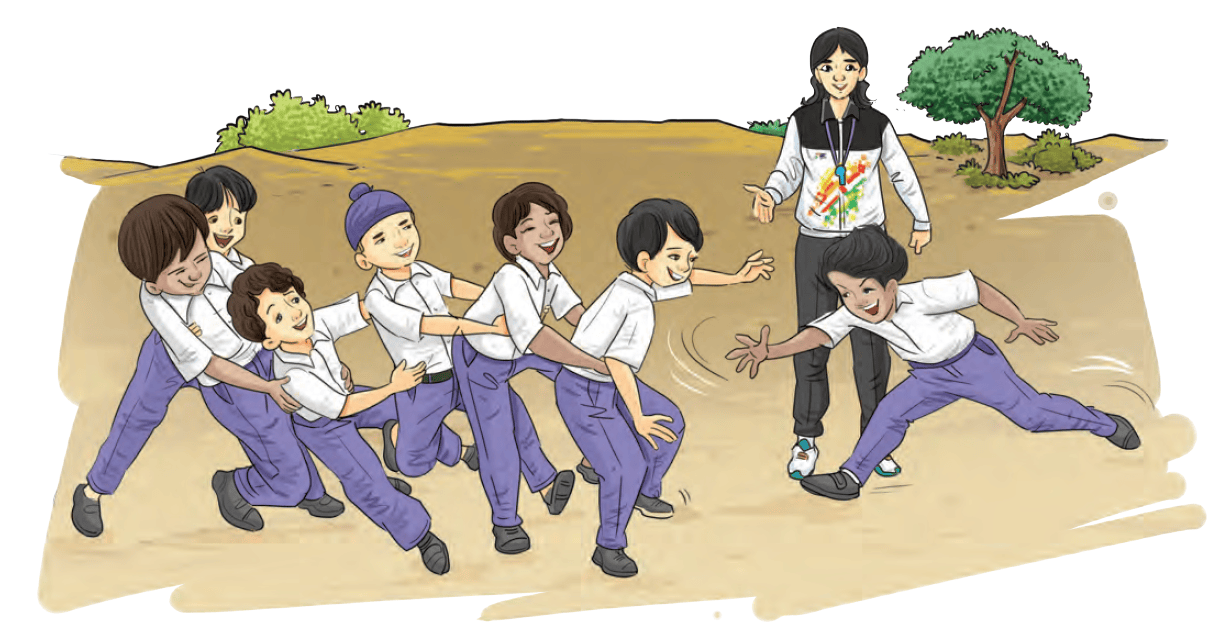
• Choose one student to be the hawk (Gidhada), while the rest of the students (mixed gender) are chickens (gudkavan). The chickens line up behind a leader, the ‘mother hen’.
• The hawk’s goal is to tag the chickens, symbolising catching its prey. The mother hen’s role is to protect the chickens by leading them away from the hawk’s attempts to tag them.
• The chickens hold onto each other’s waists, forming a chain behind the mother hen.
• The hawk tries to tag the last chicken in line while avoiding being blocked by the mother hen, who tries to shield her brood.
• The game continues until all the chickens are tagged or the hawk gives up.
• Once a chicken is tagged, they are out of the game. The last remaining chicken becomes the next hawk.
• Encourage students to stay focused, move quickly, and use strategy to avoid being tagged.
Circle Time – Working for each other
• What role did you play in saving the last chicken from the hawk?
• Discuss how students of different genders and abilities will strategise to save the chicken.
Pop Up
Winning as a team is far more important than achieving individual milestones and performance goals.
IPE - 5
Stand Up, Speak Out
Stand Up, Speak Out or Bully Role Play is an effective activity for learning about the effects of bullying, identifying its various forms, and practicing suitable reactions. Students may explore various viewpoints—those of the bully, the target, and the bystanders—through role-play and learn appropriate responses in practical scenarios.
|
Warm-up |
Skill |
Cool-down |
Circle Time |
|
Sideward Bending And Skipping Jumps, Hip And Pelvic Muscle Stretch |
Stand Up and Speak Out |
Arm Swinging, Shoulder Shrug, Hamstring Stretch, Calf Stretch |
Treating each other well (effects of bullying) |
How to play?
• Divide the students into two teams.
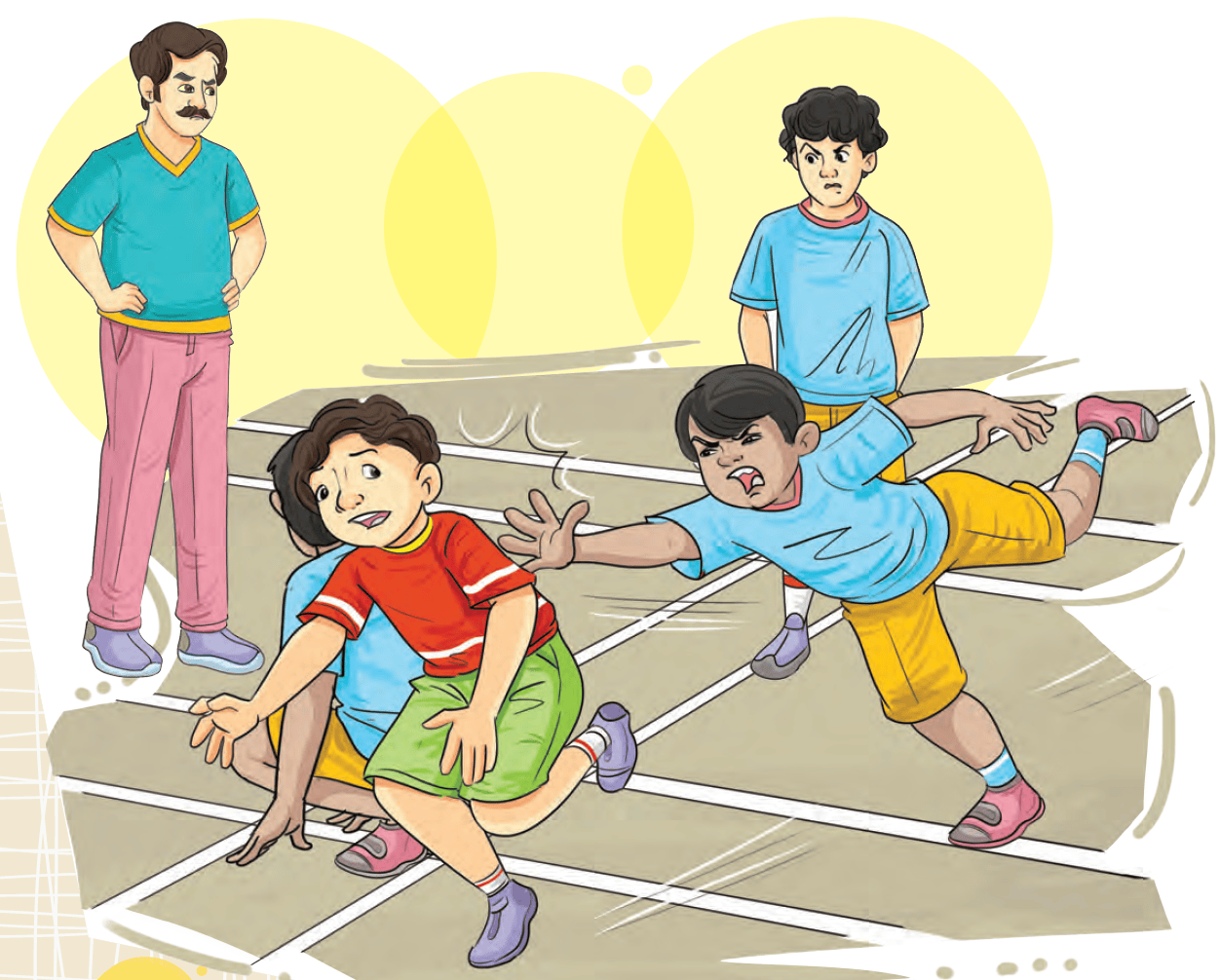
• Students will be playing kho-kho.
• Teacher will secretly assign roles to four students from the team, who will not share their roles with other students:
1. Bully (the one doing acts of bullying) – bully will deliberately tease other students by different names or push them or display anger.
2. The target, or the victim of bullying – the target while knowing that the bully is not doing this on purpose acts as if they are a victim.
3. Bystanders are individuals who observe bullying but do not do anything and some of them join the bully in harassing the victim.
4. An up-stander is a bystander who chooses to take action and confront the bully.
5. After the game, the students will discuss the acts of bullying during the circle time.
Circle Time – Treating each other well
Discuss the following questions while sitting in a circle
• If you were bullied, how would you feel?
• Why does somebody engage in bullying?
• What did the bystanders do, and how did their actions affect the situation?
• What could have been done differently to prevent or stop bullying?
Pop Up
Treat others the way you want to be treated. Treating others well will make you happy.
IPE - 6
Harassment Prevention Skit
Harassment Prevention Skit is to build students' confidence in handling difficult situations and to promote a culture of respect and safety. Harassing anyone physically, mentally, or emotionally can lead to serious repercussions for both the victim and the harasser. Through this activity, we will learn how to eliminate this harmful act from our society.
|
Warm-up |
Skill |
Cool-down |
Circle Time |
|
Exercise of Facial Expression Manifesting or Depicting Anger, Happiness, Pain, Pleasure and Anxiety |
Harassment Prevention Skit |
Deep Breathing Exercise to Control Anger and Anxiety |
Treating each other well |
How to play?
• Make groups of 7–8 students.
• Prepare a set of scenarios that can include situations like someone making uncomfortable (which has sexual undertones) comments, inappropriate touching, poking or peer pressure as per the POCSO Act.
• Assign different roles to different students in each scenario such as the perpetrator/offender and the victim.
• Describe the objective of the role-playing exercise. Explain that it is to show the harassment as per the understanding of the students.
• Students enact the scenarios according to the roles they have been assigned.
• Encourage them to share their thoughts and feelings about each scenario.
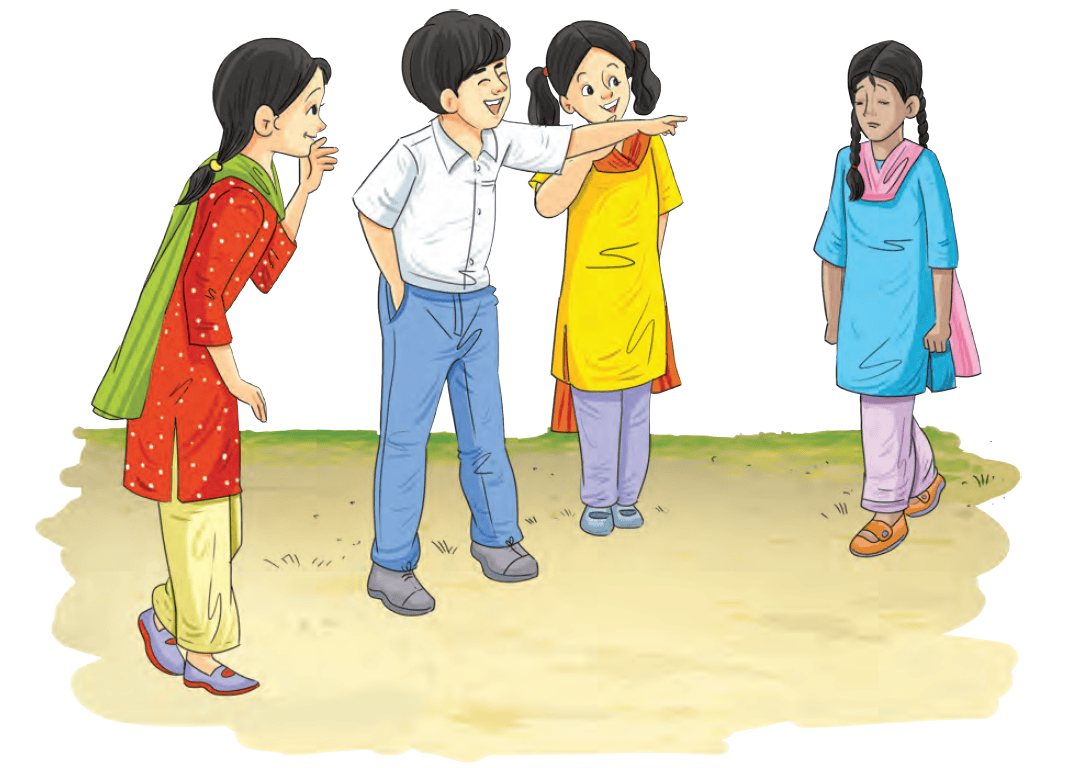
Circle Time – Discussion about the harassment prevention
Discuss on the following topics while sitting in a circle:
• What was challenging about responding to the situation?
• How would you handle a similar situation in real life?
Note for the teacher
• Please read the prevention of sexual harassment under the POCSO Act before conducting this activity.
• Teacher must provide different scenarios to groups of seven to eight students and ask them to prepare a different skit.
• Ensure that all of the possibilities in role plays are hypothetical and that this is a safe place for learning.
• Be sensitive and prepare a skit in such a manner that students can share their feelings openly.
• Identify the good touch and bad touch.
• Also, make students aware of where to report such incidents and seek help.
Pop Up
Sexual harassment is a punishable offence. It can lead to severe legal punishment.
Self-Assessment
Read the statement and tick the most suitable answer for you.
Safety on the Ground
|
1 |
2 |
3 |
4 |
5 |
|
I think the games could be safer |
Some games are safer than others. |
Most of the games are safe. |
All the games are safe. |
If the games are not safe, we change them to make them safe. |
Caring Attitude
|
1 |
2 |
3 |
4 |
5 |
|
I like to play alone. |
Sometimes, I like to play with my classmates. |
I like to play in the group most of the time. |
I always like to play in a group. |
I like playing in a group because I can understand the benefits of playing with others. |
Understand Bullying
|
1 |
2 |
3 |
4 |
5 |
|
Bullying does not happen around me. |
Bullying happens around me, and I am able to identify bullying. |
I am able to identify bullying, and I speak up when it happens. |
I am able to identify bullying and sympathise with the victim. |
I am able to stand against bullying if it happens around me. |
Understand Harassment
|
1 |
2 |
3 |
4 |
5 |
|
Harassment does not happen around me. |
Harassment happens, and I am able to identify it. |
I am able to identify harassment, and I speak up when it happens. |
I am able to identify harassment and sympathise with the victim. |
I am able to stand against harassment if it happens around me. |
Emotion Control
|
1 |
2 |
3 |
4 |
5 |
|
I find it difficult to control my emotions. |
I get frustrated only when things are not going my way. |
Occasionally, I lose control and get frustrated, but I recover very soon. |
I am able to stay calm during the game. |
I am able to stay calm and help others to calm down. |