
Unit 2: Physical and Motor Fitness
This unit focuses on improving heart health, muscular strength, and agility through structured exercises and activities. Students will enhance their running, jumping, and movement skills while learning proper techniques for endurance and strength training. They will also explore the importance of warm-up and cool-down routines, ensuring injury prevention and muscle recovery. Through hands-on activities, discussions, and self-reflection, students will experience the role of large muscle groups in movement and develop the ability to sustain physical activity over time. Additionally, they will learn about traditional games from different regions, fostering cultural awareness and diversity in physical education.
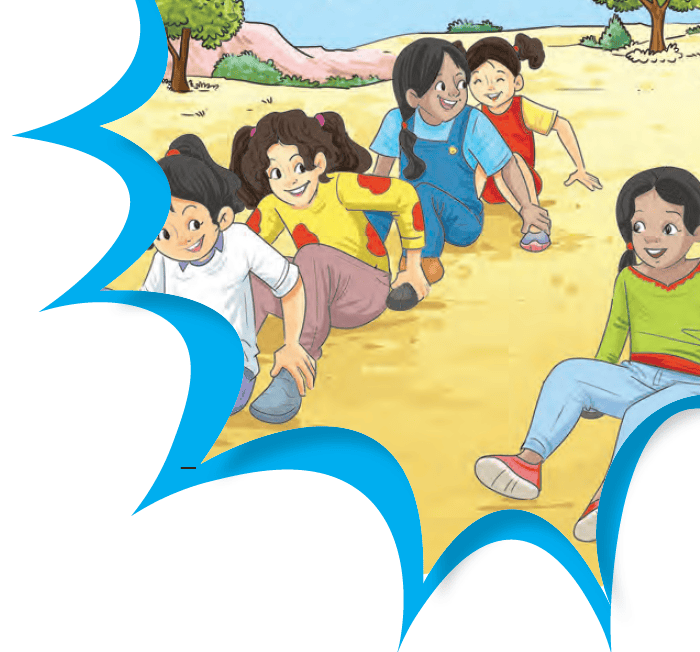
MF - 1
Set It Up, Knock It Down
Set It Up, Knock It Down is an exciting and quick-paced team game that combines strategy, agility and cooperation. Get ready for a fun-filled experience.
|
Warm-up |
Skill |
Cool-down |
Circle Time |
|
Overhead Arm Stretch, Crossed-leg Toe Touch |
Set It Up, Knock It Down |
Calf Shakes, Single-leg Knee Hugs, Both-leg Knee Hugs |
Personal Goal |
How to play?
• Mark an area of about 20 by 10 metres.
• Place the markers randomly throughout the marked area. The number of markers should be more than the total number of students. An equal number of markers should be facing up or down.
• Form two teams of 10 students each. Form two to four team of five to ten students each.
• One team will be ‘Markers Up’ and the other will be ‘Markers Down’.
• Each team member will also count the number of markers they flipped.
• On the whistle, the students of the ‘Markers Up’ team will flip the ‘markers down’ to ‘markers up’ position and vice versa.
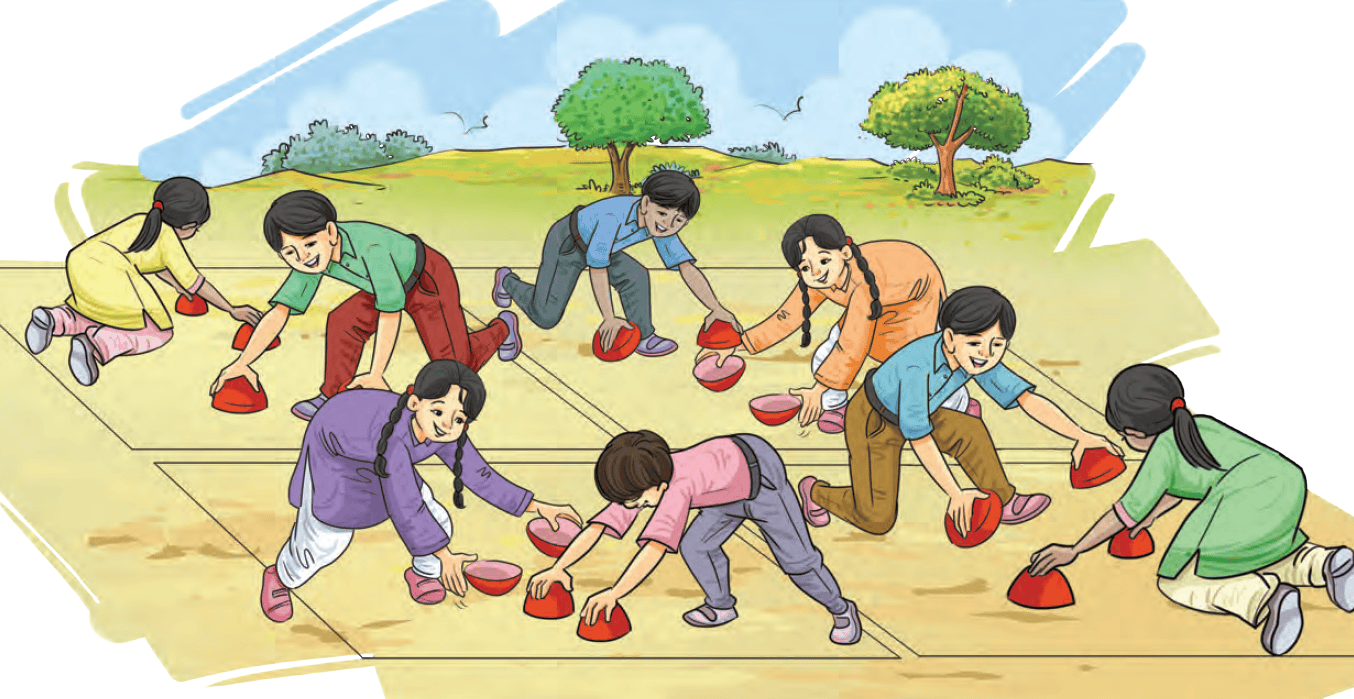
• The game will be played for 2 minutes; the game will be stopped by blowing the whistle.
• Count the number of ‘markers up’ and ‘markers down’ to decide who won the game.
• Play multiple rounds in odd numbers and after each round, each individual will set a higher individual goal of flipping the marker. This activity of setting the goal will be repeated after every round individuals are free to reset their target.
Circle Time – Personal Goal
• Discuss how many times you increased or decreased the goal and why?
• If you were to repeat the same activity, what would you do differently?
Pop Up
Always set realistic but challenging goals.
MF- 2
Dhaan Ki Bori
Dhaan Ki Bori is a lively and entertaining activity where pairs compete by racing with one student carrying the other on their back. It encourages to work in sync and cooperate with others. It helps in developing strength, balance and coordination.
|
Warm-up |
Skill |
Cool-down |
Circle Time |
|
Shoulder Rotation, Quadriceps Stretch and Torso Rotation |
Dhaan Ki Bori |
Calf and Hamstring Stretch, Trunk Backward Stretch and Forward Stretch |
Own body weight as resistance (gravity) |
How to play?
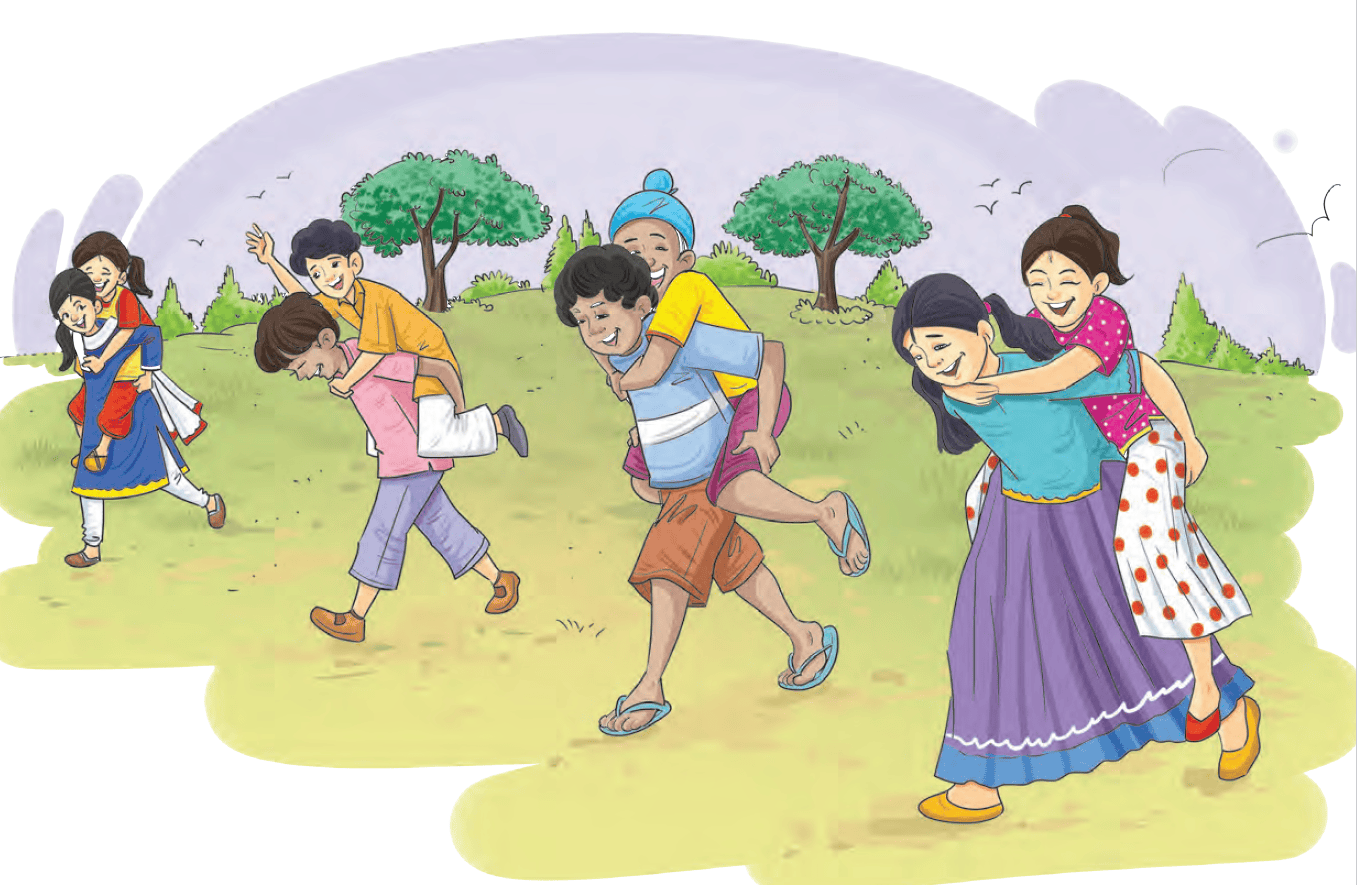
• Form a pair. One student will be the ‘carrier’, and the other will be the ‘rider’.
• The students will take position at the starting line and run towards the finishing line.
• The rider will wrap their arms around the carrier’s shoulders and their legs around the carrier’s waist.
• Race will begin with the whistle, the carrier will run towards the finishing line while carrying the rider.
• After the carrier reaches the finishing line, the roles will switch carrier will become the rider and rider will be the carrier. The pair will come back to the starting line to finish the race.
• The pair who finishes first will be the winner.
Circle Time – Own body weight as resistance (gravity)
• Discuss within your group to identify who found the race more challenging and why.
• List down some games or activities where you have to work against gravity, such as pull-ups or holding a plank.
Pop Up
Use the different body postures to increase the difficulty.
MF - 3
Caterpillar Race
Caterpillar Race is an enjoyable and demanding team activity. It emphasises the value of teamwork because each team member’s contribution is essential to the group’s success. It helps to develop coordination and timing because all team members have to work together to progress. It is a fantastic method to have fun, build unity among participants, and inspire teamwork.
|
Warm-up |
Skill |
Cool-down |
Circle Time |
|
Forward and Backward Bending, Crossed Toe Touch |
Caterpillar Race |
Calf Shaking, Both Knee Hugs |
Working with others |
How to play?
• Students will form different teams. The number of students per team can vary depending on the size of the group.
• Form a straight line, each team member sits on the ground behind the others.
• Each student extends their arm to hold the ankles of the student behind them.
• The team slides on the ground to move forward in sync. The idea is for every member of the team to move together mimicking a caterpillar’s motion.
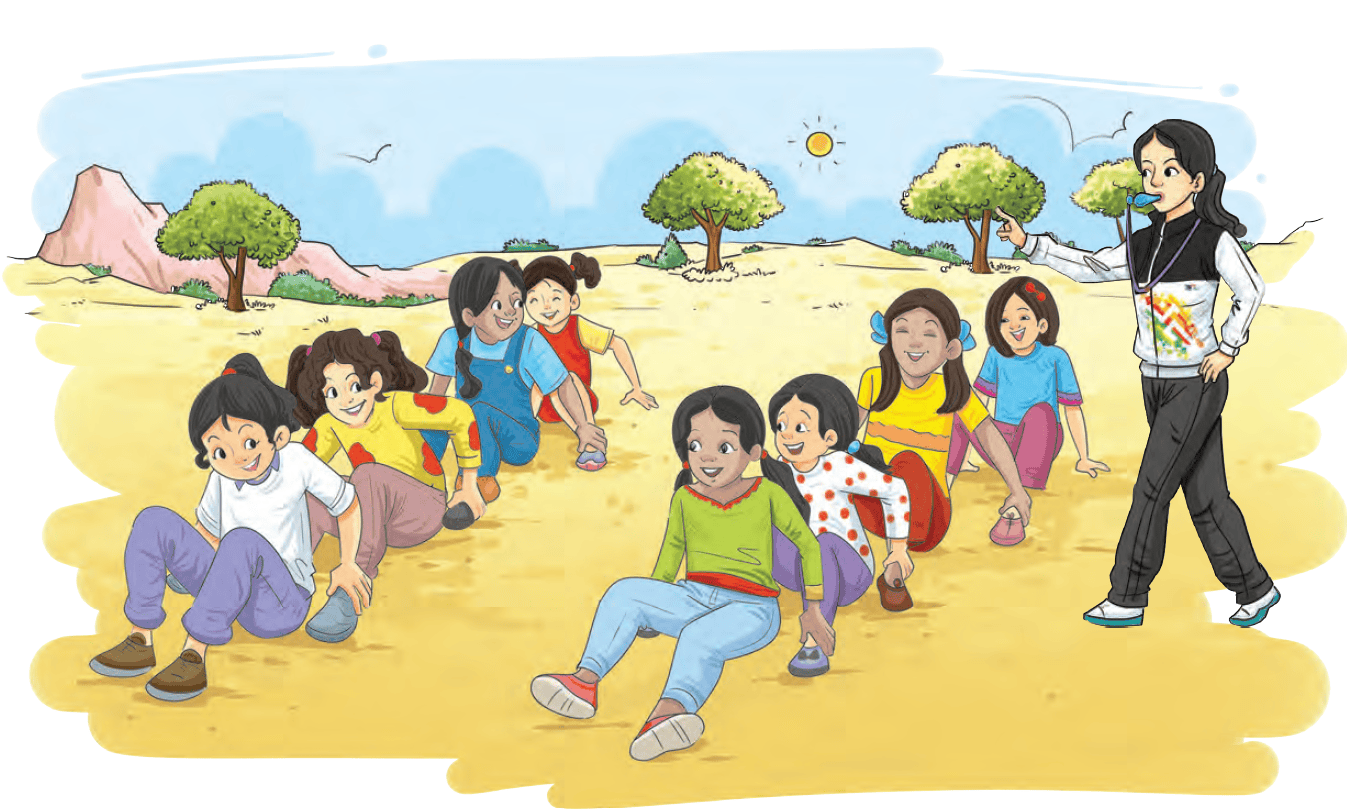
• The team members use their legs and arms to push and pull themselves forward while maintaining their grip on the ankles of the student at the back.
• The first team to cross the finish line with all members still connected in their original positions wins the race.
Circle Time – Working with others
Discuss the movements which helped you move better together and discuss the movements which created an obstacle or hindrance.
Pop Up
Coordinated movements improve efficiency.
MF - 4
Count and Connect Game
Count and Connect Game is an interactive outdoor activity that combines movement while working as a team. The goal is to find a partner or form groups according to the number called out by the teacher.
|
Warm-up |
Skill |
Cool-down |
Circle Time |
|
Forward and Sideward Lunges with Trunk Rotation |
Count and Connect Game |
Deep Breathing, Ground Touch |
Types of resistance |
How to play?
• Mark a circle on the ground.
• Students will move around the circle. As per the teacher’s instruction, if the teacher says frog jump students will move while performing frog jump, if the teacher says run anti-clockwise then students need to follow the instructions.
• Then, the teacher will suddenly calls out a number. For example- “three!” or “six!”
• The students need to form groups with the exact number of the students as the numbers are called out.
• Students who can’t find the group with the correct number of students, they will either be out and let them sit inside the circle or perform a fun challenge (like doing 10 burpees) given by the teacher and after that they can rejoin the game.
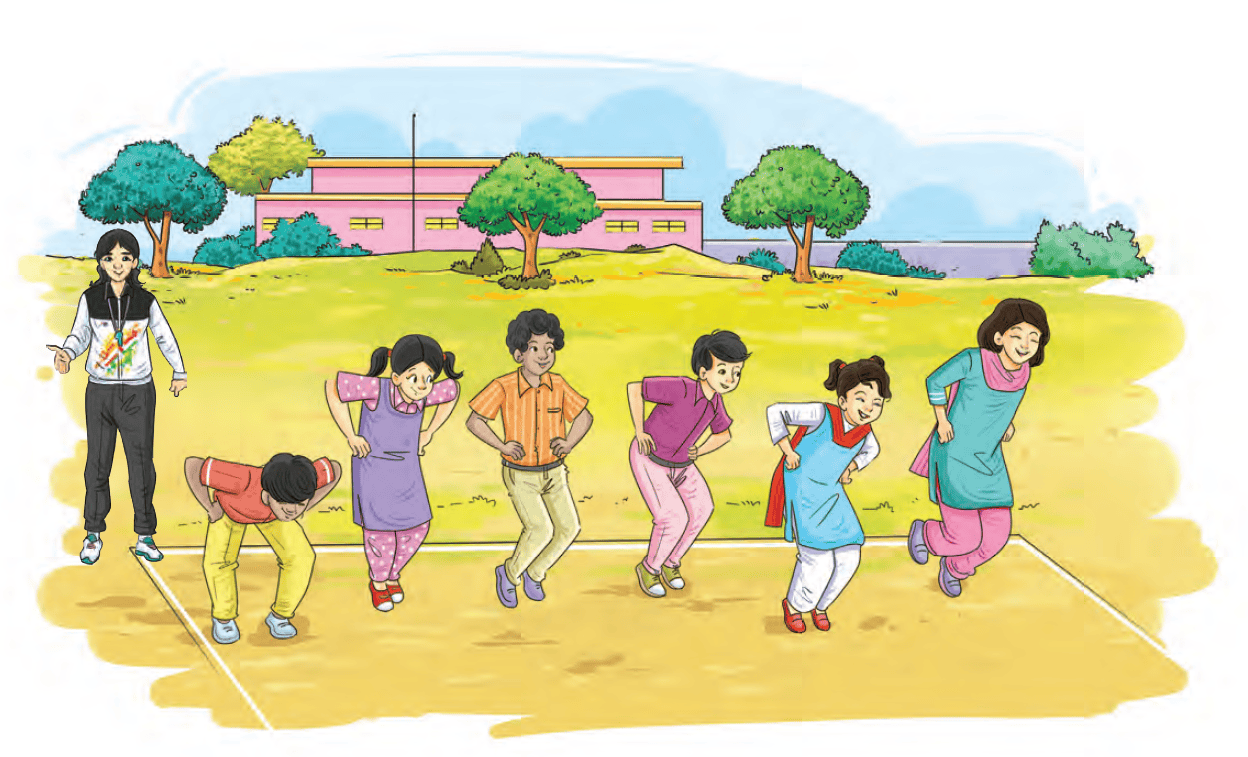
Circle Time – Types of Resistance
While performing different actions (e.g. jumping like a frog, turning directions, running against the wind, swimming) you must have felt different resistance on your body. Name new activities and identify their respective resistance.
Pop Up
Change the resistance to change the difficulty level of the activity.
MF - 5
Skipping Race
Skipping Race is a fun and energetic activity that involves participants skipping to a finishing line. It develops coordination and balance.
|
Warm-up |
Skill |
Cool-down |
Circle Time |
|
Burpees |
Skipping Race |
Quadriceps, Calves and Hamstring Stretch |
Good Technique and Form |
How to play?
• Mark a starting and end line. The distance between the lines can be 20 to 40 metres.
• Divide the students into teams.
• The first student in the lanes will begin the race by skipping the entire distance, alternating feet while hopping, before returning to the starting line and passing the skipping rope to the next student.
• The sequence will continue till the last teammate gets their turn.
• The team that finishes first wins the game.
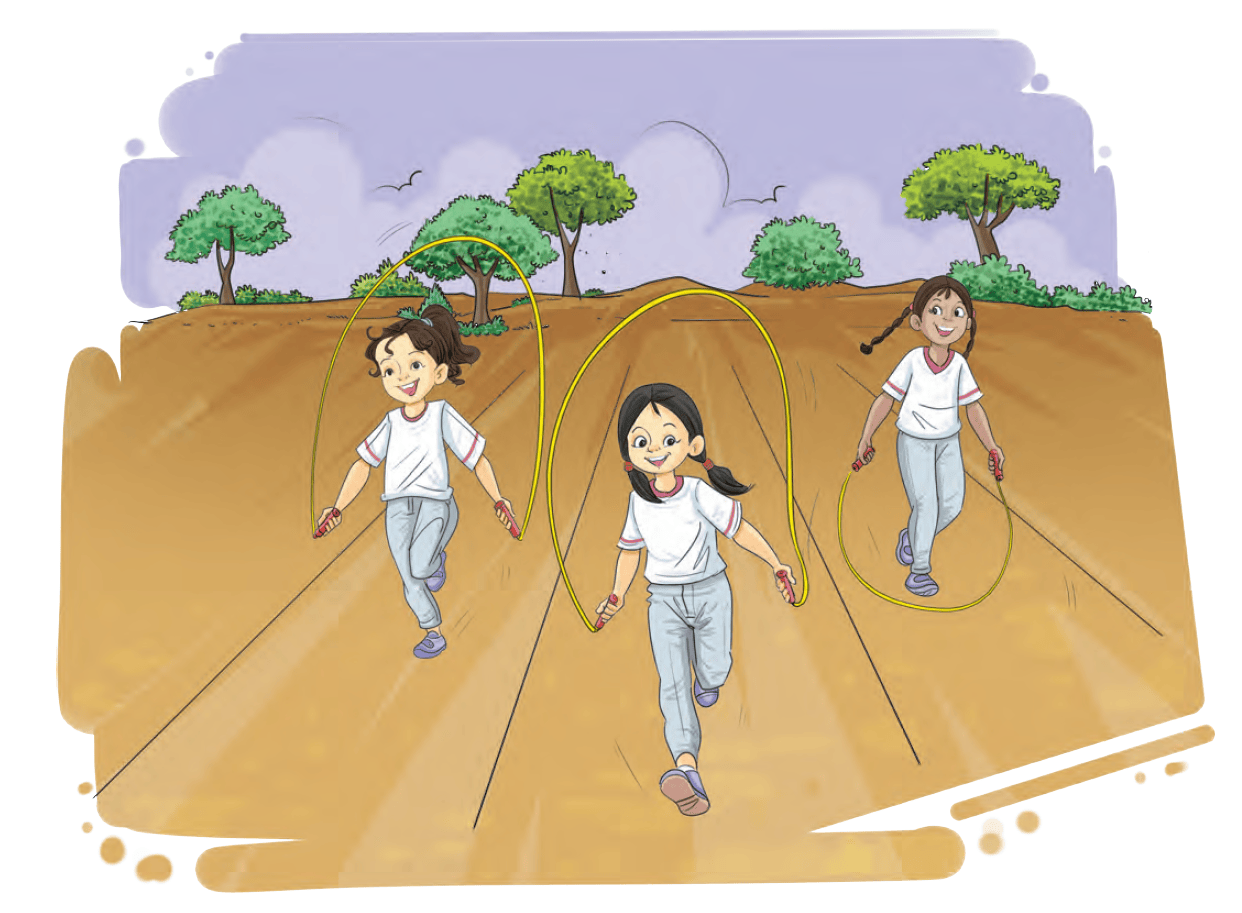
Circle Time – Good Technique and Form
• Identify different techniques adopted by the students and relate it with the ease of doing it.
• Identify the techniques which helped the student to move faster.
Note for the teacher
• The teacher will help the student to understand the importance of correct technique and the efficiency of movement.
MF - 6
Atya-patya
Atya-patya is a traditional Bhartiya tag and running game, often referred to as a game of agility and strategy. The playing field is a rectangular court. The objective is for the ‘runners’ to cross as many trenches as possible while the ‘defenders’ try to tag them out. The game emphasises speed, quick decision-making and teamwork. Similar type of game is played in other parts of the country with different names and rules like Dariya Bandha, etc.
|
Warm-up |
Skill |
Cool-down |
Circle Time |
|
Spot Jogging, Leg Swings and Calf Stretches |
Atya-patya |
Quadriceps Stretch, Hamstring Stretch, Torso Stretch |
Prerequisites for playing the game |
How to play?
• Form two teams, one as the ‘runners’ and the other as the ‘defenders’.
• The runners attempt to cross all nine lanes from one side of the court to the other without getting tagged by the defenders.
• Defenders stand in each lane and can only move sideways within their designated lanes to tag runners. One of the defenders can start and move in the centre lane.
• The runners score points for every lane they successfully cross without being tagged.
• If a runner is tagged, they are out, and the next runner takes their place.
• After all the runners have taken their turn, teams switch roles. The team with the most points at the end wins.
• Ensure safety by encouraging controlled movements and maintaining sportsmanship throughout the game.
• The game ends after 4 innings (scoring turns) of 7 minutes each, with each team having two innings to score. The team that scores more points will be declared the winner.
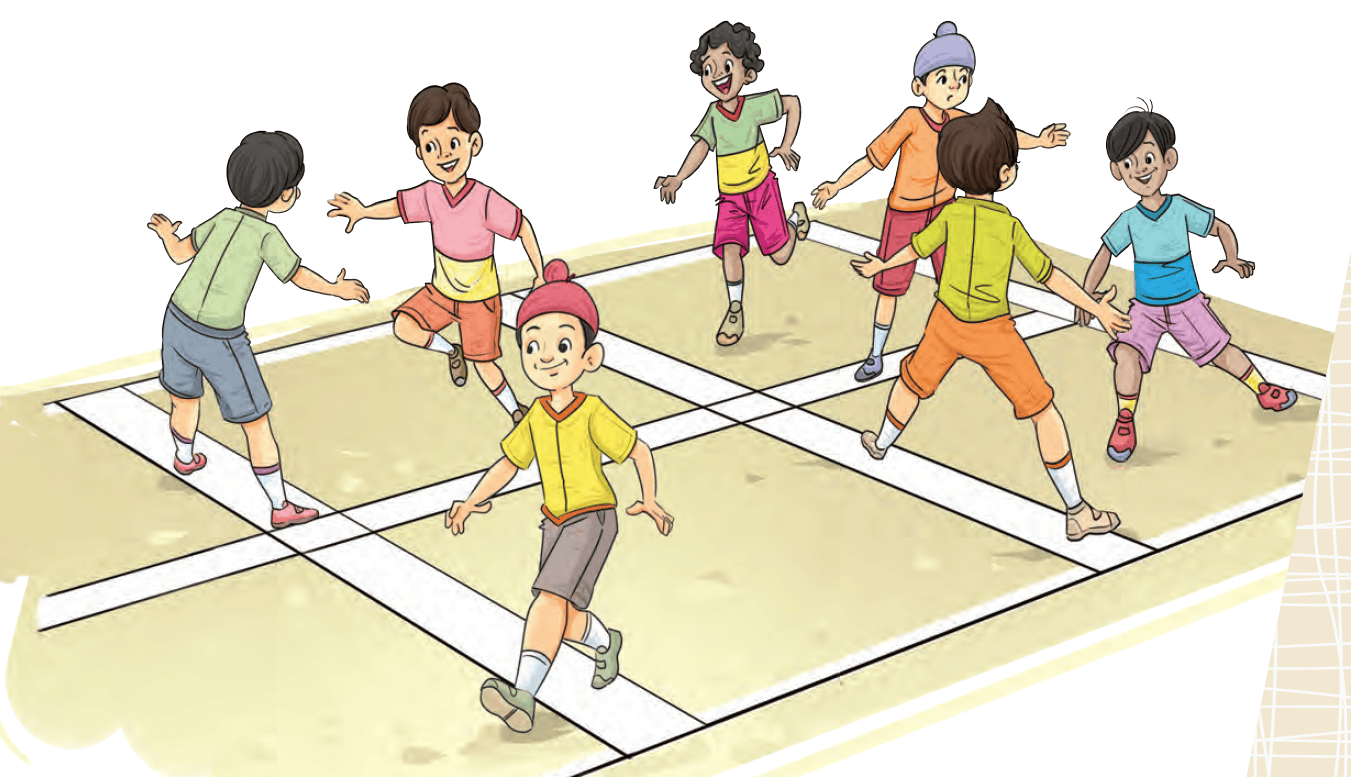
Circle Time – Prerequisites for playing the game
Discuss the prerequisite skills that influence the outcome of the game, for example, changing the direction while running. Describe more such skills.
Pop Up
Prerequisite skills will help you minimise the chances of injury and play the game better.
MF - 7
Food for Health
|
Warm-up |
Skill |
Cool-down |
Circle Time |
|
Jumping Jacks, Lunges, Spot Running |
Food for Health |
Full Body Stretch |
Make your own plate |
How to play?
• Divide the students in two groups, first group will be called as ‘type of food’ and the other will be ‘source of food’.
• Choose four students for ‘type of food’ group and give three students the name of Macronutrients i.e. Protein, Fats and Carbohydrates and one student as junk foods.
• Now give remaining students the name of their favourite food such as soyabean, bread, butter, pizza, etc., and they will be called as ‘source of food’ group.
• On the blow of whistle students will start running in the designated area and the ‘type of food’ group will chase and try to catch its sources.
• Whichever source catches all its sources first will win.
• Reverse the roles in the next round.
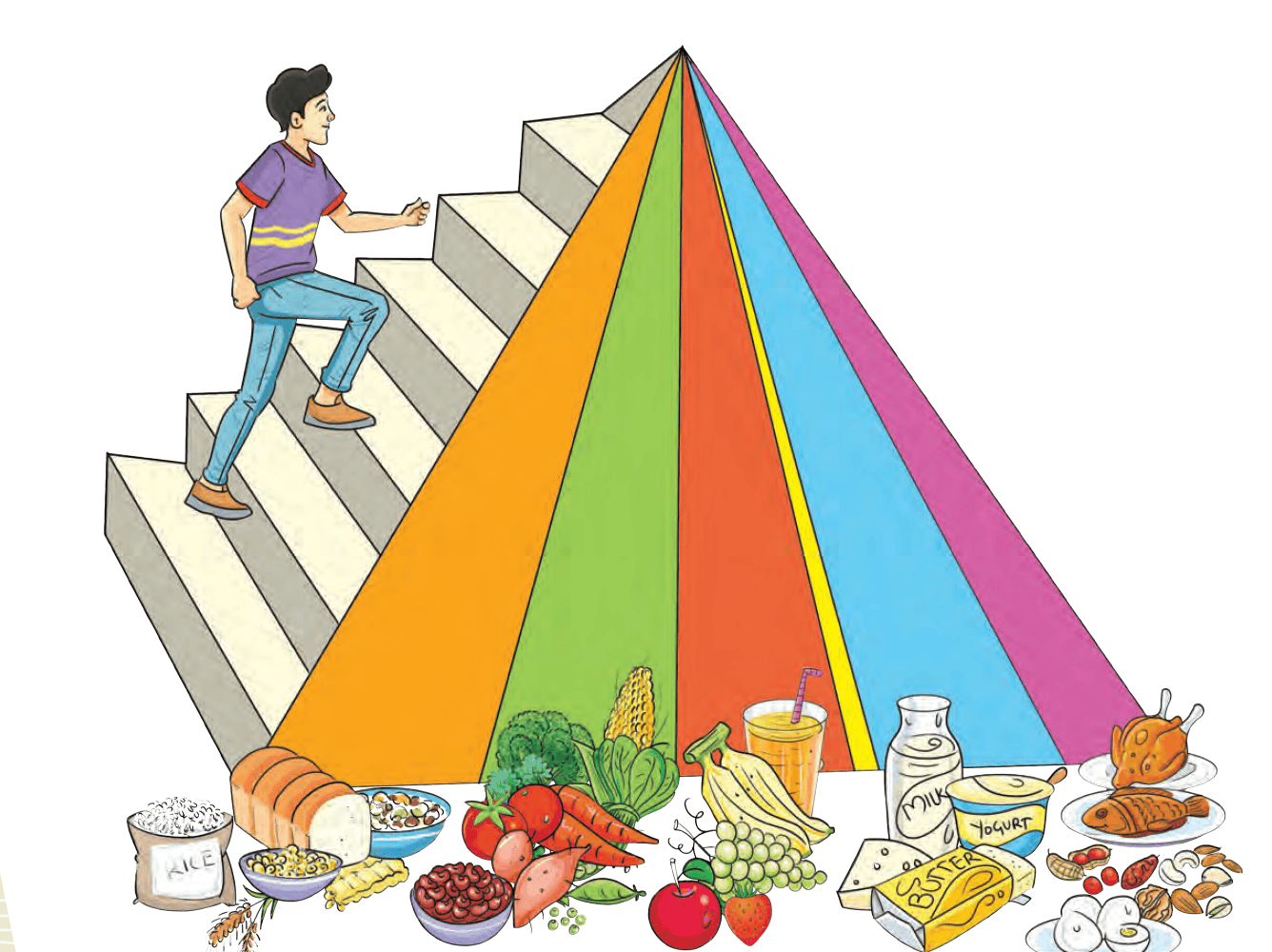
|
GRAINS |
VEGETABLES |
FRUITS |
MILK |
PROTEIN-RICH FOODS |
|
Make half your grains whole Eat at least 85.05 g of whole grain cereals, breads, rice, etc., every day. 28.35 g is about 1 slice of bread, about 1 cup of breakfast cereal or 1/2 cup of cooked rice, cereal. |
Vary your veggies Eat more dark green veggies like spinach and other dark leafy greens. Eat more orange vegetables like carrot and sweet potatoes. Eat more dry beans and peas like french beans, kidney beans and lentils. |
Focus on fruits Eat a variety of fruits. Choose fresh or dried fruits. Go easy on fruit juices. |
Get your calcium-rich foods Go low-fat or fat-free when you choose milk, yogurt and other milk products. If you don't or can't consume milk, choose lactose-free products or other calcium sources such as fortified foods and beverages. |
Go lean with protein Choose low-fat or lean non-veg and poultry. Bake it, broil it or grill it. Vary your protein routine—choose more fish, beans, peas, nuts and seeds. |
For a 2000-calorie diet, you need the amounts below from each food group. Find the amount that is right for you.
|
Eat 170 g every day |
Eat 2 cups every day |
Eat 2 cups every day. |
Get 3 cups every day. |
Get 156 g every day. |
Lead-up Activity
The students will form a circle and the antakshari will be played:
• Divide the students into two teams and one student will stand up and randomly call one food item of their region.
• The student will be asked to narrate the called food item’s type and source. For example, Dal and Kidney Beans are sources of lentils and are types of protein.
• The correct narration of the type of the food and it’s source will get a point.
• The next student will call the food item starting from the last alphabet of the food item called by the previous student.
• The team that gets the highest marks will be the winner.
Circle Time – Make Your Own Plate
Teacher will discuss about balanced diet and the students will paint a thali with their local or regional dishes representing a balanced diet.
MF - 8
Dapo Nyarka Sunam
Dapo Nyarka Sunam also known as Bamboo Wrestling, is a traditional wrestling game played by the tribes of Northeast states. This unique sport showcases strength, technique and strategy, as two students engage in a contest using a bamboo stick as their primary tool.
|
Warm-up |
Skill |
Cool-down |
Circle Time |
|
Butt Kicks and Ankle Toe Rotation |
Dapo Nyarka Sunam |
Static Stretches for Arms and Legs |
Feeling the different muscles |
How to play?
• The game involves two students who face each other, each gripping one corner of a bamboo stick.
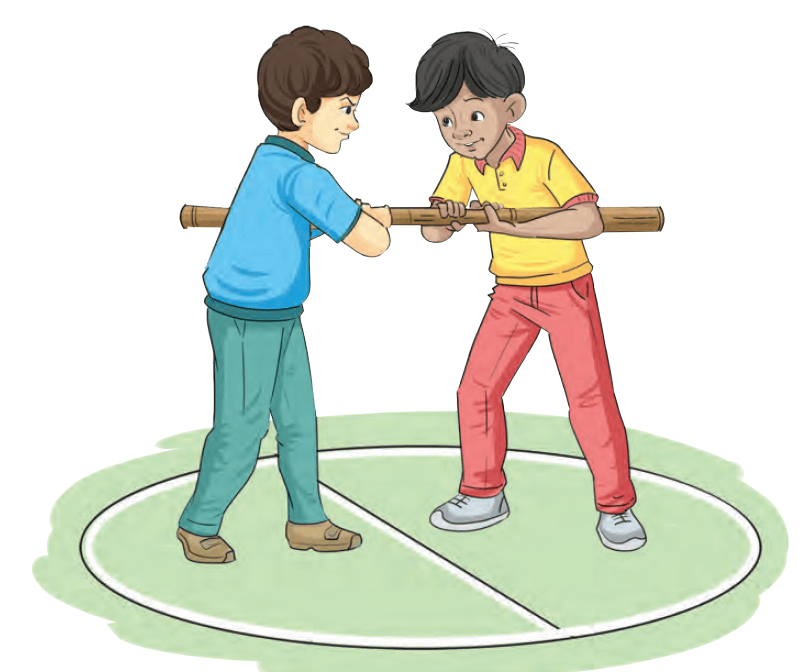
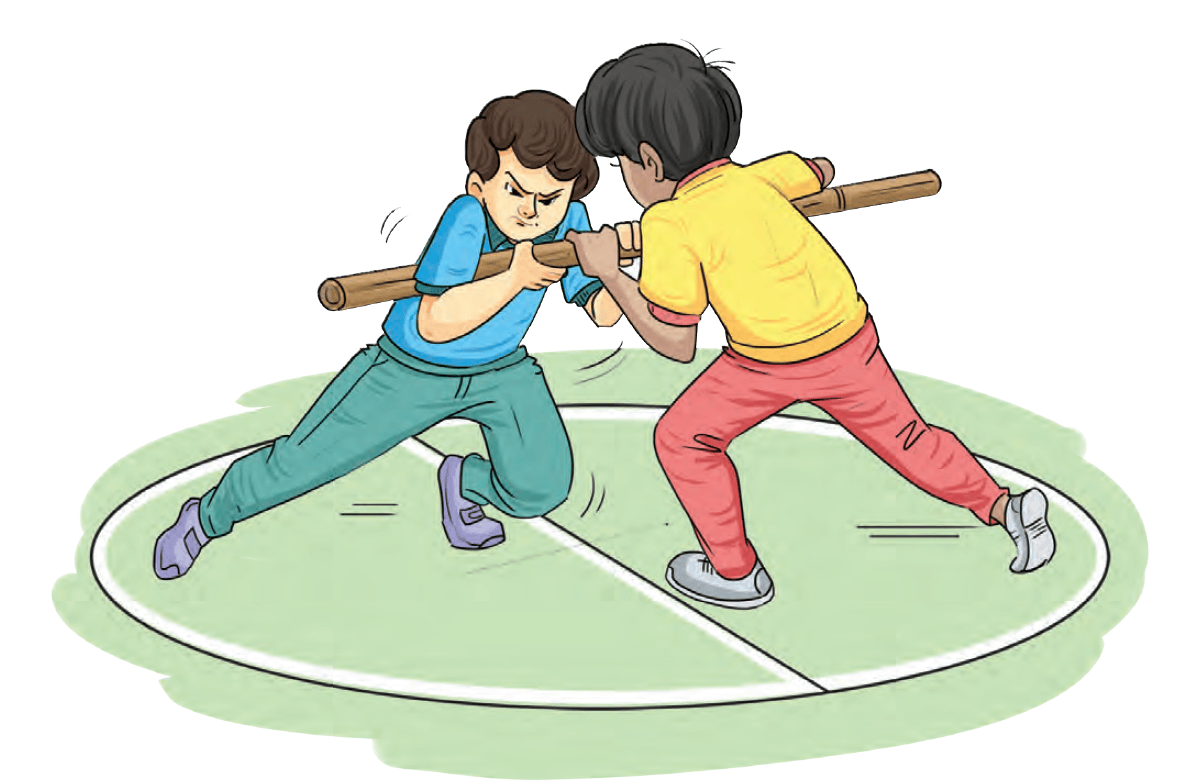
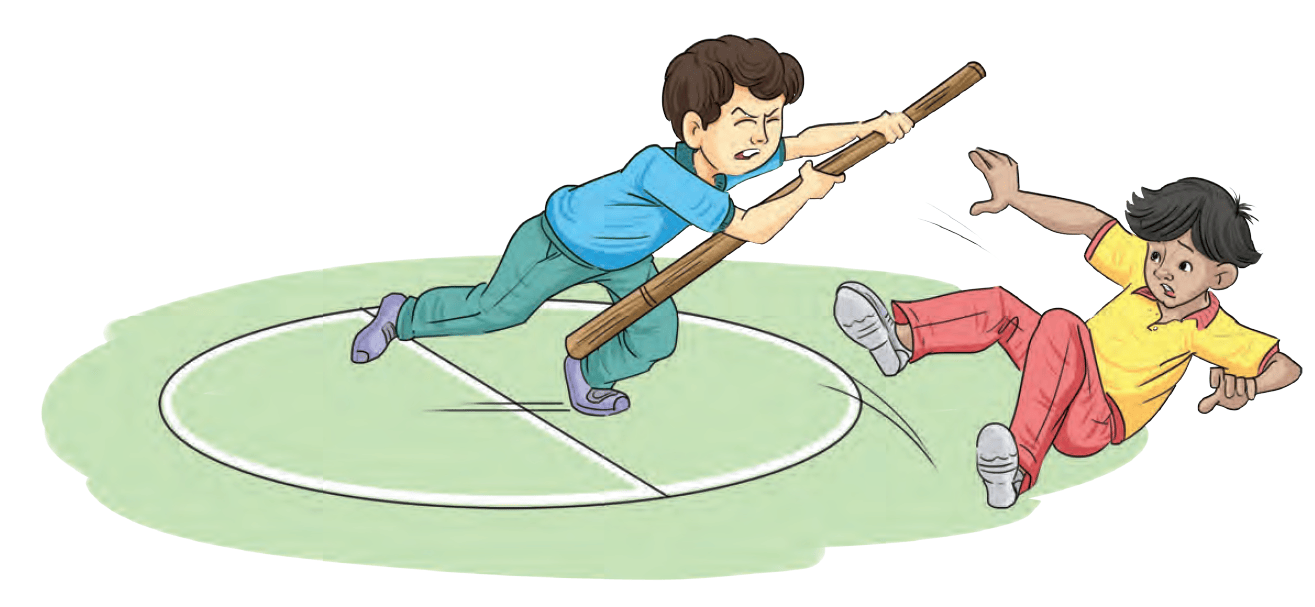
• The primary aim is to push the opponent back and out of the marked circle while maintaining balance and control of the bamboo stick.
• Students must use their strength and technique to push their opponent off balance, causing them to fall or push out of the circle. The student who succeeds in making their opponent fall or push out is declared the winner of that round.
• Students can use footwork, body positioning and leverage to outmanoeuvre their opponent.
• The game is typically played in an open and circular marked area, allowing students to move freely while engaging in the contest.
Circle Time – Feeling the different muscles
Try to remember the name of muscles as discussed with the teacher in Unit 1 and enlist the muscles which you felt while performing the activity.
Note for the teacher
Teacher will discuss how to feel the major muscles involved, for example, Front Thigh and Rear Thigh.
While touching the partner to feel the muscle involved, educate the student on gender sensitivity.
Pop Up
Do you know there are approximately 630 muscles in the human body.
MF - 9
Madhu and Manu
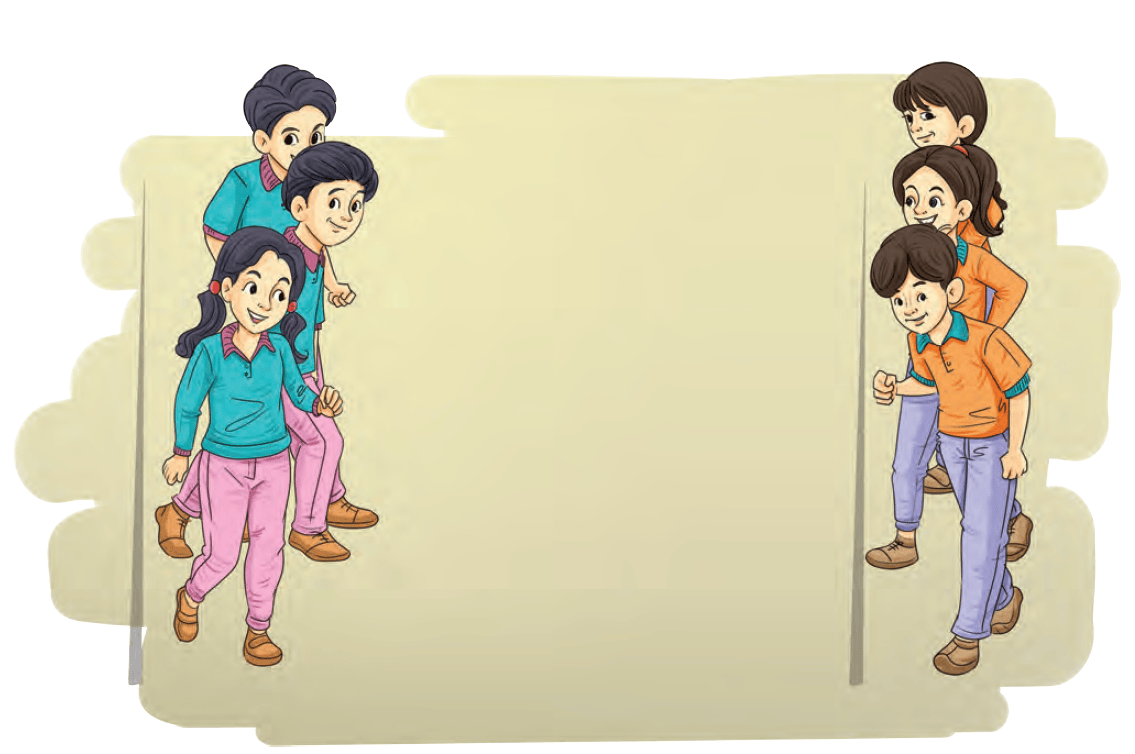
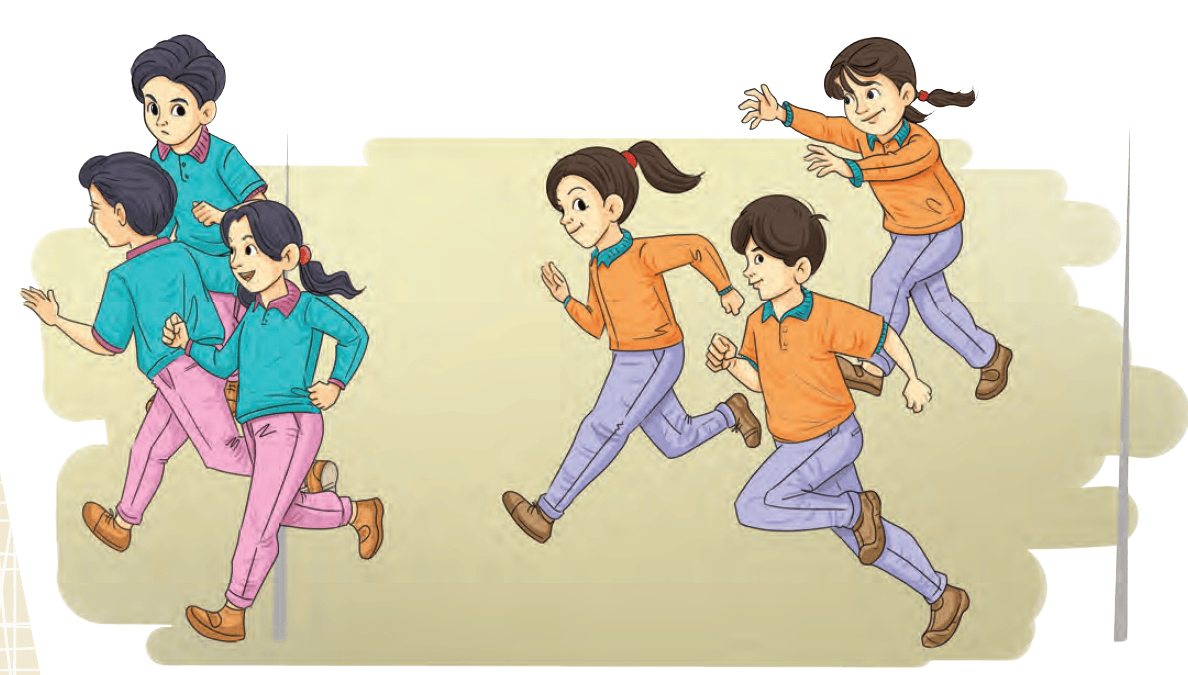
Madhu and Manu is a tag game where two teams, the madhu and manu, race to their respective safety zones without getting tagged by the other team.
|
Warm-up |
Skill |
Cool-down |
Circle Time |
|
Mountain Climbers, Jogging |
Madhu and Manu |
Lower Body Stretching |
Agility |
How to play?
• Establish two goal lines on opposite sides of an area. The class is divided into two groups—madhu and manu.
• The groups face each other at the centre of the area, about 5 feet apart.
• The leader calls out either ‘Madhu’ or ‘Manu’ using a ma-a-a-a-a-a sound at the start of either word to mask the result.
• If ‘Madhu’ is the call, the madhu chase the manu to the goal line.
• If ‘Manu’ is the call, then the manu chase the madhu to the goal line.
• Any student caught goes over to the other side and becomes a member of that group. The goal is to capture the most number of students.
Variations
1. Toe-to-toe: Instead of facing each other, students stand backto-back about a foot apart in the centre.
2. Red and Blue: Instead of using calls, throw a piece of cardboard (red on one side and blue on the other) into the air between the teams. If red comes up, the red team chases, and vice versa.
3. Nouns and Verbs: When the leader calls out any verb, the nouns team chases, and vice versa.
4. Odd and Even: Throw a large foam rubber dice in the air. If they come up even, the even team chases. If they come up odd, the odd team chases.
Circle Time – Agility
Discuss with your teacher about the difference between running straight and changing direction while running.
Pop Up
Agility is the ability to quickly change body position, vary your speed, maintain balance and react swiftly.
Note for the teacher
Discuss some activities with the players which involve a change of direction quickly while moving.
MF - 10
Skipping Song
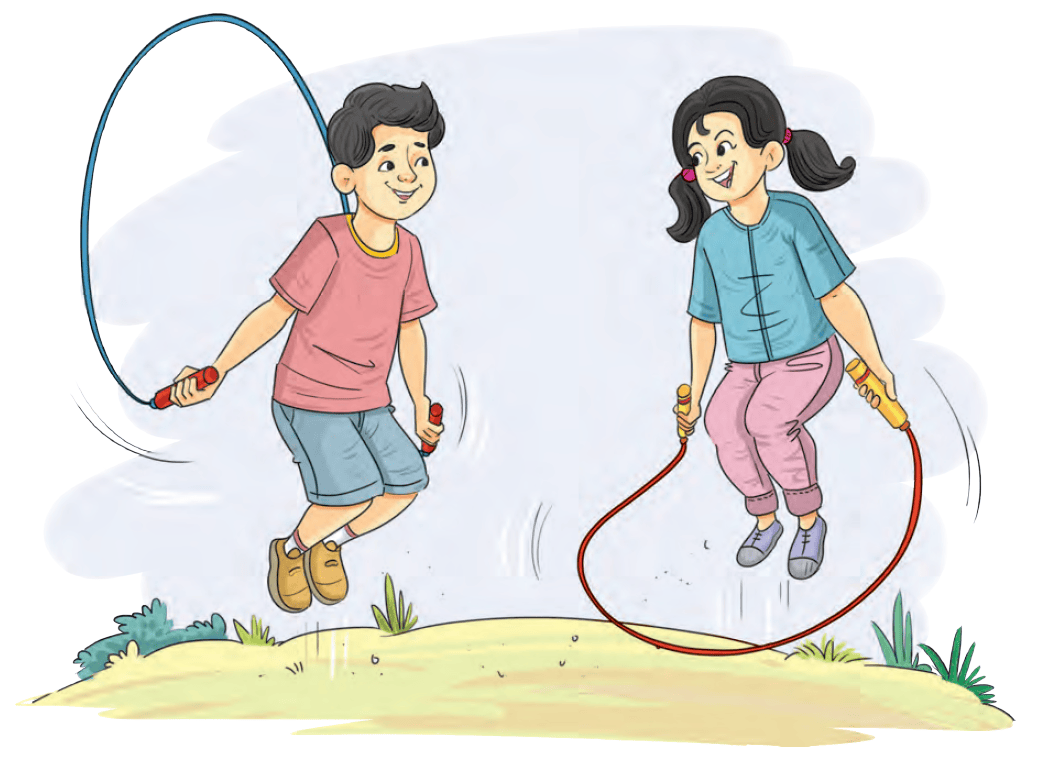
A skipping song involves a combination of two locomotor skills—a step and a hop. Like a gallop, a skip has an uneven rhythm with more emphasis on the step than the hop. This results in a light, gliding motion where the feet briefly lift off the ground before reconnecting.
|
Warm-up |
Skill |
Cool-down |
Circle Time |
|
Shoulder Circumduction, Flexion and Extension of Shoulder, Half Squat, Lunges |
Skipping Song |
Child’s Pose, Downward Dog |
Cardiovascular endurance |
How to play?
• Mark an area of about 20 by 10 metres.
• Students will stand in the starting line with a skipping rope in hand.
• While running, students will skip the skipping rope with their right leg or both legs (and then repeat with the other foot).
• Students will perform the activity for as long as they can without any break.
• Some students will learn to skip by pretending the floor is very hot and that as soon as they step on it with one foot, they will want to hop right back off it.
• Some students may learn by imitation, and others learn by holding hands and skipping with someone who knows how. The latter method is particularly effective for students who can skip on one side and not on the other.
Variations
1. Play ‘Skipping Song’ and ask the students to accompany it with skipping. Some students may find that the rhythm of the music helps.
2. Once students are skipping successfully, provide some variety by suggesting them to skip in circles, as lightly as possible, quickly and in curving and zig-zag paths.
Circle Time – Cardiovascular endurance
• Discuss how skipping for a long time feels like and enlist the reasons which helped you to perform the activity even when you were already tired.
• Discuss the need for such exercises that are done for long durations and what kind of fitness is required to do so.
Note for the teacher
Teacher will discuss how to feel the major muscles involved. For example: Front Thigh and Rear Thigh. While touching the partner to feel the muscle involved, educate the student on gender sensitivity.
Pop Up
Activities that are performed for a longer duration strengthen your heart and lung capabilities.
Assessment
Instructions
1. Perform each fitness test and record your Baseline result.
2. Set a goal for improvement.
3. Retest and compare your progress.
4. Teachers should ensure they set up the testing environment.
5. The procedure for conducting each test is mentioned in the Annexure.
Agility
Test: T - Test
• Baseline Time: ................ seconds
• Goal (Improve by 1–2 sec): ................ seconds
Cardiovascular Endurance
Test: 600-m Run/Walk
• Baseline Time: ................ minutes
• Goal (Improve by 10–20 sec): ................ minutes
or
Test: 3-Minute Step Test (Measure heart rate after)
• Baseline HR: ................ bpm
• Goal (Lower HR over time): ................ bpm
Strength and Muscular Endurance
Push-Ups (Max in 1 Min)
• Baseline: ................ reps
• Goal (Increase by 3–5 reps): ................ reps
Squats (Max in 1 Min),
• Baseline: ................ reps
• Goal (Increase by 5–10 reps): ................ reps
Plank Hold (Time)
• Baseline: ................ seconds
• Goal (Hold 10 –15 sec longer): ................ seconds
Flexibility
Sit-and-Reach Test (Measure reach in inches past toes)
• Baseline: ................ inches
• Goal (Improve by 1–2 inches): ................ inches
Speed
50-Metre Sprint
• Baseline Time: ................ seconds
• Goal (Improve by 0.2– 0.5 sec): ................ seconds
Reflection and Progress
• In which area maximum improvement was observed?
............................................................
• What was the biggest challenge?...............................
• How can I improve further?..............................