
Unit 5: Fundamental Skills of Sports
Kabaddi
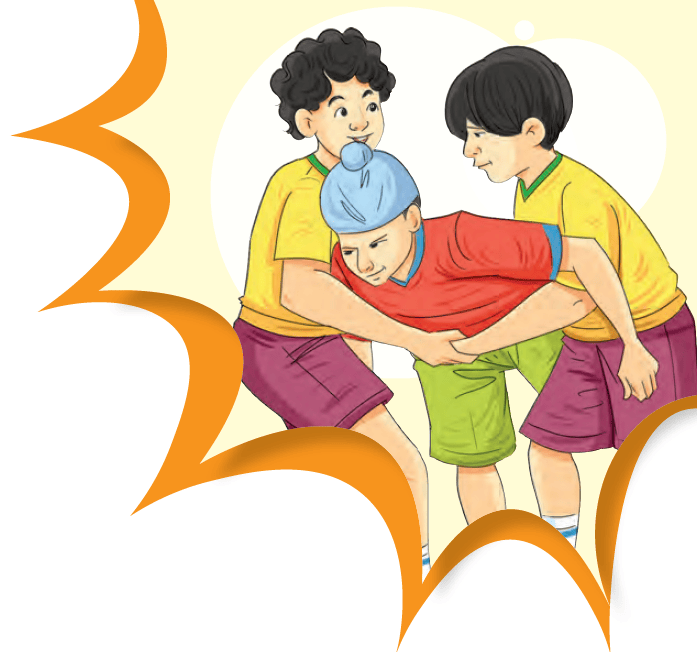
Kabaddi is played between two teams, and the goal is to tag players. Players must touch opponents and return to their side of the court without getting caught. Kabaddi helps build strength, speed, and improves teamwork. It is a popular game in many countries and is also played in the Asian Games.
KB - 1
Raiding Foot Work
Raiders perform offensive skills in the opponent’s half to touch the defenders and score points for their team.
|
Warm-up |
Skill |
Cool-down |
Circle Time |
|
Jumping Jacks, High Knees, Butt Kicks, Jogging Drills |
Raiding Foot Work |
Hamstring Stretch, Calves Stretch, Crossed-leg Toe Touch |
Footwork and Anticipation |
Raiding Foot Work
Steps to Learn
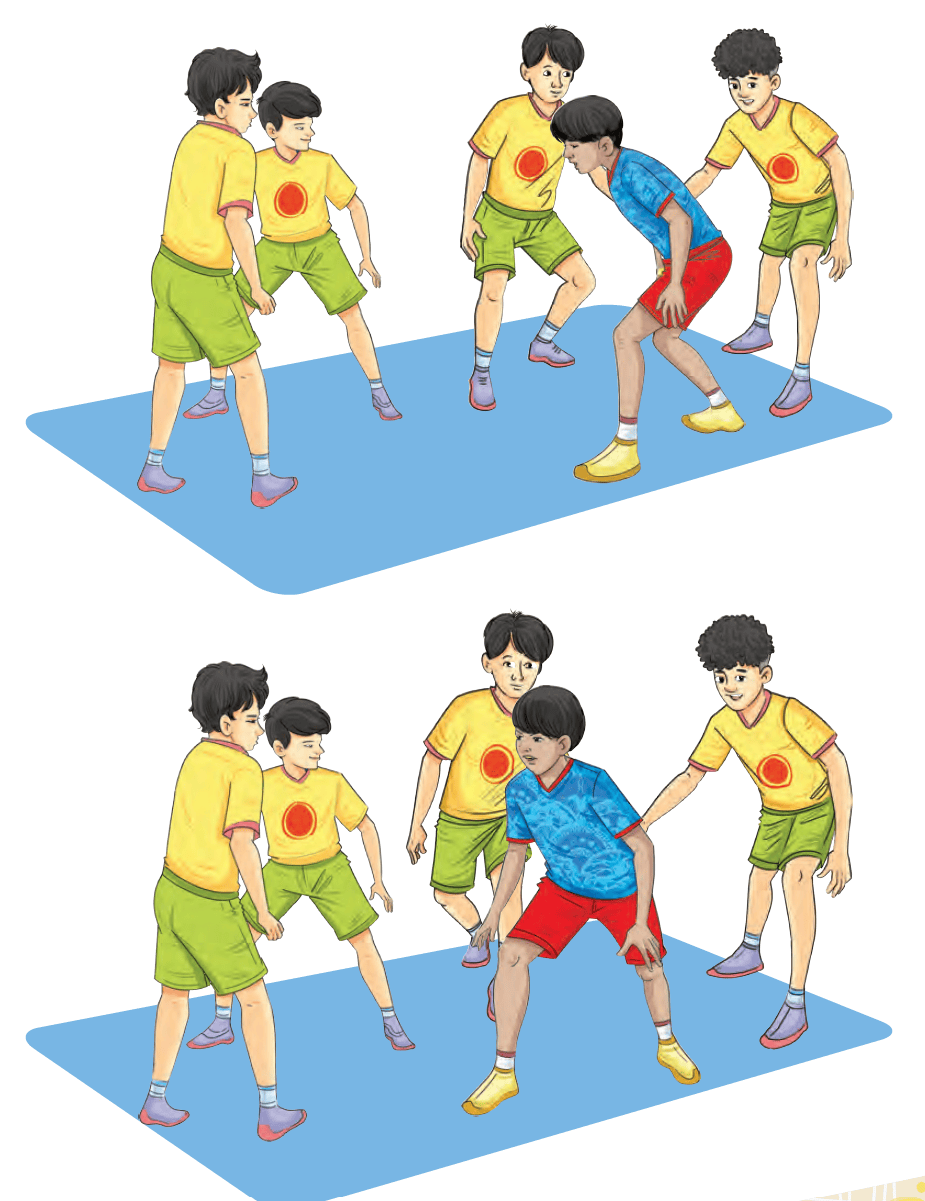
The primary aim of the raiding foot work technique is to prevent raider from defender and return safe after a raid to their own half.
1. Stance
• Keep your feet apart in a parallel or diagonal position; body weight should be evenly distributed on both feet.
• Keep your legs apart with knees bent, head held high, slightly leaning forward and elbows slightly bent and balanced.
2. Execution
• Foot work movement is executed in different directions with agility, anticipation, orientation ability and skill.
• It includes moving forward, sideward and backward randomly but with a purpose to tag a student.
3. Follow Through
•After execution, regain body balance and change the direction of the body towards the mid line.
Lead-up Activity
Mark two parallel lines of 30 feet each (9.15 m). Set up two blocks 30 feet apart, opposite each line. Keep two blocks on the other side of the starting line. The player will stand at the starting line opposite the blocks. The player will start running towards the blocks as fast as possible on the signal ‘Ready? Go!’. They will pick up a block and return to place it behind the starting line, then run fast to pick up the second block, then run with it backwards across the line. The player who takes the minimum time to finish the activity will be the ‘winner’.
Circle Time – Footwork and Anticipation
Discuss what type of footwork you used for quickly running to the opposite block, picking up the block, taking a turn and returning.
Pop Up
Types of Raid
• Leading Leg Raid • Shuffling Leg Raid • Natural Run Raid
KB - 2
Hand Touch
|
Warm-up |
Skill |
Cool-down |
Circle Time |
|
Wrist Rotation, Shoulder Exercise, Jogging Drills |
Hand Touch |
Chest Stretch, Shoulder Circles, Cross Body Shoulder Stretch |
Reaction Time, Movement Time and Memory |
Hand Touch
Steps to Learn
The primary aim of the hand touch technique is to touch a defender and return back to their own half of the court after a successful raid.
1. Stance
• Stand in a diagonal or parallel position.
• The leading leg toe should be pointed towards the target and the rear leg toe slightly diagonal towards midline with bent knees.
• The executing hand should be free for touch and the eyes should be towards the target.
2. Execution
• Fix the target and move towards the target - variation of the hand movement.
– Vertical or Diagonal on covers and corners.
– Sideward swing on wings and supporter.
– Sideward to forward on the chain in front.
– Sideward to reverse on the defense who is covering the rear
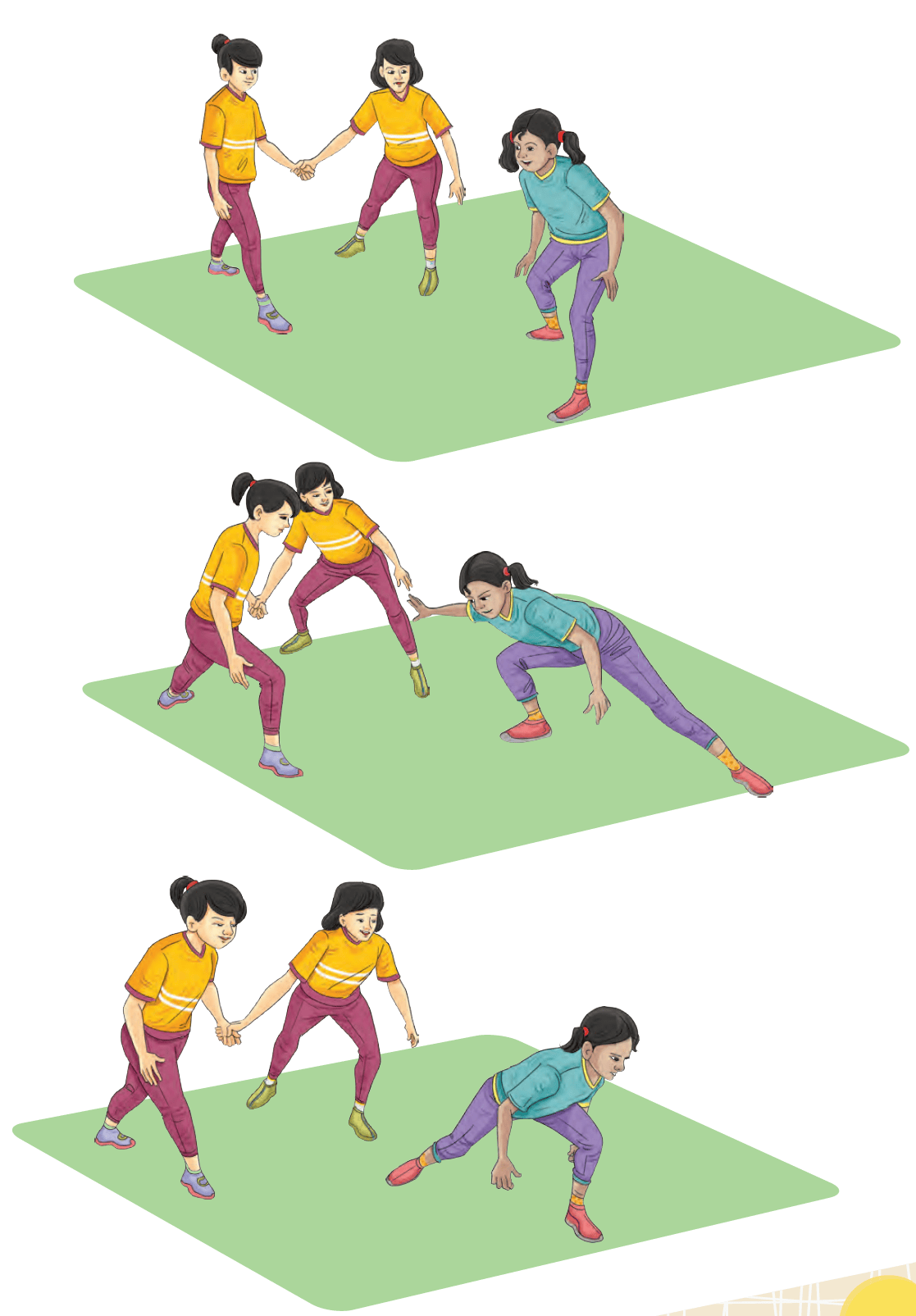
3. Follow Through
• After execution regain body balance and change the direction of the body towards the mid line.
Lead-up Activity
Make two teams (Team A and Team B) and ask the teams to stand away from the 10-metres line, keep a small ball in the centre of both lines. Every player is given a chest number (same number for both teams). When a number is called out, one player from both sides runs in and tries to take the ball placed in the centre to their side using hands only. The team that succeeds to score a point will be declared the winner.
Note for the teacher
• The teacher should give different activities for the development of reaction and movement time, for example ruler drop.
Circle Time – Reaction time, Movement time and Memory
What did you do to remember your chest number and remain focused for the call?
KB - 3
Toe Touch
|
Warm-up |
Skill |
Cool-down |
Circle Time |
|
Ankle Rotation, Toe Walk, Lunging |
Toe Touch |
Ankle Stretch, Calf Muscles Stretch, Thigh Muscles Stretch |
Eye-foot Coordination |
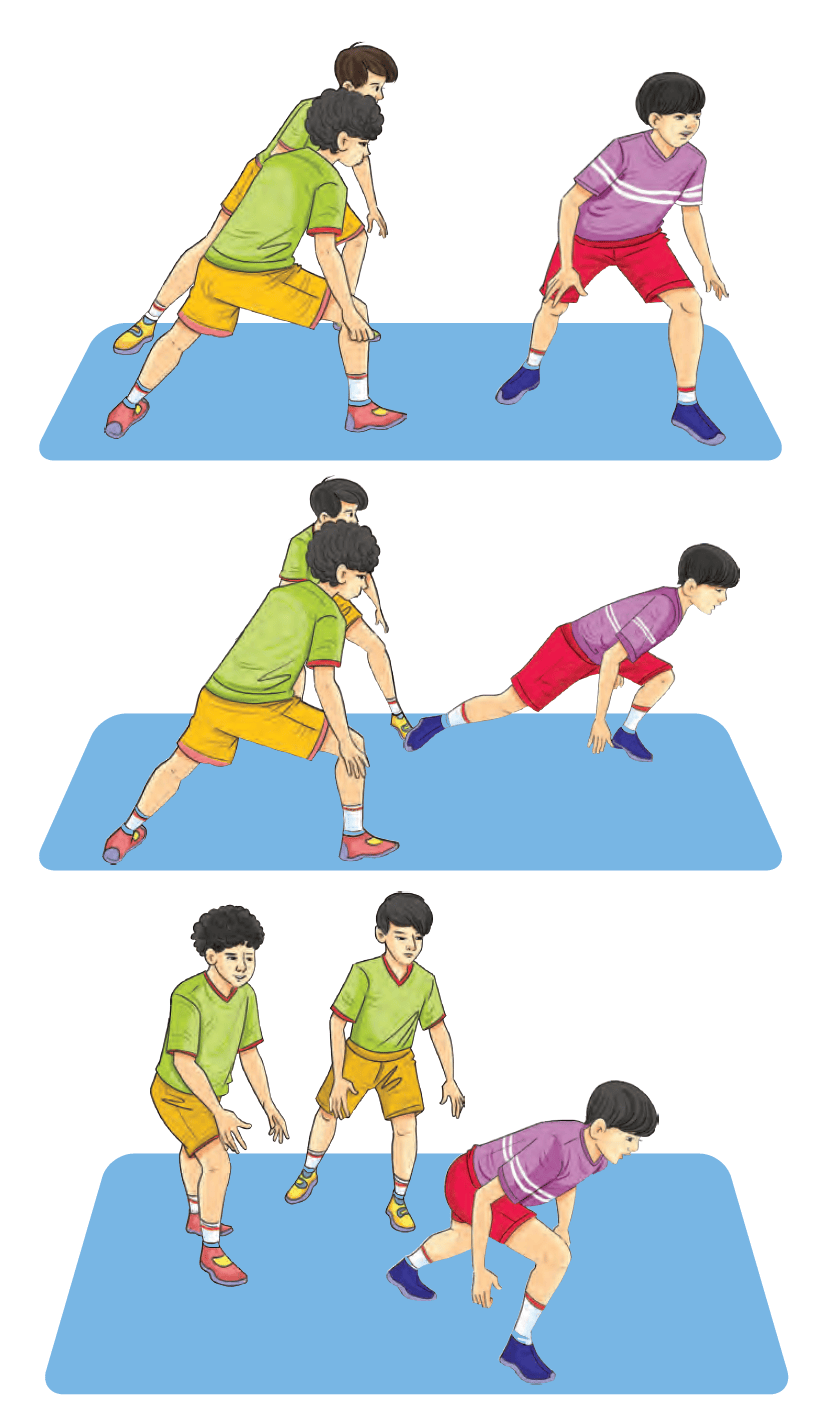
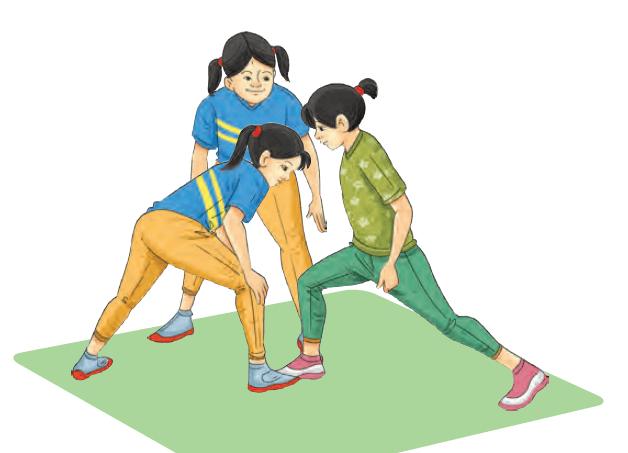
Toe Touch
The primary aim of the Toe Touch technique is to touch a defender and return to their half of the court after a raid.
Types of Toe Touch:
• Toe touch on same stance.
• Taking one step back and toe touch.
• Running toe touch.
• Dragging back and toe touch.
• Feinting and toe touch.
Steps to Learn
1. Approach
•The raider has to settle to reach the target by taking one step back or by dragging back.
• Stance of the body may be parallel or diagonal.
• Body weight should be shifted from the leading leg to the rear leg.
• Body should be in crouch position leaning towards the midline.
• Knee and ankle joint should be in extended position.
• Arms should be flexed and free.
DID YOU KNOW
Baulk line is a marker on the court, positioned 3.75 metre from the midline, anda ridermust cross this line for a raidtobe considered valid.
2. Execution
• Leg movements during the attack should be straight or diagonal or in curvature.
• Forward movement of executing leg, rushing towards the midline in bending position.
3. Follow Through
• After execution, regain body balance and change direction of body towards the mid line.
• The movement of leading leg toe should be towards the mid line while returning.
• The upper body should be in crunch position and the player should rush towards the midline.
Lead-up Activity
Draw four different shapes (triangle, square, circle, etc.) in the court. Every player has a chest number and when the number is called, the player will run to the baulk line. Just before the player reaches the baulk line, the teacher will randomly call out a shape. The player has to quickly run and toe touch the shape and return to the centre line. Each player will be given equal chances on the basis of time feasibility. The player with the minimum recorded time will be the winner. The remaining students will observe each raid very carefully.
Circle Time – Eye-foot Coordination
• Each student will discuss what was going in their mind when they were awaiting for the teachers call to callout the shape.
• Discuss which students used the movements suggested in the body movement and execution parts above.
KB - 4
Kick
|
Warm-up |
Skill |
Cool-down |
Circle Time |
|
Leg Swings, Lateral Leg Kicks, Walking Lunges, High Knees |
Kick |
Hamstring Stretch, Standing Quad Stretch, Hip Flexor Stretch |
Doing kicks differently |
Kick
Kick is one of the major offensive skills in Kabaddi used by the raider. The primary aim of the kick technique is to touch a defender with a leg and return back to their own half of the court after a raid.
Steps to Learn
1. Approach
• Approach depends upon variation of the target and the distance to be covered.
2. Stance
• Stance should be diagonal or parallel.
• Maintain stability on rear leg.
• Shoulder line towards the mid line.
• Upper body to be in crouch position.
• Arms flexed and relaxed to balance the body.
2. Execution
• Kick without flexing the knee joint, keeping in mind distance and position of the target.
• Rear leg in pivot position.
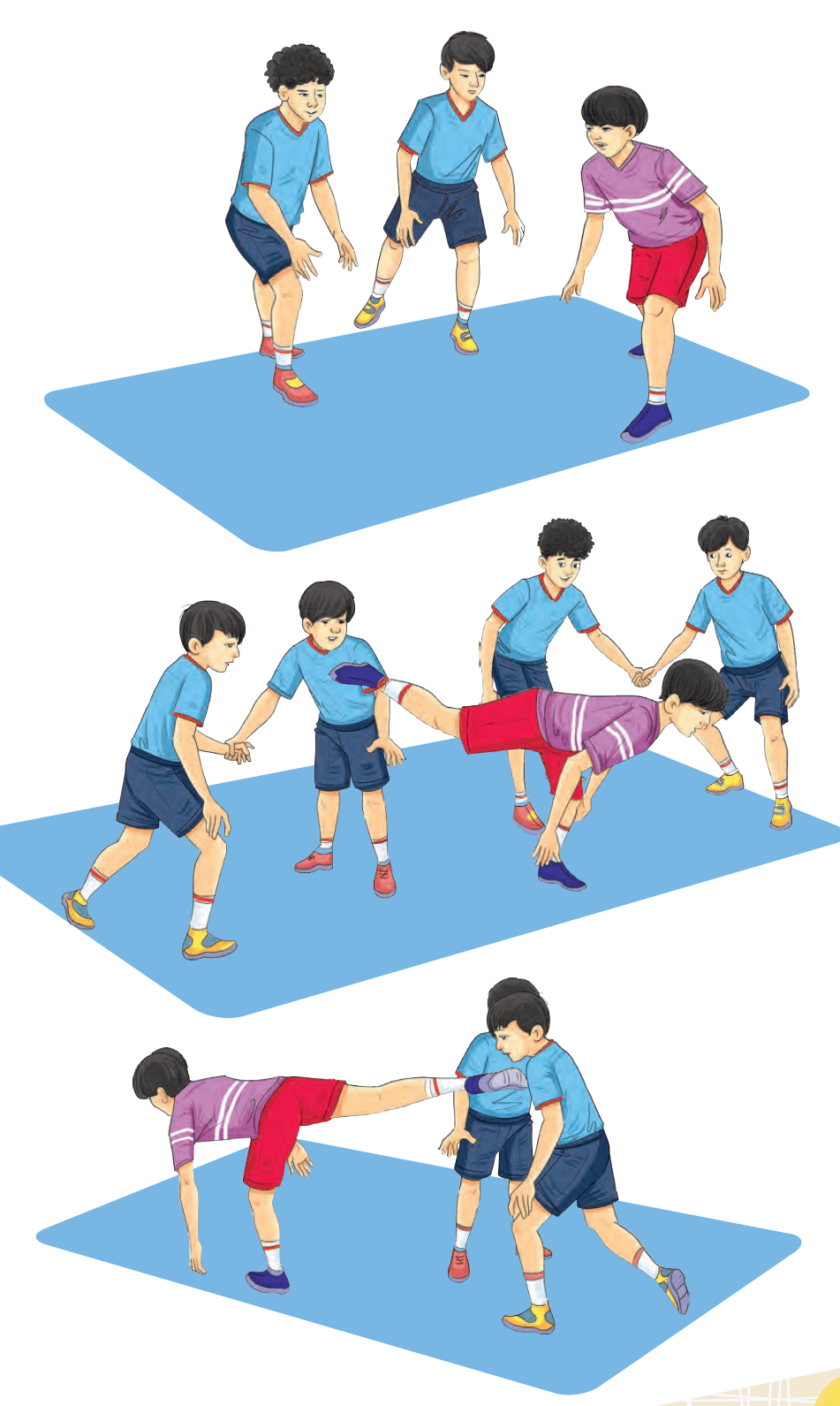
3. Follow Through
• After executing the kick, bring the kicking leg forward immediately, to avoid catches by defenders.
• Move in bending position towards midline to avoid covers and chain.
Variation
The following types of kicks can be used as variation:
• Back kick
• Side kick
• Roll or Curve kick
Lead-up Activity
Make two teams stand with their arms extended at the corners behind the bonus line. Both teams will line up in opposite sides of the court; first player will start at the whistle. The objective is that all team members will take turns to go to the opposite court, kick the extended arm and return in minimum time. The team that finishes first will be the winner.
Circle Time – Using different kicks
•How has the raider added variation to kick in order to improve the performance?
Defensive Skill
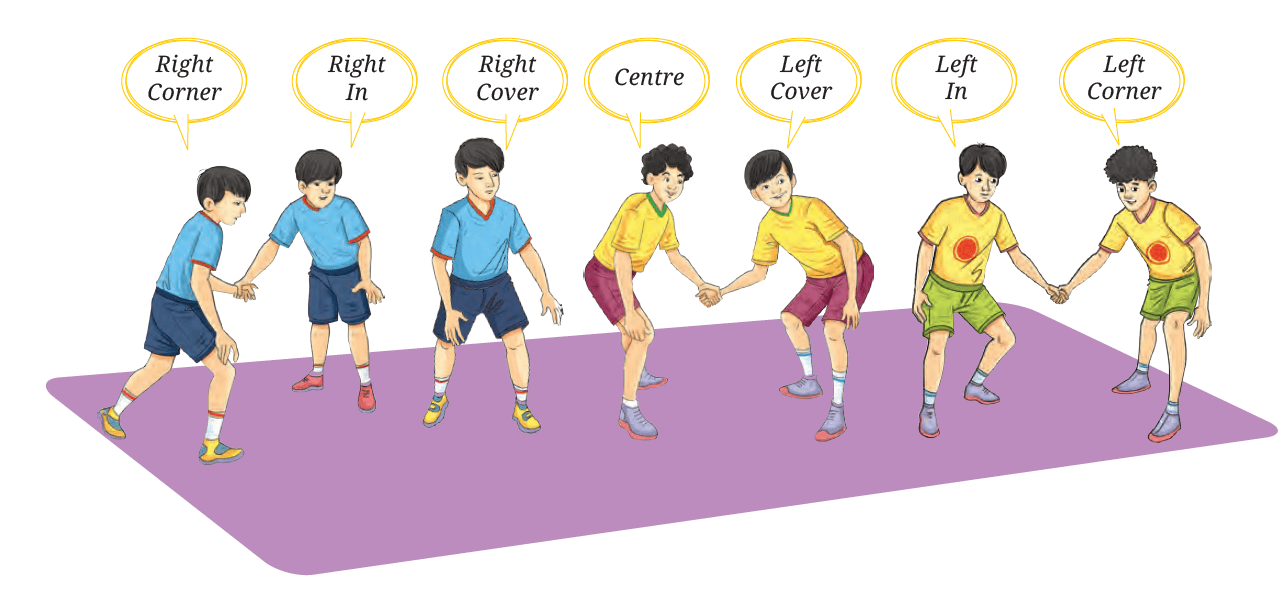
Some defensive positions are given below:
Corners – The players of the team stand on the extreme right and left corner on the kabaddi court. The responsibility of the corners is to initiate tackles. When the left raider is in action, the right corner is in prime position to initiate any attack and vice versa.
Centre – Centre player plays in centre position. The raider of the team mostly stands in the centre position.
Ins – The ins are positioned between the corners and the covers. One of the major responsibilities of the ‘in’ is to protect the corner defender from going into the lobby or out of the court. The ins are generally the raiders of the team and also help in defense such as catching the raider.
Covers – The defenders positioned between the ins and centre are known as the covers. Generally, the teams position their all-rounders in this position.
KB - 5
Ankle-hold
|
Warm-up |
Skill |
Cool-down |
Circle Time |
|
Trunk Twist, Sideward and Forward Lunges, Burpees, Push-ups |
Ankle-hold |
Triceps Stretch, Shoulder Stretch, Hamstring Stretch, Calf Stretch |
Reaction Time |
Ankle-hold
The primary aim of the defensive ankle hold technique is to catch the attacker in such a way that the raider loses their breath of 30 seconds in the defensive court during a raid.
Steps to Learn
1. Body Position
• Wider stance
• Upper body slightly inclined towards the raider.
• More body weight on the leading leg and pointed towards the raider.
• Knees slightly flexed to balance.
• Hands should be free.
• Eyes on the target.
2. Approach
• Before going in for ankle hold, the defender should observe the raider’s foot, and anticipate the next movement of the raider’s footwork.
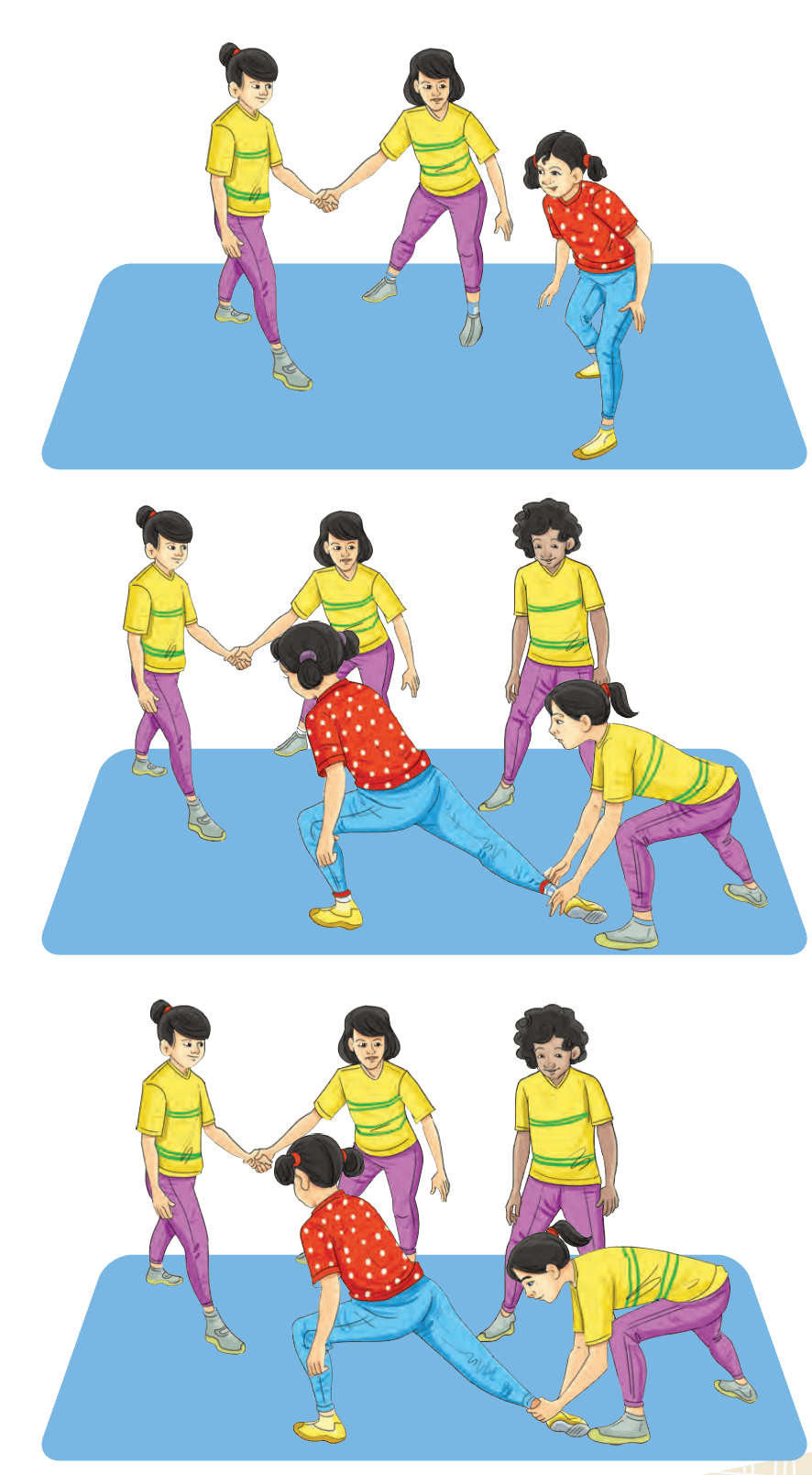
• Bend the upper body towards the raider’s leg completely by bending the leading leg, at the same time bringing both hands towards the raider’s ankle.
2. Execution
• The inner hand should be placed on the joint of the raider’s ankle, other hand supporting a firm grip on the ankle of the raider.
3. Follow Through
• Once the raider is caught, the defender should maintain stability and firm grip, lift the raider up towards the inner shoulder or pull by taking the leading leg back, shifting the body weight backwards or taking small steps towards the end line.
Lead-up Activity
Draw four different shapes in the court and place four defenders just behind the shape. Every player has a chest number and when the number is called out, the player will run to the baulk line. Just before the player reaches the baulk line, the teacher will randomly call out a shape. The student has to quickly run and toe touch the shape while the defender will try to ankle hold at the time of toe touch. The aim of the player is to return safely while the defender ankle-holds. One point will be awarded for every ankle hold. Each defender will get equal chances.
Circle Time – Reaction Time
• Each defender will discuss what was going on in their mind when the student was approaching the for toe touch.
• Discuss which defenders used the right method to ankle-hold as suggested in the body position and execution parts above.
KB - 6
Thigh-hold
|
Warm-up |
Skill |
Cool-down |
Circle Time |
|
Forward Lunges, Backward Lunges, Jumping Jacks |
Thigh-hold |
Hamstring Stretch, Calf Stretch, Crossed-leg Toe Touch, Torso Twist |
Grip Strength |
Thigh Hold
The primary aim of the defensive thigh-hold technique is to catch a raider in such a way that the raider loses their breath of 30 seconds in the defensive court during a raid.
Steps to Learn
1. Body Position
• Optimum diagonal stance.
• Leading leg toe should be towards the front lobby.
• Rear leg toe should be towards the end line.
• Leading leg and rear leg knee slightly bent.
• Eyes on the target.
• Upper body slightly inclined towards the raider.
2. Approach
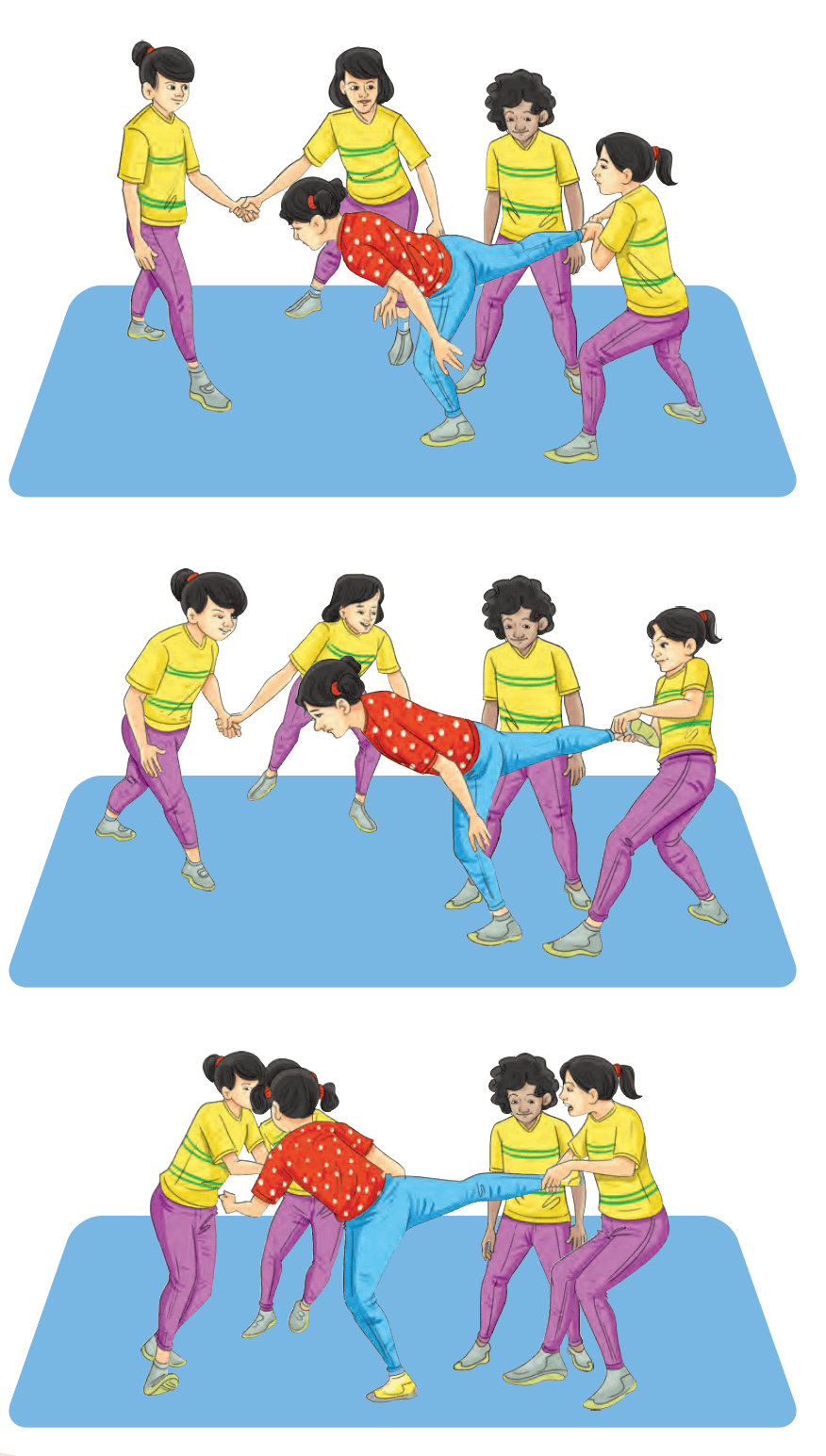
• Before going in for thigh-hold, the defender should observe the raider’s foot. After analysing the path of the raider, the defender should anticipate the next movement of the raider’s footwork.
• Slightly bend the upper body towards the raider’s hip joint.
• Place the shoulders in line of the hip joint of raider.
• Defender’s leading leg should be placed between the raider’s stance.
2. Execution
• After reaching the lower limbs of the raider, the defender should encircle the thigh of the raider with the elbow grip.
• Inner hand should be placed below the knee joint of the raider
• Put the shoulder on the hip joint of the raider.
3. Follow Through
• Once the raider is caught, the defender should maintain stability with firm grip and the raider’s direction should be changed towards the end line.
Lead-up Activity
Two teams are divided into four students each with varied weights. One player from each team will start at the signal from the teacher, lift their teammate by holding the other players thigh, and then bring the lifted student towards the starting point and again return to bring another player of the team. The drill of both teams will be completed when the last player is lifted to the starting point. The team which will reach first with their last player will win and the same can be repeated by other player.

Circle Time – Grip Strength
• Identify the differences in lifting partners of varied weight. Does changing the holding grip change the feeling in lifting your partner?
KB - 7
Knee-hold
|
Warm-up |
Skill |
Cool-down |
Circle Time |
|
Deep Squat, Single Leg Squat |
Knee-hold |
Quadriceps and Hamstring Stretch |
Proper Technique |
Knee Hold
The primary aim of the defensive knee hold technique is to prevent the raider from escaping or returning to their own half of the court after a raid. Knee hold is similar to the thigh hold. Knee hold is a tactic generally used by the second supporting student.
Steps to Learn
1. Body Position
• Optimum diagonal stance.
• Leading leg toe should be towards the lobby.
• Rear leg toe should be parallel to the end line.
• Leading leg and rear leg knee should be slightly bent.
• Eyes should be on the target.
• Upper body should be slightly inclined towards the raider.
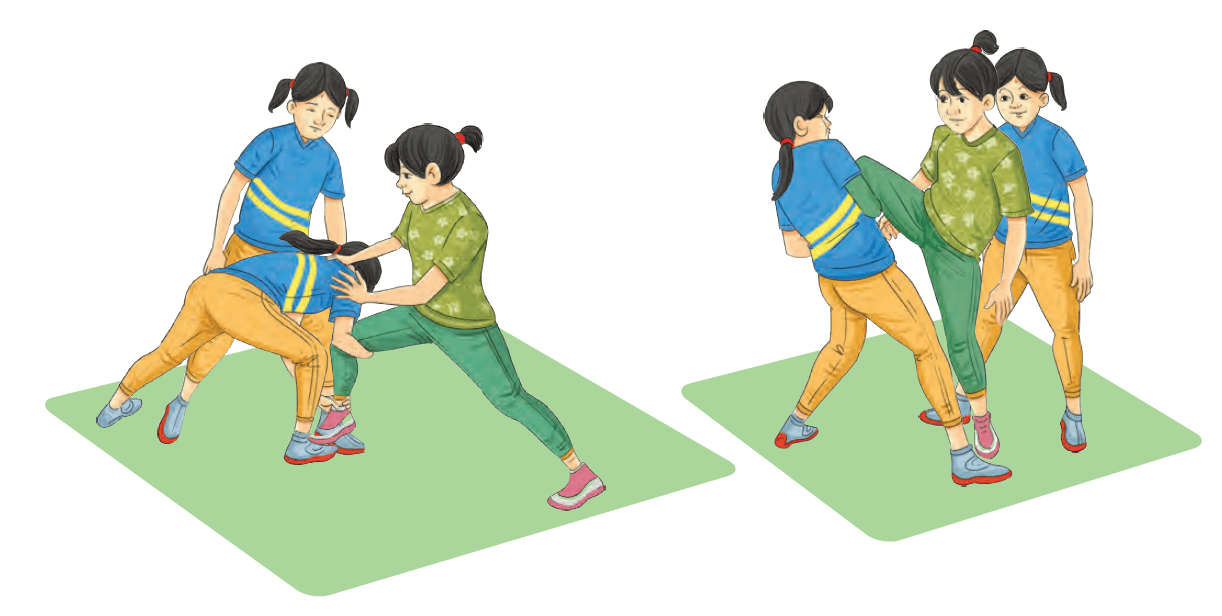
2. Approach
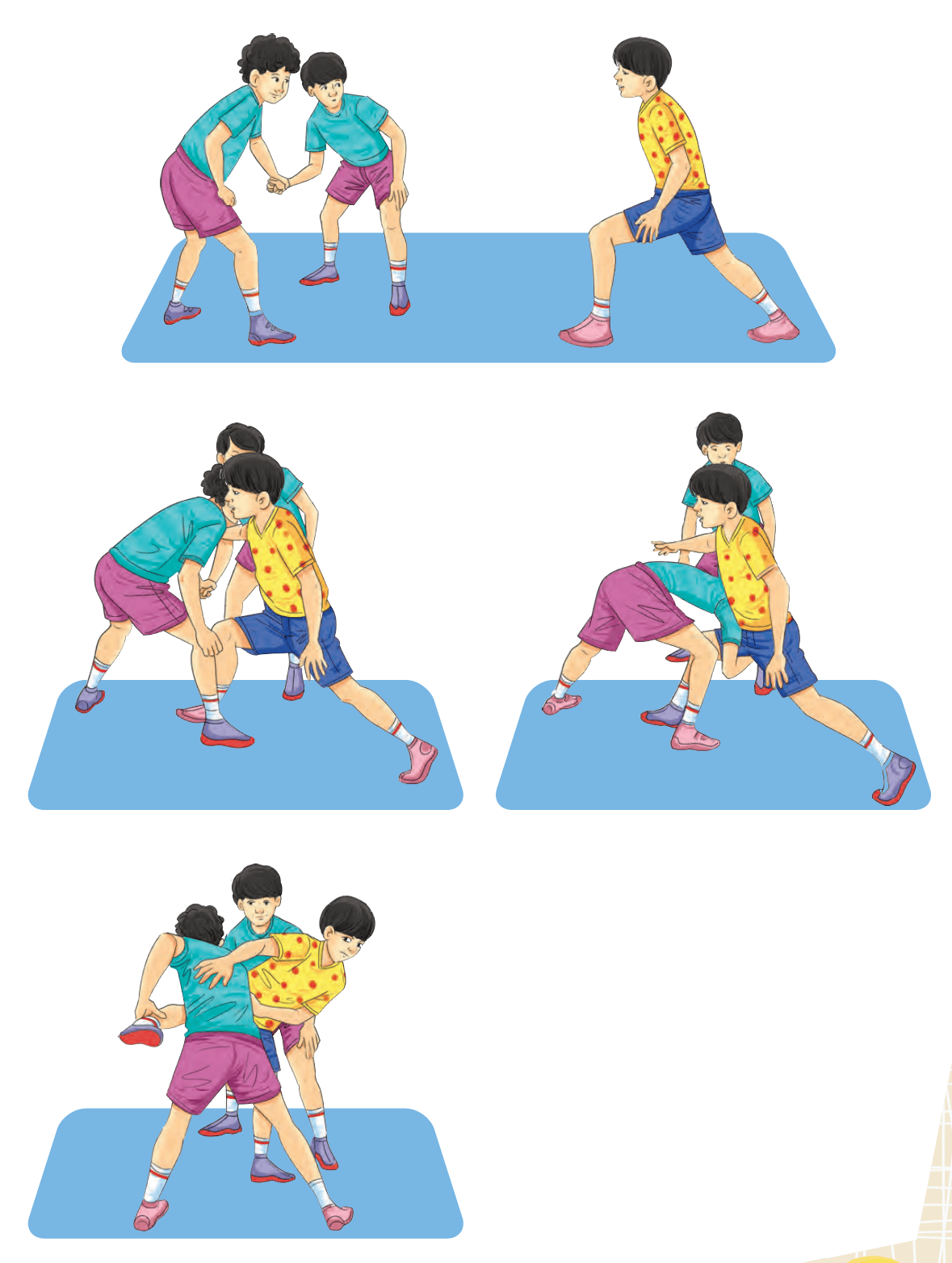
• Before going in for knee hold, the defender should observe and judge the raider’s foot movement, and should anticipate the next movement of the raider’s footwork.
• Bend upper body towards the raider’s knee joint.
• Place both hands in line of the knee joint of the raider.
• Defender leading leg should be placed sideward of the raider’s knee to be hold.
2. Execution
• After reaching the lower limbs of the raider, the defender should encircle the knee of the raider with the elbow grip, wrist grip or palm grip.
3. Follow Through
• Once the raider is caught, the defender should maintain stability with firm grip and the defender should pull the raider towards the end line.
Lead-up Activity
Rules to be followed while playing kabaddi are:
• The raider can only use the hand touch technique to tag the defender.
• The defenders can only do knee-hold to restrict the raider from scoring a point.
• Ensure each defender will get ample opportunity to do knee-hold.
Circle Time – Grip Strength
• Discuss which defenders used the right method to catch and hold as suggested in the body position and execution parts above.
KB - 8
Wrist-hold
|
Warm-up |
Skill |
Cool-down |
Circle Time |
|
Wrist Rotation, Palm Stretching, Shoulder Rotation, Jumping Jacks |
Wrist-hold |
Palm Stretch, Cross Body Shoulder Stretch |
Reflex and Strategy |
Wrist-hold
The primary aim of the wrist hold technique is to prevent the raider from escaping or returning to their half of the court after a raid so that the defending team can gain points.
Steps to Learn
1. Types of wrist-hold
• Holding the wrist from above.
• Holding the wrist from below.
2. Approach
• Before going in for wrist-hold, the defender should observe, focus and judge the raider’s hand movements.
• The defender should be in free and relaxed position without holding the chain.
• The defender palms in a cup shape with the thumb finger apart and the rest of the fingers close together for a firm grip.
• The defender should lean slightly forward.
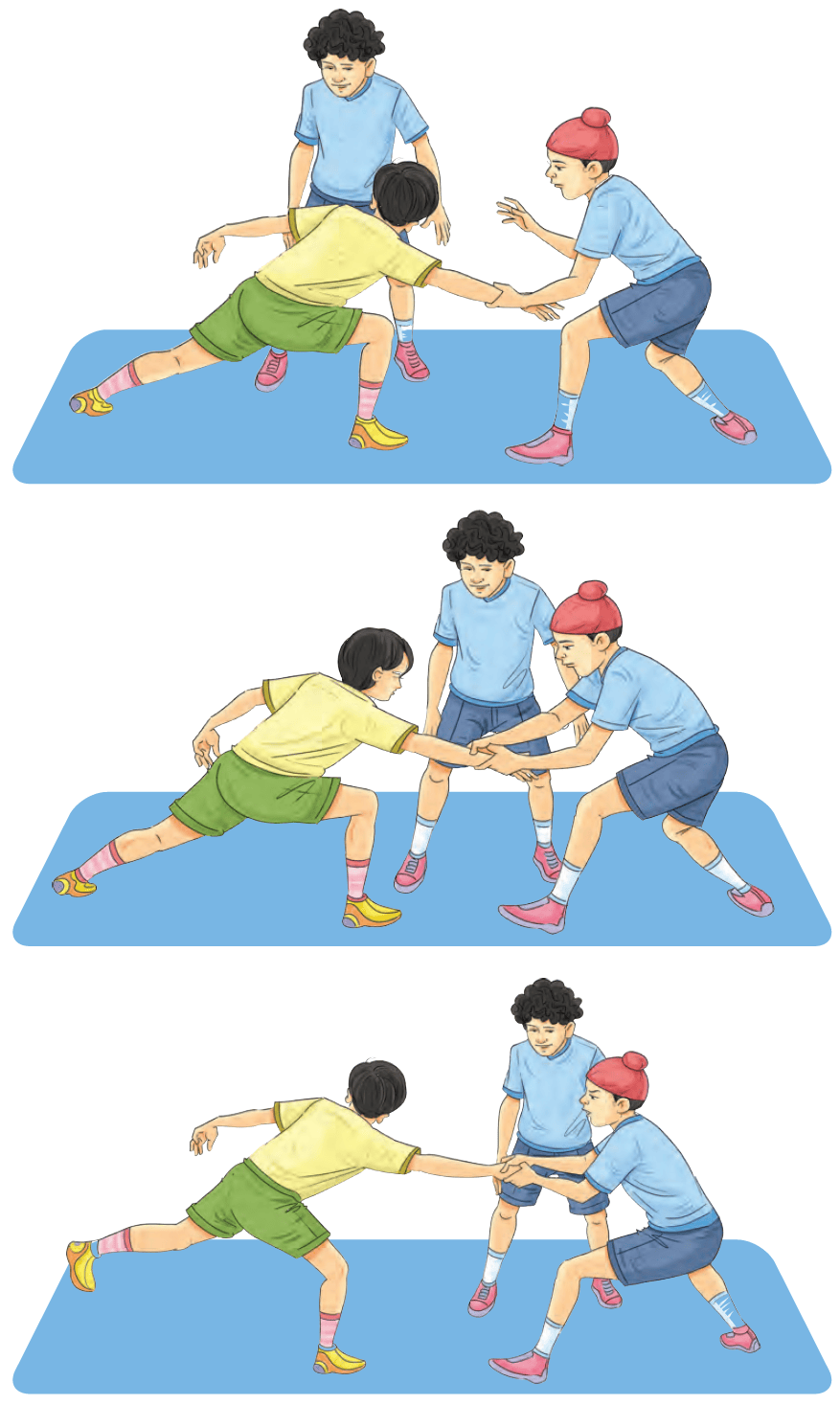
2. Execution of wrist-hold
• Take a firm grip of the raider’s wrist as soon as he is in the reach.
The defender should take the support of the other hand immediately and pull the raider towards end line for proper follow through.
The raider’s movement should be countered by the defender’s body weight.
Lead-up Activity
The player hold the wrists of one another and pull in the opposite direction. This can be done from the midline to the buck lane as a competitive drill.
Circle Time – Reflex and Strategy
Discuss the appropriate defensive skill for the following:
1. Hand Touch
2. Toe Touch
3. Kick
KB - 9
Waist-hold
|
Warm-up |
Skill |
Cool-down |
Circle Time |
|
Leaping and Skipping Jumps Hip and Pelvic Muscle Stretch |
Waist-hold |
Bow Pose, Cross-body Shoulder Stretch, Crouch Leg Stretch |
Holding Grip |
Waist-hold
Steps to Learn
1. Body Position
• Optimum diagonal stance
• Defender should completely cover the raiders outer shoulder from behind .
• Knee bend
• Chin up and eyes on the target
2. Approach
• Before going in for waist-hold, defender should observe the raider’s foot and anticipate the next movement of raider footwork.
• Skip forward or take one step forward to cover raider’s back with balance and wider stance position.
• Bend upper body towards the raider..
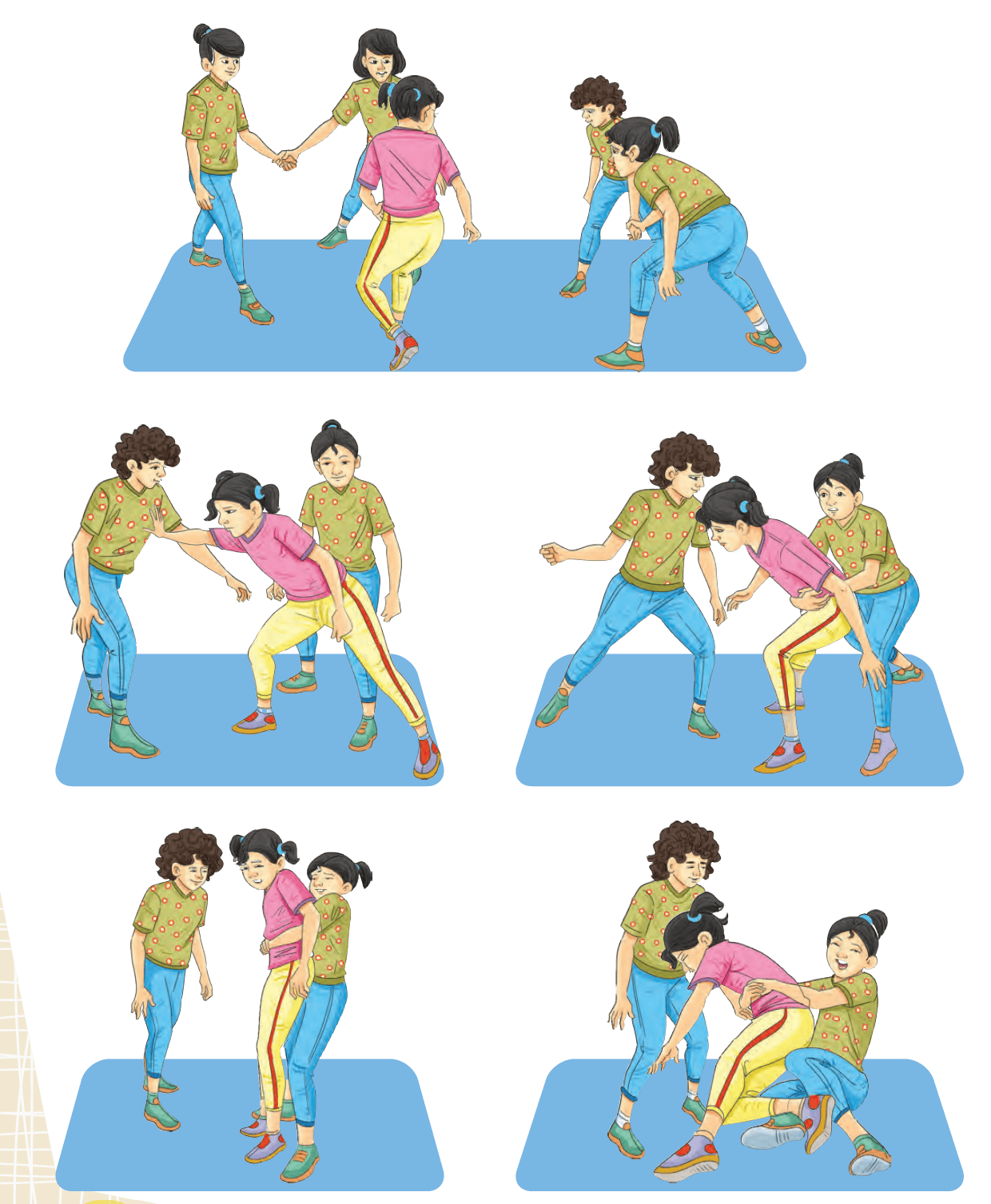
3. Holding and Execution
• There should not be any gap between raider and defender position.
• Use free hand to encircle the raiders waist from the outer shoulder.
Inner hand should be used to make a firm grip.
4. Follow Through Action
Once the raider is caught, prime motive of defender is to stop the raiders approach towards the mid line. For this defender should maintain firm grip and can apply any of the follow through according to need and situation
• Raider should be dragged towards the end line
• Lift raider towards the end line
• Defender can change direction of hold from back to front of the raider
• Defender can fall back or roll back holding the raider
Lead-up Activity
All the player will be asked to hold the trunk of the player in front and form a train. A single player who is in front of the train is the opponent, who will try to touch the last player (compartment) to put him out. All the player will try to guard the last player by moving away from the opponent’s attack without breaking the waist hold. If the player is put out, she will change her position and the game will resume.
Circle Time – Holding grip
Discuss the grip of holding the opponent so that they are not able to move or touch the last student in the train.
KB - 10
Chain-hold
|
Warm-up |
Skill |
Cool-down |
Circle Time |
|
Frog Jump, Chest and Back Stretch |
Chain-hold |
Overhead Arm Stretch, Torso Twist, Crossed-leg Toe Touch |
Safety Measures |
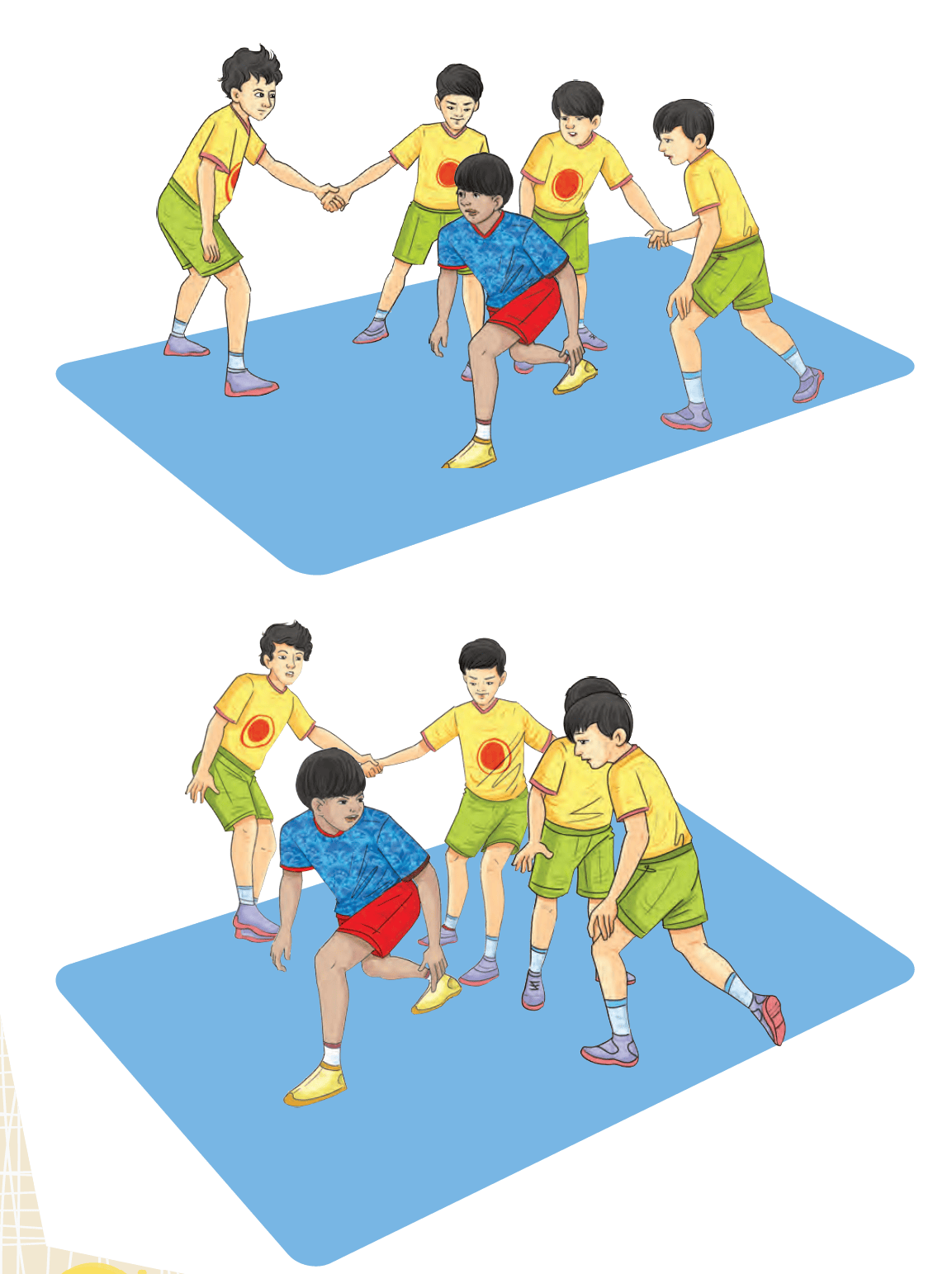
Chain-hold
The primary aim of the chain hold technique is to prevent the raider from escaping or returning to their own half of the court after a raid, so that defending team can gain points.
Steps to Learn
1. How to form the chain?
• Hold either the wrist or a palm of the other player to form a chain while forming a grip.
2. Approach
• Form the chain: Chain should be formed with the help of the supporting students.
• Cover the path and outer shoulder of the raider and observe the path and attack of the raider very carefully in order to anticipate the movement.
• Maintain the grip while approaching the raider.
3. Stance
• Stance must be wide.
• Shoulder of the player involved in chain must be parallel and close to each other.
Grip should be firm in formation of chain.
Position your head towards the line of attack of the raider
4. Execution
Defender involved in chain formation will come close to the raider and cover the raider.
• Chain should be placed on the abdominal region of the raider.
• The other hand opposite to the chain formation will be used as support to lift the raider from holding the thigh from behind.
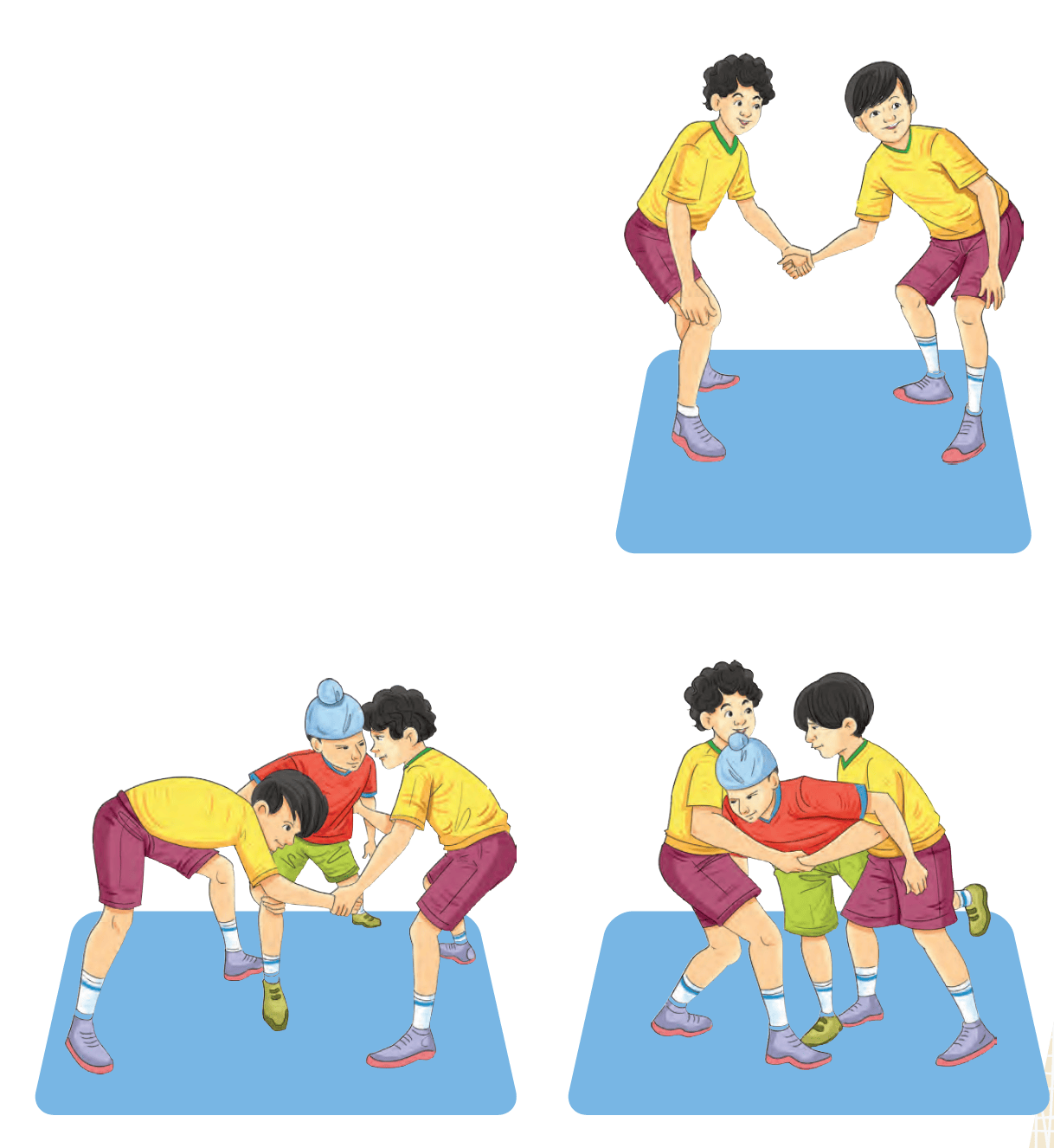
5. Follow Through
Two methods are used in follow-through action:
• Lifting the raider at the same spot by taking the wider stance.
• Change the direction of the raider by pushing him away from mid line with the chain.
Lead-up Activity
Form two teams. Line up both the teams facing each other at a distance of six metres approximately. One player from each team will come in the centre and will lock elbows with each other. Both player will sing one to two lines of any folk song while moving in a circle. As the first round ends, both the players will try to pull each other towards their own side. The player that successfully pulls the other player towards their side earns one point. Repeat the process until everyone gets their turn.
Circle Time –– Safety Measures
Discuss a set of instructions on avoiding head collision during chain-hold.
Complete the following task
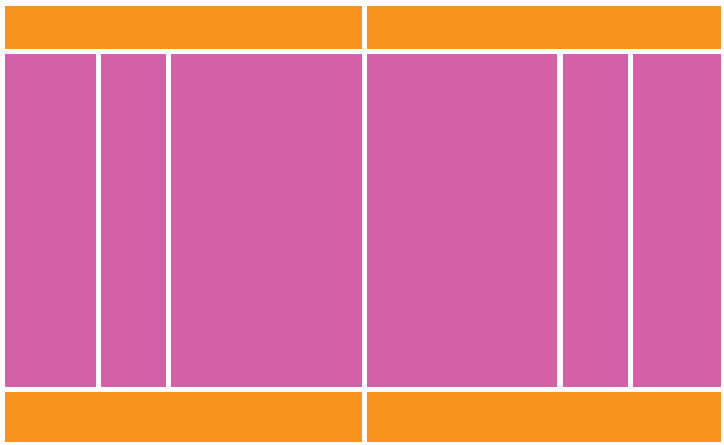
• Mark the court by joining the dots in the figure below.
• Find out the courts dimensions for junior boys and junior girls and label it.
• Find out the basic rules of Kabaddi and discuss them with your peers.

Teacher-Assessment
Touch (Hand Touch and Toe Touch)
|
1 |
2 |
3 |
4 |
5 |
|
Student is learning how to balance while attempting to touch with hands and toes. |
Student can do simple hand and toe touches but have trouble with speed and precision. |
Occasionally avoids defenders and perform hand and toe touches with respectable control. |
Student is agile and aware on how to make rapid, calculated touches. |
Confidently makes accurate hand and toe movements, avoiding opponents with agility and planning. |
Hold (Ankle Hold, Knee Hold and Thigh Hold)
|
1 |
2 |
3 |
4 |
5 |
|
Student is getting better at controlling grip on the raider’s leg, knee, or ankle. |
Tries holds, but occasionally have trouble with timing and grip strength. |
Using holds with respectable strength and skill the student slowdowns the raider. |
Successfully halts the raider with powerful, well-timed holds. |
Uses strategy and control to secure the raider with strong, accurate holds executed with assurance. |
Hold (Wrist Hold and Waist Hold)
|
1 |
2 |
3 |
4 |
5 |
|
Student is becoming better at controlling grip on the raider’s waist or wrist. |
Tries waist and wrist holds, but needs to improve timing and grip strength. |
Using holds with respectable strength and skill the student makes it difficult for the raider to get away. |
Successfully halts the raider’s movement with firm, well-timed holds. |
Executes solid, well-planned holds with assurance, keeping the raider from getting away. |
Understanding Self-Distress
|
1 |
2 |
3 |
4 |
5 |
|
Student has trouble identifying feelings and hardly ever acknowledge their problem. |
Occasionally becomes aware of the distress, but finds it hard to pinpoint the reason. |
Although having trouble controlling themself, student is aware of the distress and its causes. |
Has a good understanding of their distress and can control emotions to some extent. |
Successfully controls emotions and completely understand the reasons behind distress. |