Exploring the
Investigative
World of Science
1

Probe and ponder
Dear Young Scientists,
Welcome back! On the first page of each chapter, you will find a set of questions. These are not meant for any exam—they are unique invitations to spark your curiosity to explore the world of science!
- Why is one side of a puri thinner than the other?
- Are there more grains of sand on all the beaches and deserts of the world, or more stars in our galaxy?
- Right from Grade 6, we’ve observed the incredible diversity of plants and animals around us. From the different shapes of leaves to the many kinds of insects—why has nature created such a vast variety?
Is there such a question that makes you curious about the world?
Write it here! _________________

Our journey with Curiosity, into the world of science continues in Grade 8. We hope you bring along the spirit of adventure and exploration that has guided us so far. In Grade 6, we discovered how science begins with wonder, with simple “Why?” and “How?” questions about the world around us.
In Grade 7, we learnt that science is always evolving — that each answer opens new questions, and how our ideas can slowly change as we explore deeper. Now, in Grade 8, we take the next step: entering the Investigative World of Science, where wonder and evolution come together to form the heart of how science works.
We don’t want you to just learn new facts, we want you to learn how to find new facts. Investigation in science means more than just looking at something and asking only simple questions. Now you can ask more focused questions, and design ways to perhaps do simple experiments to answer those questions, and then use your observations to improve your understanding.
Step by step, we will learn how to use questions as starting points to try to observe carefully, experiment thoughtfully, and explain clearly what we see. In doing so, each of you won’t just be learners but also investigators, young scientists, exploring real-world puzzles. These may range from everyday life — like why does dough rise? — to the bigger mysteries of Earth and beyond like is the world getting warmer?
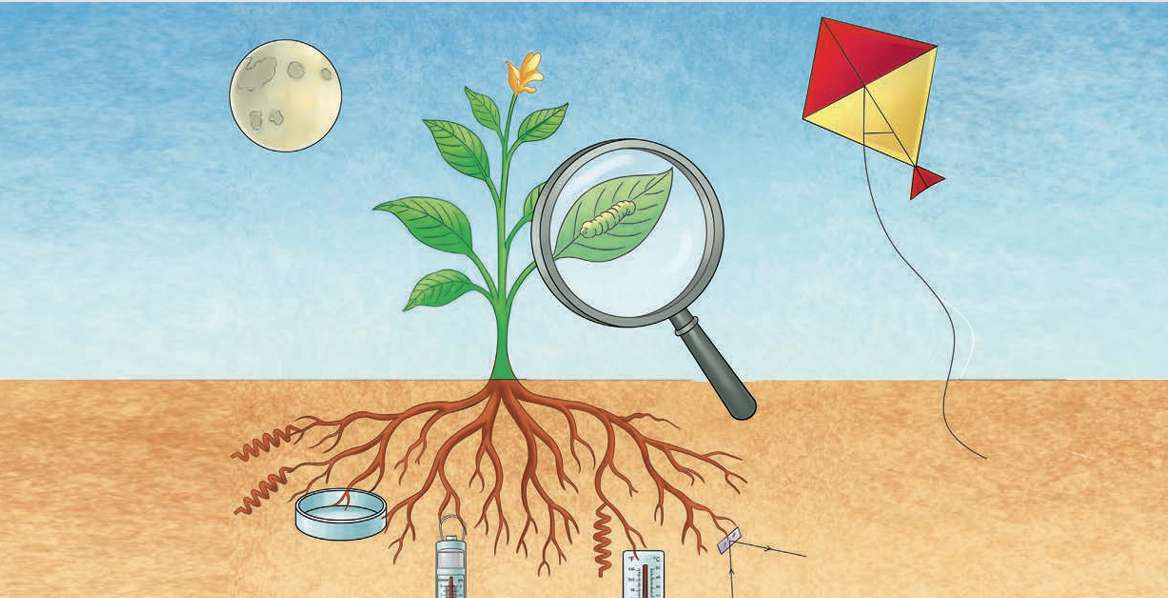
As you turn each page of this book, we hope you notice the interesting design of our page numbers once again. On the left-hand pages, at the bottom, you’ll find the image of a root, symbolising the deep, solid foundation of knowledge that keeps us connected to our environment, traditions, and our cultural and natural heritage.
On the right-hand pages, in the top corner, you’ll find a kite soaring in the sky, reminding us that curiosity must take flight if we are to explore the unknown. Together, these two symbols — the root and the kite — invite you to stay grounded in real observations, while allowing your ideas to soar towards new horizons. Remember, investigation in science works best only when we balance the solid ground of careful observation with the freedom of creative thinking.
You will also notice some patterns in the lines at the bottom of the page. There are some hidden scientific thoughts in these as well. But don’t worry, they are mainly to make the page a little less boring. Let us now take a brief look at the various stops on our journey this year, and see where our curiosity, supported by strong roots and lifted by soaring ideas, might take us!
 This year, our investigative adventure will take
us on a journey from the tiny microbes we can’t
see to planet-wide challenges we can’t ignore.
This year, our investigative adventure will take
us on a journey from the tiny microbes we can’t
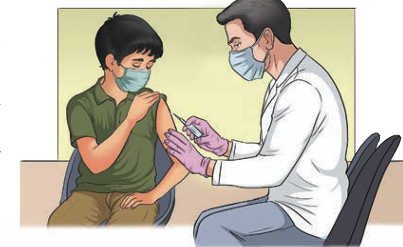
see to planet-wide challenges we can’t ignore.We will start by examining something as small as a single drop of water, and uncover a hidden world of tiny organisms, unseen but deeply linked to us. Some of these are invisible helpers, that help us digest our food or produce medicines, while others can be harmful, causing infections.


But what does our body need to stay healthy? How do we fight these infections? We’ll find out how nutritious food, exercise, medicines, and vaccines help us stay healthy and fight infections. But that’s just the beginning. In today’s world, science does play a major role in improving our lives.
For example, we use electric current in many ways to help make our lives easier. We depend on the heating effect of electric current to keep us warm, while the magnetic effect helps motors run and machines function.
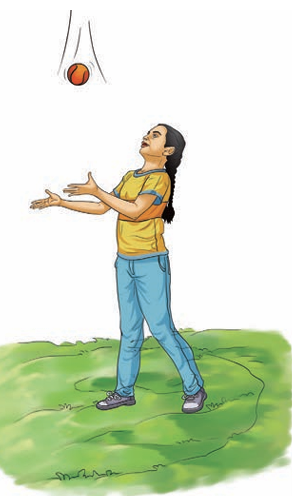 These phenomena depend on fundamental forces. So after
watching electricity do work, we move on to study these forces
themselves, starting with those that make objects speed up, slow
down, or change direction.
These phenomena depend on fundamental forces. So after
watching electricity do work, we move on to study these forces
themselves, starting with those that make objects speed up, slow
down, or change direction.Understanding forces helps explain why a ball thrown up in the air falls back to the ground, or why a car stops when the brakes are applied.
This also leads us to the idea of pressure — how the force is distributed over an object. The same concepts of force and pressure also decide how air moves. A small difference in pressure can result in a gentle breeze while a stronger pressure difference can lead to strong winds, and sometimes even cyclones.
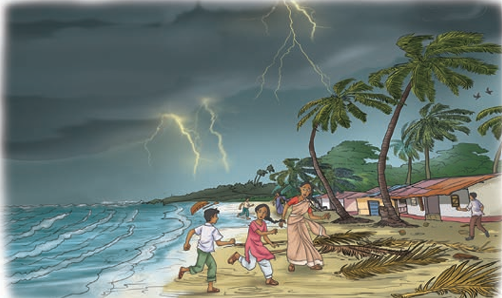
 So, these forces are connected to powerful weather
events—like storms and cyclones—that affect our daily
lives, agriculture, and even our safety.
So, these forces are connected to powerful weather
events—like storms and cyclones—that affect our daily
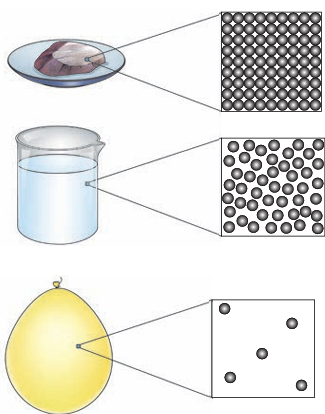
lives, agriculture, and even our safety.To truly understand how air can exert pressure or why water boils at a certain temperature we need to zoom into these materials and see what kind of particles they are made up of, and how they move around.
Everything around us is made of tiny particles. In materials that are solid these particles cannot move much, while in gases they can move around freely.
Classifying things around us is an important feature of science. We can also classify materials around us into elements (pure substances), compounds (two or more elements bonded together), and mixtures (combinations that can be separated physically).
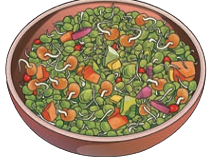
Once we know how particles combine or mix, we can then understand solutions — for example, how sugar dissolves in tea to make it sweet.
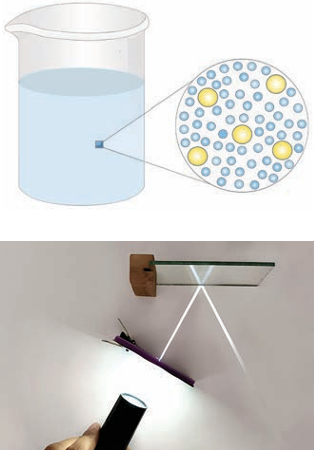
 From the world of particles and
mixtures, we then move into the world
of light. We’ll study how light rays reflect
off flat and curved mirrors, and bends
when passing through lenses and helps
us understand the working of many
objects around us. The bending of light
explains what happens when we see an image in a shiny
metal spoon or how corrective glasses help many of us
see clearly.
From the world of particles and
mixtures, we then move into the world
of light. We’ll study how light rays reflect
off flat and curved mirrors, and bends
when passing through lenses and helps
us understand the working of many
objects around us. The bending of light
explains what happens when we see an image in a shiny
metal spoon or how corrective glasses help many of us
see clearly.It’s not just a polished mirror that reflects light, rough surfaces reflect light as well, and so does the Moon. Depending on the relative positions of the Earth, Moon and Sun, a slightly different part of the Moon is illuminated each night, giving rise to the beautiful phases of the Moon that we see in the sky.

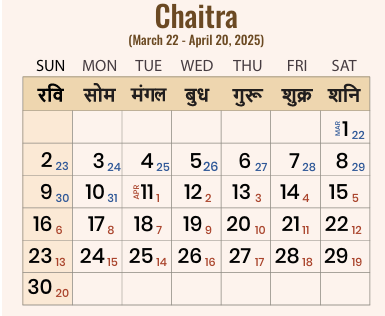
Watching the periodic cycles of the Moon’s phases allowed humans to come up with the first calendars. By combining careful observations of sunrises, sunsets, and lunar cycles, various calendars came into being. Isn’t it fascinating that the calendars which determine our routines on Earth are linked to the motions of objects far beyond our planet?
 But it’s not just calendars or the movements
of the Sun and Moon that are linked. Right here
on Earth, there are marvellous and complex
patterns of relationships between living
organisms and their environments. Every living
being — from tiniest insect to the largest whale,
from blades of grasses to tall trees — depends
on and responds to the air, water, sunlight,
and other organisms around them forming the
ecosystems that support life on our planet.
But it’s not just calendars or the movements
of the Sun and Moon that are linked. Right here
on Earth, there are marvellous and complex
patterns of relationships between living
organisms and their environments. Every living
being — from tiniest insect to the largest whale,
from blades of grasses to tall trees — depends
on and responds to the air, water, sunlight,
and other organisms around them forming the
ecosystems that support life on our planet.In the final chapter of this book, we can put it all together and try to understand what makes Earth ‘just right’ for life and to recognise the urgent challenges that our planet now faces.
Most importantly, the Earth lies at the perfect distance from the Sun, where water remains liquid, and it has an atmosphere that provides the oxygen we breathe while shielding us from harmful ultraviolet rays. But human activities on the planet can cause small changes in the temperature of the Earth, disrupting climate patterns, with dangerous consequences.
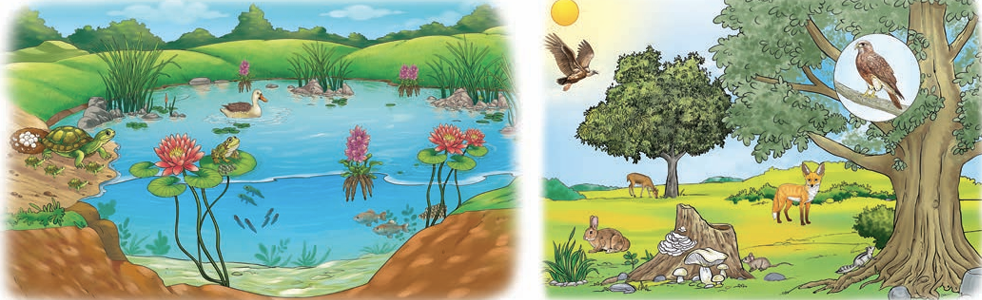
At the heart of both the problem — and any possible solution — is us. We are the ones influencing Earth’s climate. But we are also the ones who can — and must — use science to understand these changes and guide our actions.
The same scientific principles that we have guided our journey through the middle stages — observing, measuring, experimenting — will be key in helping us protect the delicate balance on which life depends. The challenges ahead won’t always be easy. We hope some of you will try to solve these difficult problems with Curiosity as your guide.
To help you think like a scientist, let us go back to a question we asked on the first page: Why is one side of a puri thinner than the other?
Firstly, remember that science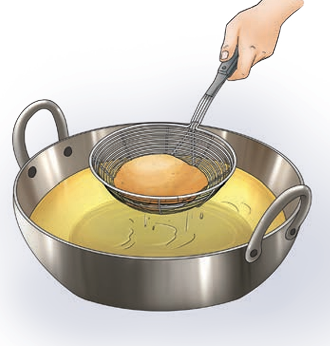 is everywhere! You don’t need
a fancy laboratory to do simple
experiments. Even your kitchen
at home is a wonderful place to
observe and ask questions. All
you need is to start with curiosity,
careful observation, and asking
what happens if…? Have you
noticed how a puri or a batura
puffs up when placed in hot oil?
Or how a phulka swells when
put directly on the flame. Why
does it puff up like a balloon? And why is one side thinner than
the other? These are questions a scientist might ask — and you
can too! Let’s see how we can investigate this simple everyday
phenomenon like a scientist would.
is everywhere! You don’t need
a fancy laboratory to do simple
experiments. Even your kitchen
at home is a wonderful place to
observe and ask questions. All
you need is to start with curiosity,
careful observation, and asking
what happens if…? Have you
noticed how a puri or a batura
puffs up when placed in hot oil?
Or how a phulka swells when
put directly on the flame. Why
does it puff up like a balloon? And why is one side thinner than
the other? These are questions a scientist might ask — and you
can too! Let’s see how we can investigate this simple everyday
phenomenon like a scientist would. First, we will try to ask a scientific question. What are the different things that may change the way a puri puffs up when fried? To answer this, we may want to do some simple experiments. For that, we try and find out two main things — what all can we change or control when we do the experiment, and what all can we observe to see if these changes made any difference.
In this case, we can perhaps think of the changing the thickness and the size of the rolled dough. We could also try to use different types of flour (atta, maida, etc.). While frying the puri, we can also change the temperature of the hot oil, or try and drop the rolled dough into the oil in different ways (drop it vertically? slide it at an angle? slide it slowly?) Notice that these are things that we can control.
However, to make sense of the changes, we also need to think of what we can observe or measure. Some of these may have just yes/no answers, in some cases there might be a number we can measure. Maybe we can start by checking whether the puri puffs up (yes/no), or we can measure the time it takes to puff up (seconds). We can check whether a very thick layer of dough still gives a thin side to the puri. Further, while doing such experiments, it is better to change only one thing at a time while keeping the other conditions same. For example, if we wanted to see the effect of boiling hot, hot, and not very hot oil, we would use circles of dough of the same thickness, and drop them in the same way. It is also a good idea to keep notes of everything that you see and sense when doing an experiment. Did the oil splatter, smell, or smoke? And after doing one round of experiments, you may think of more questions. Do puris puff better when made fresh or from stored dough? What happens if I prick a hole in the puri before frying?
This is exactly how all scientific experiments, from simple to the most complicated are done. This is the idea of systematic investigation. And just so you know, even this simple everyday observation — of a puri swelling — is not really completely understood by scientists today!
So, whether it is the swelling of a puri or the shrinking bright part of the Moon after purnima, let your careful observations guide you along your explorations into the investigate world of science.
Happy investigating!