Electricity: Magnetic
Heating Effects
- If we don’t have an electric lamp while making an electric circuit
with an electric cell, is there any other way through which we
can find out if current is flowing in the circuit?

- Is it possible to make temporary magnets? How can these be made?
- We can generate heat by burning fossil fuels and wood; but how is heat generated in various electrical appliances?
- How do we know if a cell or a battery is dead? Can all cells and batteries be recharged?
- Share your questions
_____________
____________?

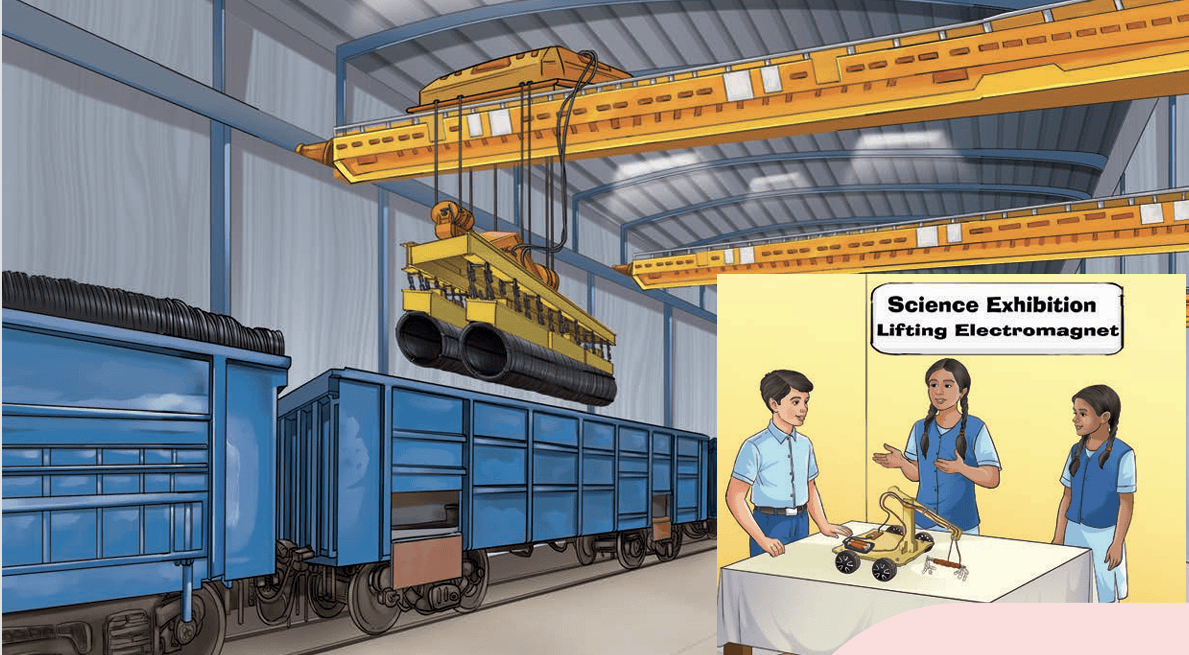
It was the day of the science exhibition, and the school was buzzing with energy. Mohini and Aakarsh, along with their friends, went from one exhibit to another, eagerly exploring different models, asking questions and taking notes. One simple model really fascinated them. It was a working model of a lifting electromagnet which was displayed by their senior, Sumana. In it, instead of a hook like a typical crane, there was an iron nail wrapped with a wire, which was connected to a battery. When Sumana closed the circuit, the nail picked up iron paper clips like a magnet. When she opened the circuit, the clips fell off. Mohini and Aakarsh, were surprised. They remembered learning earlier (in the chapter ‘Exploring Magnets’, Curiosity, Grade 6) that magnetic materials were attracted by magnet and that iron was a magnetic material. But in Sumana’s model, there was no magnet, only an electric circuit. They were so excited that they wanted to try it out themselves.
4.1 Does an Electric Current Have a Magnetic Effect?
Activity 4.1: Let us investigate
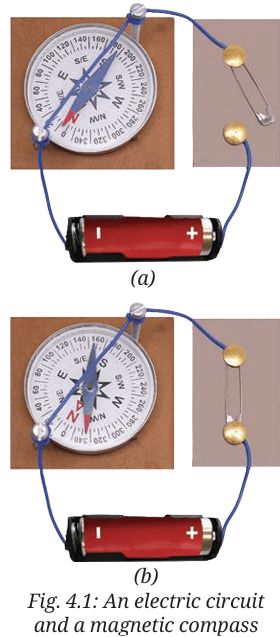
- Collect a magnetic compass, an electric cell, a cell holder, two drawing pins, a safety pin, two nails, two pieces of connecting wires (one longer and one shorter), and two small pieces of cardboard.
- Using two drawing pins, a safety pin, and a cardboard piece, make a switch (as you made it earlier in the chapter ‘Electricity: Circuits and their Components’ in Curiosity, Grade 7).
- Place the cell in the cell holder.
- Fix two nails to a piece of cardboard as shown in Fig. 4.1a. Fix the middle portion of the longer wire stretched between the nails, such that it is slightly above the surface of the cardboard. Attach one end of that wire to the cell holder and another end to the switch.
- Connect the second wire between the cell holder and the switch.
- Place the magnetic compass beneath the wire between the two nails (Fig. 4.1a).
- Now again while watching the compass needle, move the switch to ‘OFF’ position. What do you observe this time?
- Move the switch between ‘ON’ and ‘OFF’ positions a few more times. Carefully observe how the compass needle behaves the each time.
As we have learnt earlier (in the chapter ‘Exploring Magnets’ in Curiosity, Grade 6), the compass needle is a tiny magnet which deflects when a magnet is brought near it and this magnetic effect can act through any non-magnetic materials kept in between. But why does the compass needle deflect when the current flows through the wire? The deflection indicates that the current carrying wire has a magnetic effect on the compass needle. When the current stops, this magnetic effect disappears and the compass needle returns to its original direction. The region around a magnet or a current carrying wire where its magnetic effect can be felt, such as by the deflection of a compass needle, is said to have a magnetic field.
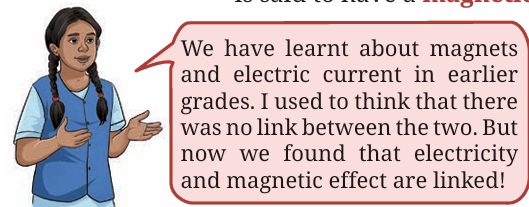
- We have learnt about magnets and electric current in earlier grades. I used to think that there was no link between the two. But now we found that electricity and magnetic effect are linked!
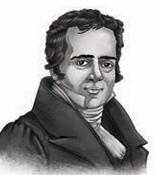 You have just now made the same discovery which
was made by the scientist Hans Christian Oersted
(1777–1851) in 1820, that is, the discovery that
electricity and magnetism are linked. He was a
professor at a university in Denmark. It is said that
once while giving a demonstration, he noticed that
whenever an electrical circuit was closed or
opened, the needle of a magnetic compass, lying
nearby, deflected. He investigated this and when he was certain that
an electric current indeed produced a magnetic field, he published
his findings. This led to other scientists repeating his experiment to
check if they got the same results, and further investigating the
connection between electricity and magnetism.
You have just now made the same discovery which
was made by the scientist Hans Christian Oersted
(1777–1851) in 1820, that is, the discovery that
electricity and magnetism are linked. He was a
professor at a university in Denmark. It is said that
once while giving a demonstration, he noticed that
whenever an electrical circuit was closed or
opened, the needle of a magnetic compass, lying
nearby, deflected. He investigated this and when he was certain that
an electric current indeed produced a magnetic field, he published
his findings. This led to other scientists repeating his experiment to
check if they got the same results, and further investigating the
connection between electricity and magnetism.
- Can we use electric current to make a magnet?
Staying healthy means eating nutritious food, maintaining hygiene, staying in a clean place, exercising regularly, getting proper sleep, spending time with family and friends, and having a positive attitude. What we should do and what should not do to keep ourselves healthy?
Activity 4.2: Let us explore
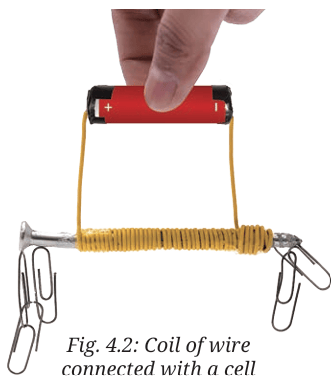
- Take around 50 cm long length of a flexible insulated wire, an iron nail, an electric cell, and few iron paper clips.
- Tightly wrap the wire around the nail in the form of a coil, as shown in Fig. 4.2, and secure it with an adhesive tape.
- Connect the ends of the wire to the cell. Take care to not connect the wires to the cell for more than a few seconds; otherwise, the cell may weaken quickly.
- Bring the nail close to the iron paper clips and lift up. Do the clips hang to the ends of the nail?
- Disconnect the wire from the cell to stop the flow of electric current in the wire. Do the clips fall down?
When electric current flows through the coil, the clips cling to it. But when the current is stopped, the clips no longer cling to it. Let us now try to investigate these observations in detail through Activity 4.3.
Activity 4.3: Let us experiment
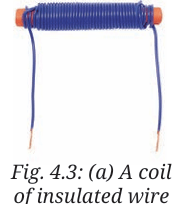
- Take around 100 cm long flexible insulated wire, a piece of chart paper, an iron nail, an electric cell, two magnetic compasses, and few iron/steel paper clips.
- Roll a piece of chart paper to make a cylinder of diameter roughly equal to the width of a pencil. Secure it with an adhesive tape.
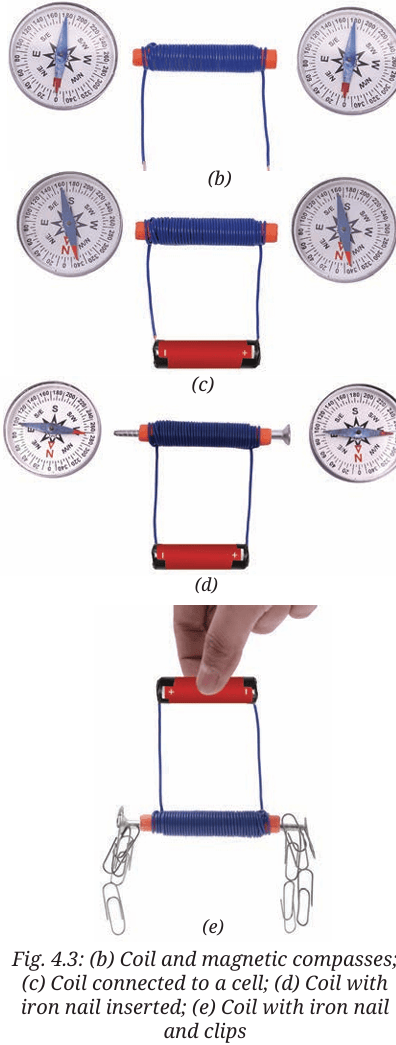
- Tightly wind around 50 turns of the insulated wire on the cylinder to form a cylindrical coil as shown in Fig. 4.3a. Secure the wire with an adhesive tape.
- Place the compasses near the two ends of the cylindrical coil (Fig. 4.3b).
- Connect the two ends of the coil with the terminals of the cell as shown in Fig. 4.3c and observe the magnetic compasses. Do you find any deflection in the needles of the compasses?
- Disconnect the wire from the cell. Do the needles of the compasses come back to their original positions?
- Insert an iron nail in the paper cylinder (Fig. 4.3d) and repeat the steps. Is there any difference in the deflection of the compass needles?
- Place some iron paper clips near the two ends of the nail. Are the clips attracted to the ends of the nail?
A current carrying coil that behaves as a magnet is
called an electromagnet. For practical applications,
most electromagnets have an iron core to make them
stronger.
- Does electromagnet also have two poles like a bar magnet?
Activity 4.4: Let us investigate
- Take the electromagnet made in Activity 4.3 and a magnetic compass. Label the two ends of the coil as A and B.
- Place the magnetic compass near the end A of the coil as shown in Fig. 4.4a.
- Connect the coil to the cell and observe the compass. Note down which pole of the magnetic compass is attracted to end A.
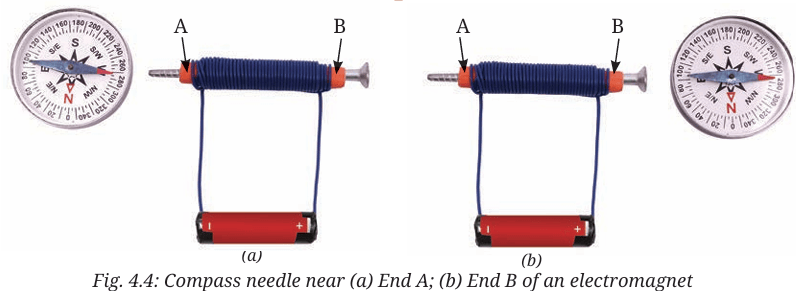 As we have learnt earlier, when two magnets are brought close
to each other, their unlike poles (North–South) attract each other.
So, if north pole of the magnetic compass is attracted towards
end A of the electromagnet, then end A is south pole.
As we have learnt earlier, when two magnets are brought close
to each other, their unlike poles (North–South) attract each other.
So, if north pole of the magnetic compass is attracted towards
end A of the electromagnet, then end A is south pole.
- Repeat this procedure to find the polarity of end B as well (Fig. 4.4b). Did you find that the polarity of end B is opposite to the polarity of end A?
4.1.2 Lifting electromagnets
- Are electromagnets also used in real life, for lifting objects?
4.2 Does a Current Carrying Wire Get Hot?
Activity 4.5: Let us observe
In this activity, we will use a special kind of wire, called a nichrome wire.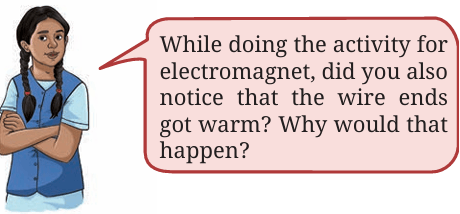
- While doing the activity for electromagnet, did you also notice that the wire ends got warm? Why would that happen?
- Take a cardboard piece of about 10 cm length and 10 cm width, two nails, a nichrome wire of thickness about 0.3 mm (26–28 gauge) and length of 10 cm, an electric cell, a cell holder, a switch, and connecting wires.
- Mount the nails on the cardboard about 5 cm apart.
- Tie the nichrome wire between these nails and make the connections as shown in Fig. 4.5 with the switch in OFF position.
- Touch the nichrome wire. What do you feel?
- Move the switch to ON position for about 30 s and then move it back to OFF. Touch the nichrome wire momentarily (Do not hold the nichrome wire). What difference do you feel?
- Repeat the last two steps to confirm the observation.
You may have observed that nichrome wire
feels warm when current is passed through it.
This happens because, when electric current 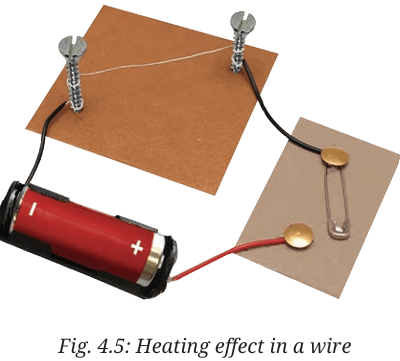 flows through any conductor, it faces some
opposition or resistance to its flow. Different
conductors offer different levels of resistance
to the flow of current. A nichrome wire, for
example, offers higher resistance compared to
a copper wire of the same size and length. This
resistance causes some of the electrical energy to
be converted into heat energy. When an electric
current passes through a conductor, it gets
heated. This warming is known as the heating
effect of electric current.
flows through any conductor, it faces some
opposition or resistance to its flow. Different
conductors offer different levels of resistance
to the flow of current. A nichrome wire, for
example, offers higher resistance compared to
a copper wire of the same size and length. This
resistance causes some of the electrical energy to
be converted into heat energy. When an electric
current passes through a conductor, it gets
heated. This warming is known as the heating
effect of electric current.
Repeat Activity 4.5 with a battery of 2 cells. What do you notice? For the same duration, does the wire heat up more with one cell or two cells?
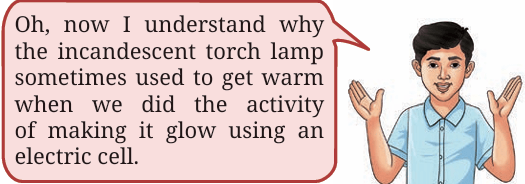
The amount of heat generated is more in the experiment with 2 cells. This is due to the fact that the heat generated depends on the magnitude of the electric current. The heat generated in a wire depends on the material, thickness, and length of the wire, and the duration for which the current flows.In Grade 7, we have learnt that an incandescent lamp glows because its filament is heated by an electric current. Many household appliances, such as electric room heaters, stoves, irons, immersion rods, water
- Oh, now I understand why the incandescent torch lamp sometimes used to get warm when we did the activity of making it glow using an electric cell.
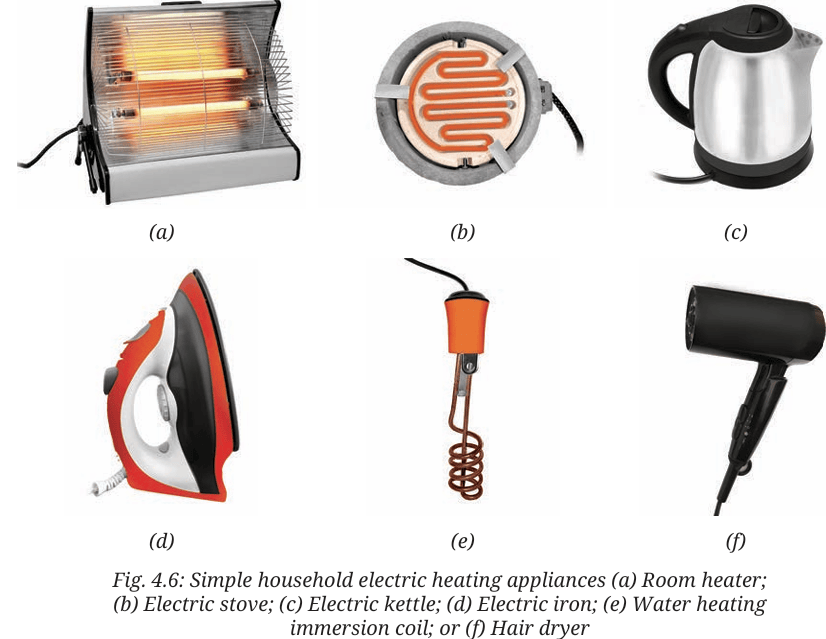

The heating effect of electric current is useful in many everyday appliances. But sometimes, it can cause problems, like energy loss in wires during transmission. Overheating in appliances may cause damage to plugs and sockets where plastic parts may melt, or even lead to fires. In household circuits, there are safety devices placed in the circuit to minimise such incidents.

- The portable sources of electricity, such as cells and batteries, are so fascinating. Using these, we could light up a small lamp, make a magnet, and heat up a wire.
- Yes, but have you ever wondered what is inside these cells and batteries that produces electricity?
4.3 How Does a Battery Generate Electricity?
Let us start with one of the earliest types of electric cells ever made.
4.3.1 Voltaic cell
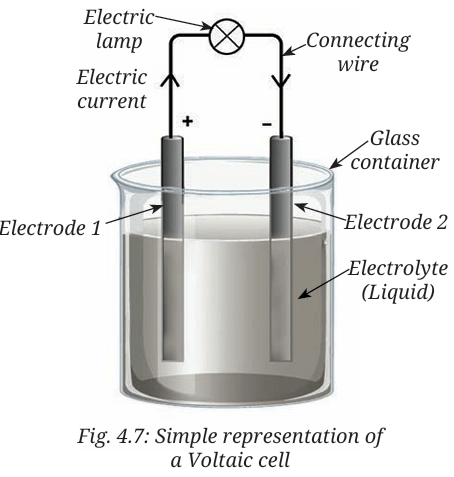
A Voltaic cell, also known as Galvanic cell, is shown in Fig. 4.7. It contains two metal plates made of different materials and a liquid called an electrolyte, placed in a glass or plastic container. The plates, called electrodes, are partly dipped in the electrolyte, which is usually a weak acid or salt solution. A chemical reaction between the plates and the electrolyte produces electricity. When the circuit is connected, electric current flows from the positive terminal through the circuit to the negative terminal. Over time, the chemicals get used up, and the cell stops working. It is then called ‘dead’ and cannot supply any more electricity.
Activity 4.6: Let us construct
- Can we also make our own Voltaic cell using easily available materials?
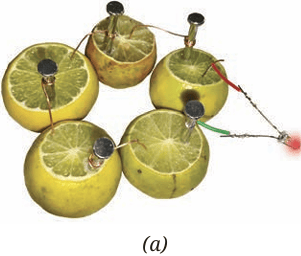
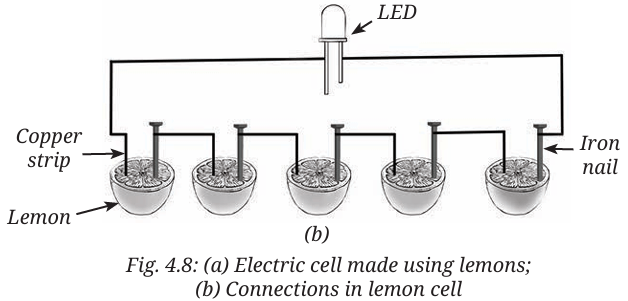
- Take five or six juicy lemons, copper wires/ strips (1–2 mm thick) and iron nails. Also take one LED and some connecting wires.
- Insert the copper wire and the iron nail in one of the lemons keeping them apart by a small distance as shown in Fig. 4.8a.
- Repeat the above step for all the remaining lemons.
- Join the copper wires and nails as shown in Fig. 4.8b.
- Connect the LED between the copper wire of the first lemon and the iron nail of the last lemon, using connecting wires. What do you observe? Does the LED glow?
- If the LED does not glow, reverse its connections. Does the LED glow now? [Remember that we have learnt earlier that current can pass through the LED only when the positive terminal (longer wire) of the LED is connected to the positive terminal of the battery, and negative terminal (shorter wire) of the LED is connected to the negative terminal of the battery].
4.3.2 Dry cells
Voltaic cells were an important discovery, but they are not convenient for everyday use. Instead, dry cells are one of the most widely used electric cells today. They are called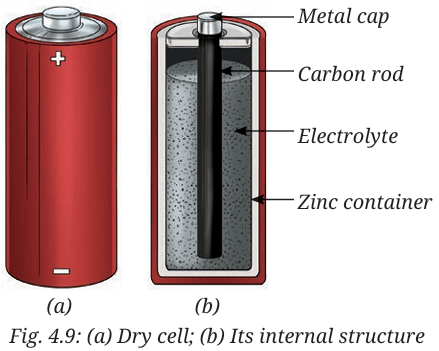 ‘dry’ because the electrolyte is not a liquid but
a thick moist paste. The structure of a dry cell is
shown in Fig. 4.9. It consists of a zinc container
which acts as a negative terminal and a carbon
rod at the centre covered with metal cap that
acts as the positive terminal. The carbon rod is
surrounded by the paste-like electrolyte.
‘dry’ because the electrolyte is not a liquid but
a thick moist paste. The structure of a dry cell is
shown in Fig. 4.9. It consists of a zinc container
which acts as a negative terminal and a carbon
rod at the centre covered with metal cap that
acts as the positive terminal. The carbon rod is
surrounded by the paste-like electrolyte.
The dry cell is a single use cell, meaning once it is used up, it has to be disposed of. For several applications, rechargeable batteries are increasingly being used now.
4.3.3 Rechargeable batteries
Rechargeable batteries can be recharged and reused multiple times. This prevents wastage and saves money over time as well.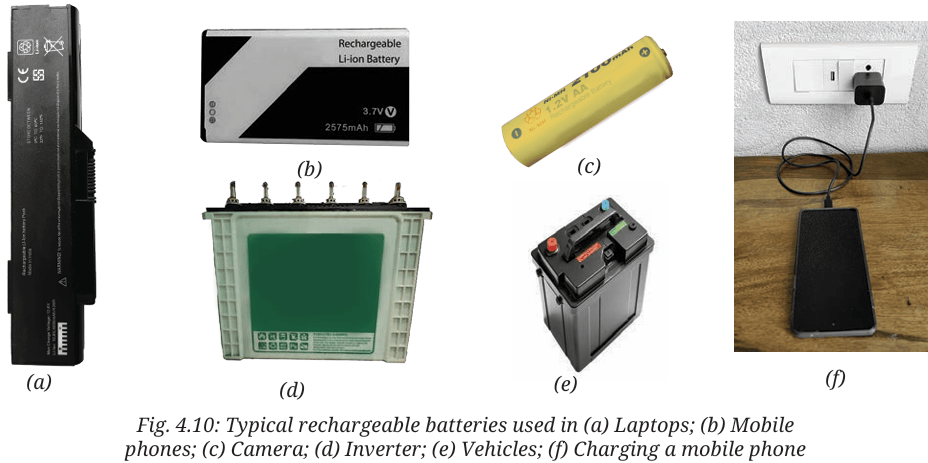
There are many different kinds of rechargeable batteries that
are used for different applications — from small batteries used
in watches and phones to batteries used in 
- Oh, so this is the reason why after a year or two, the phone battery requires charging more often!
- When electric current flows through a conductor (like a wire), it produces a magnetic field around it. This phenomenon is known as the magnetic effect of electric current.
- A current carrying coil that behaves as a magnet is called an electromagnet. For practical applications, most electromagnets have an iron core to make them stronger.
- Generation of heat in conductors due to flow of electric current is known as the heating effect of electric current.
- A cell or a battery is a device that generates electric current because of chemical reactions taking place inside it.
- Rechargeable batteries can be recharged and reused multiple times.
- Fill in the blanks:
(i) The solution used in a Voltaic cell is called ________.
(ii) A current carrying coil behaves like a _______ . - Choose the correct option:
(i) Dry cells are less portable compared to Voltaic cells. (True/False)
(ii) A coil becomes an electromagnet only when electric current flows through it. (True/False)
(iii) An electromagnet, using a single cell, attracts more iron paper clips than the same electromagnet with a battery of 2 cells. (True/False) - An electric current flows through a nichrome wire for a
short time.
(i) The wire becomes warm.
(ii) A magnetic compass placed below the wire is deflected.
Choose the correct option:
(a) Only (i) is correct
(b) Only (ii) is correct
(c) Both (i) and (ii) are correct
(d) Both (i) and (ii) are not correct - Match the items in Column A with those in Column B.
Column A Column B (i) Voltaic cell (a) Best suited for electric heater (ii) Electric iron (b) Works on magnetic effect of electric current (iii) Nichrome wire (c) Works on heating effect of electric current (iv) Electromagnet (d) Generates electricity by chemical reactions - Nichrome wire is commonly used in electrical heating
devices because it
(i) is a good conductor of electricity.
(ii) generates more heat for a given current.
(iii) is cheaper than copper.
(iv) is an insulator of electricity. - Electric heating devices (like an electric heater or a stove) are often considered more convenient than traditional heating methods (like burning firewood or charcoal). Give reason(s) to support this statement considering societal impact.
- Look at the Fig. 4.4a. If the compass placed near the coil deflects: (i) Draw an arrow on the diagram to show the path of the electric current. (ii) Explain why the compass needle moves when current flows. (iii) Predict what would happen to the deflection if you reverse the battery terminals.
- Suppose Sumana forgets to move the switch of her lifting electromagnet model to OFF position (in introduction story). After some time, the iron nail no longer picks up the iron paper clips, but the wire wrapped around the iron nail is still warm. Why did the lifting electromagnet stop lifting the clips? Give possible reasons.
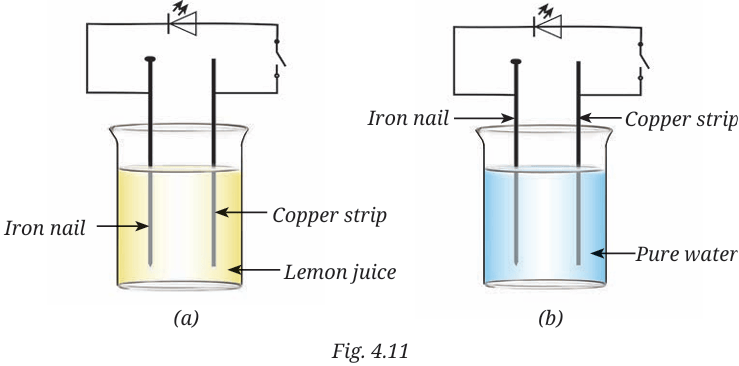
- In Fig. 4.11, in which case the LED will glow when the switch is closed?
- Neha keeps the coil exactly the same as in Activity 4.4 but slides the iron nail out, leaving only the coiled wire. Will the coil still deflect the compass? If yes, will the deflection be more or less than before?
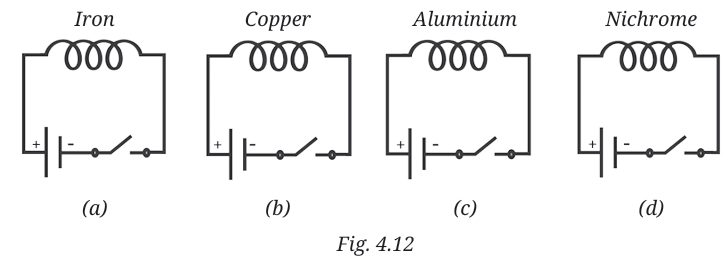
- We have four coils, of similar shape and size, made up from
iron, copper, aluminium, and nichrome as shown in Fig. 4.12.
Reflect on the questions framed by your friends and try to answer ...
When current is passed through the coils, compass needles
placed near the coils will show deflection.
(i) Only in circuit (a)
(ii) Only in circuits (a) and (b)
(iii) Only in circuits (a), (b), and (c)
(iv) In all four circuits
- Make coils of turns 25, 50, 75, and 100. Connect them to the same cell one by one. Note the deflection in a magnetic compass placed in the same position in all the cases. Report your observations. Draw conclusion of the effect of number of turns of the coil on the strength of the electromagnet.
- Take two thin nichrome wires of equal length and different thickness (approximately one of these wire thickness to be double of the other, say 0.3 mm and 0.6 mm). Connect them one by one in a circuit which has a switch and a cell, and allow the current to flow for 30 s in each case. Momentarily touch these wires. Which wire heats up more? Now repeat the same activity with two nichrome wires of same diameter but of different lengths. Prepare a brief report of your activity.
- Try to make an electric cell using various fruits and vegetables. Also try with electrodes of different metals. Prepare a brief report.