Electricity: Magnetic
Heating Effects

- Why are winds stronger on some days than on others?

- Why are water tanks usually placed at a height?
- Can air pressure really crush us?
- What causes storms and cyclones? If the Earth stopped rotating, would cyclones still form?
- Share your questions
______________
_____________?
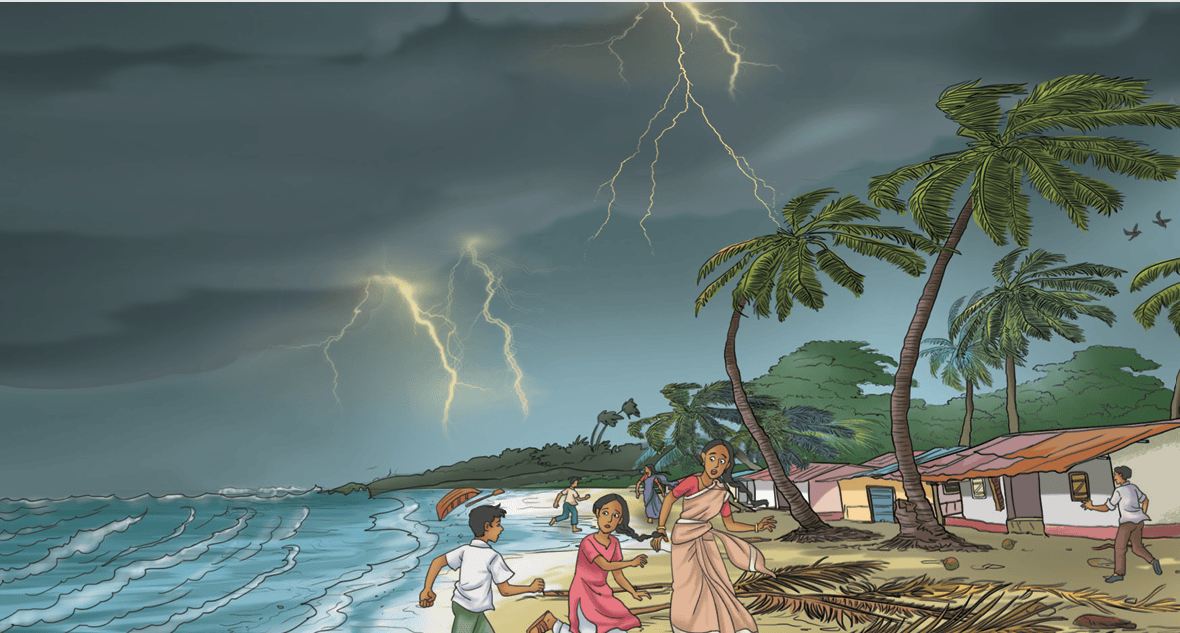
You must have observed fallen leaves on the ground swirling in the air or being swept away, and trees swaying or even bending when a strong wind blows. Have you ever wondered why fallen leaves rise in the air or trees sway or bend? Does the wind exert force on fallen leaves to make them rise or on trees to bend? Recall other similar effects of the force exerted by wind like slamming of doors or rattling of windows, or fluttering of clothes? How does the force exerted by wind make this happen? The force exerted by wind creates wind pressure which causes these effects. In this chapter, we will explore the relationship between force and pressure, and understand how they shape powerful natural events like thunderstorms and cyclones.
6.1 Pressure
Megha and her brother Pawan are going on a picnic. They walk
to the picnic spot, carrying identical items in their bags (Fig. 6.1).
On the way, Pawan keeps adjusting his bag, and looks 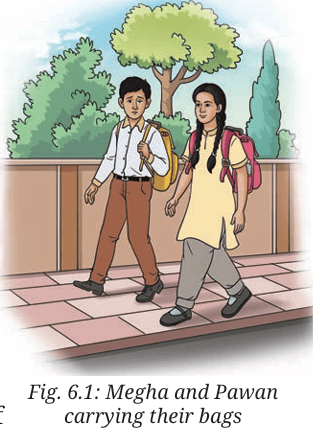 uncomfortable. Megha asks, “Is there a problem with
your bag?” Pawan responds, “Yes, it is hurting my
shoulders.” Megha says, “Both our bags are equally
heavy. Why does your bag hurt, and mine doesn’t?”
Pawan reflects for a minute and says, “Perhaps, it is
because of the difference in the straps of our bags.
My bag has narrow straps while your bag has broad
straps.”
uncomfortable. Megha asks, “Is there a problem with
your bag?” Pawan responds, “Yes, it is hurting my
shoulders.” Megha says, “Both our bags are equally
heavy. Why does your bag hurt, and mine doesn’t?”
Pawan reflects for a minute and says, “Perhaps, it is
because of the difference in the straps of our bags.
My bag has narrow straps while your bag has broad
straps.”
When we carry a bag, we feel its weight because of the force of gravity acting on our shoulders. The weight of the bag with narrow straps acts on a smaller area of our shoulders, whereas the weight of the bag with broad straps is spread out over a larger area of our shoulders. It is due to this reason that we feel more comfortable carrying a bag with broader straps than one with narrow straps, although both bags have the same weight. Since the area over which the force acts is involved, we define a quantity called pressure, which is the force per unit area.
So, Pressure =Force/Area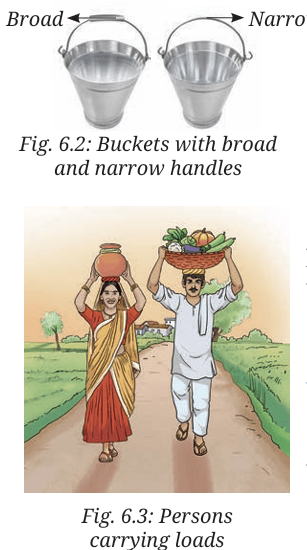 Broad straps reduce the pressure exerted by the bag on
our shoulders as compared to narrow straps. Therefore, we
feel more comfortable carrying a bag with broad straps.
Broad straps reduce the pressure exerted by the bag on
our shoulders as compared to narrow straps. Therefore, we
feel more comfortable carrying a bag with broad straps. Can you now understand why it feels easier to lift a water-filled bucket with a broad handle than with a narrow handle (Fig. 6.2)? Similarly, we have seen that when people carry loads like pots or vegetable baskets on their heads, they often place a round piece of cloth under the loads (Fig. 6.3). In both cases, the objective is to reduce pressure by increasing the area over which the weight acts.
Pressure is defined as the force per unit area. The SI unit of force is newton and that of area is metre2. Therefore, the larger area of SI unitpressure is newton/metre2 (N/m2). This unit is also called a pascal, denoted by Pa.If a force of 100 N is applied on a cardboard of area 2 m2, then the pressure applied on the cardboard will be:
Pressure = Force/Area = 100 N/2 m2 = 50 N/m2
There are many situations in daily life where pressure plays a role.Conduct the activities given in Table 6.1 and record your observations. Explain how pressure influences the mode of action undertaken for each activity.What can you conclude from your observations in Table 6.1?
 We conclude that when the area over which a
force applied is smaller, the resulting pressure is
higher, making it easier to do certain tasks. This is
why it is easier to drive a nail using its pointed end,
and it is easier to cut an apple with the sharp edge
of a knife.
We conclude that when the area over which a
force applied is smaller, the resulting pressure is
higher, making it easier to do certain tasks. This is
why it is easier to drive a nail using its pointed end,
and it is easier to cut an apple with the sharp edge
of a knife.
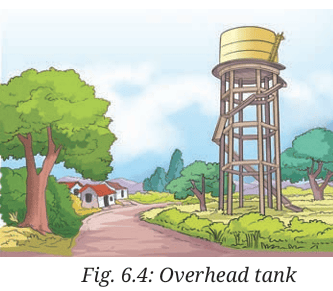
You must have seen overhead water tanks
(Fig. 6.4) in your locality, or on the rooftops of houses
used for water supply. Why are these tanks always
placed at a height?
Activity 6.1: Let us try and find out
- Take two transparent glass or plastic pipes of the same length (about 25 cm), but of different diameters, as shown in Fig. 6.5.
- Take two good-quality rubber balloons. Attach them to one end of each pipe.
- Clamp the pipes on a stand as shown in Fig. 6.5.
- Now, fill both the pipes with water up to the same level about halfway.
- Observe what happens to the balloons.
- Do both balloons bulge? Do they bulge to the same extent?
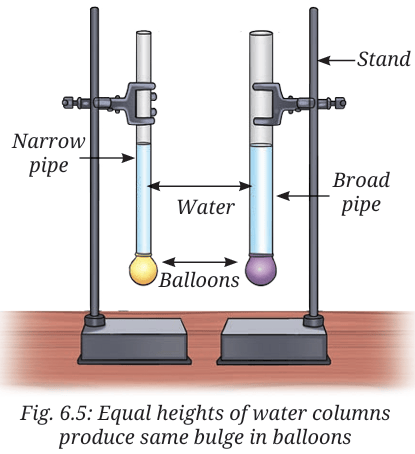
Could it be that the water column is exerting pressure? Yes, it is the pressure exerted by the water column which is responsible for the bulge. That is why equal water column heights produce equal bulges in the balloons, despite their different diameters.
Pour some more water in any one of the pipes
used in Fig. 6.5. Observe the bulge of the balloon.
Repeat this process a few times, adding more
water each time and noting the extent of bulge as
shown in Fig. 6.6. 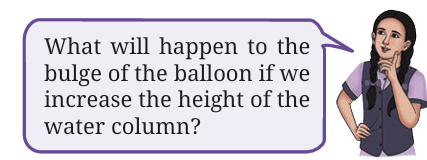
- What will happen to the bulge of the balloon if we increase the height of the water column?
Suppose you are living on the second floor of a three-storeyed building and an overhead water tank is placed on the top floor. Will you or your friend on the first floor receive a more powerful stream of tap water? Give reasons.
.....................................Do liquids also exert pressure on the walls of the container? Let us find out by conducting the following activity.
Activity 6.2: Let us find out
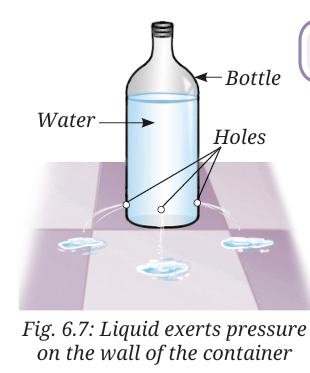
- Take a used plastic bottle and remove its cap. Make four small holes near the bottom around the sides using a needle or a nail. Make sure that the holes are at the same height from the bottom as shown in Fig. 6.7. (If you find it difficult to make a hole, you can slightly heat the needle and poke it to make holes.)
- Seal the holes with a tape and fill the bottle with water.
- Now, remove the tape from all holes at the same time.
- What do you observe?
You must have seen water spurting out like a fountain from leaking joints or holes in water pipes. Can you explain why this happens? Is it due to the pressure exerted by water on the walls of the pipes?
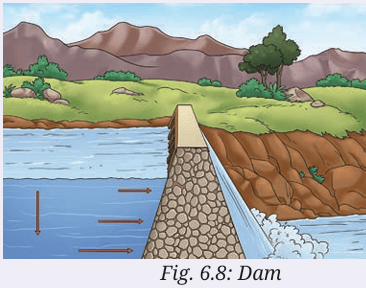 Do you know that the base of
a dam is much broader than
the top? This is because a
broad base not only supports
the structure of the dam, but
also withstands the horizontal
water pressure near the bottom
(Fig. 6.8). The water stored
in the dam, exerts pressure
horizontally on the side walls
of the dam and vertically on
the floor due to the height of the water level. The pressure which
acts horizontally, is very large near its bottom. Thus, to withstand the
pressure, the base of the dam is made broader.
Do you know that the base of
a dam is much broader than
the top? This is because a
broad base not only supports
the structure of the dam, but
also withstands the horizontal
water pressure near the bottom
(Fig. 6.8). The water stored
in the dam, exerts pressure
horizontally on the side walls
of the dam and vertically on
the floor due to the height of the water level. The pressure which
acts horizontally, is very large near its bottom. Thus, to withstand the
pressure, the base of the dam is made broader.Let us now try to understand if air also exerts pressure.
6.2 Pressure Exerted by Air
You already know that air is all around us. The envelope of air surrounding the Earth is called atmosphere. The atmospheric air contains nitrogen, oxygen, argon, carbon dioxide, and other gases in small quantities. The atmosphere extends up to many kilometres above the surface of the Earth.
Let us find out if the atmosphere exerts pressure by performing the following activity.Activity 6.3: Let us explore
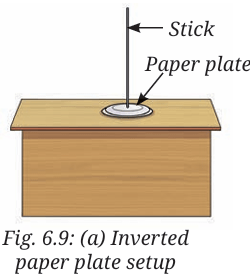
- Take a paper plate, invert it and attach a stick to it as shown in Fig. 6.9a. Place it on a plain surface.
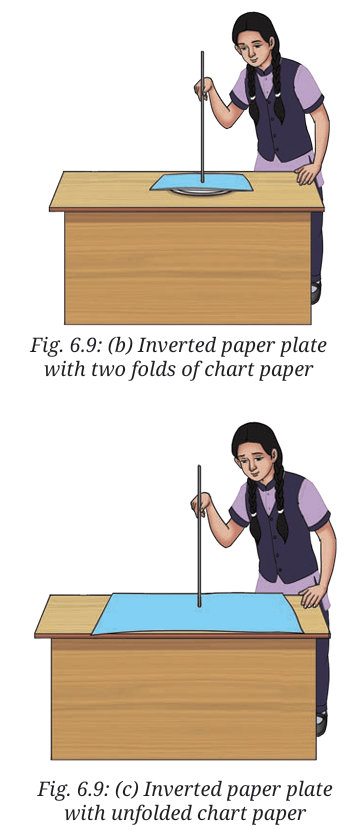
- Take two identical sheets of chart paper about 70 cm × 56 cm each. Fold one sheet twice and make a hole in the centre of the folded chart paper sheet — big enough for the stick to come out. Place the folded sheet on top of the inverted paper plate as shown in Fig. 6.9b.
- Now, try to lift the paper plate covered with a folded sheet using the stick.
- Observe how much effort is needed to lift it.
- Now, place the second unfolded chart paper sheet in place of the folded sheet. Make a hole at the centre of this chart paper for the stick to pass through. Cover the paper plate with the unfolded chart paper as shown in Fig. 6.9 c.
- Lift the paper plate again and feel the effort needed in doing so.
- In which case is the lifting easier, with the folded or the unfolded chart paper covering the paper plate?
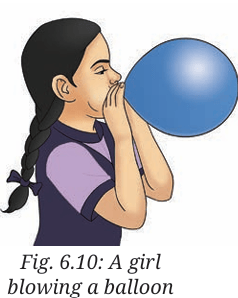
You must have experienced that when you blow air into a balloon, it gets inflated. Why? This is because the air being filled inside the balloon exerts pressure on the walls of the balloon (Fig 6.10). Can we say that air exerts pressure in all directions? Yes, that is why the balloon expands in all directions. What happens when an inflated balloon is kept without closing its mouth? The air escapes from the balloon. Why does the air escape from the balloon?
Have you ever wondered how large the atmospheric pressure is? Let us get an idea about its magnitude by performing the following activity.Activity 6.4: Let us perform
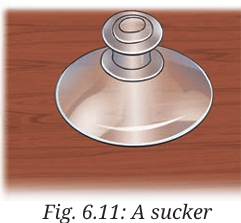
- Take a good-quality rubber sucker. Press it firmly against a smooth flat surface (Fig. 6.11).
- Do you realise that it sticks to the surface?
- Now, try to pull it off. Do you find it difficult to pull it off?
Do you know how large the atmospheric pressure is? The force exerted by the atmospheric air column over an area 15 cm × 15 cm is nearly equal to the force of gravity on an object of mass 225 kg (2250 N). The reason we are not crushed under this weight is that the pressure inside our bodies is also equal to the atmospheric pressure. This balances the pressure exerted from outside. The pressure inside our body is caused by the movement of fluids and gases in tissues and organs of the body.
6.3 Formation of Wind
You must have noticed that on some days, the wind blows strongly, whereas on other days, it is calm. Sometimes, wind becomes so strong that it causes damage to life and property.
You must have seen that when an inflated balloon is kept without closing its mouth, the air from the balloon escapes. Recall that when there is a puncture in the bicycle tube, the air escapes and the tube collapses. In both of these cases, does air move from a high pressure region to a low pressure region?
- Does the difference in air pressure have anything to do with the formation of winds?
- How do winds form?
Let us find out from the following activity.
Activity 6.5: Let us observe
- Take two similar balloons made of thin rubber, and a drinking straw.
- Insert one end of the straw into one balloon and secure it with a rubber band or thread.
- Now inflate the second balloon and hold its mouth with your fingers, so that air does not escape.
- Insert the free end of the straw into the neck of the inflated balloon and secure it with a rubber band or thread. Make sure that the air does not leak from the balloon as the straw is inserted in it. Now you have one end of the straw inside the inflated balloon and the other end inside the uninflated balloon as shown in Fig. 6.12.
- Predict what would happen to the balloons.
- Observe what happens to both the balloons. Did it happen as predicted?
- Do you observe any change in the size of the balloons? Write down your observations. ...............
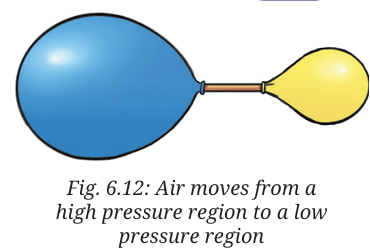
Do you notice that after some time both the balloons attain almost the same size and the flow of air stops? Why does the air flow stop? The flow of air continues till the air pressure in the inflated balloon is higher than the air pressure in the uninflated balloon. The air flow stops when the pressure in both balloons becomes equal. At this stage, both balloons are almost of the same size. Thus, we can conclude that air moves from a region of high air pressure to a region of low air pressure.
You can relate this conclusion to the directions of the sea breeze and land breeze, which you studied in Curiosity, Grade 7. As land gets heated faster than water during the day, the air above the land becomes warmer and lighter. Hence, it rises, creating an area of low pressure. The air from the high pressure region of the sea blows to the low pressure region which develops on the land, resulting in a sea breeze. At night, the water is warmer than the land. Therefore, a low pressure area develops above the sea. As a result, wind blows from the land to the sea, giving rise to land breeze. Thus, the phenomenon of land breeze and sea breeze is mainly due to the pressure differences over the land and the sea.If we could measure the speed of the escaping air in Activity 6.5, we would find that the speed of the air is higher if the pressure difference is higher.

- I have read that high-speed winds can blow off roofs.
- I wonder how?
6.4 High-Speed Winds Result in Lowering of Air Pressure
Activity 6.6: Let us observe
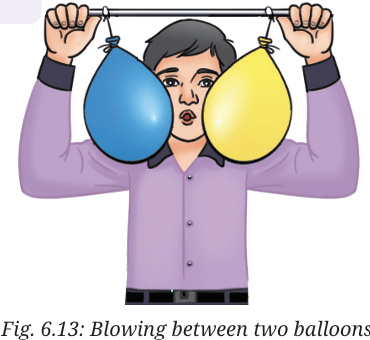
- Take two balloons of the same size.
- Inflate both balloons and tie strings to them.
- Hang the two balloons from a stick, leaving a gap of 6–10 cm (Fig. 6.13).
- Now, blow air into the narrow space between the balloons.
- What happens to the balloons? Note down your observations.
- Now blow harder and observe.
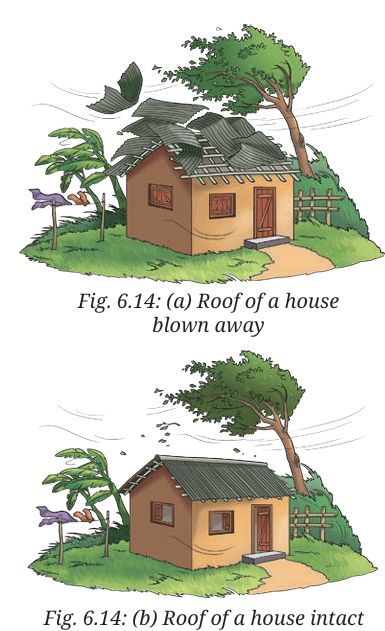
When high-speed winds blow over houses, a low-pressure area is created over them, as high-speed winds are accompanied by a reduced pressure. Therefore, the air pressure above the roofs of the houses is lower than the pressure below them. If the pressure difference is large and the roofs are weak, they may be blown away, as shown in Fig. 6.14 a. That is why it is safer to keep doors and windows of the houses open during storms with high-speed winds. When the same wind moves over the roofs, and through the houses, the pressure difference between inside of the houses and over the roofs is reduced to a large extent. This helps prevent the roofs from being blown off as shown in Fig. 6.14 b.
You must have experienced that when high-speed winds blow during storms, they are sometimes accompanied by thunder and lightning. Let us learn more about them.
6.5 Storms, Thunderstorms, and Lightning

- Have you heard the sound of thunder and seen lightning during the rainy season?
- Yes, the sound of thunder is so frightening! Usually there is heavy rainfall too.
 As the rising air expands, it cools and moisture in it
condenses to form water droplets, creating clouds.
The water droplets merge to form heavier drops,
which come down as rain, hail, or snow. The strong
winds accompanied by rain is called a storm. In hot,
humid, and tropical regions like India, storms are
more frequent. Under certain conditions, warm air
rises to great heights that the low temperature there
converts water droplets into ice particles.
As the rising air expands, it cools and moisture in it
condenses to form water droplets, creating clouds.
The water droplets merge to form heavier drops,
which come down as rain, hail, or snow. The strong
winds accompanied by rain is called a storm. In hot,
humid, and tropical regions like India, storms are
more frequent. Under certain conditions, warm air
rises to great heights that the low temperature there
converts water droplets into ice particles.
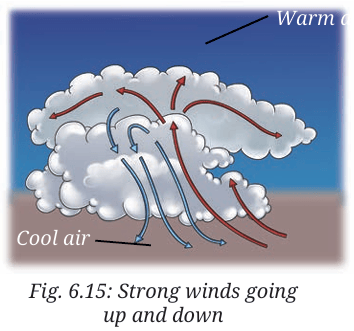
Strong winds blowing upwards and downwards (Fig. 6.15) facilitate rubbing between water droplets and ice particles. You have learnt in the chapter ‘Exploring Forces’ that when two objects are rubbed against each other, they get charged. In this case, strong winds blowing upwards and downwards and rubbing against each other cause static electric charges to develop within the clouds.
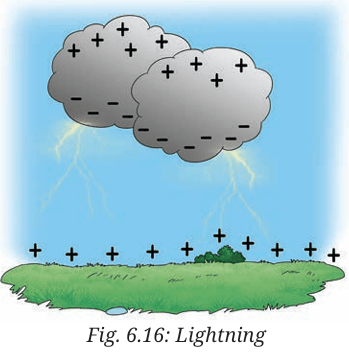 The positively charged lighter ice particles move
upwards and occupy the upper part of the clouds. The
negatively charged heavier water droplets occupy the
lower part of the clouds. Thus, a charge separation
within the cloud takes place. Also, when the negatively
charged lower part of the cloud moves closer to the
ground, it causes the ground and nearby objects, such as trees or
buildings, to become positively charged (Fig. 6.16).
The positively charged lighter ice particles move
upwards and occupy the upper part of the clouds. The
negatively charged heavier water droplets occupy the
lower part of the clouds. Thus, a charge separation
within the cloud takes place. Also, when the negatively
charged lower part of the cloud moves closer to the
ground, it causes the ground and nearby objects, such as trees or
buildings, to become positively charged (Fig. 6.16).
Normally, air acts as an electrical insulator and does not let opposite charges meet. But when the build up of charges becomes very large, the insulating property of air breaks down. A sudden flow of charges takes place, producing a bright flash of light called lightning.
Lightning can occur as opposite charges collide within a cloud, between clouds, or between clouds and the ground. Lightning rapidly heats up the air around it, causing the air to expand and produce a loud sound known as thunder. A storm accompanied by lightning and thunder is called a thunderstorm. 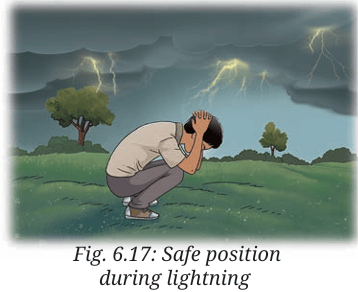 Lightning can be dangerous! It can ignite fires,
damage buildings, and cause severe burns or death
in humans and animals. We must take necessary
precautions and protect ourselves from lightning.
During lightning, stay away from tall objects, find a
low-lying open area and crouch down, and minimise
contact with the ground. Do not lie down flat. Avoid
using an umbrella with a metallic rod. If you are in
water, get out of it. If you are inside a bus or a car, you
are comparatively safer.
Lightning can be dangerous! It can ignite fires,
damage buildings, and cause severe burns or death
in humans and animals. We must take necessary
precautions and protect ourselves from lightning.
During lightning, stay away from tall objects, find a
low-lying open area and crouch down, and minimise
contact with the ground. Do not lie down flat. Avoid
using an umbrella with a metallic rod. If you are in
water, get out of it. If you are inside a bus or a car, you
are comparatively safer.
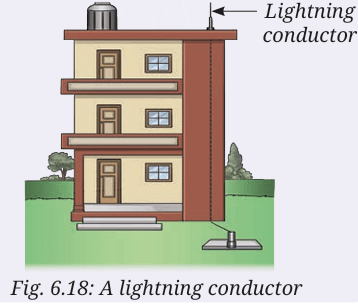 A lightning conductor is a
metallic rod installed along the
walls of buildings during their
construction. One end of the
rod is pointed. This end is kept
higher than the highest point of
the building (Fig. 6.18). The other
end of the rod is buried deep in
the ground. The rod provides
easy path for the transfer of
electric charges into the ground.
A lightning conductor is a
metallic rod installed along the
walls of buildings during their
construction. One end of the
rod is pointed. This end is kept
higher than the highest point of
the building (Fig. 6.18). The other
end of the rod is buried deep in
the ground. The rod provides
easy path for the transfer of
electric charges into the ground. 6.6 Cyclone
Cyclones are large storms that form over warm ocean waters. 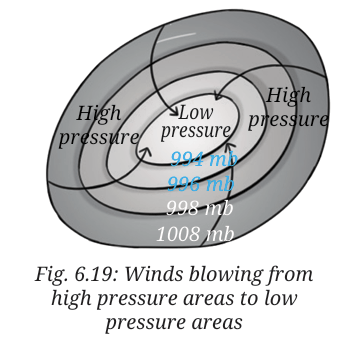 As the ocean water gets heated, the warm and moist air above
it rises. As the moist air rises, the water vapour condenses to
form raindrops. We know that during evaporation,
water takes up heat to change into vapour. When
this water vapour condenses into raindrops, heat is
released back into the atmosphere. This causes further
warming of the ascending air leading it to rise even
further, creating an even lower pressure. Air from the
surrounding regions rushes in and it also starts rising.
Earth’s rotation causes the moving air to spin (Fig. 6.19).
This cycle is repeated, resulting in the creation of a very
low-pressure area with high-speed winds revolving
around it. This spinning system of clouds, winds, and
rain is called a cyclone.
As the ocean water gets heated, the warm and moist air above
it rises. As the moist air rises, the water vapour condenses to
form raindrops. We know that during evaporation,
water takes up heat to change into vapour. When
this water vapour condenses into raindrops, heat is
released back into the atmosphere. This causes further
warming of the ascending air leading it to rise even
further, creating an even lower pressure. Air from the
surrounding regions rushes in and it also starts rising.
Earth’s rotation causes the moving air to spin (Fig. 6.19).
This cycle is repeated, resulting in the creation of a very
low-pressure area with high-speed winds revolving
around it. This spinning system of clouds, winds, and
rain is called a cyclone.
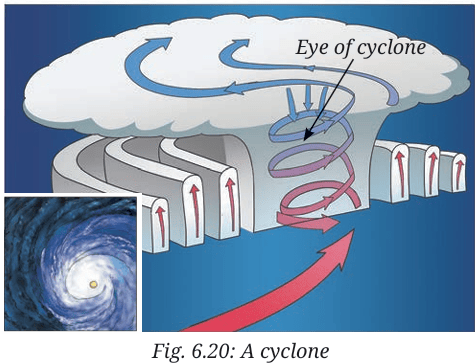 In a cyclone, the region of lowest
pressure is at the centre, known as the eye
of the cyclone. At the eye of the cyclone,
the wind is calm, but the surrounding
region experiences strong winds and
heavy rainfall. As a cyclone moves from the
ocean towards the land, it generates higher
wind speeds compared to the wind speeds
produced by regular thunderstorms. Once
the cyclone reaches land, the source of
moist air is cut off and it gradually loses its
strength.
In a cyclone, the region of lowest
pressure is at the centre, known as the eye
of the cyclone. At the eye of the cyclone,
the wind is calm, but the surrounding
region experiences strong winds and
heavy rainfall. As a cyclone moves from the
ocean towards the land, it generates higher
wind speeds compared to the wind speeds
produced by regular thunderstorms. Once
the cyclone reaches land, the source of
moist air is cut off and it gradually loses its
strength.Even as a cyclone loses its strength while travelling over land, it leaves behind a trail of destruction that can take months or even years to repair. Cyclones can be extremely destructive. For example, the Amphan cyclone in 2020 had peak wind speeds of 270 km/h.
Strong winds during a cyclone push ocean water towards the shore, creating a wall of water that can be as high as 3–12 metres. This surge of water can flood coastal areas and even areas far from the sea. The heavy rainfall which accompanies a cyclone may cause rivers to overflow and can also trigger landslides.Seawater that rushes inland can contaminate drinking water sources and damage farmland. The salt in seawater can make soil less fertile, affecting crops. Roads may get blocked due to fallen trees and debris, making it difficult for help to reach the affected areas. Power outages can last for days, disrupting emergency services and daily life.
How can we protect ourselves during cyclones? It is important to stay updated on weather reports and periodic alerts, and warnings issued by the India Meteorological Department (IMD). Thanks to the weather monitoring satellites, today we can track cyclones and predict their path, helping us reduce their impact on life and property. Several national and international organisations work together to monitor cyclone-related disasters. If you live in a cyclone-prone area, keep an emergency kit ready with essential items. During a cyclone, quickly move to a nearby designated cyclone shelter.Let us wrap up!
- Pressure is defined as force per unit area.
- The SI unit of pressure is newton/metre2 (N/m2) and is also called pascal denoted by Pa.
- Liquids and gases exert pressure on the walls of a container.
- The pressure exerted by the air around us is known as atmospheric pressure.
- Differences in air pressure cause winds to blow.
- Warm air rises, creating a low-pressure area. Cooler air from surrounding higher-pressure regions moves in to take its place.
- Important requirements for the formation of thunderstorms are moisture and strong winds.
- Strong winds moving upwards and downwards facilitate rubbing of ice particles with water droplets, causing electric charges to develop in clouds.
- Collision of electric charges within a clouds, or between clouds, or between a cloud and the ground causes lightning.
- Lightning strikes can cause destruction to life and property.
- Lightning conductors protect buildings from the effects of lightning.
- cyclones and thunderstorms in India.
- Choose the correct statement.
(i) Look at Fig. 6.21 carefully. Vessel R is filled with water. When pouring of water is stopped, the level of water will be ____________________.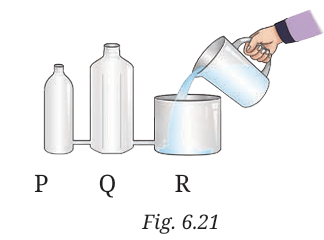
(a) the highest in vessel P
(b) the highest in vessel Q
(c) the highest in vessel R
(d) equal in all three vessels
(ii) A rubber sucker (M) is pressed on a flat smooth surface and an identical sucker (N) is pressed on a rough surface:
(a) Both M and N will stick to their surfaces.
(b) Both M and N will not stick to their surfaces.
(c) M will stick but N will not stick.
(d) M will not stick but N will stick.
(iii) A water tank is placed on the roof of a building at a height ‘H’. To get water with more pressure on the ground floor, one has to
(a) increase the height ‘H’ at which the tank is placed.
(b) decrease the height ‘H’ at which the tank is placed.
(c) replace the tank with another tank of the same height that can hold more water.
(d) replace the tank with another tank of the same height that can hold less water.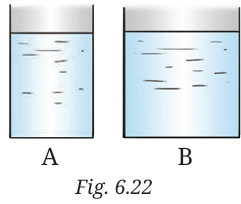 (iv) Two vessels, A and B contain water up to the
same level as shown in Fig. 6.22. PA
and PB is the pressure at the bottom of the vessels. FA and FB is the force exerted by the water at the bottom of the vessels A and B.
(iv) Two vessels, A and B contain water up to the
same level as shown in Fig. 6.22. PA
and PB is the pressure at the bottom of the vessels. FA and FB is the force exerted by the water at the bottom of the vessels A and B.
(a) PA = PB , FA = FB
(b) PA = PB , FA < FB
(c) PA< PB , FA = FB
(d) PA > PB , FA > FB - State whether the following statements are True [T] or
False [F].
(i) Air flows from a region of higher pressure to a region of lower pressure. [ ]
(ii) Liquids exert pressure only at the bottom of a container. [ ]
(iii) Weather is stormy at the eye of a cyclone. [ ]
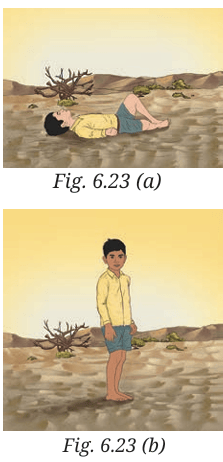
(iv) During a thunderstorm, it is safer to be in a car. [ ] - Fig. 6.23 a shows a boy lying horizontally, and Fig. 6.23 b shows the boy standing vertically on a loose sand bed. In which case does the boy sink more in sand? Give reasons.
- An elephant stands on four feet. If the area covered by one foot is 0.25 m2, calculate the pressure exerted by the elephant on the ground if its weight is 20000 N.
- There are two boats, A and B. Boat A has a base area of 7 m2, and 5 persons are seated in it. Boat B has a base area of 3.5 m2, and 3 persons are seating in it. If each person has a weight of 700 N, find out which boat will experience more pressure on its base and by how much?
- Would lightning occur if air and clouds were good conductors of electricity? Give reasons for your answer.
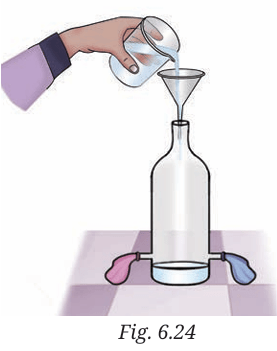
- What will happen to the two identical balloons A and B as shown in Fig. 6.24 when water is filled into the bottle up to a certain height. Will both the balloons bulge? If yes, will they bulge equally? Explain your answer.
- Explain how a storm becomes a cyclone.
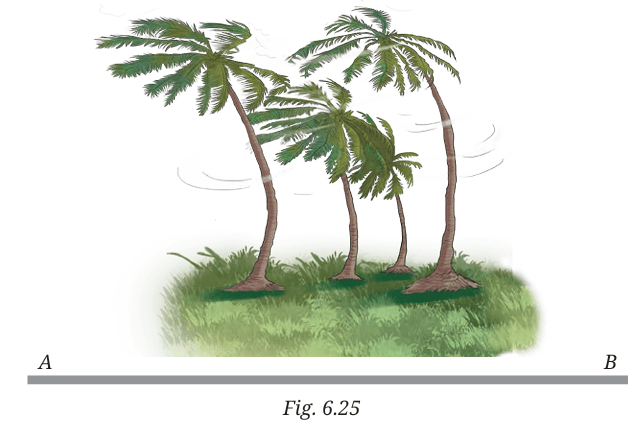
- Fig. 6.25 shows trees along the sea coast in a summer
afternoon. Identify which side is land — A or B. Explain your
answer.
- Describe an activity to show that air flows from a region of high pressure to a region of low pressure.
- What is a thunderstorm? Explain the process of its formation.
- Explain the process that causes lightning.
- Explain why holes are made in banners and hoardings.
Prepare some questions based on your learnings so far ...
Reflect on the questions framed by your friends and try to answer ...
- Hold a strip of paper, 18 cm long and 2 cm wide, between
your thumb and forefinger so that it hangs freely. Predict
what you will observe if you blow over the paper. Perform
the activity now. Note down your observations and interpret
your results.

- List three major cyclones which have occured in India in the last 20 years. List two major destruction caused by each of the cyclones. What measures were taken by the local government and communities to reduce the loss of life and destruction of property? Mention two suggestions you would like to propose to the local government.
- Collect data on the strength of thunderstorms for various regions of India. Compare your findings and identify which regions are more prone to thunderstorms. Can you give reasons for your findings?