- Have you ever seen the Moon during the day? Why do you think it is sometimes visible when the Sun is up?
- Imagine you lived on the Moon instead of Earth. What would you mean by a day, a month or a year?
- What would happen if Earth had two moons instead of one? How would that change the night sky?
- If we didn’t have clocks or calendars, how else could we measure time?
- Share your questions
__________________________
__________________________?
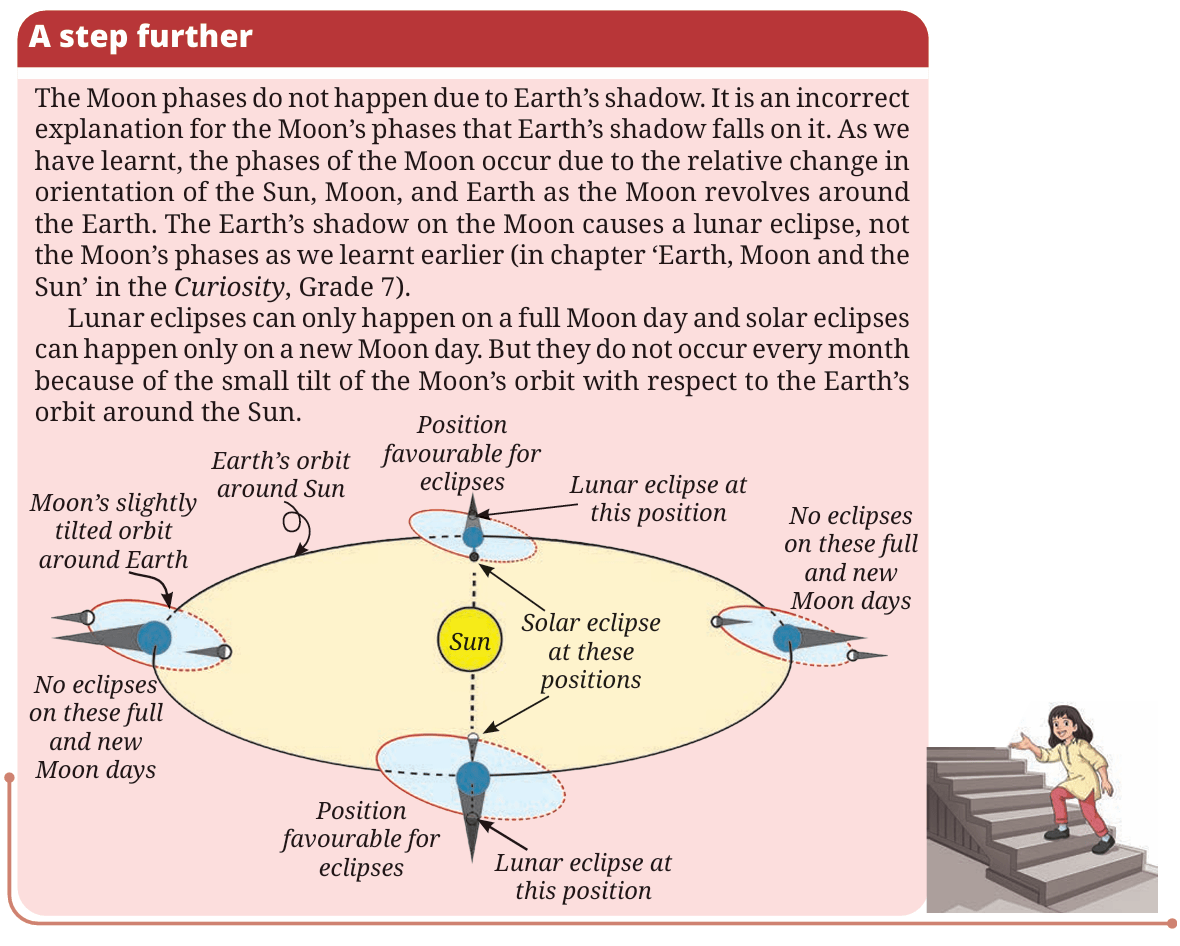
It was Makar Sankranti, and Meera was in Ahmedabad for the Patang Mahotsav, the International Kite Festival. As she looked up at the sky filled with colourful kites, she noticed the Moon shining during the daytime. She was surprised as she had always thought the Moon appeared only at night. Also, the Moon did not appear like a full circle, but that didn’t surprise her as much. She knew its shape changed every night. Still, it got her thinking. She remembered learning that the Moon is spherical and shines by reflecting sunlight. Then why isn’t the whole Moon visible every night? For a moment, she wondered if it was due to a lunar eclipse. But eclipses are rare and brief. So, what causes the Moon’s changing shape?
11.1 How Does the Moon’s Appearance Change and Why?
Let us carefully watch the Moon to understand how its appearance changes over a month. You may have done a similar activity earlier, but let us now do it in more detail. Begin this activity from the sunrise after a full Moon day, that is when it is easiest to spot the Moon in the sky
Activity 11.1: Let us explore*
- Spot the Moon at sunrise in the western direction on the first day after the full Moon.
- Make a table similar to Table 11.1 in your notebook. Document
the following:
- Date
- When you saw the Moon (at sunrise or sunset)?
- Shade the corresponding Circle with pencil to show the bright portion of the Moon as shown in Fig. 11.1.
- Date
- From the second day onwards also document the following.
- Is the size of bright portion of the Moon increasing or decreasing from the previous day.
- Whether the Moon appears closer to or farther from the Sun in the sky than the day before.
- After about 15 days, you may not be able to see the Moon at sunrise or sunset. For the next 15 days, carry out this activity at sunset.
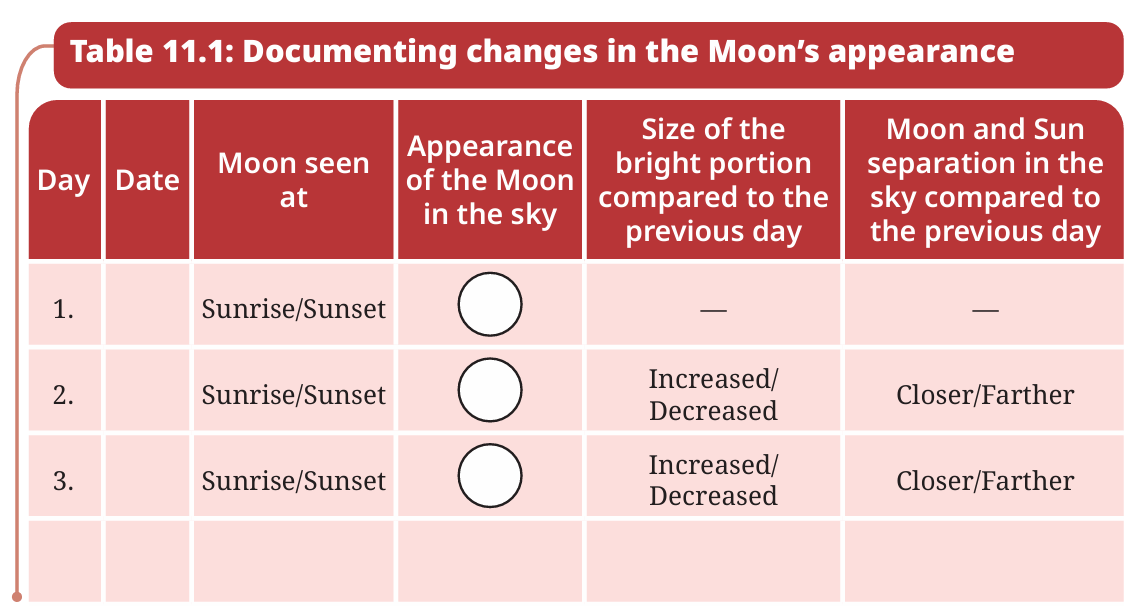
Analyse the data recorded by you in Table 11.1. Did the Moon appear different each day? Was the Moon visible on all days? Did the Moon appear at the same position in the sky as on the previous day?
11.1.1 Phases of the Moon
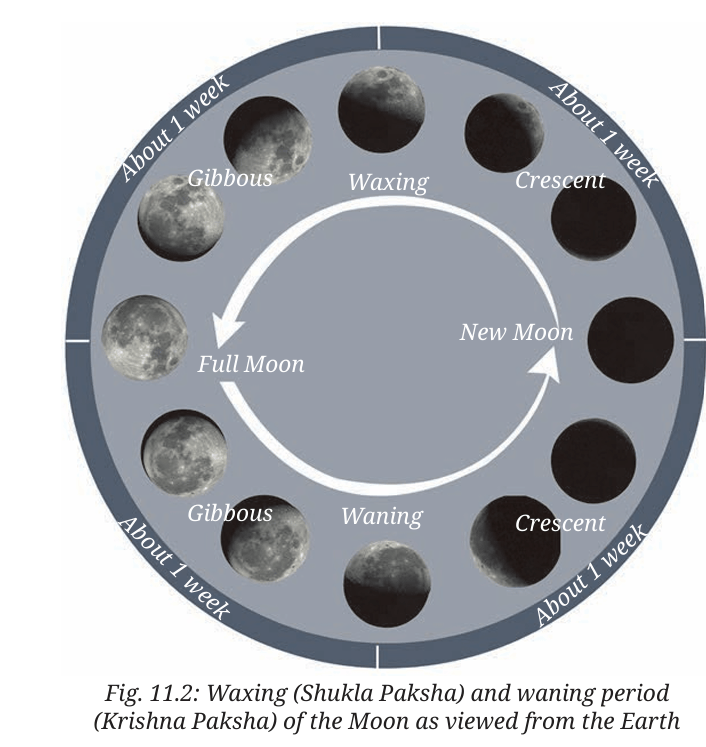
Gibbous Full Moon About 1 week Gibbous Waxing Waning Crescent New Moon Crescent About 1 week You may have observed that the bright portion of the Moon decreases from a full circle to a half circle in about a week, as shown in Fig. 11.2. The bright portion continues to shrink for another week until it is no longer visible. This two-week period is called the waning period of the Moon. Different names are given to the Moon’s visible shapes during this cycle (Fig. 11.2). The day when the Moon appears as a full bright circle is called the full Moon day (or Purnima), and the day when it is not visible is called the new Moon day (or Amavasya). After the new Moon, its bright side grows to a half circle in about a week and to a full circle (full Moon) in another week. The period when the bright part of the Moon increases is called the waxing period. In India, the waning period of the Moon is generally called the Krishna Paksha, while the waxing period is called the Shukla Paksha. The Moon goes through a waning period followed by a waxing period in a cyclical manner as shown in Fig. 11.2. The cycle from one full Moon to the next takes about a month. The changing shapes of the bright portion of the Moon from one day to another as seen from the Earth are called the phases of the Moon.
11.1.2 Locating the Moon
When you checked the Moon at the same time on successive days (for example, at sunrise), did you see it in a different part of the sky? On a full Moon day, the Moon is nearly opposite the Sun — when the Sun rises in the East, the Moon is almost setting in the West. On subsequent mornings at sunrise, as its bright part continues to decrease, the Moon appears to move closer in the sky to the Sun. When the bright part of the Moon decreases to a half circle shape, the Moon is overhead at Sunrise. A few days later, the crescent Moon appears even closer to the Sun. Knowing the phase of the Moon and whether it is waxing or waning can thus help us find out where and when to look for the Moon on any given day. A waxing Moon is easiest to spot at sunset, and a waning Moon at sunrise. Because of these shifts, the Moon always rises and sets at different times than the Sun.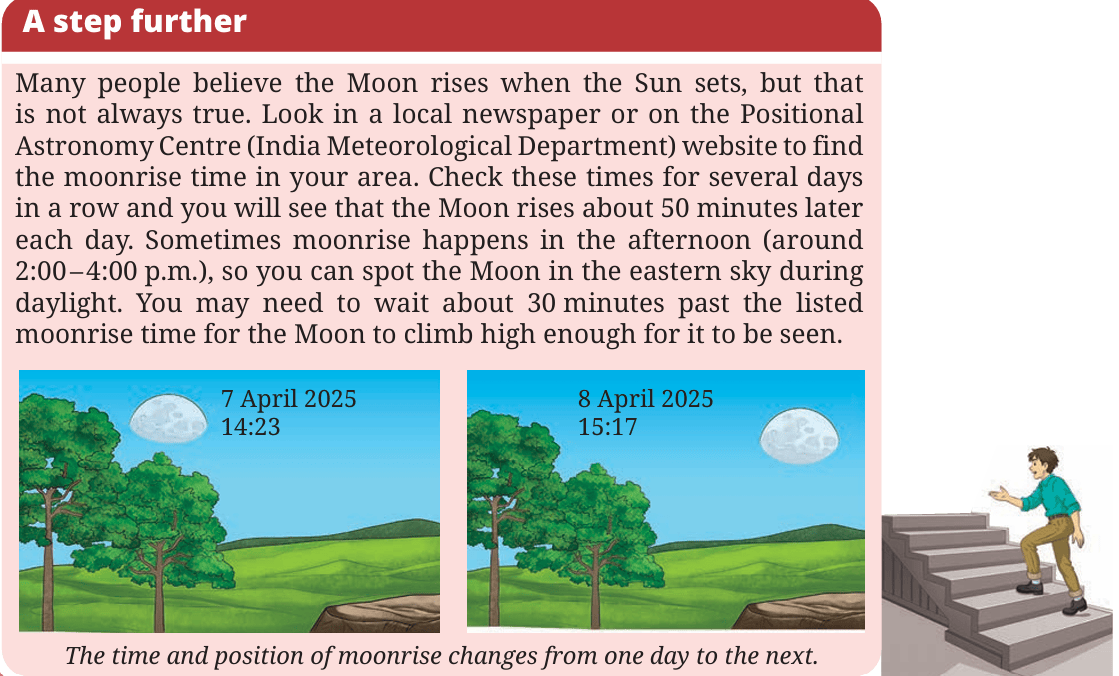
11.1.3 Making sense of our observations
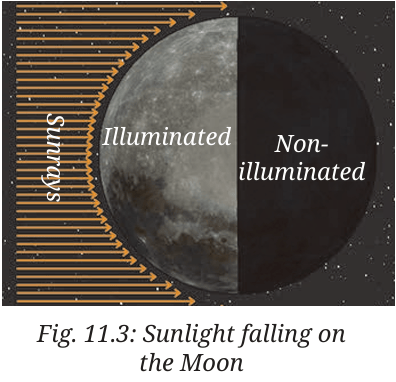
The shape of the Moon itself does not change, only what
we see changes. You may recall learning earlier that the
Moon does not emit light of its own, but shines because it
reflects sunlight that falls on it. The half of the Moon that
faces the Sun receives sunlight and becomes illuminated
(Fig. 11.3). The other half facing away from the Sun does
not receive sunlight and remains non-illuminated.
The Moon revolves around the Earth and, only one
half of the Moon always faces the Earth. However, the
portion of the Moon facing the Earth is not always its
illuminated part. We can only see the illuminated portion
of the Moon from Earth. Sometimes, the entire illuminated portion
of the Moon faces the Earth, and at other times only a part of it.
At such times the illuminated portion of the Moon that we see is
not a full circle. On New Moon day, we do not see the illuminated
portion of the Moon at all, as only the non-illuminated portion of
the Moon faces the Earth. Therefore, the Moon appears different
on different days.
Let us do an activity to understand how the
illuminated portion of the Moon, as seen by us,
changes when its position changes with respect
to the Sun.
Activity 11.2: Let us explore
- Take a small soft ball and insert a stick into it (Fig. 11.4a). This represents the Moon.
- Go to a dark open place (at night), and ask a teacher or guardian to shine a torchlight towards you from about 3 m to represent light coming from the Sun or stand near an electric lamp. Your head represents the Earth.
- Now hold the ball at arm’s length in one hand such that it is slightly above your head as shown in Fig. 11.4b. Keep the ball at position E towards the direction of the lamp. Does the portion of the ball facing you appear to be illuminated or not?
- Turn around slowly, in the anti-clockwise direction, with your arm outstretched as shown in Fig. 11.4b and keep looking at the ball. Does the shape of the illuminated portion change? Is the line separating the illuminated and non-illuminated portions of the ball curved?
- Was your observation similar to the changing shape of the illuminated portion of ball shown in Fig. 11.4c? The shape of the illuminated portion of the ball, as seen by you, changes depending on where the ball is with respect to the lamp.
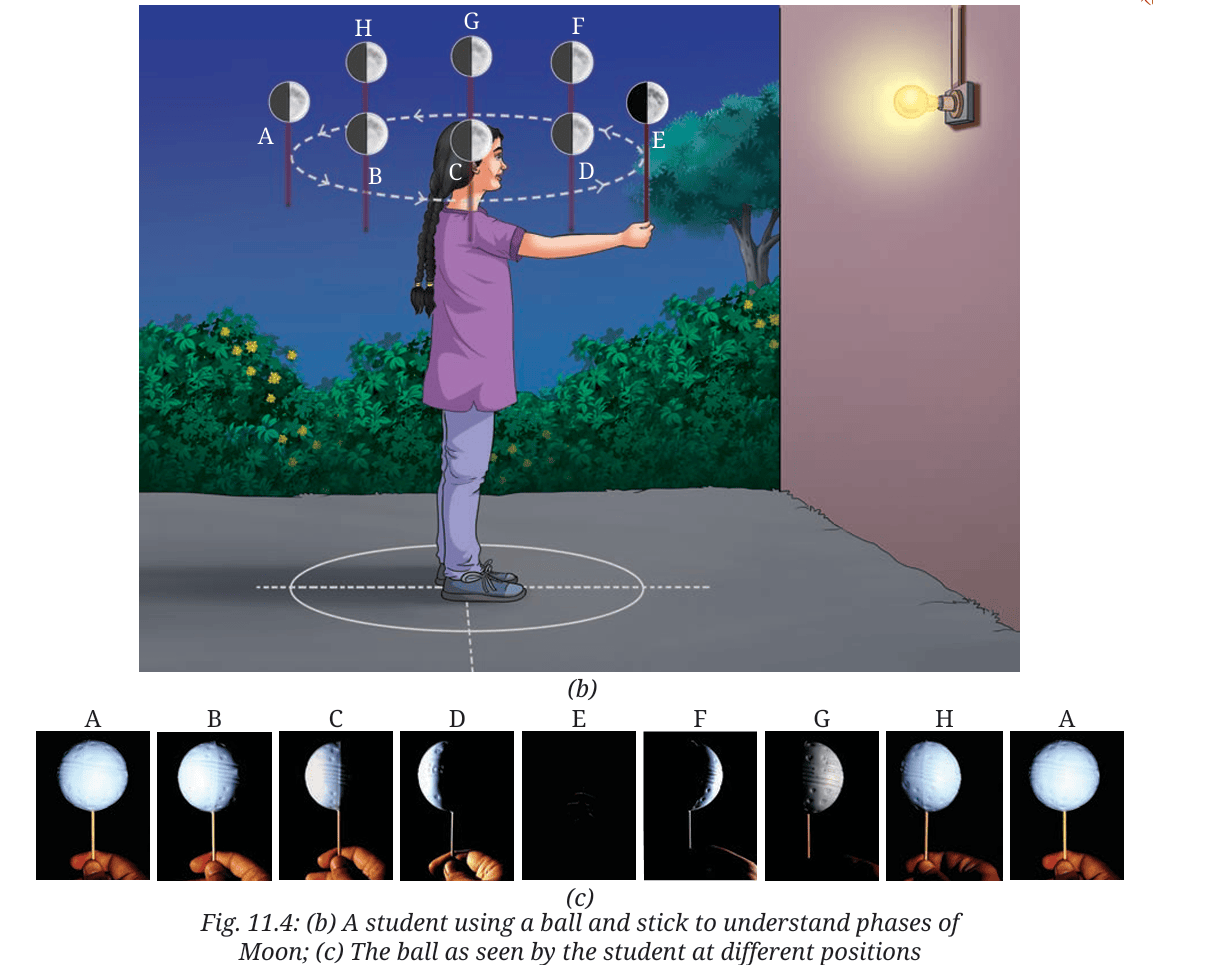
When the ball is held opposite to the direction of the lamp
(at A), you are facing the entire illuminated portion of the ball,
just like the full Moon day. On the other hand, when the ball
is held towards the direction of the lamp (at E), you are facing
the non-illuminated portion of the ball, and cannot see the
illuminated portion of the ball at all. This is similar to the new
Moon day. Notice how in other cases, the line separating the
illuminated and non-illuminated portions of the ball appears
curved (Fig. 11.4c), similar to the shape of the illuminated portion
of the Moon viewed from the Earth on other days.
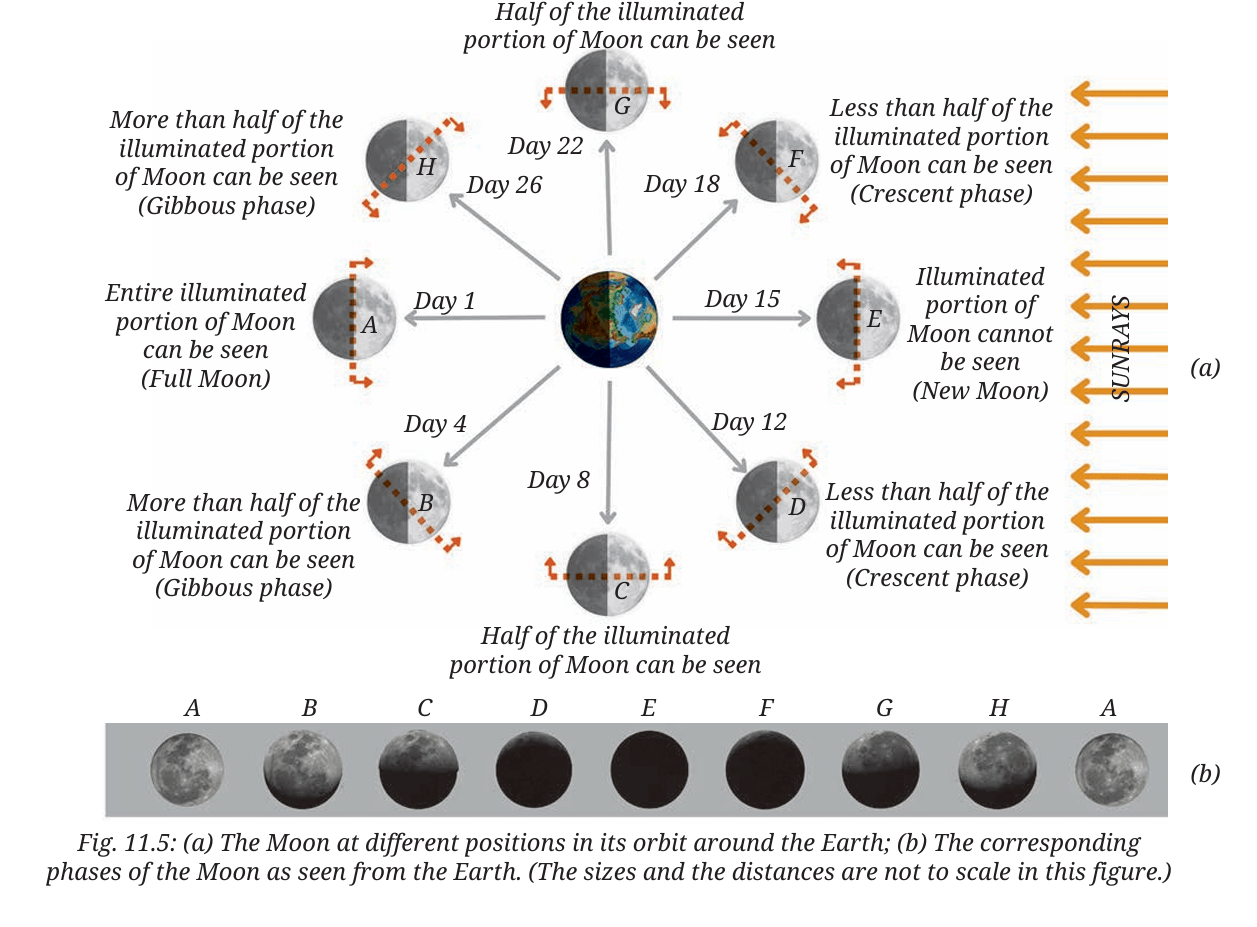
Using our observations of Activity 11.2, let us now try to
understand the phases of Moon. Fig. 11.5a shows the positions of
the Moon corresponding to the different positions of the ball in
Fig. 11.4b. Also shown are the Earth and the sunrays. As shown
in Fig. 11.5a, the Moon revolves once around the Earth from
position A to H and back to position A in about one month. The
side of the Moon that faces the Sun is illuminated.
The portion of the Moon that faces the Earth is marked by the
orange dashed lines and arrows. The illuminated portion of only
this part of the Moon can be seen from the Earth. At positions
B and H, more than half of the illuminated portion, called the
gibbous phase, can be seen. At positions D and F, less than half
of the illuminated portion, called the crescent phase, can be
seen. The change in the fraction of the illuminated portion of the
Moon seen from Earth causes phases of the Moon.
The phases that will be seen from the Earth at different
positions of the Moon are shown in Fig. 11.5b. From A to C to E,
we see the waning phase, and from E to G and back to A, we
see the waxing phase. Since the rotation period of the Earth of
one day is much smaller compared to the revolution period of
the Moon which is nearly a month, on a given day, people on
different parts of the Earth see nearly the same phase.
As can be seen in Fig. 11.5a, on the New Moon day, the Moon
appears closest to the Sun and it appears farthest on the Full
Moon day. Is this not what we also observed in Activity 11.1?
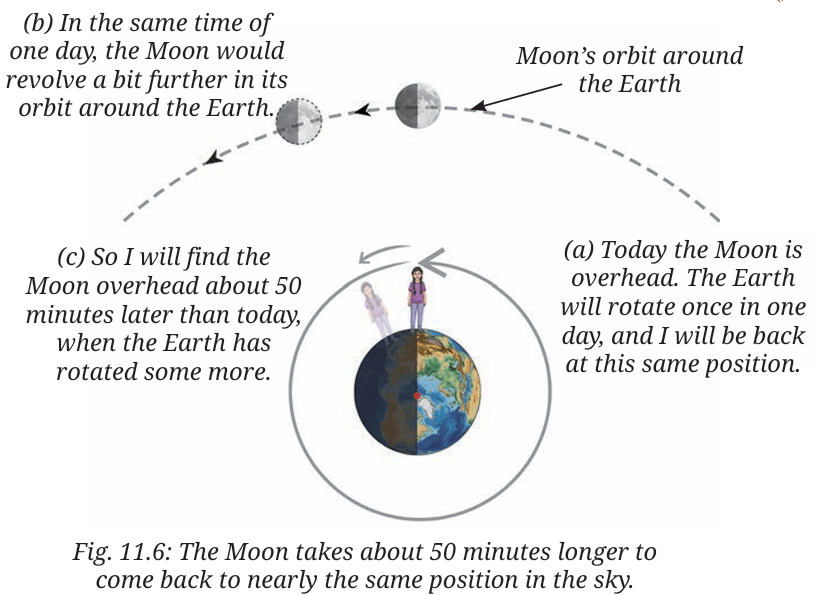
In Activity 11.1, we
also observed that the
position of the Moon
at sunrise (or sunset)
appeared to be shifted
on successive days.
This happens because,
as shown in Fig. 11.6,
the Moon moves ahead in its orbit while the
Earth completes one
rotation about its axis in 24 hours. Earth
needs to rotate some
more for the Moon to
appear in nearly the
same spot in the sky.
11.2 How Did Calendars Come into Existence?
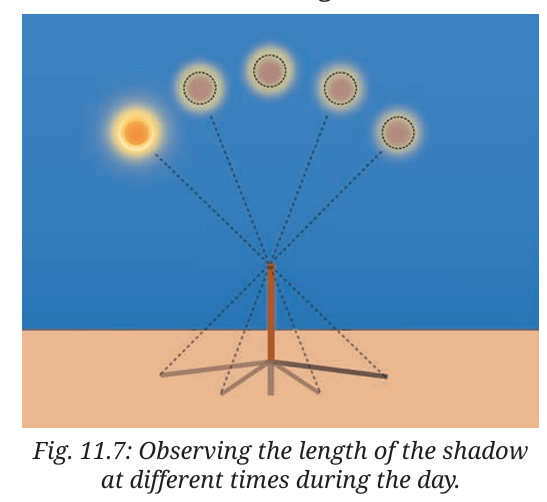
We have learnt earlier that when viewed from the Earth, the Sun appears to rise in the eastward direction, set in the westward direction every day, and rise again the next day. This apparent periodic motion of the Sun seen by us is primarily due to the rotation of the Earth around its own axis. This natural cycle of the Sun due to the rotation of the Earth, is the foundation of the day, a unit to measure time. The average time that the Sun takes to go from its highest position in the sky on one day to the highest position in the sky the next day, is 24 hours, and is called the mean solar day. The highest position of the Sun in the sky can be found by measuring the length of the shadows cast by an object during the day. The shadow is shortest when the Sun is at the highest point in the sky.
Activity 11.3: Let us measure a day!
- Find a small flat area in a ground which receives sunlight during the day. Fix a 1 m stick vertically in it as shown in Fig. 11.7.
- Start observing at 11:00 a.m. Every minute, mark a dot on the ground at the tip of the stick’s shadow. Keep marking dots until around 1:10 p.m.
- Identify when the shadow was shortest and find out its time by counting the number of dots. Record this time in Table 11.2. Repeat this exercise for the next few days.
- Find the duration of the solar day by finding a difference in time on two consecutive days as shown in Table 11.1.
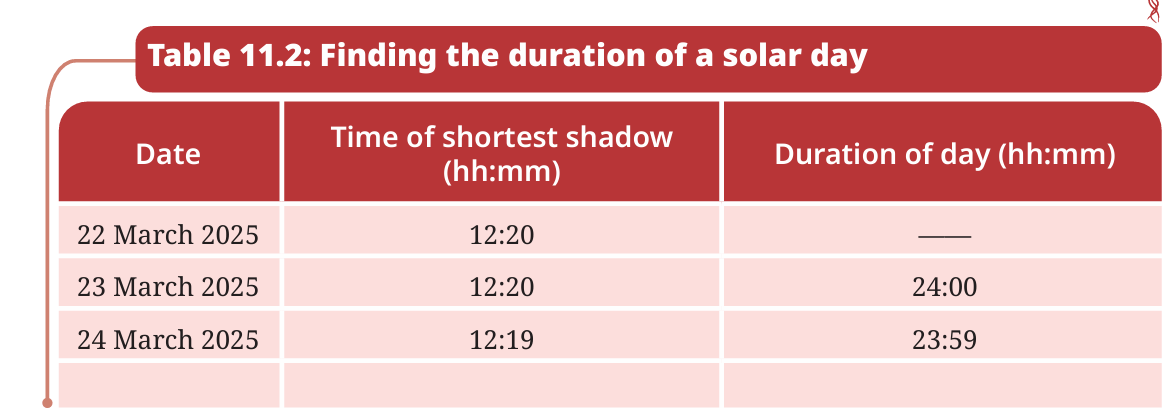 Find the average duration of the day. Is it nearly equal to
24 hours?
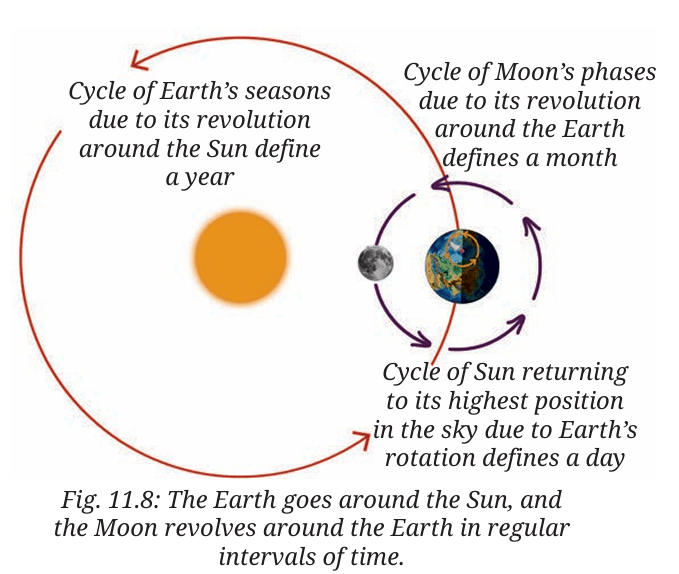
The phases of the Moon give us
another natural cycle with a duration
that is longer than a day. The Moon
takes about 29.5 days (nearly a month)
to cycle through all its phases. The
cycle of the phases of the Moon is the
basis for a month, another unit to
measure time (Fig. 11.8).
The next larger unit to measure
time is related to the natural cycle of
seasons. Do you remember learning
earlier that the Earth revolves
around the Sun and takes nearly 365
and a quarter days to complete one
revolution around the Sun? The Earth
undergoes one cycle of seasons during
this time, which can be used to define
a solar year (Fig. 11.8).
Find the average duration of the day. Is it nearly equal to
24 hours?
The phases of the Moon give us
another natural cycle with a duration
that is longer than a day. The Moon
takes about 29.5 days (nearly a month)
to cycle through all its phases. The
cycle of the phases of the Moon is the
basis for a month, another unit to
measure time (Fig. 11.8).
The next larger unit to measure
time is related to the natural cycle of
seasons. Do you remember learning
earlier that the Earth revolves
around the Sun and takes nearly 365
and a quarter days to complete one
revolution around the Sun? The Earth
undergoes one cycle of seasons during
this time, which can be used to define
a solar year (Fig. 11.8).
11.2.1 Lunar calendars
In ancient times, people had noticed that during one cycle of seasons, one can fit nearly 12 cycles of the phases of the moon, that is, 12 lunar months. This is how lunar calendars came into being, with the day as the shortest unit, a month of nearly 29.5 days, and a lunar year consisting of 12 lunar months. The phases of the Moon thus gave an easy and a perfectly sound way to track the passage of time. However, in a lunar calendar the seasons do not remain synchronised to the same lunar months in successive lunar years. The reason is that the seasons repeat in approximately 365 days while the lunar year is 354 days long.
11.2.2 Solar calendars
It was important to know the arrival of seasons for agricultural
purposes. This need for a year to synchronise with seasons led to
the creation of solar calendars. The Gregorian calendar, widely
used today, is a solar calendar. The months in solar calendars are
adjusted to add up to 365 days. That is why in Gregorian calendars,
some months have 30 days, others 31, and February has only
28 days.
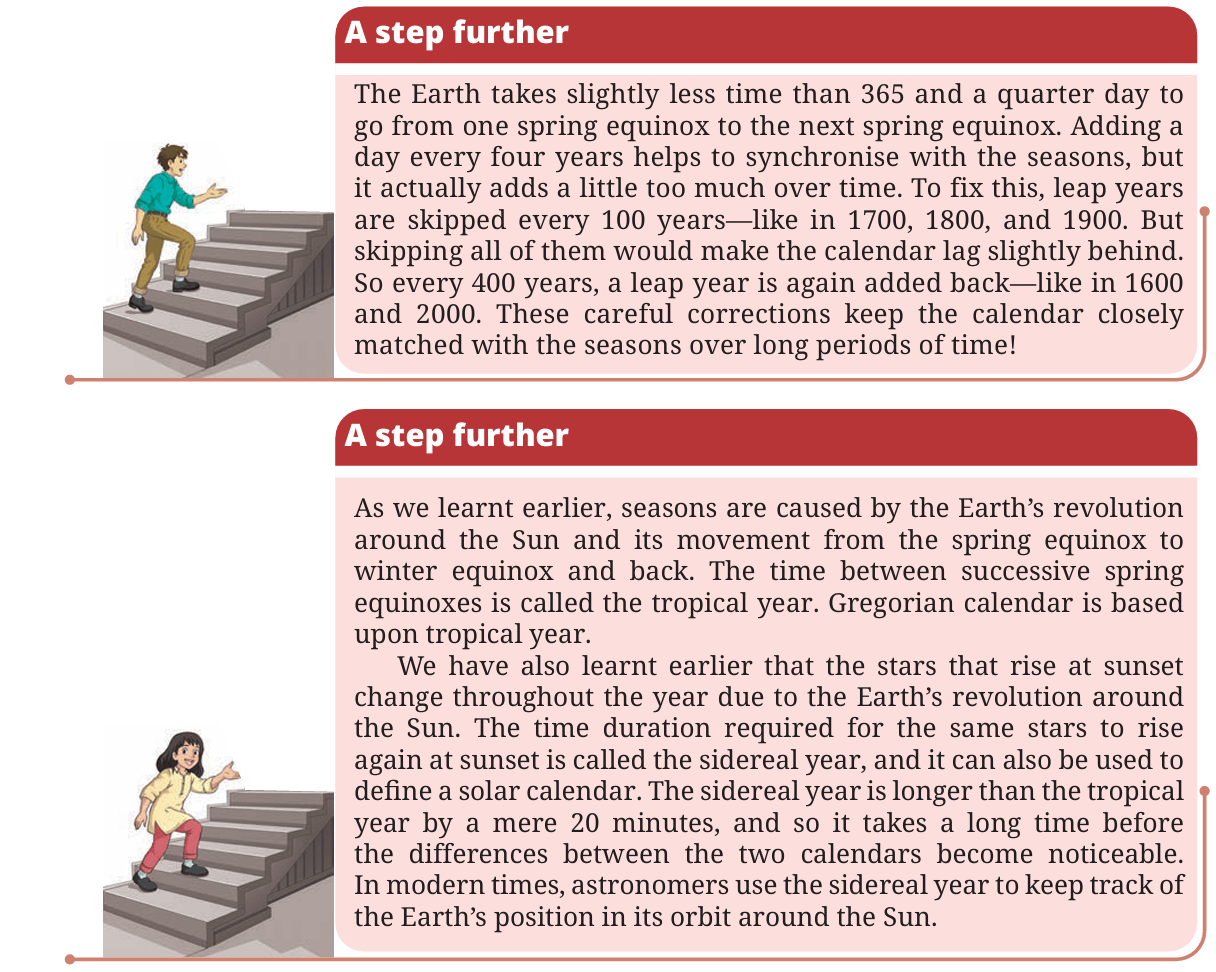
On top of the 365 days, the Earth takes nearly an extra quarter
of a day to complete one revolution around the Sun. These extra
hours add up to approximately one day every four years. To
adjust for this, solar calendars add an extra day every four years
using the concept of a leap year. In the Gregorian calendar, if a
year is divisible by four, then an extra leap day is added. So in a
leap year, February has 29 days, which keeps the calendar well
synchronised with the seasons.
11.2.3 Luni-solar calendars
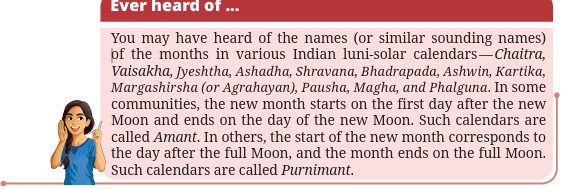
There is another kind of calendar which primarily uses the Moon’s phases for counting days and months but also make adjustments to stay in sync with the cycle of seasons. The 12 lunar months add up to 354 days and thus fall short by nearly 11 days compared to the solar year. Thus every 2–3 years,the accumulated difference becomes close to a full month. Therefore, every few years, an extra month (called Adhika Maasa or intercalary month) i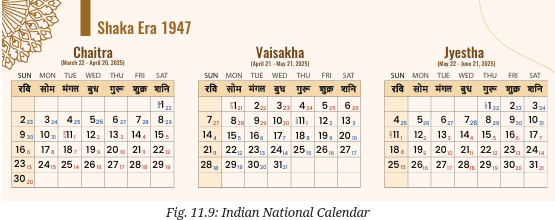 s added to the year in some calendars. This keeps the solar year and the lunar cycle in step. Such calendars are called luni-solar calendars. They combine elements from both the solar and the lunar calendars and are used in many parts of India.
11.2.4 The Indian National Calendar
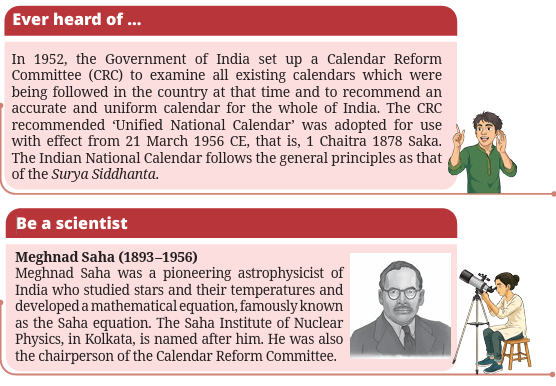
A national calendar by the Government of India is used along with Gregorian calendar for multiple official purposes.
It is a solar calendar (Fig. 11.9) consisting of 365 days in a year. The year begins on 22 March, which is the day after the spring equinox. Unlike the Gregorian calendar, months in the Indian National Calendar have either 30 or 31 days. The names of these months were taken from traditional Indian calendars. In a regular year, the second to sixth months have 31 days and the rest have 30 days. The leap years are matched to the Gregorian calendar by adding a day to Chaitra, the first month of the year. In such years, the new year begins on 21 March of the Gregorian calendar.
11.3 Are Festivals Related to Astronomical Phenomena?
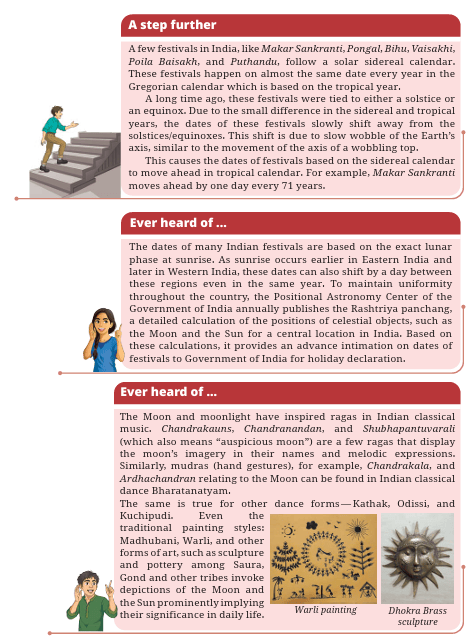
Many Indian festivals are tied to the phases of the Moon and hence are based on either lunar or luni-solar calendars. For instance, Diwali falls on the new Moon of the month of Kartika, Holi on the full Moon of Phalguna, Buddha Purnima on the full Moon of Vaisakha, Eid-ul-Fitr is celebrated after sighting the crescent Moon at the end of the month of Ramazan, while Dussehra is celebrated on the tenth day in the month of Ashwina. Hence, they occur on different dates in the Gregorian calendar in successive years. For festivals based on luni-solar calendars, the Gregorian calendar dates can shift, but this shift is typically less than a month. This is because the luni-solar calendars add the intercalary month every few years which correct for the difference between the lunar and the solar year. In contrast, purely lunar calendars do not account for this difference. Any festival celebrated according to the phases of the Moon, such as Eid-ul-fitr, therefore can occur in different months of the Gregorian calendar year after year.
11.4 Why Do We Launch Artificial Satellites in Space?
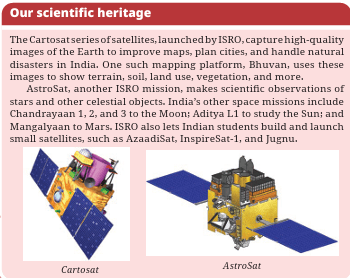
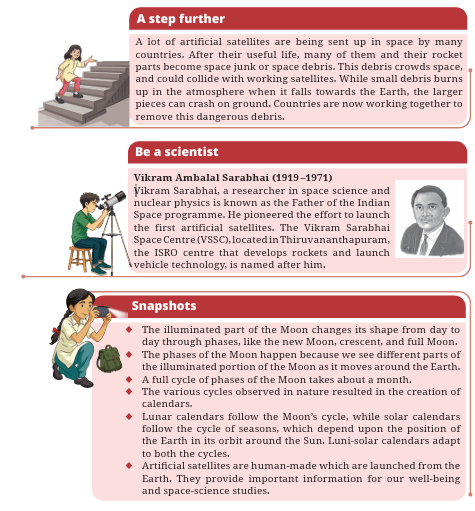
The Moon is Earth’s natural satellite, orbiting our planet. Besides the Moon, man-made satellites sent by various countries also orbit the Earth. These artificial satellites appear as tiny specks moving in the night sky. Most orbit about 800 km above Earth’s surface and take roughly 100 minutes to complete one orbit.
 These satellites help us in many ways like communication, navigation, weather monitoring, disaster management, and scientific research. The Indian Space Research Organisation (ISRO) has launched many satellites that support these activities.
Activity 11.4: Let us identify
- Spotting an artificial satellite is a night sky watching activity like we have done previously. Just before sunrise or after sunset, go to a location, accompanied by an adult, that has a clear view of the sky, without any obstruction of trees or tall buildings.
- To identify satellites in the sky, look for any moving object in the sky that appears as a point of light with steady or flickering brightness and is moving very fast across the sky. You can see them with the naked eye or with binoculars.
- You may use mobile apps or websites that provide details of satellites visible in your location and when they will be passing above you in the sky.
Keep the curiosity alive
- 1. State whether the following statements are True or False.
- (i) We can only see that part of the Moon which reflects sunlight towards us.
- (ii) The shadow of Earth blocks sunlight from reaching the Moon causing phases.
- (iii) Calendars are based on various astronomical cycles which repeat in a predictable manner.
- (iv) The Moon can only be seen at night.
- 2. Amol was born on 6th of May on a full Moon day. Does his birthday fall on the full Moon day every year? Explain your answer.
- 3. Name two things that are incorrect in Fig. 11.10.

- 4. Look at the pictures of the Moon in Fig. 11.11, and answer the following questions.

- (i) Write the correct panel number corresponding to the phases of the Moon shown in the pictures above.
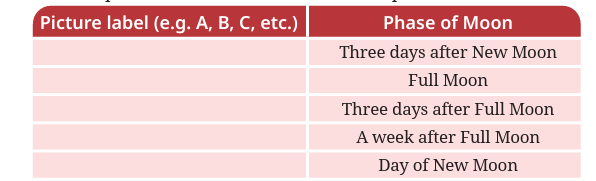
- (ii) List the picture labels of the phases of the Moon that are never seen from Earth. Hint: You can use your observations from Activity 11.1 or Fig. 11.2 as reference.
- 5. Malini saw the Moon overhead in the sky at sunset.
- (i)Draw the phase of the Moon that Malini saw.
- (ii) Is the Moon in the waxing or the waning phase?
- 6. Ravi said, “I saw a crescent Moon, and it was rising in the East, when the Sun was setting.” Kaushalya said, “Once I saw the gibbous Moon during the afternoon in the East.” Who out of the two is telling the truth?
- 7. Scientific studies show that the Moon is getting farther away from the Earth and slower in its revolution. Will luni-solar calendars need an intercalary month more often or less often?
- 8. A total of 37 full Moons happen during 3 years in a solar calendar. Show that at least two of the 37 full moons must happen during the same month of the solar calendar.
- 9. On a particular night, Vaishali saw the Moon in the sky from sunset to sunrise. What phase of the Moon would she have noticed?
- 10. If we stopped having leap years, in approximately how many years would the Indian Independence day happen in winter?
- 11. What is the purpose of launching artificial satellites?
- 12. On which periodic phenomenon are the following measures of time based: (i) day (ii) month (iii) year?
Discover, design, and debate
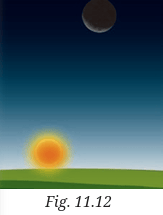
- The Moon’s crescent always faces towards the Sun (Fig. 11.12). On days when you see the crescent Moon, point your finger towards the Sun, and slowly move it across the sky towards the Moon taking as short a path as you can. Note how your finger always crosses the illuminated part of the Moon first and clearly shows us that we see sunlight reflected off the Moon. The line joining the tips of the crescent would correspond to the diameter of the Moon.
- Most of the dates in the Indian National Calendar always map to the same dates in the Gregorian calendar. Can you find out which ones may differ for certain years?
- Different states in India celebrate the New Year according to their local cultures. Find out the names of the New Year festival celebrated in any 10 states of India. Also find out whether it is based on the lunar calendar or the solar calendar or the lunisolar calendar.
- Collect Gregorian calendars (the regular calendar you use every day) for the last five years with the help of your family members or teachers or the internet. For each year, look for the dates on which the festivals Eid-ul-Fitr and Diwali were celebrated and list them year wise in a tabular form. Do you notice that the date of Eid-ul-Fitr moves earlier each year — by about 11 days? If you have a corresponding lunar calendar at home or on the internet, check that the month and the day for Eid-ul-Fitr according to the lunar calendar remains the same. Does Diwali follow the same steady pattern, or are there some sudden jumps? Based on your chart, try to guess which year might have included an intercalary month (Adhikamaasa). Obtain a luni-solar calendar and confirm if there is an intercalary month between Diwali in the previous year and that year.
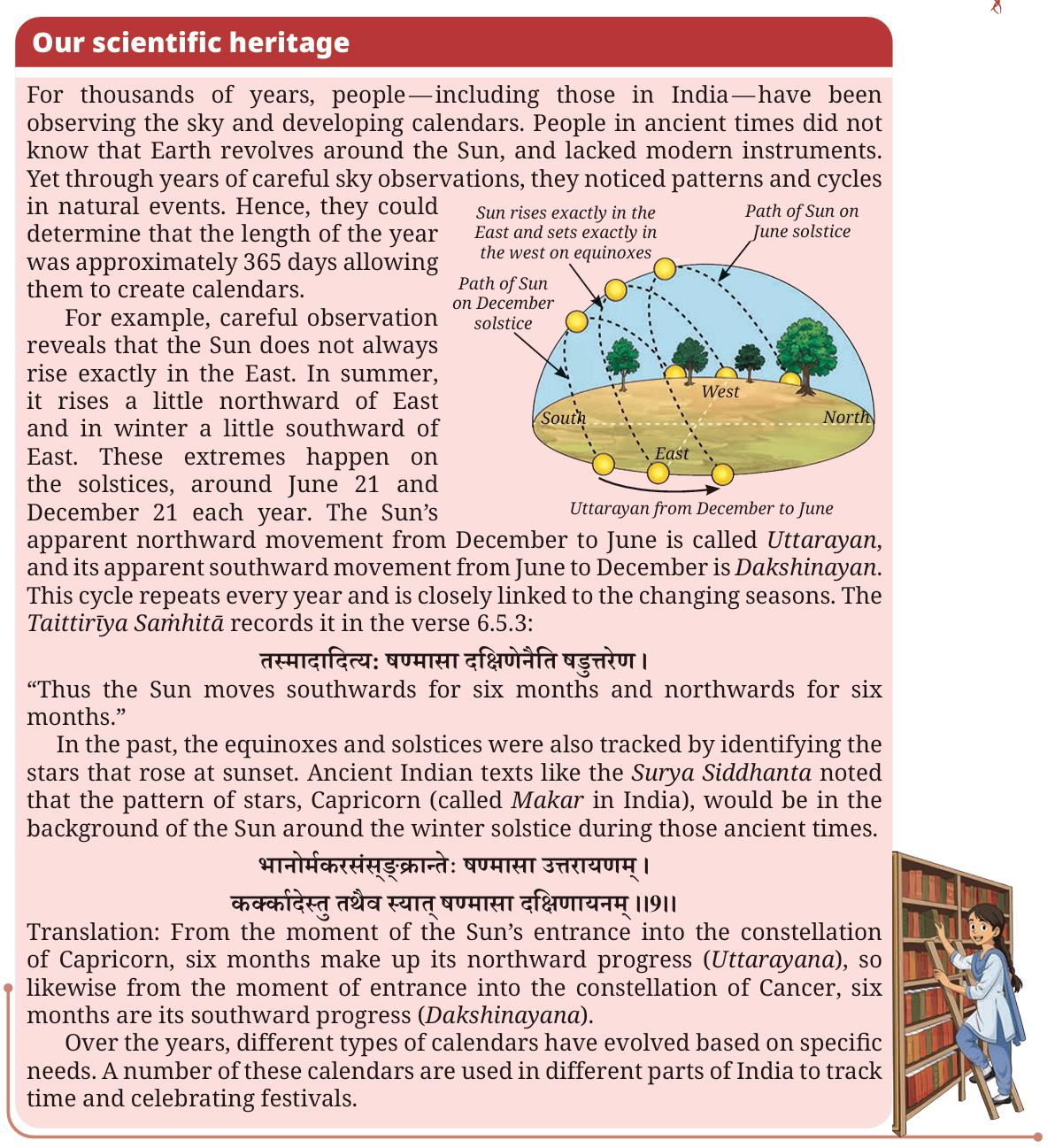
- Every morning on your way to school, notice the direction in which the Sun rises. Decide on a spot and look towards east, with trees, poles, or buildings acting as markers. Sketch the eastern horizon in your notebook. For the next one year, at the start of each month, stand at the same spot and mark the Sun’s position on your sketch. Label it with the name of the month. At the end of the year analyse your sketch. Do you find that the positions of sunrise shift in particular direction? Can you identify it with the Uttarayaan and Dakshinayaan that our ancestors noticed? (Refer the ‘A step further’ box on page 181).