
6 The Parliamentary System: Legislature and Executive
"The Constitution is not a mere lawyer’s document; it is a
vehicle of life, and its spirit is always the spirit of the age." — Alladi Krishnaswami Ayyar
November 1949, Constituent Assembly Debates
The Big Questions?
1. What is India’s
parliamentary system, and
how is it structured?
2. What are the key functions
of the Parliament?
3. What are the roles of the
legislature and the executive
in India’s Parliamentary
democracy?
4. How are the legislature and
the executive organised at
the union and state levels?
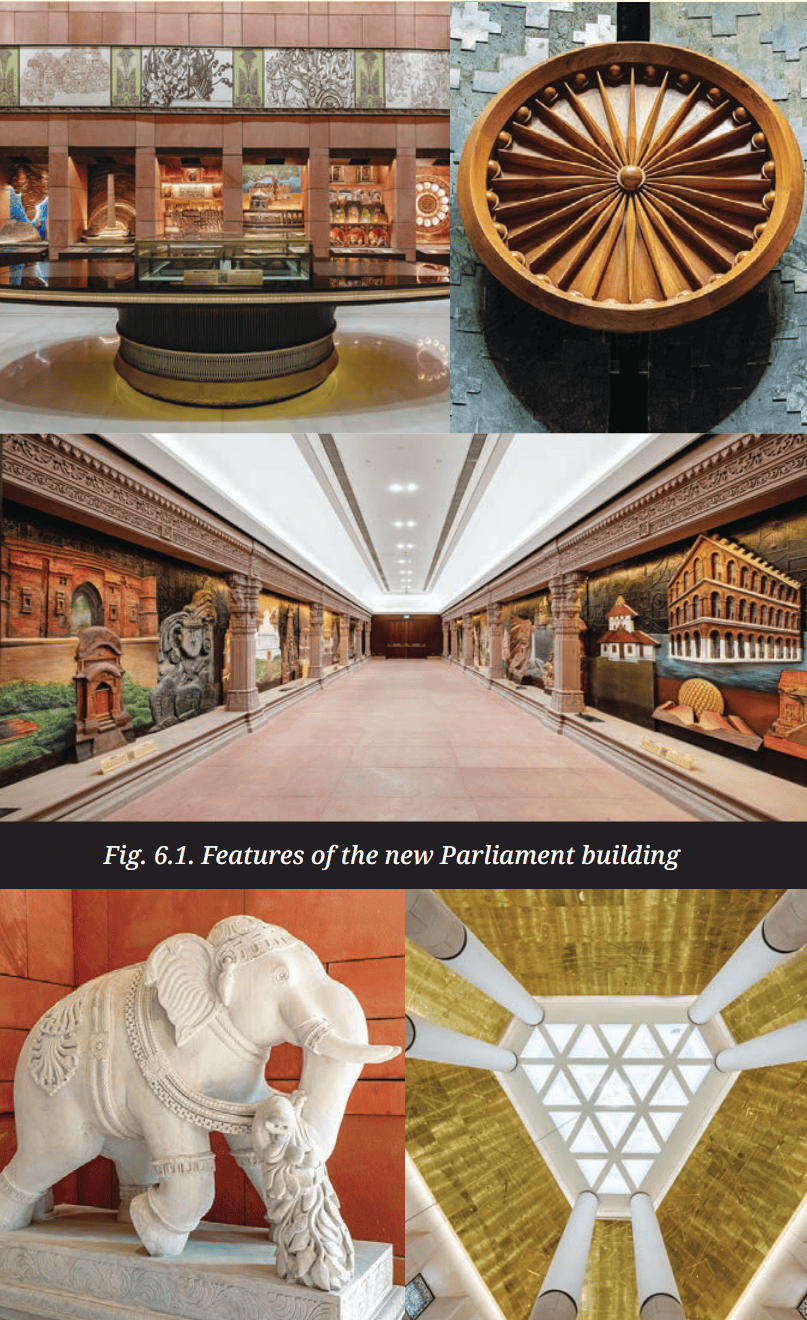
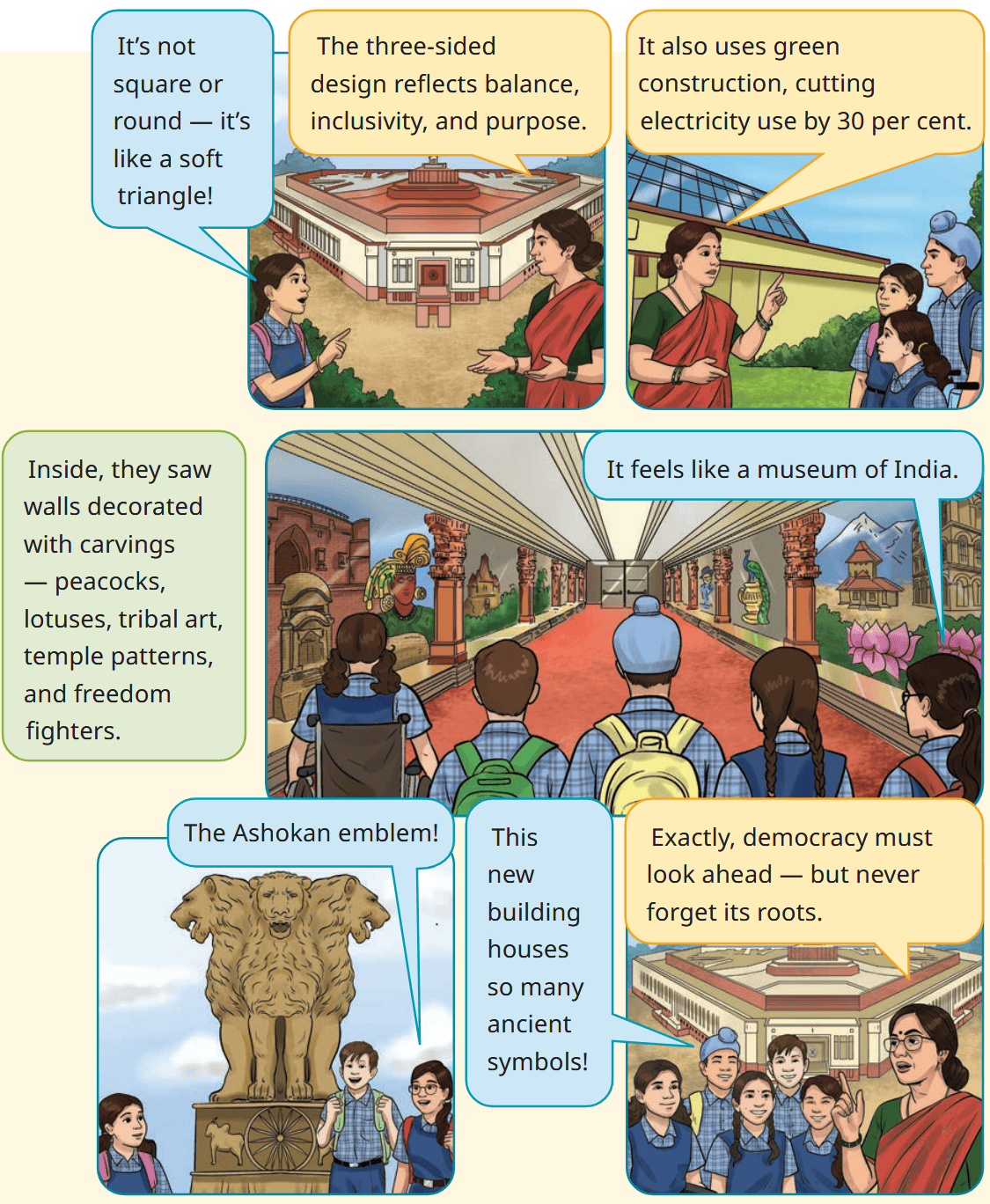
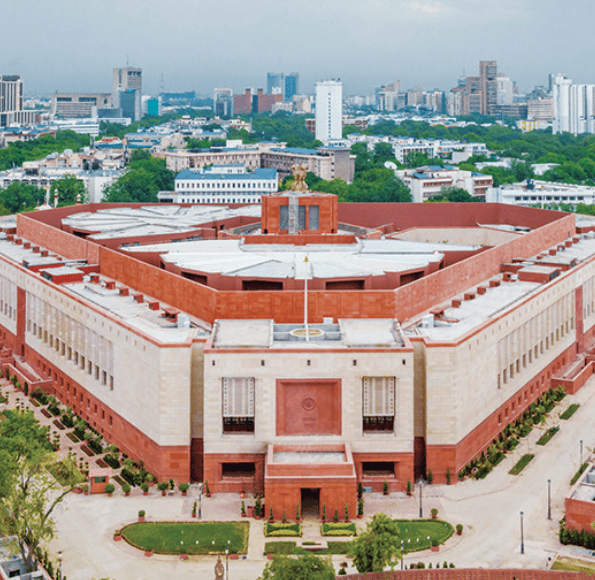
The Grade 8 students from Nalanda Vidyalaya were on a school trip to Delhi. Usha, Sukhwinder, Anjali, John, and Farida were especially excited to visit the new Parliament building.
INTRODUCTION
India’s independence was achieved through great sacrifices by many people of the country after years of struggle against colonial rule. The citizens of a free country could now make decisions about their own governance. The first important step in this new epoch in the life of our nation was the drafting of the Constitution of independent India. This comprehensive document laid foundational principles for the nation, including that of Universal Adult Franchise which guarantees all adult citizens of the country the right to vote irrespective of their social or economic background, gender, race, or religion.
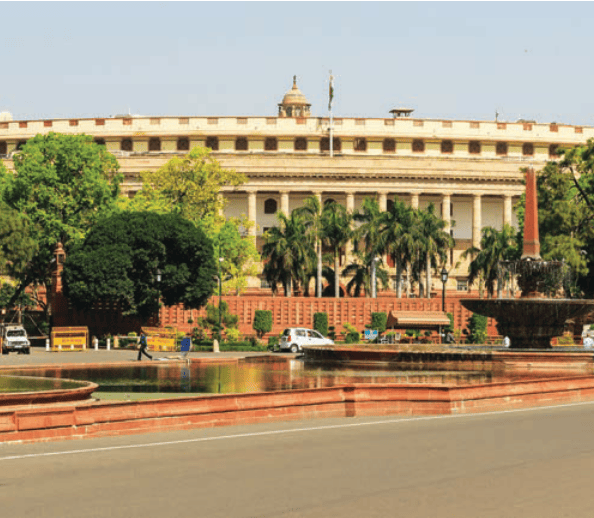
The people of India directly elect their representatives who become members of the Lok Sabha. A majority group from among these elected representatives forms the government. The Parliament is the supreme legislative body of the government (it makes laws for the country). It comprises all elected representatives of the people and controls and guides the work of the government. The government can therefore be seen as functioning with the people’s consent. There have been 17 Lok Sabhas since the first one in 1952. The 18th Lok Sabha was constituted in June 2024.
COMPOSITION OF THE PARLIUAMENT OF INDIA
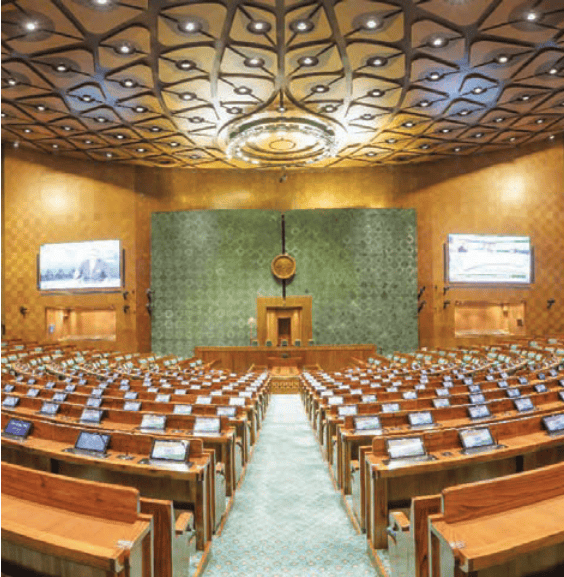
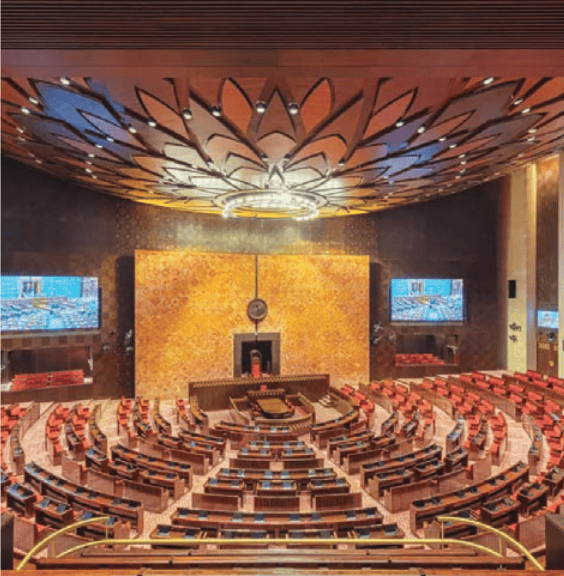
The Indian Parliament is composed of the President and two houses: the Lok Sabha (House of the People / Lower House) and the Rajya Sabha (Council of States / Upper House). This structure with two houses is called a ‘bicameral’ system (‘bi’ means two, ‘cameral’ means chamber / house).
LET'S REMEMBER
The people of India choose their representatives for the Lok Sabha through a direct election (based on universal adult suffrage). The maximum number of members of this House envisaged by the Constitution is 550. The Members of Parliament (MPs) in the Rajya Sabha are elected indirectly by the electoral college that you read about in the previous chapter. Both, the number of Rajya Sabha seats allocated and the number of MPs represented in the Lok Sabha, are based on the population of each state.
DON'T MISS OUT
We are aware that several aspects of the Indian Constitution were drawn from the constitutions of other countries. Britain’s system inspired our system of Parliamentary democracy. However, there were also experiences that our freedom fighters and Constitution makers had ― the practical experience gained through participation in British colonial governance structures, even if in a very limited way, that provided familiarity with Parliamentary procedures; the memory of the ancient republics (mahājanapadas); the village panchayats where elders made collective decisions, as we learnt in a previous chapter.
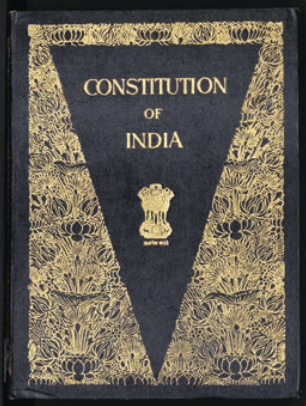
Extensive discussions took place during the making of the Constitution regarding whether India should have a bicameral system. It was felt that a single directly elected House would be inadequate to meet the challenges independent India would face. In the spirit of ‘federalism’, it was felt that a Council of States, the Rajya Sabha, was needed. The composition and process of election to the Rajya Sabha were also designed to be different. India practices federalism, which is a form of government where power is distributed between the centre, states, as well as local governments. This system helps to keep the balance between national unity and local interests.
FUNCTION
Each House of the Parliament has a presiding officer to ensure that debates and discussions are conducted in an orderly manner. In the Lok Sabha, the members elect a speaker, who conducts the sessions, allows members to speak, maintains discipline, and ensures that rules are followed. The Rajya Sabha is presided over by the Vice President of India, who acts as its chairperson.
DON'T MISS OUT
The Sengol, a gold-plated, silver sceptre was symbolically handed over to Pt. Jawaharlal Nehru, the first Prime Minister of India, on 14 August 1947 on the occasion of Indian Independence as a powerful symbol to mark the transfer of power. It is now placed near the Speaker’s chair in the new Lok Sabha, and served as a symbol of righteous and just rule. Dating back to the Chola period, the Sengol was handed to new rulers as a reminder that power must be guided by dharma and righteousness. At its top sits Nandi, symbolising justice.

To help make Parliamentary discussions accessible to all, translation services are provided in multiple Indian languages. Previously, simultaneous interpretation was available in 12 languages, namely, Hindi, English, Assamese, Bengali, Gujarati, Kannada, Malayalam, Marathi, Odia, Tamil, Punjabi and Telugu. Recently, six more languages were added: Bodo, Dogri, Maithili, Manipuri, Urdu, and Sanskrit. More languages are expected to be added in the future.
The ‘executive’ responsibility of the Parliament (i.e., ensuring that laws are implemented and enforced) is as important as its ‘legislative’ function (i.e., the making of laws). The Union Executive gives life to the legislative functions and power of the Parliament. The Union Executive consists of the following members:
- The President,
- The Vice President, and
- The Council of Ministers headed by the Prime Minister.
The Council of Ministers is chosen from among the MPs of both houses of Parliament. These ministers are collectively responsible to the Lok Sabha.
Let us now discuss the Legislative and Executive functions of the Parliament.
LEGISLATIVE FUNCTIONS OF THE PARLIAMENT
The Constitution lays down the key functions that the Parliament needs to fulfil. They can be broadly classified under the following heads:
- 1. Constitutional functions
- 2. Lawmaking
- 3. Executive accountability
- 4. Financial accountability
We explore them briefly in the sections below.
1) Constitutional function
LET'S REMEMBER
From your previous lessons on the theme of Democracy and Governance, name a few Constitutional functions of the Parliament. Did you list the election of President and Vice President? What about amendments to the Constitution? Indeed, these are vital constitutional functions of the Parliament. There are other important functions that we will explore in higher grades.
The Parliament is directly entrusted with upholding the core values of the Indian Constitution, including:
- a. Enabling parliamentary democracy through universal adult suffrage,
- b. Following the separation of powers between the legislature, executive, and judiciary,
- c. Ensuring federalism, and
- d. Upholding Fundamental Rights and Directive Principles of State Policy by framing laws and policies.
2) Lawmaking
Among the primary responsibilities of the legislature is to make laws. The Constitution has laid out an elaborate and rigorous process for lawmaking. A law is generally brought into force through an instrument called an act. A bill, which is a draft of a proposed law, is introduced in Parliament and goes through a long and effortful journey before it becomes an act. Given below is the journey of how a bill becomes an act, and ultimately a law, in the case of the Right of Children to Free and Compulsory Education Act, 2009 (RTE).
“Most people call me RTE. I came into existence in August 2009, though the idea began almost a century before.
My roots lie in the Directive Principles of State Policy of the Indian Constitution. Though the Constitution makers wanted me implemented within a decade after Independence, this didn’t happen, leaving countless children without access to education.
In the early 1990s, someone argued in court that I was inherently part of the Fundamental Rights in the Constitution, namely, the Right to Life — as education is important to lead a meaningful life. Parliamentary action began some years later with the introduction of the 86 th Constitutional Amendment Act, 2002, which mandated — as Article 21A of the Constitution — that the state shall provide free and compulsory education to all children between the ages of 6 and 14 years.
Six years later, I was tabled as a bill in the Rajya Sabha. A committee studied me thoroughly and suggested modifications.
The major debate concerned funding — new schools, infra- structure, and teachers for millions of children would be costly. By 2008, the MPs determined it was time.
After the 2009 elections, the new government pursued the matter, and in August 2009, I was passed in the Lok Sabha and received the President’s assent, becoming an AcT.
Today, I’ve enabled the creation of legal pathways for children to attend school, facilitated new school construction, and ensured free books and uniforms for children.”
From bill to act – the process of lawmaking in the Parliament
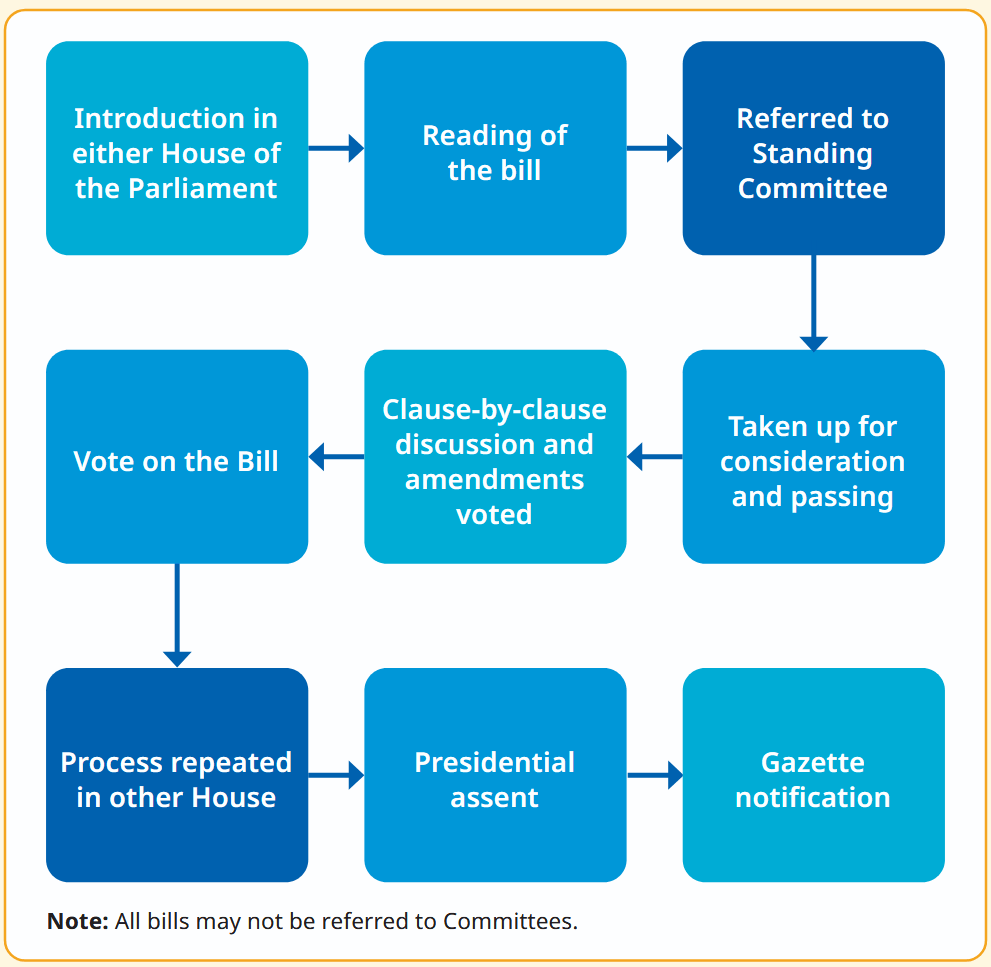
Reading: The origins are in the British Parliament. Many MPs were illiterate, so a clerk would read out the contents of the bill for the MPs to discuss. Today MPs read the bill before the discussions take place.
Clause: These are parts of a bill that explain the specific details of the bill; eg. RTE defines the age group to which it applies (6 to 14 years).
Gazette: This is an official government publication that announces legal documents and official information.
LET'S EXPLORE
Draw a small chart to show the process of how RTE became an act. What do you think the process would be if RTE had been tabled in the Lok Sabha?
DON'T MISS OUT
Some types of bills have to be tabled only in the Lok Sabha. One example is a ‘Money Bill’ that is concerned with financial matters (including taxation, government borrowing, etc.). It is essentially a draft law that can be introduced only in the Lok Sabha; however, the introduction of the bill requires the prior recommendation of the President.
3) Executive accountability
The Prime Minister and the Council of Ministers are part of the Union Executive. They are:
- primarily responsible for implementing and enforcing laws and overseeing the effective running of the government;
- take decisions regarding the day-to-day functioning of the government based on the principles laid out in the Constitution and its laws;
- answerable to the Lok Sabha, through mechanisms like the Question Hour which require ministers to justify their actions and decisions. The Question Hour in the Lok Sabha is a select period (typically the first hour of a Parliamentary session) where MPs can ask the ministers questions about government policies and activities. It is a process of the Parliament that holds the Executive ‘accountable’ (i.e., it must justify all actions and decisions). Special committees also hold meetings where ministries have to explain and answer questions about their policies. These committees may include MPs from different political parties.
The Parliament isn’t always formal and serious. Sometimes, the atmosphere is set through poetry and humour!
Example 1: Verse in the Parliament
While presenting the Union Budget for the year 2025-26 on the 1 st of February, 2025, Smt. Nirmala Sitharaman recited the following verse from Tirukkural (an ancient Indian treatise in Tamil on ethics and morality):
Vaanokki vaalum ulakellaam
Mannavan koalnokki vaalung kudi.
It means:
Just as living beings live expecting rains,
Citizens live expecting good governance.
On hearing this, there was an enthusiastic thumping of desks from the Treasury Benches.
Example 2: Humour in the Parliament
In 2011, during a spirited debate in the Lok Sabha, Parliamen- tarian Sushma Swaraj quoted a poetic verse to criticise the government:
“Tu idhar udhar ki na baat kar, yeh bata ki kafila kyun luta, humein rahjano se gila nahi, teri rahbari ka sawal hai.”
Don’t change the topic, just say why the caravan was looted. We have no complaint with the robbers, but this is a question on your leadership.
In response, the then Prime Minister Dr. Manmohan Singh calmly replied with another poetic line:
“Maana ki teri deed ke qabil nahin hoon main, tu mera shauq dekh mera intezar dekh.”
I admit that I am not worthy of your sight; you should look at my zeal and my perseverance.
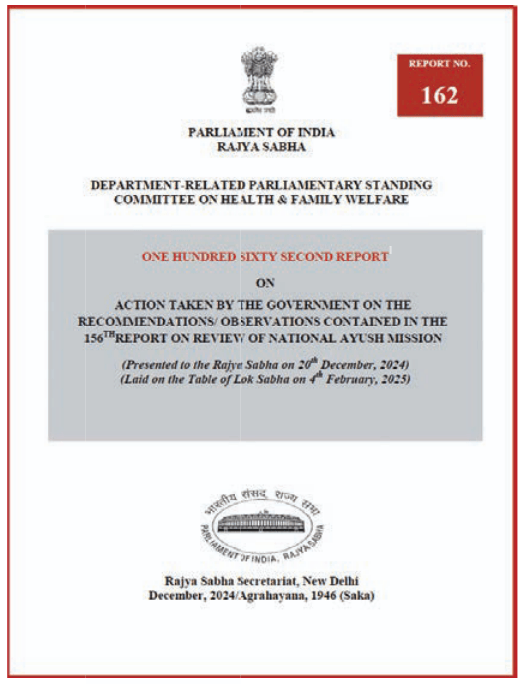
1.2 Co-location of Ayush facilities at Primary Health Centers (PHCs), Community Health Centers (CHCs) and District Hospitals (DHs)
Recommendation:
1.2.1 The Committee, at this juncture, notices that in some states and UTs, a separate Department of Ayush has not been opened. The Committee, to boost the Ayush system and for better coordination in Ayush Healthcare, recommends the Ministry of Ayush to impress upon and persuade the States and UTs with no separate department of Ayush to create such a department for speedy development and implementation of Ayush sector and schemes respectively.
(Para 2.13 of the Report)
Action Taken:
1.2.2 Public Health is being a state subject, creation of separate Department of Ayush in the States/UTs comes under purview of respective State/UT Governments. However. Ministry of Ayush has requested States/UTs Governments in different meetings to create separate Directorates, deployment of manpower in SPMU and DPMU in the States/UTs for speedy development and implementation of NAM scheme As on date, separate Ayush Directorate is available in 24 States/UTs. (SPMU=state project management unit; DPMU=district project management unit)
(Para 2.23 of the Report)
LET'S EXPLORE
Given here is an extract from the report of meetings between the Standing Committee on Health and Family Welfare and the officers from the Ministry of Health and Family Welfare. Observe the screenshots above and discuss the following in small groups — Who is reporting to whom? What is the subject that has been reviewed? Identify the Committee’s recommendation. What is the government’s reply?
4) Financial accountability
The Parliament approves and monitors government expenditure through the annual budget, and examining the distribution of funds to different ministries.
LET'S EXPLORE
Why do you think that Parliament keeps an eye on government expenditure? (Hint: Whose money does the government spend?)
The government is expected to provide the necessary information to Parliament in a timely and accurate manner.
EXECUTIVE FUNCTIONS OF PARLIAMENT
We have uncovered a few points on the role of the executive in the previous sections. We look at this a little more closely now.
1) Constitutional function
The President is the Head of State and the nominal head of the Executive. The Prime Minister and the Council of Ministers are responsible for running the government. The President appoints the Prime Minister and other ministers, summons the Parliament, and gives assent to bills, among other functions. The Council of Ministers aids and advises the President. However, in specific circumstances, the President can exercise discretionary powers, particularly during political crises, like when no party holds a clear majority in a Lok Sabha election.
2) The Prime Minister and the Council of Ministers
The Prime Minister is the de facto executive authority in India’s Parliamentary system. The President appoints the leader of the majority party or coalition in the Lok Sabha as the Prime Minister. The Prime Minister serves with the support of the majority of the MPs in the Lok Sabha.
The Prime Minister’s key functions include:
- Leading the Council of Ministers
- Advising the President
- Coordinating the work of different ministries
- Shaping national policies
The Prime Minister and the Council of Ministers take decisions and run the government. They are collectively responsible to the Lok Sabha. Most of the bills that come to the Parliament for discussion are initiated by the government. A permanent group of officials — called ‘civil servants’ — help in implementing laws and policies. These officers, often called administrators or bureaucrats, work under the direction of ministers and ensure that government departments function smoothly.
LET'S EXPLORE
If the Executive is part of the Legislature, how do we say that there is separation of power? (Hint: revisit the section on legislature above)
DON'T MISS OUT
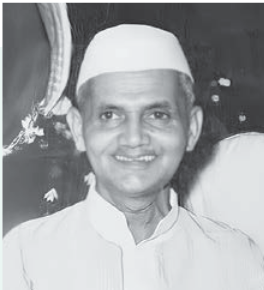
In 1956, Railway Minister Lal Bahadur Shastri resigned after a train accident. Although he was not blamed for the accident, he believed that a minister must take moral responsibility for anything that happens in their ministry. He offered his resignation to the then Prime Minister Jawaharlal Nehru; Nehru declined at first, but Shastri insisted. Finally, his resignation was accepted.
Differences Between the Legislature and the Executive
It is important to understand some key differences between the Legislature and the Executive. The following table briefly summarises the distinctions.
| Aspect | Legislature | Executive |
| Composition | The Parliament of India is the supreme legislative body of the country, composed of the President, the Lok Sabha and the Rajya Sabha. | The Executive is composed of the President, the Vice- President, and the Council of Ministers headed by the Prime Minister. |
| Main Role | Making laws and overseeing the work of the Executive | Enforcing the laws made by the Legislature |
| Functions | Can introduce some bills in the Parliament | Most of the bills are introduced by the Executive in the Parliament |
| Keeps a check on the activities of the Executive by asking questions and seeking explanations | Provides information and explanations to the Legislature on its decisions and actions. Aids and advises the President on important matters, including calling sessions of Parliament | |
| Sanctions all government-related expenses | Prepares and implements the budget approved by Parliament. | |
| Consults different Parliamentary committees | Can function independently in day-to-day matters and may consult committees when required. |
THE JUDICIARY - ROLES OF CHECKS AND BALANCES
The Judiciary is the branch of government that is responsible for interpreting and applying the laws of the land, including in specific cases of disputes. The Judiciary functions through a system of courts and plays a pivotal role in maintaining the democratic nature of society and governance. The Judiciary acts as the custodian of the Constitution, ensuring that all branches of the government operate within the principles and parameters enshrined in the Constitution. It keeps a check on the effective functioning of society and institutions of the government by interpreting laws, resolving disputes, and safeguarding fundamental rights.
The Constitution not only describes how the Legislature and Executive are given power to govern the country, but it also lists the specific responsibilities of these organs. To ensure that the powers of the Legislature are used properly and responsibilities are followed, the Judiciary is given the unique and critical responsibility of checking that the laws passed by Parliament have not violated the Constitutional framework. Similarly, if a violation of the Constitution occurs when the laws are implemented by the Executive, the Judiciary again has the power to step in. Just as the Parliament functions through its Legislature and the Executive arms, the Judiciary functions through its Courts.
In this chapter, we have explored how the organs within the Parliament balance making of the law and executing it, and how the Judiciary checks these actions. These are all examples of the separation of powers and the system of checks and balances among the Legislature, the Executive, and the Judiciary, ensuring that no one organ becomes too powerful.
LET'S EXPLORE
→ What might happen if one of the organs — Legislature, Executive, Judiciary — had all the power? How could it affect the rights of people? Discuss with your classmates how each organ checks the others. For example, how does the Legislature question the actions of the Executive? How does the Judiciary make sure that laws and government actions respect the Constitution? Do you think there might be ways in which the actions of the Judiciary itself are reviewed?
→ Can you find examples where the Judiciary has asked lawmakers to review a law? Can you find any instances when the implementation of a law has been questioned by the Judiciary?
We will learn more about the Judiciary in a later chapter.
LEGISLATIVE AND EXECUTIVE FUNCTIONS AT THE STATE LEVEL
As discussed, the Union Government has a Parliament with legislative and executive functions. Similarly, each state has its own legislature and executive, called its ‘State Assembly’. Just as the Parliament has Members of Parliament (MPs) who make laws, there are Members of Legislative Assembly (MLAs) who formulate laws on subjects that are on the ‘State List’ and on the ‘Concurrent List’.
Union List, State List, and Concurrent List
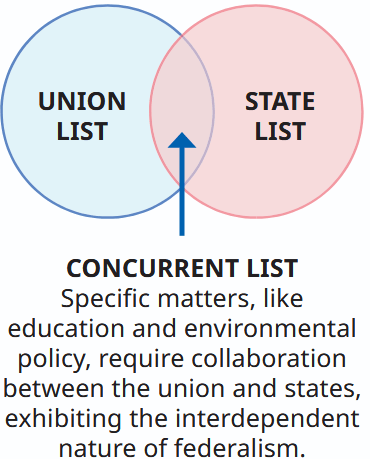
The Constitution has lists that help to clarify the areas on which the Union and State governments can exclusively legislate, called the Union List and the State List, respectively. There is also a Concurrent List that has subjects on which both the Union and State governments can legislate. However, in the case that the Union government legislates on a subject in the Concurrent List, the state government is bound to follow it. In the case of RTE, for example, the Act is applicable all over India even though education is in the Concurrent List.
Parallel Structure of Union and State Governments in India
The structure at the state-level imitates the one at the union-level. You can see this structure across both levels in the table:
| Feature | Union Government | State Government |
| Constitutional Head | The President of India elected by an electoral college | Governor of the State appointed by the President |
| Term of Office (Head) | 5 years | 5 years |
| Executive Head | The nominal head is the President, but the Prime Minister is the de facto executive authority at the centre | The nominal head is the Governor, but the Chief Minister is the de facto executive authority of the state |
| Selection of Executive | Leader of majority party/ coalition in Lok Sabha | Leader of majority party/ coalition in Vidhan Sabha |
| Council of Ministers | Selected by Prime Minister | Selected by Chief Minister |
| Responsibility | Collectively responsible to Lok Sabha | Collectively responsible to Vidhan Sabha |
| Legislature Structure | Bicameral - Lok Sabha and Rajya Sabha | Can be unicameral (Vidhan Sabha only) or bicameral (Vidhan Sabha and Vidhan Parishad) |
| Lower House | Lok Sabha (House of the People) | Vidhan Sabha (Legislative Assembly) |
| Upper House | Rajya Sabha (Council of States) | Vidhan Parishad (Legislative Council) - in some states only |
| Term of Lower House | 5 years | 5 years |
| Presiding Officer (Lower House) | Speaker | Speaker |
| Legislative Powers | Makes laws on subjects in Union List and Concurrent List | Makes laws on subjects in State List and Concurrent List |
| Financial Powers | Money bills originate only in Lok Sabha | Money bills originate only in Vidhan Sabha |
Structure of State Legislatures
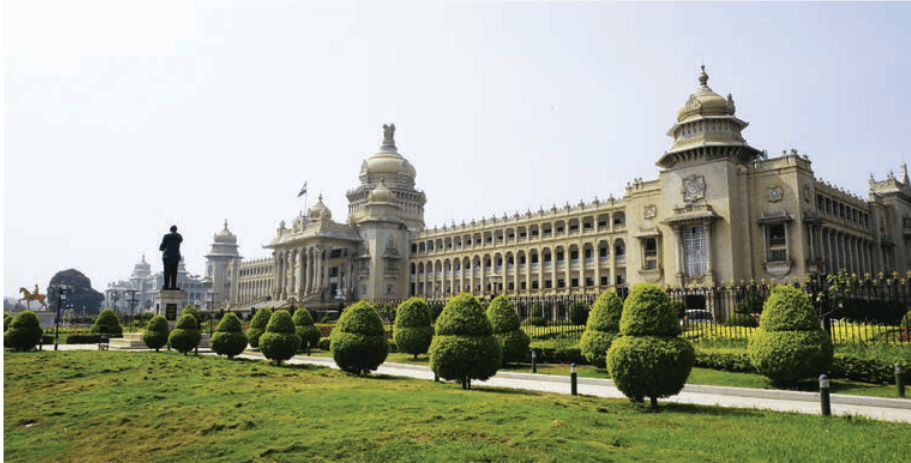
Unlike the Centre, the State legislatures can be ‘unicameral’ (having only one house) or ‘bicameral’ (having two houses). The legislative assembly is called the Vidhan Sabha, and the legislative council (the upper house) is called the Vidhan Parishad. The states having a bicameral system are Andhra Pradesh, Bihar, Karnataka, Maharashtra, Telangana, and Uttar Pradesh, while the remaining states have a unicameral system.
LET'S EXPLORE
What type of legislature does your state have?
CHALLENGES TO THE EFFECTIVE FUNCTIONING OF THE STATE LEGISLATURES
As discussed, the Indian legislature (including the Parliament at the Centre and the State Assemblies) has the critical and vital role of enacting laws, overseeing administrative processes, and approving the budget. It also provides a platform for discussing national policies, development plans, international relations, and addressing public grievances. However, the legislature also faces several challenges in its effective functioning.
Some of these can include regular absenteeism of members, non- cooperative conduct or communication of members, reduced quality of important debates, and disruptions of the Question Hour.
The Parliament typically meets three times a year. These meetings are called ‘sessions’ ― Budget Sessions, Monsoon Sessions and Winter Sessions. Each of these has ‘sittings’, where the Parliament meets to deliberate upon proposed laws, discuss important matters of governance, and seek explanations from the Executive on its decisions and actions. Usually, the Parliament sits for 6 hours a day during sessions. This can be extended on special occasions or when there is a need to complete urgent business. The State Assemblies too, have similar schedules.
LET'S EXPLORE
→ Study the data given in the following table. What conclusions can you draw about the functioning of Parliament over time? Compile data for more recent years
| Period of Lok Sabha | Number of sessions | Number of sittings |
| 1 st Lok Sabha (1952-1957) | 14 | 677 |
| 2nd Lok Sabha (1957-1962) | 16 | 567 |
| 10th Lok Sabha (1991-1996) | 16 | 423 |
| 13 th Lok Sabha (1999-2004) | 14 | 356 |
→ Read the following statement of the former chairman of the Rajya Sabha, M. Venkaiah Naidu given in 2021: “...the productivity of Rajya Sabha during 2004-14 has been about 78% and it declined to about 65% since then. Of the 11 sessions [that he presided over], four of them clocked low productivity of 6.80%, 27.30%, 28.90% and 29.55%; during the year 2018, the Rajya Sabha recorded the lowest ever productivity of 35.75% under the impact of disruptions.” What conclusions can you draw from this statement? What implications does this have for the role that the Rajya Sabha is expected to play?
The Parliament and the State Assemblies have been envisioned as spaces for thoughtful debates and discussions where laws are made in the interest of the people. However, when debates are disrupted, sessions are cut short and some bills take years to be discussed and passed, it becomes a matter of concern.
LET'S EXPLORE
→ Take up a small group project. Compile data regarding the functioning of the legislature in your state or union territory.
→ Seek an appointment with an MLA and gather information about challenges with respect to the state legislature.
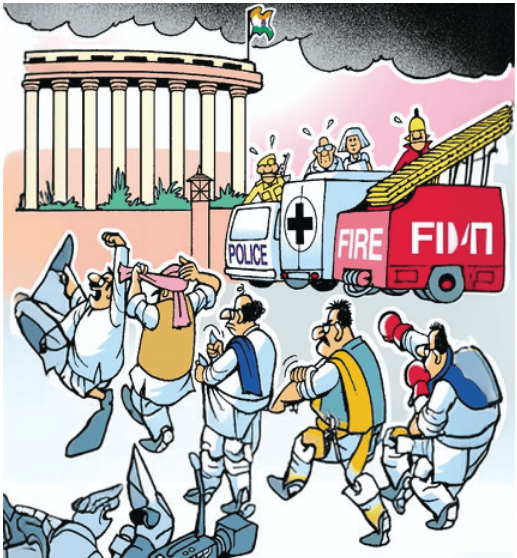
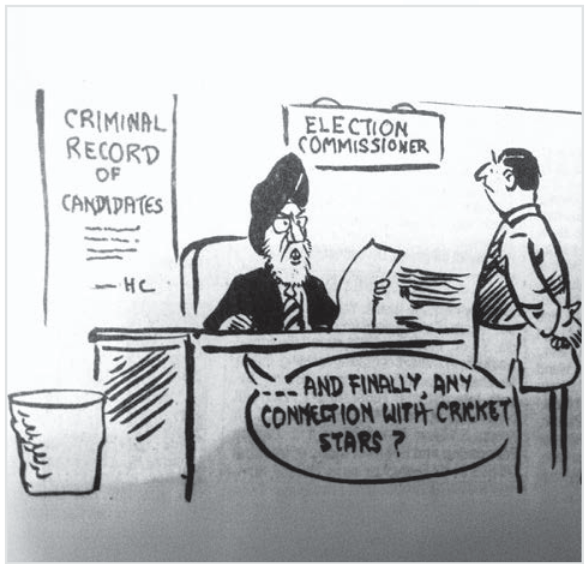
Concerns have been expressed by sections of the society about the fact that a substantial proportion of their representatives in the Lok Sabha have criminal cases against them, and that many sessions are marked by angry or biased debates that do not seriously address issues affecting the people.
The media also plays an important role in communicating the concerns of the electorate. These cartoons express them with humour, a practice common to all healthy democracies.
Yet, our democracy grows stronger when citizens stay informed and engaged. By asking questions, sharing their views, and participating in public discussions, people help shape better policies. Therefore, one of the best ways to overcome the challenges India faces regarding its legislature, is to ensure that many more citizens stay informed on matters of importance to society, participate in discussions through public debate on digital spaces that various government departments offer during policymaking processes, and constructively engaging with political representatives on policies.
Many more young leaders and diverse voices are entering public life, and technology is making it easier to stay connected and involved with governance. As future voters, your choices, and participation will play a key role in strengthening our Parliament and the assembly of the state you belong to, ensuring that they truly serve all people.
DON'T MISS OUT
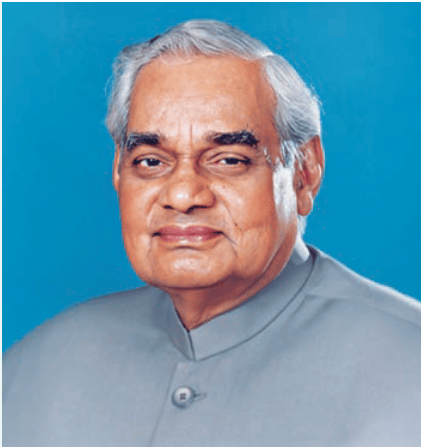
→ Atal Bihari Vajpayee, a former Prime Minister of India, said during a speech in the Lok Sabha, “Sarkaarein aayengi, jaayengi. Paartiyaan banengi, bigadengi. Lekin yeh desh rehna chaahiye, is desh ka loktantra amar rehna chaahiye.” (Governments will come and go, parties will rise and fall. But the nation must endure, and its democracy must live on.)
→ What message do you think this gives about the role of Parliament and leaders in a democracy? Why is it important to protect democratic values even when political power changes?
Before we move on …
→ India’s Parliamentary system ensures that power is shared, decisions are debated, and leaders are held accountable.
→ The Legislature makes laws, the Executive implements them, and the Judiciary ensures that they follow the Constitution.
→ The Parliament represents the voice of the people and reflects the federal spirit of our democracy.
→ Both at the Centre and in the states, structures are designed to balance representation, responsibility, and unity.
→ Checks and balances between institutions help protect citizens’ rights and uphold democratic values.
→ The functioning of the Parliament needs to become more efficient and productive so that the country’s progress is not thwarted.
Questions and activities
1. Find out how many representatives from your state are in each House of the Parliament.
2. What makes the Indian Parliament the “voice of the people”? How does it ensure that different opinions are heard?
3. Why do you think the Constitution made the Executive responsible to the Legislature?
4. Why do you think we have chosen the system of bicameral legislature at the Union level?
5. Try to track the journey of a recent bill passed by the Parliament. Identify in which House it was introduced. Were there any major debates or disagreements? How long did it take for the bill to become a law? Use newspaper archives, government websites, and Lok Sabha debates, or ask your teacher for help.
6. Choose a recent law passed by the Parliament. Divide into teams to role-play different parts of the process — MPs debating in Lok Sabha and Rajya Sabha, ministers answering questions, and the President giving assent. Present a short skit showing how a bill becomes a law; enact a ‘model Parliament’.
7. The Women’s Reservation Bill, 2023, was passed with wide support. Why might it have taken over 25 years for this bill to be passed, despite being discussed for so long?
8. Sometimes the Parliament is disrupted and does not function for the number of days it is supposed to. What impact do you think this has on the quality of laws and the trust people place in their representatives?
9. Can you create ‘interest’ groups among students and list questions related to any policy that you may want to ask your MP and / or your MLA? How would these questions be different if it is to the MP instead of the MLA, and vice versa?
10. What is the role that the Judiciary plays in Indian democracy? What could happen if we didn’t have an independent judiciary?