Chapter - 3

A STORY OF NUMBERS
3.1 Reema's Curiosity
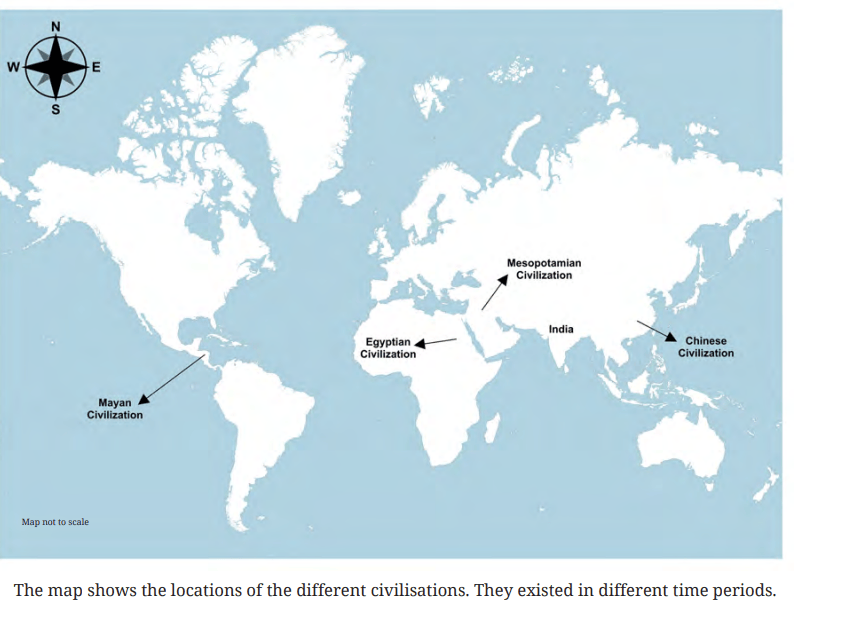
One lazy afternoon, Reema was flipping through an old book when-whoosh!-a piece of paper slipped out and floated to the floor. She picked it up and stared at the strange symbols all over it. "What is this?" she wondered. She ran to her father, holding the paper as if it were a secret treasure. He looked at it and smiled. "Around 4000 years ago, there flourished a civilisation in a region called Mesopotamia, in the western part of Asia, containing a major part of the present-day Iraq and a few other neighbouring countries. This is one of the ways they wrote their numbers!" Reema’s eyes lit up, “Seriously? These strange symbols were numbers?”
Her curiosity was sparked, and questions started swirling in her head.
Reema’s eyes lit up, “Seriously? These strange symbols were numbers?”
Her curiosity was sparked, and questions started swirling in her head.
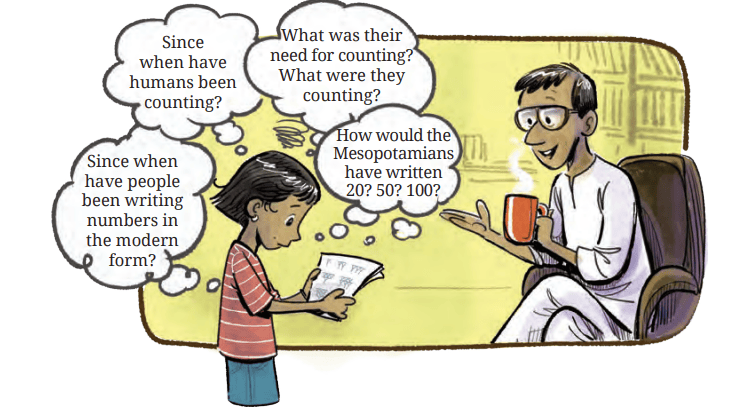 Sensing her curiosity, her father started telling her how the idea of number and number representation evolved over the course of time, across geographies, to finally reach its modern efficient form. Get ready to travel back in time with them!

Humans had the need to count even as early as the Stone Age. They were counting to determine the quantity of food they had, the number of animals in their livestock, details regarding trades of goods, the number of offerings given in rituals, etc. They also wanted to keep track of the passing days, e.g., to know and predict when important events such as the new moon, full moon, or onset of a season would occur. However, when they said or wrote down such numbers, they didn't make use of the numbers that we use today.
The structure of the modern oral and written numbers that we use today had its origin thousands of years ago in India. Ancient Indian texts, such as the Yajurveda Samhita, mentioned names of numbers based on powers of 10, almost as we say them orally today. For example, they listed names for the numbers one (eka), ten (dasha), hundred (shata), thousand (sahasra), ten thousand (@yuta), etc., all the way up to 10 ^ 12 and beyond. written using ten digits, including the digit 0শাশ্বতমতাপন্ধাতার অছিল
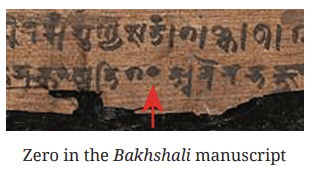
The way we write our numbers today - using the digits 0 through 9 -also originated and were developed in India, around 2000 years ago. The first known instance of numbers being the Bakhshali manuscript (c. 3rd century (which was then notated as a dot), occurs in CE). Aryabhata (c. 499 CE) was the first mathematician to fully explain, and do elaborate scientific computations with the Indian system of 10 symbols. Zero in the Bakhshali manuscript
The Indian number system was transmitted to the Arab world by around 800 CE. It was popularised in the Arab world by the great Persian mathematician Al-Khwārizmi (after whom the word 'algorithm' is named) through his book On the Calculation with Hindu Numerals (c.825) and by the noted philosopher Al-Kindi through his work On the Use of the Hindu Numerals (c. 830).
From the Arab world, the Hindu numerals were transmitted to Europe and to parts of Africa by around 1100 CE. Though Al-Khwārizmī's work on calculation with Hindu numerals was translated into Latin, it was the Italian mathematician Fibonacci who around the year 1200 really made the case to Europe to adopt the Indian numerals. However, the Roman numerals were so ingrained in European thinking and writing at the time that the Indian numerals did not gain widespread use for several more centuries. But eventually, during the European Renaissance and by the 17th century, not adopting them became impossible or it would impede scientific progress.
- Pierre-Simon Laplace (1749-1827)
Their use then spread to every continent, and are now used in every corner of the world.
Because European scholars learned the Indian numerals from the Arab world, they called them 'Arabic numerals' to reflect their European perspective. On the other hand, as noted above, Arab scholars, such as Al-Khwārizmī and Al-Kindi, called them 'Hindu numerals'. During the period of European colonisation, the European term Arabic numbers became widely used. However, in recent years, this mistake is being corrected in many textbooks and documents around the world, including in Europe. The most commonly used terminologies for the numbers we use today are 'Hindu numerals', 'Indian numerals', and the transitional 'Hindu-Arabic numerals'. It is worth noting that the word 'Hindu' here does not refer to a religion, but rather a geography/people from whom these numbers came.
The shape of the digits 0, 1, 2, ..., 9 used to write numbers in the Indian number system today evolved over a period of time, as shown below: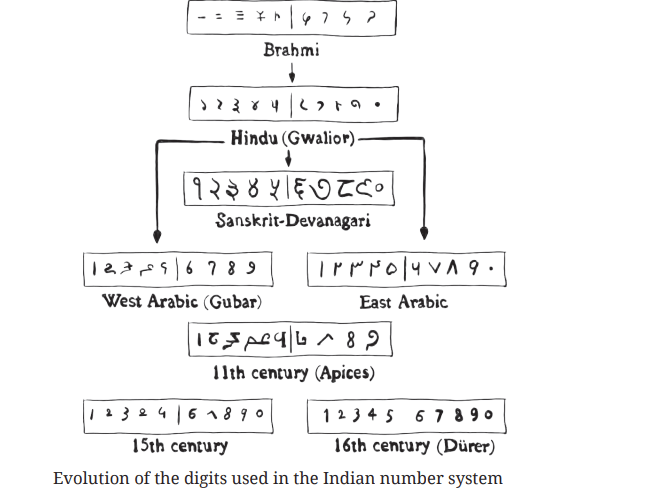
Prior to the global adoption of the Indian system of numerals, different groups of people used different methods of representing numbers We shall take a glimpse of some of them. We will not be looking at different systems in a chronological order, but rather an order that shows us the main stages in the development of the idea of number representation.
But first, let us explore some of the foundational ideas needed to count and to determine the number of objects in a given collection.
The Mechanism of Counting
Imagine that we are living in the Stone Age, say, around ten thousand years ago. Suppose we have a herd of cows. Here are some natural questions that we might ask about our herd- ?
?Q1. How do we ensure that all cows have returned safely after grazing? ??Q2. Do we have fewer cows than our neighbour? ?
?Q3. If there are fewer, how many more cows would we need so that we have the same number of cows as our neighbour?
We need to tackle these questions without the use of the number names or written numbers of the Hindu number system. How do we do it?
Here are some possible methods.
Method 1: We could tackle the questions by using pebbles, sticks or any object that is available in abundance. Let us choose sticks. For every cow in the herd, we could keep a stick. The final collection of sticks tells us the number of cows, which can be used to check if any cows have gone missing.
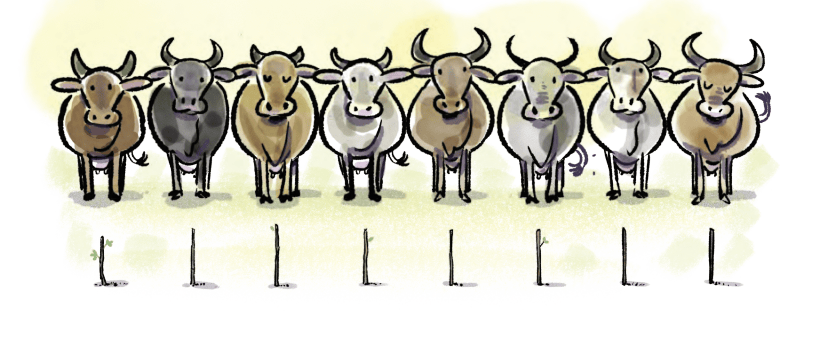
This way of associating each cow with a stick, such that no two cows are associated or mapped to the same stick is called a one-to-one mapping. This mapping can then be used to come up with a way to represent numbers, as shown in the table.
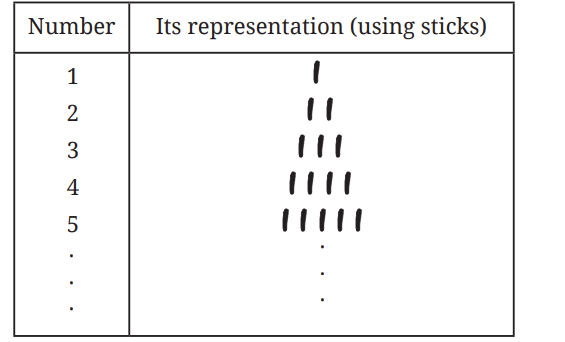 ?How will you use such sticks to answer the other two questions (Q2 and
Q3)?
?How will you use such sticks to answer the other two questions (Q2 and
Q3)?
Method 2: Instead of objects, we could use a standard sequence of sounds or names. For example, we could use the sounds of the letters of any language. While counting, we could make a one-to-one mapping between the objects and the letters: that is, associate each object to be counted with a letter, following the letter-order. This mapping can then be used to come up with a way of verbally representing numbers. For example, we get the following number representation if we use English letters ‘a’ to ‘z’.
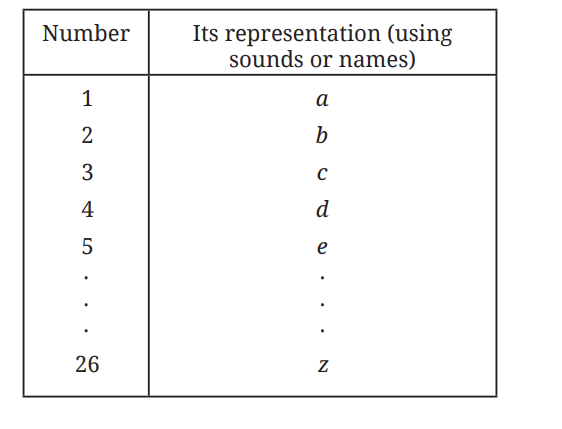
An obvious limitation of using only the letters of the English alphabet in this form is that it cannot be used to count collections having more than 26 objects.
?How many numbers can you represent in this way using the sounds of the letters of your language?
Method 3: We could use a sequence of written symbols as follows.
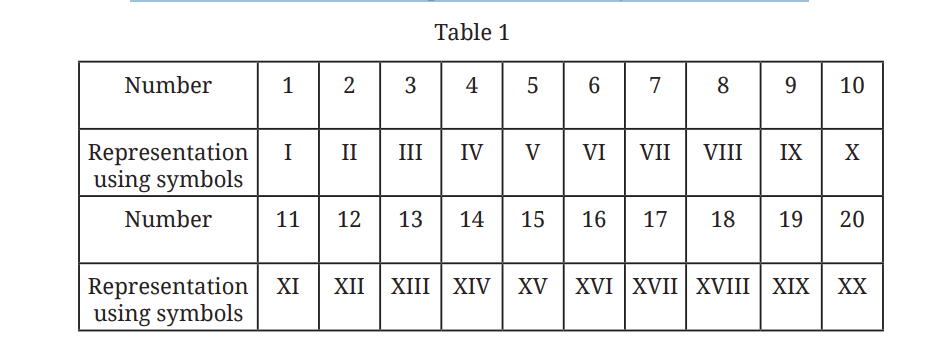
?Do you see a way of extending this method to represent bigger numbers as well? How?
From the discussion above, we see that for counting and finding the size of a collection, we need a standard sequence of objects, or names, or written symbols, that has a fixed order. Let us call this standard sequence a number system. A collection of objects can be counted by making a one-to-one mapping between them and the standard sequence, following the sequence order.
Since there is no end to numbers, the challenge is to come up with an unending standard sequence/number system that is easy to count with. Using sticks gives an unending standard sequence/number system. However, it is not convenient to count larger collections, as we will need as many sticks as the number of objects being counted. Using the sounds of the letters of a language, as in Method 2, is convenient for the counting process but is not an unending standard sequence/number system. The standard sequence/number system given in Method 3 was actually the system used in Europe before it got replaced by the Hindu number system. It is called the Roman number system. It was widely used in Europe for centuries, and was convenient for many purposes, but had the similar drawback that one cannot write arbitrarily large numbers without introducing more and more symbols. We will learn more about this system of writing numbers later on.
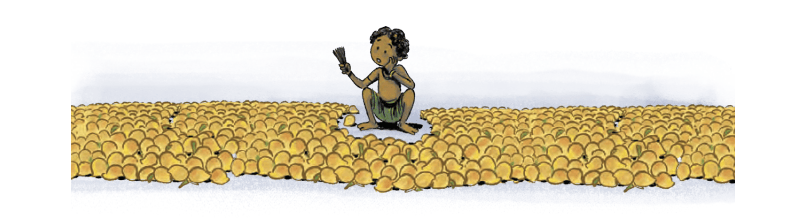
As illustrated by the three methods, history gives us examples of number systems formed using physical objects (such as sticks, pebbles, body parts, etc.), names, and written symbols. Some groups of people had numbers represented both by physical objects as well as by names, while others like the Chinese had all three forms of representation. The symbols occurring in a written number system are called numerals. For example, 0, 1, 5, 36, 193, etc., are some of the numerals occurring in the Hindu number system. Numerals representing ‘smaller’ numbers always had names, and so a number system composed of written symbols always went hand in hand with a number system composed of names, as is the case with the modern-day Hindu system.
Figure it Out
1. Suppose you are using the number system that uses sticks to represent numbers, as in Method 1. Without using either the number names or the numerals of the Hindu number system, give a method for adding, subtracting, multiplying and dividing two numbers or two collections of sticks.
2. One way of extending the number system in Method 2 is by using strings with more than one letter—for example, we could use ‘aa’ for 27. How can you extend this system to represent all the numbers? There are many ways of doing it! 3. Try making your own number system.
3.2 Some Early Number Systems
I. Use of Body Parts
Many groups of people across the world have used their hands and body parts for counting. Here is how a group of people in Papua New Guinea used and still use their body parts as the standard sequence/number system.
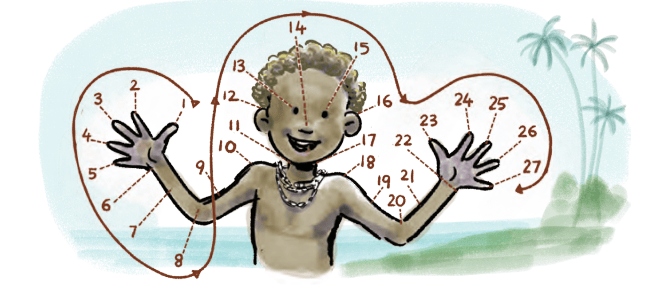 II. Tally Marks on Bones and Other Surfaces
One of the oldest methods of number representation is by making notches—marks cut on a surface such as a bone or a wall of a cave. These marks are also called tally marks.
One of the oldest methods of number representation is by making notches—marks cut on a surface such as a bone or a wall of a cave. These marks are also called tally marks.
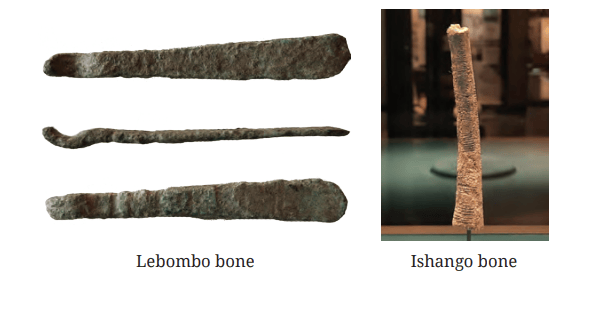
Archaeologists have discovered bones dating back more than 20,000 years that seem to have tally marks. The oldest known such bones with markings that are thought to represent numbers are the Ishango bone and the Lebombo bone. The Ishango bone, dating back 20,000 to 35,000 years, was discovered in the Democratic Republic of Congo. It features notches arranged in columns, possibly indicating calendrical systems. The Lebombo bone, discovered in South Africa, is an even older tally stick with 29 notches, estimated to be around 44,000 years old. It is considered one of the oldest mathematical artefacts, and may have served as a tally stick or lunar calendar.
III. Number Names Obtained by Counting in Twos
A group of indigenous people in Australia called the Gumulgal had the following words for their numbers.
Gumulgal (Australia)- 1. urapon
- 2. ukasar
- 3. ukasar-urapon
- 4. ukasar-ukasar
- 5. ukasar-ukasar-urapon
- 6. ukasar-ukasar-ukasar
The number name for 3 is composed of number names of 2 and 1.
The number name for 4 is composed of two occurrences of the number name for 2.
? Can you see how the names of the other numbers are formed?
The numbers are counted in 2s, using which the number names are formed: 3 = 2 + 1 5 = 2 + 2 + 1 6 = 2 + 2 + 2
Gumulgal called any number greater than 6 ras.
There is a very interesting and puzzling historical phenomenon associated with this number system. Look at the following number systems of a group of indigenous people in South America, and the Bushmen of South Africa:
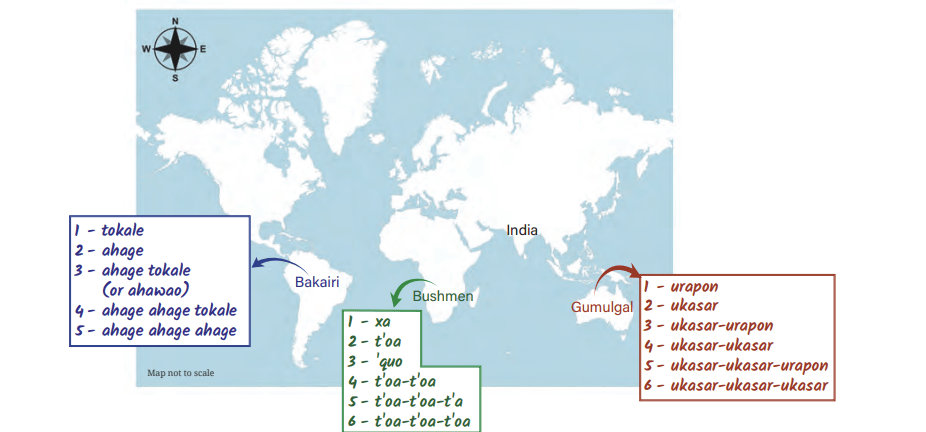
Despite being so far apart geographically, and with no trace of contact between them, these three groups have developed equivalent number systems! Historians have wondered how this happened. One theory is that these three groups of people may have had common ancestors, who used this number system. In course of time, their descendants migrated to these places.
Even though the number system of Gumulgal had number names for numbers only till 6, we can see the emergence of an idea here. Counting in 2s is more efficient for representing numbers than, for example, a tally system. A general form which this idea has taken in different number systems is as follows: count in groups of a certain number (like 2 in the case of Gumulgal's system), and use the word or symbol associated with this group size to represent bigger numbers. Some of the commonly used group sizes in different number systems have been 2, 5, 10 and 20. You can find the idea of counting by 5s in the Roman system (Table 1).
This idea of counting in a certain group size and using it to represent numbers is an important idea in the history of the evolution of number systems.
One of the phenomena that could have led people to this idea might be the human limit for immediately knowing the size of a collection at a glance. Let us try out the following activity.
? Quickly count the number of objects in each of the following boxes:
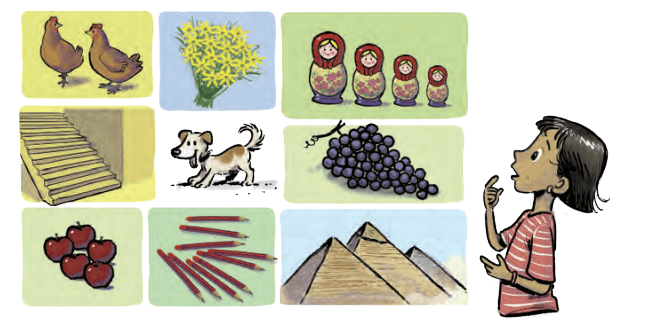
Up to what group size could you immediately see the number of objects without counting? Most humans find it difficult to count groups having 5 or more objects in a single glance.
This limit of perception could have prompted people using tally marks to replace every group of, say, 5 marks, with a new symbol, as seen in the system shown in Table 1.
? What could be the difficulties with using a number system that counts only in groups of a single particular size? How would you represent a number like 1345 in a system that counts only by 5s?
Even though counting in groups of a particular size and using it for number representation is more efficient than the tally system, this method can still become cumbersome for larger numbers. The next system shows a refinement of this idea.
IV. The Roman Numerals
We have already seen the Roman number system till 20 (Table 1). We have seen that it uses I for 1, V for 5, X for 10.
To get the Roman numeral for any number till 39, it is first grouped into as many 10s as possible, the remaining is grouped into as many 5s as possible, and finally the remaining is grouped into 1s. Example: Let us take the number 27.
27 = 10 + 10 + 5 + 1 + 1So, 27 in Roman numerals is XXVII.
Instead of representing 50 as XXXXX, a new symbol is given to it: L. Following the way the number 4 is represented as 1 less than 5 — that is, as IV — 40 is represented as 10 less than 50 — that is, as XL. However, people using this system were not always consistent with this practice. Sometimes, 40 was also represented as XXXX.
The Roman number system introduces newer symbols to represent certain bigger numbers. Let us call all these numbers that have a new basic symbol as landmark numbers. Here are some of the landmark numbers of the Roman system and their associated numerals.

These symbols are used to denote other numbers as well. For example, consider the number 2367. Writing it as a sum of landmark numbers starting from 1000 such that we take as many 1000s as possible, 500s as possible, and so on, we get
2367 1000+1000+100+100+100+50+10+5+1+1So in Roman numerals, this number is MMCCCLXII.
? Figure it Out
1. Represent the following numbers in the Roman system.
- (i) 1222
- (ii) 2999
- (iii) 302
- (iv) 715
We see how vastly efficient this system is compared to some of the previous number systems that we have seen. This system seems to have evolved out of the ancient Greek number system in around the 8th century BCE in Rome, and evolved over time. It spread throughout Europe with the expansion of the Roman empire.
Despite the relative efficiency of the Roman system, it doesn't lend itself to an easy performance of arithmetic operations, particularly multiplication and division.
? Example: Try adding the following numbers without converting them to Hindu numerals:
(a) CCXXXII + CCCCXIIILet us find the total number of Is, Xs, and Cs, and group them starting from the largest landmark number. Apparently, it looks like the largest landmark number is C, but note that 5 Cs (100s) make a D (500). So the sum is
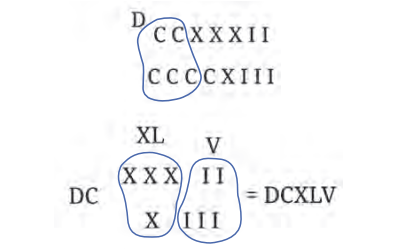 Do it yourself now:
(b) LXXXVII + LXXVIII
? How will you multiply two numbers given in Roman numerals, without converting them to Hindu numerals? Try to find the product of the following pairs of landmark numbers: VL LD VD VII × IX.
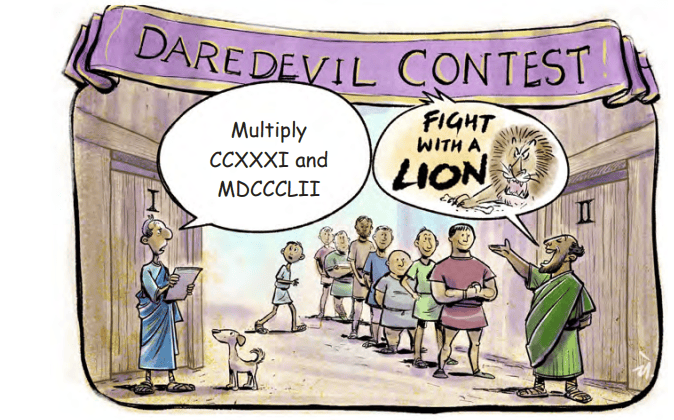
People using the Roman system made use of a calculating tool called the abacus to perform their arithmetic operations. We will see what it is in a later section. However, only specially trained people used this tool for calculation.
While going through the number systems discussed above, it should not be understood that, historically, one system developed as an improvement over the previous system. This point should be kept in mind when studying the upcoming number systems too. The actual story of how each of the number systems developed is much more complex, and many times not clearly known, and so we will not try to trace this in the chapter.
? Figure it Out 1. A group of indigenous people in a Pacific island use different sequences of number names to count different objects. Why do you think they do this?
2. Consider the extension of the Gumulgal number system beyond 6 in the same way of counting by 2s. Come up with ways of performing the different arithmetic operations (+, –, ×, ÷) for numbers occurring in this system, without using Hindu numerals. Use this to evaluate the following:
- (i) (ukasar-ukasar-ukasar-ukasar-urapon) + (ukasar-ukasarukasar-urapon)
- (ii) (ukasar-ukasar-ukasar-ukasar-urapon) – (ukasar-ukasarukasar)
- (iii) (ukasar-ukasar-ukasar-ukasar-urapon) × (ukasar-ukasar)
- (iv) (ukasar-ukasar-ukasar-ukasar-ukasar-ukasar-ukasar-ukasar) ÷
- (ukasar-ukasar)
3.3 The Idea of a Base
I. The Egyptian Number System
We are now going to see a written number system that the Egyptians developed around 3000 BCE. In this system, we see the use of landmark numbers to group and represent a given number. However, what makes this system special is its sequence of landmark numbers.
Imagine making collections of pebbles. The first landmark number is 1. Group together 10 collections of the previous landmark number (1). Its size is the second landmark number which is 10. Group together 10 collections of the previous landmark number (10). Its size is the third landmark number which is 10 × 10 = 100, and so on.
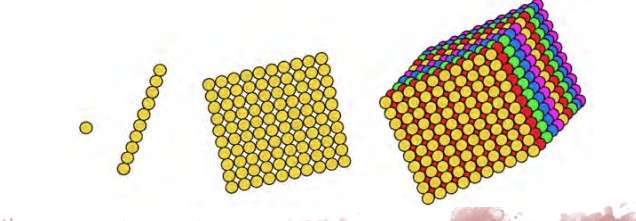
Each landmark number is 10 times the previous one. Since 1 is the first landmark number, they are all powers of 10. The following are the symbols given to these numbers —

As in the case of Roman numbers, a given number is counted in groups of the landmark numbers, starting from the largest landmark number less than the given number. This is then used to assign the numeral.
For example 324 which equals 100 + 100 + 100 + 10 + 10 + 4 is written as໑໑໑∩∩∩||||
For example? Figure it Out
- 1. Represent the following numbers in the Egyptian system: 10458, 1023, 2660, 784, 1111, 70707.
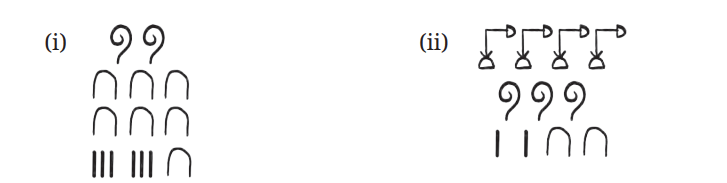
- 2. What numbers do these numerals stand for?
II. Variations on the Egyptian System and the Notion of Base
? Instead of grouping together 10 collections of size equal to the previous landmark number (as in the case of the Egyptian system), can we get a number system by grouping together 5 collections of size equal to the previous landmark number? Can this 5 be replaced by any positive integer?
Let us examine this possibility. Let 1 be the first landmark number.
Group together 5 collections of size equal to the previous landmark number (1). Its size is the second landmark number which is 5
5. Group together 5 collections of size equal to the previous landmark number (5). Its size is the third landmark number which is 5 * 5 = 25
Group together 5 collections of size equal to the previous landmark number (5). Its size is the fourth landmark number which is 5 * 25 = 125

Thus, we have a new number system where each landmark number is 5 times the previous one. Since 1 is the first landmark number, they are all powers of 5.

? Express the number 143 in this new system. Let us start grouping, starting with the size 53 125, as this is the largest landmark number smaller than 143. We get-
143 = 125 + 5 + 5 + 5 + 1 + 1 + 1.
So the number 143 in the new system is
Number systems having landmark numbers in which the

Number systems having landmark numbers in which the
- (a) first landmark number is 1, and
- (b) every next landmark number is obtained by multiplying the current landmark number by some fixed number n is said to be a base-n number system. The Egyptian number system is a base-10 system, and the number system that we created is a base-5 system. A base-10 number system is also called a decimal number system.
? Figure it Out
- 1. Write the following numbers in the above base-5 system using the symbols in Table 2: 15, 50, 137, 293, 651.
- 2. Is there a number that cannot be represented in our base-5 system above? Why or why not?
- 3. Compute the landmark numbers of a base-7 system. In general, what are the landmark numbers of a base-n system?
Advantages of a Base-n System
What is the advantage of having landmark numbers that are all the
powers of a number? To understand this, let us perform some arithmetic
operations using them.
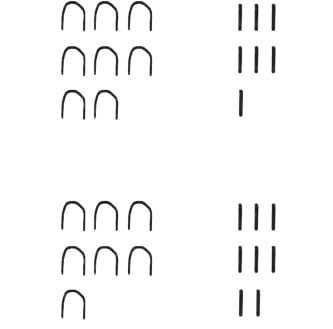
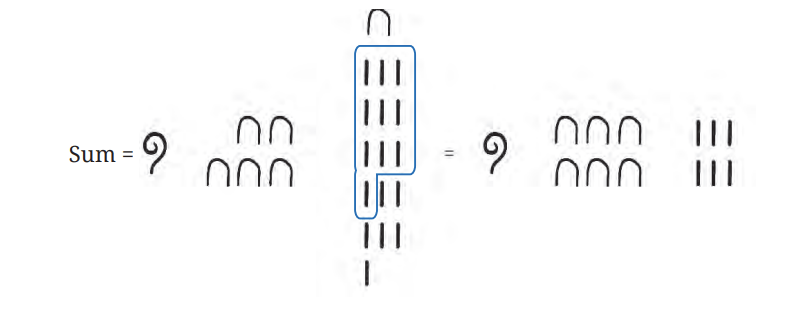
Let us find the total number of | and ∩ and group them starting from the largest possible landmark number. It has a total of—
15 ∩ and 15 |.
Since 10 ∩ gives the next landmark number ,

the sum can be regrouped
as—
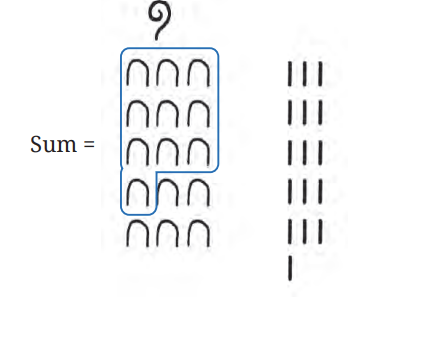
Since 10| gives a ∩, we have
? Figure it Out
1. Add the following Egyptian numerals: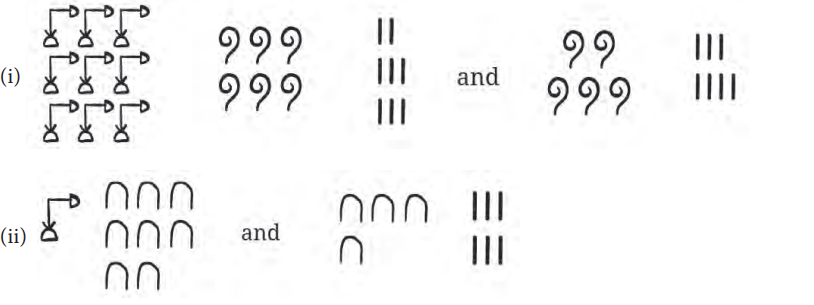
2. Add the following numerals that are in the base-5 system that we created:

Remember that in this system, 5 times a landmark number gives the next one!
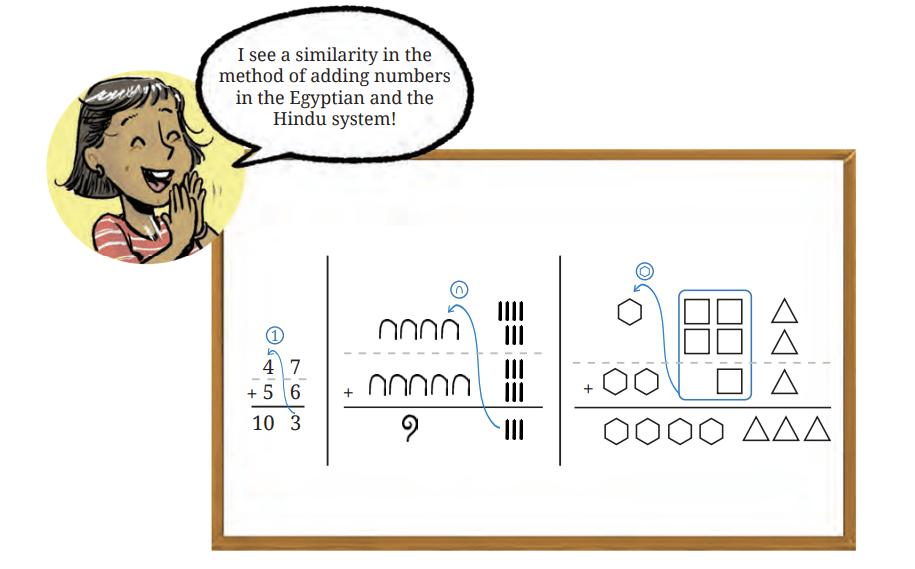
Contrast the addition done in a base-n number system with that done in the Roman system. In the Roman system, the grouping and rearranging has to be done carefully as it is not always by the same size that each landmark number has to be grouped to get the next one.
The advantage of a number system with a base becomes more evident when we consider multiplication.
? How to multiply two numbers in Egyptian numerals?
Let us first consider the product of two landmark numbers.
? 1. What is any landmark number multiplied by (that is 10)? Find the following products-

Each landmark number is a power of 10 and so multiplying it with 10 increases the power by 1, which is the next landmark number.
? 2. What is any landmark number multiplied
by10( 2) ? Find the
following products-

Each landmark number is a power of 10 and so multiplying it with 10 increases the power by 1, which is the next landmark number.
? 2. What is any landmark number multiplied by
10( 2) Find the following products-

? Find the following products-

Thus, the product of any two landmark numbers is another landmark number!
? Does this property hold true in the base-5 system that we created? Does this hold for any number system with a base?
? What can we conclude about the product of a number and∩ (10), in the Egyptian system?
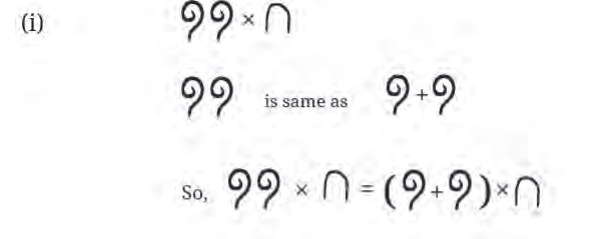 As these are numbers, the distributive law holds. So,
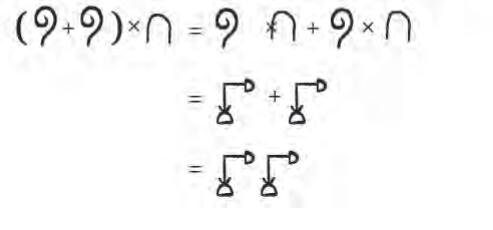 (ii)
(ii)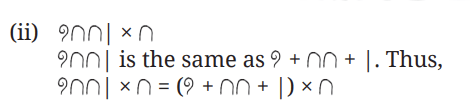
Will the distributive property hold here? For the same reason that it holds for (a + b) * n it also holds when one of the numbers has more than 2 terms. For example, (a + b + c) * n = an + bn + cn So,
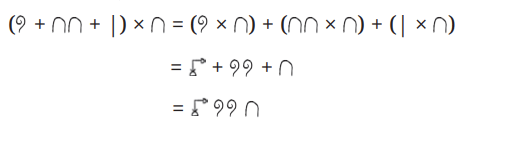
? Now find the following products-

? What would be a simple rule to multiply a number with ∩ ?
As has been seen, a process of multiplying two numbers involves the multiplication of landmark numbers. When the landmark numbers are powers of a number, then their product is another landmark number. This fact simplifies the process of multiplication. However, this is not the case with the Roman numerals, which is why multiplication using them is difficult.
Thus, a number system whose landmark numbers are powers of a number, i.e., a number system with a base, is efficient not only in number representation but also in its utility in carrying out arithmetic operations.
The idea of a number system with a base was a turning point in the history of the evolution of number systems. Our modern Hindu number system is built on this structure.
Abacus that Makes Use of the Decimal System
In around the 11th century, even the people still using the Roman numerals started using a calculating device-the abacus-constructed using a decimal system. It was a board with lines, as shown in the Fig. 3.1. Starting from the line that stood for 1, each successive line stood for a successive power of 10.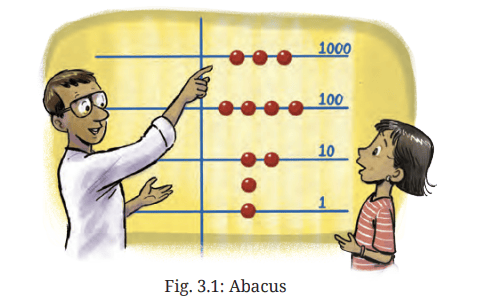
Numbers were represented in it as follows: the given number was first grouped into the landmark numbers (powers of 10), in exactly the same way we have been grouping them so far. For each power of 10, as many counters were placed on its line as the number of times it occurred in the grouping. The presence of a counter above a line contributed a value of 5.
For example let us take the number 3426. It can be grouped as
3426= 1000 + 1000 + 1000 + 100 + 100 + 100 + 100 + 10 + 10 + 10 + 1 + 1 +This number was represented as shown in Fig. 3.1. Notice how the 6 ones are represented.
To get an idea of how the abacus was used for calculations, let us consider a simple addition problem: 2907 + 43. The two numbers were taken on either side of the vertical partition.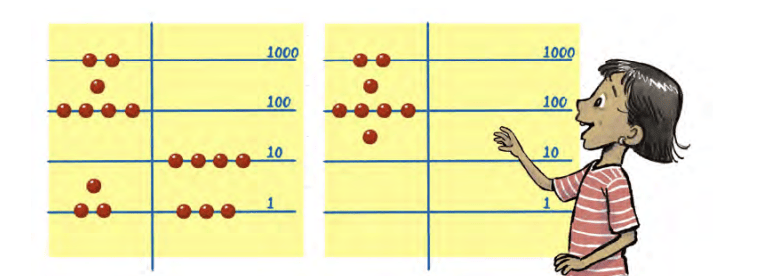
How would you use this to find the sum?
The counters along each line were brought together. What is to be done if the total in a line exceeded 10?
Hint: In this problem, the 7 ones and the 3 ones together make 10 ones which contributes a counter to the line representing 10s.
III. Shortcomings of the Egyptian System
Despite being a number system that enabled relatively efficient number representations for numbers till a crore (107 ), and relatively easy
computations, the Egyptian system had a drawback.If larger and larger numbers needed to be represented, then there was a need for inventing an unending sequence of symbols for higher and higher powers of 10. Here we see the original challenge of number representation resurfacing in a different form!
The next and the final idea in the history of the evolution of number systems not only solves this problem but also remarkably simplifies number representation and computations!
?Figure it Out
1. Can there be a number whose representation in Egyptian numerals has one of the symbols occurring 10 or more times? Why not?
2. Create your own number system of base 4, and represent numbers from 1 to 16.
3. Give a simple rule to multiply a given number by 5 in the base-5 system that we created.
3.4. Place Value Representation
I. The Mesopotamian Number System
In the beginning, the number system used in ancient Mesopotamia had different symbols for different landmark numbers. In later times, it became a base-60 system, also called the sexagesimal system, with a very efficient number representation.
It has puzzled many why they chose base 60. Different theories exist to explain this, ranging from the connection between 60 and the periods of some important events (like the length of their lunar month which had 30 days, or the time taken for the Sun to complete one revolution around the Earth when Earth is taken to be stationary), the ease of representing fractions (we will not go into this here), their earlier sequence of landmark numbers — 1, 10, 60, 600, 3600, 36000,… — getting reduced to only the powers of 60, and so on.
The influence of the Mesopotamian sexagesimal system, also known
as the Babylonian number system, can be seen even now in our units
of time measurements—1 hour = 60 minutes and 1 minute = 60 seconds.
This system used the
symbol  for 1 and for
 10.
10.
Let us now briefly pause on the study of their number system, and ideate on how one can build an efficient number system using the Mesopotamian features seen so far.
Let us give our own symbols to their landmark numbers—

Note that we have actually used Indian numerals in creating these symbols. We could have invented our own symbols but for the sake of easy recall and use, we have chosen to take help of the familiar numerals 1, 2, 3, ...
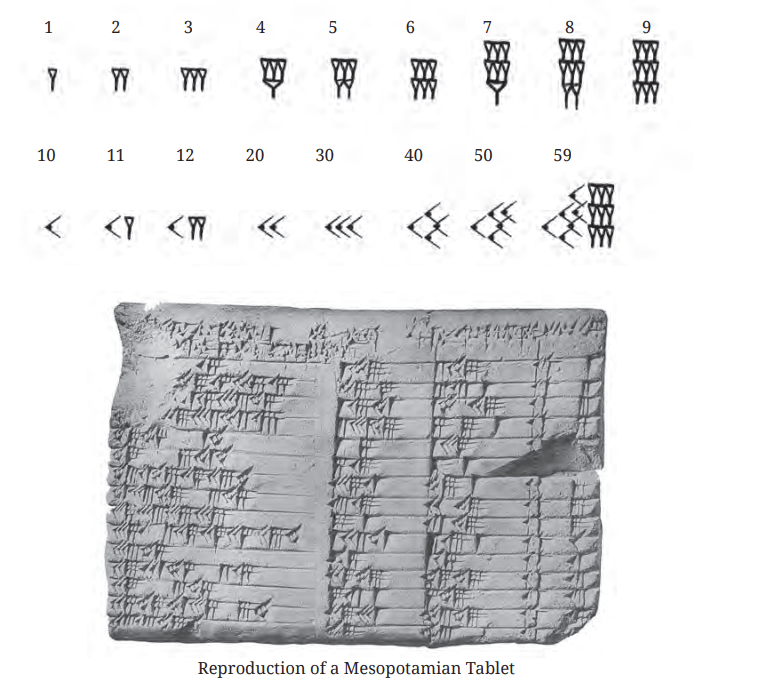
Using
and
, numbers from 1 to 59 can be represented—
? Example: Let us represent the number 640 in this system. Grouping it into landmark numbers, we see that
10 640 = (10) * 60 + 40.
If we use the Egyptian idea, this number would be represented using  s, and 40 would be represented
using 4 s.
s, and 40 would be represented
using 4 s.
? Can we represent this more compactly? We can simply represent this number as

which can be read as ten 60s and one 40, just as we have written in the equation.
? Example: Let us try another number - 7530. 7530 = (2) * 3600 + (5) * 60 + 30 So, its representation would be

Note that when a number is grouped into powers of 60 for its representation, no power of 60 can occur 60 or more times. If this happens, then 60 of them can be grouped to form the next power of 60. For example, consider the expression—
(1) × 3600 + (70) × 60 + 2
= (1) ×
602
+ (60 + 10) × 60 + 2
= (1) × 602
+ 602 + (10) × 60 + 2
= (2) × 602+ (10) × 60 + 2
Therefore, any number can be represented using the numerals from 1–59, along with the numerals for landmark numbers. Now, what if we make the representation even more compact by dropping the symbols for the different powers of 60 altogether?
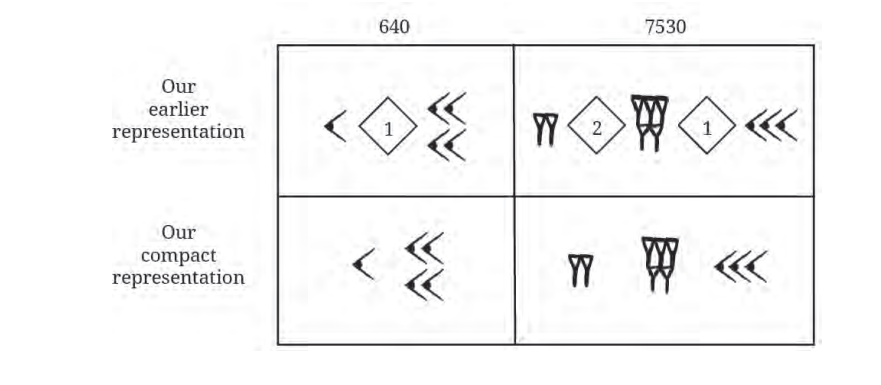
This is exactly what the Mesopotamians did! In their numeral, the rightmost set of symbols showed the number of 1s, the set of symbols to its left showed the number of 60s, the next showed the number of 3600s and so on. Whenever there was no occurrence of a power of 60, a blank space was given in that position.
It does not seem that the Mesopotamians arrived at this idea in the same way we did. Some scholars suggest that the similarity of symbols given to the landmark numbers 1 and 60 in their earlier number system, and an accidental usage of them, might have made them stumble upon this idea.
?Figure it Out
1. Represent the following numbers in the
Mesopotamian system —
(i) 63 (ii) 132 (iii) 200 (iv) 60 (v) 3605
Thus, we can see how the Mesopotamian system removes the need for generating an unending sequence of symbols for the landmark numbers by making use of the positions where the symbols are written. Such a number system (having a base) that makes use of the position of each symbol in determining the landmark number that it is associated with is called a positional number system or a place value system.
This idea of place value marks the highest point in the history of evolution of number systems, and gives a very elegant solution to the problem of representing the unending sequence of numbers using only a finite number of different symbols!
The Mesopotamian system however cannot be considered a fully developed place value system. It has certain defects that lead to confusion while reading a number.? Look at the representation of 60. What will be the representation for 3,600?
While writing the numerals, the spacing between symbols was not given the way we are giving it here. It was also difficult to maintain a consistent spacing for blanks across different manuscripts written by different people. These created ambiguities. For example, consider the representations of the following numbers -
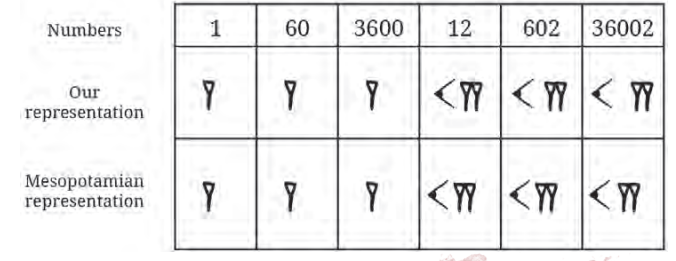
Because of the ambiguity in finding which symbols correspond to which powers of 60, the same numeral can be read in different ways. Even in our representation which uses uniform spacing between symbols for different powers of 60, it is difficult to know the number of blanks between two sets of symbols, as in the representation of 36002.
To address the issue arising out of blank spaces, the later Mesopotamians used a brilliant idea of assigning a ‘placeholder’ symbol to denote a blank space. This is like the 0 (zero) we use in our system. Thus, zero—the symbol that shows nothingness—is indispensable as a placeholder in a place value system in which numbers are written in an unambiguous manner.
Even with the problem arising out of blank spaces solved, other ambiguities still remained in the system. For example, the placeholder symbol was primarily used in the middle of numbers and not at the end; so they would not use it to represent a number like (what we would write as) 3600.
II. The Mayan Number System
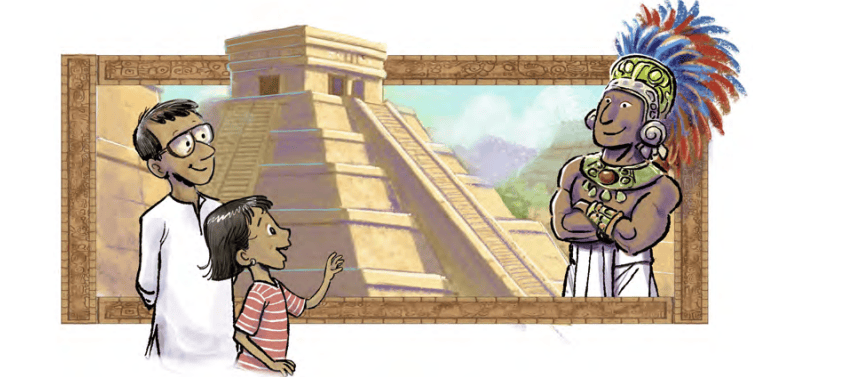
In Central America, there flourished a civilisation known as the Mayan civilisation that made great intellectual and cultural progress between the 3rd and 10th centuries CE. Among their intellectual achievements stands their place value system designed independently of those in Asia. They also made use of a placeholder symbol, for the modern-day ‘0’, that looked like a seashell.
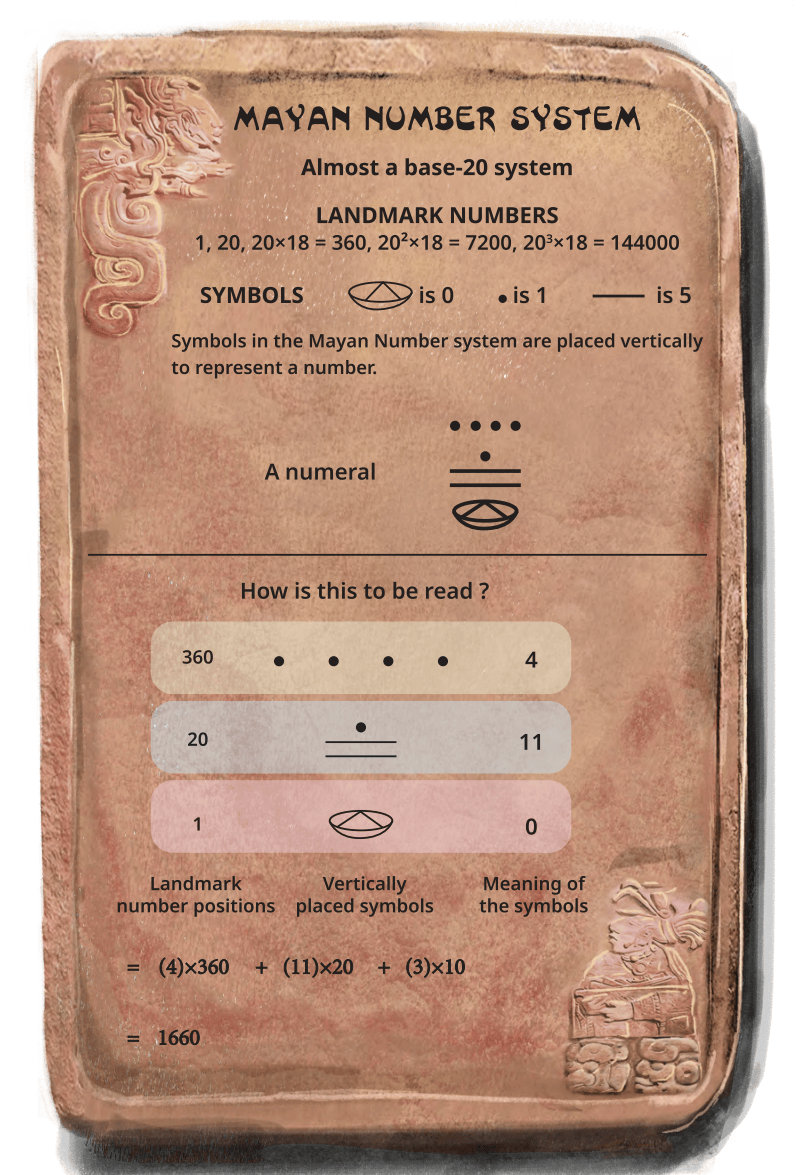
Here we find a puzzling phenomenon. Why was their third landmark number 360 rather than 400? Some scholars feel that this might have something to do with their calendars.
They used a dot for 1, and a bar for 5. These were used to denote numbers from 1 to 19.
The symbols associated with different landmark numbers were written one below the other with the lowermost set of symbols corresponding to the number of 1s, the set above corresponding to the number of 20s, the set above to the number of 360s and so on.
?Represent the following numbers using the Mayan system:
(i) 77 (ii) 100 (iii) 361 (iv) 721
Because the Mayan system is not an actual base-20 system, it lacks the advantages that a system with a base has for computations. Nevertheless, their place value notation and their use of a placeholder symbol for zero is considered an important advance in the history of number systems.
A curious fact is that we can still find the use of base-20 in the number names of some European languages.
III. The Chinese Number System

The Chinese used two number systems—a written system for recording quantities, and a system making use of rods for performing computations. The numerals in the rod-based number system are called rod numerals. Here we discuss the rod numerals, which are more efficient in writing and computing with numbers than the written system of the Chinese.
The rod numerals developed in China by at least by 3rd century AD and were used till the 17th century. It was a decimal system (base-10). The symbols for 1 to 9 were as follows:
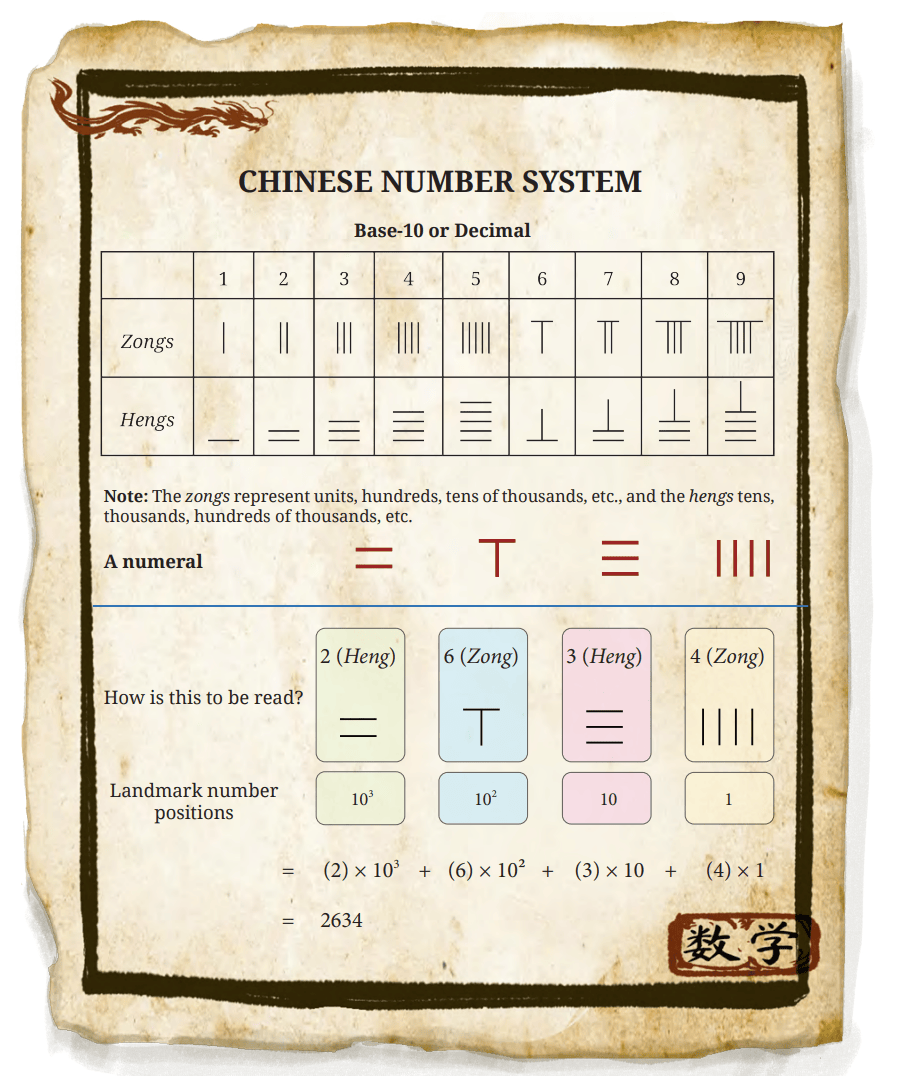
Like the Mesopotamians, the rod numerals used a blank space to indicate the skipping of a place value. However, because of the slightly more uniform sizes of the symbols for one through nine, the blank spaces were easier to locate than in the Mesopotamian system.
Notice how similar the rod numerals are to the Hindu system. The Chinese system, with a symbol for zero, would be a fully developed place value system.
IV. The Hindu Number System
?Where does the Hindu/Indian number system figure in the evolution of ideas of number representation? What are its landmark numbers? And does it use a place value system?
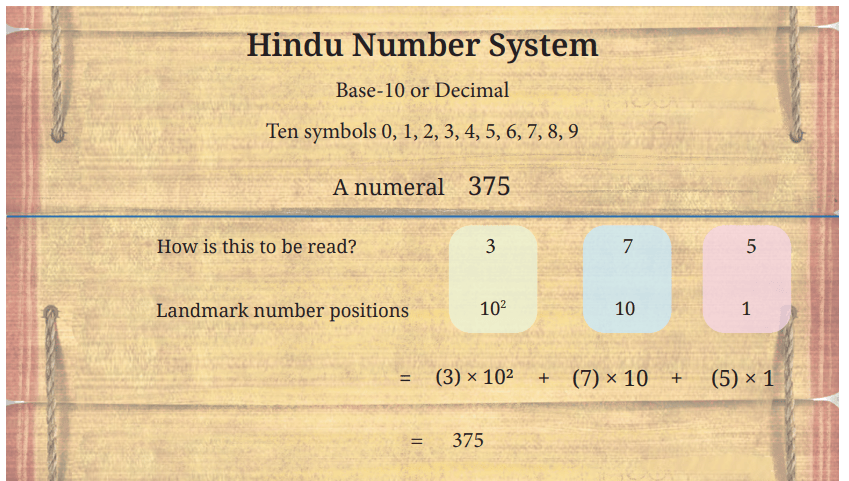
As can be seen, the Hindu number system is a place value system. The Hindu number system has had a symbol for 0 at least as early as 200 BCE. Because of the use of 0 as a digit, and the use of a single digit in each position, this system does not lead to any kind of ambiguity when reading or writing numerals. It is for this reason that the Hindu number system is now used throughout the world.
The use of 0 as a digit, and indeed as a number, was a breakthrough that truly changed the world of mathematics and science. In Indian mathematics, indeed, zero was not just used as a placeholder in the place value system, but was also given the status of a number in its own right, on par with other numbers. The arithmetic properties of the number 0 (e.g., that 0 plus any number is the same number, and that 0 times any number is zero) were explicitly used by Aryabhata in his Āryabhaṭīya in 499 CE to compute with and do elaborate scientific computations using Hindu numerals. The use of 0 as a number like any other number, on which one can perform the basic arithmetic operations, was codified by Brahmagupta in his work Brāhmasphuṭasiddhānta in 628 CE, as we learned in an earlier grade.
By introducing 0 as a number, along with the negative numbers, Brahmagupta created what in modern terms is called a ring, i.e., a set of numbers that is closed under addition, subtraction, and multiplication (i.e., any two numbers in the set can be added, subtracted, or multiplied to get another number in that set). These new ideas laid the foundations for modern mathematics, and particularly for the areas of algebra and analysis.
Hopefully, this gives you a sense of all the ideas that went into writing and computing with numbers in the way that we do today. The discovery of 0 and the resulting Indian number system is truly one of the greatest, most creative, and most influential inventions of all time—appearing constantly in our daily lives and forming the basis of much of modern science, technology, computing, accounting, surveying, and more. The next time you are writing numbers, think about the incredible history behind them and all the deep ideas that went into their discovery!
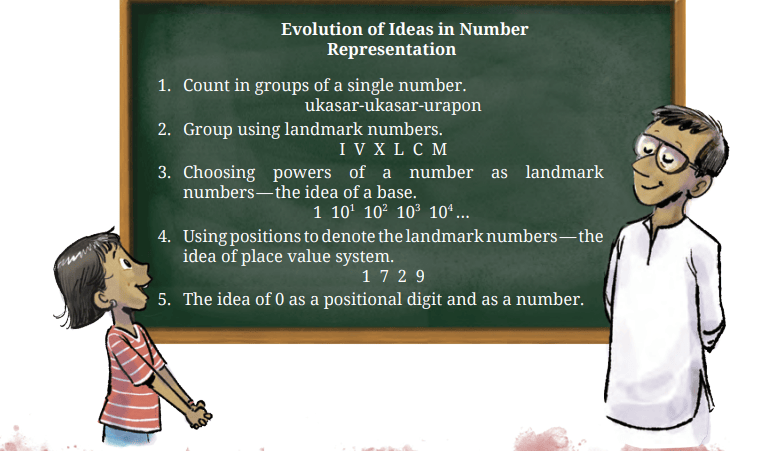
?Figure it Out
1. Why do you think the Chinese alternated between the Zong and Heng symbols? If only the Zong symbols were to be used, how would 41 be represented? Could this numeral be interpreted in any other way if there is no significant space between two successive positions?
2. Form a base-2 place value system using ‘ukasar’ and ‘urapon’ as the digits. Compare this system with that of the Gumulgal’s
3. Where in your daily lives, and in which professions, do the Hindu numerals, and 0, play an important role? How might our lives have been different if our number system and 0 hadn’t been invented or conceived of?
4. The ancient Indians likely used base 10 for the Hindu number system because humans have 10 fingers, and so we can use our fingers to count. But what if we had only 8 fingers? How would we be writing numbers then? What would the Hindu numerals look like if we were using base 8 instead? Base 5? Try writing the base-10 Hindu numeral 25 as base-8 and base-5 Hindu numerals, respectively. Can you write it in base-2?
SUMMARY
- To represent numbers, we need a standard sequence of objects, names, or written symbols that have a fixed order. This standard sequence is called a number system.
- The symbols representing numbers in a written number system are called numerals.
- In a number system, landmark numbers are numbers that are easily recognisable and used as reference points for understanding and working with other numbers. They serve as anchors within the number system, helping people to orient themselves and make sense of quantities, particularly larger ones.
- A number system whose landmark numbers are the powers of a number n is referred to as a base-n number system.
- Number systems having a base that make use of the position
of a symbol in determining the landmark number that it is
associated with are called positional number systems or
place value systems.
- Place value representations were used in the Mesopotamian (Babylonian), Mayan, Chinese and Indian civilisations.
- The system of numerals that we use throughout the world today is the Hindu number system (also sometimes called the Indian number system, or the Hindu-Arabic number system). It is a place value system with (usually) 10 digits, including the digit 0 which is treated on par with other digits. Due to its use of 0 as a number, the system enables the writing of all numbers unambiguously using just finitely many symbols, and also enables efficient computation. The system originated in India around 2000 years ago, and then spread across the world, and is considered one of human history’s greatest inventions.