
Chapter - 5
NUMBER PLAY
5.1 Is This a Multiple Of?
Sum of Consecutive Numbers
Anshu is exploring sums of consecutive numbers. He has written the following —
7 = 3 + 4
10 = 1 + 2 + 3 + 4
12 = 3 + 4 + 5
15 = 7 + 8
= 4 + 5 + 6
= 1 + 2 + 3 + 4 + 5
Now, he is wondering —
• “Can I write every natural number as a sum of consecutive numbers?”
• “Which numbers can I write as the sum of consecutive numbers in more than one way?”
• “Ohh, I know all odd numbers can be written as a sum of two consecutive numbers. Can we write all even numbers as a sum of consecutive numbers?”
• “Can I write 0 as a sum of consecutive numbers? Maybe I should use negative numbers.”
? Explore these questions and any others that may occur to you. Discuss them with the class.
? Take any 4 consecutive numbers. For example, 3, 4, 5, and 6. Place ‘+’ and ‘–’ signs in between the numbers. How many different possibilities exist? Write all of them.
3 + 4 – 5 + 6
3 – 4 – 5 – 6
Eight such expressions are possible. You can use the diagram below to systematically list all the possibilities.
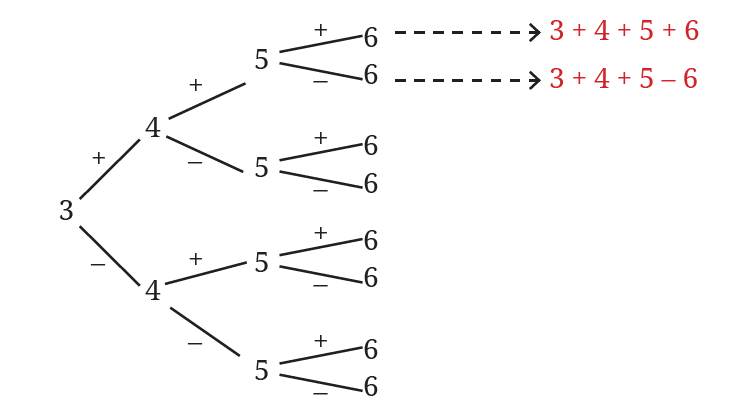
? Evaluate each expression and write the result next to it. Do you notice anything interesting?
? Now, take four other consecutive numbers. Place the ‘+’ and ‘–’ signs as you have done before. Find out the results of each expression. What do you observe?
? Repeat this for one more set of 4 consecutive numbers. Share your findings.
3 + 4 – 5 + 6 = 8
3 – 4 – 5 – 6 = – 12
.
.
.
5 + 6 – 7 + 8 = 12
5 – 6 – 7 – 8 = – 16
.
.
.
__ + __ – __ + __ = __
__ – __ – __ – __ = __
.
.
.
Some sums appear always no matter which 4 consecutive numbers are chosen. Isn’t that interesting?
? Do these patterns occur no matter which 4 consecutive numbers are chosen? Is there a way to find out through reasoning?
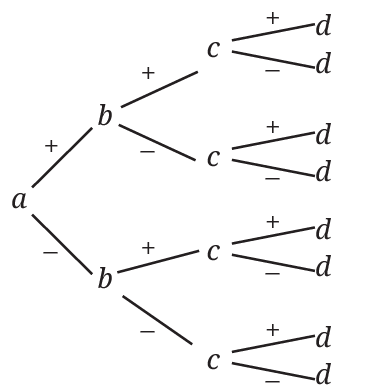
Hint: Use algebra and describe the 8 expressions in a general form.
You might have noticed that the results of all expressions are even numbers. Even numbers have a factor of 2. Negative numbers having a factor 2 are also even numbers, for example, – 2, – 4, – 6, and so on. Check if anyone in your class got an odd number.
When 4 consecutive numbers are chosen, no matter how the ‘+’ and ‘–’ signs are placed between them, the resulting expressions always have even parity.
Now take any 4 numbers, place ‘+’ and ‘–’ signs in the eight different ways, and evaluate the resulting expression. What do you observe about their parities?
Repeat this with other sets of 4 numbers.
? Is there a way to explain why this happens?
Hint: Think of the rules for parity of the sum or difference of two numbers.
Explanation 1: Let us consider any of the 8 expressions formed by four numbers a, b, c, and d. When one of its signs is switched, its value always increases or decreases by an even number! Let us see why.
Consider one of the expressions: a + b – c – d.
Replacing +b by – b, we get
a – b – c – d.
By how much has the number changed? It has changed by
(a + b – c – d) – (a – b – c – d)
= a + b – c – d – a + b + c + d (notice how the signs changed when we opened the second set of brackets)
= 2b (this is an even number).
If the difference between two numbers is even, can they have different parities? No! So either both are even or both are odd.
Now, let us see what happens when a negative sign is switched to a positive sign.
? Replace any negative sign in the expression a + b – c – d with a positive sign and find the difference between the two numbers.
? What do you conclude from this observation?
Starting from any expression, we can get 7 expressions by switching one or more ‘+’ and ‘–’ signs. Thus, all the expressions have the same parity!
Explanation 2: We know that
odd ± odd = even
even ± even = even
odd ± even = odd.
We have seen that the parity of a + b and a – b is the same, regardless of the parities of a and b.
In short, a ± b have the same parity. By the same argument, a ± b + c and a ± b – c have the same parity. Extending this further, we can say that all the expressions a ± b ± c ± d have the same parity.
Explanation 3: This can also be explained using the positive and negative token model you studied in the chapter on Integers. Try to think how.
The number of ways to choose 4 numbers a, b, c, d and combine them using ‘+’ and ‘–’ signs is infinite. Mathematical reasoning allows us to prove that all the combinations a ± b ± c ± d always have the same parity, without having to go through them one by one.
Several problems in mathematics can be thought about and solved in different ways. While the method you came up with may be dear to you, it can be amusing and enriching to know how others thought about it. Two tidbits: ‘share’ and ‘listen’.
? Is the phenomenon of all the expressions having the same parity limited to taking 4 numbers? What do you think?
‘What if …?’, ‘Will it always happen?’— Wondering and posing questions and conjectures is as much a part of mathematics as problem solving.
Breaking Even
We know how to identify even numbers. Without computing them, find out which of the following arithmetic expressions are even.
43 + 37
672 – 348
4 × 347 × 3
708 – 477
809 + 214
119 × 303
543 – 479
5133
? Using our understanding of how parity behaves under different operations, identify which of the following algebraic expressions give an even number for any integer values for the letter-numbers.
2a + 2b
3g + 5h
4m + 2n
2u – 4v
13k – 5k
6m – 3n
x2 + 2
b2 + 1
4k × 3j
The expression 4m + 2q will always evaluate to an even number for any integer values of m and q. We can justify this in two different ways —
• We know 4m is even and 2q is even for any integers m and q. Therefore, their sum will also be even.
• The expression 4m + 2q is equal to the expression 2(2m + q). Here, the expression 2(2m + q) means 2 times 2m + q. In other words, 2 is a factor of this expression. Therefore, this expression will always give an even number for any integers m and q.
For example, if m = 4 and q = – 9, the expression 4m + 2q becomes 4 × 4 + 2 × (–9) = – 2, which is an even number.
In the expression x2 + 2, x2 is even if x is even, and x2 is odd if x is odd. Therefore, the expression x2 + 2 will not always give an even number. An example and a non-example for when the expression evaluates to an even number — (i) if x = 6, then x2 + 2 = 38, and (ii) if x = 3, then x2 + 2 = 11.
? Similarly, determine and explain which of the other expressions always give even numbers. Write a couple of examples and non-examples, as appropriate, for each expression.
? Write a few algebraic expressions which always give an even number.
Pairs to Make Fours
? Take a pair of even numbers. Add them. Is the sum divisible by 4?
Try this with different pairs of even numbers.
When is the sum a multiple of 4, and when is it not?
Is there a general rule or a pattern?
Even numbers can be of two types based on the remainders they leave when divided by 4.
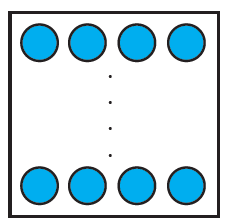
Even numbers that are multiples of 4 leave a remainder of 0 when divided by 4.
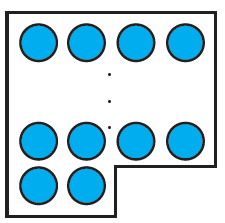
Even numbers that are not multiples of 4 leave a remainder 2 when divided by 4.
? When will two even numbers add up to give a multiple of 4?
This problem is similar to the question of identifying when adding two numbers will result in an even number. Can you see this?
There are three cases to examine:
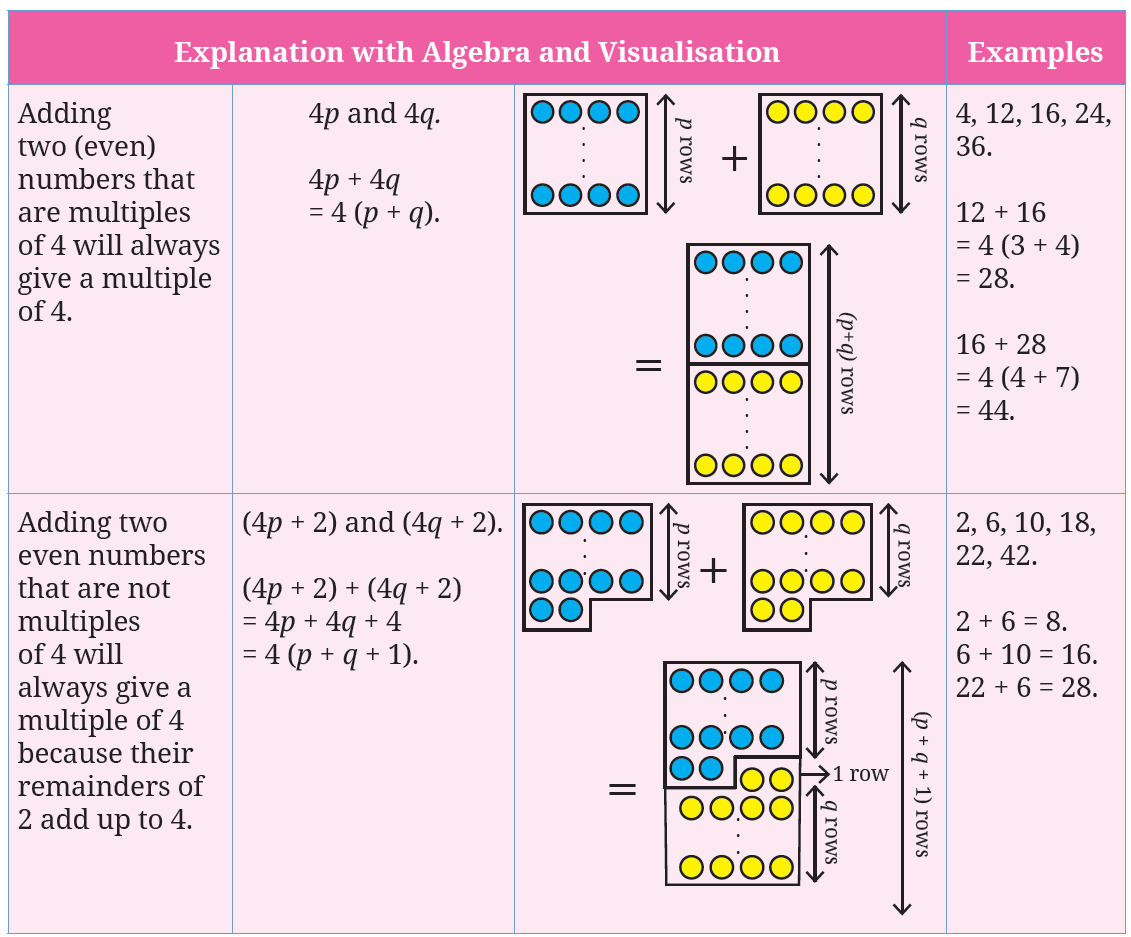
What happens when we add a multiple of 4 to an even number that is not a multiple of 4? Is it similar to the case of the parity of the sum of an even and an odd number?
? Look at the following expressions and the visualisation. Write the corresponding explanation and examples.
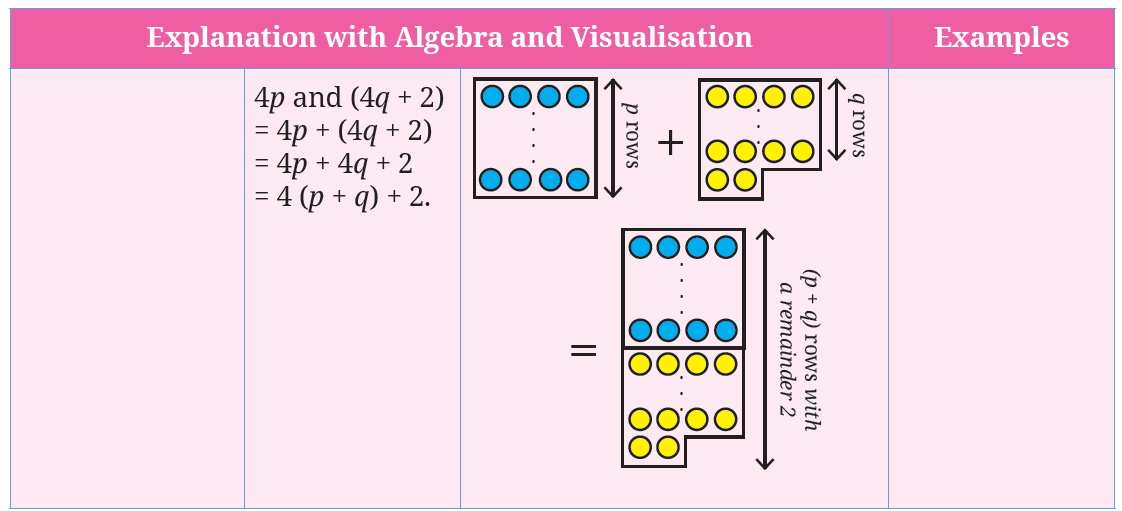
Notice how we are able to generalise and prove properties of arithmetic using algebra and also using visualisation.
Always, Sometimes, or Never
? We examine different statements about factors and multiples and determine whether a statement is ‘Always True’, ‘Sometimes True’, or ‘Never True’.
We know that the sum of any two multiples of 2 is also a multiple of 2.
? 1. If 8 exactly divides two numbers separately, it must exactly divide their sum.
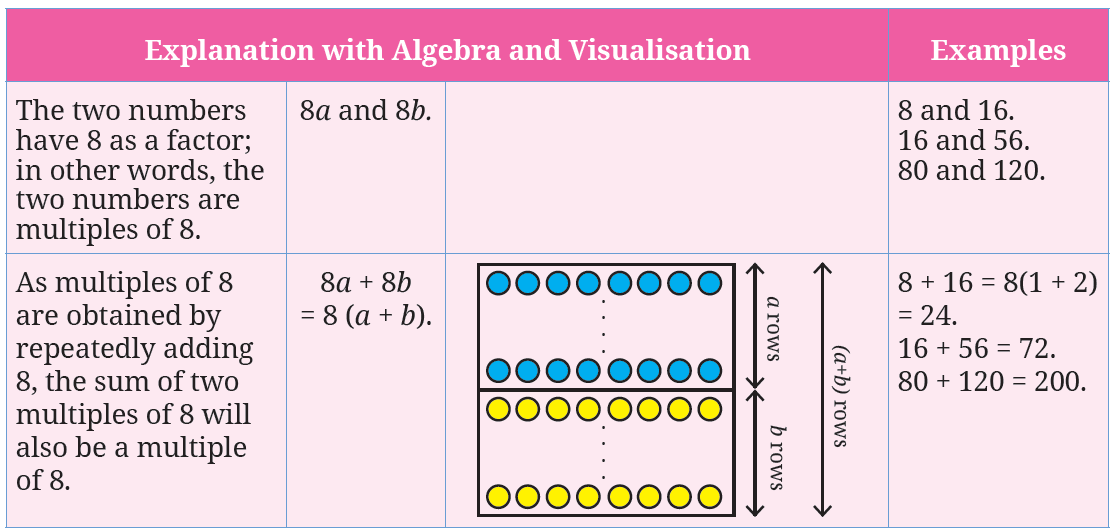
Statement 1 is always true. Determine if it is true with subtraction.
In general, if a divides M and a divides N, then a divides M + N and a divides M – N. In other words, if M and N are multiples of a, then M + N and M – N will also be multiples of a.
? 2. If a number is divisible by 8, then 8 also divides any two numbers (separately) that add up to the number.
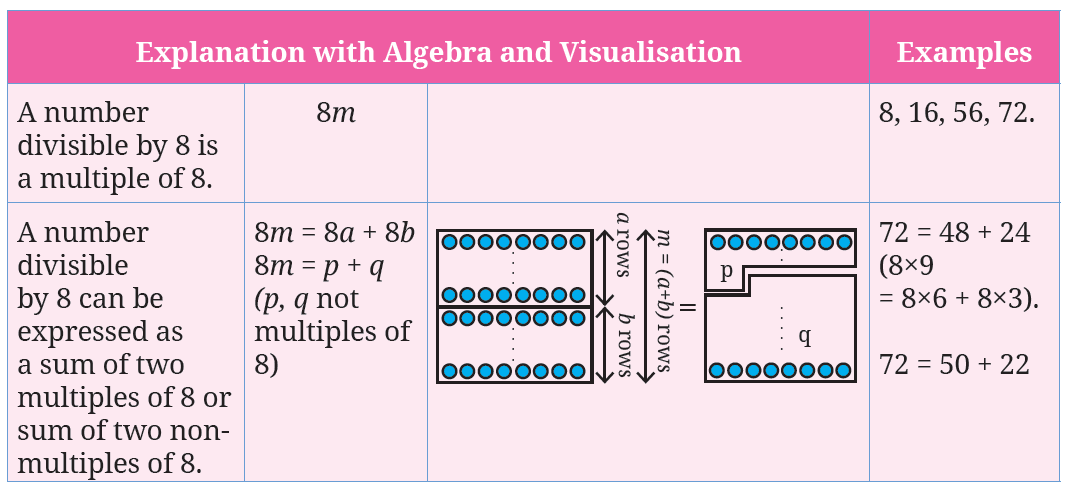
So, statement 2 is sometimes true.
? 3. If a number is divisible by 7, then all multiples of that number will be divisible by 7.
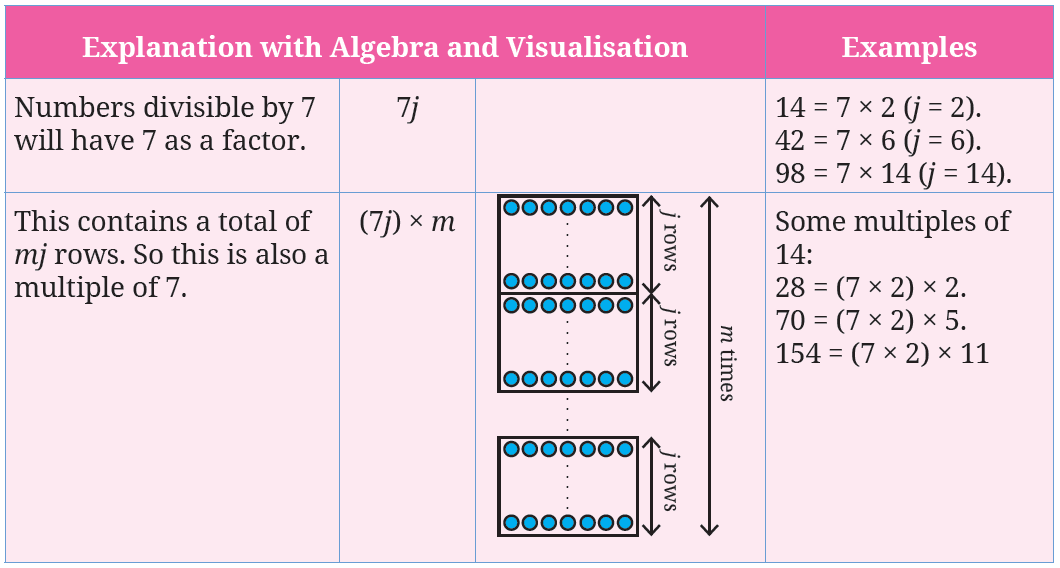
The number 7jm or (7 × j × m) has a factor of 7. We can see that Statement 3 is always true.
In general, if A is divisible by k, then all multiples of A are divisible by k.
? 4. If a number is divisible by 12, then the number is also divisible by all the factors of 12.
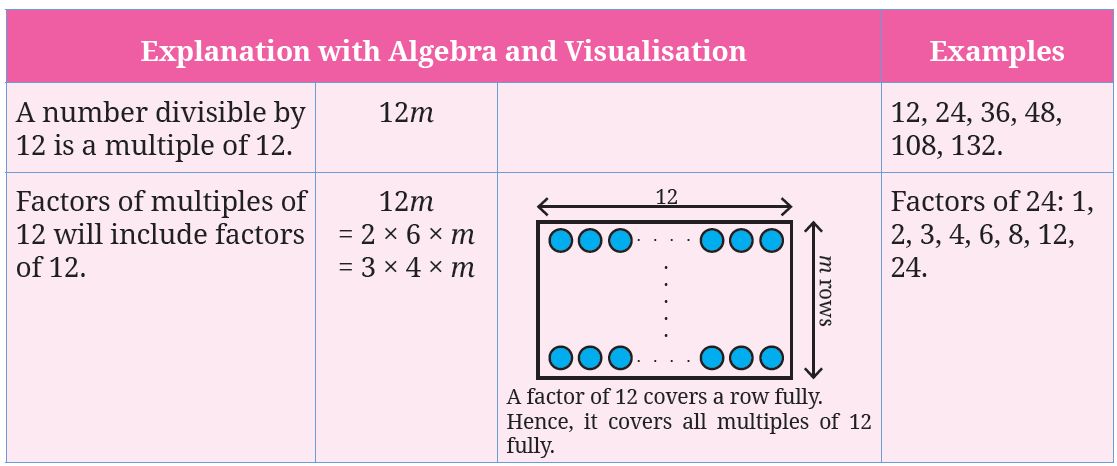
In general, if A is divisible by k, then A is divisible by all the factors of k. Hence, Statement 4 is always true.
? 5. If a number is divisible by 7, then it is also divisible by any multiple of 7.
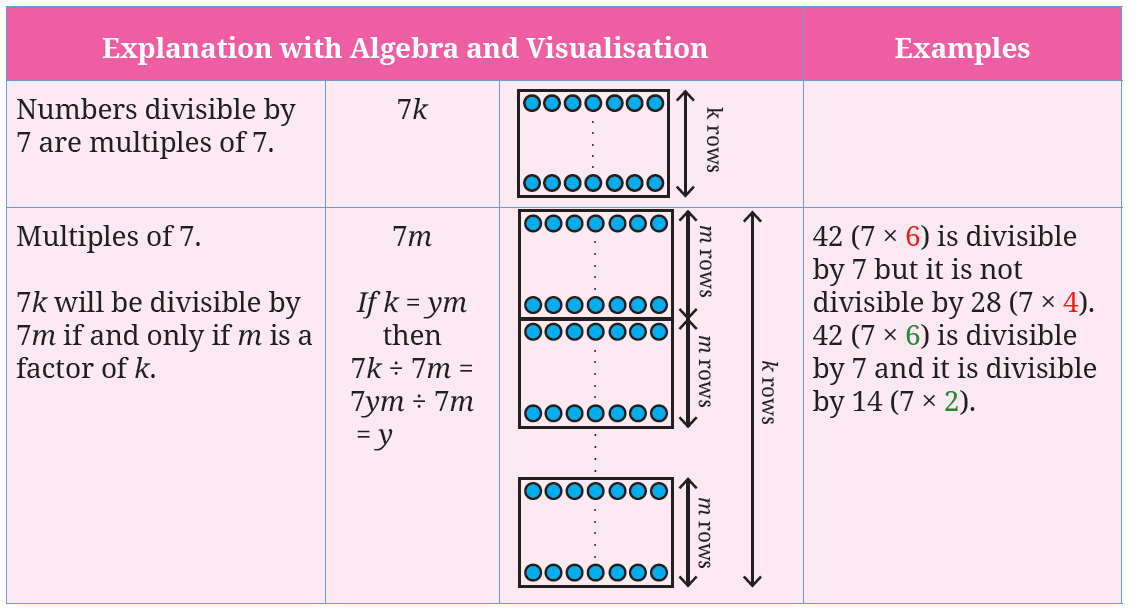
We can see that this statement is only sometimes true.
? Examine each of the following statements, and determine whether it is ‛Always true’, ‛Sometimes true’, ‛Never true’.
? 6. If a number is divisible by both 9 and 4, it must be divisible by 36.
? 7. If a number is divisible by both 6 and 4, it must be divisible by 24.
In general, if A is divisible by k and A is also divisible by m, then A is divisible by the LCM of k and m. This is because A is a multiple of k and also a multiple of m, so A’s prime factorisation should contain the prime factorisation of LCM (k, m).
? 8. When you add an odd number to an even number we get a multiple of 6.
We know that multiples of 6 are all even numbers. The sum of an odd number and an even number will be an odd number. Therefore, this statement is never true. We can also explain this algebraically. Suppose,
(2n) + (2m + 1) = 6j,
where 2n is an even number, 2m + 1 is an odd number, and 6j is a multiple of 6. Then
2n + 2m = 6j – 1
2 (n + m) = 6j – 1
Can I write an even and an odd number as 2n and 2n+1 instead?
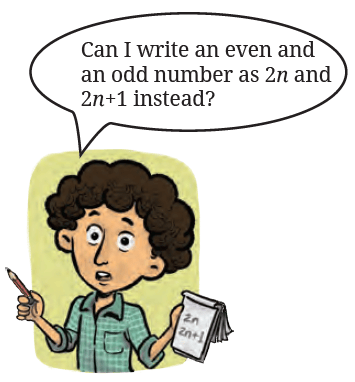
which means 2(n + m), which is an even number, should be equal to 6j – 1, which is an odd number. This is never true.
What Remains?
? Find a number that has a remainder of 3 when divided by 5. Write more such numbers.
? Which algebraic expression(s) capture all such numbers?
(i) 3k + 5
(ii) 3k – 5
(iii) 3k/5
(iv) 5k + 3
(v) 5k – 2
(vi) 5k – 3
The numbers that leave a remainder of 0 when divided by 5 are the multiples of 5. But we want numbers that leave a remainder of 3 when divided by 5. These numbers are 3 more than multiples of 5. Multiples of 5 are of the form 5k. So, numbers that leave a remainder of 3 when divided by 5 are those of the form 5k + 3
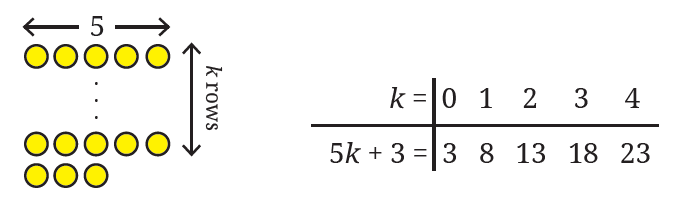
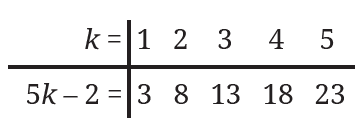
? Let us consider another expression, 5k – 2, and see the values it takes for different values of k.
Numbers that leave a remainder of 3 when divided by 5 can also be seen as 2 less than multiples of 5; 5k – 2, where k ≥ 1.
? Are there other expressions that generate numbers that are 3 more than a multiple of 5?
Figure it Out
1. The sum of four consecutive numbers is 34. What are these numbers?
2. Suppose p is the greatest of five consecutive numbers. Describe the other four numbers in terms of p.
3. For each statement below, determine whether it is always true, sometimes true, or never true. Explain your answer. Mention examples and non-examples as appropriate. Justify your claim using algebra.
(i) The sum of two even numbers is a multiple of 3.
(ii) If a number is not divisible by 18, then it is also not divisible by 9.
(iii) If two numbers are not divisible by 6, then their sum is not divisible by 6.
(iv) The sum of a multiple of 6 and a multiple of 9 is a multiple of 3.
(v) The sum of a multiple of 6 and a multiple of 3 is a multiple of 9.
4. Find a few numbers that leave a remainder of 2 when divided by 3 and a remainder of 2 when divided by 4. Write an algebraic expression to describe all such numbers.
5. “I hold some pebbles, not too many, When I group them in 3’s, one stays with me. Try pairing them up — it simply won’t do, A stubborn odd pebble remains in my view. Group them by 5, yet one’s still around, But grouping by seven, perfection is found. More than one hundred would be far too bold, Can you tell me the number of pebbles I hold?”

6. Tathagat has written several numbers that leave a remainder of 2 when divided by 6. He claims, “If you add any three such numbers, the sum will always be a multiple of 6.” Is Tathagat’s claim true?
7. When divided by 7, the number 661 leaves a remainder of 3, and 4779 leaves a remainder of 5. Without calculating, can you say what remainders the following expressions will leave when divided by 7? Show the solution both algebraically and visually.
(i) 4779 + 661
(ii) 4779 – 661
8. Find a number that leaves a remainder of 2 when divided by 3, a remainder of 3 when divided by 4, and a remainder of 4 when divided by 5. What is the smallest such number? Can you give a simple explanation of why it is the smallest?
5.2 Checking Divisibility Quickly
Earlier, you have learnt shortcuts to check whether a given number, written in the Indian number system is divisible by 2, 4, 5, 8, and 10. Let us revisit them.
Divisibility by 10, 5, and 2: If the units digit of a number is ‘0’, then it is divisible by 10. Let us understand why this works through algebra. We can write the general form of a number in the Indian system using a set of letter-numbers. For example, a 5-digit number can be expressed as, edcba denoting e × 10000 + d × 1000 + c × 100 + b × 10 + a. The letter-numbers e, d, c, b, and a denote each digit of a 5-digit number. Any number can be written in general as … dcba, where the letter numbers a, b, c and d represent the units, tens, hundreds and thousands digit, respectively, and so on. As a sum of place values, this number is
… +1000d + 100c + 10b + a.
(For example, in the number 4075, d = 4, c = 0, b = 7, and a = 5.)
We know that each place value, with the exception of the units place, is a multiple of 10. So, 10b, 100c, … all will be multiples of 10. Hence, the number will be divisible by 10 if and only if the units digit a is 0.
? Similarly, explain using algebra why the divisibility shortcuts for 5, 2, 4, and 8 work.
Let us now examine shortcuts to check divisibility by some other numbers and explain why they work!
A Shortcut for Divisibility by 9
? Can you say, without actually calculating, which of these numbers are divisible by 9: 999, 909, 900, 90, 990? All of them.
? Can we say that any number made up of only the digits ‘0’ and ‘9’, in any order, will always be divisible by 9?
Yes, if each digit is either 0 or 9, then each term in its expanded form will be 9 × or 0 × (the ‘ ’ denotes a place value). This means each term will be a multiple of 9, for example,
99009 = 9 × 10000 + 9 × 1000 + 0 × 100 + 0 × 10 + 9 × 1.
But this shortcut alone cannot identify all the multiples of 9. Unlike the numbers 2, 5, and 10, we cannot identify the multiples of 9 by just looking at the unit’s digit. 99 and 109 are two numbers with 9 as the units digit; but 99 is divisible by 9, while 109 is not.
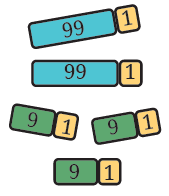
? Is 10 divisible by 9? If not, what is the remainder?
Check the divisibility of other multiples of 10 (10, 20, 30, ...) by 9. You will notice that for any multiple of 10, the remainder is the same as the number of tens.
? Similarly, look at the remainder when the multiples of 100 (100, 200, 300, … ) are divided by 9. What do you notice?
The remainder is the same as the number of hundreds for any multiple of 100.
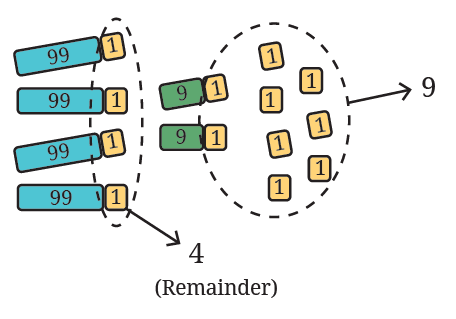
? Using this observation, find the remainder when 427 is divided by 9.
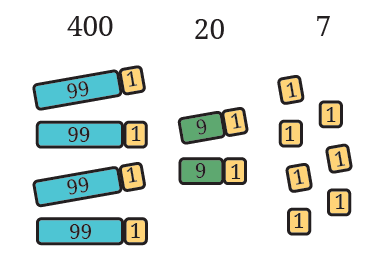
We see that 427 has 4 hundreds; thus, its corresponding remainder (upon division by 9) would be 4. 427 has 2 tens, and its corresponding remainder would be 2. We have 7 units also remaining. Adding all the remainders, we get 4 + 2 + 7 = 13. We can make one more group of 9 with 13, leaving a remainder of 4. Therefore, 427 ÷ 9 gives a remainder of 4.
? Will this work with bigger numbers?
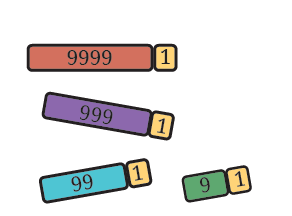
You can see that this is true for any place value:
1 = 0 + 1
10 = 9 + 1
100 = 99 + 1
1000 = 999 + 1
10000 = 9999 + 1, and so on. Each digit thus denotes the remainder when the corresponding place value is divided by 9.
For example, to find the remainder of 7309 when divided by 9, we can just add all the digits — 7 + 3 + 0 + 9 — to get 19. This can be seen as follows:
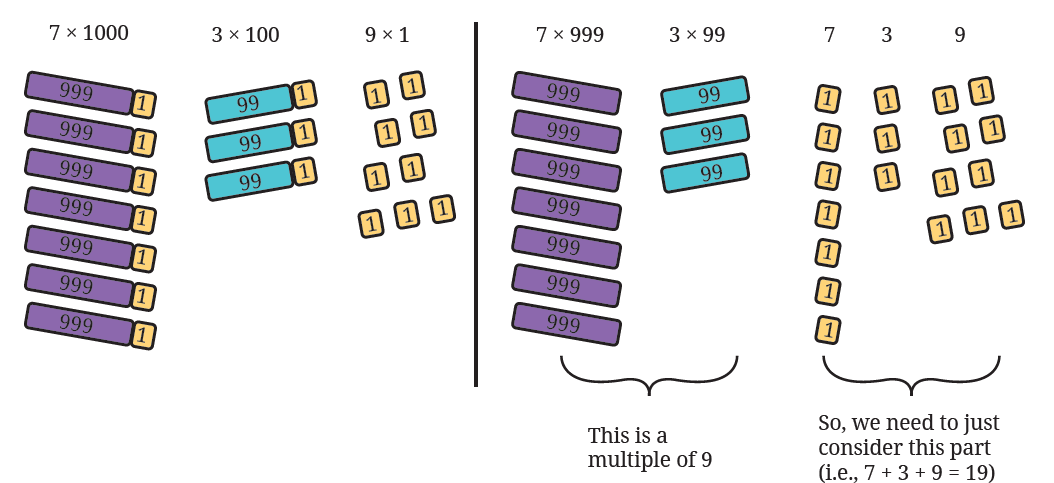
7 × 1000 + 3 × 100 + 0 × 10 + 9 × 1
= 7 × (999 + 1) + 3 × (99 + 1) + 0 × (9 + 1) + 9 × (0+1)
= (7 × 999 + 3 × 99 + 0 × 9 + 9 × 0) + (7 × 1 + 3 × 1 + 0 × 1 + 9 × 1)
= (7 × 999 + 3 × 99 + 0 × 9 + 9 × 0) + (7 + 3 + 0 + 9).
(This is a multiple of 9) (So, we need to just consider this part)
This means that the number 7309 is 19 more than some multiple of 9. The digits 1 and 9 can further be added to get 1 + 9 = 10. Now, we can say that 7309 is 10 more than a multiple of 9. And repeating this step for the number 10, we get the remainder to be 1 + 0 = 1, meaning 7309 is 1 more than a multiple of 9. Therefore, 7309 ÷ 9 gives a remainder of 1.
A number is divisible by 9 if and only if the sum of its digits is divisible by 9. Also, we can add the digits of a number repeatedly till a single digit is obtained. This single digit is the remainder when the number is divided by 9.
? Look at each of the following statements. Which are correct and why?
(i) If a number is divisible by 9, then the sum of its digits is divisible by 9
(ii) If the sum of the digits of a number is divisible by 9, then the number is divisible by 9.
(iii) If a number is not divisible by 9, then the sum of its digits is not divisible by 9.
(iv) If the sum of the digits of a number is not divisible by 9, then the number is not divisible by 9.
Learning maths is not just about knowing some shortcuts and following procedures but about understanding ‘why’ something works.
Figure it Out
1. Find, without dividing, whether the following numbers are divisible by 9.
(i) 123
(ii) 405
(iii) 8888
(iv) 93547
(v) 358095
2. Find the smallest multiple of 9 with no odd digits.
3. Find the multiple of 9 that is closest to the number 6000.
4. How many multiples of 9 are there between the numbers 4300 and 4400?
A Shortcut for Divisibility by 3
We know that all the multiples of 9 are also multiples of 3. That is, if a number is divisible by 9, it will also be divisible by 3. However, there are other multiples of 3 that are not multiples of 9 for example — 15, 33, and 87.
? The shortcut to find the divisibility by 3 is similar to the method for 9. A number is divisible by 3 if the sum of its digits is divisible by 3. Explore the remainders when powers of 10 are divided by 3. Explain why this method works.
A Shortcut for Divisibility by 11
Interestingly, the shortcut for 11 is also based on checking the remainders with place value. Let us see how.
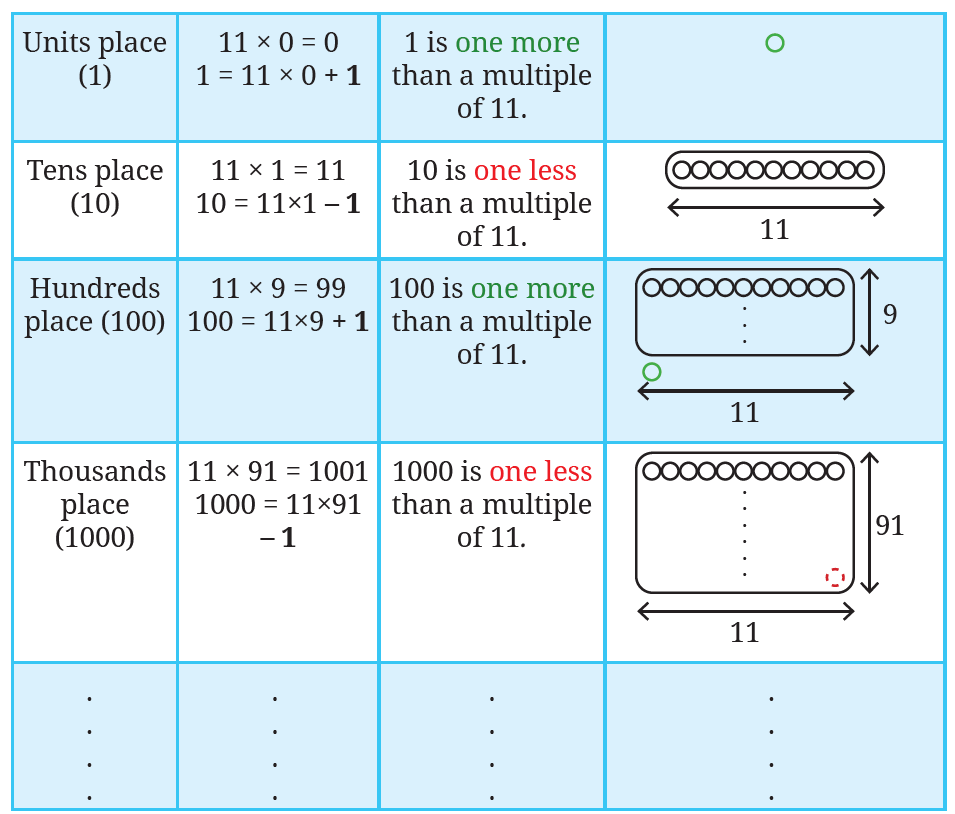
This alternating pattern of one more than 11 and one less than 11 continues for higher place values.
Since 400 contains 4 hundreds, 400 is 4 more than a multiple of 11 (396 + 4). Since 60 contains 6 tens, 60 is 6 less than a multiple of 11 (66 – 6). Since 2 contains 2 units, 2 is 2 more than a multiple of 11, i.e., 2 = (0 + 2).
? Using these observations, can you tell whether the number 462 is divisible by 11?
? What could be a general method or shortcut to check divisibility by 11?
We saw that the place values alternate as 1 more and 1 less than a multiple of 11. Using this observation,
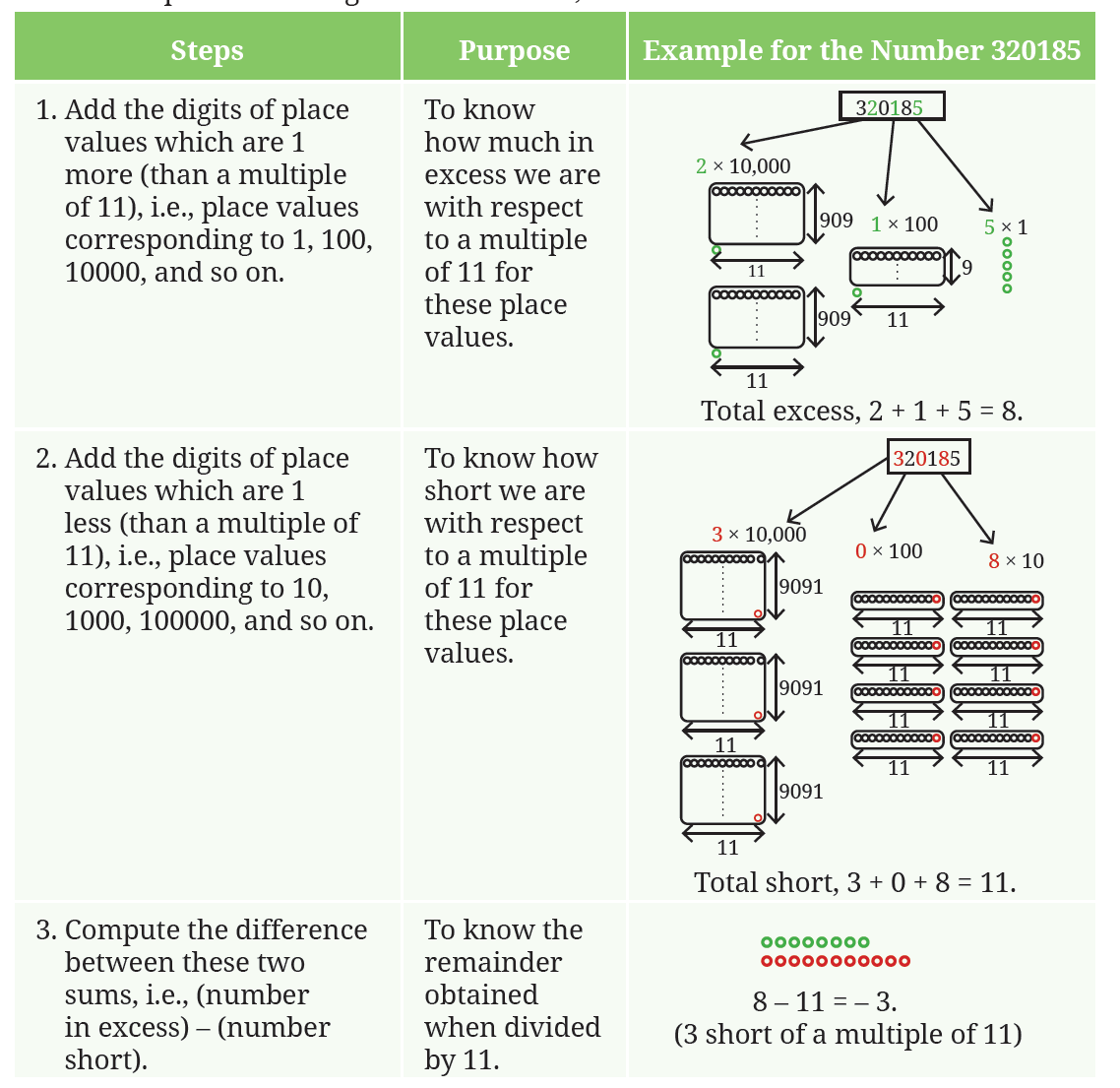
The difference between these two sums 8 – 11 = – 3, indicating that the number 3,28,105 is 3 short of or 8 more than a multiple of 11.
? If this difference is 11 or a multiple of 11, what does that say about the remainder obtained when the number is divisible by 11?
? Using this shortcut, find out whether the following numbers are divisible by 11. Further, find the remainder if the number is not divisible by 11.
(i) 158 (ii) 841 (iii) 481 (iv) 5529 (v) 90904 (vi) 857076
Look at the following procedure —
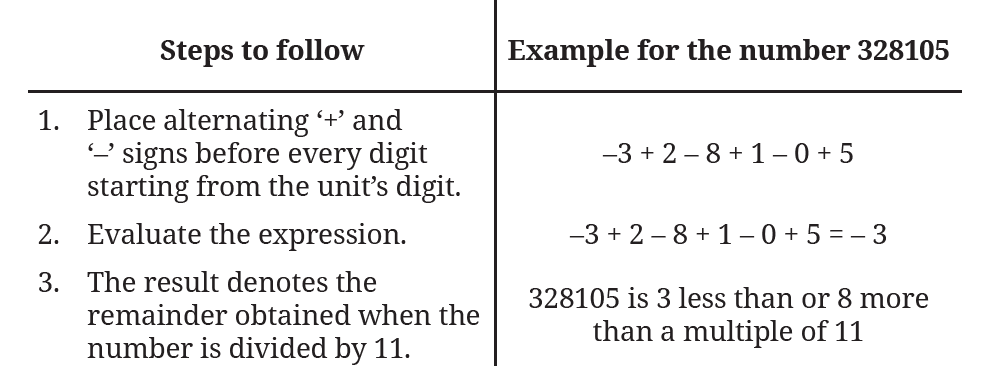
? Is this method similar to or different from the method we saw just before?
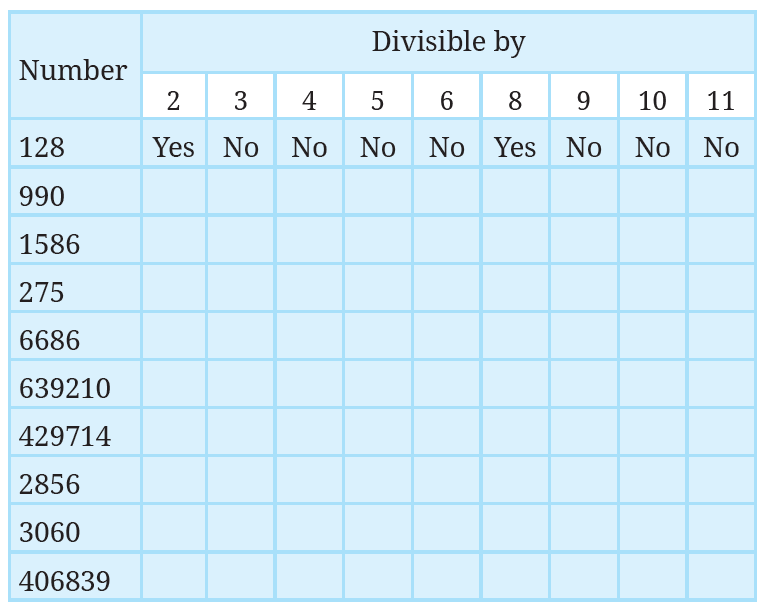
? Fill in the following table. Find a quick way to do this?
More on Divisibility Shortcuts
Divisibility Shortcuts for Other Numbers
? How can we find out if a number is divisible by 6?
? Will checking its divisibility by its factors 2 and 3 work? Use the shortcuts for 2 and 3 on these numbers and divide each number by 6 to verify —
38, 225, 186, 64.
? How about checking divisibility by 24? Will checking the divisibility by its factors, 4 and 6, work? Why or why not?
Determining divisibility by 24 by checking divisibility by 4 and by 6 does not work. For example, the number 12 is divisible by both 4 and 6, but not by 24.
To check for the divisibility by 24, we can instead check for the divisibility by 3 and divisibility by 8.
Explain using prime factorisation why checking divisibility by 3 and 8 works for checking divisibility by 24, but checking divisibility by 4 and 6 is not sufficient for checking divisibility by 24.
There are such shortcuts to check divisibility by every number until 100, and for some numbers beyond 100. You may try to understand how these work after learning certain concepts in higher grades.
Digital Roots
Take a number. Add its digits repeatedly till you get a single-digit number. This single-digit number is called the digital root of the number. For example, the digital root of the number 489710 will be
2 (4 + 8 + 9 + 7 + 1 + 0 = 29, 2 + 9 = 11, 1 + 1 = 2).
? What property do you think this digital root will have? Recall that we did this while finding the divisibility shortcut for 9.
? Between the numbers 600 and 700, which numbers have the digital root: (i) 5, (ii) 7, (iii) 3?
v Write the digital roots of any 12 consecutive numbers. What do you observe?
We saw that the digital root of multiples of 9 is always 9.
? Now, find the digital roots of some consecutive multiples of (i) 3, (ii) 4, and (iii) 6.
? What are the digital roots of numbers that are 1 more than a multiple of 6? What do you notice?
Try to explain the patterns noticed.
? I’m made of digits, each tiniest and odd, No shared ground with root #1 — how odd!
My digits count, their sum, my root — All point to one bold number’s pursuit — The largest odd single-digit I proudly claim.
What’s my number? What’s my name?

Aryabhata II’s (c. 950 CE) work Mahāsiddhānta, mentions the method of computing the digital root of a number by repeatedly adding the digits till a single-digit number is obtained. This method is known to have been used to perform checks on calculations of arithmetic operations.
? Figure it Out
1. The digital root of an 8-digit number is 5. What will be the digital root of 10 more than that number?
2. Write any number. Generate a sequence of numbers by repeatedly adding 11. What would be the digital roots of this sequence of numbers? Share your observations.
3. What will be the digital root of the number 9a + 36b + 13?
4. Make conjectures by examining if there are any patterns or relations between
(i) the parity of a number and its digital root.
(ii) the digital root of a number and the remainder obtained when the number is divided by 3 or 9.
5.3 Digits in Disguise
Last year, we saw cryptarithms — puzzles where each letter stands for a digit, each digit is represented by at most one letter, and the first digit of a number is never 0.
? Solve the cryptarithms given below.

Let us now try solving some cryptarithms involving multiplication.
? (v) PQ × 8 = RS.
Guna says, “Oh, this means a 2-digit number multiplied by 8 should give another 2-digit number. I know that 10 × 8 = 80. But the units digits of 10 and 80 are the same, which we don’t want. For the same reason PQ cannot be 11 as P and Q correspond to different digits. 12 × 8 = 96 fits all the conditions”. Can PQ be 13? Think.

It is not possible because 13 × 8 = 104. For all 2-digit numbers greater than 12, the product with 8 is a 3-digit number.
? (vi) Try this now: GH × H = 9K.
This means a 2-digit number multiplied by a 1-digit number gives another 2-digit number in the 90s. Observe the letters corresponding to the units digits in this cryptarithm. Pick the solution to this question from the options given below:
11 × 9 = 99, 12 × 8 = 96, 46 × 2 = 92, 24 × 4 = 96, 47 × 2 = 94, 31 × 3 = 93, 16 × 6 = 96.
? (vii) Here is one more: BYE × 6 = RAY.

Anshu says, “Since the product is a 3-digit number, B can’t be 2 or more. If B = 2, i.e., 2 hundreds, the product will be more than 1200. So, B = 1.”
? What can you say about ‘Y’? What digits are possible/not possible?
“Y cannot be 7 or more because, if Y = 7, then 170 × 6 = 1020; but we want a 3-digit product. Also, Y will be even”, Anshu explains.
We can solve cryptarithms using patterns, properties, and reasoning related to numbers and operations.
? Solve the following:
(i) UT × 3 = PUT
(ii) AB × 5 = BC
(iii) L2N × 2 = 2NP
(iv) XY × 4 = ZX
(v) PP × QQ = PRP
(vi) JK × 6 = KKK
? Figure it Out
1. If 31z5 is a multiple of 9, where z is a digit, what is the value of z? Explain why there are two answers to this problem.
2. “I take a number that leaves a remainder of 8 when divided by 12. I take another number which is 4 short of a multiple of 12. Their sum will always be a multiple of 8”, claims Snehal. Examine his claim and justify your conclusion.
3. When is the sum of two multiples of 3, a multiple of 6 and when is it not? Explain the different possible cases, and generalise the pattern.
4. Sreelatha says, “I have a number that is divisible by 9. If I reverse its digits, it will still be divisible by 9”.
(i) Examine if her conjecture is true for any multiple of 9.
(ii) Are any other digit shuffles possible such that the number formed is still a multiple of 9?
5. If 48a23b is a multiple of 18, list all possible pairs of values for a and b.
6. If 3p7q8 is divisible by 44, list all possible pairs of values for p and q.
7. Find three consecutive numbers such that the first number is a multiple of 2, the second number is a multiple of 3, and the third number is a multiple of 4.
Are there more such numbers? How often do they occur?
8. Write five multiples of 36 between 45,000 and 47,000. Share your approach with the class.
9. The middle number in the sequence of 5 consecutive even numbers is 5p. Express the other four numbers in sequence in terms of p.
10. Write a 6-digit number that it is divisible by 15, such that when the digits are reversed, it is divisible by 6.
11. Deepak claims, “There are some multiples of 11 which, when doubled, are still multiples of 11. But other multiples of 11 don’t remain multiples of 11 when doubled”. Examine if his conjecture is true; explain your conclusion.
12. Determine whether the statements below are ‘Always True’, ‘Sometimes True’, or ‘Never True’. Explain your reasoning.
(i) The product of a multiple of 6 and a multiple of 3 is a multiple of 9.
(ii) The sum of three consecutive even numbers will be divisible by 6.
(iii) If abcdef is a multiple of 6, then badcef will be a multiple of 6.
(iv) 8 (7b – 3) – 4 (11b + 1) is a multiple of 12.
13. Choose any 3 numbers. When is their sum divisible by 3? Explore all possible cases and generalise.
14. Is the product of two consecutive integers always multiple of 2? Why? What about the product of these consecutive integers? Is it always a multiple of 6? Why or why not? What can you say about the product of 4 consecutive integers? What about the product of five consecutive integers?
15. Solve the cryptarithms —
(i) EF × E = GGG
(ii) WOW × 5 = MEOW
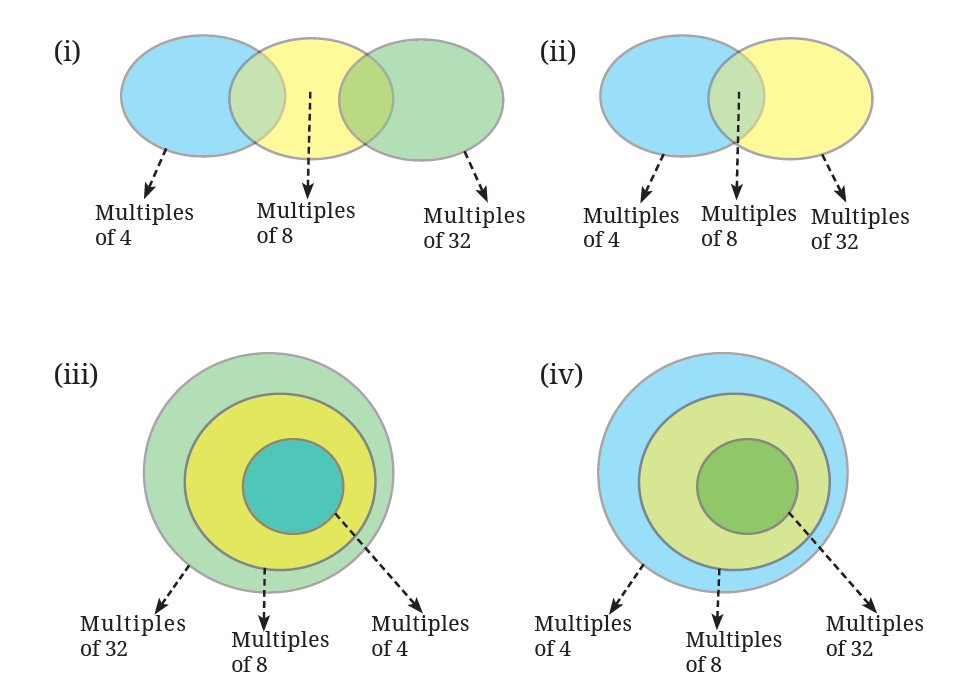
16. Which of the following Venn diagrams captures the relationship between the multiples of 4, 8, and 32?
SUMMARY
1. We explored and learnt various properties of divisibility—
- If a is divisible by b, then all multiples of a are divisible by b.
- If a is divisible by b, then a is divisible by all the factors of b.
- If a divides m and a divides n, then a divides m + n and m – n.
- If a is divisible by b and is also divisible by c, then a is divisible by the LCM of b and c.
2. We learnt shortcuts to check divisibility by 3, 9 and 11, and why they work.
3. Through all this we were exposed to the power of mathematical thinking and reasoning, using algebra, visualisation, examples and counterexamples.
PUZZLE TIME
Navakankari
Navakankari, also known as Sālu Mane Āṭa, Chār-Pār, or Navkakri, is a traditional Indian board game that is the same as ‛Nine Men’s Morris’ or ‛Mills in the West’. It is a strategy game for two players where the goal is to form lines of three pawns to eliminate the opponent’s pawns or block their movement.
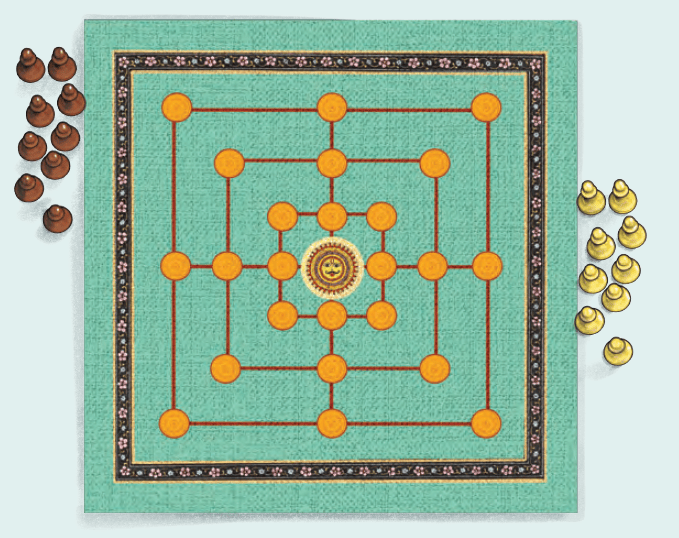
Gameplay
1. Each player starts with 9 pawns. The players take turns in placing their pawns on the marked intersections. An intersection can have at most one pawn.
2. Once all the pawns are placed, the players take turns to move one of their pawns to adjacent empty intersections to form lines of three. The line can be horizontal or vertical.
3. Once a player makes a line with their pawns they can remove any one of the opponent’s pawns as long as it is not a part of one of their lines.
A player wins if the opponent has less than 3 pawns or is unable to make a move.