Chapter-1
FRACTIONS IN DISGUISE
1.1 Fractions as Percentages
You might have heard statements like, "Mega Sale-up to 50% off!" or "Hiya scored 83% in her board exams".
Do you know what the symbol '%' means?
This symbol is read as per cent.
The word 'per cent' is derived from the Latin phrase 'per centum', meaning 'by the hundred' or 'out of hundred'.
So, 25 per cent (25%) means 25 out of every 100-like 25 people out of 100, 25 rupees out of 100 rupees, or 25 marks out of 100 marks.
If we say 50% of some quantity s, it means
50% = 50 * 1/100 * s (50 times the unit fraction of s)
= 50/100 * s = 1/2 * s .
Thus, percentages are simply fractions where the denominator is 100. Examples:
20% = 20 /100 = 2/10 = 1/5,
33% = 33/100.
We saw that percentages are just fractions. Given any fraction, can we express it as a percentage? Yes, let us see how.
Expressing Fractions as Percentages
? Example 1: Surya wants to use a deep orange colour to capture the sunset. He mixes some red paint and yellow paint to make this colour. The red paint makes up 3/4 of this mixture. What percentage of the colour is made with red?
3/4 is 3 out of every 4.
That is, 6 out of every 8 (equivalent fraction).
That is, 30 out of every 40.
That is, 75 out of every 100.
This means 75%.
Explaining this in a different way: To express 3/4 as a percentage, we need to find its equivalent fraction with 100 as the denominator. Two ways of going ahead are shown below.
Method 1
3/4 = 3*24 /4*25
= 75/100 = 75%
Method 2
3/4 = x/100 .
3/4 × 100 = x/100 × 100
[multiply both sides by 100]
x = 3/4 × 100
= 75.
So, 3/4 can be expressed as 75%.
Observe the following bar model diagram showing the equivalence between 3/4 and 75%.
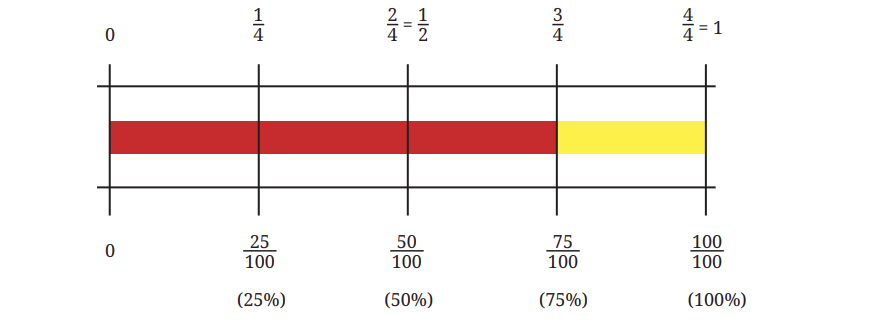
? Can you tell what percentage of the colour was made using yellow?
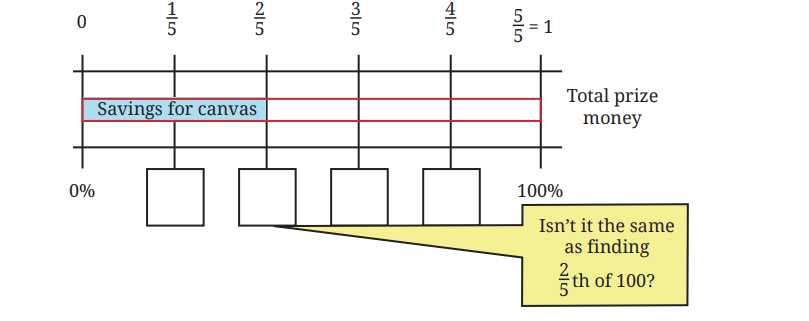
? Example 2: Surya won some prize money in a contest. He wants to save 2/5 of the money to purchase a new canvas. Express this quantity as a percentage.
Try to understand the different methods for solving this problem, as shown below.
Method 1
2/5 = 20/50 = 40/100
= 40%
Method 2
2/5 = x/100 .
x = 2/5 × 100 = 40.
? Try completing Method 3 by filling the boxes. Method 3
? Example 3: Given a percentage, can you express it as a fraction? For example, express 24% as a fraction.
Since a percentage is a fraction, 24% is the same as 24/100
We can find other equivalent forms of 24/100 = 12/50 = 6/25 = 48/200
In general, we can say that a percentage, z%, can be expressed by any of the fractions that are equivalent to z/100
? Figure it Out
1. Express the following fractions as percentages.
(1) 3/5(ii) 7/14
(iii) 9/20
(iv) 72/150
(v 1/3
(vi) 5/11
2. Nandini has 25 marbles, of which 15 are white. What percentage of her marbles are white?
(i) 10%(ii) 15%
(iii) 25%
(iv) 60%
(v) 40%
(vi) None of these
3. In a school, 15 of the 80 students come to school by walking. What percentage of the students come by walking?
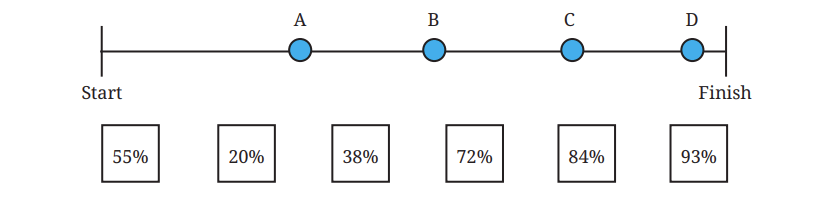
4. A group of friends is participating in a long-distance run. The positions of each of them after 15 minutes are shown in the following picture. Match (among the given options) what percentage of the race each of them has approximately completed.
5. Pairs of quantities are shown below. Identify and write appropriate symbols ‘>’, ‘<’, ‘=’ in the blanks. Try to do it without calculations.
(i) 50% ____ 5%(ii) 5/10 ____ 50%/
(iii) 3/11 _____ 61%
(iv) 30% ____ 1/3
? Well, if percentages are just a particular type of fraction, why do we need them? Why can't we just continue using fractions?
Let us consider an example.
A biscuit-making factory is experimenting with 2 new varieties of biscuits. Sugar makes up 9/34 of Variety 1 and 13/45 of Variety 2. Which variety is more sugary? It may not be clear at first glance and we may have to do some calculations. But, when the same information is presented as — Sugar makes up 26.47% of Variety 1 and 28.88% of Variety 2, it is immediately clear which variety is more sugary.
If we want to have the same denominator, why choose 100 in particular? Why not 10, 50, 1000, or 43? Think.
In principle, we could choose any number as the denominator. But with 100, there are some advantages. Since our number system is base 10, numbers like 10, 100, and 1000 fit easily with decimals. For example,
31% = 31/100 = 0.31.
Converting between fractions, decimals, and percentages becomes quick and intuitive.
The number 100 is round, and easy to understand and work with. We could say “per 1000” or “per 100,000” (this usage is present in statistics like “per thousand people” or “per lakh”), but 100 hits the sweet spot — it’s large enough to give detail, yet simple enough to grasp mentally. Per 10 would be too small for many purposes.
9/34 = 26.47 percent (per 100)
9/34 = 2.647 per decem (per 10)
9/34 = 264.7 per mille (per 1000)
Long before the decimal fraction was introduced, the need for it was felt in computations by tenths, twentieths, and hundredths. The idea of ‘per hundred’ can be found as early as the 4th century BCE in Kautilya’s Arthaśhāstra, “An interest of a pana and a quarter per month per cent is just. Five panas per month per cent is commercial interest. Ten panas per month per cent prevails among forests. Twenty panas per month per cent prevails among sea traders”.
Around the same time, the Romans used taxes of 1/20, 1/100 in transactions related to trade and auctions. In the Italian manuscripts of the 15th century, expressions such as ‘xx p cento’, ‘x p cento’, ‘vii p cento’ can be found (equivalent to our 20%, 10%, and 7%).
Percentages Around Us
Percentages are widely used in a variety of contexts. Here are some interesting findings that involve percentages.
 The human body, on
average, is about 60%
water by weight. The human body, on
average, is about 60%
water by weight. |
 Ice cream is about
30 – 50% air by
volume. Ice cream is about
30 – 50% air by
volume. |
 45% of the world̛
s
population watched at
least part of the 2022
FIFA World Cup. 45% of the world̛
s
population watched at
least part of the 2022
FIFA World Cup. |
 Over 80% of the teenagers
globally fail to meet the
recommendation of at
least one hour of daily
physical actvity. Over 80% of the teenagers
globally fail to meet the
recommendation of at
least one hour of daily
physical actvity. |
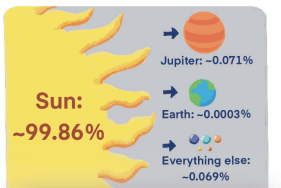 About 99.86% of the
Solar System̛s mass is
contained in the Sun. About 99.86% of the
Solar System̛s mass is
contained in the Sun. |
 An estimated 52% of
the agricultural land
worldwide is degraded. An estimated 52% of
the agricultural land
worldwide is degraded. |
1.2 Percentage of Some Quantity
Example 1: Madhu and Madhav each ate biscuits of a different variety. Madhu’s biscuits had 25% sugar, while Madhav’s had 35% sugar. Can you tell who ate more sugar?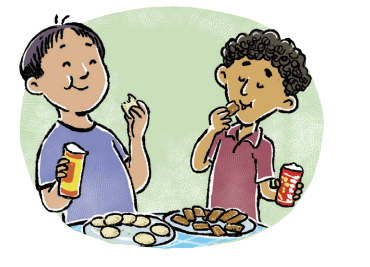
As we just saw, percentages represent fractional quantities or proportions. It would be inappropriate to compare just the percentages when they are referring to different quantities or wholes. That is, if they both had 100 g of biscuits, then clearly Madhav ate more sugar — 35 g (35% of 100 g is 35 g per 100 g) vs. Madhu’s 25 g (25% of 100 g is 25 g per 100 g).
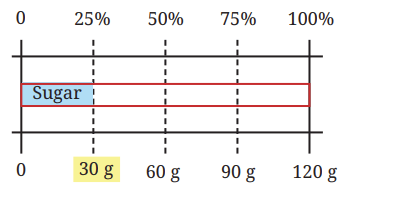
?Suppose Madhu ate 120 g of biscuits and Madhav ate 95 g of biscuits. Who consumed more sugar? Try to find out. We know that the weight of sugar is proportional to the weight of the biscuits consumed. Madhu ate 120 g of biscuits having 25% sugar. The amount of sugar he ate is the value in the blank-
25: 100::—— :120.
A few ways of going forward are shown.
25% sugar means — 25 g sugar per 100 g of biscuits, which means 5 g sugar per 20 g biscuits, so 30 g sugar per 120 g biscuits. |
The proportional
relationship can be
written as
25/100 = s/120. s = 25/100 × 120 = 30 . |
Do any of the methods match your thinking? Were you able to understand all the methods?
Now, let us find out how much sugar Madhav ate. He ate 95 g of biscuits with 35% sugar. Sometimes the numbers may not be convenient to calculate using different methods as we did just before. 100 g of the biscuits he ate has 35 g of sugar.
This means, 1 g of the biscuits has 35/100 g of sugar.
We can say that 95 g of the biscuit will have 35/100 g × 95 = 33.25 g.
This can also be solved by finding the value of s in the proportional relationship 35/100 =s/95.
Therefore, Madhav ate more sugar.
More generally, y% of some value, say 80, is given by y/100 × 80.
We can also say that 45% of some value, say z, is given by 45/100 × z.
Free-hand Computations
We just calculated 25% of 120. Is 25% the same as 1/4th (a quarter)?
Suppose we want to find 25% of 40. Is it the same as 1/4th of 40?
Yes, since 25 is 1/4th (a quarter) of 100 ( 25/100 =1/4).
Therefore 25% of 40 = 25/100 × 40 is the same as 1/4 × 40.
? Try to calculate (without using pen and paper) the indicated percentages of the values shown in the table below. Write your answers in the table.
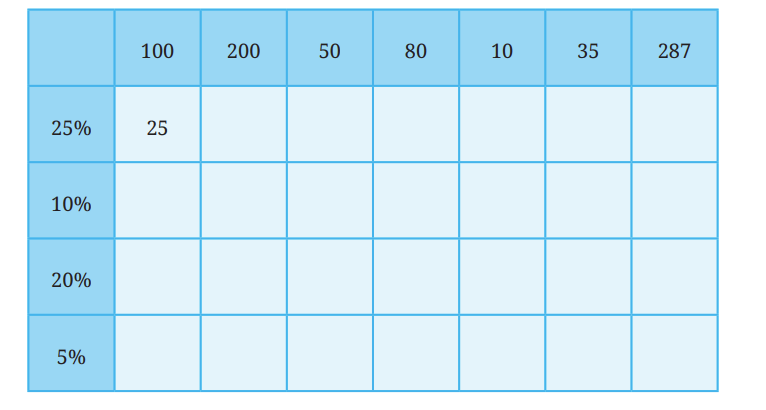
? How did you find these values? Discuss the methods with the class. Do you find anything interesting in the table?
You may have noticed that 20% of a value is double that of 10% of the same value. This will always happen as 20% (20 parts out of 100) is twice that of 10% (10 parts out of 100).
? Using this understanding, mentally calculate how much 40% of the values in the table above would be.
What relationship do you observe among 20%, 5% and 25% of a value? It appears that (20% of y) + (5% of y) = 25% of y. We can verify that this property always holds:
(20/100 * y) + (5/100 * y) = (25/100 * y)
? Using this observation, mentally calculate how much 15% of the values in the table would be.
? Suppose you have to mentally calculate the following percentages of some value: 75%, 90%, 70%, 55%. How would you do it? Discuss.
The FDP Trio — Fractions, Decimals, and Percentages
? Example 2: We can find 50% of a value by multiplying 1/2 with the value.
Will multiplying the value by 0.5 also give the answer for 50% of the value?
Yes, since 1/2 = 0.5.
50% = 50/100 = 1/2 = 0.5/1 = 0.5.
50% of 24 = 12
0.5 × 24 = 12
? Similarly, to find 10% of a quantity, what decimal value should be multiplied?
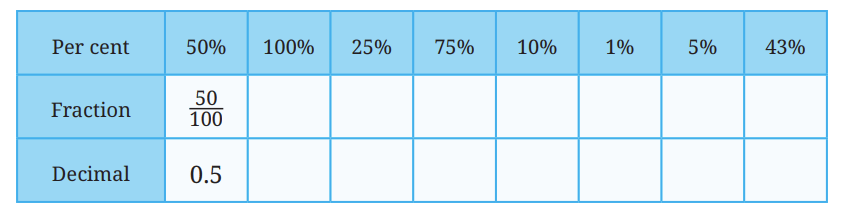
? Complete the following table:
Make a pair. Each of you choose a number. Suppose, the numbers chosen are a and b. Share your numbers with each other. Both of you should estimate the percentage equivalent to the fraction a/b (where a < b) and announce your answers by a fixed time, say, 5 seconds. The one whose estimate is the closest wins this round. Play this for 10 rounds.
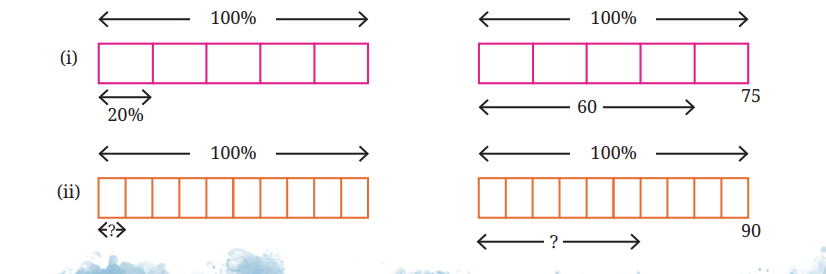
? Example 3: The maximum marks in a test are 75. If students score 80% or above in the test, they get an A grade. How much should Zubin score at least to get an A grade? We can find 80% of 75 in different ways, using our understanding of fraction and decimal multiplication, as well as of proportionality.
Fraction Multiplication →80/100 * 75
= 4/5 * 75 = 60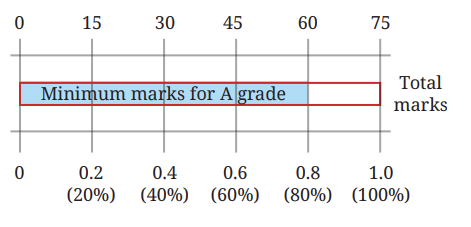
Decimal Multiplication 0.8 * 75 = 60 .
Proportional Reasoning → Out of 100, the minimum mark is 80.
Out of 75, it is
(75 * 80)/100 = 60
? Example 4: To prepare a particular millet kanji (porridge), suppose the ratio of millet to water to be mixed for boiling is 2:7. What percentage does the millet constitute in this mixture? If 500 ml of the mixture is to be made, how much millet should be used?This situation can be modelled as shown in the bar model on the right side.
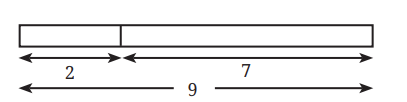
The ratio of millet to the volume of the mixture is 2:9. In other words, in one unit of the mixture, millet occupies 2/9 units and water occupies 7/9 units.
So, 2/9 is clearly less
than 50%. Half of
4.5 is 2.25. So, 2/9 is
less than 25%.

So, 2/9 could be between
20% – 25%.
? Estimate first what percentage 2/ 9 would be.
The percentage (i.e., in 100 such units) of millet in the mixture is
2/9 × 100 = 22.22%.
The percentage of water in the mixture will be 100 – 22.22 = 77.78%.
A mixture with 22.22% millet means 100 ml mixture will have 22.22 ml millet. Therefore, 500 ml with 22.22% millet will have 5 × 22.22 = 111.1 ml of millet.
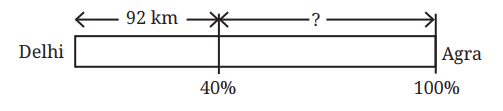
Example 5: A cyclist cycles from Delhi to Agra and completes 40% of the journey. If he has covered 92 km, how many more kilometres does he have to travel to reach Agra?
Let us first try to model this situation by a bar model.
? Estimate first before solving further.
A few ways of solving this problem are shown below. Does your method match any of the given ones? Do you like any of the other methods?
It is given that 40% of the distance is 92 km. We have to find out how much the rest of the 60% distance is.
| Method 1
40% is 92 km, therefore 20% is 46 km. This makes 60% to be 92 + 46 = 138 km. Method 2 If 40% is 92, 60% is ? 40 : 92 :: 60: ? 40/92 = 60/r (r is the remaining distance) r = 60 × 92/40 = 138. |
Method 3 40/100 = 92/d (d is the total distance) d = 92 × 100/40 = 230. Remaining distance = 230 km – 92 km = 138 km. |
Method 4
If x is the remaining distance then the total distance from Delhi to Agra is x + 92. Since, we know that 92 is 40% of this total distance, 40/100 × (x + 92) = 92. (x + 92) = 92 × 100/40 x = 230 – 92 = 138. |
Percentages Greater than 100
Till now, we saw percentages with a value 100 or less than 100. Can there be percentages with a value more than 100? What could it mean when a percentage is greater than 100? Let us explore.
? Example 6: Kishanlal recently opened a garment shop. He aims to achieve a daily sales of at least ₹5000. The sales on the first 2 days were ₹2000 and ₹3500. What percentage of his target did he achieve?
The percentage target achieved is visualised below.
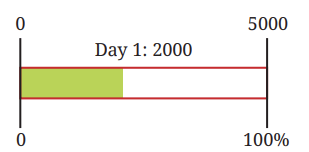
% of target:
2000/5000 × 100 = 40%
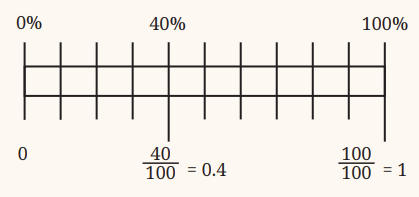
40% = 40/100 = 2/5 = 0.4
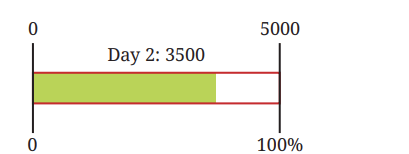
% of target:
3500/5000 × 100 = 70%
70% = 70/100 = 7/10 = 0.7
It is 40% on Day 1 and 70% on Day 2.
Another way of saying it is — he was 60% short of his target on Day 1 and 30% short of his target on Day 2.
? In the next two days, he made ₹5000 and ₹6000 respectively. What percentage of his target are these values?
His target is ₹5000, and he made ₹5000 on Day 3 - this is 100%. On Day 4, he made ₹6000, which is 1000 more than his target.
? What percentage of the target was achieved on Day 4?
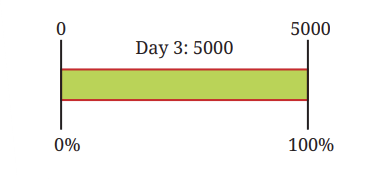
5000/5000 × 100 = 100%
100% = 100/100 = 1/1 = 1.0
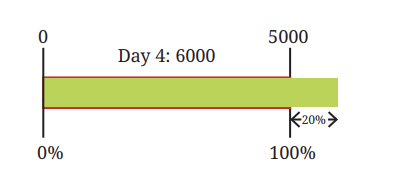
% of target:
6000/5000 × 100 = 120%
120% = 120/100 = 6/5 = 1.2
1000 is 20% of 5000. Therefore, 6000, (5000 + 1000) is 100% + 20%
= 120% of 5000. It can also be computed as 6000/5000 × 100 = 6/5 × 100 = 120%. This means he achieved 120% of his target, i.e., 20% more than his target.
? On Days 5 and 6 his sales were ₹7800 and ₹9550 respectively. Calculate the percentage of the target achieved on these days.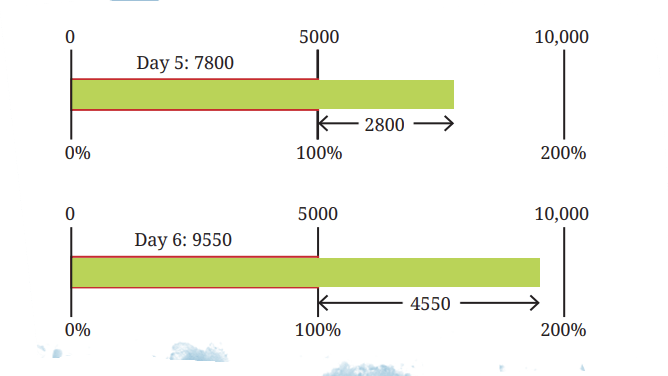
? On Day 7, he achieved 150% of his target. On Day 8, he achieved 210% of his target. Find the sales made on these days.
Suppose on some day, he made ₹2500. This can be expressed as “He achieved 1/2 of his target” or “He achieved 50% of his target” or “He achieved 0.5 of his target”. On some other day, he made ₹10,000. We can say “He achieved twice/double/2 times his target” or “He achieved 200% of his target”.
? Complete the table below. Mark the approximate locations in the following diagram.
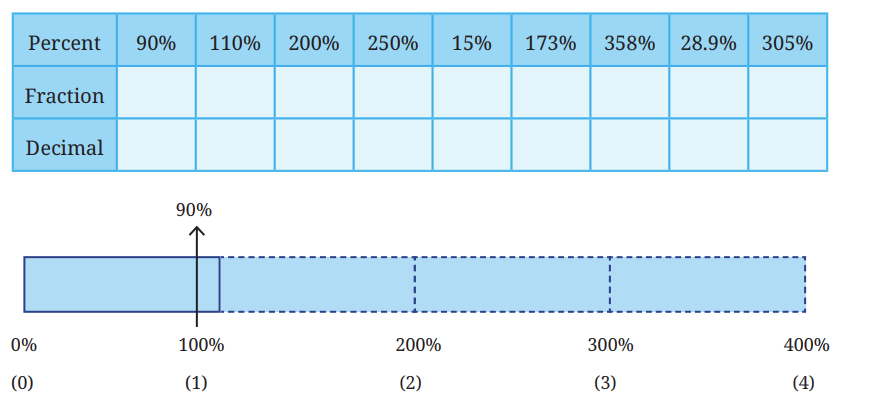
? Example 7: A farmer harvested 260 kg of wheat last year. This year, they harvested 650 kg of wheat. What percentage of last year’s harvest is this year’s harvest?
This year’s harvest = 650/260 × 100 = 250% of last year’s harvest.
250% indicates that it is 2.5 times the original value.
Figure it Out
Estimate first before making any computations to solve the following questions. Try different methods including mental computations.
1. Find the missing numbers. The first problem has been worked out.

2. Find the value of the following and also draw their bar models.
(i) 25% of 160(ii) 16% of 250
(iii) 62% of 360
(iv) 140% of 40
(v) 1% of 1 hour
(vi) 7% of 10 kg
3. Surya made 60 ml of deep orange paint, how much red paint did he use if red paint made up 3/4 of the deep orange paint?
4. Pairs of quantities are shown below. Identify and write appropriate symbols ‘>’, ‘<’, ‘=’ in the boxes. Visualising or estimating can help. Compute only if necessary or for verification.(i) 50% of 510.... 50% of 515
(ii) 37% of 148...... 73% of 148
(iii) 29% of 43..... 92% of 110
(iv) 30% of 40...... 40% of 50
(v) 45% of 200.... 10% of 490
(vi) 30% of 80 ......24% of 64
5. Fill in the blanks appropriately:
(i) 30% of k is 70, 60% of k is _____, 90% of k is _____, 120% of k is ______.
(ii) 100% of m is 215, 10% of m is _____, 1% of m is ______, 6% of m is ______.
(iii) 90% of n is 270, 9% of n is ______, 18% of n is _____, 100% of n is ______.
(iv) Make 2 more such questions and challenge your peers.
6. Fill in the blanks:
(i) 3 is ____ % of 300.
(ii) _____ is 40% of 4.
(iii) 40 is 80% of _____.
7. Is 10% of a day longer than 1% of a week? Create such questions and challenge your peers.
8. Mariam’s farm has a peculiar bull. One day she gave the bull 2 units of fodder and the bull ate 1 unit. The next day, she gave the bull 3 units of fodder and the bull ate 2 units. The day after, she gave the bull 4 units and the bull ate 3 units. This continued, and on the 99th day she gave the bull 100 units and the bull ate 99 units. Represent these quantities as percentages. This task can be distributed among the class. What do you observe?
9. Workers in a coffee plantation take 18 days to pick coffee berries in 20% of the plantation. How many days will they take to complete the picking work for the entire plantation, assuming the rate of work stays the same? Why is this assumption necessary?
10. The badminton coach has planned the training sessions such that the ratio of warm up : play : cool down is 10% : 80% : 10%. If he wants to conduct a training of 90 minutes. How long should each activity be done?
11. An estimated 90% of the world’s population lives in the Northern Hemisphere. Find the (approximate) number of people living in the Northern Hemisphere based on this year’s worldwide population.
12. A recipe for the dish, halwa, for 4 people has the following ingredients in the given proportions — Rava: 40%, Sugar: 40%, and Ghee: 20%.
(i) If you want to make halwa for 8 people, what is the proportion of each of the above ingredients?
(ii) If the total weight of the ingredients is 2 kg, how much rava, sugar and ghee are present?
1.3 Using Percentages
To Compare Proportions
Example 1: Eesha scored 42 marks out of 50 on an English test and 70 marks out of 80 in a Science test. Since she lost only 8 marks in English but 10 marks in Science, she thinks she has done better at English. Reema does not agree! She argues that since Eesha has scored more marks in Science, she has done better at Science. Vishu thinks we cannot compare the scores because the maximum marks are different. Who do you think is correct?
If the maximum marks are the same, the comparison becomes easier, isn’t it? For these kinds of comparisons, we need to convert both values to percentages.
English score as a percentage = 42/50 × 100 = 84%
Science score as a percentage = 70/80 × 100 = 87.5%
The Science score (as a percentage) is higher than the English score (as a percentage). So, we can conclude that Eesha has scored better on the Science test.
Know Your Contents (KYC)
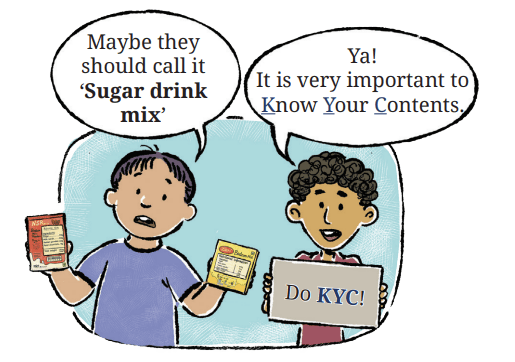
Example 2: Madhu and Madhav recently learnt about the importance of reading labels on processed food before purchase. They are at a shop to buy badam drink mix. They are looking at two products and wondering which has a larger share of badam. Can you figure it out? Which product uses a smaller proportion of food chemicals? It is easier to compare the proportions of the ingredients if we convert them into percentages. For example, DEF’s sugar content as a percentage of total weight = 99/150 × 100 = 66%.
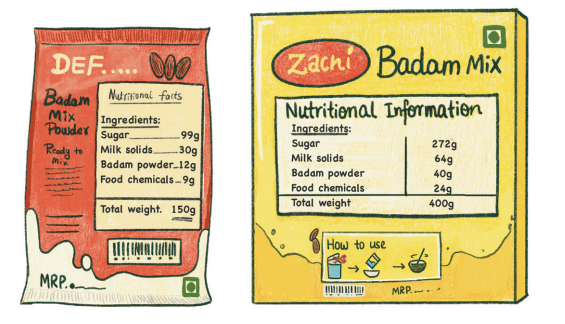
? Complete this table by calculating the percentages to answer the questions:
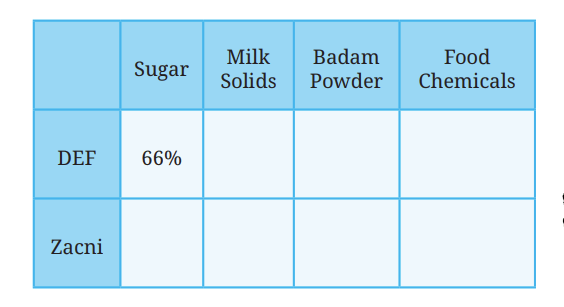
? Check if the percentages of each product add up to 100.
Percentage Increase or Decrease
Percentages are often used to describe the rate of change of quantities. For example,
1. Suppose the price of 1 kg tomatoes 3 years ago was ₹30, and the price now is ₹42. The increase in the price is ₹12.
Percentage increase = amount of increase/original amount or base × 100
=12/30 × 100 = 40%.
We say the price of tomatoes increased by 40% over the last 3 years.
2. The average footfall in this theater before COVID was 160. Now it is just 100. The decrease in the footfall is 60.
Percentage decrease = amount of decrease/original amount or base × 100
=60/160 × 100 = 37.5%.
We say the footfall in this theater post-COVID has decreased by 37.5%.
? Example 3: Do the following two statements mean the same thing?
(i) The population of this state in 1991 is 165% of that in 1961.
(ii) The population of this state has increased by 65% from 1961 to 1991. Yes, both mean the same. Suppose p is the population of the state in 1961 and q is the population of the state in 1991.
Statement A implies,
q = 165% of p
q =165/100 × p = 1.65p
Statement B implies,
q = p + 65% of p
q = p + 0.65 × p = 1.65p
In other words, the population of the state in 1991 is 1.65 times that in 1961.
Profit and LossYou may have the experience of buying something — snacks, groceries, clothes, toys, etc. Very often, the shopkeeper quotes a price and after some bargaining the customer pays the negotiated amount and buys the item(s). We call the price quoted by the shopkeeper the marked price (sometimes this can be the MRP of an item). The price the customer pays after a discount is called the selling price. Also, the price the shopkeeper paid to purchase that item is called the cost price. Let us see how these labels are relative to the context through an example.
The picture below shows the journey of a sweater from the manufacturer to the customer and what the cost price (CP), the marked price (MP), and the selling price (SP) mean in each step.
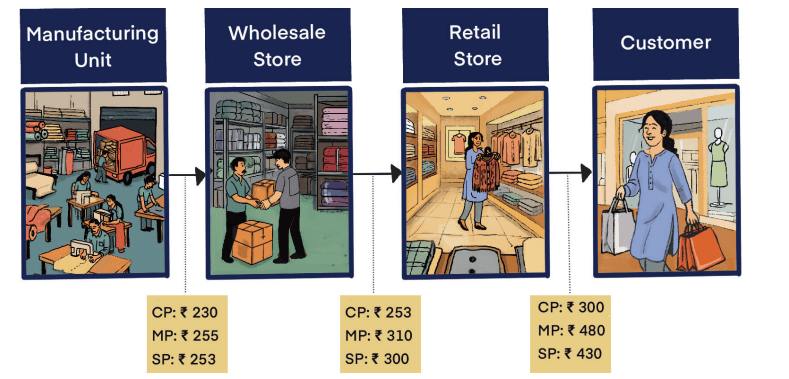
Kishanlal (retailer) buys sweaters from a wholesaler at a price of ₹300 per sweater. The marked price he quotes his customers is ₹480. After bargaining, he sells this sweater at ₹430. Notice that the selling price is greater than the cost price, resulting in a profit of ₹430 – ₹300 = ₹130. If the selling price is less than the cost price, it will result in a loss.
? Example 4: Find out the percentage profit Kishanlal made on this sweater.
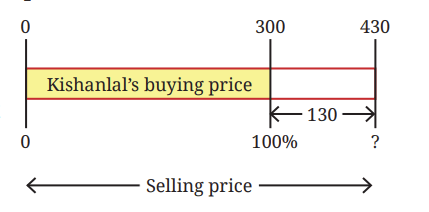
We shall consider the cost price to be 100% to find out the percentage profit made with reference to the cost price. The following rough diagram describes this situation.
The profit amount is ₹130.
The percentage profit is 130/300 × 100 = 43.3%.
? Find the profit percentage of the wholesaler and the manufacturer.
? Shambhavi owns a stationery shop. She procures 200 page notebooks at ₹36 per book. She sells them with a profit margin of 20%. Find the selling price.
? She sells crayon boxes at ₹50 per box with a profit margin of 25%. How much did Shambhavi buy them from the wholesaler?
? Example 5: The rice stock in Raghu’s provision store is getting old. He had purchased the rice at ₹35 per kg. To clear his stock, he sells 10 kg rice for ₹300. Find out the percentage loss.
The amount Raghu had paid towards buying the 10 kg rice is ₹350. He sold it for ₹300.
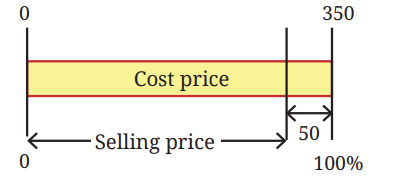
The loss is ₹350 – ₹300 = ₹50.
The percentage loss is 50/350 × 100 = 14.28%.
? Could we have just calculated the loss percentage per kg instead? Would it be the same?
? Example 6: Shyamala had procured decorative vases at ₹2650 per piece. One of the pieces was slightly damaged. She decides to sell it at a loss of 18%. How much will she get by selling this piece?
? Try making an estimate. Draw a rough diagram depicting the given situation.
Two methods of solving this are shown.
With respect to the buying price being 100%, the selling price is 18% less than the buying price. That is, the selling price would be 82%. 82% of 2650 = 0.82 × 2650 = 2173. |
The loss amount is 18% of 2650. That is, 18/100 × 2650 = 477. Reducing this from the buying price, 2650 – 477 = 2173. |
The sale amount of the damaged vase would be ₹2173.
? Due to heavy rains, Snehal could not transport strawberries to Hyderabad from his farm in Panchgani. He sells some of his stock at ₹80 per kg with a 12% loss. What is the cost price?
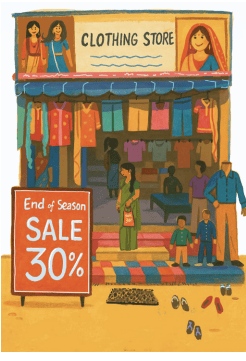
You have probably seen percentages mentioned when shops offer discounts! Do you know what 30% off (or 30% discount) means? It means that the shop is willing to reduce the price of the item by 30%.
? A utensil store is offering a 35% discount on the cooker with an MRP ₹1800. What is the selling price? If the cost price was ₹900, what is the percentage profit made after the sale?
Suppose Kishanlal achieved a sales of ₹80,000 last month. Out of this, the amount he spent on buying these goods he sold last month was ₹48,000. The difference amount, ₹80,000 – ₹48,000 = ₹32,000, is called gross profit.
After deducting the other expenses he incurred (such as transport cost, employee’s salary, electricity bill, etc.) amounting to ₹8,000, the amount remaining is called net profit, which is ₹32,000 – ₹8,000 = ₹24,000.
Note: In this chapter, the term profit refers to gross profit.
Manisha sells fertiliser. She buys 50 kg bags at ₹500 per bag. She sells it at ₹750 per bag making a profit of 250/500 × 100 = 50%.
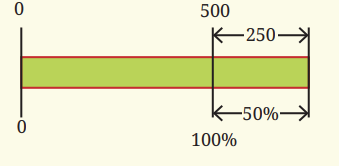
Profit percentage is calculated based on the price the goods bought when we want to know “How much profit did I make compared to what I invested in buying the goods?”.
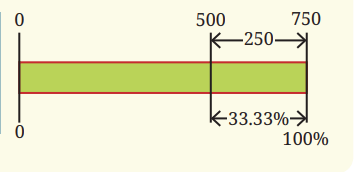
Profit percentage is calculated based on the revenue (sales amount) when we want to know “How much (net) profit did I make on my overall revenue?”.
Suppose, in a month she made sales of ₹1,50,000. The cost of buying the goods was ₹1,00,000. So, the gross profit is ₹50,000. The monthly expenses amounted to ₹5,000. The net profit is ₹45,000. Out of monthly revenue (₹1,50,000), the net profit percentage is
45000/150000 × 100 = 3/10 × 100 = 30%.
Taxes
Tax rates, like the GST (Goods and Services Tax) rate or the Income Tax rates, are also specified as percentages. You may have noticed GST mentioned as part of bills. This means that the tax is part of the amount we pay and this amount goes to the government.
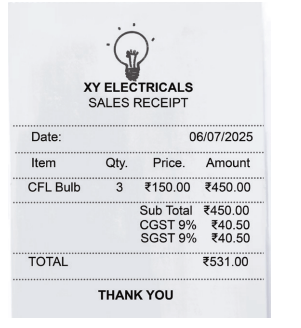
? Check if the calculations are correct in the bill shown.
? You may share any bills you have at home with the class. Observe the different elements present in the bills. Are there any similarities or differences in these bills?
? Figure it Out
1. If a shopkeeper buys a geometry box for ₹75 and sells it for ₹110, what is his profit margin with respect to the cost?
2. I am a carpenter and I make chairs. The cost of materials for a chair is ₹475 and I want to have a profit margin of 50%. At what price should I sell a chair?
3. The total sales of a company (also called revenue) was ₹2.5 crore last year. They had a healthy profit margin of 25%. What was the total expenditure (costs) of the company last year?
4. A clothing shop offers a 25% discount on all shirts. If the original price of a shirt is ₹300, how much will Anwar have to pay to buy this shirt?
5. The petrol price in 2015 was ₹60 and ₹100 in 2025. What is the percentage increase in the price of petrol?
(i) 50%(ii) 40%
(iii) 60%
(iv) 66.66%
(v) 140%
(vi) 160.66%
3. Samson bought a car for ₹4,40,000 after getting a 15% discount from the car dealer. What was the original price of the car?
4. 1600 people voted in an election and the winner got 500 votes. What percent of the total votes did the winner get? Can you guess the minimum number of candidates who stood for the election?
5. The price of 1 kg of rice was ₹38 in 2024. It is ₹42 in 2025. What is the rate of inflation? (Inflation is the percentage increase in prices.)
6. A number increased by 20% becomes 90. What is the number?
7. A milkman sold two buffaloes for ₹80,000 each. On one of them, he made a profit of 5% and on the other a loss of 10%. Find his overall profit or loss.
8. The population of elephants in a national park increased by 5% in the last decade. If the population of the elephants last decade is p, the population now is
(i) p × 0.5 (ii) p × 0.05 (iii) p × 1.5 (iv) p × 1.05 (v) p + 1.50
9. Which of the following statement(s) mean the same as — “The demand for cameras has fallen by 85% in the last decade”?
(i) The demand now is 85% of the demand a decade ago.
(ii) The demand a decade ago was 85% of the demand now.
(iii) The demand now is 15% of the demand a decade ago.
(iv) The demand a decade ago was 15% of the demand now.
(v) The demand a decade ago was 185% of the demand now.
(vi) The demand now is 185% of the demand a decade ago.
Growth and Compounding
You might have come across statements like, “1 year interest for FD (Fixed Deposit) in the bank @ 6% per annum” or “Savings account with interest @ 2.5% per annum”. Interest is the extra money paid by institutions like banks or post offices on money deposited (kept) with them. Interest is also paid by people or institutions when they borrow money.
In a Fixed Deposit (FD), you deposit a specific amount of money for a fixed period at a predetermined interest rate. The money remains locked for the chosen duration, and the bank pays you interest on it. You cannot withdraw the amount before the maturity date without incurring a penalty. At the end of the term, you receive both your original deposit and the interest earned.
For example, a bank says that the interest rate for fixed deposits is 10% p.a. What do you understand by this statement? What is the ‘p.a.’ next to the percentage?
‘p.a.’ is the short form of per annum, which means for every year. The specified interest rate indicates that if you invest ₹6000 as a deposit for a year with the bank, they will give you ₹600 as interest on this deposit. The 10% is the rate of interest and the ₹6000 on which the interest is calculated is the principal. The amount after 1 year in your bank account will be
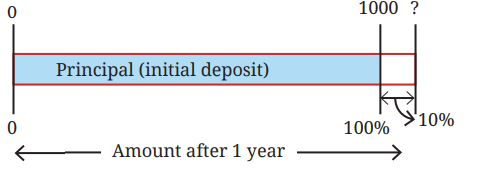
6000 + (0.10 × 6000)
(principal) + (10% interest on principal)
= 6000 + 600 = 6600.
In other words, the amount deposited, ₹6000, will become 110% (or increase by 10%),
6000 × 110% = 6000 × 110/100 = 6000 × 1.1 = 6600.
This can also be expressed as
Amount after 1 year = Principal (P) + rate of interest (r) of P
? Example 7: If one deposits ₹6000 in the bank, what is the amount after 3 years?
That depends on the choice of FD. There are two possibilities:
1. Option 1: The interest is paid out regularly (for example, every year). The principal amount is returned after the maturity period.
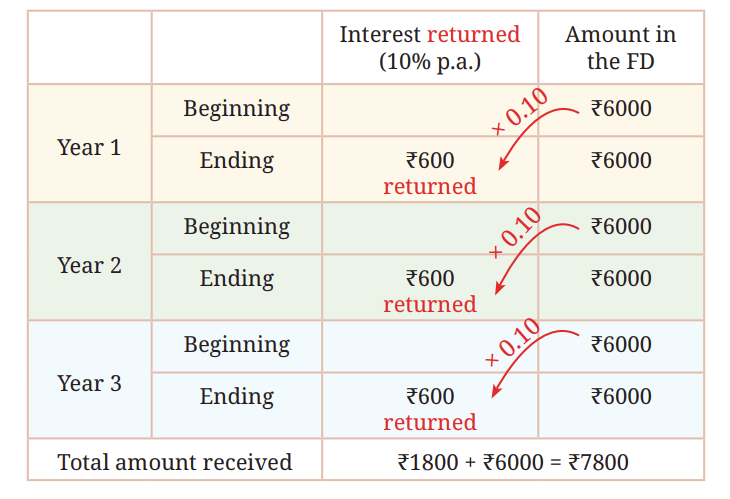
2. Option 2: The interest gained every time (say after each year) is added back to the FD, thus increasing the principal amount for the subsequent period. After the maturity period, the entire amount is returned. This phenomenon is called compounding.
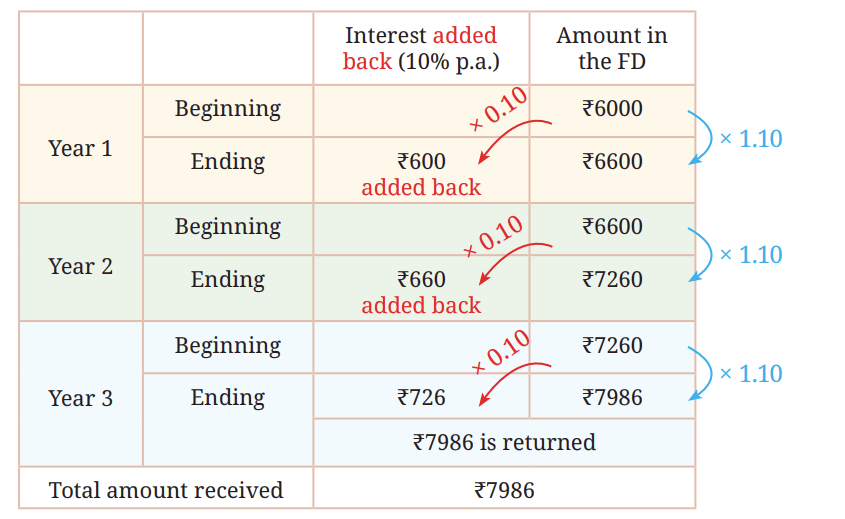
We can see that with compounding, the final amount is more.
? Example 8: What percent is the total amount received with respect to the amount deposited in both the options?
This can be calculated by finding (total amount received/amount deposited) × 100.
| Without Compounding
7800/6000 × 100 = 130% = 1.3. In other words, the total amount received = 6000 × (1 + 0.1 + 0.1 + 0.1) = 6000 × 1.3. The percentage gain over 3 years is 30%. |
With Compounding
(7986/6000) × 100 = 133.1% = 1.331. In other words, the total amount received = 6000 × 1.1 × 1.1 × 1.1. = 6000 × 1.331 The percentage gain over 3 years is 33.1%. |
? Figure it Out
1. Bank of Yahapur offers an interest of 10% p.a. Compare how much one gets if they deposit ₹20,000 for a period of 2 years with compounding and without compounding annually.
2. Bank of Wahapur offers an interest of 5% p.a. Compare how much one gets if one deposits ₹20,000 for a period of 4 years with compounding and without compounding annually.
3. Do you observe anything interesting in the solutions of the two questions above? Share and discuss.
Let us try to generalise the pattern observed in each of the options.
?Example 9: What is the amount we get back if we invest ₹6000 at an interest rate of 10% p.a. for ‘t’ years?
No CompoundingHere, the interest gained every term is paid back. Therefore, the principal amount for every term shall remain the same, and as a result, the interest gained every term also shall be the same.
| The interest gained in 1 term is 6000 × 0.1 The interest gained in 3 terms is 6000 × 0.1 × 3 The total amount at the end of an FD of 3 years is 6000 + (6000 × 0.1 × 3). | The interest gained in 1 term is p × r (p is the principal, r is the rate of interest in percentage) The interest gained in t terms is p × r × t The total amount at the end of an FD of t years is p + (p × r × t )= p + prt = p (1 + rt). |
Here, the interest gained every term/year is added back to the FD. Therefore, the principal amount increases after every term, and as a result, the interest gained every term also increases proportionately.
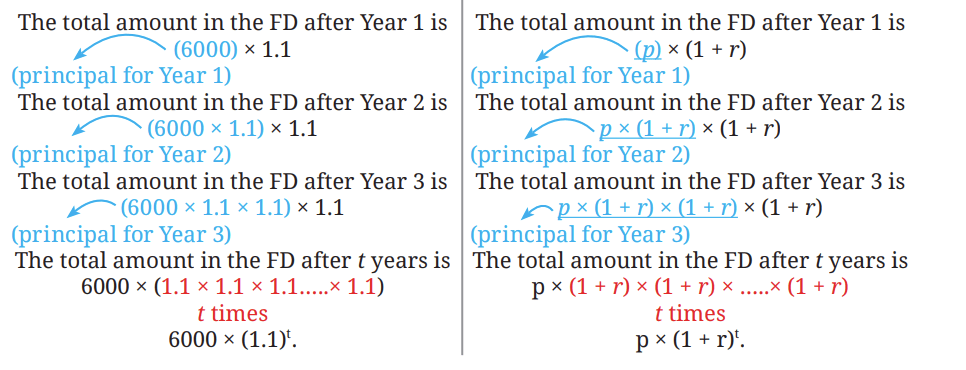
? Suppose we want to know the expression/formula to find the total interest amount gained at the end of the maturity period. What would be the formula for each of the two options?
4. Jasmine invests amount ‘p’ for 4 years at an interest of 6% p.a. Which of the following expression(s) describe the total amount she will get after 4 years when compounding is not done?
(i) p × 6 × 4(ii) p × 0.6 × 4
(iii) p × 0.6/100 × 4
(iv) p × 0.06/100 × 4
(v) p × 1.6 × 4
(vi) p × 1.06 × 4
(vii) p + (p × 0.06 × 4)
5. The post office offers an interest of 7% p.a. How much interest would one get if one invests ₹50,000 for 3 years without compounding? How much more would one get if it was compounded?
6. Giridhar borrows a loan of ₹12,500 at 12% per annum for 3 years without compounding and Raghava borrows the same amount for the same time period at 10% per annum, compounded annually. Who pays more interest and by how much?
7. Consider an amount ₹1000. If this grows at 10% p.a., how long will it take to double when compounding is done vs. when compounding is not done? Is compounding an example of exponential growth and not-compounding an example of linear growth?
8. The population of a city is rising by about 3% every year. If the current population is 1.5 crore, what is the expected population after 3 years?
9. In a laboratory, the number of bacteria in a certain experiment increases at the rate of 2.5% per hour. Find the number of bacteria at the end of 2 hours if the initial count is 5,06,000.
DeclineSeveral items or materials lose financial value over time. Suppose someone buys a bike at your home for ₹1,00,000 and after a few years they want to sell it. The value of the bike at that time will be less than ₹1,00,000. It could depend on various factors, including how many years have passed since the purchase, how many kilometres the vehicle has been used for, if there has been any damage, or if any parts have been replaced. This is called depreciation — reduction of value due to use and age of the item.
Example 10: A TV is bought at a price of ₹21,000. After 1 year, the value of the TV depreciates by 5%. Find the value of the TV after one year.
The amount of reduction in the value is 5% of 21,000 = 0.05 × 21,000 = 1050. The current value is 21,000 – 1050 = 19,950. |
The value of the TV after 1 year will be 95% of the current value = 95% of 21,000 = 0.95 × 21,000 = 19,950. |
The value of the TV after 1 year will be ₹19,950.
? Example 11: The population of a village was observed to be reducing by about 10% every decade. If the current population is 1250, what is the expected population after 3 decades?
|
The population 1 decade later will be 0.9 times the population of the current decade. Therefore, the population after 1 decade will be 1250 × 0.9. The population after 2 decades will be 1250 × 0.9 × 0.9. The population after 3 decades will be 1250 × 0.9 × 0.9 × 0.9 = 911.25. |
First decade’s decrease = 0.1 × 1250 = 125. Population after 1 decade = 1250 – 125 = 1125. Second decade’s decrease = 0.1 × 1125 = 112.5 ≅ 112. Population after 2 decades = 1125 – 112 = 1013 Third decade’s population decrease = 0.1 × 1013 = 101.3 ≅ 101. Population after 3 decades = 1013 – 101 = 912. |
Rounding off, we can say that the expected population after 3 decades will be around 910.
Tricky Percentages
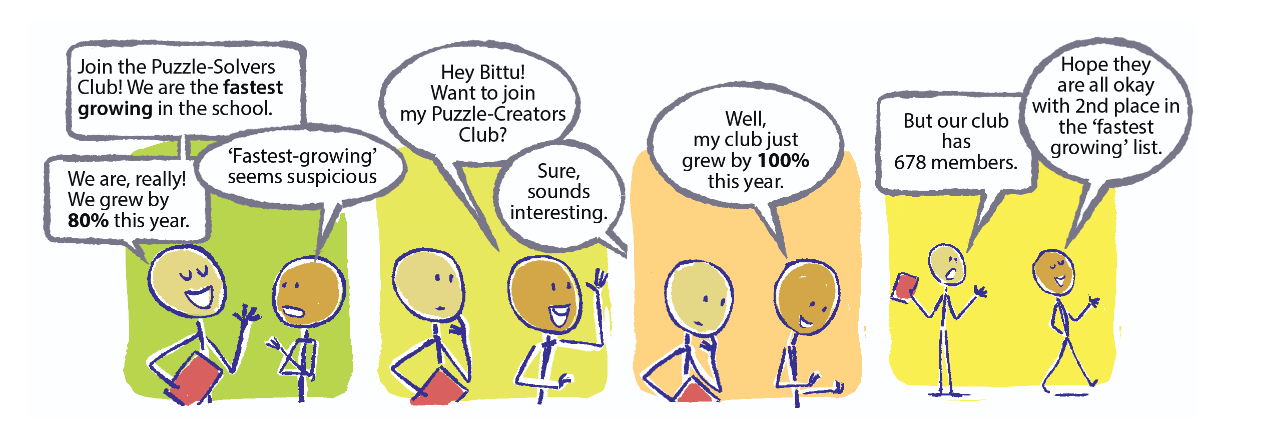
Would You Rather?? You have won a contest. The organisers offer you two options to choose from:
Option A: You deposit ₹100 and you get back ₹300.
Option B: You deposit ₹1000 and you get back ₹1500.
What is the percentage gain each option gives? You can choose any option only once. Which option would you choose? Why?
? A provision store is offering a stock clearance sale. Customers can choose one of the two options — 20% discount or ₹50 discount—for any purchase above ₹150. Which option would you choose if you want to:
(i) buy items worth ₹180(ii) buy items worth ₹225
(iii) buy items worth ₹300
? Example 12: A bakery called Cakely is offering a 30% + 20% discount on all cakes. Another bakery called Cakify is offering a 50% discount on all cakes. Would you rather choose Cakely or Cakify if you want the cheaper cost?
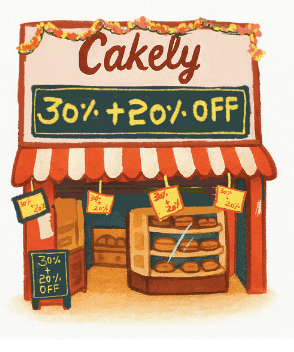
It seems that both the options should give the same benefit. Although mathematically 30% + 20% is the same as 50%, the usage of 30% + 20% in shopping means compounding.
Suppose you want to buy a cake worth ₹200.
Cakely’s 30% + 20% →
Applying the 30% discount → the price of cake is ₹200 – ₹60 = ₹140.
Applying the 20% discount on ₹140 → the price of cake is ₹140 – ₹28 = ₹112.
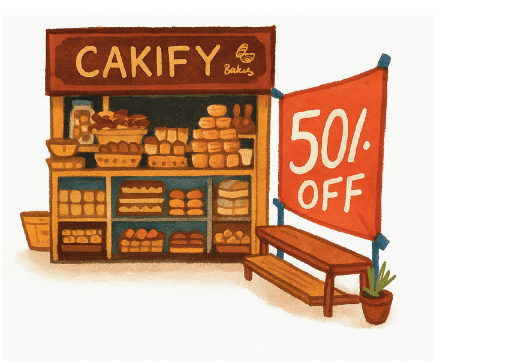
Cakify’s 50% →
The 50% discount makes the price of the cake ₹100.
A Mishap? Example 13: After Surbhi bought cookware from the wholesaler, she kept a profit margin of 50% on all the products. To clear off the remaining stock, she thought she would offer a 50% discount and come out without any loss.
(i) Do you think she didn’t make any loss?
(ii) If she had sold goods (originally) for ₹12,000 after discount, how much loss did she incur? What is the percentage loss?
(iii) What should have been the percentage discount offered so that she sold the goods at the price she had bought (i.e., no profit or loss)?
Let us model the situation first.
Suppose the worth of the products she bought from the wholesaler is x.
The worth corresponding to the selling price (with a 50% margin) is 1.5x.
A 50% discount on this price will make the worth 0.75x.
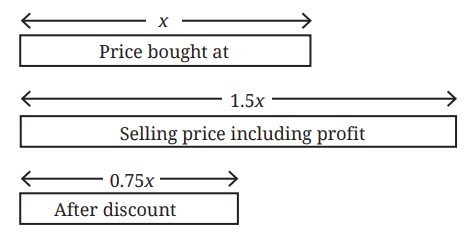
(i) This means the selling price is 3 4 of the price the goods were bought at, i.e., a 25% loss.
(ii) If she had sold goods worth ₹12,000,
0.75x = 12,000
x = 16,000.
She lost ₹4000.
(iii) To sell the goods at the same price, the discount offered should be
1.5x – d × (1.5x) = x
d =1/3 = 0.33.
The discount offered should have been 33.33%.
? Ariba and Arun have some marbles. Ariba says, “The number of marbles with me is 120% of the marbles Arun has”. What would be an appropriate statement Arun could make comparing the number of marbles he has with Ariba’s?
? Figure it Out
1. The population of Bengaluru in 2025 is about 250% of its population in 2000. If the population in 2000 was 50 lakhs, what is the population in 2025?
2. The population of the world in 2025 is about 8.2 billion. The populations of some countries in 2025 are given. Match them with their approximate percentage share of the worldwide population. [Hint: Writing these numbers in the standard form and estimating can help].

3. The price of a mobile phone is ₹8,250. A GST of 18% is added to the price. Which of the following gives the final price of the phone including the GST?
(i) 8250 + 18(ii) 8250 + 1800
(iii) 8250 + 18/100
(iv) 8250 × 18
(v) 8250 × 1.18
(vi) 8250 + 8250 × 0.18
(vii) 1.8 × 8250
4. The monthly percentage change in population (compared to the previous month) of mice in a lab is given: Month 1 change was +5%, Month 2 change was –2%, and Month 3 change was –3%. Which of the following statement(s) are true? The initial population is p .
(i) The population after three months was p × 0.05 × 0.02 × 0.03.
(ii) The population after three months was p × 1.05 × 0.98 × 0.97.
(iii) The population after three months was p + 0.05 – 0.02 – 0.03.
(iv) The population after three months was p.
(v) The population after three months was more than p.
(vi) The population after three months was less than p.
5. A shopkeeper initially set the price of a product with a 35% profit margin. Due to poor sales, he decided to offer a 30% discount on the selling price. Will he make a profit or a loss? Give reasons for your answer.
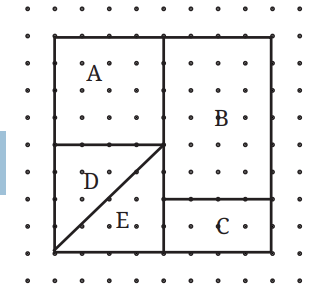
6. What percentage of area is occupied by the region marked ‘E’ in the figure?
7. What is 5% of 40? What is 40% of 5?
What is 25% of 12? What is 12% of 25?
What is 15% of 60? What is 60% of 15?
What do you notice?
Can you make a general statement and justify it using algebra, comparing x% of y and y% of x?
8. A school is organising an excursion for its students. 40% of them are Grade 8 students and the rest are Grade 9 students. Among these Grade 8 students, 60% are girls. [Hint: Drawing a rough diagram can help].
(i) What percentage of the students going to the excursion are Grade 8 girls?
(ii) If the total number of students going to the excursion is 160, how many of them are Grade 8 girls?
9. A shopkeeper sells pencils at a price such that the selling price of 3 pencils is equal to the cost of 5 pencils. Does he make a profit or a loss? What is his profit or loss percentage?
10. The bus fares were increased by 3% last year and by 4% this year. What is the overall percentage price increase in the last 2 years?
11. If the length of a rectangle is increased by 10% and the area is unchanged, by what percentage (exactly) does the breadth decrease by?
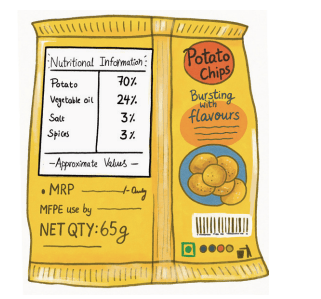
12. The percentage of ingredients in a 65 g chips packet is shown in the picture. Find out the weight each ingredient makes up in this packet.
13. Three shops sell the same items at the same price. The shops offer deals as follows:
Shop A: “Buy 1 and get 1 free”
Shop B: “Buy 2 and get 1 free”
Shop C: “Buy 3 and get 1 free”
Answer the following:
(i) If the price of one item is ₹100, what is the effective price per item in each shop? Arrange the shops from cheapest to costliest.
(ii) For each shop, calculate the percentage discount on the items. [Hint: Compare the free items to the total items you receive.]
(iii) Suppose you need 4 items. Which shop would you choose? Why?
14. In a room of 100 people, 99% are left-handed. How many left-handed people have to leave the room to bring that percentage down to 98%?
15. Look at the following graph.
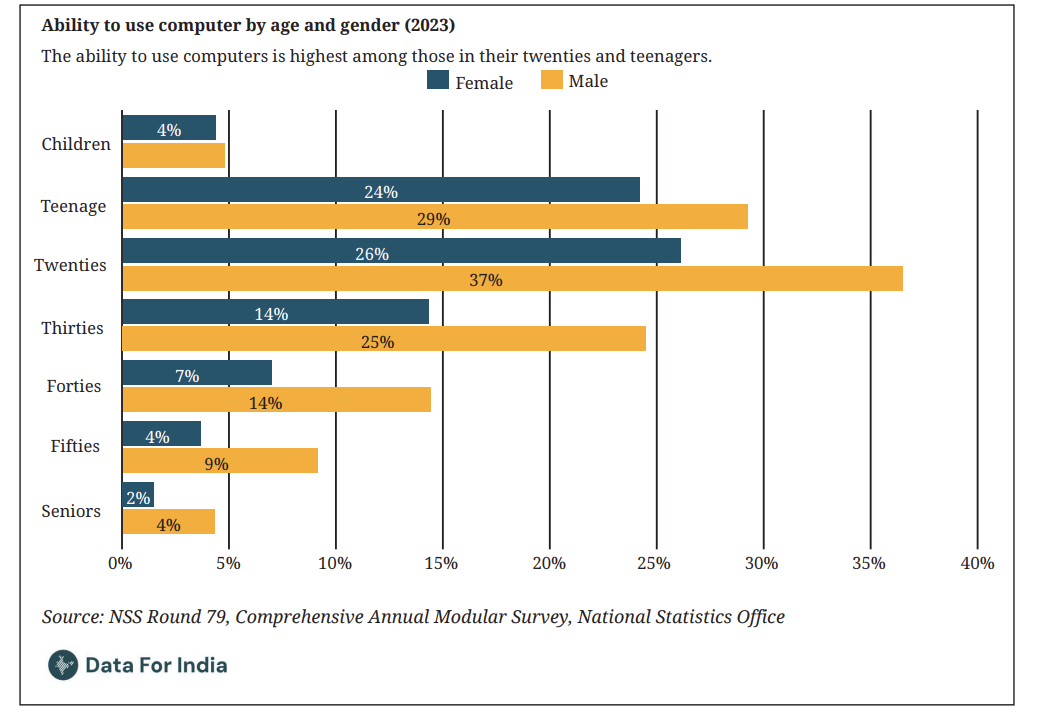
Based on the graph, which of the following statement(s) are valid?
(i) People in their twenties are the most computer-literate among all age groups.
(ii) Women lag behind in the ability to use computers across age groups.
(iii) There are more people in their twenties than teenagers.
(iv) More than a quarter of people in their thirties can use computers.
(v) Less than 1 in 10 aged 60 and above can use computers.
(vi) Half of the people in their twenties can use computers.
SUMMARY
- Percentages are widely used in our daily life.
- Percentages are fractions with denominator 100. Percentages are denoted using the symbol ʻ%ʼ, pronounced ʻper centʼ. x% = x/100.
- Fractions can be converted to percentages and vice versa. Decimals too can be converted to percentages and vice versa. For example,
4/10 = 0.4 = 40% - We have learnt to find the exact number when a certain percentage of the total quantity is given.
- When parts of a quantity are given to us as ratios, we have seen how to convert them to percentages.
- The increase or decrease in a certain quantity can also be expressed as a percentage.
- The profits or losses incurred in transactions, and tax rates, can be expressed in terms of percentages.
- We have seen how a quantity or a number grows when compounded. Interest rates are a common example of compounding. If p is the principal, r is the rate of interest, and t is the number of terms, then the total amount after the maturity period is
- A situation or a problem can often be solved by describing it using a rough diagram. We have learnt to estimate and do mental computations to solve problems related to percentages.
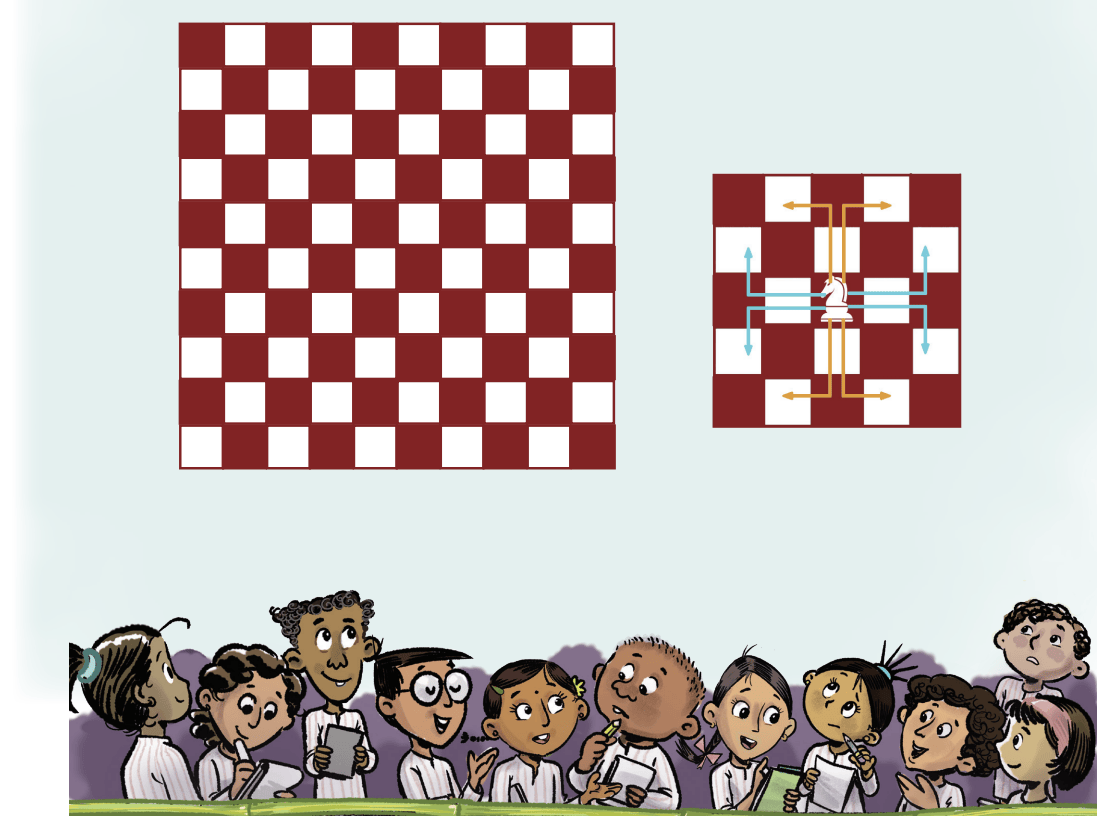
Peaceful Knights
Place 8 knights on the chess board so that no knight attacks another. A knight moves in an 'L-shape'. It can move either (a) two steps vertically and one step horizontally, or (b) two steps horizontally and one step vertically. Possible moves of a knight are shown below.