
Chapter-2
THE
BAUDHĀYANA-
PYTHAGORAS
THEOREM
2.1 Doubling a Square
In Baudhāyana’s Śulba-Sūtra (c. 800 BCE), Baudhāyana considers the following question:
? How can one construct a square having double the area of a given square?
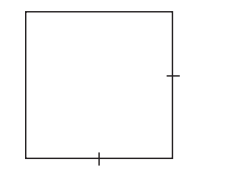
A first guess might be to simply double the length of each side of the square. Will this new square have double the area of the original square?
It’s not hard to see that the new square will have area 2 × 2 = 4 times the area of the original square:
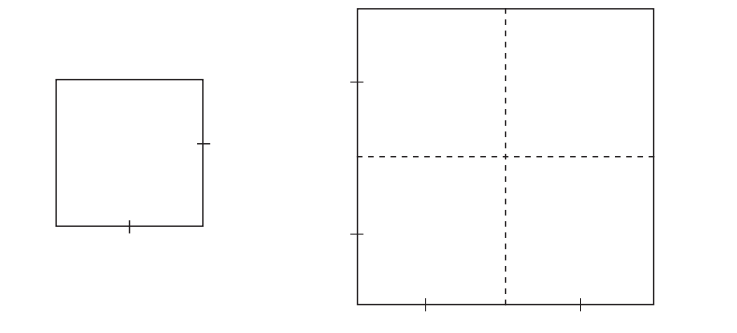
So how can one make a square that has double the area? Baudhāyana in his Śulba-Sūtra (Verse 1.9) gave an elegant answer to this question:
As Baudhāyana says, the key is to construct a square on the diagonal of the original square:
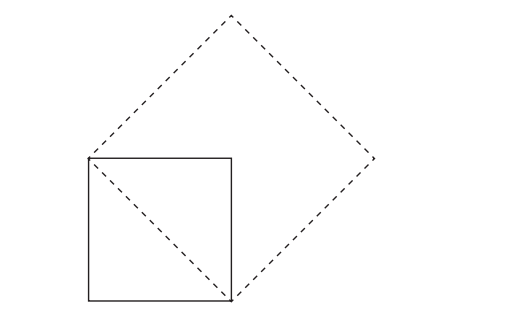
? Why does the new dotted square have double the area of the original square?
In many of the constructions in the Śulba-Sūtra, it is desirable to construct, where needed, what Baudhāyana calls ‘east-west’ and ‘north-south’ lines, i.e., horizontal and vertical lines that are perpendicular to each other. Can you draw some horizontal and vertical lines to see why the new square has double the area of the original square? You could draw some horizontal and vertical lines as shown on the right.
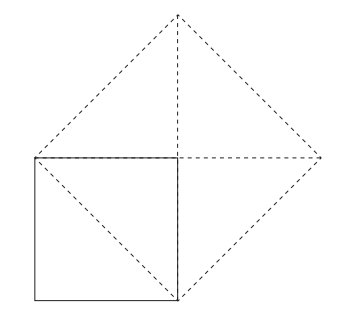
? Why should the extension of the vertical and horizontal sides of the original square pass through the vertices of the dotted square? [Hint: From the diagonal property of a square, the line that bisects an angle passes through the opposite vertex. Argue why the vertical and horizontal sides of the original square bisect the two angles of the dotted square.]
So, the new square has double the area of the original square, because the original square is made up of two small triangles, while the new square is made up of four small triangles.
? Moreover, all these small triangles are congruent to each other. Can you explain why?
Adding some more horizontal and vertical lines can make the situation even clearer:
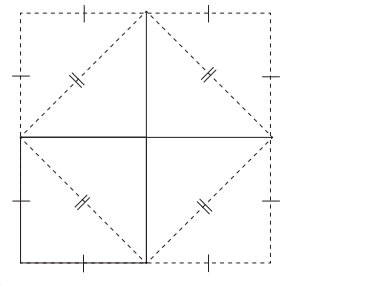
So we can make the following sequence of squares:
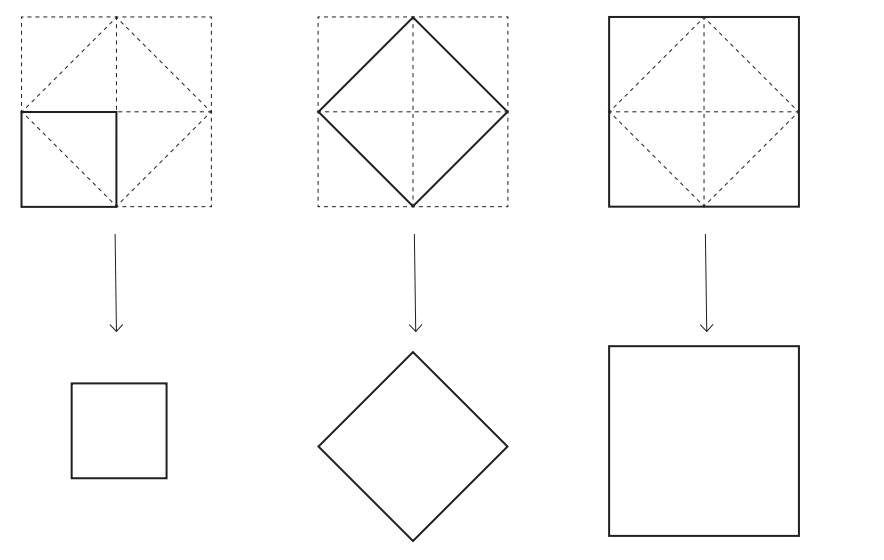
Each square has double the area of the previous one, as they are made up of 2, 4, and 8 small triangles, respectively
Doubling a Square Using Paper? Cut out two identical squares of paper. Draw, label, and cut as follows:
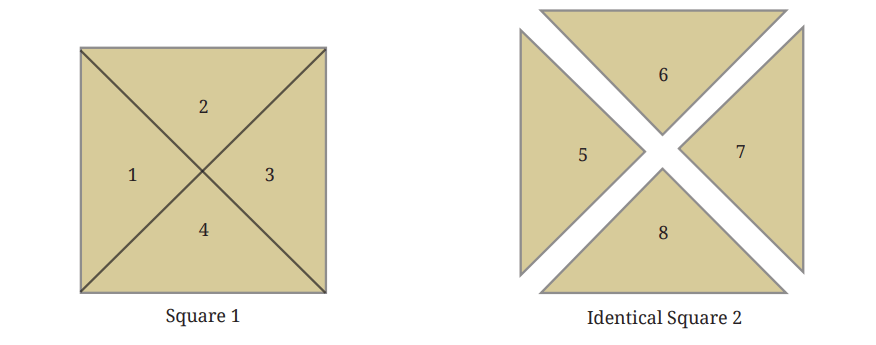
Now place the pieces 5, 6, 7, and 8 around Square 1 to get a square with double the area.
2.2 Halving a Square
? Now suppose we are given a square, and we want to construct a square whose area is half that of the original square. How would you do it?
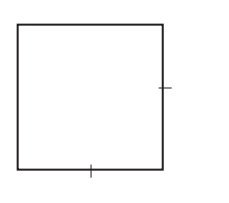
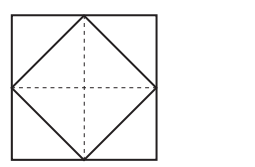
One way to do it is to reverse the construction of the previous section. We draw a tilted smaller square inside the larger one:
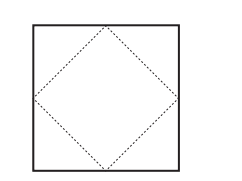
? Why is the smaller inside square half the area of the larger square? Again, adding some east-west and north-south lines can explain it:
 Halving a Square Using Paper
? Cut out a square from a piece of paper. Now make a square whose area is half the area of the first square.
? Will the square having half the sidelength have half the area? Why not? How many such squares will fill the original square?
Fold the square paper inward, as shown, such that the crease lines pass through the midpoints of the sides. PQRS is the required square with half the area.
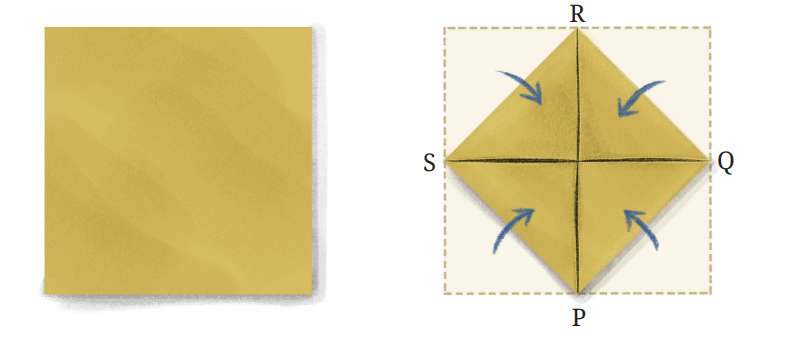
? Why is PQRS a square? Why is its area half that of the original paper?
Explain by connecting QS and PR, finding the different angles formed, and then using tringle congruence.
2.3 Hypotenuse of an Isosceles Right Triangle
Recall that in a right triangle, the side opposite to the right angle is called the hypotenuse.? Find the hypotenuse of this isosceles right triangle.
We know that a square of side 1 unit is made of two such isosceles right triangles. We also know that the square constructed on the diagonal of this square has twice the area of the original square.
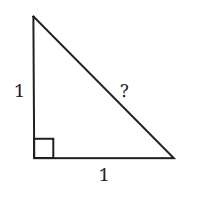
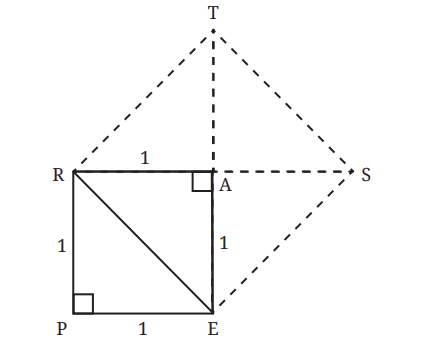
We do not yet know the length of the hypotenuse, but we know the area of the square REST on it!
Area of REST = 2 × Area of PEAR
= 2 × 1 = 2 sq. units.
We know the relation between the side and the area of a square. If c is the hypotenuse ER, then
Area of REST = c × c = c2 .
So, c2 = 2.
Therefore, c = √2.
Thus, the hypotenuse is of length √2 units.
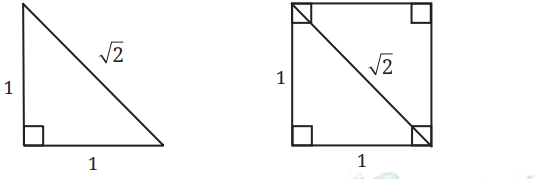
In the rest of this chapter, we will assume that all the lengths are of a fixed unit unless specified otherwise.
? What is the value of√2?
Decimal Representation of √2
The decimal representation of √2 can be found using the following argument.
Is √2 less than or greater than 1?
A square of sidelength 1 unit has an area of 1 sq. unit. A square of sidelength √2 has an area of 2 sq. units. So, 1 is less than √2. In other words, 12 = 1, and √22 = 2.
Therefore, 1 < √2.
? Is √2 less than or greater than 2?
A square of sidelength 2 units has an area of 4 sq. units. A square of sidelength √2 has an area of 2 sq. units. So, 2 is greater than √2. In other words,√22. = 2, and 22 = 4.
Therefore, √2<2
Thus, 1 <√2 <2
We call 1 a lower bound on √2 and 2 an upper bound.
? Can we find closer bounds for √2?
1.22 = 1.44
1.32 = 1.69
1.42 = 1.96
1.52 = 2.25
So, 1.4 < 2 < 1.5
1.422 = 2.0164
So, 1.41 < √2 < 1.42
1.4122 = 1.993744
1.4132 = 1.996569
1.4142 = 1.999396
1.4152 = 2.002225
So, 1.414 < √2 < 1.415
? Will we ever get a number with a terminating decimal representation whose square is 2?
If there is such a terminating decimal starting with 1.414… whose square is 2, then it must have a non-zero last digit. If this is the case, then the decimal representation of its square will also have a non-zero last digit after the decimal point. For example, if √2 is of the form 1.414…4, then its square will be of the form—
So a terminating decimal cannot have 2 or 2.000... as its square.
Thus, the decimal expansion of√2 must go on forever, i.e., it has a non-terminating decimal representation.
Can √2 be expressed as a fraction m/n , where m and n are counting numbers?
If √2 could be expressed as m/n , then we would have
√2= m/n
2 = m2/n2
2n2 = m2
Recall that in the prime factorization of a square number, each prime occurs an even number of times. So in the equation 2n2 = m2 , the prime 2 would occur an odd number of times on the left side and an even number of times on the right side. This is impossible. Thus √2 cannot be expressed as a fraction m/n .
This beautiful proof that √2 cannot be expressed as m/n where m, n are counting numbers was given by Euclid in his book Elements (c. 300 BCE). We will discuss it in more detail in a later class.
Thus the number √2 cannot be expressed as a terminating decimal or a fraction. But we can think of it as a certain non-terminating decimal: √2 = 1.41421356…
? Figure it Out
1. Earlier, we saw a method to create a square with double the area of a given square paper. There is another method to do this in which two identical square papers are cut in the following way
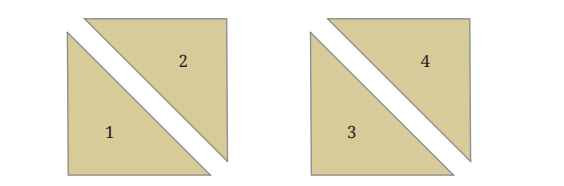
Can you arrange these pieces to create a square with double the area of either square?
2. The length of the two equal sides of an isosceles right triangle is given. Find the length of the hypotenuse. Find bounds on the length of the hypotenuse such that they have at least one digit after the decimal point.
(i) 3 (ii) 4 (iii) 6 (iv) 8 (v) 9
3. The hypotenuse of an isosceles right triangle is 10. What are its other two sidelengths? [Hint: Find the area of the square composed of two such right triangles.]
General Solution
The relation between the areas of a square and the square on its diagonal can be used to find a general relation between the hypotenuse and the other two sides of an isosceles right triangle.
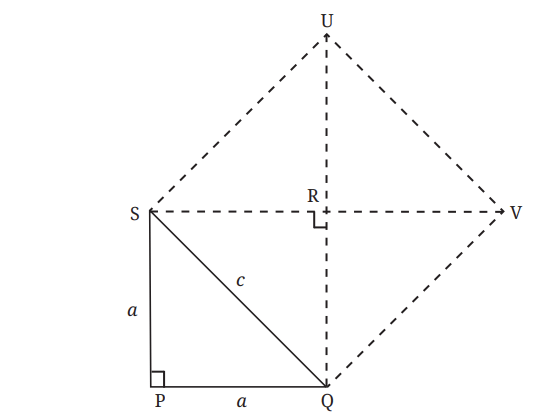
Let a be the length of the equal sides and c the length of the hypotenuse.
Area of SQVU = 2 × Area of PQRS
So, c2= 2a2 .
This formula can be used to find c when a is known, or to find a when c is known.
? Example 1: Find the hypotenuse of an isosceles right triangle whose equal sides have length 12.
We have a = 12. Using the formula, we get
c = √(2×122)=√288 .
We have 162= 256, and 172= 289.
So, √ 288 lies between 16 and 17.
The length of the hypotenuse of an isosceles right triangle, whose length of the equal sides is 12 units, is between 16 and 17 units.
? Example 2: If the hypotenuse of an isosceles right triangle is √72, find its other two sides.
We have c = √ 72. Using the formula, we get
c2 = 2a2
So, (√ 72) 2 = 2a272 = 2a2
.
Thus, a2= 72/2 = 36.
So, a = √ 36 = 6.
Therefore, each of the other two sides has length 6.
Use this formula to check your answers in the Figure it Out on page 39.
2.4 Combining Two Different Squares
We have seen in the previous sections how to combine two copies of the same square to make a larger square whose area is the sum of the areas of the two smaller squares.
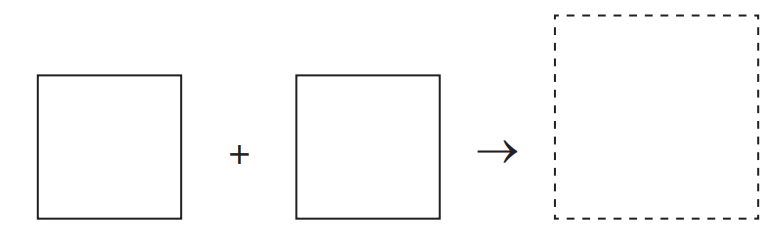
The sidelength of the larger square is the length of the diagonal of either of the smaller squares.
? What if we wish to combine two squares of ‘different’ sizes to make a large square whose area is the sum of the two smaller squares?
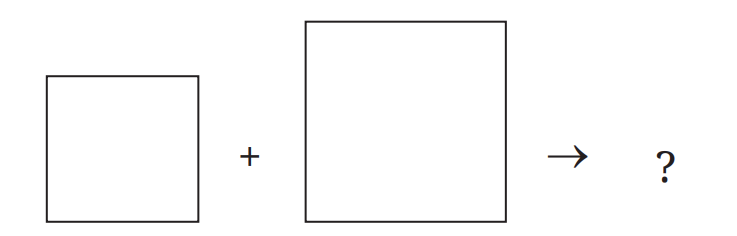
In his Śulba-Sūtra (Verse 1.12), Baudhāyana also gives a truly remarkable solution to this more general problem of combining two different sized squares. He writes:
That is, to combine two different squares, make a right-angled triangle whose perpendicular sides are the sidelengths of the two squares. The square whose sidelength is the hypotenuse of this right-angled triangle has an area that is the sum of the areas of the original two squares.
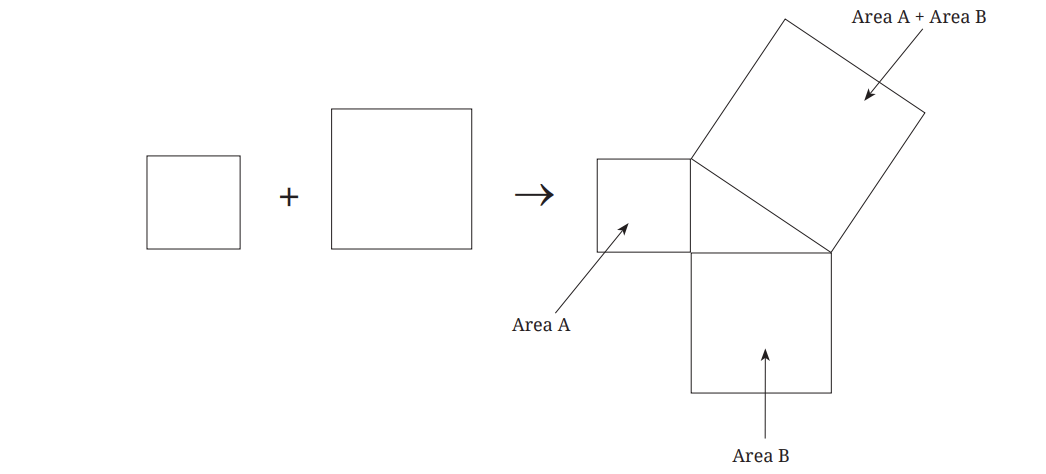
? Why does Baudhāyana’s method work?
? Can you see why the method works in the case where the two squares are the same size? Does it agree with the method we used earlier to combine two same sized squares into a bigger square?
Subsequently in his Śulba-Sūtra (Verse 2.1), Baudhāyana provides another verse that helps in explaining why the method works in general:
Let us follow Baudhayan᾽s instructions.
• Join the two squares.
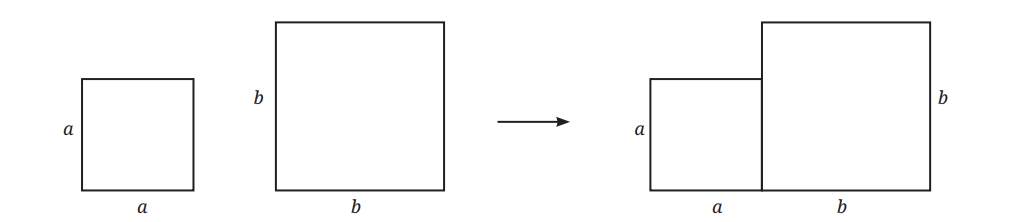
• Mark a rectangular portion of the larger square using a side of the smaller one, and draw its diagonal. By doing this, we get a right triangle with perpendicular sides a and b.
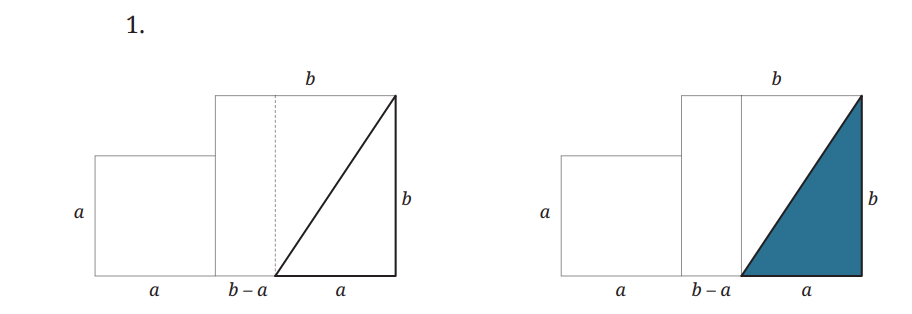
• Make a 4-sided figure over the hypotenuse by drawing three more of such right triangles:
2.
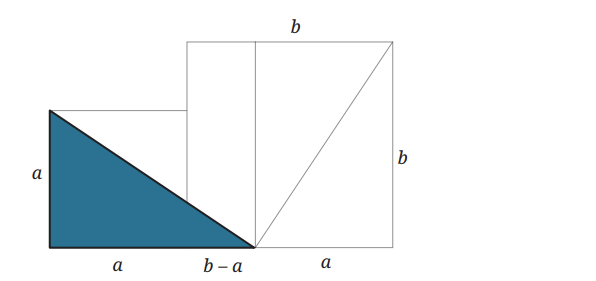
3.
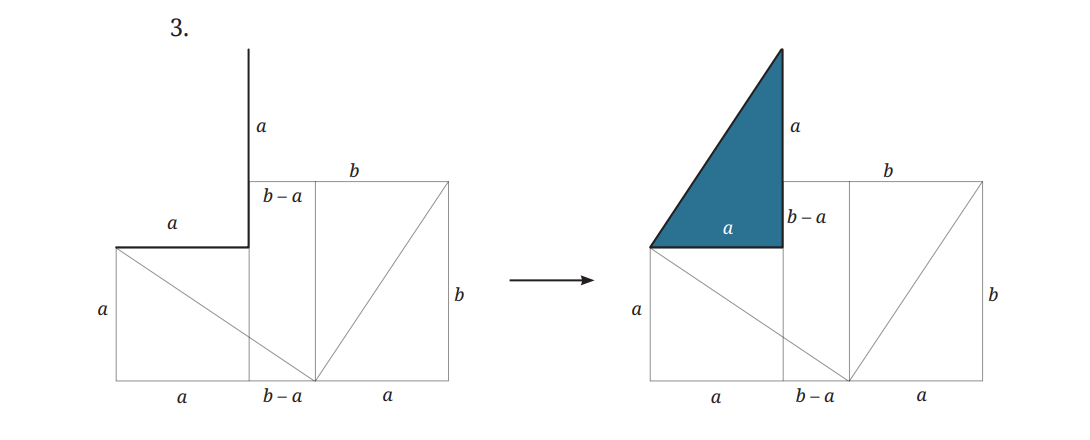
4.
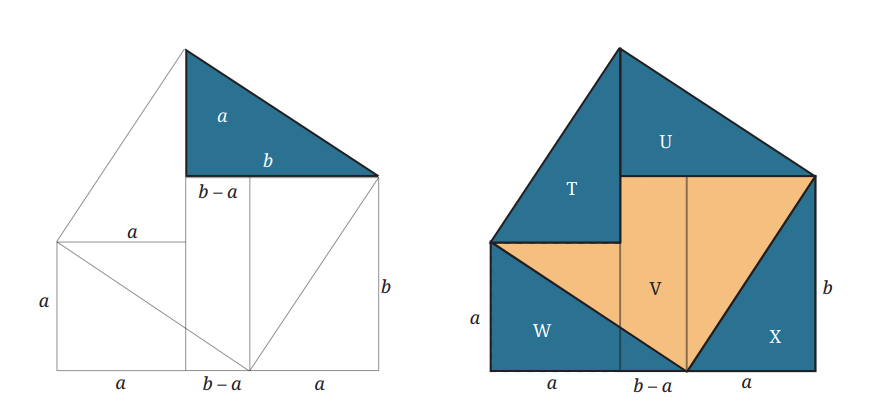
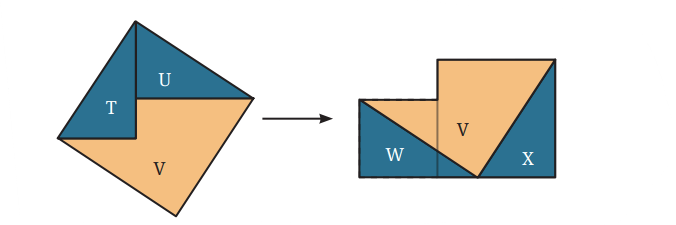
• The 4-sided figure obtained (T + U + V) is in fact a square with an area equal to the sum of the areas of the two smaller squares!
? Why?• As T, U, X and W are all congruent, the sides of this new 4-sided figure all have the same length. Notice the angles.
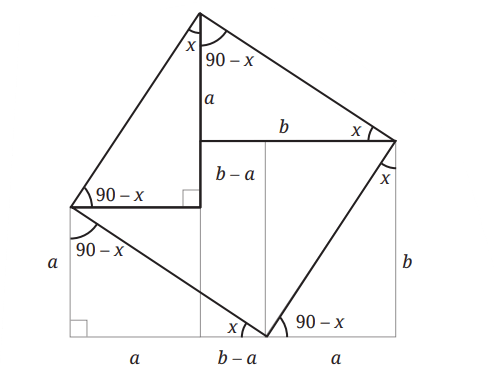
? Explain why all the angles of this new 4-sided figure are right angles and so it is a square.
Notice that this new square has as its sidelength, the hypotenuse of the right triangle of sides a and b.
Notice that this new square has as its sidelength, the hypotenuse of the right triangle of sides a and b.
• Baudhāyana’s assertion is now clear:
The area of the square on the hypotenuse = the sum of the areas of T, U, and V = the sum of the areas of V, W, and X = the sum of the areas of the two given squares.
 Combining Two Squares Using Paper
Cut out and join two different sized squares as follows:
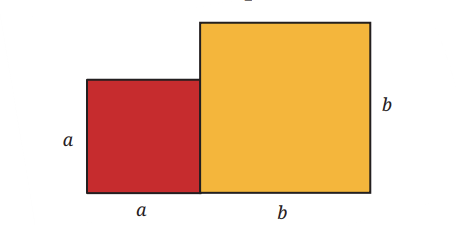
Now make two cuts to make three pieces:
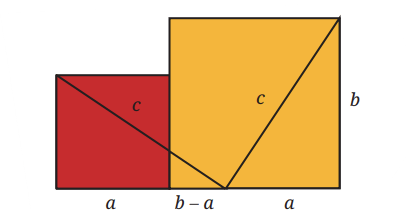
Rearrange the three pieces into a larger square:
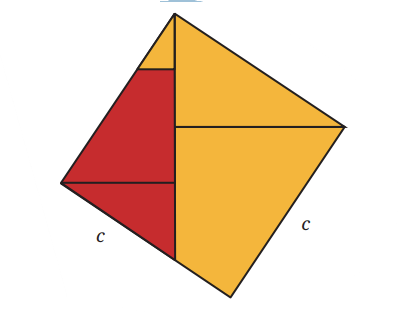
You have now combined two smaller squares into a larger square!
Now make a right triangle using the two smaller squares. Draw a square on the hypotenuse.
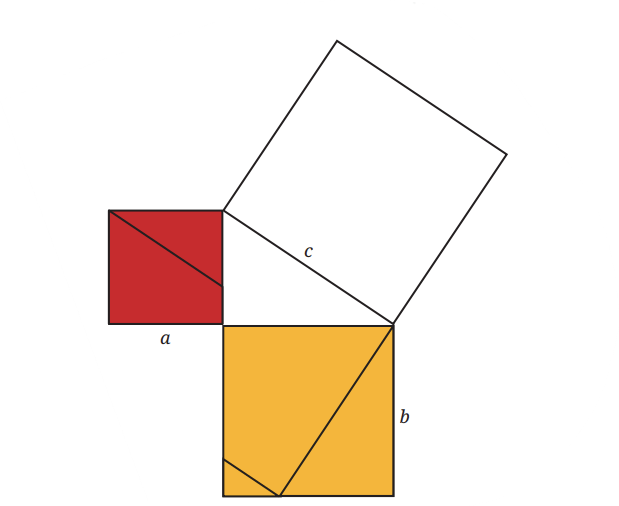
Cover the square on the hypotenuse using your pieces.
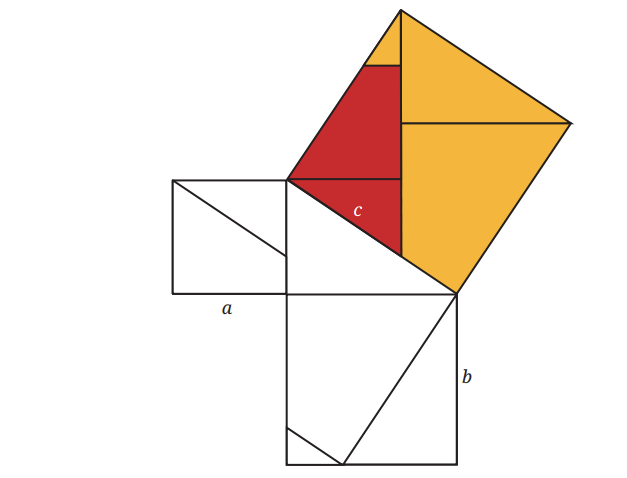
This shows that if a right triangle has shorter sides of length a and b, and hypotenuse of length c, then the areas of the two smaller squares, a2 and b2 , add up to the area of the larger square, c2 :
a2 + b2= c2
.This is the famous and fundamental theorem of Baudhāyana on right-angled triangles:
a2 + b2= c2
Baudhāyana was the first person in history to state this theorem in this generality and essentially modern form. The theorem is also known as the Pythagorean Theorem, after the Greek philosopher-mathematician Pythagoras (c. 500 BCE) who also admired and studied this theorem, and lived a couple hundred years after Baudhāyana. It is also often called the transitional name ‘Baudhāyana-Pythagoras Theorem’ so that everyone knows what theorem is being referred to.
Using Baudhāyana’s Theorem
Using Baudhāyana’s Theorem Make a right-angled triangle in your notebook whose shorter sidelengths are 3 cm and 4 cm. Now, measure the length of the hypotenuse. It should read about 5cm.
In fact, we could have used Baudhāyana’s Theorem to predict that the hypotenuse is exactly 5cm! Let a = 3 and b = 4, the lengths in cm of the two shorter sides. Then, by Baudhāyana’s Theorem, the length c of the hypotenuse satisfies the equation,
a2 + b2= c2
32+ 42= c2
9 + 16 = c2
25 = c2
So, c = 5 cm.
Figure it Out
1. If a right-angled triangle has shorter sides of lengths 5 cm and 12 cm, then what is the length of its hypotenuse? First draw the right-angled triangle with these sidelengths and measure the hypotenuse, then check your answer using Baudhāyana’s Theorem.
2. If a right-angled triangle has a short side of length 8 cm and hypotenuse of length 17 cm, what is the length of the third side? Again, try drawing the triangle and measuring, and then check your answer using Baudhāyana’s Theorem.
3. Using the constructions you have now seen, how would you construct a square whose area is triple the area of a given square? Five times the area of a given square? (Baudhāyana’s Śulba-Sūtra, Verse 1.10)
4. Let a, b and c denote the length of the sides of a right triangle, with c being the length of the hypotenuse. Find the missing sidelength in each of the following cases:
(i) a = 5, b = 7(ii) a = 8, b = 12
(iii) a = 9, c = 15
(iv) a = 7, b = 12
(v) a = 1.5, b = 3.5
2.5 Right–Triangles Having Integer Sidelengths
In his Śulba-Sūtra (Verse 1.13) Baudhāyana lists a number of integer triples (a, b, c) that form the sidelengths of a right-triangle and therefore satisfy a2+ b2= c2 . These include (3, 4, 5), (5, 12, 13) (8, 15, 17), (7, 24, 25), (12, 35, 37), and (15, 36, 39).
For this reason, such triples (a, b, c) that form the sidelengths of a right triangle (equivalently, satisfy a2+ b2= c2 ) are called Baudhāyana triples. They are also called Baudhāyana-Pythagoras triples, Pythagorean triples, and right-angled triangle triples.
? List down all the Baudhāyana triples with numbers less than or equal to 20.
? Is there an unending sequence of Baudhāyana triples?
Mathematicians have answered this question and have found a method to generate all such triples! Let us take a few steps in this direction.
We have seen that (3, 4, 5) is a Baudhāyana triple.
? Is (30, 40, 50) a Baudhāyana triple?
Is (300, 400, 500) a Baudhāyana triple?
The list of Baudhāyana triples having numbers less than or equal to 20 contains the following triples —
(3, 4, 5), (6, 8, 10), (9, 12, 15), (12, 16, 20).
? Do you see any pattern among them?
All these triples can be obtained by multiplying each term of (3, 4, 5) by a certain positive integer.
? Can we form a conjecture on Baudhāyana triples based on this observation?
Conjecture: (3k, 4k, 5k) is a Baudhāyana triple, where k is any positive integer.
? Is this true?
We have to check if (3k)2 + (4k)2= (5k)2.We have (3k)2 + (4k)2= 9k2 + 16k2 = 25k2 , which is equal to (5k)2.
So, (3k, 4k, 5k) is indeed a Baudhāyana triple.
This shows that there are infinitely many Baudhāyana triples.
Can we further generalise the conjecture?
? If (a, b, c) is a Baudhāyana triple, then (ka, kb, kc) is also a Baudhāyana triple where k is any positive integer. Is this statement true?
This statement can be shown to be true in the same way. Since (a, b,c) is a Baudhāyana triple, we have a2 + b2= c2 . We need to check whether
(ka)2+ (kb)2 = (kc)2.
(ka)2= ka × ka = k2 a2 , and (kb)2 = kb × kb = k2 b2.
So, (ka)2 + (kb)2 = k2 a2 + k2 b2.Taking out the common factor, we have
(ka)2 + (kb)2 = k2 (a2 + b2).Since a2 + b2 = c2 , we have
(ka)2 + (kb)2 = k2 c2 = (kc)2.
Thus, (ka, kb, kc) is a Baudhāyana triple if (a, b, c) is a Baudhāyana triple. We call (ka, kb, kc) a scaled version of (a, b, c).
? A Baudhāyana triple that does not have any common factor greater than 1 is called a primitive Baudhāyana triple. So, (3, 4, 5) is primitive, whereas (9,12,15) is not.
? Is (5, 12, 13) a primitive Baudhāyana triple? What are the other primitive Baudhāyana triples with numbers less than or equal to 20?
? Generate 5 scaled versions of each of these primitive triples. Are these scaled versions primitive?
? If (a, b, c) is non-primitive, and the integers have f — greater than 1 — as a common factor, then is (a/f, b/f, c/f) a Baudhāyana triple? Check this statement for (9, 12, 15). Justify this statement.
? If we can find all the primitive triples, we can find all the Baudhāyana triples.
? How do we generate more primitive triples?
We know the relation between the sum of consecutive odd numbers and square numbers.
1 = 12
1 + 3 = 22
1 + 3 + 5 = 32
The sum of the first n odd numbers is n2 . Let us express this algebraically.
? For this, we need to know the nth odd number. What is it?
The nth odd number is 2n – 1. So,
1 + 3 + 5 + … + (2n – 3) + (2n – 1) = n2
Sum of first (n – 1) odd numbers
Thus,
(n – 1)2 + (2n – 1) = n2 .
Note that this equation could also have been directly obtained by expanding (n – 1)2 and adding 2n – 1 to it.
If the nth odd number, 2n – 1, is also a square number, then we have a sum of two square numbers equal to another square number. We will use this idea to generate Baudhāyana triples.
1. 9 is an odd square. It is the 5th odd number (9 = 2 × 5 – 1). So, we have
1 + 3 + 5 + 7 + 9 = 52
42 + 32 = 52
? Could we have obtained this triple using the equation (n – 1)2 + (2n – 1) = n2
? Since we took the 5th odd number, the value of n is 5. Substituting n = 5 into the equation, we get
(5 – 1)2 + 9 = 52
42+ 32 = 52.
2. 25 is an odd square. It is the 13th odd number (25 = 2 × 13 – 1). So,
| 1 + 3 + 5 + … + 23 + 25 = 132 122 + 52= 132 |
We have n = 13. Substituting this value in the equation, we get (13 – 1)2 + 25 = 132 122 + 52 = 132 |
?Figure it Out
1. Find 5 more Baudhāyana triples using this idea.
2. Does this method yield non-primitive Baudhāyana triples? [Hint: Observe that among the triples generated, one of the smaller sidelengths is one less than the hypotenuse.]
3. Are there primitive triples that cannot be obtained through this method? If yes, give examples.
2.6 A Long-Standing Open Problem
The study of Baudhāyana triples inspired the great French mathematician Fermat — who lived during the 17th century — to make a general statement about the sum of powers of positive integers.
We have seen that there are an infinite number of square numbers that can be written as a sum of two square numbers. This made Fermat wonder if there is a perfect cube that can be written as a sum of two perfect cubes, a fourth power that can be written as a sum of two fourth powers, and so on. In other words, he wondered if there is a solution to the equation
xn + yn= zn,
where x, y, and z are natural numbers, and n > 2.
In the margin of a book that dealt with properties and patterns of positive integers (like that of Baudhāyana triples), Fermat wrote that amongst the unending sequence of numbers, one cannot find a single perfect cube that is a sum of two perfect cubes, a fourth power that is a sum of two fourth powers, and so on. So, the equation has no solution for powers greater than 2. In addition to stating this, Fermat wrote,
“I have found a truly marvellous proof of this statement, but the margin is too small to contain it”.

No one could ever find Fermat’s proof of this statement, which is called Fermat’s Last Theorem.
After his death, many great mathematicians tried their hand at proving this theorem. There followed more than 300 years of failed attempts in proving it.
In 1963, a 10-year-old boy named Andrew Wiles read a book (The Last Problem by Eric Bell) about Fermat’s Last Theorem and its history. Despite reading about the failures of so many great mathematicians, this young boy resolved to prove this theorem.
He eventually did prove this theorem in 1994!
2.7 Further Applications
of the BaudhāyanaPythagoras
Theorem
The Baudhāyana-Pythagoras theorem is one of the fundamental theorems of geometry. Let us see some of its applications
A Problem from Bhāskarāchārya’s Līlāvatī
The following is a translation of a problem from Bhāskarāchārya’s (Bhāskara II) Līlāvatī. Try to visualise what you read.
?“In a lake surrounded by chakra and krauñcha birds, there is a lotus flower peeping out of the water, with the tip of its stem 1 unit above the water. On being swayed by a gentle breeze, the tip touches the water 3 units away from its original position. Quickly tell the depth of the lake.”
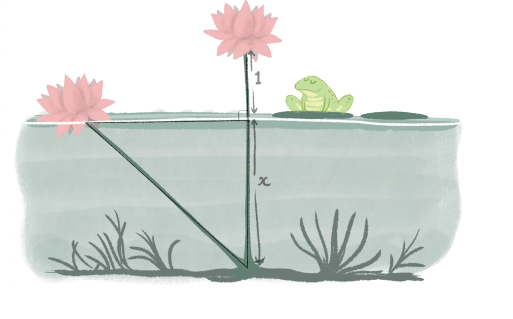
At first glance, it seems like there is insufficient data to find the solution. But the solution exists!
Let x be the length of the stem inside the water. This is the required depth of the lake. Since the stem of the lotus is sticking 1 unit above the water, the total length of the stem is x + 1.
We can make a (very reasonable) assumption that the lotus stem is perpendicular to the surface of the water in the first position. With this assumption, we get a right triangle of sides 3, x and x + 1. As this satisfies the Baudhāyana-Pythagoras theorem, we have
32 + x2 = (x + 1)2
9 + x2 = x2 + 2x + 1.
Subtracting x2 from both sides, we get
9 = 2x + 1.
x = 4.
Thus, the depth of the lake is 4 units.
?Figure it Out
1. Find the diagonal of a square with sidelength 5 cm.
2. Find the missing sidelengths in the following right triangles:
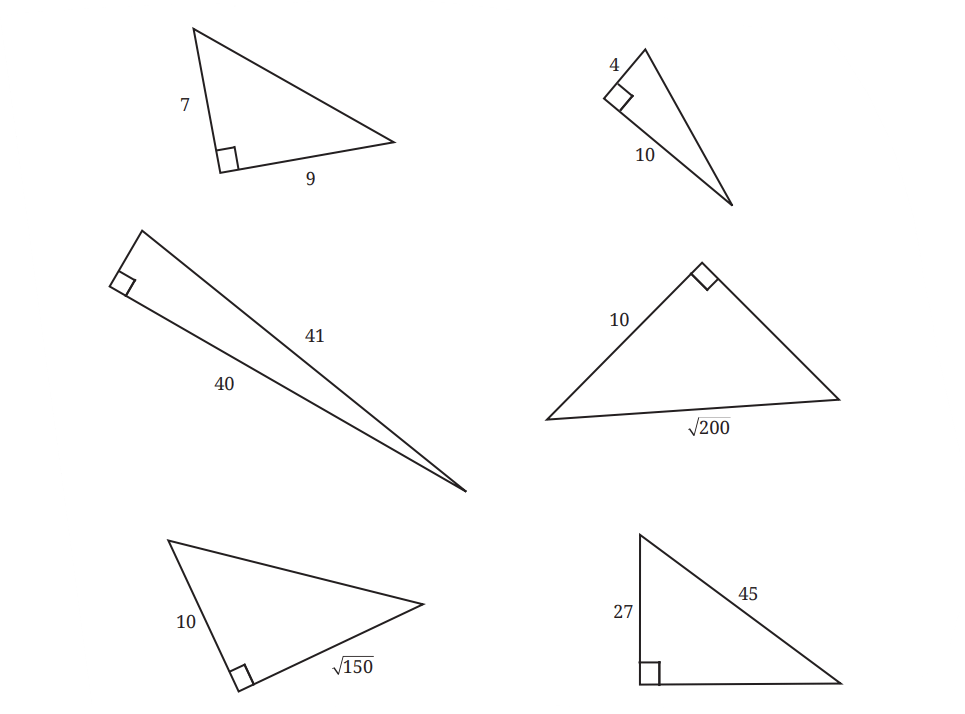
3. Find the sidelength of a rhombus whose diagonals are of length 24 units and 70 units.
4. Is the hypotenuse the longest side of a right triangle? Justify your answer.
5. True or False—Every Baudhāyana triple is either a primitive triple or a scaled version of a primitive triple.
6. Give 5 examples of rectangles whose sidelengths and diagonals are all integers.
7. Construct a square whose area is equal to the difference of the areas of squares of sidelengths 5 units and 7 units.
8. (i) Using the dots of a grid as the vertices, can you create a square that has an area of (a) 2 sq. units, (b) 3 sq. units, (c) 4 sq.units, and (d) 5 sq. unit?
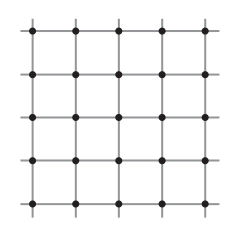
(ii) Suppose the grid extends indefinitely. What are the possible integer-valued areas of squares you can create in this manner?
9. Find the area of an equilateral triangle with sidelength 6 units. [Hint: Show that an altitude bisects the opposite side. Use this to find the height.]
- The Baudhāyana-Pythagoras Theorem is one of the most fundamental theorems in geometry. It expresses the relationship among the three sides of a right-angled triangle.
- If a, b, c, are the sidelengths of a right-angled triangle, where c is the length of hypotenuse, then a2 + b2= c2.
- In an isosceles triangle with sidelengths a, a, c, we have the relation a2 + a2 = 2a2 = c2, i.e., c = a √2 .
- The number √2 lies between 1.414 and 1.415. However, it cannot be expressed as a terminating decimal. It also cannot be expressed as a fraction m/n with m, n positive integers.
- A triple (a, b, c) of positive integers satisfying a2 + b2 = c2 is called a Baudhāyana-Pythagoras triple. Examples include (3, 4, 5), (6, 8, 10), and (5, 12, 13). Infinitely many such triples can be constructed.
- The equation an + bn = cn has no solution in positive integers when n>2. This is known as ‘Fermat’s Last Theorem’. It was proven by Andrew Wiles in 1994.
IT'S PUZZLE TIME!
Find the Colours!
There are 3 closed boxes-one containing only red balls, the second containing only blue balls and the third containing only green balls. The boxes are labelled RED, BLUE and GREEN such that 'no' box has the correct label. We need to find which label goes with which box. How can this be done if we are allowed to open only one box?
