Chapter-8
AREA
7.1 Rectangle and Squares
? How many different ways can you divide a square into 4 parts of equal area?
One can actually think of infinitely many such ways! Consider a division, such as
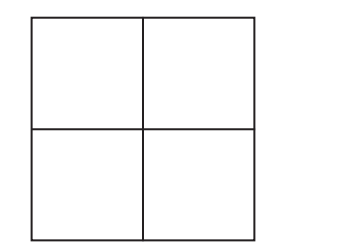
and alter each part as follows.
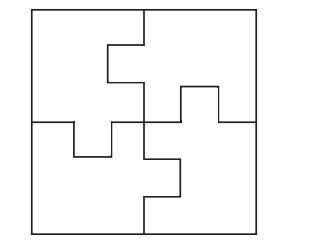
In each part, the area is compressed along one edge and expanded along another edge. If both the compression and expansion are of the same magnitude, then all 4 parts still have the same area!
? Try to think of different creative ways to divide a square into 4 parts of equal area.
You might have seen the rangoli art form, in which regions of different shapes are beautifully coloured using rangoli powder.

? Which of these rectangles requires more rangoli powder to be coloured, if the colouring is done evenly?
We can answer this by counting the number of non-overlapping unit squares (squares of sidelength 1 cm in this case) that can be packed into each of the rectangles.
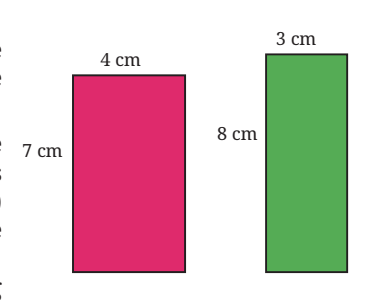
Clearly, the rectangle having sidelengths 7 cm and 4 cm contains 7 * 4 = 28 unit squares, and the rectangle having sidelengths 8 cm and 3 cm contains 8 * 3 = 24 unit squares.
Thus, the rectangle of sidelengths 7 cm and 4 cm requires more powder to be coloured.
Recall that we measure the area of a region by finding the number of unit squares (which can also be a fraction) whose area equals that of the given region.
We have seen that the number of unit squares contained in a rectangle is given by the product of its length and width-
Area of a rectangle = length × width.
The areas of the rectangles as seen in the previous problem are generally written as 28 sq. cm and 24 sq. cm, or as 28 cm² and 24 cm².
? What is the area of each triangle in this rectangle?
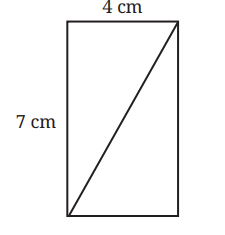
We have seen that the diagonal of a rectangle divides it into two congruent triangles. So, the area of each triangle is half the area of the rectangle.
In terms of unit squares, half the area fills exactly half the number of unit squares.
So the area of each triangle is 1/2 * 7 * 4 = 14 cm2.
Why Can't Perimeter be a Measure of Area?
? Why do we count the number of unit squares to assign measures for area? Couldn't we have just used the perimeter of a region, i.e., the length of its boundary as a measure of its area?
? If two regions have the same perimeter, can't we conclude that they have the same area? Or, if one region has a larger perimeter than another region, can't we conclude that it also has a larger area?
The perimeter of a region is not indicative of its area. The reason is that regions can have the same perimeter but different areas, and vice versa.
We can even find two regions, Region 1 and Region 2, such that
Perimeter of Region 1 > Perimeter of Region 2, but
Area of Region 1 < Area of Region 2.
? Find two rectangles that are examples of such regions. If needed, use a grid paper (given at the end of the book) for this.
? Also give an example of two regions of other shapes, where the region with the larger perimeter has the smaller area! This property should be visually clear in your example.
? Figure it Out
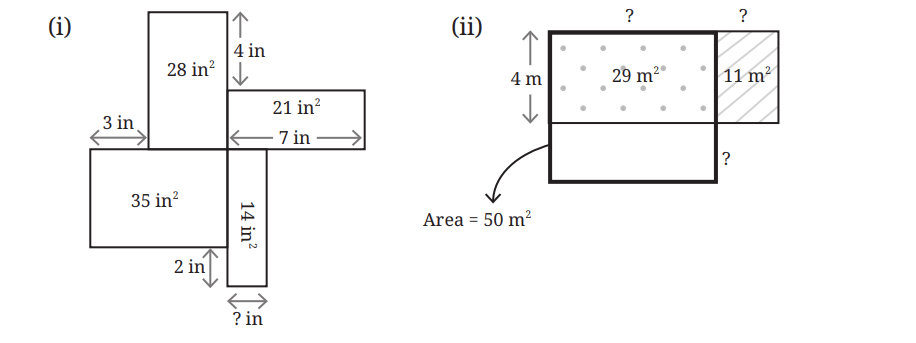
1. Identify the missing sidelengths.
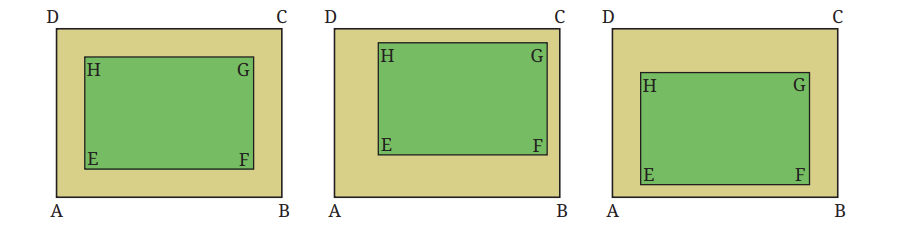
2. The figure shows a path (the shaded portion) laid around a rectangular park EFGH.
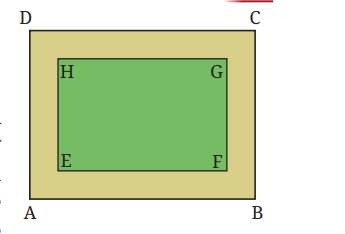
- (i) What measurements do you need to find the area of the path? Once you identify the lengths to be measured, assign possible values of your choice to these measurements and find the area of the path. Give a formula for the area.
- An example of a formula - Area of a rectangle = length × width. [Hint: There is a relation between the areas of EFGH, the path, and ABCD.]
- (ii) If the width of the path along each side is given, can you find its area? If not, what other measurements do you need? Assign values of your choice to these measurements and find the area of the path. Give a formula for the area using these measurements. [Hint: Break the path into rectangles.]
- (iii) Does the area of the path change when the outer rectangle is moved while keeping the inner rectangular park EFGH inside it, as shown?
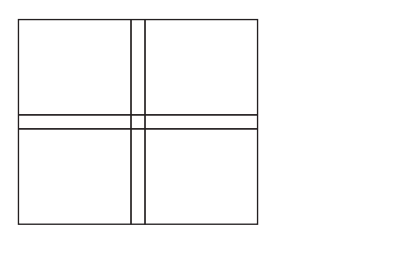
3. The figure shows a plot with sides 14m and 12m, and with a crosspath. What other measurements do you need to find the area of the crosspath? Once you identify the lengths to be measured, assign some possible values of your choice and find the area of the path. Give a formula for the area based on the measurements you choose.
4. Find the area of the spiral tube shown in the figure. The tube has the same width throughout.
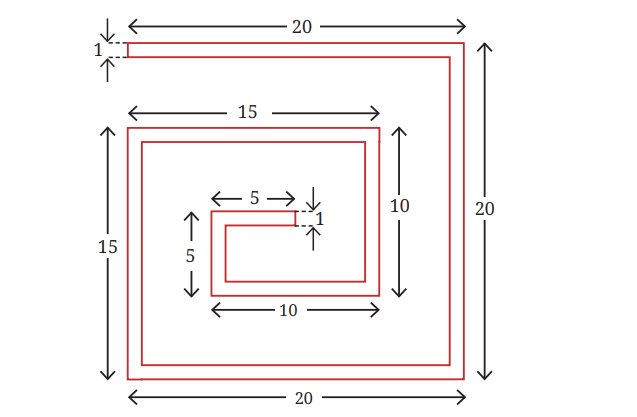
[Hint: There are different ways of finding the area. Here is one method.]
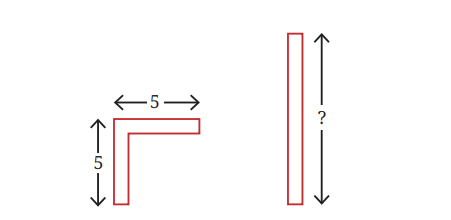
What should be the length of the straight tube if it is to have the same area as the bent tube on the left?
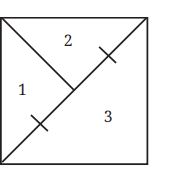
5. In this figure, if the sidelength of the square is doubled, what is the increase in the areas of the regions 1, 2 and 3? Give reasons.
6. Divide a square into 4 parts by drawing two perpendicular lines inside the square as shown in the figure.
Rearrange the pieces to get a larger square, with a hole inside.
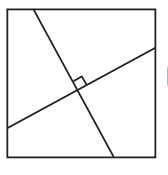
You can try this activity by constructing the square using cardboard, thick chart paper, or similar materials.
Triangles
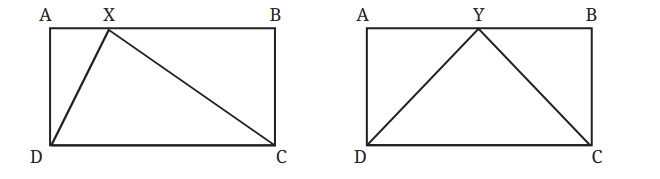
? In the given figure, which triangle has a greater area: triangle ∆XDC or triangle ∆YDC, , if both the rectangles are identical?
? In the given figure, which triangle has a greater area: triangle ∆XDC or triangle ∆YBC if both the rectangles are identical?
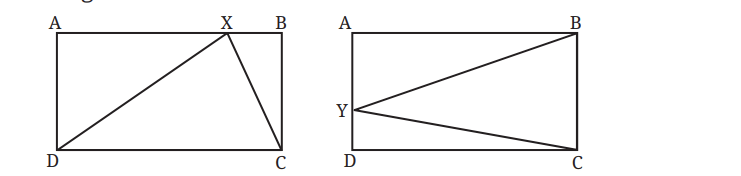
In each case, by dropping the altitudes from X and Y, it becomes clear that each triangle has exactly half the area of the rectangle ABCD.
? Find the area of ∆ XDC.
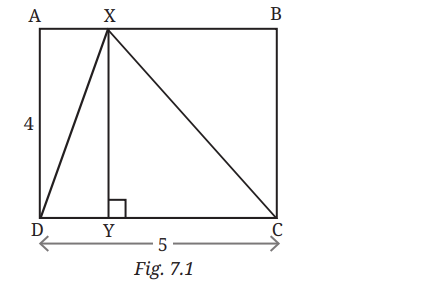
? To find the area of a triangle, what measurements do we need?
We need the sidelengths of the outer rectangle, as in Fig. 7.1.
? How do we get the outer rectangle from the given triangle?
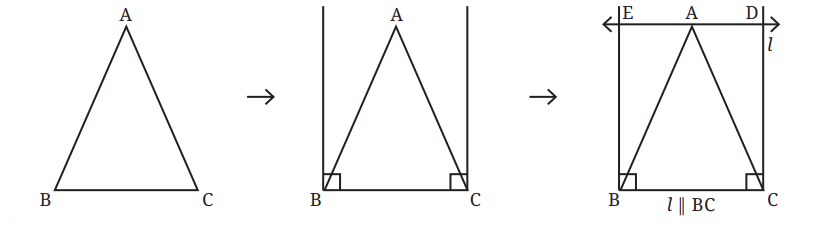
BCDE is a rectangle (how?). Let us take its sidelengths to be height and base. Then,
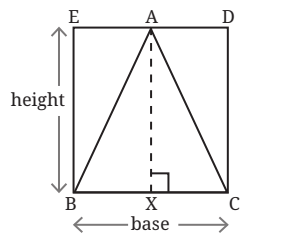
Area (∆ABC) = 1/2× base × height
Since BXAE is a rectangle (how?), the height of the rectangle is the same as the height of the triangle.
Thus, if the height and the base of a triangle are known, we can find its area. .
Area of a triangle = 1/2 × base × height
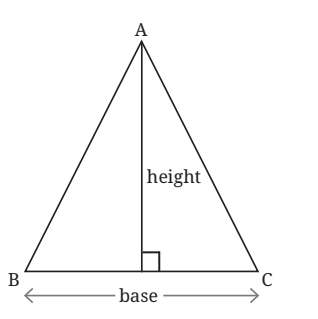 ? Will this formula hold for the kind of triangle, around which we cannot draw a rectangle with BC as the base?
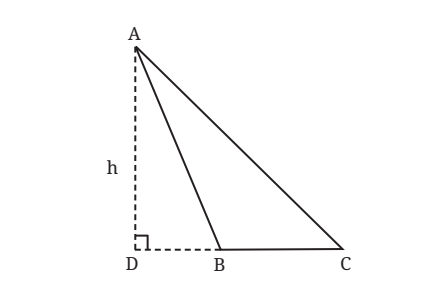
Here is one way to look at it. The area of AABC is the difference of the areas of AADC and AADB, each of which can be enclosed in a rectangle, as in Fig. 7.1.
Area ( ∆ABC) = (1/2) × h × DC-(1/2) × h× DB
= (1/2) × h (DC-DB)
= (1/2)× h × BC
Thus, the area formula holds for all types of triangles.
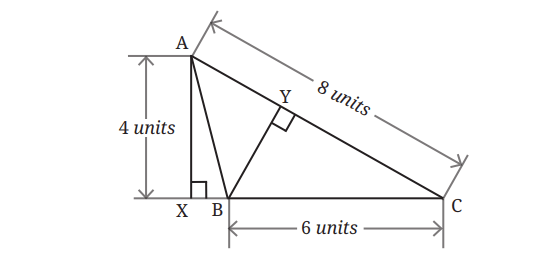
Some Applications of the Area Formula? Find BY.
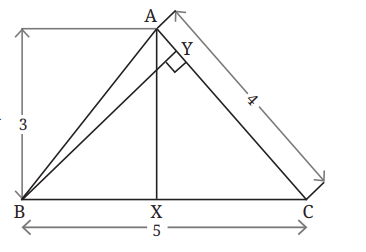
BY can be found using the formula for the area of a triangle.
What is Area ( ∆ABC )?
Area (∆ABC) = (1/2) × AX × BC = 15/2 sq. units.The area of the triangle can also be written as
Area (∆ABC) = (1/2) × BY × AC = (1/2) × 4 × BY = 2 BY.
Thus,2BY = 15/2
So, BY = 15/4 = 3.75 units.
? Are the 4 triangles obtained by drawing the diagonals of a rectangle (regions 1-4 in the figure) of equal areas?
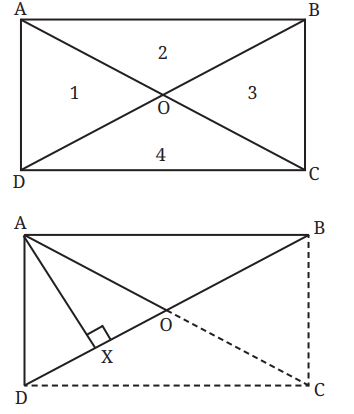
Clearly, the triangles 1-4 are not four congruent triangles.
To compare their areas, let us consider any two adjacent triangles, say 1 and 2.
Since the area of a triangle depends on its height and the base, let us consider suitable height-base pairs in each of the triangles. If OD and OB are taken as the bases, then we see that both triangles have the same altitude!
We also have OB = OD since the diagonals of a rectangle bisect each other. So, the triangles 1 and 2 have equal areas.
Arguing this way, we can show that all four triangles have equal areas.
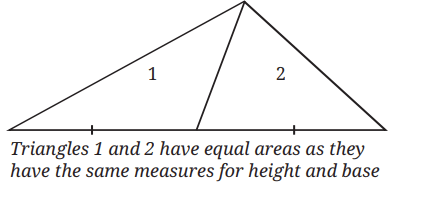
From this problem, we can make the following general statement.
In a triangle, the line joining a vertex to the midpoint of its opposite side divides the triangle into two triangles of equal areas.
Triangles between Parallel Lines with a Common Base
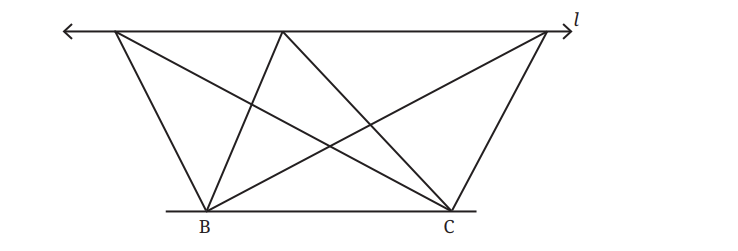
? Line I||BC. Consider the different triangles that have BC as their base, and with their third vertex lying anywhere on l.
- (i) Which of these triangles has the maximum area, and which has the minimum area?
- (ii) Which of these triangles has the maximum perimeter, and which has the minimum perimeter?
Here, we will only show how to find the triangle with the minimum perimeter, and leave the other questions as exercises.
Intuition might suggest that the triangle with the minimum perimeter can be obtained by constructing the perpendicular bisector of BC.
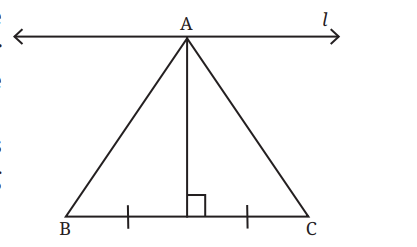
But how do we justify that this triangle has the least perimeter among all the triangles?
Firstly, note that in all these triangles, BC is a common side. Therefore, it is enough to consider the sum of the other two sides.
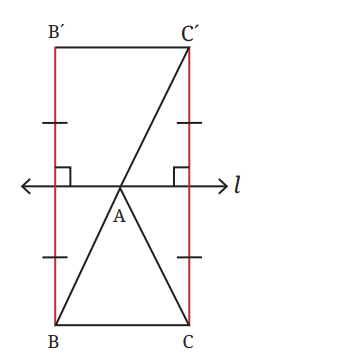
Let us imagine the line l as a mirror. Then we get a reflection of all the points and lines below it.
While studying the properties of a plane mirror, we experimentally observed that the distance of the image behind the mirror is the same as the distance of the object (that creates the image) in front of the mirror. This law can be used to locate the reflections of the points lying below the line l.
? What can we say about the lengths of AB and its reflection AB ́?
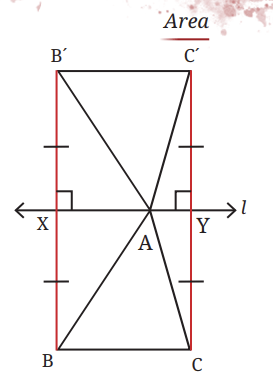
Since ∆AXB ≅ ∆AXB ́, AB = AB ́.
Similarly, AC = AC ́.
Therefore, the length of the path B→ A →C is the same as the length of the path B→ A→ C' ́.
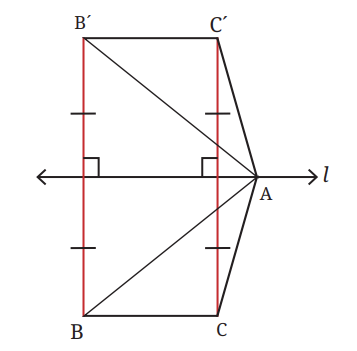 This is true no matter where point A is
on line l.
This is true no matter where point A is
on line l.
So, finding point A that gives the shortest possible path B→ A →C is the same as finding a point A that gives the shortest possible path B→ A →C ́.
But the solution to the latter problem is clear — choose A on the straight line BC ́, since BC ́ is the shortest possible path from B to C ́.
Therefore, this triangle ∆ABC has the minimum perimeter.
? Analyse whether A lies on the perpendicular bisector of BC.
? Figure it Out
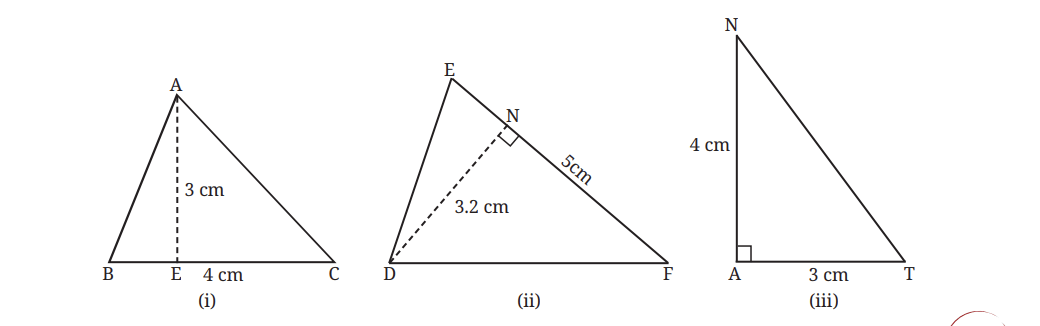
1. Find the areas of the following triangles:
2. Find the length of the altitude BY.
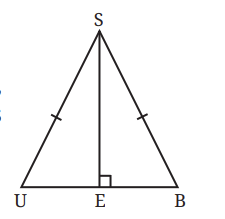
3. Find the area of ∆SUB, given that it is isosceles, SE is perpendicular to UB, and the area of ∆SEB is 24 sq. units.
In the Śulba-Sūtras, which are ancient Indian geometric texts that deal with the construction of altars, we can find many interesting problems on the topic of areas. When altars are built, they must have the exact prescribed shape and area. This gives rise to problems of the kind where one has to transform a given shape into another of the same area. The Śulba-Sūtras give solutions to many such problems.
Such problems are also posed and solved in Euclid’s Elements. Here are two problems of this kind.
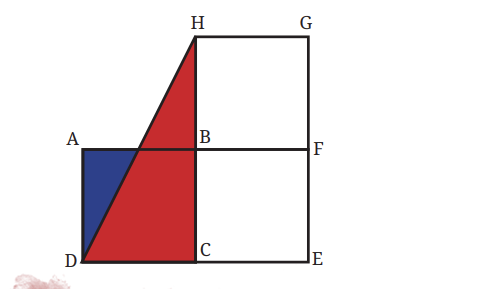
4. [Śulba-Sūtras] Give a method to transform a rectangle into a triangle of equal area. 5. [Śulba-Sūtras] Give a method to transform a triangle into a rectangle of equal area.6. ABCD, BCEF, and BFGH are identical squares.
- (i) If the area of the red region is 49 sq. units, then what is the area of the blue region?
- (ii) In another version of this figure, if the total area enclosed by the blue and red regions is 180 sq. units, then what is the area of each square?
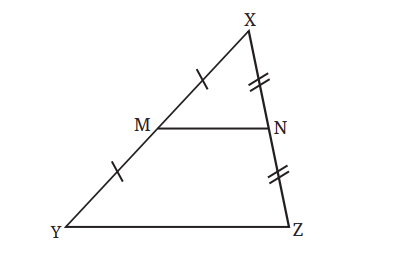
7. If M and N are the midpoints of XY and XZ, what fraction of the area of ∆XYZ is the area of ∆XMN? [Hint: Join NY]
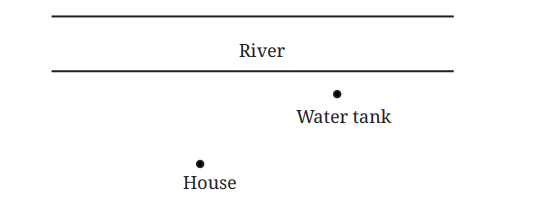
8. Gopal needs to carry water from the river to his water tank. He starts from his house. What is the shortest path he can take from his house to the river and then to the water tank? Roughly recreate the map in your notebook and trace the shortest path.
Area of any Polygon
? How do we find the area of this quadrilateral? What measurements do we need for this?
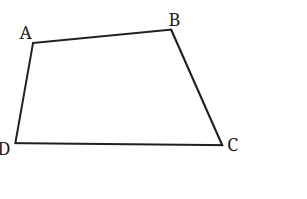
If we join BD, the quadrilateral ABCD gets divided into two triangles. By finding their areas, we can find the area of ABCD.
? How do we find the area of this pentagon?
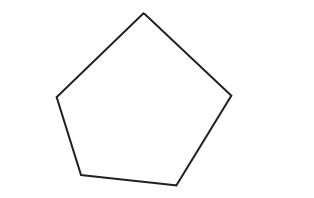
? Can any polygon be divided into triangles?
It can be seen that any polygon can be divided into triangles. Thus, by knowing how to compute the area of a triangle, we can find the area of any polygon.
? Figure it Out
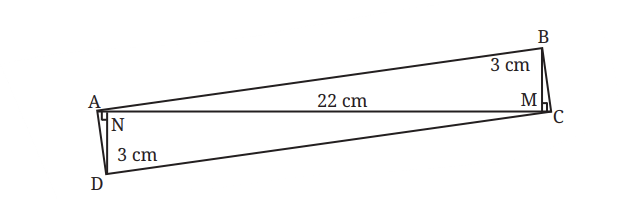
1. Find the area of the quadrilateral ABCD given that AC = 22 cm, BM = 3 cm, DN = 3 cm, BM is perpendicular to AC, and DN is perpendicular to AC.
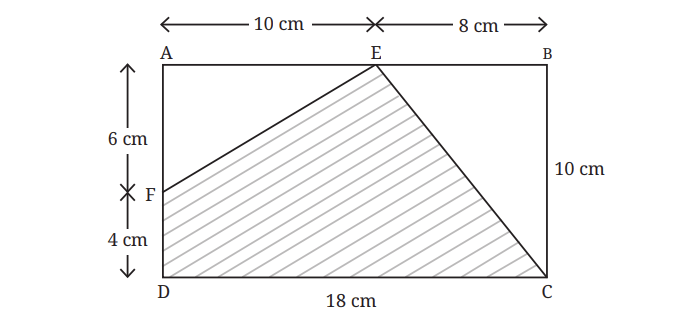
2. Find the area of the shaded region given that ABCD is a rectangle.
3. What measurements would you need to find the area of a regular hexagon?
4. What fraction of the total area of the rectangle is the area of the blue region?
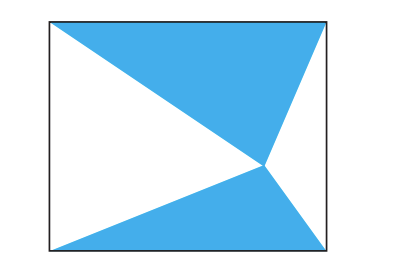
5. Give a method to obtain a quadrilateral whose area is half that of a given quadrilateral.
One can derive special formulae to find the areas of a parallelogram, rhombus and trapezium.
Parallelogram
We can derive a special formula for the area of a parallelogram by converting it into a rectangle of equal area.
? Give a method to convert a parallelogram into a rectangle of equal area.
You can try this using a cut-out of a parallelogram.
Construct AX perpendicular to CD — represented in short as AX ⊥ CD . We call this a height of the parallelogram. Cut the parallelogram into ∆AXD and trapezium ABCX.
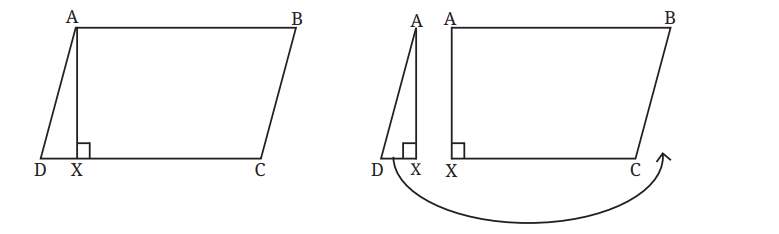
? Can ∆AXD and ABCX fit together, as shown in the figure, to get a rectangle?
One simple way to check this is to identify the triangle that can complete ABCX to a rectangle, and then check if this triangle is congruent to ∆AXD.
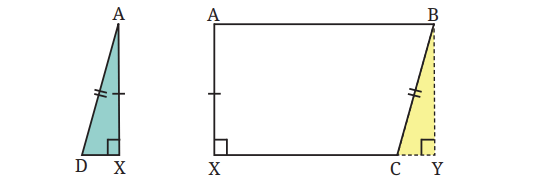
Observe that ∠X = 90°, and so ∠A = 90°, since AB‖XC. We need another right angle to get a rectangle (what about the fourth angle?). To get the third right angle, extend XC to the right and then construct a line perpendicular to XC that passes through B. The ∆BYC completes ABCX to a rectangle. Is ∆AXD congruent to it?
BY = AX (since ABYX is a rectangle)
∠BYC = ∠AXD = 90°
BC = AD (since ABCD is a parallelogram)
So, by the RHS congruency criterion, ∆BYC ≅ ∆AXD. Thus, ∆AXD will fit exactly over the region occupied by ∆BYC, and convert the parallelogram into a rectangle.
The process of cutting a figure into pieces and rearranging them to get a different figure of equal area is called dissection.
? How do we find the area of a parallelogram by dissecting it into a rectangle?
We have
Area of the parallelogram ABCD = Area of the rectangle ABYX.
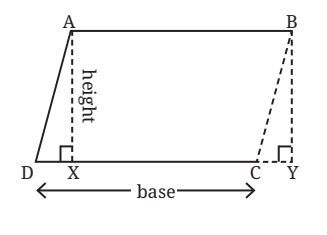
Area of the rectangle ABYX = AX × XY.
AX is the height of the parallelogram.
? Is there a relation between XY and DC?
Since DX = CY we get DC = XY by adding the common part XC to DX and CY. Since DC is the base of the parallelogram, we get
Area of the parallelogram = base × height.
? Can the area of the parallelogram be determined by taking another side as the base and its corresponding height?
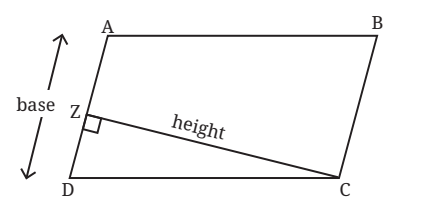
? Can the parallelogram be cut along CZ and rearranged to form a rectangle?
It can be seen that this is indeed possible, and so any side and its corresponding height can be used to find the area of a parallelogram.
? Figure it Out
1. Observe the parallelograms in the figure below.
- (i) What can we say about the areas of all these parallelograms?
- (ii) What can we say about their perimeters? Which figure appears to have the maximum perimeter, and which has the minimum perimeter?
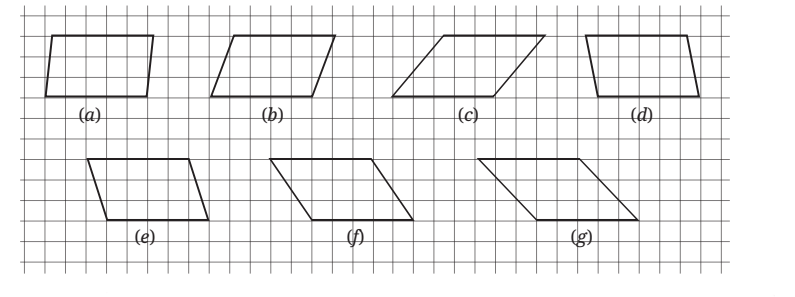
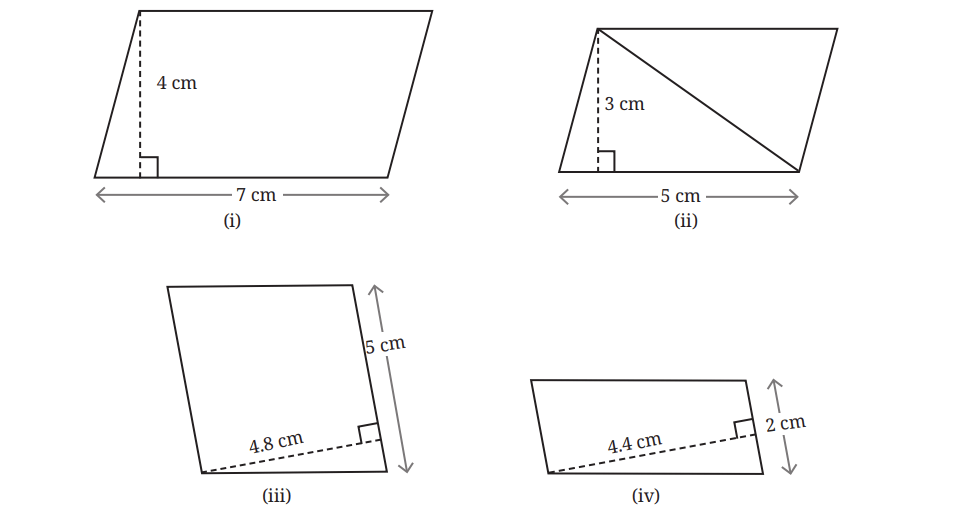
2. Find the areas of the following parallelograms:
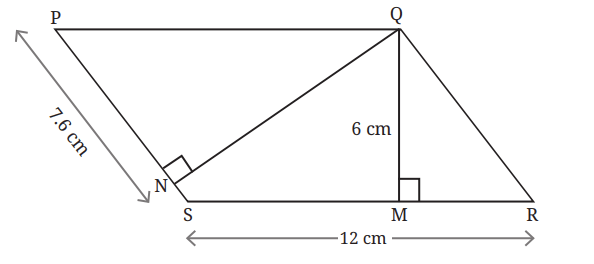
3. Find QN.
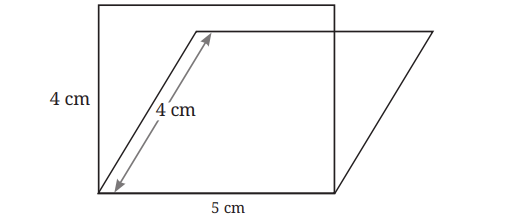
4. Consider a rectangle and a parallelogram of the same sidelengths: 5 cm and 4 cm. Which has the greater area? [Hint: Imagine constructing them on the same base.]
5. Give a method to obtain a rectangle whose area is twice that of a given triangle. What are the different methods that you can think of?
6. [Śulba-Sūtras] Give a method to obtain a rectangle of the same area as a given triangle.
7. [Śulba-Sūtras] An isosceles triangle can be converted into a rectangle by dissection in a simpler way. Can you find out how to do it?
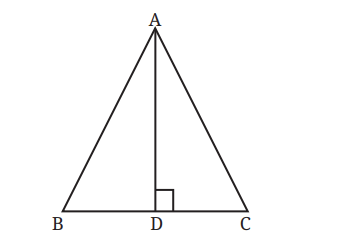
[Hint: Show that triangles ∆ADB and ∆ADC can be made into halves of a rectangle. Figure out how they should be assembled to get a rectangle. Use cut-outs if necessary.]
8. [Śulba-Sūtras] Give a method to convert a rectangle into an isosceles triangle by dissection.
9. Which has greater area — an equilateral triangle or a square of the same sidelength as the triangle? Which has greater area — two identical equilateral triangles together or a square of the same sidelength as the triangle? Give reasons.
Rhombus
Since a rhombus is a parallelogram, the area formula for a parallelogram holds for a rhombus as well. However, the additional properties of a rhombus give us another method to transform a rhombus into a rectangle of the same area by dissection. This method occurs in one of the Śulba-Sūtras.
? Try working this out!
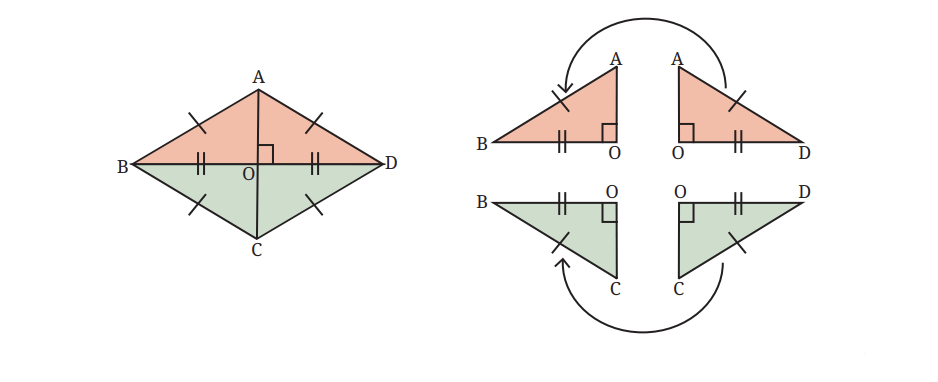
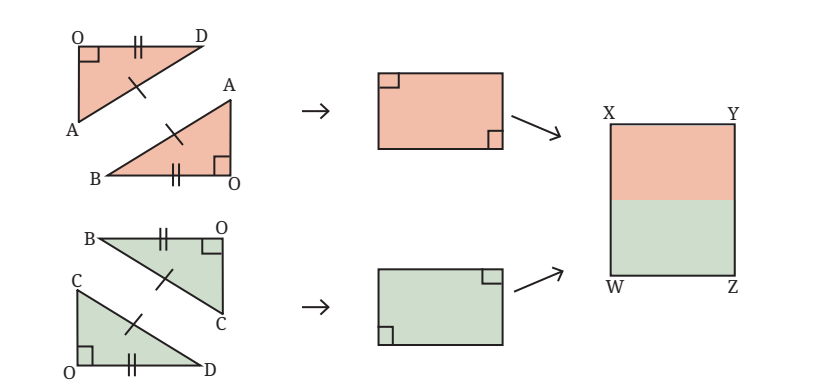
Since ABCD is a rhombus, all its sides have equal length, and the diagonals are perpendicular bisectors of each other. Therefore, triangle ∆ABD and ∆CBD are isosceles triangles. Each of them can be transformed into a rectangle of equal area, and the two rectangles can then be joined to form a single rectangle. This rectangle, say WXYZ, has the same area as the rhombus ABCD.
? What are the sidelengths of the rectangle WXYZ?
From the dissection, we can see that
- XW = length of the diagonal AC, and
- WZ = half the length of the other diagonal BD.
Thus, we have
Area of rhombus ABCD = Area of rectangle WXYZ
- = XW × WZ
- = AC × (BD)/2
- = 1/2 × AC×BD
- Area of a rhombus = 1/2 x product of diagonals.
? Area of rhombus ABCD can also be determined by finding the areas of ∆ADB and ∆CDB. What formula does this give us?
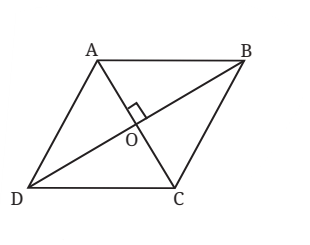
Since the diagonals are perpendicular to each other,
we have
- Area (∆ADB) =1/2 × AO × BD, and
- Area (∆CDB) = 1/2 × CO× BD and
? Simplify the expression to show that we get the same formula for the area of a rhombus in terms of its diagonals.
Trapezium
? Find the areas of the following trapeziums by breaking them into figures whose areas can be computed.
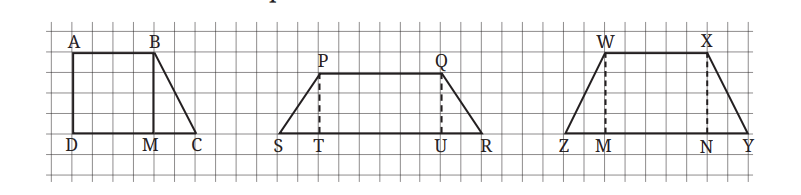
One way of finding the area of a trapezium is by breaking it into a rectangle and triangles.
? Consider a trapezium WXYZ with WX ‖ ZY. Find its area.
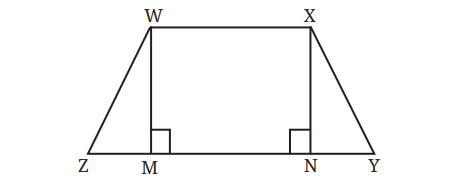
Construct WM ⊥ ZY , and XN ⊥ ZY (WM and XN perpendicular to ZY).
? Is WXNM a rectangle?
∠MWX = ∠NXW = 90°, since WX‖ZY and the interior angles on the same side of a transversal (WM and XN) add up to 180°. Therefore, WXNM is a rectangle.
We have
Area WXYZ = Area (∆WMZ) + Area WXNM + Area (∆XNY)
- =1/2 × MZ × WM + WX × WM + 1/2 × NY × XN
Let us assign letter numbers to the lengths that we need to find the area of the trapezium. Let MZ = x, WM = XN = h, WX = a, NY = y.
So we get
Area WXYZ =1/2 hx + ha + 1/2 hy
- = h(1/2 x + a + 1/2 y)
- = h(x + y + 2a)/2
=1/2 h(x + y + 2a).
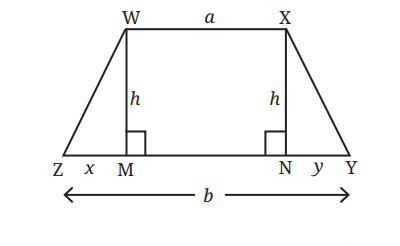
We have taken the length of one of the parallel sides as a. Let b be the length of the other parallel side.
Can the area of the trapezium be expressed in terms of a, b and h?
To replace x + y in the area expression with a and b, observe that b = x + y + a Subtracting a from both sides, we get
- x + y = b - a
Using this, we get
Area WXYZ = 1/2h(b − a + 2a)- = 1/2h(a + b) .
Therefore,
- Area of a trapezium =1/2 × height × sum of the parallel sides.
? Will this formula hold for a trapezium that looks like this?
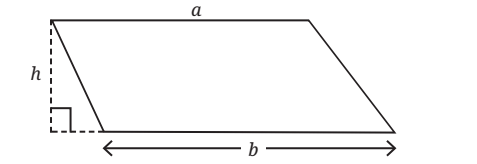
There are different ways of approaching this, which are sketched below. Complete the arguments.
Approach 1: Rectangle and Triangles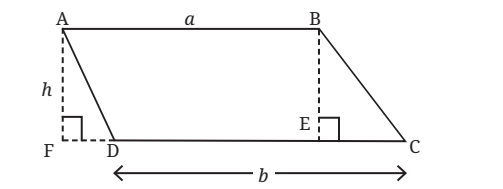
- Area ABCD = Area ABED + Area ∆ВЕС
- Area ABED = Area ABEF - Area ∆AFD
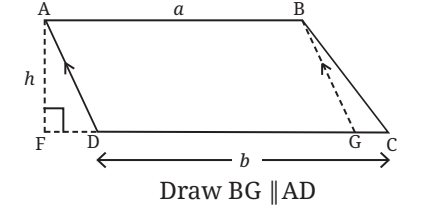
? Will Approach 2 work for any type of trapezium?
Finding the Area Using Two Copies of the Trapezium
There is another interesting way of finding the area of a trapezium. Consider two copies of the given trapezium in which AB‖CD. Rotate the second copy as shown.
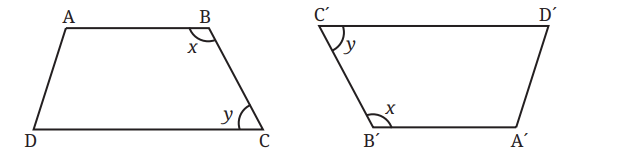
? What figure will we get when the two trapeziums are joined along BC?
The possibilities are either a 6-sided figure or a 4-sided figure (quadrilateral).
Possibilities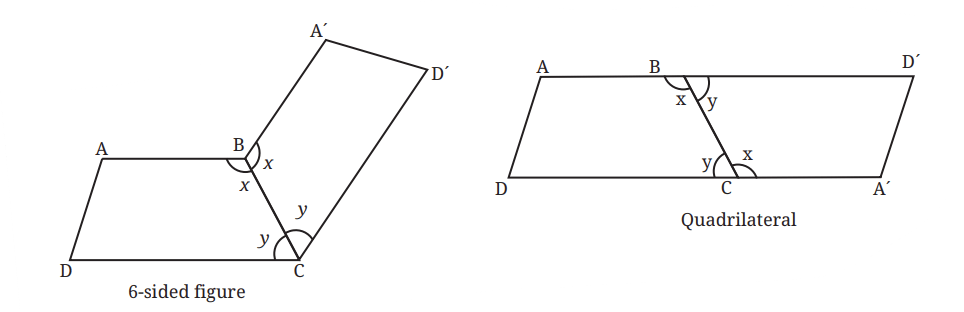
We can rule out the first possibility by looking at the sum of angles x and y.
Since AB ‖ CD, we have x + y = 180, since they are internal angles along the same side of the transversal (BC). So ABD́ and A ́CD are straight lines. Therefore, the resulting figure is a quadrilateral.
? What type of a quadrilateral is this?
Let us look at the other two angles of the trapezium.
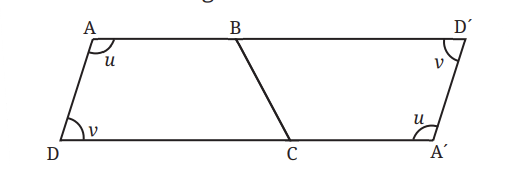
We have u + v = 180. Therefore, AD‖D́ A ́, since the sum of the internal angles along the same side of the transversal A ́D is 180°. Since we already have AD́ ‖ A ́D, the quadrilateral AD́ A ́D is actually a parallelogram.
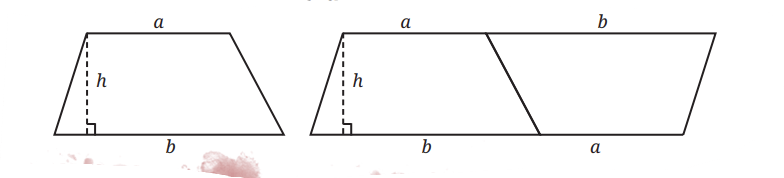
- Area of the trapezium = 1/2 × Area of the parallelogram
- = 1/2 h(a + b).
? Figure it Out
1. Find the area of a rhombus whose diagonals are 20 cm and 15 cm.
2. Give a method to convert a rectangle into a rhombus of equal area using dissection.
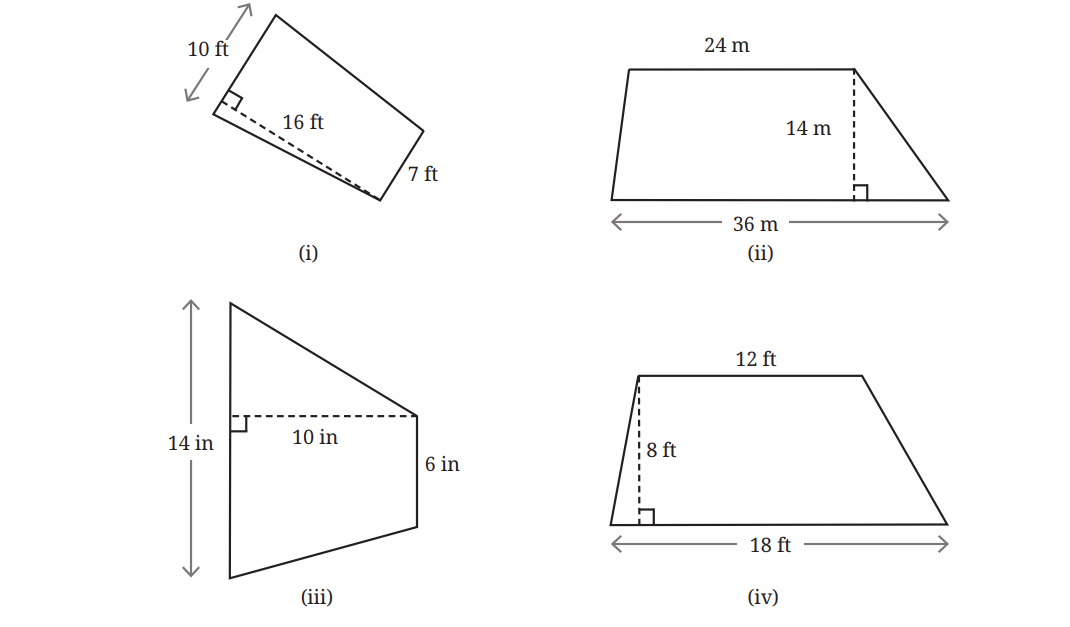
3. Find the areas of the following figures:
4. [Śulba-Sūtras] Give a method to convert an isosceles trapezium to a rectangle using dissection.
5. Here is one of the ways to convert trapezium ABCD into a rectangle EFGH of equal area —
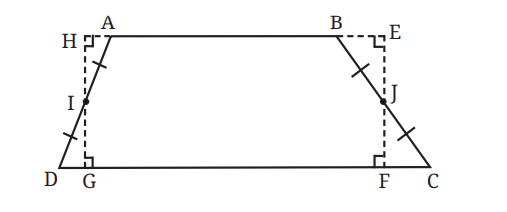
Given the trapezium ABCD, how do we find the vertices of the rectangle EFGH?
[Hint: If ∆AHI ≅ ∆DGI and ∆BEJ ≅ ∆CFJ, then the trapezium and rectangle have equal areas.]
6. Using the idea of converting a trapezium into a rectangle of equal area, and vice versa, construct a trapezium of area 144 cm2 .
7. A regular hexagon is divided into a trapezium, an equilateral triangle, and a rhombus, as shown. Find the ratio of their areas.

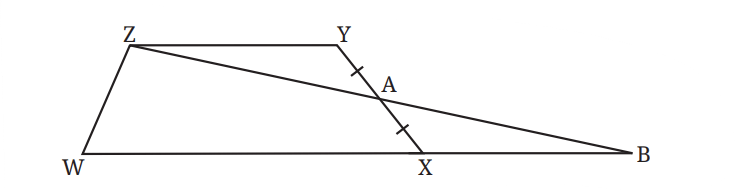
8. ZYXW is a trapezium with ZY‖WX. A is the midpoint of XY. Show that the area of the trapezium ZYXW is equal to the area of ∆ZWB.
Areas in Real Life
? What do you think is the area of an A4 sheet?
Its sidelengths are 21 cm and 29.7 cm. Now find its area.
? What do you think is the area of the tabletop that you use at school or at home? You could perhaps try to visualise how many A4 sheets can fit on your table.
The dimensions of furniture like tables and chairs are sometimes measured in inches (in) and feet (ft).
- 1in = 2.54cm
- 1ft = 12in
? Express the following lengths in centimeters:
- (i) 5 in
- (ii) 7.4 in
- (i) 5.08 cm
- (ii) 11.43 cm
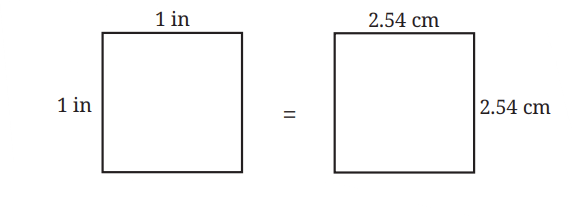
So, 1 in2 = 2.542cm2 = 6.4516 cm2 .
? How many cm² is 10 in²?
10 in2 = 10 × 6.4516 cm2 = 64.516 cm2.
? Convert 161.29 cm² to in².Every 6.4516 cm² gives an in². Hence,
161.29 cm2 = 161.29/ 6.4516 in2 .? Evaluate the quotient.
? What do you think is the area of your classroom?
Areas of classroom, house, etc., are generally measured in ft² or m².
? How many in² is 1 ft²?
? What do you think is the area of your school? Make an estimate and compare it with the actual data.
Larger areas of land are also measured in acres.
- 1 acre = 43,560 ft².
Besides these units, different parts of India use different local units for measuring area, such as bigha, gaj, katha, dhur, cent, ankanam, etc.
? Find out the local unit of area measurement in your region.
? What do you think is the area of your village/town/city? Make an estimate and compare it with the actual data.
Larger areas are measured in km².
? How many m² is a km²?
? How many times is your village/town/city bigger than your school?
? Find the city with the largest area in (i) India, and (ii) the world.
? Find the city with the smallest area in (i) India, and (ii) the world.
SUMMARY
- Area of a triangle =1/2 × base × height.
- The area of any polygon can be evaluated by breaking it into triangles.
- Area of a parallelogram = base × height.
- Area of a rhombus = 1/2 × product of its diagonals.
- Area of a trapezium = 1/2 × height × sum of parallel sides.
LEARNING MATERIAL SHEETS