
THEATRE
Abhinava Gupta lived in Kashmir between the 10th and 11th century CE. He wrote a commentary on Nāṭyaśhāstra and was instrumental in adding shanta rasa as the 9th rasa in the Navarasas.
NOTE TO THE TEACHERS
Dear Theatre Teacher,
As the students of Grade 8 are crossing a milestone by completing the middle stage of their creative and dramatic journey, this is the time for consolidation and confidence-building.
At this stage, the young learners are not just performers in the making, but also thoughtful collaborators and reflective individuals. This book has been designed to assimilate all they have explored in the previous years — from movement, and expression to storytelling and stagecraft. The activities and exercises in these pages will help the students fine-tune their theatrical skills, sharpen their communication, and cultivate a sense of responsibility — not only as artists, but also as teammates, problem-solvers, and critical thinkers.
This book encourages students to step up as powerful performers and capable backstage crew, giving them tools to plan, rehearse, review, and reflect. It honours the craft of performance while also emphasising discipline and ownership — values that will serve them far beyond the stage.
Let this be a year of exploration, expression and excellence, where the rehearsal room becomes a mirror, a stage, and a stepping stone. The curtains are ready to rise. Along with you, the show will go on — with purpose and pride.
Assessment
This is one of the crucial parts of the entire process of studying theatre in school as a mainstream subject. Though it is important to have marks or grades like in every subject, it is also essential to keep the spirit of theatre intact, and not reduce it to a pen and paper exam with a question paper. The final outcome or presentation is not the only benchmark. The thought and process behind the activities also need to be considered with —
- Knowledge application
- Effort and participation
- Creativity and presentation
- Teamwork and collaboration
Read the section on time allocation and assessments at the beginning of the book for better clarity. Assessment for Theatre has been planned at different levels.

Formative Assessment:
This is to be done in class after completing the activities and chapters, at two levels
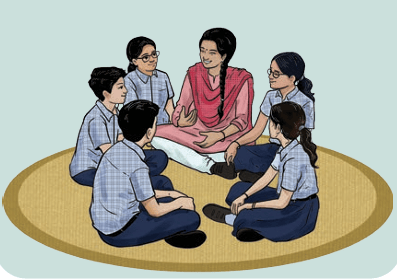
- Circle time — A process followed after every class and every activity. The teacher sits with the students in an informal setting (to get honest responses from students) to ask questions about what they did. They share their thoughts and experiences, based on which the teacher makes notes about each student. Some questions are given in the textbook. The teacher can explore more questions based on the class’s response
- Rubrics —Upon completion of every chapter, a rubric has been shared with the desired learning outcomes that the teacher can mark. The student is also asked to grade themself based on their perception of their performance in that chapter. This self-analysis is also a feedback for the teacher.
Summative Assessment:
This will be an activity-based test conducted at the end of the year. The activities need to be a combination of the lessons learnt during the year. The assessment is conducted at an individual and group level to assess different skills and competencies. A set of sample activities has been given at the end of the section.
1
Bringing Words Alive Play reading


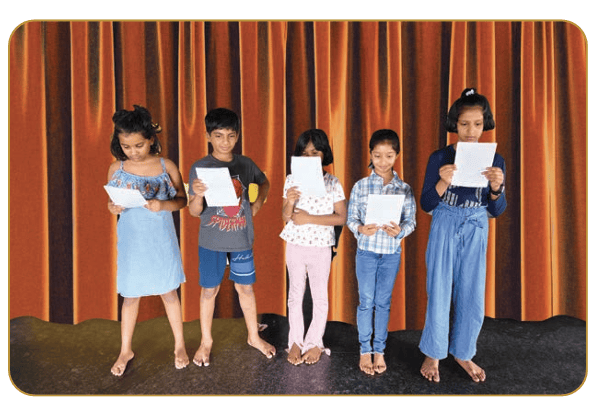
Reading the script of a play is the f irst step towards creating a full f ledged production. But did you know that this first step itself can become the final performance? Rehearsed reading or stage reading is a form of theatre
Summative Assessment:
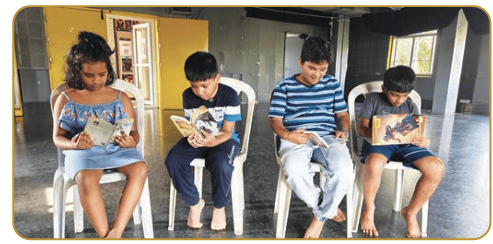
Rehearsed reading is performed without any set, props, costumes or make-up. The actors, dressed in regular clothes, sit on chairs on the stage and read the lines of their character aloud.
However, it is much more than just reading aloud. It is an art that brings characters, emotions, and stories to life. To make this happen, every word, pause and expression has to be given equal importance. Then, each dialogue becomes an engaging experience.
This experience not only sharpens the imagination but also connects the text directly to the audience, without the need of any visual enhancements like set or costumes
- Play reading as a performing ar
- Voice training
- Impactful speaking
You may say it sounds simple — “That’s so easy … I can do it."
Of course, you can do it! But this also requires a lot of hard work, practise and effort. The only difference is — all the effort goes towards perfecting your voice,
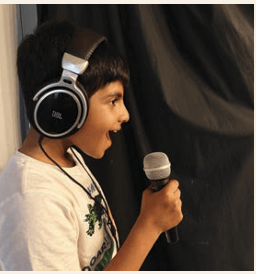
This process is similar to a singing practice. Both work on your vocal cords, pitch, volume, and the emotion it evokes!
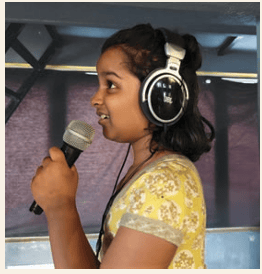
interpretation of characters and emotions. The actors remain in character throughout the reading and use all energy to emote through their voice.
Sounds interesting? Let us try a few activities and exercises that can make you a voice actor!
Since this style of acting focuses primarily on speech and dialogue delivery, the areas that we work on are related to the same. We will work on improving —
- Clarity in speech
- Voice and diction
Slightly different forms of this are — radio plays, voice acting and dubbing. The concept is the same, but it does not happen on stage.

- Emoting through speech
All these aspects are completely dependent on your physical body. You cannot take support of any equipment or instrument to enhance the effect. So, let us first understand how voice is produced in our body.
While most of us assume it is from the vocal cords, you will be surprised to know that vocal cords are among the varied parts of our body that help us produce a wide range of sounds, speech and voices.
DID YOU NOTICE
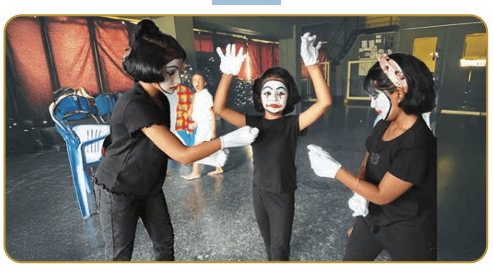
A form of performance with no voice, only action.
A form of performance with only voice, no action.
THREE VOICE SUBSYSTEMS
| Subsystem | Voice Organs | Role in Sound Production |
|---|---|---|
| Air pressure system | Diaphragm, chest muscles, ribs, abdominal muscles and lungs | Provides and regulates air pressure to cause vocal cords to vibrate |
| Vibratory system | Voice box (larynx) and vocal folds (or vocal cords) | Vocal cords vibrate, changing air pressure to sound waves producing ‘the sound of the voice’ |
| Resonating system | Vocal tract: throat (pharynx), oral cavity, nasal cavities | Changes the ‘buzzy sound’ into a person’s recognisable voice |
Understanding this will help you in better voice control, enabling you to produce the right kind of voice expected for that particular line in the script. The pitch, volume and emoting ability originate in these areas of the body!
This is called Vāchika abhinaya in the Nāṭyaśhāstra. Vāchika means ‘speech or language’. Any performance that has speech or use of language, even in the form of songs (in case of dance) is called Vāchika abhinaya.These word-sets are called tongue twisters. They are phrases that have similar sounds, which makes it hard to pronounce. The more you practise, the easier it gets and your pronunciation improves.
Start by reading slowly. Increase the speed gradually, till you can say it without any flaw. If you fumble, restart and keep trying.
Here are some challenging tongue twisters —
- She sells sea shells on the sea shore.
- Red lorry yellow lorry
- Peter Piper picked a peck of pickled peppers.
- A peck of pickled peppers Peter Piper picked; if Peter Piper picked a peck of pickled peppers, where’s the peck of pickled peppers Peter Piper picked? And so on …
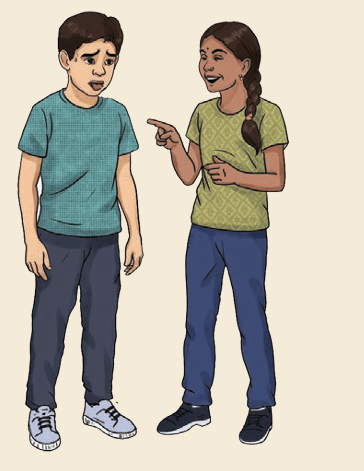
Such tongue twisters exist in every language. Do you know any tongue twisters in your local language? Share them with your friends, and learn more!
This will help you articulate your words more clearly, emphasise key points, and give your audience the time to process the information. You can also use pauses to create interest, suspense, or emotion in your speech.

Speed:
What is the pace at which you are speaking? And what is the pacing between the words you utter? Does the dialogue require a slow pace or a fast-paced delivery? Exploring the different speeds when reciting the tongue twisters can help you see the range of emotions you can express through your voice.Intonations:
Intonations are the stress and emphasis we placed on specific words to add importance in our speech. We generally stress on a word that we find important. You can practise by stressing a different word of the tongue twister as you repeat it, and then multiple words to see how the meaning changed.
WORD IMPACT!
Take a simple sentence that is grammatically correct and play around with it by emphasising each word differently. Discuss how it changes the meaning of the sentence!
Example: ‘I didn’t go to school today.’
You can take turns with your friends in stressing the highlighted word and discuss what the meaning of the sentence would be
I didn’t go to school today.
(… but my friends went)I didn’t go to school today.
(… so I missed the games)I didn’t go to school today.
(… but got all the lessons)I didn’t go to school today.
(… but walked past it on the way to the fair)I didn’t go to school today.
(… went to the park instead)I didn’t go to school today.
(… but will go tomorrow)VOLUME AND PITCH
Although the concept of volume and pitch are prominently used in music, it is very crucial for theatre students to learn this, as good acting depends entirely on it. You can refer to your music lessons while practising.
Volume is how loud or soft a sound is. You must have tried this while playing music on your gadgets. In theatre, controlling volume helps the emotions and messages to reach the audience. This is true even in our everyday lives. Don’t you scream loudly if you are angry? Animals use them too. Lions roar loudly to show power and dominance — as if declaring, “This is my territory!”, in a booming voice. Whereas, a cat meows softly to show comfort and affection. Similarly in theatre, loud volume can express strong emotions like anger or joy, while soft volume can portray sadness, fear or kindness. Learning to adjust the volume helps to express emotion more clearly and connect better with the audience, just like animals communicate their feelings in the wild.

Pitch is how high or low a sound is. A high pitch often shows excitement, fear or playfulness, like how you scream when you get a surprise gift. A low pitch can suggest seriousness, calmness or anger. For example, when a mouse squeaks in a very high-pitched sound, it is usually scared or excited. In contrast, a bear growls in a deep and low pitch sound to warn others or show aggression. In theatre, actors changes their pitch to bring characters to life, for example, a childlike character speak in a high pitch, or a wise old king speak in a deep and low tone. Mastering pitch helps to create different personalities and express a wide range of emotions.

Since we are looking at the examples of animals to understand this concept and what it can communicate, here is a simple table to help you understand it better. Notice the different combinations of volume and pitch of each animal.
| ANIMAL | VOLUME | PITCH | EMOTION |
|---|---|---|---|
| Lion — roar | Very loud | Low | Power, dominance |
| Mouse — squeak | Soft | High | Fear, excitement |
| Owl — hoot | Soft | Low | Wisdom, calmness |
| Snake — hiss | Soft | Medium-high | Threat, fear |
| Horse — neigh | Loud | High | Alarm, fear |
| Bear — growl | Loud | Low | Aggression, threat |
Here you can become an animal, an animal that shows human emotions! Match the sounds of animal with emotions using the volume and pitch. One of you can come to the front and makes an animal sound. But they must pick an emotion secretly (happy, scared, angry, sad, or any other emotion), and adjust their sound. The rest of the class guesses the animal and the emotion based on the Volume (loud/soft) and Pitch (high/low).
You can try different combinations of animals and emotions. For example, a happy lion might give a soft growl, where as a scared mouse might let out a super tiny squeal. You can try a happy and angry dog, or a tired and excited goat.
Remember: Try not to use expressions or body language that might give away the emotion. This activity requires you to use only your voice.
Imagine yourself as an actor and you are reading the script. These are some lines you are expected to say on the stage. Fill in the right pitch and volume you will use, as an actor … If you are an actor ...
You can try different combinations of animals and emotions. For example, a happy lion might give a soft growl, where as a scared mouse might let out a super tiny squeal. You can try a happy and angry dog, or a tired and excited goat.
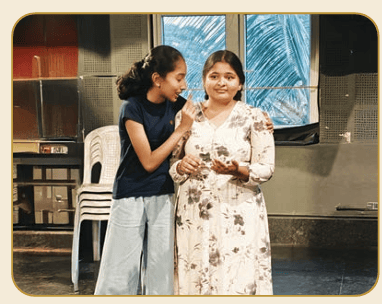 “Let me tell you a secret …
He is not feeling well …”
“Let me tell you a secret …
He is not feeling well …”
Volume ----------------------------------------------------------------------------------------------
Pitch ----------------------------------------------------------------------------------------------
 “O brave soldiers! let us fight
for our country … Jai Hind.”
“O brave soldiers! let us fight
for our country … Jai Hind.”
Volume ----------------------------------------------------------------------------------------------
Volume ----------------------------------------------------------------------------------------------
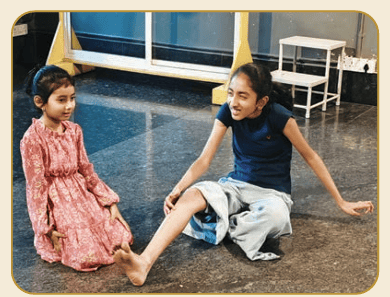 “I feel so weak and tired … and
the wound is painful. Ahhh!
“I feel so weak and tired … and
the wound is painful. Ahhh!
Volume ----------------------------------------------------------------------------------------------
Volume ----------------------------------------------------------------------------------------------
SPEAKING WITHOUT LANGUAGE!
Have you ever wondered how every word we speak has a meaning attached to it? If we spoke random sets of words with no meaning, would we still be able to communicate?
You can try different combinations of animals and emotions. For example, a happy lion might give a soft growl, where as a scared mouse might let out a super tiny squeal. You can try a happy and angry dog, or a tired and excited goat.
Remember: Try not to use expressions or body language that might give away the emotion. This activity requires you to use only your voice.
Communication depends not just on what we say but also how we say it. In fact there are instances when we don’t know the language of the person speaking to us, but we still manage to get the gist of what is being said. How is that possible? This is because the human brain can receive inputs beyond a learnt language. The brain receives information from the tone of the voice, facial expression, body language and the context when it is spoken.
Let us try an experiment where we assume that each of you have come from a different planet and speak a unique language that nobody else understands. You have to make up sentences with a set of random sounds. This kind of speech is called gibberish
BASIC
When you put together some random sounds, no one is likely to understand. Now, try saying this in a particular emotion. Say the same gibberish sentence like you are annoyed with your friend who is disturbing you and not letting you study. Use your voice, action and expression to convey this. Now, most of your friends can make some sense of what you are communicating. Combine it with volume and pitch to help in better communication.
Now, try the same with different emotions and situations. Let the other students in class guess what you are trying to say. Everyone gets a turn to communicate with gibberish. How many of them could you understand?
ADVANCED
The next level would be to try and have a simple conversation in gibberish! Sit with a friend and speak a sentence with emotion. Let the person respond to you. Continue this for about 4 – 5 lines. Now, stop and share what you actually meant.
You can also put yourself in different situations for this conversation, like a village fair, an office, school playground, etc.
DID YOU NOTICE
Look out for students who use simple gibberish instead of complex gibberish. A complex gibberish has many combinations of syllables and sounds, compared to a simple gibberish.
Example of a simple gibberish, “Tata tatata ta ttaat tatata. Or papapa pap papa paapapa papapap” Complex combination — ‘tagutta mo le bo ungji ko" Encourage the students to use multiple syllables, and change the rhythm of the sounds.
Motivate the students to use complex combinations to bring expression.
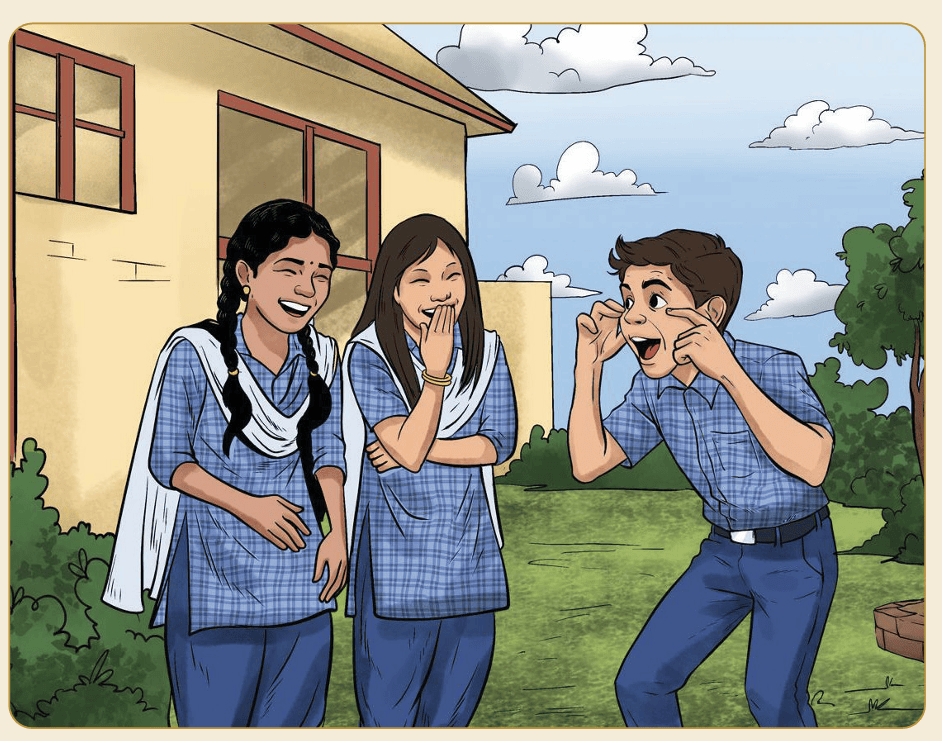
CIRCLE TIME
- What kind of a play would you choose if you were to present a play reading performance?
- Which is easier: acting with your voice and without any action, or acting without your voice and only with action?
- Has this chapter made you improve your speech and its impact? Where will it be useful to you?
RECOMMENDED PLAYS FOR PLAY READING
You can pick up one scene from below and read it as a group. If you think you are doing well, you can do a play reading performance of any of these scenes in your class. You can also use the play script in Chapter 3 of this textbook.
English
| Name of the Play | Playwright |
|---|---|
| Comedy of Errors | Lewis Carrol |
| Alice in Wonderland | Soft |
| Say the Right Thing | G C Thornley (Kriti, Grade 7 textbook |
Sanskrit (scripts available in the QR code)
| Name of the Play | Playwright |
|---|---|
| रामतपोवनाभिगमनम् (rāmatapovanābhi gamanām) | डा. विश्वासः (dā. vivaśhvāsa:) |
| गुरुदक्षिणा (gurudakṣhiṇā) | श्री म.रा. कुमारस्वामरी (śhrī ma.rā. kumārāsvāmī) |
| दानस्य महिमा (dānāsya mahima) | डा. विश्वासः (dā. vivaśhvāsa:) |
| बालचरितम् (bālaçaritam) | भास (Bhasa) |
KEY TAKEAWAYS—LESSONS FOR LIFE
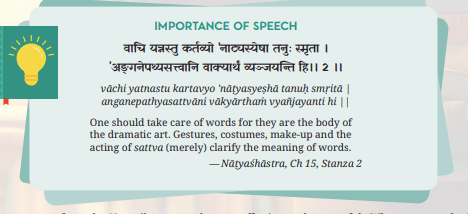
As the above stanza from the Nāṭyaśhāstra speaks about how important it is to focus on your speaking skills. This chapter on reading and performing plays also teaches you much more than just acting. It helps you understand the real power of speech. Through the activities in this chapter, you learn how to be clear, expressive and mindful while talking, not just on stage but in real life too. Being aware of your intonation, pitch, volume, and choice of words makes your communication stronger,effective and respectful. When you speak clearly and thoughtfully—
- People understand you better
- You avoid unnecessary conflicts, embarrassing moments, and misunderstandings.
- It teaches you to organise your emotions better in your mind, making you calmer, confident, and mature in handling tricky situations. Good speech is not just a theatre skill—it is a life skill!
ASSESSMENT
CHAPTER 1: BRINGING WORDS ALIVE—PLAY READING
Competencies
- C 1.2 Demonstrates flexibility in the process of collaboratively developing drama
| CG. | C. | Learning Outcomes | Teacher | Self |
|---|---|---|---|---|
| 1 | 1.2 | Understands the change in application of the script from enacting to reading | ||
| 1 | 1.2 | Tries working on ones own diction, clarity and intonation | ||
| 1 | 1.2 | Tries to apply the voice skills to other languages | ||
| 1 | 1.2 | Applies skills in everyday conversation with friends, teachers and parents | ||
| Overall participation in class |