3
From Page to Stage


THEATRE-MAKING
Now, we enter the exciting world of theatre-making! This is where ideas turn into action, and stories come alive with teamwork. In this chapter, you won’t just read about theatre — you will create it! From planning a scene to rehearsing lines and designing costumes to setting the stage, you will discover how every small role builds the big picture. As you are at the end of middle stage, this is when you will put together everything you have learnt so far.
From costume design and make up, to puppetry and mime; and from writing your own script and dialogues, to acting with emotion and voice.
Recall all your lessons, so you are ready to turn your imagination into a performance! Let the theatre-making begin!
This chapter intends to take you through the entire journey — from an idea to a successful performance. To make it interesting, this process is written as a play script itself. This script is about the students of Grade 8 working towards putting up a performance on their own. It assimilates all the steps you have worked on so far to make a play. It also suggests ideas on how to integrate music and dance into the play
- Process of presenting a drama performance
- Elements of a script
- The spirit of theatre!
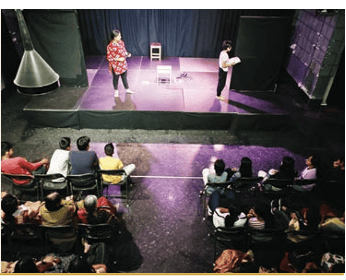
This script can also be used as an example for your exercise in Play Reading, Chapter 1.
The end of this chapter gives you pointers and tips on how to practically apply this to the performance that you put up for your school. Remember, facilities or material resources are not a necessity. So, do not worry about what you have or don’t. Theatre can be performed anywhere with whatever you have. The most important thing that you must have is dedication and the enthusiasm that you will do it!
Let us get involved in making drama!
ALL THE DRAMA OF THEATRE!
The play begins in the Grade 8 classroom. The class has just received a circular from the school principal that the students have to plan and prepare for a performance. The date of the show is also announced. The countdown has begun and the students are excited, nervous and unsure of how they can do it. Ananya, the class representative starts by addressing the class.
Scene 1: Brainstorming
(A classroom with excited students busy discussing in groups. The board reads ‘Annual Theatre Project’.)
Ananya: Alright, as per the memo we have just received, our school show is in just six weeks. The play should be 30 to 40 minutes long. Letʼs give our best and make this the best experience!
Karan: Yes, we should be the best! So, first, we need to find a great story. Should we do comedy, mystery or fantasy? Oh ... but before that, who is doing the documentation? Photos, videos? We have to keep a record of this event — we are doing our own show!
Ananya: Oh, yes! Glad, you remembered ! I can do it. I love taking pictures!
Meera: Can we do a Panchatantra or a Hitopadesha story?
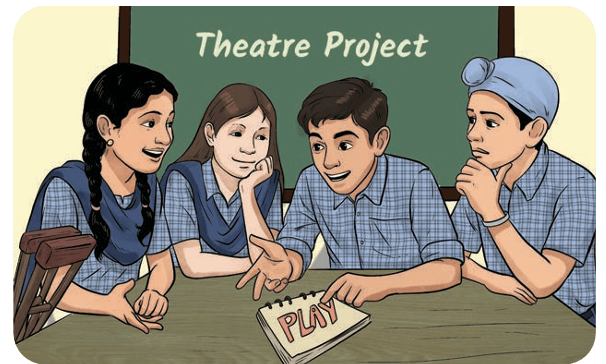
Ritu: (hesitating) What about a folktale? Or, an Indian story? We could add some classical or folk dance in it.
Meera: Yes! And we could mix it with puppetry or mime. It will be fun!
Anil: (excited) Oh! I will find some great instrumental music like dholak and sarod.
Ananya:Perfect! So, an Indian story it is. Letʼs all suggest stories from our native regions and shortlist one.
Tara: How about the tale of Savitri and Satyavan?
Seema: Or, Tenali Rama? Something with humor and wit.
Meera: Can we do a Panchatantra or a Hitopadesha story?
Ananya: Hmm ... but wait. We’ve got three good ones. Savitri and Satyavan is emotional, Tenali Rama is witty, and ʻMonkey and Crocodileʼ is fun and visual. How do we choose? Should we vote?
Ritu: Can we mix elements? Maybe Tenaliʼs wit, but with animal characters like the monkey and crocodile!
Meera:That could be chaotic!
Anil I think we should focus on something simple but dramatic. But there are so many stories.
Ananya: Let’s take five minutes, everyone think and vote.
Karan (confidently) I know a very interesting story of an old wise woman from the mountains of Himalayas. My father told me that story. Do you want to hear it?
Everyone:Yes!
(They huddle, discuss and finally settle on the Himalayan folktale with elements of dance, puppetry, and folk music.)
Ananya: Done! I think this story has a great beginning — middle, end, and an interesting conflict as well. Can we start writing the scenes and dialogues? Who can do it?
Ananya:Done! I think this story has a great beginning — middle, end, and an interesting conflict as well. Can we start writing the scenes and dialogues? Who can do it?
Karan: (strongly) I will write the script. But I will need help. Who can join me?
(Three more students agree to join Karan in the script writing and forming a team.)Ananya: So, Karan and his team will work on it together. Can you give us the final script in three days? That way, we can start planning the rehearsals.
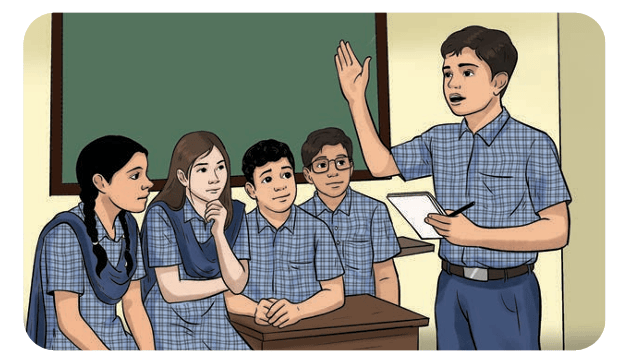
Ritu: Don’t forget to include dance, puppetry and folk music. I want to do the choreography.
Karan: Sure. We will give it in three days. But as we rehearse, I might want to add a few lines here and there to improve it.
Ananya:That is fine. We can always keep improving.
Meera: (disappointed) But I also like dancing. I wanted to work on the songs as well. I have been going to dance classes since, I was five years old. Now, I can’t do it since Ritu is doing it.
Ananya: Hey! No … that’s not how it is! You can
definitely work together. This is all going to be a team
work. You and Ritu can work together on selecting
the songs and planning the steps.

Ananya: Since we have already made two teams, I think we can also assign the other teams, so we are all ready by the time the script is complete.
(Ananya writes the names of all teams on the board and asks everyone to volunteer. After some discussion, they have the following.)
- Script — Karan, Nitin, Shama and Rekha
- Set and props — Nikhil
- Make up and costume — Ishaan, Tara and Seema
- Puppetry — Anita
- Music — Anil
- Dance — Ritu, Meera
- Documentation — Ananya
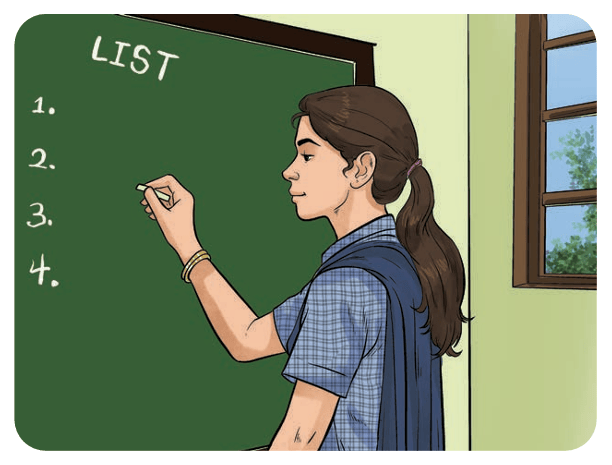
Ananya:(anxious) What about the others? We need more people for puppetry, music, set and props! Please volunteer. Aditya, Neetu, Priya, Sriram … choose your team!
Aditya and Sriram: (sounding disinterested) We want to select roles and act on stage. Can’t do this work.
(Nobody wants to do these things. The rest of the class also say they want to act on stage. Despite repeated requests, nobody volunteers to work. Ananya, feeling helpless, requests the teacher to help.)
Teacher: Great start, everyone. I really like your story! But remember, backstage work is most important! You learnt in Grade 7 that all these departments are a foundation for a good performance. Everyone in class has to be a part of at least one of the groups written on the board. You can also act, after the script is given. You all have to put effort as a united team. (looking sternly) Come on … ! start picking your team. (Understanding this, the remaining students select various groups and start working.)
Scene 2: Work Begins
(3 days later — students are working in groups. Karan and his team are writing; Ritu and Anita are drawing and cutting out puppets; Anil and Meera are working on musical notes with beats, and steps. They occasionally run to the teacher for help and suggestions, and come back to work on them.)
Karan: (loudly announcing) We have almost completed the script. Can we read it for you? (everyone nods and looks towards them.)
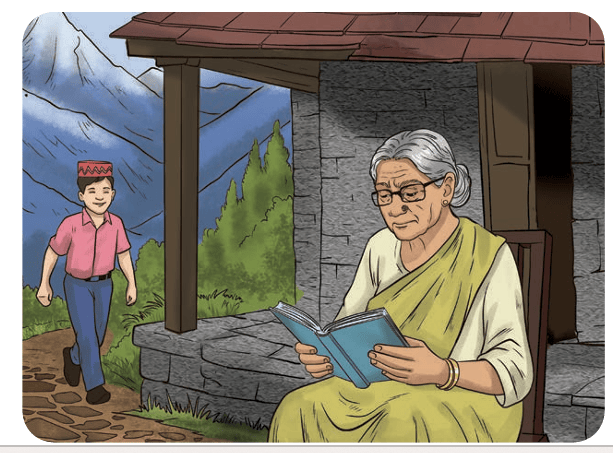
Scene 1, an old house on the Himalayan slopes. A granny is sitting, reading a book. Her grandson comes to her and says, “Naani, Iʼm hungry”. The grandmother goes to the kitchen, gives him a snack and later, they start playing a game together.
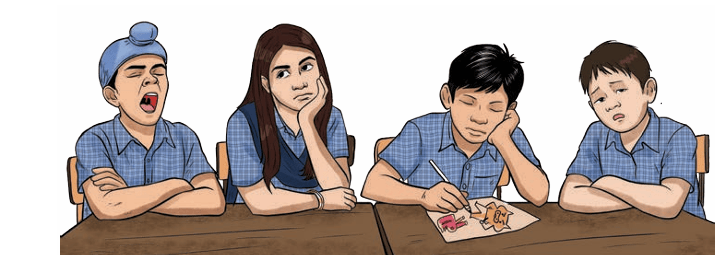
Ritu:(rolling her eyes) I think the opening is very boring. Remember, we learnt last year that you should capture your audience’s attention in the first scene.
Karan: Hey, wait … it is coming up! I have read only one line so far! (continues) (As they are playing, they hear a loud scream outside. They rush to the window and see that a big spaceship has landed on the mountain, and all the neighbours are looking at it in awe.)
Nikhil: Karan, we can’t show all this on stage. How can we make a spaceship land? How can we show mountains? You have to write something that is practically possible.
Karan:(annoyed that no one likes his script) Please wait and listen to the whole thing. You don’t have to make mountains on stage. All this is depicted only through the conversation between the grandmother and grandson as they look out of the window. Can I continue now? (continues)
The boy is scared and says, “Naani, what is that? Will it harm us?” The grandmother says, “Nothing can harm us if we are strong and brave. Let us go out and see”. But the boy runs and hides under the cot
Anil: This seems like a modern story — with a space-ship and all! What next? Aliens will come out of it (laughs loudly). This is a futuristic play. Not a folk play!
Meera: Yes! It is not a folk story at all. Where can we bring in dance? (in a teasing tone) I can’t do a folk dance with aliens!
Anita: I can’t think of puppetry either, for a story like this.
Karan:(angrily) Ok … fine. You write the script yourself. Nobody wants to listen. I can’t continue writing like this (puts down the script on the desk with a thud and walks out).
Ananya: (quickly runs out and brings him back and addresses the class) Karan and his team have worked hard to come up with this.

First, let us listen to the entire script. It is important to give feedback as it will help him improve the script. But let us not interrupt the reading. We have to respect each other’s work. He too knows what we can show on stage and what the school allows us. I am sure he has kept all that in his mind along with the dance and puppetry, while writing. (Karan nods in agreement.) You can continue reading Karan. We will make notes and share it at the end. (They all listen, make notes, share and discuss. Karan makes changes based on some suggestions. At the end, everyone looks happy and confident that their play is going to be great!)
Scene 3: Rehearsals and Preparation
(It has been a week since practice has started. Roles are allotted, preparation is in full swing. Tension is in the air as students are arguing.)
Nikhil: This is chaos! Everyoneʼs using my costume corner like a dumping ground! Every time I arrange the costume designs in order of the script, someone messes it up.
Ritu: I need space to dry the crocodile puppet! Anita! (shouts) Please help!
Karan: My script team canʼt focus with all this shouting. You have suggested changes and now, you don’t allow us to work! We canʼt even remember your suggestion for Scene 3. So much distraction!
Meera: And don’t even ask about dance rehearsals. No oneʼs showing up!
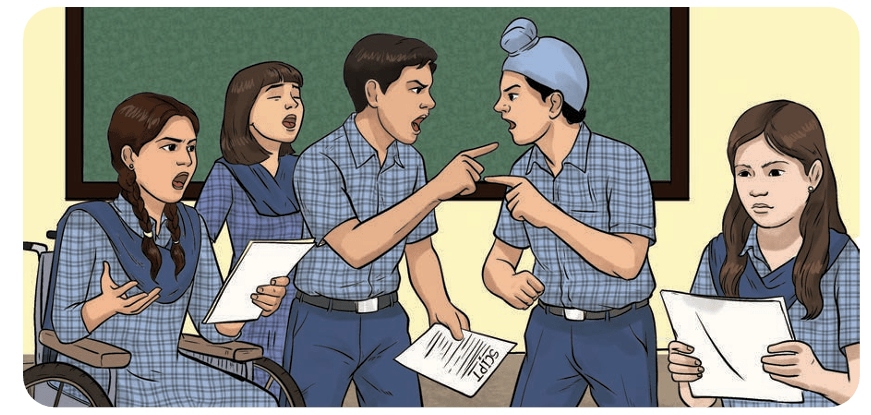
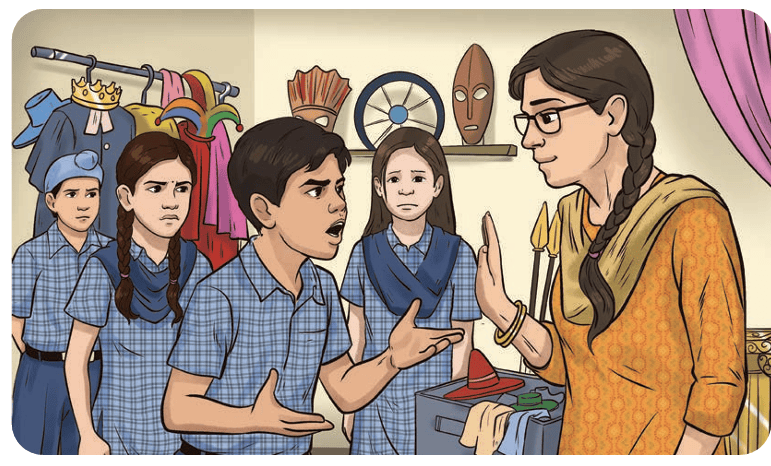
Anil: I composed three songs and now the dance team says they want something else! I can’t keep doing this.
Ananya: (shouting louder, trying to calm them) Guys! This is not working. We’re supposed to be a team!
Teacher: Whatʼs going on here? Why is there so much noise? The other classes are complaining!
Ananya:No work has been completed and we only have a week before we present it to the teachers.
Karan:Everything’s falling apart. Weʼre stuck!
Teacher: (smiling) That means youʼre right on track.
Everyone: Huh?
Teacher: Every team hits a wall. It’s part of the creative process. You’re all passionate and excited — that’s good. But now, step back, breathe and listen to each other.
Ananya:We’ve all been so focused on our own parts that we forgot — this is one story, one show.
Teacher:Exactly. Here’s a tip — use a common storyboard chart so all departments are aligned. Find different places to work. You can look for empty rooms or even go to the playground. Hold a combined check-in every two days.
Karan: Right! That’s a great idea. When we meet, we can act out each scene briefly and let all teams visualise what’s needed
Anil: I’ll coordinate with Ritu and Anita. I have to work on music for dance and puppetry separately. (Meera glares at him) Okay … okay … no more remix surprises from film music, promise! (Everyone laughs.)
Teacher:Good! Now, back to work. Find your places. Don’t disturb each other. But remember, you are all one team. So work together.
Scene 4: The First Run-through
(In the school auditorium. Only about 4 to 5 teachers are watching. Students perform one scene after another. Lots of mistakes. More laughter. They complete performing and sit in a circle for feedback.)
Ananya: Sorry ma’am … there were a lot of mistakes. We had practised … but …
Teacher 1:Actually, completing it from beginning to end is a huge task in itself! You have to clap for your team. Well done!
About your corrections, the scene transitions were slow. You took a lot of time to shift from one scene to another. You need smoother scene changes. Who is in charge of set and props?
Nikhil:It’s me. I too felt we took a lot of time to change set and props for each scene. I think we’ll arrange all the required props, scene wise. That’ll help cover the time. We lost a lot of time running around to fetch props.
Teacher 2: Good thinking. Also, project your voice more. I couldn’t hear some of your lines clearly. You have to be aware of the stage-voice. It does not mean you have to scream. You should be able to hold emotions and yet project your voice in such a way that it is audible to the last row.
Ananya:Thank you, ma’am. We’ll fix these before the final show.
Teacher 3: I really loved how you used puppetry to depict the little boy’s dream. The connection between the music of puppetry and the folk dance is a brilliant
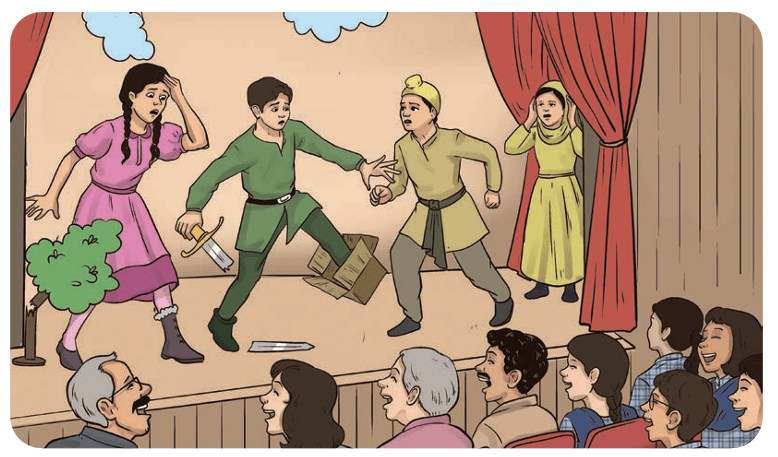
idea! But Ritu, make sure you don’t drop the puppets during the show!
Ritu: (covering her face) Sorry! It slipped from my hand. I will be more careful.
Scene 5: Showtime!
(Backstage. Whispers. Music tuning. Actors in costumes.)
Ritu: Puppets, ready?
Sana: The stick was broken. Just replaced it ... done!
Ananya:: (anxious) It is almost time for the show! Let’s do our team prayer!
(Everyone makes a circle and hold hands. The teacher too joins them.)
Teacher: All of you have worked very hard. I know you will put in your full efforts. The chief guest, has already arrived. We can have a discussion with her after your show. I’m sure you will get good feedback. Now, close your eyes, take a deep breath and start the prayer.
Suggested prayer
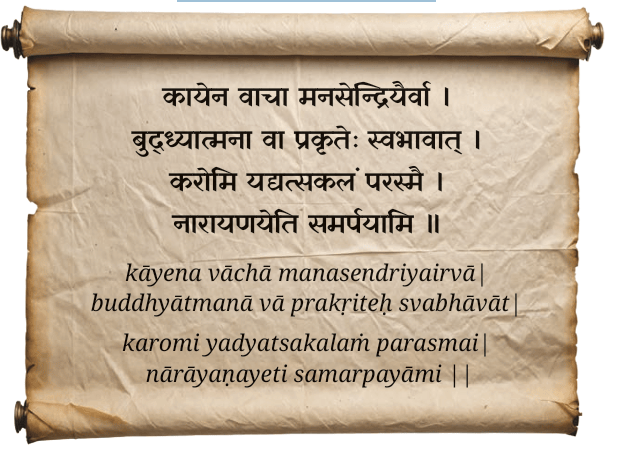
Meaning:Whatever I do with my body, speech, mind or sense organs, through my intellect, or unconsciously by the natural tendencies of my mind, all those, I do for the Supreme Being, without sense of attachment to the results. I surrender them to the lotus feet of Sri Narayana. (Teacher wishes the best and goes to sit among the audience. Students get together.)
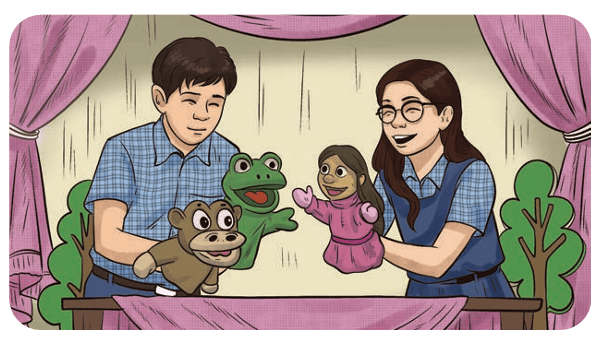
Everyone: One team, one show; let the magic flow! (Actors take position. Stage lights up. Show begins. One scene after another, it flows. Third scene, Aditya has to enter. Other actors, Suraj and Nandini are waiting … Aditya is nowhere to be seen. If he doesn’t say his line, puppetry can’t begin. Tension. Actors don’t know what to do.)
Nandini: (deciding to manage the situation, takes on Aditya’s line) Oh! Both of you are here, I wanted to take you to the mountain to show something interesting. Come with me! (exits)
(Puppetry begins. Audience clap in excitement. Final scene. Music rises. Dance weaves in and the story concludes. As all the actors and backstage team assemble on stage for a curtain call, the audience is silent. The team is tense. Did they not like it? Did they not understand? What mistake did we do? A second later, the chief guest stands and applauds wholeheartedly, congratulating them.)
Audience: (all standing) Bravo! Amazing!
Teacher: (teary-eyed) I am so proud of all of you.
Ananya: (on stage) Thank you for joining us on this journey. We learnt more than just a story. We learnt teamwork, creativity and that every part matters
(Whispering to Nandini) Thanks for saving the show! Aditya fell backstage and sprained his leg
Everyone: The great show ends ... but our theatre journey has just begun!
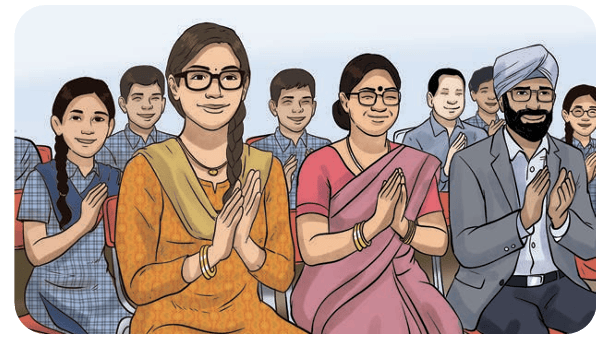
What are the immediate thoughts in your mind after reading the entire play? Relatable? Felt like it was happening in your class? Did you have any questions? Write down your immediate thoughts here. You can also make drawings or doodles of what is on your mind
You can share and discuss the points you have noted with the rest of the class, and see what others think about it.
Now, let us analyse the play script and see what we can learn from it.
Each scene has different elements of theatre-making that you can learn and apply in the process of preparing for your performance. We will discuss it scene-by-scene.
You can also refer back to the scenes to identify parts of theatre-making.

Note to the Teacher:
It is advisable for the students to put their ideas together and create a script of their own, for the performance. Using the script in this chapter or a ready script is not preferred. Doing this would prevent the students from applying the lessons learnt in Grades 6 and 7 in script writing.

| S.No. | Scene | Steps for preparation | Lessons learnt |
|---|---|---|---|
| 1. | Brainstorming |
|
|
| 2. | Work Begins |
|
|
| 3. | Rehearsals and Preparation |
|
|
| 4. | First Run-through |
|
|
| 5. | Showtime |
|
|
Note to the Teacher:
As mentioned in the script, the teacher is to play only a supportive role and let the students build it on their own. The students should take decisions and solve problems. Allow them to make mistakes. Provide suggestions and tips only when they need help.
Only some points have been listed in this table. You can add more points for each scene, as you notice them. It is important to discuss each scene in your class and analyse the steps, before creating a complete 30 minute performance.
Don’t forget the journaling and documentation. It is an important part of any production. Record using photos or videos along with written records. This is done through regular diary entries of your process.
THE PREPARATION
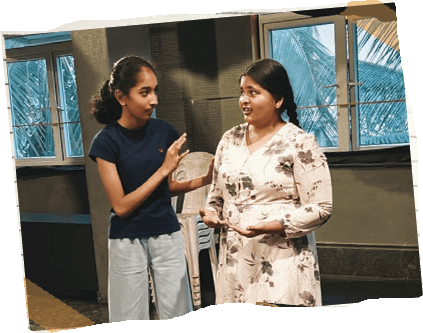
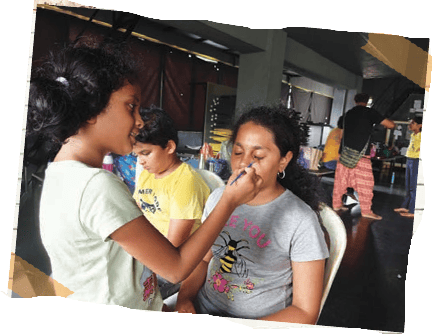
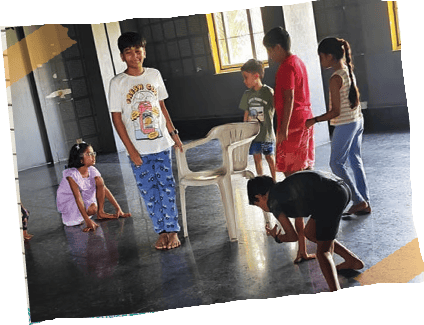
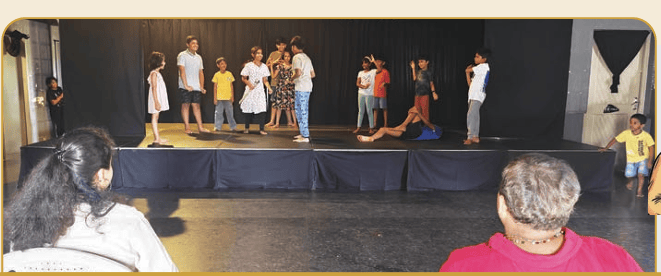
THE SHOW
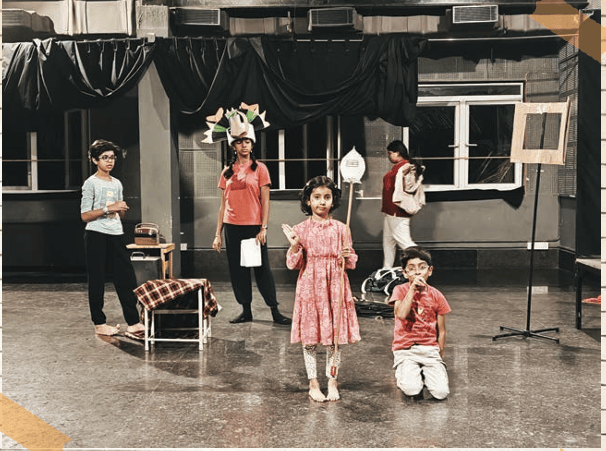
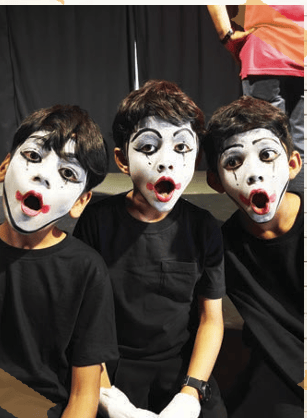
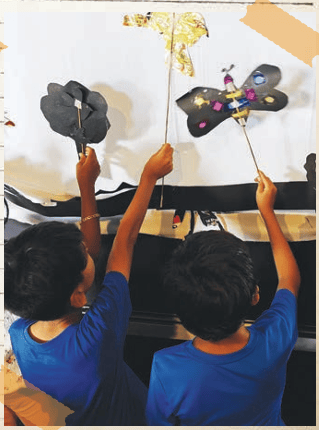
Observe the writing style of the script given in this chapter. This is the standard style used in the scripts.
- Not every line in the script is a dialogue or
a conversation. What are the non-dialogue
lines called? Why are they in the script? How
important are they?
---------------------------------------------------------- - How can the reader differentiate between the
dialogue and the non-dialogue lines?
---------------------------------------------------------- - Each line said by different characters can be
spoken and expressed in different ways. They
will mean many things based on the intonation,
diction, volume and other styles of dialogue
delivery (learnt in Chapter 1). How does the script-writer make sure that each line is said in
the intended emotion or style?
---------------------------------------------------------- - Note down any other points you may have noticed when reading the script. Would you like to write a play of your own?
Answers:
- They are called stage instructions. It helps in communicating the actions and visual representation of the scenes.
- Non-dialogue lines are written in italics and within brackets.
- The emotion of the line, i.e., to be spoken, is given in italics with brackets immediately after the name of the character.
KEY TAKEAWAYS — LESSONS FOR LIFE
Theatre Motto: The Show Must Go On — Your Superpower for Life! As students of theatre, this is a line you should never forget. Even if a crown falls off, someone sneezes loudly, or the lights goes out — actors don’t stop (like Nandini managed the above play). The audience sitting in front of you have given you their time (and sometimes money — for tickets). You owe it to them. It is the responsibility of every theatre person to make sure that the audience is not disappointed. So, no matter what happens, they smile, improvise and keep the story alive! That’s the magic behind ‘The show must go on’.
For you, it is like having a superpower in real life! When a plan goes wrong, or when you make a mistake, you don’t have to freeze, panic or quit. Just take a deep breath, think quick and move forward like a star. It teaches resilience, adaptability, and the courage to stay calm even when things don’t go perfectly. In daily life, challenges, mistakes and surprises are natural. But just like actors on stage, we learn to continue with confidence, do our best and not give up at the first sign of trouble. It reminds us that perseverance and a positive attitude are often more important than perfection. Life is not about being perfect — it’s about being brave, smart, and unstoppable, no matter what! Because just like the show, life goes on!
Here is a real-life story of a show performed in a school, where the students demonstrated the undying spirit of theatre —
In the year 1995, in a town in the Dharwad district of Karnataka, a team of school students was presenting a drama production before an audience of more than 200 people in an auditorium. It was an old auditorium with pulley operated backdrops to depict different scenes like forest, palace, etc. During the performance, the lead actor was standing right under the backdrop when the ropes snapped and the backdrop started falling down, she heard the sound and noticed the backdrop slipping down, but did not move or stop her dialogue! She hoped and trusted the backstage team to do something, and was determined not to disturb the flow of the play.
Almost as if on cue, two backstage crew members who noticed this, immediately ran to both sides and held the ropes by hand. This kept the backdrop in position. But they couldn’t move as it meant it would fall off, if they let go. So, they held the heavy backdrop by hand for one full hour, till the play was completed! What about the other work they were supposed to do backstage? The rest of the team came to help and took over their work, and managed the entire show without a glitch! The hands of the two crew members were completely bruised and bleeding. The audience was very happy with the play and praised the team.
For this reason, the joy and satisfaction of having completed a show successfully was so high that all the trouble that the team went through, was forgotten. With team work and determination — the show went on!
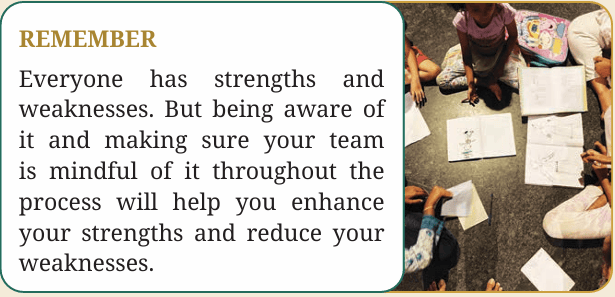
CIRCLE TIME
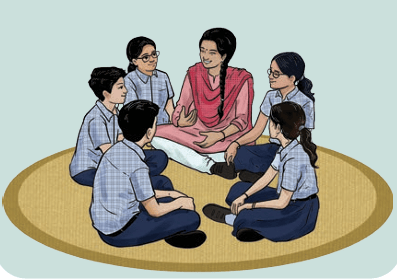
- In your effort to put up a performance in school, list out the following —
- How do you plan to work on your weaknesses?
- How can you creatively use your strengths to your advantage?
- Discuss on how you can work on them as
a team.
ASSESSMENT
CHAPTER 3: FROM PAGE TO STAGE
Competencies
- C-1.1 Expresses confidently their personal and everyday life experiences through various drama activities
- C-3.1 Demonstrates care and basic stage etiquette; and makes informed choices while using various materials, tools and techniques of drama
- C-4.1 Demonstrates familiarity with various local and regional forms of theatre
| CG. | C. | Learning Outcomes | Teacher | Self |
|---|---|---|---|---|
| 1 | 1.1 | Able to bring relevant experiences into the story and script | ||
| 1 | 1.1 | Relates to others’ experiences and stories to build a script | ||
| 3 | 3.1 | Respects others’ works in the preparation process and helps if required | ||
| 3 | 3.1 | Tries to work with whatever is available and reduce wastage | ||
| 4 | 4.1 | Can connect art forms like dance, puppetry, music at relevant contexts | ||
| Overall participation in class |